Physicists break record for extreme quantum state

Physicists in China have broken their own record for the number of photons entangled in a “Schrödinger’s cat state”. They have managed to entangle eight photons in the state, beating the previous record of six, which they set in 2007. The Schrödinger’s cat state plays an important role in several quantum-computing and metrology protocols. However, it is very easily destroyed when photons interact with their surroundings, prompting the researchers to describe its creation in eight photons as “state of the art” in quantum control.

In Erwin Schrödinger’s famous thought experiment of 1935, all of the molecules in a cat are in a superposition of two extreme states – living and dead – and an observer cannot tell which until a measurement puts the cat into one of the two states. Today physicists use the term “Schrödinger’s cat state” (or Greenberger–Horne–Zeilinger state) to describe any multi-particle quantum system that is in a superposition of extreme states.

For example, a pair of entangled photons can be created in the lab such that they are in a superposition of both photons having horizontal polarization and both having vertical polarization. Entanglement is a quantum effect, which means that particles such as photons can have a much closer relationship than is allowed by classical physics. By measuring the polarization of one of the pair, we immediately know the state of the other, no matter how far apart they are.

The Schrödinger’s cat state of eight entangled photons was created by Jian-Wei Pan and colleagues at the University of Science and Technology of China in Hefei. The team began by firing laser light at a nonlinear crystal, which converts single high-energy photons into pairs of entangled lower-energy photons with perpendicular polarizations. The polarization of one of the photons was then rotated by 90°, which puts each pair into a two-photon Schrödinger’s cat state.

Pairing up photons

Pan and colleagues then took one photon from each pair and combined the quartet in an optical network consisting of three polarizing beam splitters. One photon leaves each of the network’s four outputs only if all four photons have the same polarization. As there is no way of knowing what this common polarization is, the photons are therefore entangled in a Schrödinger’s cat state. But as each of the four photons is already entangled with one other photon, all eight photons are therefore entangled in a Schrödinger’s cat state.

This entanglement was established by measuring the polarizations of the eight photons as they emerged from the experiment. This reveals the “fidelity” of the eight-photon Schrödinger’s cat state, which effectively says how close the different states are to the ideal Schrödinger’s cat. The team measured a fidelity value of 0.708 – much larger than the threshold value of 0.5, above which a state is considered to be entangled.

According to Xiao-Qi Zhou of the University of Bristol, UK, Pan and team were able to entangle eight qubits because they managed to separate the photons into “ordinary light” and “extraordinary light”. Both types are produced by parametric down conversion and ensuring that four extraordinary photons are sent for further entanglement boosts the efficiency of the process.

Hyper-entanglement could be next

Pan told physicsworld.com that there are several ways that the team can take this work forward. One is to use “hyper-entanglement” to create a 16-qubit Schrödinger’s cat state for their eight photons. Hyper-entanglement makes use of more than one degree of freedom of the photon – momentum and polarization, for example – which multiplies the number of states that can be entangled. In 2008 the team used hyper-entanglement to create a 10-state Schrödinger’s cat state using five photons.

Zhou points out that the technique of separating ordinary and extraordinary light could also be used to entangle six photons at a higher efficiency than previously possible. This, he thinks, could be used to create a wide range of different entangled states that could be used in quantum computing.

The Schrödinger’s cat state could be particularly useful for quantum error correction, which protects a quantum computation from the destructive effects of noise. For example, one bit of quantum information (a qubit) could be encoded into all eight photons of a Schrödinger’s cat state. If the polarization of one of the eight photons is inadvertently flipped, for example, this can be corrected by determining the value of the other seven photons.

Polariton coupling becomes stronger

Researchers at the University of Pennsylvania in the US claim that polaritons – quasiparticles that are part matter and part light – couple more strongly when confined in nanoscale semiconductors. The new result could benefit photonic circuits that exploit light rather than electricity.

A polariton is a particle-like entity (or quasiparticle) that can be used to describe how light interacts with semiconductors and other materials. It has two different components: an electron-hole pair (or “exciton”) and a photon, which is emitted when the electron and hole recombine. When a photon is emitted, it is immediately reabsorbed to reform an exciton, so the cycle is repeated. This continuous exchange, or coupling, of energy between photons and excitons can be described in terms of polariton states.

Polaritons are expected to play an important role in future photonics devices that would use light instead of electricity to process information. Such devices would be much faster and use less energy than their electronic counterparts. The strong coupling of polaritons will be crucial for the success of this new photonics, but the coupling strength of polaritons in bulk semiconductors was always thought to be limited by the properties of the semiconductor material itself.

The right finishing techniques

Ritesh Agarwal and colleagues are now saying that this limit can be overcome if the right fabrication and finishing techniques are used to make the semiconductor structures in question. This is because the light-matter coupling strength increases dramatically as semiconductors become smaller than 500 nm or so, explains Agarwal.

“When you’re working at bigger sizes, the surface is not as important,” he said. “The surface to volume ratio – the number of atoms on the surface divided by the number of atoms in the whole material – is a very small number. But when you make a very small structure, say 100 nm, this number is dramatically increased. Then what is happening on the surface critically determines the device’s properties.”

Although researchers had previously attempted to make polariton cavities on such a small scale, the “top-down” chemical etching methods employed to fabricate the devices damaged the semiconductor surfaces, so creating defects. These defects trapped the excitons, making them unavailable for transporting current.

Self-assembling nanowires

Agarwal’s team overcame this problem by self-assembling nanowires made from cadmium sulphide instead of etching nanoscale structures. Surface quality was still an issue, even with this fabrication technique, so they developed a way to “passivate” the surface of the nanowires by growing a silicon oxide around them. This greatly improved the optical properties of the wires because the oxide shell fills the electrical gaps in the nanowire surface and prevents the excitons from getting trapped on the surface, says Agarwal.

The scientists also developed techniques (based on detecting the energy of standing waves formed in the nanowire cavities) for measuring the light-matter coupling strength and showed that it was indeed enhanced as the semiconductor structures became smaller. Stronger light-matter coupling means faster photonic switches and much more efficient polariton lasers, light-emitting diodes and amplifiers – to name a few possible applications.

However, not all scientists are convinced of the team’s results. Benoit Deveaud-Plédran of École Polytechnique Fédérale de Lausanne described the team’s claims as “overstated” and said that they don’t appear to be backed up by data presented in a paper outlining the experiment (PNAS 108 10050 ).

Others are more enthusiastic. “This paper looks like an interesting addition to the armoury of light-matter strong coupling effects in semiconductors,” commented Jeremy Baumberg of the University of Cambridge’s Cavendish Laboratory in the UK. “The results show a new way to reduce the volume of the microcavity, by using high refractive index nanowires, which tightly confine the light inside. The rate at which energy is flipped back and forth between light and excitons depends on inverse square root of the volume within which the light is trapped. Here the wall of the semiconductor is used to confine the light, and it is tighter than normal, giving rise to faster rates and thus a higher splitting between the polariton ‘modes’.”

Improvements needed

It is an interesting new route to making strong coupled systems at room temperature, he told physicsworld.com, but the design might not be more than just “fortuitous”, Baumberg cautions. The light leaks out from the structure in many directions, and is not confined well enough to keep the resonances narrow. “Improvements will rely on much better control of the length, width, orientation and out-coupling of light from nanowires,” he added.

Other teams around the world are also looking at new ways of achieving room temperature strong polariton coupling. Baumberg’s group, for its part, has recently published a paper in Applied Physics Letters describing a set-up that comprises air suspended mirrors and simpler semiconductors based on the well known gallium arsenide. This system has light out-coupled in only vertical directions and it can be electrically controlled.

European physics chief speaks out

This video is the third in a series filmed in Munich in May 2011 at a meeting to celebrate 25 years of the journal EPL. Originally known as Europhysics Letters, the journal rebranded itself in 2007 and is the flagship publication of the European Physical Society (EPS). The society is currently headed by Luisa Cifarelli – a particle physicist from the University of Bologna and the first female president of the society in its 43 year history.

The main remit of the EPS is to support the development of physics across the continent and in that aim a lab at which Cifarelli has spent much time – CERN in Geneva – is a shining example of what is possible when European physicists put their minds together. But Cifarelli sees other opportunities for joint projects, picking out two facilities currently being built – the X-ray Free-Electron Laser (X-FEL) in Hamburg, Germany, and the European Spallation Source in Lund, Sweden. She also sees potential for joining forces on education, energy, climate, the environment and technology transfer. “We have to transfer our know-how to industry for innovative production methods and to upgrade technology,” she says.

As for the question of women in physics, Cifarelli thinks this is something for both men and women alike to tackle. “Men should really care about solving the overall problem,” she says. Although Cifarelli feels that incentives to help female physicists who need to take time off to raise a family can help, she adds that despite not being a fan of specific quotas, they may be a necessary evil. “I don’t like quotas but maybe they might help,” she says.

Finally, Cifarelli reveals details of her plans for an official World Year of Light. Although there have recently been specific years devoted to physics (2005), astronomy (2009) and chemistry (2011), Cifarelli thinks that celebrating light would be “more fascinating” and is eyeing up either 2014 or 2015 as a possible date. “Light is something that comes everywhere in our lives, not only in science, but in culture and technology,” she says. “It’s a very charming and fascinating subject that will definitely attract the attention of the world on what scientists do.”

What's your favourite number?

alex2.jpg

By Hamish Johnston

What’s your favourite number, and does the fact that you are interested in physics inform your choice?

I have been thinking about this today after hearing an interview on BBC radio with the mathematics writer Alex Bellos, author of the book Alex’s Adventures in Numberland, or Here’s looking at Euclid if you are in North America.

Bellos (right) has launched an online survey asking people for their choices and the reasons behind their picks. He also requests for a small amount of biographical information.

What did I say? Three, because of the old adage “Two’s company, three’s a crowd”. Although a small number, three is fascinating because it can cause very large problems in social settings.

Three is also interesting from a physics point of view. Solving problems involving three bodies is much more difficult than those involving two. And then there’s the Efimov effect, whereby a group of three particles will bind together, even though pairs of the constituent particles will not.

How about you, perhaps it’s one over the fine-structure constant (137) or Avogadro’s number?

You can read more about the project and listen to an interview with Bellos here.

Australian climate researchers face death threats

Climate researchers in Australia have been rocked by revelations that several scientists have received aggressive e-mails and even death threats. The intimidation, which first came to light in the Australian press early last month, has resulted in some of the targeted researchers being moved into more secure offices. The abuse comes as the Australian minority Labor government led by Prime Minister Julia Gillard is framing legislation that would determine a price that businesses have to pay for releasing carbon into the atmosphere.

One scientist who has been under attack is marine biologist Ove Hoegh-Guldberg, who directs the Global Change Institute at the University of Queensland, Brisbane. He is known for speaking out about his research into the deadly effects of increased sea temperatures on corals. On 13 June he was sent five threatening e-mails from anonymous sources, which included the line “Eat shit and die to [sic] lying communist asshole”.

Another scientist who is affected is Will Steffen, head of the Climate Change Institute (CCI), based at the Australian National University (ANU) and a member of the Climate Commission that advises the Australian government. He has received a death threat and “a spate of obnoxious and nasty e-mails” after writing a commission report published on 24 May that recommends the country “strongly and urgently” curbs carbon emissions.

Completely intolerable

In response to the harassment, the ANU has now moved nine staff members of the CCI, including Steffen, to a more secure location, which requires card access. “It’s completely intolerable that people be subjected to this sort of abuse and to threats like this,” Ian Young, vice-chancellor of the ANU, told Physics World. The police have been advised but have not investigated so far.

Gillard is yet to determine a specific pricing for the carbon tax, with the government’s eventual decision promised for this month. However, the government has been publicly attacked on its policy, especially by the Conservative opposition led by Tony Abbott. He says the policy is a “great big new tax” on every citizen and that the nation’s lucrative coal, gas and iron-ore exporters will be forced to shed jobs as a result.

The more controversial the area, the more important that any researcher should feel free to argue a case based on evidence without fear of reprisalSuzanne Cory, president of the Australian Academy of Science

In a statement, Suzanne Cory, president of the Australian Academy of Science, defended the right of researchers to do their work free from abuse and threats of violence: “The more controversial the area, the more important that any researcher should feel free to argue a case based on evidence without fear of reprisal.”

Intimidation tactics

According to Susannah Eliott, head of the independent Australian Science Media Centre, scientists in Australia have been subjected to threats for a few years, but they are now becoming increasingly wary of talking to the media for fear of further intimidation. Indeed, David Karoly, a meteorologist from the University of Melbourne, says that every time he appears in the media he then gets threatened, which has now got “more highly offensive and abusive”. One such recent example he received was a message stating that “Global warming is the biggest fraud in the history of mankind. People that promote it need to be put down!”

Michael Mann, director of the Earth System Science Center at Pennsylvania State University and creator of the widely accepted “hockey-stick graph” showing the recent surge in temperatures caused by climate change, says he finds it disturbing that Australian climate scientists have been subjected to the same sort of intimidation tactics that he has had to contend with in the US. “It would seem to confirm a level of coordination and even orchestration to the attacks against climate science and climate scientists,” he says.

Introducing the ‘wrinklon’

A new quasiparticle called the “wrinklon” could help explain why materials as diverse as graphene and household curtains wrinkle in much the same way – despite their very different length scales. The particle has been introduced by researchers in Belgium, France and the US as a result of measurements on a wide range of materials on length scales from micrometres to metres. While the work may not lead to more attractive curtains, wrinkles do turn out to affect the electronic properties of graphene and the analysis could therefore influence the development of graphene-based devices.

Wrinkles can appear whenever a sheet of material is fixed along one or more edges. In the case of a fabric curtain, the wrinkles are close together at the top and the space between wrinkles increases continuously further down the curtain. The emergence of wrinklons – by Pascal Damman and colleagues at the universities of Mons, Paris and California Riverside, as well as the Massachusetts Institute of Technology – reflects this change and defines the patterns of wrinkles seen in such materials.

Self-similar patterns

Physicists have enjoyed great success in describing complex systems in terms of quasiparticles – collective excitations that behave much like discrete particles. This latest wrinklon quasiparticle describes a localized region with a high degree of stretching where two wrinkles merge into one (see figure). Indeed, if you happen to be sitting next to a curtain, then you can probably see a few wrinklons, which may appear depending on the tension in the material and its physical properties such as thickness and elasticity.

By studying images of wrinkled materials, the team led by Damman found that the patterns are self-similar. This means that the same pattern occurs in different regions of the material but on different length scales. As Damman explains, “If you look at a photograph of a region of the curtain without knowing the length scale, you can’t know where it was taken.”

The team demonstrated the universal nature of wrinkling by studying materials as diverse as graphene (a sheet of carbon just one atom thick), curtains made of fabric and rubber, as well as paper and plastic sheets. For each material the team measured the distance between neighbouring wrinkles (the wavelength) as a function of the distance from the fixed edge of the material (the top of a curtain, for example). They also measured the tension on the material – in the case of curtains this is supplied by the downward pull of gravity. The Young modulus (or elasticity) and thickness of the material were also measured.

One power law for all

The team found that the “normalized wavelength” (the wavelength divided by the thickness of the material) of ripples in a number of materials have the same power-law relationship with the “normalized distance” from the fixed edge. This distance includes a term that is a function of the tension, thickness and elasticity of the material.

When plotted on a log–log graph, measurements on materials ranging from graphene to fabric curtains fall on the same line. “This is the best evidence yet that wrinkling occurs in the same way over a wide range of length scales,” says Benjamin Davidovitch of the University of Massachusetts, Amherst, who was not involved with the experiment. “It has never been demonstrated with such clarity,” he adds.

According to Damman, the findings could be important to those studying graphene. As the wrinklons are affected by the thickness of the material, it should be possible to determine the thickness of a sample simply by looking at its wrinkles. Researchers could therefore distinguish between graphene that is one atom thick and samples that are two or three atoms thick – something that can be difficult to do.

These latest results could also be used to ensure that graphene devices are made wrinkle-free, or with specific patterns of wrinkles. This could be important for those developing electronic devices based on graphene, because the electronic properties of the material are affected by wrinkles. According to Damman’s colleague Chun Ning Lau of the University of California, Riverside, devices with desirable properties could be created by “straintronics” – whereby specific wrinkle patterns are created by controlling the strain on graphene.

The work is describe in Phys. Rev. Lett. 106 224301.

Top cosmologist to teach at humanities dream school

USPS.jpg
Krauss will bring cosmology into the humanities

By James Dacey

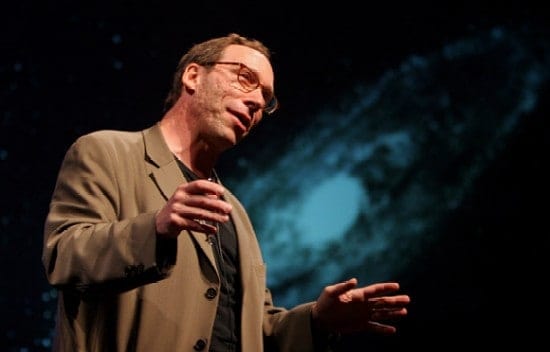
The physicist and popular-science author, Lawrence Krauss, will join a star-studded array of academics to teach at a private university in London called the New College for the Humanities.

The new university is the brainchild of A C Grayling, a philosopher at the University of London, who is well known in the UK through his regular appearances in the media. Grayling says the university will bring a much needed boost to the arts and humanities in the UK, which are being squeezed in state-supported universities due to budget cutbacks. Its business model takes inspiration from the US Ivy League universities as students will pay £18,000 a year for tuition fees – double the maximum that most UK universities can charge.

Students will be offered a very broad syllabus and will be encouraged at every turn to take a critical outlook. They will be treated to lectures by world-leading academics including Richard Dawkins who will teach evolutionary biology and science literacy, and Stephen Pinker who will cover philosophy and psychology.

Among this dream team will be Lawrence Krauss, the author of Physics of Star Trek and several other popular-science books. He told me that he plans to give an introduction to the modern view of the universe, and he will touch on other subjects, including quantum mechanics. “Science literacy will play a large part in the program, as it should,” he said. “A literate person should have the same kind of fluency in the ideas of science that they have in the arts and humanities.”

Krauss says that he will pitch the course to be understood by students with little scientific background. “Based on my teaching experience at a variety of US institutions, I believe one can proceed rather far in this regard with minimal background – with motivated students it should be fun” he said.

But not everybody in the UK has been as enthusiastic as Krauss about Grayling’s new venture. Since the philosopher announced his plans for the new university at the beginning of June, he has been attacked by critics who have dismissed the venture as elitist or opportunistic. Last week, both Grayling and Dawkins were both confronted by angry protesters during public lectures, with Grayling’s talk being evacuated after a smoke bomb was let off. Even the Mayor of London, Boris Johnson, has chirped in with a letter to the Telegraph in which he labels the university as “rejects college” – for rich kids who weren’t bright enough to get into Oxford and Cambridge.

Grayling has since struck back by emphasizing the fact that 30% of students will be offered financial support, funded largely by the fees of the wealthier students. He also argues that foreign students at state-funded universities already pay in the region of £18,000, and many universities have been increasing their overseas student intake for some time. You can read Grayling’s full arguments expanded in this opinion piece published in the Independent yesterday.

So I bid Lawrence good luck. But with continuing criticism, including a big thumbs down from the president of the National Union of Students, it may not be plain-sailing. The celebrity professors will have to use all their brain power to win the hearts and minds of the British public.

Hackers steal quantum code

While in principle unbreakable, quantum cryptography is known to have weaknesses in practice. One shortcoming has now been graphically illustrated by physicists in Singapore and Norway, who have been able to copy a secret quantum key without revealing their presence to either sender or receiver. The researchers are now working to remove the loophole they have exposed.

Quantum cryptography involves encoding messages using a key that is rendered secret by a quantum-mechanical principle – that the act of measuring affects the system being measured. In one popular scheme, the sender “Alice” sends a key in the form of a series of polarized single photons to the receiver “Bob”. Alice polarizes each photon at random using either a horizontal–vertical polarizer or a polarizer with two diagonal axes. Bob detects each photon by also randomly selecting one of the two different polarizers.

If Bob happens to pick the same polarizer as Alice, then he will definitely measure the correct polarization of a given photon. Otherwise, as the uncertainty principle dictates, there is a 50% chance he will get it wrong. Once he has made all the measurements, Bob asks Alice over an open channel which polarizers she used for each photon and he only keeps the results for those measurements where he happened to pick the correct polarizer, and this series of results becomes the secret key.

Catching Eve

An eavesdropper, “Eve”, who seeks to measure the polarization of the photons sent by Alice would reveal her presence because, given a long enough string of photons, the probability of her correctly guessing Alice’s sequence of polarizers becomes practically zero. When she makes incorrect measurements, she randomizes the polarization. This means that in some of the cases where Bob should make a correct measurement, he makes a wrong one. So, again speaking openly with Alice and comparing a small subset of the key, Bob realizes there is an intruder if that subset contains errors.

Now Christian Kurtsiefer and colleagues at the National University of Singapore and researchers at the University of Trondheim have found a way to hide Eve’s eavesdropping by exploiting a weakness in the single-photon detectors used in many commercially available quantum-cryptographic receivers. This involves Eve using a bright light to “blind” the four avalanche photodiodes that Bob uses to detect photons in each of the four different polarization states.

The blinded photodiodes are no longer sensitive to single photons, but instead behave like classical detectors that generate a current proportional to the intensity of the incoming light and respond to pulses of light above a certain intensity threshold. “The detectors are like human eyes, which at night can almost distinguish single photons but during the day are unable to do so because they are flooded with light,” says Vadim Makarov of the Trondheim team.

Alice and Bob are oblivious

Eve intercepts each of the photons sent by Alice and measures them using randomly chosen polarizers. With each measurement Eve sends a bright pulse of light, above the intensity threshold and with the same polarization as the photon measured, to Bob’s detectors. This removes Bob’s ability to randomly assign polarizers for each measurement. Instead he is constrained to the same sequence of polarizations as obtained by Eve. This means that when Bob and Alice publicly compare the subset of the key, they find no errors. In other words, Eve has found out the key and has remained hidden while doing so.

Kurtsiefer and colleagues attacked an existing 290 m-long fibre link on the campus of the National University of Singapore. Using equipment that fits inside a suitcase, they intercepted single photons travelling along the fibre and then re-emitted the corresponding bright light pulses. During a 5 min interval they intercepted more than eight million photons and then forwarded the corresponding bright pulses, with every single pulse being registered by Bob in the correct detector.

Now we have shown that that vulnerability can be practically exploitedVadim Makarov, University of Trondheim

This is not the first experiment to reveal that a quantum key can be surreptitiously copied. In the past three years Hoi-Kwong Lo of the University of Toronto and colleagues have demonstrated a number of loopholes in a commercial quantum-cryptographic system, while last year Makarov’s research group showed that commercial systems can be disabled using bright light. But, says Makarov, this latest work represents the first time that anyone has built a complete quantum eavesdropper and actually stolen a key. “Previously, we showed that quantum-cryptography systems were vulnerable,” he explains, “and now we have shown that this vulnerability can be practically exploited.”

However, Makarov, believes this vulnerability could be corrected. One possible solution, he says, is to place a small single-photon source just in front of Bob’s detectors and switching it on at random intervals to ensure that the detectors can still register individual photons. If the detectors repeatedly fail, then the operators would be alerted to Eve.

“The whole purpose of our research is to try and make quantum cryptography more secure,” says Makarov. “All security technologies go through this proving phase.”

Nicolas Gisin, a physicist at the University of Geneva in Switzerland and co-founder of quantum-cryptographic manufacturer ID Quantique, welcomes the latest research, pointing out that his company has now developed counter-measures to deal with such attacks. “The only way to guarantee good implementation of quantum cryptography is by independent tests,” he says. “In this sense, quantum hackers do a very useful job.”

The research is published in the online journal Nature Communications 10.1038/ncomms1348.

‘Plasmon ruler’ measures tiny distances in 3D

The first ever 3D “plasmon ruler” has been unveiled by researchers in the US, Germany and France. Until now, such nanoscale measuring devices were limited to measuring distances in just 1D, which meant that they could not be used to monitor 3D processes in biological and soft matter. The new sensor could prove useful for monitoring structural changes in biological samples, such as protein folding and DNA interactions.

Metals can absorb light by creating plasmons, which are particle-like collective excitations of conduction electrons at a metallic surface. A 1D plasmon ruler exploits the fact that the plasmon resonances of two metallic nanoparticles couple with each other when they are close together. The spectrum of light associated with the plasmons is strongly shifted toward the blue or red depending on how close or far apart the nanoparticles are to each other.

For example, in previous studies two gold nanoparticles were connected together via a single strand of DNA. When complementary double-stranded DNA was then added, researchers observed a significant blueshift in the light spectrum of the plasmon resonances. Since double-stranded DNA is much stronger than single stranded, the nanoparticles are pushed apart – that is, the distance between them becomes larger. By continuously monitoring the spectrum of the gold particles, the dynamics of the DNA “hybridization” could be recorded.

Stack of gold nanorods

Now, Laura Na Liu of the Lawrence Berkeley National Laboratory and colleagues at the University of Stuttgart and the University Blaise Pascal in Aubière have extended this concept so that it works in 3D. In their new plasmon ruler, the researchers employed a stack of five gold nanorods arranged in a “H” shape with the central rod acting as the horizontal bar of the H (see image). The other two pairs of rods were chosen so that they acted as quadrupolar “antennas” for visible lightwaves. When biological molecules are attached to the structure, the central rod or quadrupole antennas move relative to each other, which results in a shift of the plasmon resonances of the system that can be measured, just like the 1D ruler. The researchers fabricated their set-up using high-precision electron-beam lithography and layer-by-layer stacking nanotechniques.

“Compared with its 1D counterpart, our ruler offers additional degrees of freedom – such as rotating, twisting and tilting – to detect the dynamic behaviour of bioentities,” Liu told physicsworld.com.

New generation of plasmon rulers

According to the researchers, the concept can be applied to single metallic nanocrystals joined together by oligonucleotides or peptides. This could lead to a new generation of plasmon rulers capable of monitoring events occurring during a wide variety of macromolecular transformations in 3D. Such transformations include DNA interacting with enzymes or proteins, protein folding and the dynamics of peptide motion, and the elastic vibrations of cells membranes in situ and in vivo, to name but a few.

“Metallic nanoparticles of different sizes could also be attached at different positions on DNA or proteins and each metallic element may move individually or collectively in three dimensions,” explains Liu.

The team now hopes to make 3D plasmon rulers using biochemical linkers. The concept might even be extended to even more complicated plasmon structures, according to Carsten Sönnichsen of the Johannes Gutenberg University of Mainz in Germany.

The research is described in Science 332 1407.

The lunar eclipse as Physics World readers saw it

By James Dacey

Skygazers in many parts of the world were treated yesterday to the longest total lunar eclipse in over a decade. Sadly, here in the south-west of England almost complete cloud cover meant that I saw precisely none of it. It was rotten luck and Google’s “live coverage'”of the eclipse felt like a very poor second best.

But thankfully my spirits were lifted this morning when I saw these two splendid photographs sent to us by readers via the Physics World Facebook page. The first image was taken by Pedram Esfahani, an engineering physics student based in Tehran, Iran, who captured this shot of the Moon just before the total eclipse.

eclipse1.jpg

This second photo taken by Jawaid Siddiq in Lahore, Pakistan, also shows the Moon just before the total eclipse at 0910 GMT (0110 local time).

eclipse2.jpg

In the second image you can see that the shadowy region takes on a slightly red hue. This effect (as I’m sure you’ve all been explaining to your non-physicist friends) is due to the way light interacts with the Earth’s atmosphere. To reach the Moon during an eclipse, light has to pass around the Earth and light at the blue end of the spectrum tends to be scattered by the atmosphere. But light at the red end of the spectrum, with its relatively longer wavelengths, has a much better chance of sneaking through and reaching the Moon, before it is then reflected back to Earth.

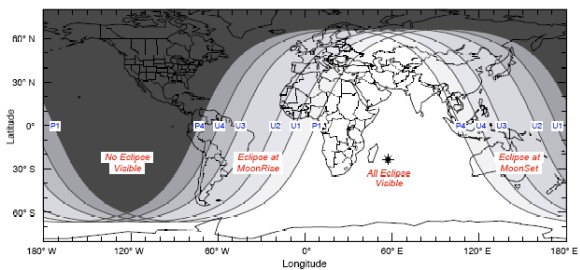
Totality – when the lunar face is completely blocked – lasted from 1922 GMT until 2102 GMT, making it the longest total eclipse since July 2000. The diagram below was created by NASA to show the extent to which the eclipse was observable across the planet.

nasadiagram.jpg

You can see a larger version of this diagram with the different eclipse stages explained at NASA’s official eclipse website. The site also gives details of the eclipses coming up during the rest of the year, with the next event to add to your calendar being a partial solar eclipse on 1 July.

Copyright © 2026 by IOP Publishing Ltd and individual contributors