Peer pressure keeps young planets growing

Two US astrophysicists claim they have answered an important question about how planets form: why don’t young planets get pushed into their companion stars before they have a chance to grow? It turns out that a little company is enough to keep them there, say the researchers, who argue that multiple planets moving through a rocky disk can prevent one another from falling into the star.

“All young planets are subject to migration,” says Scott Kenyon of the Smithsonian Astrophysical Observatory in Massachusetts, who did the work with Benjamin Bromley of the University of Utah. “Migration for gas or ice giants is more commonly discussed, but migration is also an issue for terrestrial planets with masses ranging from that of Pluto to the Earth.”

Astronomers believe that planets form in a disk of gas and dust surrounding a young star. The first step towards planet formation is the planetesimal – a small rocky body with radius of roughly 1–10 km. As the dust condenses into planetesimals during the first few million years of a star’s life, larger rocks begin to emerge that grow much more rapidly than the rest. These bodies, termed oligarchs, are on their way to young planethood, using their gravitational pull to attract and pack on more planetesimals.

Pushy planetesimals

In addition to providing a means for growth, planetesimals can also push an oligarch towards its doom in the central star. A lone oligarch orbiting through the disk of planetesimals clears a path much like a stick being dragged through sand. The planetesimals on either side of the trench press on the oligarch, says Kenyon, and as the outer ring has more mass, the planetesimals deliver a net inward push.

In the past, magnetic fields, turbulence and thermodynamics have been used to explain how rocky planets are prevented from falling into their stars. However, Bromley and Kenyon say that the wake patterns created by multiple oligarchs circling a star are enough to prevent structures from forming in the planetesimal disk that would push the young planets in.

Once the oligarchs account for about half of the material in the disk, a few tens of millions of years after the birth of the star, they begin making even more material gains by combining with one another. Rather than hollowing out a series of trenches, the oligarchs are now randomly scrawling in the planetesimal “sand”, which also prevents the planetesimals from settling into patterns that would feed the oligarchs to the star.

Real, but not clear

“This is a real effect,” says John Papaloizou of the University of Cambridge in the UK. “However, its extension to interactions with gas is not clear.”

Making direct calculations of the movements of multiple planets through a more realistic disk of gas and planetesimals raises the complexity significantly, requiring more computing power than is practical today. Instead, Bromley and Kenyon extended their simulation to gas disks.

They looked for scenarios in which a gas cloud behaves like a disk of planetesimals, and they found two key requirements: the gas must have low viscosity; and the planets must be small. A denser, high-viscosity gas has a stronger tendency to smooth itself out after the oligarch runs through – like the wake of a canoe in water. This means that the disruptions to the patterns do not last as long. If the gas in the disk is dilute, the researchers argue that these conditions are met well enough that rocky planets should not fall into the star.

“Our results tell us that growing terrestrial protoplanets cannot migrate through a disk of planetesimals, allowing protoplanets to grow into the planets we see in our and other planetary systems,” says Kenyon. If the generalization to gaseous disks is realistic, then Kenyon believes that “we are a step or two closer to understanding the origins of the Earth and other planets”.

This research appears in the Astrophysical Journal 735 29.
Closing in on dark matter

In part one of the interview Hooper discusses the strong evidence for the existence of dark matter. This includes various astrophysical observations such as the dynamics of large-scale structures in the universe. “When we look at clusters of galaxies we find that they are much more massive, and have much more gravity associated with them, than their visual counterparts can account for,” he says.

Part one

Hooper explains that the favoured candidates for a dark-matter particle are “weakly interacting massive particles”, or WIMPs. As the name suggests, these particles appear to keep a low profile in the universe by interacting very little with all other matter. “They were created in the first fraction of a second after the Big Bang and more or less have existed without doing much of anything ever since.”

Hooper goes on to discuss the different types of experiment that have been created to try to detect dark-matter particles. One approach involves designing highly sensitive equipment capable of spotting WIMPs directly as they interact with detectors that are buried deep underground to shield them from background radiation. The other approaches Hooper describes look for indirect evidence of these particles using telescopes, or try to create dark matter at particle accelerators such as the Large Hadron Collider (LHC) at CERN.

Prospects for discovery

In the second part of the interview, Hooper speaks his mind about the prospects of discovery for these dark-matter experiments and some of the results to emerge so far. He believes that the scientific community is yet to see indisputable evidence for a discovery of dark matter, but some interesting “positive results” are starting to emerge.

Part two

Hooper shares his thoughts on one collaboration known as DAMA/LIBRA, which has been claiming for over a decade that it has detected dark matter, even though many in the community have remained highly sceptical of those claims. DAMA/LIBRA researchers have been reporting for 13 years that their experiment in Italy records a seasonal oscillation in its detections. This, they say, is caused by the Earth moving with (and against) a cosmic flow of dark matter.

Hooper believes DAMA/LIBRA’s claims could be strengthened if another experiment called CoGeNT, based in a mine in Minnesota, can observe a similar annual modulation in its detector. Since the interview was recorded early last month, CoGeNT has released new findings that seem to corroborate tentatively with the DAMA results.

But whatever comes of these claims, Hooper is confident that a verified discovery of dark matter could be just around the corner. “If I didn’t think it could happen then I would work on something else,” he says. “Any scientific goal has to have a plausible positive outcome or it’s not interesting and not worth doing.” What is more, Hooper is a scientist who puts his money where his mouth is. He tells the story of how four years ago he placed a bet with a colleague that dark matter would be discovered within five years. Despite there being just one year to run, Hooper still believes this is a good bet.

To change the world

I recently read a book with remarkable insights about what it is to be a scientist, the plight of science in the modern world and the challenge of maintaining its values. Before I tell you the name of the book – no peeking, or it will destroy the effect! – let me summarize the argument, specifying key passages.

Scientists, the book observes, tend to be attracted not only by the joy of practising science, but also by the beauty and wonder of nature (p3). Many know that science plays an indispensable part in solving pressing social problems, and are eager to help.

Yet, strangely, the cultural position of science is beleaguered. On the one hand, viewed from the local perspective of universities and labs, research exhibits an "extraordinary and genuine vitality" (p91). On the other hand, science does not have the cultural influence that it should; from a global and social perspective, science is not only marginalized but a "weak culture". Despite the vitality of science, "the whole (in terms of its influence in the larger political economy of cultural production) is significantly less than the sum of its parts" (p92). Furthermore, though science is vital to our personal, economic and political wellbeing, it "has become highly politicized" (p109).

Three coping strategies

Scientists tend to cope by adopting one of three postures, which might be called the progressive, "neo-Anabaptist" and conservative attitudes (p109). Progressives actively seek to use science for social agendas, running the risk of compromising its ideals and distorting its otherwise rigorous standards and practice. Neo-Anabaptists hold an opposing view. They find politics corrupting to science and keep their distance from it. They maintain that science belongs in the laboratory, and distrust attempts to use it for political ends. Conservatives – the vast majority – blame the schools, media and politicians for encouraging irrationalism and pseudoscience, and for spreading "misinformation and fear" (p117), which is causing great harm to humanity and to the planet. Scientists, the conservatives claim, "have been under-represented, ridiculed and outright ignored by our political leaders for much too long" (p117), and that it is time to reassert reason in cultural discourse.

But none of these three approaches has managed to improve the cultural status of science. The principal reason is a failure to understand culture. Most scientists – understandably, for they are untrained in social theory – have a deeply flawed working theory of culture and how it changes (p24). This theory, a form of idealism, assumes that culture is ultimately a matter of ideas: to change culture you change ideas, and therefore "the autonomous and rational individual is the key actor in social change" (p26). Scientists, for instance, tend to assume they can change deeply ingrained ideas about science simply by speaking up loudly and articulately enough. But this is naive, ignores how culture "is generated, coordinated and organized", and "mistakenly imputes a logic and rationality to culture where such linearity and reasonableness does not exist but rather contingency and accident" (p26).

To make science seem not just a set of true facts, but symbolically and culturally vital, requires creating and developing new means of exhibiting the value of scientific research in its own right, and of showing its value for addressing social problems. "The only way to change culture is to create more of it," according to the author (p28).

This is not as formidable as it sounds; science has plenty of resources. First, nearly everyone is implicitly and informally a scientist because they possess certain scientific qualities (let's say knowing how to inquire, test and discover) even if only "in fragments or in corrupted form" (p232). Nearly everyone therefore has a proto-scientific attitude that can be fostered. This fostering should not have as its goal changing people into scientists, but rather encouraging their appreciation of its value in understanding and coping with the world (p242). Another means to improve science's cultural role would be to build institutions that give "tangible expression" (p78) to scientific culture alongside the existing social environment.

Science is fated to have a dual destiny. It is a rigorous discipline with its own norms and vitality independent of the general culture – but it is also historically and practically important to that general culture. Thus the book counsels a practice of "scientific presence" in which scientists engage the world by exhibiting "the exercise of leadership in all spheres and all levels of life and activity" oriented to "the flourishing of the world around us" (p260–261).

The critical point

How accurate and insightful did you find this characterization? I find it spot on. But let me now confess that my description was not entirely above board. It was instead a thought-experiment because the book I have been quoting from is To Change the World: The Irony, Tragedy, and Possibility of Christianity in the Late Modern World by James Hunter, Distinguished Professor of Religion, Culture and Social Theory at the University of Virginia. I was alerted to the book by a newspaper editorial. While my summary of its key portions was on the whole accurate, I have changed a handful of words, substituting "scientists" for "Christians", "scientific" for "Christian" and "science/ research" for "Christianity", "the church", "faith" and so forth.

Conservatives can imagine this book as a sophisticated strategy manual that has been captured from an enemy combatant: while the goals radically differ from your own, it is a must-read for strategy tips. To keep science robust and healthy, it is not enough to conduct scientific research; we also have to promote those values that allow research to be effectively and wisely conducted, and seen as relevant to current social problems. Yet because of our flawed theory of culture, the way scientists promote such values has been haphazard, incompetent and often even counter-productive. If we have not studied culture seriously, a first step is to learn from those who have.

Catching sight of the elusive wavefunction

In the orthodox interpretation of quantum mechanics, the wavefunction contains the maximal knowledge that is available about the state of a system. It determines the probabilities that various results will be obtained when measurements are made on the dynamic variables of the system such as its position or momentum.

However, measuring the wavefunction is no easy task. Thanks to Heisenberg's uncertainty principle, measuring a quantum system without effectively destroying it before the wavefunction is fully known has seemed impossible. Now, by taking a new approach to quantum measurement, Jeff Lundeen and his team from the National Research Council, Canada, have directly measured the wavefunction of identical single photons for the first time.

Making a measurement on just one copy of a system – such as just a single photon – gives us part of the wavefunction. However, the measurement must be repeated many times on an ensemble of identical photons to gain enough information to construct the entire wavefunction. This indirect form of measurement is known as "quantum tomography" and has been used for some time.

Recording ripples

Lundeen likens tomography to mapping the shape of a ripple on the surface of a pond (the wavefunction) by taking snapshots of the shadows of the ripples on the bottom. By combining information from many snapshots, the shape of the ripple can be inferred. In quantum tomography, however, each snapshot measurement is so "strong" that it destroys the ripple and the process must be repeated with identical ripples. Beyond the destructive nature, certain wavefunctions such as atomic or molecular orbitals cannot be determined using tomography.

Instead of focusing on the shadows, the team has worked out a way to directly probe both the real and imaginary parts of the wavefunction of an ensemble of photons. The method relies on the concept of "weak measurement", which has been used recently to measure some quantum systems – and does not destroy the wavefunction.

"Our understanding of the wavefunction is rather abstract and there is no official textbook definition," says Lundeen. "We decided to look into the method of weak measurements irrespective of how wary scientists seem to be of it," he continues, explaining that, although the theory of weak measurements was developed in the 1980s, it was dismissed by many researchers because it produced rather "odd results" that were much larger than expected. The reason for the unexpected results, explains Lundeen, is that a weak measurement gives a complex number – it has a real part and an imaginary part.

Gentle measurements

The theory of weak measurement says that it is possible to "gently" or "weakly" measure a quantum system and to gain some information about one property (say, position) without appreciably disturbing the complementary property (momentum) and therefore the future evolution of the system. Though the information obtained for each measurement is tiny, an average of multiple measurements gives an accurate estimation of the measurement of the property without distorting its final value.

For a generic quantum measurement, the system to be measured is coupled with another state that can be thought of as a "pointer". Information about a measured property is gained by observing a change in the position of the pointer. Generally, this is considered to be a strong measurement because there is little overlap between the original and final positions of the pointer. The detection of a photon in a CCD, for example, would swing the pointer from zero photons to one but result in the destruction of that photon.

In a weak measurement, it is just the opposite, with the final position of the pointer overlapping to a large extent with its initial position. In the measurement carried out by the team, the real part of the wavefunction is given by a small shift of the pointer related to the position of the photon. The imaginary part of the wavefunction is given by a shift of the pointer related to the momentum of the photon. So the position is weakly measured while the momentum is strongly measured.

Four basic steps

The experiment has four basic steps. The first is to generate a stream of single photons with identical wavefunctions. "It is virtually impossible to measure a wavefunction with just one copy of a quantum system (i.e. one photon), this we are almost sure of," explained Lundeen. The team either used an attenuated laser beam or a process known as spontaneous parametric down-conversion (SPDC) to produce its photon stream.

The next step is to set up the weak measurement of the transverse position of the photon by inducing a rotation in each photon's polarization by a very small amount – 10° – using a quartz crystal. Because the polarization change is small, the system is not greatly disturbed.

The photons are then collimated and only photons travelling in a specific direction are detected – a process called post-selection. This is the strong measurement. In the final step, the weak measurement is carried out by measuring the two types of polarization that have actually occurred in the photons post-collimation. This is two-fold because the real part of the measurement is the actual amount of linear rotation that has occurred and the imaginary part is given by the circular rotation or the "ellipticity" of the polarization that has occurred. Together, these values give the weak measurement of the wavefunction. The researchers repeated the measurement for photons with different wavefunctions to confirm the accuracy of the results.

Better than tomography?

Lundeen points out that the signal-to-noise ratio of his team's experiment was rather good. Indeed, he says that an important benefit of the weak measurement technique is that the results are amplified. Therefore it could prove to be especially useful for studying systems that are currently very hard to measure.

While he believes that there will still be a place for quantum tomography, Lundeen feels that certain systems will benefit from the technique used by his team. "While tomography is a global measurement that is more a reconstruction of the wave function, our measurement is local and direct." he explained. "The simple benefit of our research is that we now have an operational textbook definition of a wavefunction...something that is essential."

The research was reported in Nature.

A preprint of the paper can be found at arXiv: 1112.3575.

CoGeNT findings support dark-matter halo theory

New findings from the CoGeNT experiment in the US add strength to the claims of a group in Italy that has been saying for over a decade that it has detected dark matter.

More than 80% of the mass in the universe is believed to be accounted for by dark matter. But while the substance appears to have a strong gravitational influence on the motion of galaxies, it does not interact with light and has proven very difficult to detect directly – let alone study in any detail. The favoured candidate for a dark-matter particle is known as a "weakly interacting massive particle", or WIMP for short. Various experiments have been constructed to detect WIMPs by looking to see if they interact with highly sensitive detectors.

Researchers at one of these experiments, the DAMA/LIBRA detector at the Gran Sasso National Laboratories in central Italy, stand apart from the rest of the dark-matter community. That is because they have been claiming for years that they have successfully detected dark matter. Rather than looking for individual WIMPs, the DAMA/LIBRA experiment is designed to look for variations over the course of a year in the interactions between dark-matter particles and the sodium iodine crystals inside their detector. The researchers say they have observed an annual oscillation in detections for the past 13 years, which they believe is caused by Earth's motion through dark matter.

DAMA/LIBRA explains the oscillation by saying that, during the summer, the Earth is moving into the rest frame of a halo of dark matter that surrounds the Milky Way, which causes the number of interactions to peak. Then, in the winter, the Earth is moving away from this rest frame, causing the signal to drop off. The situation is analogous to a car driving through a rainstorm where more raindrops hit the front windshield than the back one.

A sceptical community

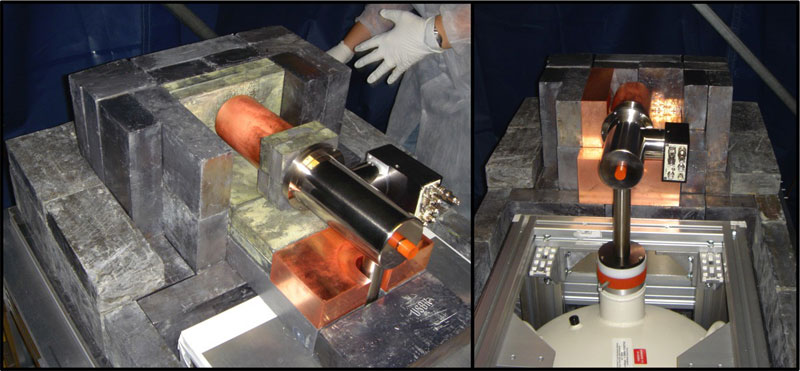
But while few in the dark-matter community deny the existence of modulation, many researchers have remained sceptical of the DAMA/LIBRA claims, and to date no other detector has managed to repeat the findings. Among the sceptics is Juan Collar, a member of the CoGeNT collaboration. CoGeNT is a relatively small dark-matter detector located in the Soudan Mine in northern Minnesota, which uses a germanium target to look for low-mass WIMPs. Indeed, Collar's collaboration set out to test the DAMA/LIBRA claims by looking for an oscillation in 15 months of data. "I thought we were going to blow the DAMA claims out of the water," Collar told physicsworld.com.

I thought we were going to blow the DAMA claims out of the water Juan Collar, CoGeNT collaboration

But to Collar's surprise, CoGeNT's findings appear to corroborate the DAMA/LIBRA data. They reveal a seasonal modulation consistent with the presence of WIMPs with masses of 7 GeV/c2. Detailing their findings in a paper submitted to arXiv, Collar and colleagues say that their results are reliable to a statistical significance of 2.8 sigma. In everyday terms, this means there is just a 0.6% chance that the result is a statistical fluke.

Collar says that his collaboration is still "as critical of DAMA as anyone else" over the claim that the seasonal modulation must be dark matter. But he admits that he cannot yet explain what could be causing the seasonal modulation. He says that his team was careful to exclude other possible sources that could have caused a modulation in the signal, such as seasonal variations in the flux of muons passing through the atmosphere, or radon emerging from rocks surrounding the detector.

Dan Hooper, a theorist based at Fermilab in the US, says that he is "very excited" about the CoGeNT results. "In all of the ways I have studied the data, they look like what you would expect to see from dark matter," he says. "I suspect that these results will cause some scientists to reconsider the long-claimed DAMA/LIBRA signal". Hooper warns, though, that the collaboration will need more data to rule out the possibility that the signal is purely due to chance.

Lucky escape from the fire

Indeed, Hooper was pleased to tell physicsworld.com that the CoGeNT team had commenced a fresh run a data collection last Monday (6 June). There had been concern that the detector had undergone damage following a fire in the Soudan Mine in March.

But other researchers have been more sceptical of the CoGeNT collaboration from its outset. Researchers at the XENON 100 experiment in Italy, for instance, claim that they have already ruled out the possibility of WIMPs existing within the mass range that CoGeNT is designed to consider. The XENON 100 is a liquid-xenon-based detector considered by many to be the most sophisticated experiment designed for direct dark-matter searches.

However, both Collar and Hooper believe that there are reasons to believe that a light-mass dark-matter particle could have escaped detection by XENON 100. In a separate paper submitted to arXiv, Collar questions the sensitivities of the XENON 100 detector and its predecessor, XENON 10. Collar proposes that the XENON teams have made far too many assumptions in excluding low-mass WIMPs. "XENON is tremendously biased," he told physicsworld.com.

The debate, however, is likely to go on. Henrique Araujo, a dark-matter researcher at Imperial College London remains open to the idea that CoGeNT has seen dark matter but he expects that other detectors should have seen the CoGeNT signal. "Bearing in mind that CoGeNT has a very small target mass of 440 g and that it actually claims to see quite a large total number of 'light WIMP' events, other detectors should find plenty of recoils creeping up at the energy threshold," he said.

Evidence mounts for previously unseen neutrino oscillation

Physicists at the Tokai-to-Kamioka (T2K) experiment in Japan claim to have measured, for the first time, muon neutrinos changing into electron neutrinos. The effect could allow researchers to pinpoint the final undetermined neutrino "mixing angle" as well as provide a clue toward solving the mystery of why matter, rather than antimatter, dominates the universe.

Neutrinos exist in three "flavours" – muon, electron and tau – that change or "oscillate" from one to another as they travel in space and are very hard to detect because they interact weakly with matter. Researchers at T2K generate neutrinos at the $1.5bn Japan Proton Accelerator Research Complex (J-PARC) based in Tokai on the east coast of Japan. The facility accelerates protons to around 30 GeV and then fires them into a graphite target to produce pions, which then decay into muons – heavier cousins of the electron – and muon neutrinos.

After passing through a detector that determines how many muon neutrinos are in the beam, the particles are sent underground to the vast SuperKamiokande detector in Hida, some 300 km north-west of Tokai on Japan's west coast. SuperKamiokande consists of 50,000 tonnes of water surrounded by 11,146 photomultiplier tubes, each 50 cm in diameter. The photomultiplier tubes pick up the radiation emitted when a neutrino interacts with a water molecule.

Changing flavours

The oscillation strength between different types of neutrino is characterized by three "mixing angles" – known as theta-12, theta-23 and theta-13. T2K's predecessor, the KEK to Kamioka (K2K) experiment, as well as the KAMland experiment in Japan and the Sudbury Neutrino Observatory in Canada, have already measured theta-12 and theta-23. Theta-12 was estimated from the difference in the number of electron neutrinos ought to originate from the Sun and the smaller numbers actually detected, which were presumed to have oscillated into other flavours as they travel to Earth. Similarly, for theta-23, researchers looked at atmospheric neutrinos and observed a deficit in the expected number of muon neutrinos.

Now, researchers at J-PARC have made a step towards measuring the final mixing angle – theta-13 – by measuring muon neutrinos oscillating into electron neutrinos. From January 2010 until March this year, the SuperKamiokande detector observed 121 neutrinos that clearly originated from the J-PARC neutrino beam. The background signal, which could mimic a signal from electron neutrinos that are present anyway, was estimated to be around 1.5 events. However, over 13 months, researchers at T2K, which has more than 500 researchers from 12 countries, spotted six events arising from muon neutrinos turning into electron neutrinos. The probability of observing, by chance, six events when only 1.5 are expected is 0.7%, or a little less than 1 in 100.

"The result is not enough to claim a discovery, but it is important for not only T2K but also high-energy physics in general," says Koichiro Nishikawa, former spokesperson for the T2K experiment and based at the KEK particle physics lab in Tsukuba. "This result is also, except for one 'tau event' in the OPERA experiment at Gran Sasso in Italy, the first time that anyone has shown that neutrino oscillations occur as a change of flavour."

Data collecting at Kamioka, however, was cut short due to the Tohoku earthquake that struck north-east Japan on 11 March and which badly hit the J-PARC facility, affecting roads and buildings. J-PARC will remain closed until later this year when lab officials hope to start powering up the accelerators again. "It is very unfortunate that we lost most of this year's running, as otherwise (assuming we aren't the victim of a statistical fluke) we would have something pretty convincing by now," says Dave Wark of Imperial College London and former international co-spokesperson for T2K.

When J-PARC restarts, Nishikawa adds that physicists on T2K should be able to get a good estimate for theta-13 by "summer 2013". After a few years, researchers will also switch to generating anti-muon neutrinos that could oscillate into anti-electron neutrinos. As the initial and final states can be measured this could give a clear indication if there is any difference between the behaviour of matter and antimatter particles. The experiment will then also search for "charge-parity" violation in different kinds of leptons, which could help us better understand why there is much more matter than antimatter in the universe.

The work has been submitted to Physical Review Letters.

Italy picks site for SuperB collider

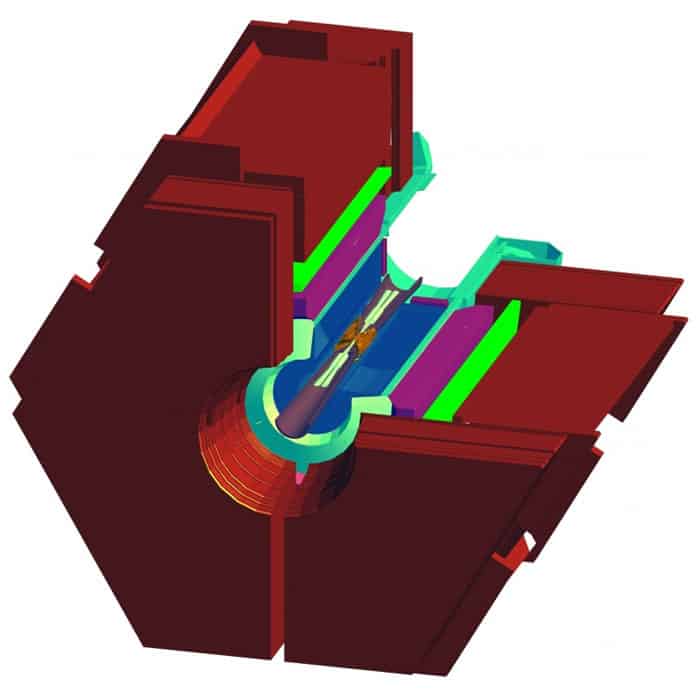
The SuperB particle collider will be built at the University of Rome, Tor Vergata. Located on the outskirts of the Italian capital, the site will be called the Cabibbo Laboratory in honour of the particle physicist Nicola Cabibbo, who died in August 2010. The experiment is expected to start collecting data in 2017.

The €500m SuperB facility will be built by Italy's National Institute for Nuclear Physics (INFN) with funds provided by the host nation and several other countries. It will consist of a 2 km circumference ring with two accelerators – one for electrons and the other for positrons. Collisions will occur within a large detector and produce extensive numbers of B-mesons, D-mesons and tau-leptons. The detector will track the decay products from these particles and measure their energy.

Change of location

The original plan was to locate SuperB at the INFN's Frascati campus just outside Rome. However, a decision taken in 2010 to include a synchrotron-radiation facility within SuperB meant that the Frascati site was too small.

Now, the INFN has decided to locate SuperB on a 30 hectare site at Tor Vergata, which is about 4.8 km from the Frascati lab. The larger site will make it much easier to include up to six synchrotron beam lines and associated experimental halls.

The next step for SuperB physicists is to set up a European Research Infrastructure Consortium (ERIC) to build the facility. ERIC is a new organizational structure available to European physicists and SuperB will be the first project to create such a set-up.

Watching tau leptons

According to Adrian Bevan of Queen Mary University of London – who is part of the UK's SuperB contingent – the collider will produce about 100-times more data than other "B factories" such as BaBar in the US, which stopped running in 2008, and Belle in Japan.

SuperB will produce large numbers of tau-leptons – and one of the first things physicists will look for is "charged lepton flavour violation" such as a tau-lepton decaying into three muons without producing any neutrinos. The observation of such decays would point to new physics beyond the Standard Model.

Bevan told physicsworld.com that SuperB should be completed in 2016 and start taking data in 2017. He expects the experiment to run for about 10 years before the facility is converted into a dedicated synchrotron light source that could run for an additional 20 years.

Introduced the "Cabibbo angle"

Cabibbo was best known for his work on the weak interaction in quarks and was recognized for his contribution to "quark mixing" between different favours of these particle. In 1963 he introduced the "Cabibbo angle" that is related to the relative probability that down and strange quarks decay into up quarks. Cabibbo's 2 × 2 quark-mixing matrix was later extended to include a third generation of quarks by the Japanese physicists Makoto Kobayashi and Toshihide Maskawa, who then shared the 2008 Nobel Prize for Physics together with theorist Yoichiro Nambu.

Weird Kansas weather

heatburst_new.jpg
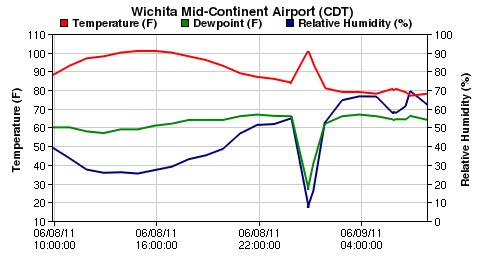
Temperature and humidity graph from Wichita, Kansas (Courtesy: AccuWeather)

By Margaret Harris

I grew up in Kansas, where unusual weather isn't so much a conversation topic as a spectator sport. But even by Kansas standards, what happened in Wichita (the state's largest city) last Thursday night was decidedly weird.

As the graph shows, shortly after midnight on 9 June, the temperature in Wichita jumped from 85 to 102 °F (roughly from 30 to 40 °C) in less than 20 minutes. At the same time, the relative humidity plunged, dropping from 55% to a desert-like 7%. Two hours later, both readings had returned to "normal" – or at least, as normal as Kansas weather ever gets.

What happened in Wichita is known as a "heat burst", and it occurs when a pocket of air in the upper atmosphere collapses, producing a hot, dry downdraft and winds in excess of 60 miles per hour. Such bursts can be seriously damaging: when a meteorologically similar (but colder and wetter) event called a microburst hit a neighbourhood in my hometown back in the late 1990s, it flattened houses as efficiently as any tornado. But how did the air pocket get there in the first place?

The answer (courtesy of this excellent post from John Rennie of The Gleaming Retort blog) turns out to involve one of my favourite weather phenomena: virga, the high-altitude rain that leaves grey streaks across the sky as the moisture evaporates before reaching the ground. This evaporation process pulls heat out of the surrounding air, leaving it colder and denser. If this pocket of air becomes more dense than the air below it, it falls.

But as Rennie notes, that doesn't explain the heat and low humidity in Wichita's heat burst. For that, we need some more physics. As a parcel of cold, dense air falls, it becomes even more dense because it gets squeezed by the higher-pressure air present at lower altitudes. This squeezing does work on the parcel, heating it adiabatically. But of course, heating air causes it to expand, and as a result, most potential bursts never hit the ground. Instead, the competing influences of pressure and temperature cancel each other out, the parcels reach an equilibrium at some altitude, and any excess heat is absorbed by the surrounding air. Wet air is particularly good at this, thanks to the high heat capacity of water vapour.

In Wichita, however, the air seems to have been falling too fast to achieve any kind of equilibrium. It was also falling through a relatively dry layer of atmosphere, so there wasn't much water vapour around to absorb the heat it generated as it fell. The result was the hot, dry "whoosh" shown in the graph.

I should warn you that there are probably some holes in this explanation, since downbursts of all types (wet, cold, hot, dry) are still poorly understood. But the next time you wake up hot and thirsty in the middle of a strange wind storm, relax:it may just be Kansas weather up to its usual tricks.

Nanotransfer makes large-area NIMs

Researchers at the University of Illinois at Urbana-Champaign have figured out a way to fabricate 3D "negative index" metamaterials (NIMs) by the square foot. The feat is a real advance over traditional fabrication techniques that are slow and which can only make such materials over small areas.

Metamaterials are man-made structures that have very different properties to those of naturally occurring materials. For example, NIMs are structures artificially engineered to have a negative index of refraction. This means that light travelling through such materials is bent in the "wrong way" compared with that in normal materials, which have a positive index.

NIMs have a number of desirable properties that do not exist in normal materials, including the ability to focus light to a point smaller than its wavelength. Scientists have already used these structures to make novel devices such as "invisibility cloaks" and hyperlenses – devices that can image objects much smaller than is possible using an optical microscope.

Until now, however, techniques to produce NIMs were limited to micron-sized surface areas. John Rogers and colleagues' new method, which is based on nanotransfer printing, overcomes this problem. "The advance is important because such an approach will be required for any practical applications of these materials," said Rogers.

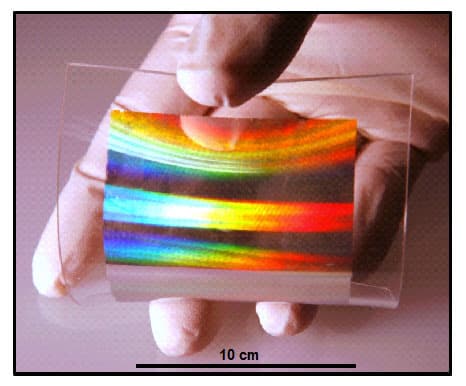
The researchers begin by making a high-resolution stamp comprising "hills" and "valleys" on the surface of a moulded polymer. By then depositing alternate layers of materials using an evaporation process, they are able to coat the entire surface (both the raised and depressed regions) with precise multilayer stacks. By peeling off the stacks from just the raised regions allows them to produce a thin film structure that looks like a fishnet, which can be transferred to other substrates such as glass or plastic.

The stamp can be used again for another fabrication cycle and the multilayer fishnets can be designed to have a negative index of refraction. Rogers and co-workers showed that this was possible by detailed optical measurements and modelling studies on the structure.

New applications

"Conventional methods use a focused beam of electrons or ions to fabricate the fishnets in a serial, slow process that are typically applied over areas of a fraction of a square millimetre," Rogers said. "Our structures are formed in parallel and we can make fishnet structures at the scale of 10 × 10 cm, limited only by the tooling in our academic cleanroom facilities."

Scientists are very much interested in artificial metamaterial structures that have a negative index of refraction. Applications range from ultrathin, high-performance lenses, to photonic device components, sensors and the famous invisibility cloaks.

The team is now busy working on scaling down the feature sizes of its structures so that they operate in the visible wavelength range. Operation in the visible has been difficult to achieve so far because the structures in the metamaterials must be about the same size as the wavelength of the radiation – for light, this is hundreds of nanometres. "We are also exploring applications of large-area sheets of flexible NIMs," revealed Rogers.

The work was published in Nature Nanotechnology.

EPL – the first 25 years

The Internet has had a profound impact on many areas of modern life, and that includes the traditionally cosy world of journals publishing. With anyone able to "publish" their own work by uploading it to a free-to-access preprint server or onto their own website, the once-dominant role of the traditional scientific journal is under threat. And with library budgets being squeezed around the world, publishers have needed to come up with clever strategies to maintain their publications' profitability and circulation.

In this special video report, Michael Schreiber, editor-in-chief of the letters journal EPL, describes some of the challenges facing such scientific publications. The video was filmed in Munich at a special 25th-anniversary meeting of the journal, which was originally known as Europhysics Letters before being rebranded as EPL in 2007. The journal was originally set up in 1986 as a collaborative venture among the French and Italian physical societies, the UK's Institute of Physics (which publishes physicsworld.com) and the European Physical Society (EPS).

But despite the pressures on publishing imposed by the Internet, traditional journals such as EPL are alive and well. As Schreiber explains, one key reason for their continued success is that the material they publish is peer reviewed, which imposes rigorous quality control and means researchers know that what is in the journal is worth reading. "There is so much dubious research on the Internet nowadays", Schreiber explains, "that it's not possible to have an overview or a feeling of what is good or bad, but with a journal [you] can rely on [what it contains]."

As for the future of EPL – what Schreiber calls "the flagship journal of the European Physical Society" – he is sure that by the time the journal celebrates its 50th anniversary, it will be purely online, have gone completely global, and contain many more good papers than it does now. A quarter of papers published in EPL are already from the US, with many from other growing scientific superpowers such as India, China and Brazil. But Schreiber – a physicist from the University of Chemnitz in Germany – is looking forward to receiving papers from an even more unusual source, as you can find out by watching the video.

Copyright © 2026 by IOP Publishing Ltd and individual contributors