Readdressing Feynman's legacy

feynman.jpg

By James Dacey at the APS April meeting, Anaheim, California

Bongo player, womanizer and all-round practical joker are common depictions used by biographers in describing the great 20th century physicist, Richard Feynman.

Tonight, here at the Hyatt hotel, Anaheim, theorist and popular science writer Lawrence Krauss will offer a fresh perspective by readdressing Feynmann’s legacy to science – in physics and beyond.

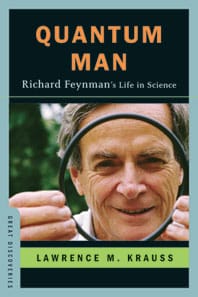
Krauss has just written a book _Quantum Man: Richard Feynman’s Life in Science_, which is released in March in the US.

I managed to catch up with Krauss earlier today to find about what inspired him to write the book and what he admires most about Feynman’s approach to physics.

“Feynman for me, like most scientists, was a sort of idol and it was a great opportunity to pay homage to him, and a personal homage because the last time I saw him I’d meant to tell him a few things and didn’t get a chance to,” he said.

Part of Krauss’ motivation for writing the book was his feeling that many earlier biographies have focused too much on Feynman’s personality, which can give the impression that science was something Feynman did “on the side”.

“The public knows of him as a curious character, and he is a fascinating human individual, and he’s obviously captured people’s imagination. But what was clear to me is that people did not know why physicists revered him and I wanted to talk about his scientific legacy.”

Krauss told me that his own approach to physics was inspired by Feynman. “He often appeared to have results by magic, and what I also wanted to get across is how incredibly organized he was in his own thinking.

“The reason he could answer so many questions is that at some point or other he’d worked it out before. He’d have thousands and thousands of pages of notes in a very organized fashion.

“While he was a joker in life, when it came to science he was dead serious and he didn’t mess around.”

Organic transistor targets displays

Tiny carbon nanotubes could have a big impact on the size and performance of television screens based on organic light-emitting diodes (OLEDs). That’s the claim of a team of researchers in the US, which has created red, green and blue pixels from transistors incorporating nanotubes and light emitting organic materials.

Displays based on OLEDs have shown great commercial promise because they offer high pixel brightness, wide viewing angle, a very high contrast ratio, fast response times and low power consumption. But display size is limited – today’s OLED TVs made by the likes of Sony and LG have screens just 11–15 inches across.

Now, Andrew Rinzler and colleagues at the University of Florida have built display pixels from light-emitting transistors using a technique that could be scaled to form large arrays of organic emitters.

Not suitable for large screens

Their technology could replace the polycrystalline silicon transistors that are used today to deliver the high drive currents needed to turn on the light emission from the OLED pixels of a display. Rinzler claims that these silicon transistors are unsuitable for deployment in larger screens because they suffer from large variations in electrical characteristics, which impact commercial production yields.

“Even for a 3-inch diagonal hand-held display, the yield off the assembly line is only about 70%,” Rinzler told physicsworld.com.

It is impractical to turn to amorphous silicon transistors that control pixels in liquid crystal displays, due to their low electron mobility. To deliver enough current from the transistor to turn on the OLED, drive voltages have to be cranked up, leading to very high power consumption. Amorphous silicon transistors have an unacceptably high degree of instability when driven in this manner, making them unsuitable for displays.

New power benchmark

The Florida researchers are not the first to make a light-emitting transistor – this accolade goes to a team from Darmstadt University of Technology, Germany, who reported success in 2003. However, the device from the University of Florida sets a new benchmark for power management.

At a display brightness of 500 cd/m2 – broadly comparable to that of a TV screen – the transistor element of green pixels made by Rinzler’s team accounts for just 6% of total power consumption, with the remainder used for light generation. The closest contender, which employs the same organic material to make the OLED, devours more than half its power in the transistor section.

The researchers describe their device as a carbon nanotube enabled, vertical field-effect transistor. It is assembled on a glass substrate coated in indium tin oxide, a transparent material employed for the transistor’s gate.

A lithium fluoride and aluminum alloy forms the drain contact that injects electrons into the OLED. Positive charge carriers, known as holes, are provided by single-wall carbon nanotubes, and when these two types of charge carriers come together in the organic layer they interact to produce light.

Controlling the flow

The new device features a “contact barrier”, formed between the nanotubes and an organic, highly conductive layer that sits on top of them. Adjusting the gate voltage alters the contact barrier, which determines whether holes flow or not and ultimately governs when the OLED emits light.

Red, green and blue pixels made by the Florida team produce 500 cd/m2 when driven by single-digit voltages. The transistors driving red and blue pixels take a bigger share of the power consumption budget than those powering green pixels, accounting for 19% and 15% of the total power, respectively.

When the pixels made by Rinzler and team are turned off they consume very little power. The researchers calculate that a 50-inch screen made from their devices would consume just 67 mW if every pixel were in its “off” state. In comparison, LCD displays of the same size consume 100–200 W, whether the pixels are on or off.

Venture capital support

The work of the team has been supported by venture capital firm Nanoholdings LLC. “They recognize that development of high technology takes effort, money, and most importantly, time,” says Rinzler. “We have taken the attitude that if we build it, the OLED developers will come [to us].”

Peter Ho from the National University of Singapore is impressed by the work of the Florida team: “I think this is an exciting step forward for organic electronics”. He added, “[This work] allows the typically high drive current required in the OLED to be controlled by a separate voltage control circuit, which reduces the demand on its transistor”.

The researchers report their work in Science 332 570.

Are dark forces behind CDF's bump?

dan-hooper.png

By James Dacey at the APS April Meeting in Anaheim, California

Three weeks ago the CDF collaboration at Fermilab triggered a tidal wave of media coverage when it announced that it had discovered bump in its data that could not be explained by the Standard Model of particles physics. The unexplained signal was spotted in a study of W and Z boson pairs that are created when protons and antiprotons collide in Fermilab’s Tevatron collider.

Here at the APS April Meeting, I’ve just had a very interesting discussion with Fermilab theorist Dan Hooper, who speculates that the bump could be linked with dark matter. He believes that the excess of events, including a lepton and two jets, could be explained by the presence of a new gauge boson responsible for transmitting the force between dark matter and ordinary matter.

Hooper details his idea in a paper just uploaded to the arXiv preprint server in which he argues that the properties of the predicted boson would provide a natural explanation for the dark matter signals reported by the Cogent and DAMA/LIBRA collaborations.

“The most attractive explanation for the bump is the existence of a new fundamental force… if you’ll excuse the pun,” he said. “If this does turn out to be true, it would be absolutely incredible for physics.”

Earlier analysis by other researchers included speculation that the bump could be explained by a “technicolour” force. All seem to be in agreement, however, that the signal is not related to a Standard Model Higgs boson.

Hooper believes that whatever the bump turns out to be, its discovery has added significant weight to the case to extend the lifetime of the Tevatron. This iconic particle accelerator is due to close at the end of the US fiscal year (end of September), but several high-profile physicists have argued for an extension.

From Rutherford to Higgs

hyatt.jpg

By James Dacey at the APS April Meeting, Anaheim, California

I took this photo just now looking back at the Hyatt Regency hotel in Anaheim, which is hosting this year’s April Meeting of the American Physical Society. I landed here in California last night having surely been one of the few Brits to fly out of the country on the day Prince William married Kate, and the country enjoyed a national holiday. That’s dedication to physics!

The theme of this year’s meeting is “100 years of subatomic physics”, commemorating the centenary of Ernest Rutherford’s discovery of the atomic nucleus. And this morning the programme kicked off with a special plenary lecture by Nobel laureate Steven Weinberg who crammed the history of particle physics into a half hour talk.

In a fascinating discussion, Weinberg argued that the big questions in present-day particle physics mark the end of an adventure that began with Rutherford’s discovery. “The search for the Higgs boson, as well as supersymmetry and dark matter, is the culmination of a reductionist programme that began with quantum mechanics, which followed Rutherford’s experiment.”

But it’s not just particle physics on the bill here in Anaheim: nuclear physics, astrophysics and plasma physics will also feature heavily. So there will no shortage of physics for me to get my teeth stuck into over the next four days. Watch this space for updates!

Through two mirrors, brightly

100 supercon.jpg
Hubble’s “Rose of Galaxies” anniversary image
(Courtesy: NASA, ESA, A Riess (STScI/JHU), L Macri (Texas A&M University) and Hubble Heritage Team (STScI/AURA))

By Tushna Commissariat

Millions of people worldwide have exclaimed in awe and wonder at the images that the Hubble Space Telescope (HST) has been producing for more than two decades. The satellite has had a significant impact on all fields of science from planetary science to cosmology ever since it was launched on 24 April 1990 aboard Discovery’s STS-31 mission. In a bid to celebrate the 21st anniversary of the HST, astronomers at the Space Telescope Science Institute in Baltimore, Maryland, in the US pointed Hubble’s eye at a particularly magnificent cosmic phenomenon – a pair of interacting galaxies in the shape of a rose.

The newly released Hubble image shows two interacting galaxies known as Arp 273. The larger of the spiral galaxies – UGC 1810 – has a disc that is being distorted into a rose-like spiral thanks to the gravitational tidal pull of the companion galaxy below it, known as UGC 1813. The smaller companion shows signs of intense star formation at its nucleus, quite possibly triggered by the smaller galaxy actually passing through the disc of the larger galaxy. A veil of bright and hot young blue stars glows across the top of the dancing discs.

Arp 273 lies in the constellation Andromeda and is about 300 million light-years away from Earth. Though the galaxies are separated from each other by tens of thousands of light-years, they are connected by a tidal bridge of material between them that formed post interaction.

Take a look at the gorgeous image (above) and a video (below) zooming into the region of the galaxies.

In other space-related news, the final launch of the space shuttle Endeavour will take place tomorrow, 29 April, from Florida’s Space Coast in the US. So while Britons and many others all over the world will be watching the royal wedding, Kennedy Space Center is anticipating the arrival of an estimated half a million onlookers, eager to watch the space shuttle lift off one more time. Endeavour, first launched in May 1992, is expected to carry six astronauts, a cargo bay full of spare supplies and a $2bn astrophysics experiment to the International Space Station.

To look at some interesting images in the follow-up to the launch, look here: http://www.space.com/11221-photos-space-shuttle-endeavour-final-mission-sts134.html

Invisibility cloak offers a snug fit

An invisibility cloak that is less than five times bigger than the object it conceals has been unveiled by physicists in Denmark and the UK. They say that their device, which they built using semiconductor manufacturing techniques, offers the smallest cloak size relative to cloaked area to date.

First developed in 2006, invisibility cloaks can hide an object from view by bending light around it. The effect is similar to how a star’s immense gravity can warp space–time so that passing light is forced to take a curved path. In invisibility cloaks, however, the path of light is altered not by gravity, but by specially engineered variations in the refractive index of the devices.

Most invisibility cloaks have been able to hide objects the size of just a few microns, but earlier this year a group at the Singapore-MIT Alliance for Research and Technology Centre reported a cloak that could hide objects up to two millimetres big. Meanwhile, Jingjing Zhang and colleagues at the Technical University of Denmark in Lyngby, along with researchers at Imperial College London and the University of Birmingham, reported a cloak that could hide objects on the scale of centimetres. Yet both these cloaks had to be more than 10 times bigger than their cloaking area.

Hiding surface defects

Now Zhang and colleagues have worked out how to reduce this ratio. “In some applications where space is a critical issue, we need to design a cloak as small as possible for a given obstacle,” says Zhang. One of these applications might be in the optoelectronics industry, he adds, which sometimes needs to hide surface defects on microcircuits.

The cloak built by Zhang and colleagues is a carpet cloak, a type of cloak that uses a conducting sheet to flatten – or appear to flatten – the bulge of an object hidden beneath. In previous carpet cloaks, the design has been realized with a complex array of silicon holes or rods, varying in density everywhere to produce an anisotropic structure.

The cloak of Zhang’s group, however, is much simpler: a series of uniform slits (a grating) crafted into silicon using normal semiconductor manufacturing techniques. By changing the amount of silicon relative to air in the grating, the researchers could tune their cloak to be almost as anisotropic as they want. This is crucial to the design because keeping the cloak small relative to the cloaking area requires a lot of anisotropy.

In tests, the cloak could hide a bump in a surface that is the same width as the cloak (10 µm) and around four times shorter (the bump’s height is 1.84 µm and the cloak’s 8 µm). It worked over infrared light wavelengths between 1480 and 1580 nm, although the researchers say that in principle it should work over a broader range.

Drawbacks from very large anisotropy?

Won Park, an engineer specializing in invisibility cloaks at the University of Colorado, says the cloak’s very large anisotropy might have drawbacks. “Some unintended effects such as diffraction may occur at some wavelengths,” he says.

Zhang says her group is now looking to extend the design for bigger objects and for microwaves. “In microwave frequencies…we [may be] able to achieve even bigger object-to-cloak ratios,” she says.

The research is published in Optics Express 19 8625.

Keeping a close eye on the future

The Optical Society of America (OSA) was founded in 1916 with the mission “To promote the generation, application, archiving and worldwide dissemination of knowledge in optics and photonics.” Based in Washington, DC, it has a staff of about 130 and an annual operating budget of around $30m (€21m). With more than 16,000 members in 95 countries, including some 220 active student chapters in 48 countries, the OSA serves about 100,000 optics professionals globally. Christopher Dainty is the society’s current president; he is also professor of applied physics at the National University of Ireland in Galway. In recent years his research has focused on adaptive optics and other aspects of imaging.

How would you assess the current state of optics science and technology, both in academia and industry?

Very healthy indeed! Optical science ranges from the fundamental to the highly applied, and there have been many examples in recent decades of fundamental science leading to applications – think of lasers, fibre optics and detectors. There is a huge optics and photonics industry, with sales estimated by the industrial association Photonics 21 to be about €270bn a year. In Europe, photonics has recently been elevated to the status of a “key enabling technology”, along with the usual suspects of nanotechnology and biotechnology. In short, optics is thriving.

What do you see as the OSA’s role within the international optics community?

The OSA publishes some of the world’s top-rated journals in optics and photonics, and with 80% of our authors coming from outside the US, it is de facto a global organization. More than half of our student members are also from countries other than the US. In fact, students and recent graduates are particularly well served by the OSA, with many grants, leadership and global networking opportunities available.

What do you see as the main challenges facing those involved with optics science and technology? How can the OSA’s initiatives help address those goals?

The challenges facing those working in optics are really the same as for those working in many other fields of science: keeping up to date with the latest developments; and effective publishing, networking and collaboration on a global scale. And as in many other fields, professional societies such as the OSA help to meet these goals. The OSA focuses in particular on its peer-reviewed journals and publishes or co-publishes 15 titles in different sub-fields of optics, including the leading open-access journal Optics Express. We are leading the way in many new developments in publishing – for example, “interactive science publishing”, where authors can publish multidimensional data sets that readers can interact with and interrogate. The OSA also organizes a limited number of high-quality peer-reviewed topical meetings around the world and co-organizes major conferences such as the Optical Fibre Conference (OFC) and the Conference on Lasers and Electro-Optics (CLEO).

How does the OSA plan to develop?

At present the OSA is working to serve optics professionals more effectively wherever they may be in the world. China, India and South America are three areas where the growth of all science and technologies is advancing rapidly. The OSA wants to help everyone in optics realize their potential for personal development, whether it is in teaching, research, industry or government. We try to do everything to the highest possible standards. In publishing we are focusing on new technologies, such as XML, and on the challenges of open-access publishing, where we already have a lot of experience.

What aspects of basic science do you think will have the biggest impact on optical science and technology over the next 20 years?

That’s a difficult one. During my 40-year career in optics, I’ve been wrong so many times I am probably the last person you should ask. But since you do ask, new optical materials have got to come near the top of the list. These will lead to new technologies and devices, which in turn will lead to new discoveries – I am a firm believer that science and technology feed into each other and are complementary. The laser was 50 years old last year, but I still think that new tunable low-cost lasers (costing a few euros) will emerge and enable all kinds of new applications. Imaging detectors, such as those based on CMOS technology, are also dropping in price and I believe that ubiquitous imaging (i.e. imaging every-where) will be with us in a decade. And who knows, even quantum computation might produce new consumer devices. One thing I am certain of is that basic physics, chemistry and maths are key disciplines that will underpin advances in optics in the foreseeable future.

Optical sensors boost space science

Andor Technology and e2v are two firms that excel in the design and manufacture of optical sensors. While e2v has carved a niche in space science, Andor has made great strides in developing imaging systems for the biological sciences.

In 1996 the UK-based optoelectronics company e2v entered the space race when it created digital cameras for the Envisat mission of the European Space Agency (ESA). Envisat was launched in 2002 with two charge-coupled devices (CCDs) from e2v and since then the firm’s sensors have been launched aboard an impressive list of space missions. These include NASA’s Messenger mission to Mercury, which uses e2v’s sensors in its Mercury Dual Imaging System (MDIS).

Comprising a multispectral wide-angle camera and a monochrome narrow-angle camera, MDIS is used to map the surface of the planet in monochrome, colour and stereo. It has been used to acquire 1200 images during each of Messenger’s three fly-bys of the planet since the mission launched in 2004. In March Messenger began to orbit Mercury and e2v’s cameras supplied the first close-up images of the planet.

Beyond our solar system, much of what we know about planets orbiting stars other than the Sun (exoplanets) comes from e2v devices on ESA’s COROT and NASA’s Kepler satellites. Also, the latest dramatic images of the Sun from NASA’s STEREO mission were obtained in part using e2v’s CCD devices.

Founded in 1947 and based in Chelmsford, e2v is a publicly traded company with 1600 employees, a third of whom are scientists and engineers. The firm has annual sales of about £201m (€227m) and 13 major locations worldwide. The company first started making CCD sensors about 30 years ago, and according to Jean-Francois Bruyeres from the firm’s Space & Defence Imaging division, e2v specializes in customizing CCD technology for use in space. This involves removing nearly all of the semiconductor material from the back of the CCD device, allowing light to enter via the back and straight into the optically sensitive region.

Special coatings

The CCDs are also coated with different films, making them sensitive to light at different wavelengths from the near-infrared through the visible and ultraviolet up to soft X-rays. So where will the next images be coming from? Bruyeres says e2v has signed a major contract to supply 100 sensors for the ESA’s Gaia mission, which will launch in 2013. Gaia will study about a billion stars and also look for exoplanets.

Back on Earth, UK-based Andor Technology has created devices that allow scientists to watch the inner workings of living cells at a length scale of about 100 nm – which is not possible with conventional optical microscopes. Belfast-based Andor spun out of Queens University in 1989 and employs more than 200 people in 15 offices worldwide. It had a turnover of £42.7m in 2010. The firm makes more than 70 products, including its electron multiplying charge-coupled device (EMCCD) optical sensors. The EMCCDs can be used as part of a system that can resolve tiny features in living cells. It works by firing a beam of light at the boundary of two media with different indices of refraction – say a glass slide and water. The angle of incidence is chosen such that all of the light reflects back through the glass.

The electromagnetic field of the reflected light extends about 100 nm into the water, where its intensity decays exponentially. This “evanescent” light forms the basis of total internal reflection fluorescence (TIRF) microscopy. This evanescent light penetrates a very short distance into a single-cell organism placed on the glass slide. Organelles within the cell are labelled using special fluorescent molecules that emit light when bathed in the evanescent light. The fluorescent light can be detected some distance away using a microscope. As a result, the technique can be used to make high-spatial-resolution studies of the movement of organelles.

The fluorescent light is extremely dim and is therefore very difficult to pick out from background light and noise. Andor makes the technique possible thanks to its new iXon3 EMCCD camera. A CCD works by converting light to electrical charge. In an EMCCD the amount of charge is multiplied over several stages to enhance very weak signals. Andor and e2v have enjoyed success by pushing the limits of optical sensors in very different directions – showing how important such devices have become across a broad range of science and technology.

Optoelectronics: a green explosion

Green photonics is booming according to the US-based Optoelectronic Industry Development Association, which reckons this incredibly diverse global industry netted a colossal $57.9bn (€40bn) in 2008. In 2021 this is expected to rise to nearly $300bn and encompass just over half of the optoelectronic industry, says the association.

This rapid growth looks set to make the world a better place. For example, it promises to aid increased solar-cell deployment to boost clean energy generation, cut greenhouse-gas emissions and pollution, and ultimately lead to a more environmentally sustainable approach to producing electricity. Another consequence of the green photonics revolution could be improved public health, with light-emitting diodes (LEDs) starting to purify water and improve the treatment of skin conditions.

The area where green photonics is tipped to generate its biggest sales is flat-panel displays. Recently, TVs with liquid-crystal and plasma displays have nudged up household electricity bills. These technologies do not need any more juice than the cathode-ray tube per unit of screen area, but their screens are often larger, making them more power hungry. Customers can save energy by investing in laser-projection TVs: for 60–65 inch screens, plasma and liquid-crystal display (LCD) TVs typically consume 525 W, while an equivalent based on projection technology requires just 135 W. A cheaper green option is also tipped for huge growth: an LCD screen backlit with an array of LEDs rather than the conventional cold compact fluorescent lamp. This cuts electrical consumption by up to 60% for a 42 inch TV, according to Chinese screen manufacturer Chi Mei Optoelectronics.

Revolution in lighting

LEDs will also drive a revolution in general lighting. LED devices on sale today can deliver up to twice the efficiency of a compact fluorescent, and unlike this incumbent they are free from mercury. High prices are holding back sales – a 40 W equivalent with a good hue retails for $20 or more – but prices could plummet to $5 by 2014.

A robust evaluation of the environmental impact of any lighting source must consider the energy required for product manufacture. For LEDs, compact fluorescents and incandescents this equals about 2% of energy used during the entire life cycle, according to calculations made by German firm Osram Opto Semiconductors. “But you have to compare the lifetimes,” says Osram’s Berit Wessler. “LED lamps last 25,000 hours – two-and-a-half times as long as a compact fluorescent and 25 times that of an incandescent,” he explains.

An LED that is on for 4 hours a day should last 15 years, which means that lighting sources need no longer be thought of as consumables. This has already led developers of LED products to blur the distinction between the lamp and the light fixture – or luminaire. “At some time in the future people will buy luminaires, and due to the extremely long lifetimes they will not exchange the lamp anymore, because the LEDs are connected directly to the luminaires,” says Wessler.

Lightweight spectrometers

Photonics can also help to create a greener world by monitoring air quality. One company making such a product is Ocean Optics of Dunedin, Florida, which builds lightweight spectrometers that were widely used during the 2008 Olympics. “You can put an optical sensor inside a factory, traversing the smoke stack, and monitor emissions – we were a big part of that in Beijing,” says Jason Eichenholz from Ocean Optics.

Eichenholz says that one of the strengths of spectroscopy, compared with more traditional technologies for atmospheric monitoring, is the small size. “In the UK we are working with customers to do mobile sensing. They are able to put something that used to be the size of a small trailer into something the size of a briefcase,” he says. The spectrometer can be fitted on the top of a car, enabling comparisons of sulphur-dioxide and nitrous-oxide levels on different parts of the road.

To reduce emissions produced by cars and improve manufacturing throughput, Swedish car maker Volvo has been replacing its resistance spot-welding systems for assembling car body frames with laser-based versions. The optical approach cuts downtime because of greater reliability, and less metal is scrapped thanks to less variation in weld quality.

Reducing carbon-dioxide emissions

Volvo’s Johnny Larson says it is possible to shave a few kilograms off the weight of a car’s metal frame by optimizing its design for a laser process. This has knocked up to 2 kg off the XC60, and for every one of these models that clocks up 100 000 km, 24 kg of carbon-dioxide emissions will be saved.

Lighter cars that are less polluting, air that is monitored for public health, and LEDs that power more efficient displays and lighting are sure to drive up revenues in green photonics. But making more money will not be the only outcome – a better quality of life for all of us is also on the horizon.

African Astronomical Society debuts in Cape Town

The first astronomical society encompassing all of Africa has been formally launched at a meeting of the International Astronomical Union (IAU) in Cape Town, South Africa. The African Astronomical Society (AfAS) debuted at the Second Middle East-Africa Regional IAU Meeting on 14 April – just three years after the society was first proposed.

The ceremony was attended by astronomers from each of five regions of Africa: Northern, Southern, Eastern, Western and Central. There were also representatives from a sixth region designated as the African Diaspora. This society follows in the wake of the African Physical Society (AfPS), which launched last year.

Organize and connect

The aims of the AfAS are to organize and connect a community of astronomers, and to develop resources for astronomy and astrophysics throughout Africa. The American physicist Hakeem Oluseyi has been elected interim president of the society. Oluseyi is at the Department of Physics and Space Sciences, Florida Institute of Technology and has worked in Africa to promote astronomy.

According to its constitution, the main vision of the society is “to be the voice of the astronomy profession in Africa in order to promote and support research on the continent and to facilitate the use of astronomy in addressing the challenges faced by Africa”.

The AfAS will promote astronomy as a tool for socioeconomic development in Africa and plans to further the study of mathematics and physics at a school level in order to encourage students to pursue careers in astronomy. It will also advocate the production and dissemination of scientific works by African astronomers. To achieve these goals the society will collaborate with institutions like the IAU, AfPS, UNESCO and the US-based National Society of Black Physicists.

‘Outpouring of support’

“The AfAS has received an outpouring of support from astronomical societies, institutions and organizations worldwide,” said Oluseyi who is eager to usher in a new era for astronomy in Africa. “Of course there are still challenges despite the support that we have received,” he added. “One issue is that although computers are ubiquitous across Africa, high-speed Internet is not.” Regarding the popularization of astronomy, “a big challenge is in reaching students and the public in Africa’s rural areas”.

Oluseyi acknowledges that the current global financial scenario could make fundraising difficult. “Our approach is to put together the right people, do the good work, and continuously seek support and cooperation,” he told physicsworld.com. “As an individual, I worked in Africa for many years with several others and we had virtually no support. We have made progress, and we believe that ultimately we will win support and achieve even more.”

The AfAS has six different types of membership categories that extend from student memberships to honorary memberships to memberships for non-professional astronomers that any person interested in astronomy could apply for. As there are already a number of local astronomy groups and societies that exist in Africa, members of such groups have been encouraged to join the society. For example, the Ghana Association of Astronomy (GAOA) has been active since 2009 and some of its members have already joined the AfAS.

Supporting SKA

South Africa is currently one of the nations contending to be the site of the Square Kilometer Array (SKA), which will be a giant network of thousands of radio telescopes. “Supporting Africa’s SKA bid is a primary objective of the society and played a role in its inception” explained Oluseyi. “The impact of Africa’s selection as the host site of the SKA can not be overstated,” he added.

Would Africa not being chosen as the primary site for SKA affect the society in any way? “I’m sure that the AfAS membership and leadership will continue to work as hard as possible to support astronomy research and education in Africa regardless of the SKA outcome,” said Oluseyi. “The one thing that I can assure you, which will probably surprise most people in the Western world, is that the African people are as scientifically literate and talented as any people on Earth. However, the full potential of Africa’s minds is not being tapped. Having the SKA on African soil will raise the visibility of Africa’s many bright scientists and students at home and abroad.”

Copyright © 2026 by IOP Publishing Ltd and individual contributors