Spreading the word: why science outreach matters

Amy Moll is a scientist on a mission to inform. A professor in the department of materials science and engineering at Boise State University, Idaho, she’s also chair of the Materials Research Society (MRS) public outreach committee, a role that sees her “bringing science and materials science to the general public”.

In our latest video report, Moll acknowledges that fear is a big issue for many scientists wary of communicating their research to a wider audience. “It’s sometimes hard to talk to the general public about your science, and it can be difficult to communicate with folks when you don’t know where they’re coming from or you don’t know what their background is.”

Nevertheless, she argues that outreach is not optional, rather that scientists have a duty to spread the word about their work. “These are the folks that vote, that make decisions, that are active in their local community…It’s their tax money that’s paying us to do research, so we have an obligation to tell them about it.”

This interview forms part of a series filmed at the MRS Fall Meeting in Boston. See also “Living in a material world” and “Funding the frontiers of materials science”.

Moon outshines the Sun…

By Hamish Johnston at the AAS meeting in Seattle

You know it has been a good day when you learn a new amazing fact.

Today I discovered that the Moon is brighter than the Sun when it comes to gamma radiation.

How can a cold lump of rock give off more gamma radiation than a seething fusion reactor?

The answer, according to NASA’s Julie McEnery, is that both bodies glow with gammas because they are illuminated by cosmic radiation. The Sun’s strong magnetic field deflects much of this radiation away from the star. The Moon, however, has an extremely weak field that is not much use at deflecting cosmic rays.

Planck discoveries run hot and cold

Scientists working on the Planck microwave probe have presented the mission’s first scientific results here at the 217th meeting of the American Astronomical Society meeting in Seattle. The results include the discovery of thousands of new cold cores in the Milky Way and a new way of spotting extremely hot galaxy clusters.

The European Space Agency’s Planck probe was launched in April 2009, and is designed primarily to map the cosmic microwave background (CMB) – a remnant of the Big Bang that pervades the universe. However, the mission’s two instruments are also proving very useful at studying smaller structures such as stars and galaxies. Many of these new data will be used by astrophysicists to inform studies that use a number of other ground-based and space telescopes.

Introducing the results in Seattle, Planck scientist Charles Lawrence of the Jet Propulsion Laboratory described these structures as “bugs on the windshield” in the Planck data. So far, Planck scientists have written 18 scientific papers describing these bugs, as well as the first catalogue of objects seen by the probe – including a large number of never-before-seen structures.

‘Teetering on the edge of star formation’

These include 10,000 cold, dense clouds of gas in the Milky Way called cold cores. They are thought to be some of the coldest objects in the universe and form when diffuse clouds of gas cool and contract. According to Planck scientist George Helou of Caltech, cold cores are “teetering on the edge of star formation”. Therefore, the study of cold cores could provide important information about how stars form. “It’s always coldest just before a star is born,” said Helou.

One early finding is that cold cores can be up to 30 light-years across and weigh in at 1000 solar masses. This came as a surprise, according to Helou, because larger cores were not expected to survive being jostled about by the rotation of the Milky Way. Planck also found cold cores with temperatures as low as 7 K, which Lawrence described as “gratifying”, because such temperatures had been predicted by theory.

Hotter than the Sun

Planck has also proven itself to very useful in the study of massive galaxy clusters, which can contain hundreds of galaxies and are the largest structures in the universe that are held together by gravity. These are mostly invisible dark matter but also contain large amounts of extremely hot gas at 107 Kelvin – which is much hotter than the Sun.

Indeed, the gas is so hot that it emits mostly X-rays and can’t be seen with an optical telescope. However, it can be seen by Planck because microwave radiation passing through a cluster is given an extra energy “kick”. This is called the Sunyaev-Zel’dovich (SZ) effect and can be detected by Planck.

According to Planck scientist Elena Pierpaoli of the University of Southern California, the probe has already discovered 12 new galaxy clusters. Many of these have dim X-ray signals and therefore would not have been spotted by X-ray telescopes. Another benefit of Planck, according to Pierpaoli, is that the SZ effect is not affected by long distances and so the probe can look back further in time.

What about the CMB data?

Although these dead bugs are very useful to astrophysicists, the main prize from Planck will be a much better insight into the early universe brought by its superior CMB measurements. Unfortunately cosmologists will have to wait another two years before these data are released – despite the fact that Planck has already produced the best map of the CMB yet. The reason, according to Lawrence, is that more measurements of the CMB intensity and polarization are needed before cosmologists can differentiate between various phenomena in the early universe.

Tevatron reaches the end of the road

Fermilab’s Tevatron particle accelerator will cease operations at the end of September as originally planned, despite calls to extend operations for a further three years. The decision – made by the Department of Energy (DoE) – means that the search for the elusive Higgs boson is now likely to become a one-horse race involving the Large Hadron Collider (LHC) at CERN.

The DoE had been considering whether to let the Tevatron run until the end of 2014 after an extension proposal was submitted to it last October by the independent High Energy Physics Advisory Panel (HEPAP). The panel had concluded that the Tevatron could continue to produce physics of significant value to complement research at CERN and should continue for three more years. But a sub-panel, referred to as P5, had advised that extension of the Tevatron’s operation should be approved only if additional funds were made available to high-energy physics.

“Unfortunately, the current budgetary climate is very challenging and additional funding has not been identified,” writes William Brinkman, director of the DOE’s Office of Science, in a letter to HEPAP. “Therefore, based in part on the P5 recommendation, operation of the Tevatron will end in FY 2011, as originally scheduled.” Keeping Tevatron running was expected to cost at least $60m a year.

All eyes on the LHC

Brinkman acknowledges that the baton in the race for the Higgs has now been handed over to CERN, but he is keen to stress that the US will continue its involvement at the LHC. “US scientists play a major role in the ATLAS and CMS collaborations at the LHC, with both experiments publishing early results that clearly demonstrate the impressive capabilities of these detectors,” he writes.

In response to the news, Lisa Randall, a particle physicist at Harvard University, posted a message on the social networking site Twitter yesterday expressing her disappointment. “Very sad. Tevatron will be turned off at end of year. All eyes on LHC for Higgs discovery and more. Good news is that LHC doing great,” she wrote.

Randall was among 38 US physicists, unaffiliated with Fermilab, who sent a letter in July to the US energy secretary Steven Chu, urging him to support a three-year extension of the Tevatron. The researchers argued that the machine’s recent successes and the 15-month shutdown at the LHC planned for 2012 presented a good opportunity for the Tevatron to continue to rival its European counterpart.

Towards the Intenstiy Frontier

For other researchers in the US, however, the decision to close the Tevatron may be a cause for celebration because it will enable Fermilab’s Intensity Frontier programme to go ahead as planned in 2012. One such project is NOvA, which is designed to study neutrinos produced when a 700 kW beam of protons from Fermilab’s Main Injector accelerator collides with a graphite target.

Had the Tevatron, which collides protons with antiprotons, still been running when NOvA starts in 2013, the available beam power would drop to about 400 kW, thereby sharply reducing the amount of data NOvA collects in its first 18 months.

Rob Roser, co-spokesperson on CDF, one of Fermilab’s two main detector experiments, says that the news should not be viewed as a failure of the Tevatron programme. “I think the community, through the process, agreed that there is a compelling physics case to run this program longer but in our current economic climate – tough decisions have to be made.

“[Tevatron’s] been tremendously successful – with CDF alone publishing over 500 papers, many discoveries and important limits. I am very proud of our accomplishments.”

Thunderstorms hurl antimatter into space

thunder.jpg


By Hamish Johnston at the AAS meeting in Seattle

Everyone likes a good thunderstorm – the spectacular flashes, crashes and wind, and then calm, clear air. But for the past few years physicists have begun to realize that thunderstorms can generate very-high-energy gamma rays – 100 MeV being the highest seen so far.

Now, researchers have discovered that these gamma rays are creating beams of positrons (the antimatter version of electrons) and hurling them into space!

These bizarre discoveries have come about thanks to the Fermi gamma ray telescope – the primary mission of which is to scan the heavens for gamma ray bursts. However, the satellite can’t help detecting terrestrial gamma ray bursts (TGBs) and once it determined that they are a regular occurrence over the tropics it was optimized to look down as well as up.

While most TGBs last about a millisecond, Fermi has seen events that last for much longer. What’s more intriguing is that one of these events appeared to occur over southern Egypt, where there was no thunderstorm activity.

Loving a good mystery, Michael Briggs at the University of Alabama and colleagues decided to investigate. One thing that they noticed was a preponderance of gamma rays at 511 keV, which are produced when electrons and positrons annihilate.

The positrons are created when high-energy gamma rays scatter off atoms in the atmosphere, converting into electron–positron pairs. Even more electrons are created by other scattering processes and, being charged particles, the electrons and positrons travel along Earth’s magnetic field lines. As they travel, they collide with gas atoms and can emit gamma rays.

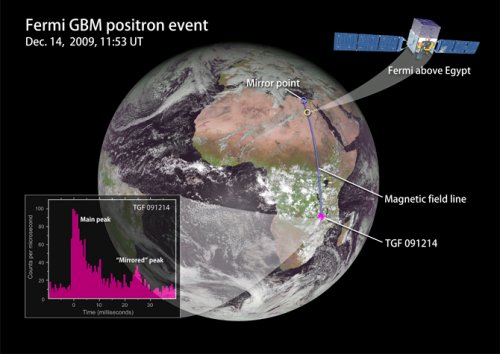
So what does this have to do with the TGB over Egypt? What Briggs and colleagues think is that the initial TGB occurred thousands of miles away in southern Africa, sending a beam of electrons and positrons hurling up and over Egypt, where collisions produced gamma rays. See the above figure.

The charged particles kept going to a mirror point, where they were reflected back down over Egypt – creating a second pulse. This entire process took less than 30 ms.

Amazingly, physicists have only known about these high-energy bursts for a decade or so. The problem, according to Briggs, is that they are difficult to detect here on Earth because the gamma rays are absorbed by the dense lower atmosphere. However, they have been seen at certain high-altitude facilities and at sea level in Japan, where thunderstorms are believed to occur lower in the sky than in most places.

The big mystery, however, remains how such high-energy gamma rays are created in the first place.

An inordinate fondness for bits

This is how it usually goes. I arrive at a party, get myself a beer and start chatting to people. Soon, it becomes apparent that I am a physicist. Various responses follow. Some people never talk to me again. Some politely say that they failed to appreciate physics in school because of the lack of a good teacher. And then there are some who simply exclaim “You must be brainy!”. But, eventually, I am almost always asked “Do you believe in God?”.

The God question is awkward for non-religious physicists like me. If I do not feel like continuing with a philosophical debate (or if I detect that I would be offending religious sensibilities), I usually just reply with a plain “no” and go and get myself another beer. But if I feel that the person inquiring is up for a challenging discussion, I ask them to define “God” in the first place. This request may sound pedantic, I explain, but the whole point of science is to make well-defined conjectures, so that conclusive tests could be performed that would (at least in principle) falsify these conjectures.

Despite attending many parties, I have still not heard a definition of God that is good enough to make me subscribe to it. Yes, we physicists frequently use the word God in our popular writings, but it is usually meant as a synonym for “the universe”, “reality” and “nature”. Science is all about understanding the world we live in, and sometimes this quest is metaphorically called “knowing the mind of God” – in Einstein’s rather poetic words.

A new book sets out to change all this by, among other things, providing an unusually physical definition of God. Information and the Nature of Reality: From Physics to Metaphysics is a collection of non-technical articles compiled by Paul Davies (a physicist) and Niels Henrik Gregersen (a theologian), and written by biologists, historians and philosophers, as well as physicists and theologians. Each article explores the hypothesis that information is at the root of everything. And I mean everything – from atoms to, perhaps, a deity.

The collection starts with historical essays by philosopher of science Ernan McMullin and philosopher-theologian Philip Clayton, who write about materialism (the worldview that states that the only thing that really exists is matter and that all other phenomena are just interactions between different pieces of matter) and its receding hold on philosophy. The stage being set, Davies and fellow physicist Seth Lloyd then present a physics perspective on information. Davies is without a doubt one of the best popular-science writers in the world, and his article demonstrates why. In it, he explains why, in light of modern physics discoveries, materialism is not the most viable philosophy. Lloyd then expands on this idea by introducing the notion that the universe is a giant information-processing device. This is a view that has emerged from my own field of research – quantum computation – and Lloyd is one of its most prominent advocates.

Next, we get a biological perspective, introduced by one of the finest UK evolutionary biologists, the late John Maynard Smith. Smith’s essay elaborates on the central dogma of biology, namely that information flows from genes to the phenotype but never backwards. In other words, the fact that your father was a bodybuilder when you were conceived does not mean you will have a nice six-pack when you grow up. Continuing through the book, however, we soon encounter a somewhat contrary view from anthropologist Terrence Deacon. He argues that Shannon’s theory of information – which states that the amount of information in an event is proportional to how surprising that event is – may not be sufficient to fully capture biological information. What Shannon’s definition lacks, Deacon says, is “semantics”. In other words, the information itself does not make much sense without the medium that interprets this information and gives it a meaning. The debate on meaning, expanded on by Bernd-Olaf Küppers and Jesper Hoffmeyer, naturally leads us into the realms of philosophy, metaphysics and, yes, theology.

The idea that information is the basic building block of reality very much resonates with me. I recently wrote a book, Decoding Reality (see review from August 2010), in which I explained why information is central to biology, economics and sociology, as well as quantum physics, computing and philosophy. At the end of the book, I muse on how information processing might give rise to reality itself. But the last section of Davies and Gregersen’s collection goes well beyond my own speculations. This is the part of the book that I enjoyed the most, even (or especially) when I disagreed with what was being argued.

This section starts with an article by the late Arthur Peacocke, to whom the book is dedicated. As both an ordained priest and a biochemist, Peacocke embodied two very different aspects of information explored in the present book. His essay is on the problem of evil, namely why an omnipotent and benevolent God would allow evil to exist in the world. Peacocke maintains that evil is simply necessary, since for any creation of good to occur, something first needs to be destroyed (he views the extinction of species in the process of natural selection in this way). So far, so good. Then the Roman Catholic theologian John Haught makes a curious suggestion: an event that has the maximum amount of information – in other words, the least likely one – ought to be taken to represent a religious revelation. The pinnacle of this “theological” section, however, is the proposal by Keith Ward that deity is a form of information-theoretic principle. Ward’s proposal is related to the observation that the universe walks a fine line between total disorder and compete order. Logically, it would seem that disorder is a more natural state of affairs if things were left to themselves, and so to get some order out we clearly need an extra guiding principle. And this extra principle, Ward suggests, is synonymous with God – albeit a very different sort of God than an all-powerful creator. Now, there is a definition of God with which I might almost agree!

The problem, of course, is that once we leave the scientific domain, it becomes rather easy to make unfounded speculations about the connections between information and various other religious concepts. For instance, in the last chapter of this book we encounter suggestions that the Christian Gospel of John could be interpreted in information-theoretic terms. Similar parallels are drawn in the essay by Michael Welker, who discusses the information content in the resurrection of the Christ. Carelessly extrapolated, this sort of exposition might lead to arguments similar to Frank Tipler’s nonsensical “proofs” of various Christian dogmas in his two books The Physics of Immortality and The Physics of Christianity. Amusing as such parallels might be, it is doubtful that they will ever lead to any greater enlightenment as to the nature of reality itself.

When the famous British geneticist J B S Haldane was asked if his research taught him anything about God, he replied “The Creator, if He exists, has an inordinate fondness for beetles”. The collection by Davies and Gregersen suggests, in line with my own views, that we could go deeper than Haldane: the ultimate answer might just turn out to be a Creator with an inordinate fondness for bits. Certainly, bits of information are present everywhere we look, and if you want to know more about this novel take on reality, then I highly recommend Davies and Gregersen’s erudite and entertaining collection.


Kepler bags first rocky exoplanet

The first rocky exoplanet has been discovered by NASA’s Kepler space telescope, according to the mission’s deputy science team leader Natalie Batalha. The planet is called Kepler-10b and has a density on par with that of iron – making it much denser than Earth. The exoplanet orbits a star about 560 light years from Earth.

Kepler-10b is about 20 times closer to its host star than Mercury is to the Sun – and as a result its surface temperature is expected to be as high as 1400 °C. It always shows the same side to its star and is likely to have oceans of molten rock on its day side and a solid night side, according to Batalha. It has an orbital period of about 0.84 days and its star is known to be about the same size as the Sun.

Since the discovery of the first extrasolar planet (exoplanet) in 1995, over 500 more have subsequently been unveiled. While most of these are gas giants like Jupiter, astronomers are getting better at finding smaller exoplanets that could be more similar to Earth. Before Kepler-10b was identified, the best candidate was Corot-7b. While Corot-7b could indeed be rocky, its star is very active, making it difficult to accurately determine its density.

Three key measurements

Kepler-10b, however, is a very different case because its star is very old – about 8 billion years – which means that it is very quiet and much easier to deal with. The team determined the planet’s density by making three different observations. First, they determined its radius relative to the star’s by measuring how much light it blocks when it transits between Earth and its star. Then they determined its mass (again relative to its star) by measuring the wobble of the star caused by the orbiting planet. The final, and crucial step was to determine the radius and mass of the star itself, which was done by measuring the vibrational frequency of “starquakes” on the star.

Putting it all together the team believes that the planet’s density is about 8.8 g/cm3, which is denser than iron.

“This is the first unquestionably rocky planet,” said Batalha today the American Astronomical Society meeting in Seattle. “Its discovery is an important milestone for humanity,” she added. Geoff Marcy of the University of California at Berkeley, who was not involved in the work, said that the discovery “will go into every textbook on astronomy”.

Night and day temperatures

Batalha said that the Kepler team is now studying a possible modulation in the amount of light that reaches the telescope during the planet’s transit. This could allow the researchers to determine the temperatures of the day and night surfaces of the planet. While Kepler-10b is similar to Earth in some ways, it is not within the habitable zone around its star, where life could emerge – the Kepler group already knows it is much to hot for life as we know it.

One mystery surrounding Kepler-10b is how it managed to get so close to its star. Edward Guinan of Villanova University believes that it could be the remains of a gas giant like Jupiter that got so close to its star that the gas was blown off and only the rocky core remained.

Cutting the cost of coffee and a space telescope

By Hamish Johnston at the AAS meeting in Seattle

Times are tough, and cutting costs was on the agenda for the two speakers who opened the 217th Meeting of the American Astronomical Society here in Seattle.

On the podium first was AAS president Debra Elmegreen, who had something to say about the cost of coffee at the Seattle Convention Center – which is astronomical. Indeed, catering is the single largest expense for the meeting, and free coffee adds over one hundred dollars per delegate. Yikes, that’s a lot of money considering that more than 10% of the 2700 folks here are undergraduates.

So no more free coffee breaks between sessions – with the exception of ticketed coffee in the exhibition – and not a groan in the audience. If only the bankers would take the same attitude towards their bonuses!

The next speaker was the Nobel laureate John Mather, who spoke about progress towards launching the James Webb Space Telescope in 2015. The big news is that construction of the telescope’s 18 primary mirrors is well under way and they should all be completed by this summer. “It’s huge,” said Mather, referring to the telescope, which is 6.5 m across, compared with Hubble at 2.4 m.

The next big step, according to Mather, is to place the entire optical system into a giant chamber at the Johnson Space Center to simulate the rigours of space.

Mather took a few questions, which is when the thorny issue of money came up. A recent article in the New York Times pointed out that cost overruns on the James Webb were going to sap funds from other NASA missions. Not surprisingly, Mather was adamant that the extra funds were needed, and expensive projects such as the Johnson testing must go ahead.

I’m afraid that at this point there was some muttering in the audience – and the person next to me said under his breath that the James Webb was consuming far too much of NASA’s astrophysics budget.

Let’s hope Mather and colleagues can keep costs under control for the sake of my neighbour’s blood pressure.

Dwarf galaxy solves supermassive mystery

Ever since supermassive black holes were found to lurk at the heart of most large galaxies, astronomers have wondered what came first: the galaxies or the black holes themselves? Now astronomers in the US have spotted the first known supermassive black hole at the heart of a very young “dwarf” galaxy, where stars are still breeding rapidly. The finding, obtained using data from the Very Large Array radio telescope in New Mexico and the Hubble Space Telescope, suggests that supermassive black holes form before their companion galaxies.

The mystery about which came first – galaxies or their supermassive black holes – initially arose when astronomers found that the mass of the black hole divided by that of the galaxy’s dense central core (or “bulge”) is the same for nearly all large galaxies, including our own Milky Way. It seemed that the black holes and bulges affect each other’s growth – and therefore develop at the same time. However, over the past few years observations seem to be suggesting that young galaxies harbour much more massive black holes than this ratio would allow – suggesting that their black holes formed first.

Super-fast jets

The latest evidence backing this black-holes-were-first theory comes from Amy Reines and colleagues at the University of Virginia and the National Radio Astronomy Observatory (NRAO) in the US. They examined the intense radio waves emanating from the centre of Henize 2-10 – a galaxy with a radius about 3% that of the Milky Way and 30 million light-years from Earth. The galaxy is forming stars very rapidly and some astronomers believe that it resembles the first galaxies to form in the early universe.

The radiation streaming from the centre of Henize 2-10 was found to resemble that expected from super-fast “jets” of material spewed outward from areas close to a black hole. The presence of a supermassive black hole was then confirmed by measurements from the Chandra X-ray Observatory. These revealed intense X-ray emission from the galactic core, which – together with the radio data – indicated what the researchers say is a supermassive black hole a million times more massive than our own Sun.

The case strengthens

While central black holes of about the same mass have been found in other galaxies, those galaxies are larger – and have much more regular shapes – than Henize 2-10. They also do not support the same high rate of star formation as Henize 2-10. “Now, we have found a dwarf galaxy with no bulge at all, yet it has a supermassive black hole,” says Reines. “This greatly strengthens the case for the black holes developing first, before the galaxy’s bulge is formed.”

That view is echoed by Reines’ colleague, Kelsey Johnson of the University of Virginia. “This galaxy probably resembles those in the very young universe, when galaxies were just starting to form and were colliding frequently,” she says. “All its properties, including the supermassive black hole, are giving us important new clues about how these black holes and galaxies formed at that time,” Johnson says.

The research is described in Nature doi:10.1038/nature09724 and is being presented by Reines today in Seattle at the 217th meeting of the American Astronomical Society.

Racetrack memory nears the finish line

IBM researchers have moved another step closer to commercializing “racetrack memory” – a new technology that uses magnetic nanowires as high-density data storage devices. Racetrack involves moving magnetic domain walls – the boundaries between regions of opposite magnetization – along a nanowire using small spin-polarized current pulses. It could make for a new type of magnetic memory that can store up to 100 times more data than existing random-access memories (RAMs).

A conventional computer hard drive uses a motor to rotate glass discs on which magnetic bits are stored in a thin film. Racetrack memory is radically different because it uses electric currents to move magnetic domain walls up and down a nanowire without displacing any atoms at all. Magnetic domain walls are narrow boundaries between regions in a material where the magnetic moments point “up” on one side of the wall and “down” on the other. Walls can be moved inside a material by applying an external magnetic field or by injecting a spin-polarized current pulse (a current of spin-polarized electrons that carries spin angular momentum).

In a racetrack memory, data are stored as a sequence of magnetic domains – separated by domain walls – along a nanowire and individual bits are stored and retrieved by moving the sequence along the nanowire and across magnetic read and write devices. A typical racetrack chip would contain arrays of nanowires a few microns long and about 30 nm wide and could store hundreds of gigabytes of data.

Do walls move instantly?

Stuart Parkin’s team at IBM Almaden Research Center in San Jose, California, has been working on the technology since 2004 and has already developed some basic racetrack prototypes that can read and write simple data sets. However, until now, the researchers did not know how magnetic domain walls move in a nanowire. Do the walls move instantly as soon as the current is applied and come to a stop straight away when the current is switched off, or do they take time to reach their peak velocity and come to a slow stop when there is no current?

Parkin and colleagues say that the second scenario holds true. The researchers came to their conclusion by measuring the time it takes for a domain wall to accelerate to its peak velocity and the distance travelled by the domain wall when it is excited by a current pulse. They did this by using an exciting current pulse and a second probe current pulse while also measuring the time it takes for the domain wall to decelerate from this peak velocity to zero when the current is switched off.

‘Surprisingly long’ time and distance

“We found that the time required for acceleration/deceleration is surprisingly long at around 10 ns and the distance travelled is long too at around 1 µm,” Parkin told physicsworld.com. “However, the distance lagged during acceleration is the same as the distance moved by the domain under its own inertia (or mass) when the current is switched off.” This latter finding is very important because it means that, although the domain wall has inertia, it still moves a distance that corresponds to the length of the applied current pulse. Knowing this, the researchers will thus now be able to precisely control the position of the domain wall along the racetrack by using carefully tailored current pulses or sequences of pulses and so accurately move and retrieve data on it.

“This is clearly an important breakthrough in our understanding of current-driven domain wall dynamics relevant to building racetrack memories,” stated Parkin.

The IBM team followed domain wall motion by measuring the resistance of racetracks made of permalloy – a soft magnetic alloy made of nickel and iron. The presence of a domain wall slightly lowers the resistance of the nanowire.

‘Ingenious technique’

“We use the resistance of the nanowire to determine not only whether a domain wall is present, but also the number of domain walls and even the detailed internal magnetic structure of the domain wall,” explained Parkin. “We used a rather ingenious technique that involves combining two current pulses – one to excite the domain wall and the second to probe the domain wall’s motion – somewhat akin to pump-probe techniques using photon pulses.”

The researchers now plan to build an integrated prototype of a racetrack memory with reading, writing and shifting elements built into the track itself.

The work is reported in Science 330 1810.

Copyright © 2026 by IOP Publishing Ltd and individual contributors