Racing towards the $10 million prize?

greaves-495px.jpg
DNA being pulled through a sheet of graphene. Courtesy: Robert R Johnson

By James Dacey

High achievers who commit their working life to fundamental research do not tend to be driven primarily by money. But the chance to win a slice of a $10 million prize must at least bring a bounce to the step of a scientist as they whizz around the lab. That’s the situation for researchers developing DNA sequencing technologies who stand a chance of sharing the Archon Genomics X Prize, which will pay this money to the first privately funded company that can accurately sequence 100 human genomes in 10 days.

Earlier this week, researchers at the University of California reported an important breakthrough in one of the promising techniques that could scoop this prize. Kate Lieberman and her colleagues are seeking to develop a system known as nanopore sequencing. The basic idea is that by feeding DNA through pores in thin films that are so small that the molecules almost fill the gap, the DNA could alter the electronic properties of the film. If researchers can also develop a highly sensitive way of monitoring electronic currents passing across the gap, they could in theory identify individual bases – A, C, G and T.

The idea was first mooted in the mid 1990s, but naturally there have been a number of challenges along the way. Lieberman and her colleagues have addressed one of these, which is to find a controlled way of passing DNA strands through the gap. They manage to pass a single strand of DNA through a nanopore in protein by coupling the DNA with a polymerase enzyme, which can then pass smoothly through the gap and be detected in the presence of an electric field.

The researchers, who report their findings this week in Journal of the American Chemical Society, intend to develop their technology by working with their industrial partners, the UK-based company Oxford Nanopore. “The ‘strand sequencing’ method of DNA sequencing using a nanopore has been studied for many years, but this paper shows for the first time that DNA can be translocated by an enzyme using methods that are consistent with a high throughput electronic technology,” said Gordon Sanghera, CEO of Oxford Nanopore.

If you are a member of the Institute of Physics, you can read more about nanopore sequencing and the incentive of the X Prize in this recent feature article from the print edition of Physics World.

Medical isotope shortages could become commonplace


Supply shortages of molybdenum-99 could become commonplace over the next decade unless longer-term actions are taken. That is the main conclusion of a report from the Nuclear Energy Agency (NEA) of the Organisation for Economic Co-operation and Development. Published by the NEA’s High-level Group on the Security of Supply of Medical Radioisotopes (HLG-MR), the report points out that more than 90% of the world’s molybdenum-99 is produced by just five research reactors. These facilities are all 43–50 years old and two – NRU in Canada and OSIRIS in France – are expected to stop production by 2016.

Molybdenum-99 is used to produce technetium-99m, which is used in 30 million medical imaging procedures every year. Technetium-99m is bound into radiopharmaceuticals, which are injected into the body and target specific tissues or biological processes. Technetium-99m decays producing just a gamma ray, which can easily leave the body and be detected. The isotope is well suited for this application because it does not emit harmful charged particles and has a relatively long half-life (6 h) for a gamma emitter.

The HLG-MR was set up in April 2009 in the wake of short-term isotope shortages caused by scheduled and unscheduled shutdowns of several reactors worldwide. The most significant disruption occurred in 2009–2010 when a leak put the NRU reactor in Canada out of commission for more than 13 months.

Constraints on processing capacity

Currently, all of the world’s nine major isotope-producing reactors are running – one each in Canada, South Africa, Australia and Argentina and five in Europe. However, the HLG-MR report cautions that shortages could be expected as demand continues to grow, some reactors are shut down and constraints remain on regional processing capacity.

Molybdenum-99 has a half-life of 66 h, which is not long enough for the isotope to be stockpiled. It is produced by irradiating a target containing uranium-235 inside a nuclear reactor. The molybdenum-99 is then extracted from the target in a processing facility. The uranium targets cannot be transported by air, which means that processing should be located less than 1000 km from the reactor.

There are currently six major processing centres worldwide – all near major reactors. The report points out that the processing capacity in some regions is not enough to support increased target irradiation in those locales. Indeed, during a recent global isotope shortage, reactors in Europe could not crank out targets at full capacity due to a lack of processing facilities. As a result, the HLG-MR recommends that production and processing capacities should be coordinated on a regional level.

Investment in processing needed

A new large processing facility would cost about $200m to build. According to the report, this is a “significant investment to be made for an industry where there is uncertainty around reliability of irradiation services and a revenue stream that does not currently support the economic sustainability of the industry”.

Another challenge facing processors is the ongoing shift from using highly enriched uranium (HEU) targets – which could be used to make weapons – to low-enriched uranium (LEU) targets. LEU targets produce less molybdenum-99 produced by HEU targets and therefore require greater processing capacity as well as the ability to dispose of more nuclear waste.

Medical isotope suppliers believe that demand for technetium-99m will grow by about 1–2% per year. Ignoring any problems with processing, demand is expected to outstrip supply from existing reactors by about 2017.

Impending crunch

As a result of this impending crunch, there are currently about a dozen new facilities on the drawing board, most of which are expected to come online by 2015. If all proposed facilities are built, no supply problems are expected assuming 2% growth in demand. However, when problems of processing capacity and the possibility that some projects will not proceed are factored in, the world could again face shortages by about 2021.

According to Ronald Cameron, head of the NEA’s Nuclear Development Division, many of the industry’s woes are related to the fact that the current economic model of production is not sustainable. Molybdenum-99 production began as a sideline for research reactors and as a result many facilities were locked into long-term supply contracts at low prices, he says. In some cases, according to Cameron, the price of the isotopes does not cover the operating cost of the reactor. Indeed, the HLG-MR report says “current economic return on producing molybdenum-99 at the reactor is not sufficient to support the development of new infrastructure for the production of molybdenum-99; a new multi-purpose research reactor has been estimated to cost more than €400m”. However, Cameron stresses that new facilities could be cost-effective if they pursued different business models.

Not all production methods currently under development require new reactors. TRIUMF in Canada, for example, is working on an accelerator-based method for producing the material. Another option is to use some of the world’s many power reactors to make isotopes – however, Cameron points out that this could prove difficult because it would require changes in how power reactors are regulated.

Nanotube rubber stays stretchy at extreme temperatures

Researchers in Japan have developed a new viscoelastic material that remains stable over an incredibly wide temperature range – from –196 °C to 1000 °C. This is the first such material of its kind as rubbery materials like these normally break down at high temperatures and become brittle when too cold.

Scientists have been studying carbon nanotubes for the last 20 years because these materials have many remarkable properties that include extremely high tensile strength and high electrical conductivity. Now, Ming Xu of AIST in Tsukuba and colleagues have discovered yet another exceptional property in these tubes – viscoelasticity over a wide temperature range.

Viscoelastic materials behave like thick liquids (for example, honey) but are also reversibly elastic, like rubber bands. One example of such a material is polymer foam – widely used in earplugs that adapt themselves to the shape of your ear yet recover their original form after they are removed. Viscoelasticity is seen in a variety of materials, including amorphous and semicrystalline polymers, some biomaterials, crystals and even some metallic alloys.

Random networks

The new rubber is made from a random network of interconnected single-, double- and triple-walled carbon nanotubes and has the same viscoelasticity as that of the most thermally resistant silicone rubber at room temperature. However, silicone rubber only retains its viscoelasticity between –55 °C and 300 °C. The new material remains flexible over a much higher temperature range, can recover its shape after being repeatedly deformed and shows excellent fatigue resistance.

Xu’s team began by depositing metal catalysts on a silicon substrate. These catalysts act as seeds for growing the nanotubes from a carbon source, such as ethylene. A drop of water (100–200 ppm) added to the mix greatly increases carbon nanotube growth and produces long tubes.

The carbon nanotubes normally just grow upwards using such a technique, but by pre-treating the catalyst, the researchers succeeded in lowering the density of the tubes to create an entangled network of long tubes as growth progresses – similar to vines in a jungle, says Xu. “Importantly, an individual carbon nanotube cannot stand on its own, so as one tube grows from the substrate, it touches another tube for support. This results in a network of tubes that contact each other via Van der Waals forces.”

Zipping and unzipping

According to the team, the network is highly stable over a broad temperature range thanks to the energy dissipated as the individual nanotubes zip and unzip at the points of contact. The carbon nanotubes themselves are also very heat resistant – between 2000 °C and 3000 °C – so an even broader temperature range might be possible for this rubber.

As for potential applications, Xu says that they are not yet sure since the material made is totally new and unique with hitherto unseen properties. “We are currently searching for applications that could benefit from such temperature invariant properties,” Xu told physicsworld.com.

Yury Gogotsi of Drexel University says that the entangled nanotube material “is a kind of versatile rubber that could be used in cold interstellar space or inside a high-temperature vacuum furnace”. With further developments, such a material may find use not only in space vehicles but also in more down-to-earth applications, such as wrinkle-free textiles or viscoelastic shoe insoles that reduce mechanical shocks, he adds.

The Japan team, which includes researchers from the National Science and Technology Agency in Kawaguchi, would now like to tailor the viscoelastic properties in the nanotube networks to create softer, stronger or more elastic materials. “Such an approach would also help us meet the demands of target applications,” says Xu.

The work was reported in Science.

An audience with the Pope's astronomer

By James Dacey

If you are a regular follower of this blog, you may remember that a few weeks ago I went to see the Pope’s astronomer, Brother Guy Consolmagno, who was giving a talk at the British Science Festival in Birmingham.

Here is a video of that talk in full in which Brother Guy discusses many things including science, religion and the Catholic church’s view on extraterrestrial life. On serious topics such as how he squares his belief with his rational scientific thought, Consolmagno was a lot more candid than I had expected. For instance, if you skip to just over 7 minutes in you can hear how his decision to become a Jesuit just before his 40th birthday was based on a botched calculation regarding his age.

The loudest laugh of the night came when Consolmagno dismisses the idea that Catholics read the Bible as if it were a literal truth, as if it were a science book. “That’s not a Catholic idea… that’s a protestant idea,” he says with a mischievous grin on his face. (See 11 min 30 sec in.)

Video credit: David Evetts from the Birmingham Astronomical Society

Secret of diamond polishing revealed

It is the hardest everyday material on Earth, so why does diamond glisten when rubbed against another diamond? Now, the ancient but mysterious process of diamond grinding may have been explained by physicists in Germany, who have created a model for explaining the frictional interactions at the molecular level.

For centuries precious-stone merchants have polished diamonds by grinding them with cast-iron wheels embedded with coarse diamond fragments. It is not clear why this procedure is so effective at cleaning diamonds, but experience suggests that it works far better when the diamond is fixed at certain angles to the wheel than others.

This directional dependence of diamond grinding has now been investigated by Lars Pastewka at the Fraunhofer Institute for Mechanics of Materials who set out to investigate the phenomenon. Working with colleagues at several other institutes across Germany, he has developed a quantum mechanical model to study the atomic interactions in “diamond-like” carbon films, which are often used in industry to reduce friction in machinery.

Diamond in the rough

But when the researchers applied their model to diamond itself, they were surprised to find that it accurately predicted the experimental wear rates for this material – even though the exact wear mechanism has so far remained poorly understood. “At this point we became very excited about this work and analysed our simulations in much more detail to uncover the details of the process,” Pastewka told physicsworld.com.

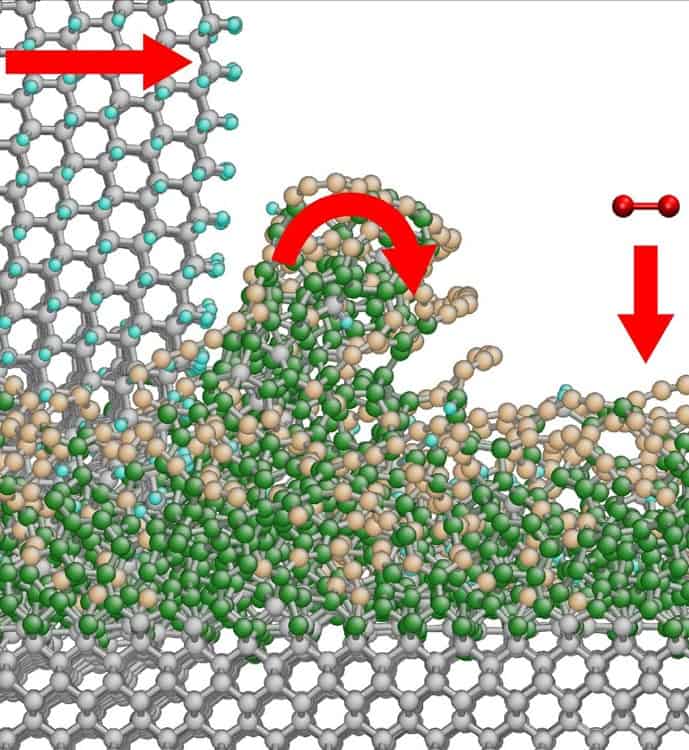
Pastewka’s team set about simulating diamond grinding using 70 computer processors running for a year, and discovered that during the grinding the diamond surfaces were being transformed into soft, amorphous layers. These thin films can then be easily removed by either chipping them away, or through carbon molecules bonding with oxygen in the atmosphere, leaving behind clean diamond surfaces.

This creation of the amorphous film occurs because of existing imperfections at the diamond surface, including the build-up of dirt over time. As a diamond atom slides over the surface it repeatedly pulls at the diamond crystal’s atoms, and sometimes removes an atom from the crystal surface, which becomes part of the amorphous layer.

Like a stack of paper clips

“Imagine you have a stack of paper clips neatly arranged on your desk,” explains Pastewka. “Now you take a magnet and move that over these clips at a certain height. You cannot keep the height ideally constant, so if the height is right you will pull some paper clips to your magnet and others will remain on the desk.”

Changfeng Chen, a materials scientist at the University of Nevada in the US is impressed by the research and its potential to boost industrial processes. “This research is of particular significance in nanotechnology where the orientations of nanoscale crystallites can be well defined and controlled,” he says. “The predicted orientation-dependent anisotropic amorphization wear mechanism may open doors to a new level of material processing, ranging from better designer jewellery to superior high-tech device components.”

To develop the work, however, Pastewka’s team intends to further investigate diamond’s surface chemistry, and is currently writing a paper on the oxidation of the amorphous layer.

This research is described in a research paper in Nature Materials.

Peering into the 'super microscope'

greaves-495px.jpg
“Glass” (Courtesy: Neville Greaves/Aberystwyth University)

By Michael Banks

Make sure you do not miss a new exhibition at the Didcot Cornerstone Arts Centre in Oxfordshire, which starts today and runs until 9 January.

ISIS: Super Microscope features pictures of the ISIS neutron source taken by photographer Stephen Kill as well as images from some of the science performed at the facility.

The exhibition is aimed at raising the public’s awareness of the neutron source, which is at the Rutherford Appleton Laboratory in Oxfordshire and operated by the UK’s Science and Technology Facilities Council.

Completed in 1984, ISIS remains Europe’s only source of pulsed neutron beams. In 2008 the facility completed the construction of a second target station, which will see the number of instruments double to over 40.

Every year hundreds of researchers come to ISIS from around the world to study a range of materials from magnetic materials to biological samples.

One of the images on display is called “Glass” (shown above), which shows the atomic structure of glass as inferred from data collected in neutron experiments.

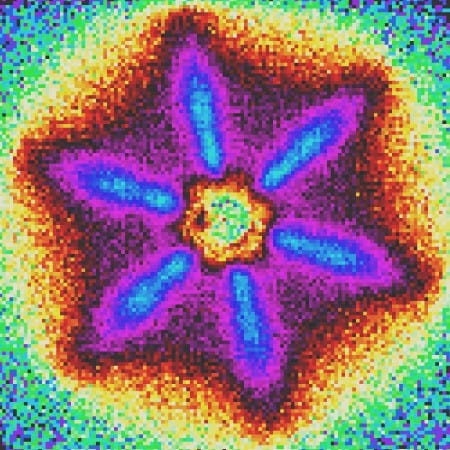
The image below, which has the appearance of a petal, is taken from raw data collected by a neutron camera at ISIS.

flower.jpg
The “flower” (Courtesy: Steve King/ISIS)

Flower
ISIS researcher Stephen King explains how the image was made using neutrons

Building a better bobsleigh run

bobsleigh.jpg


By Hamish Johnston

Much of Britain is under a thick blanket of snow – and there is even a light sprinkling of the stuff here in normally balmy Bristol. So it’s not surprising that our thoughts have turned to the physics of winter sports.

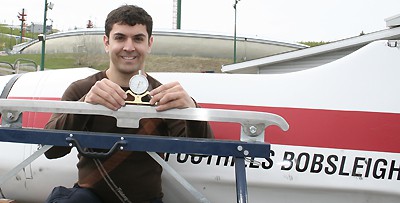
Louis Poirier is one physicist with both a practical and theoretical understanding of that subject. Poirier spent more than five years on Canada’s national bobsleigh team before starting a PhD in physics at the University of Calgary.

Poirier still has an academic interest in the sport and last year he published a paper in the journal Sports Engineering on “Optimization of handheld gauge sizes for rocker measurements of skate blades and bobsleigh runners”. That’s Louis pictured above with a gauge (photo courtesy of U of Calgary/Ken Bendiktsen).

Now, Poirier has turned his attention to making bobsleigh runs safer for athletes – an important issue for the sport after the death of a competitor in this year’s Winter Olympics. Tomorrow, Poirier will be at an international bobsleigh, skeleton and luge competition near Calgary armed with a radar gun.

Poirier told the Toronto Star that current models used to design tracks are not very accurate because they only consider the time the sled passes about six points along the run.

Using his radar data, Poirier hopes to work out the acceleration on the competitors as they whiz around bends in the track.

Interestingly, he says that speed isn’t always the problem – and that slow tracks can sometimes be more challenging (and dangerous) than faster ones.

Poirier hopes to be able to publish his findings but admits that it may be impossible to perform controlled measurements in a competitive event. You can read about his work here.

Spin ices slip into ground state

Physicists in the UK and the US are the first to encourage artificial spin ices – magnetic nano-structures analogous to water ice – into a square formation that is very close to the ground state. The discovery could help researchers to develop “bit pattern” data storage, where sheets of magnetic material are replaced by arrays of magnetic islands.

In spin ices, the interactions between atoms are “frustrated” so they cannot settle into a crystalline state where all interaction energies are minimized. Water ice is an example of such a frustrated structure. To form a perfect crystal, the hydrogen atoms would have to be located halfway between the oxygen atoms. However, each oxygen atom prefers to hold on closely to two hydrogens through short-range covalent bonds.

In fact, the solid only works when every oxygen is covalently bonded to two hydrogen atoms – those identified in the “H20″ – and two at a distance through long-distance hydrogen bonds. The result is a solid with a disordered distribution of short and long bonds between oxygen and hydrogen.

Artificial spin ices consist of analogous “atoms” made of tiny magnets, each a dipole that tries to align with its neighbours to satisfy interactions. They present a way to understand the frustrated structure of water because, unlike water, their interactions occur on a large enough scale to be studied through a microscope. Artificial spin ices could also be studied to figure out how to pack together magnetic dipoles for data storage, without letting interactions spoil the dipoles’ alignment.

Spin ice jam

Yet one of the troubles in working with artificial spin ices has been how to get them into a ground state, where the dipoles exhibit long-range order. Like coarse sand in a funnel, the dipoles tend to jam in a high-energy state during fabrication. In the past, researchers have tried applying rotating magnetic fields to encourage the dipoles into lower energy states – the equivalent of shaking up the sand – but this has not proved totally successful. “You get them into some low energy state, but not into the ground state, or anywhere close,” says Christopher Marrows of the University of Leeds.

Marrows’ group, which includes colleagues at Rutherford Appleton Laboratory in Oxfordshire and Brookhaven National Laboratory in the US, has now identified a square artificial spin ice in what seems to be the ground state – or very close to it. In their experiment, Marrows and colleagues placed a stencil on top of a silicon wafer and used an electron beam to deposit a nickel-iron alloy. When they removed the stencil, they were left with a square array of magnetic domains – the artificial spin ice.

Marrows’ group then used a technique called magnetic force microscopy to image the sample, and discovered that, unusually, it displayed the long-range order typical of a ground state. According to Marrows, the order probably arose because of thermal agitations that could shake the diploes towards the ground state while the spin ice was still thin. In the normal fabrication of artificial spin ices, he says, this can’t happen because a thick layer of magnetic alloy is etched away to form dipoles – there is no thin stage.

Square versus triangles

Oleg Tchernyshyov, an expert in spin ices at Johns Hopkins University in Baltimore, US, believes the development is not totally new, since other researchers have achieved ground-state ordering in spin ices with “kagome” (interlaced triangular) arrays of dipoles, as opposed to square arrays. Tchernyshyov adds, however: “To Marrows’ credit, it is much harder to get rid of defects in square ice than in its kagome counterpart.”

Marrows told physicsworld.com he next wants to investigate what happens with artificial spin ices on smaller scales, which might be able to show how thermal agitations shift the dipoles around. “Because you’ve built it using nanotechnology you can control everything,” he says. “You can tune the strength of all the interactions at will, just by making a slightly different pattern – a little bigger, or a little smaller. You can’t do that with the natural systems.”

The research is published in Nature Physics.

Happy birthday, Royal Society

By Matin Durrani

The Royal Society – one of the oldest scientific societies in the world – has been spending all this year marking its 350th anniversary.

The society was founded on 30 November 1660 and its outgoing president is the Cambridge University cosmologist Martin Rees.

Rees, whom I interviewed earlier this year (see video above), stepped down yesterday after five years in the hot seat, to be replaced by the Nobel-prize-winning geneticist Sir Paul Nurse, who was lured back to the UK after a stint in New York.

It takes a certain polished charm, coupled with a clear vision, to get appointed as Royal Society president – a quality that Rees has for sure, as you’ll see from the interview.

Nurse no doubt has those qualities too, insisting to the Observer in a recent interview that “scientists have to earn their licence to operate and that means getting out there to talk to people and explain what we do.”

To mark Nurse’s appointment, the Royal Society has also just released a new report entitled Science Sees Further: How Science Will Answer Some of the World’s Biggest Questions containing 12 articles on the “most exciting areas of science today”.

The topics are quite general – ageing and Web science being among them, with the most closely related to physics probably being those on, greenhouse gases, geoengineering and extraterrestrial life.

As for Rees, I doubt his life will get much quieter – he’s still president of Trinity College Cambridge and the UK’s Astronomer Royal after all.

Super-Earth’s atmosphere comes into view

A team of astronomers has made the first direct measurement of the atmosphere of an exoplanetary “super-Earth”. The findings suggest that the exoplanet named GJ 1214b has either an atmosphere swarming with clouds or one enveloped in water vapour.

Since the discovery of the first extra-solar planet – or exoplanet – in 1995, over 500 more have subsequently been unveiled. While most of these are gas giants like Jupiter, astronomers are getting better at finding smaller exoplanets that could be more similar to Earth.

GJ 1214b weighs in at 6.5 Earth masses and is a so called super-Earth because it tips the scales at between twice and ten times the mass of our own planet. Discovered in 2009, and circling a star approximately 40 light-years from Earth, the exoplanet’s low density implied that it is blanketed by an atmosphere. However, until this latest research, led by Jacob Bean at the Harvard-Smithsonian Center for Astrophysics, US, direct measurements of this atmosphere had remained elusive.

Bean and colleagues used a spectrograph, attached to the Very Large Telescope (VLT), to analyse light from the parent star as the planet passed in front of it. During such a transit some starlight passes through the planet’s atmosphere and can be soaked up by its constituent chemicals. This produces a spectrum containing tell-tale fingerprints – gaps at wavelengths where light is absorbed by the atmosphere. Crucially, Bean’s spectrum for GJ 1214b was featureless: there were no gaps in the data.

Cloud-free skies ruled out

Such a result rules out models suggesting the possibility of a cloud-free, hydrogen-rich atmosphere similar in composition to Neptune. Hydrogen, the lightest element, doesn’t cling very tightly to a planet, giving it a better chance of absorbing incoming sunlight. “A hydrogen-dominated atmosphere would be very ‘puffy’,” Bean told physicsworld.com. “It is this puffiness that would have given a very strong signature in the spectrum that we measured,” he added.

The lack of such a signature leaves two rival explanations fighting to explain Bean’s finding. “The featureless spectrum tells us that it is probably a very dense atmosphere. However, the alternative is that it does have a puffy atmosphere but with thick, high clouds that we can’t see through, similar to Venus, or [Saturn’s largest Moon] Titan,” explained Bean.

I think we’ll get the answer within a year, maybe even sooner Jacob Bean, Harvard-Smithsonian Center for Astrophysics

Should it turn out to be the former, the most likely chemical candidate is water vapour; GJ 1214b orbits so close to its host star that it could well be shrouded in steam. Bean is confident of nailing the answer soon: “I think we’ll get the answer within a year, maybe even sooner, we just need longer wavelength observations. Whilst clouds and hazes give a uniform absorption over the wavelength range we used, over very large wavelengths you would expect a difference,” he said.

However, some researchers are cautious. “They’ve done this looking through the Earth’s atmosphere, which is never a friend to astronomy,” Carole Haswell, an exoplanet researcher at the Open University, told physicsworld.com. “What they’ve done is very difficult; any slight systematic effects are going to have a huge effect on the conclusions that you draw. It’s good, solid and exciting stuff but I’d like to see it checked from space, e.g. with Hubble,” she added.

Should Bean’s findings be confirmed, Haswell sees this area of research as a crucial part of finding a “second Earth”. “If you can measure the composition of the atmospheres of planets like GJ 1214b then you are getting quite close to saying how similar they are to Earth. This is a big step in addressing the question of whether Earth is unique,” she explained.

This is a pretty major stepping stone in getting to the end goal of finding an Earth-like planet with signatures of life David Sing, University of Exeter

David Sing, who researches exoplanet atmospheres at the University of Exeter, agrees. “There have been a number of spectral studies of so-called ‘hot-Jupiters’ but this is the first time it’s been done for a terrestrial-type planet,” he said. “This is a pretty major stepping stone in getting to the end goal of finding an Earth-like planet with signatures of life,” he added.

And Haswell believes we’ve come along way in a short period of time, telling physicsworld.com: “The fact that in 1995 we didn’t know of any planets around other stars and now we’re measuring the atmospheres of planets in the same ball park as the Earth is amazing.”

The findings are described in a paper published in Nature 468 669.

Copyright © 2026 by IOP Publishing Ltd and individual contributors