Questions raised about giant piezoresistance

Four years after scientists in the US reported seeing “giant piezoresistance” in silicon nanowires, a team of researchers in France and Switzerland claims that this phenomenon may not exist after all.

Giant piezoresistance is a large change in electrical resistance that occurs when a material is stretched. After it was first reported in tiny silicon wires, claims were made that it could significantly improve nanoelectronic devices, such as nanoscale transistors, and help make ultrasensitive nanosensors.

Now, new work by Jason Milne and Alistair Rowe at the Ecole Polytechnique, Steve Arscott of IEMN-CNRS and Christoph Renner at the University of Geneva calls such applications into question.

Physicists have known about piezoresistance (PZR) – whereby the electrical resistance of a semiconductor changes when a small mechanical stress is applied to it – for many years. Giant piezoresistance occurs when there is a much larger change in resistance for the same applied strain. For example, the change in resistance per unit of strain (the “gauge factor”) typically ranges up to 100 in bulk silicon but in giant PZR, this value can reach several thousand.

Practical applications

Giant PZR would find many practical applications. For example, it might be used to detect motion in nanomechanical systems (NEMS) because traditional detectors lose their sensitivity at these length scales. Furthermore, because mechanical stress is currently employed to enhance the performance of electronic devices (in so-called “strain engineering”), it might also help enhance nanoscale transistors too.

The very act of measuring the resistance changes its value Alistair Rowe, Ecole Polytechnique

Four years ago Peidong Yang’s team at the University of California at Berkeley first observed giant PZR in silicon nanowires and the discovery created a flurry of interest in labs worldwide. Indeed, the researchers measured gauge factors up to almost 6000. The effect was thought to be a new phenomenon occurring in an otherwise well-characterized material resulting from the sample’s reduced size and characteristic surface states.

In a paper just published in Physical Review Letters, the France-Switzerland team claims that these observations were probably artefacts in no way related to the mechanical stress applied to the silicon nanowires. They were, instead, caused by surface trapping of charges induced by the voltage applied to measure the resistance. “In other words, the very act of measuring the resistance changes its value,” explained Rowe.

Non-stress-related drift

PZR is usually measured by performing a standard resistance measurement on a sample while gradually changing the applied mechanical stress on it. The trouble is that any non-stress-related drift in the value of the resistance cannot be separated from that caused by the applied stress.

The France-Switzerland team says it overcame this problem by applying an oscillating stress to its samples. In this way, stress repeatedly increases and then decreases as function of time. “This is a fairly standard technique (called heterodyne detection) in physics and engineering and is used to separate two or more signals and give artefact-free measurements,” said Rowe.

According to Rowe, scientists had never applied heterodyne techniques to PZR measurements before, so previous measurements revealed large (but not stress-related) resistance changes in the silicon nanowires. “This meant that the resistance drift due to charge trapping (also known as dielectric relaxation) was assumed to be the result of the applied stress”, he added. “This now appears to have been an incorrect assumption.”

Top-down or bottom-up?

Yang himself disagrees: “They are reporting PZR measurements on a collection of top-down micro- and nano-wires while our measurements were on bottom-up grown nanowires. Their results might not actually be that surprising as we now all know that bottom-up synthetic bridging nanowires have quite different strain levels, surface states and dopant profiles from those of top-down fabricated ones. In fact, the lack of giant PZR effect in such nanowires was already reported back in 2003. However, the lack of giant PZR effect in these new fabricated samples should not automatically imply the same in our synthetic bridging nanowires.

The observed PZR effect in our nanowires, whether it is intrinsic or from the surface states effect, has already proven to be useful Peidong Yang University of California at Berkeley

“After all, the observed PZR effect in our nanowires, whether it is intrinsic or from the surface states effect, has already proven to be useful,” he added. “For example, we recently demonstrated the first piezoresistively transduced very high frequency silicon nanowire resonators with on-chip electronic actuation at room temperature. We clearly showed that, for very thin silicon nanowires, their time-varying strain can be exploited for self-transducing the devices’ resonant motions at frequencies as high as 100 MHz. This simply would not be possible without the enhanced PZR effect.”

The debate looks set to continue.

Not slippery when wet

Ever wondered how a fly effortlessly lands and runs on your window without falling off? Judging by the natural curiosity of most Physics World readers, it is probably the sort of thing you thought about when you first started exploring the world around you as a child. However, as you might have noticed back then if you tried to get a better look, it is really hard to see those little insect feet in action without any form of magnification.

As the childlike curiosity of scientists never ends, it is somehow no big surprise that this apparently simple question – of how a fly sticks to a surface instead of just sliding off – was addressed in the 17th century by some of the pioneers of optical microscopy, including Robert Hooke. Better optical lenses suddenly allowed researchers to explore the world beyond the resolution of their eyes for the very first time.

Even back then, scientists knew that there is more to insects than meets the eye. While the most basic system of mechanical interlocking found in arthropods is the claw, insects do not merely have a miniature version of this. Many surfaces in the natural world are simply not soft enough to allow claws to be inserted, or are too smooth to provide a safe grip. The question of how insects stick, crawl and run on vertical surfaces and even upside down remains as hotly debated between scientists now as it was in the 17th century.

More than 300 years of scrutiny

One of the first books on microscopy was Experimental Philosophy, written by Henry Power in 1664. Along with detailed observations of various organisms, Power described and discussed the adhesive organs of the fly. He suggested that the fly’s feet can hold the creature upside down using a “whitish viscous liquor” secreted via tiny sponges on its feet.

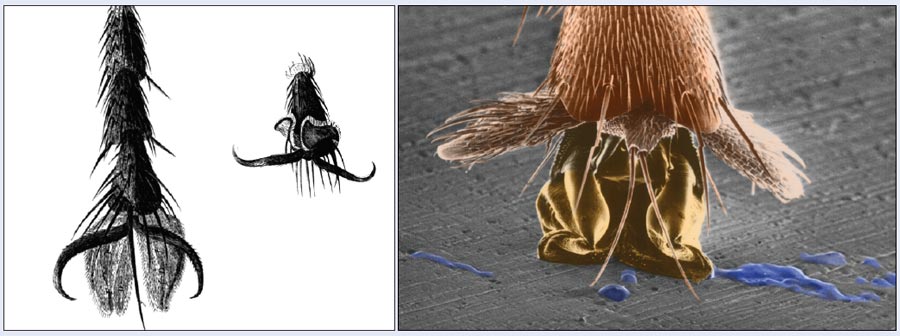
However, just one year later, Hooke (best known to physicists for his eponymous law of elasticity) sparked a heated debate by challenging Power’s wet-adhesion theory. In his respected book Micrographia, Hooke speculated that on the length scale of a fly’s foot, surfaces are rough enough that the feet can interlock and adhere using fine hairs (figure 1): “without the access or need of any such Sponges fill’d with an imaginary gluten, as many have, for want of good Glasses, perhaps, or a troublesome and diligent examination, suppos’d”.

After this rather personal dispute, many researchers proposed and tested the mechanisms of insect adhesion over the subsequent 200 years. Even Jonathan Swift, the passionate Irish natural scientist, mentions how insects stick in his well-known 1726 novel Gulliver’s Travels. Gulliver, exploring a land of giants during his second journey, is attacked by wasps one morning and complains that “these odious insects would sometimes alight upon my victuals, and leave their loathsome excrement, or spawn behind…which, our naturalists tell us, enables those creatures to walk with their feet upwards upon a ceiling”.

By the mid-19th century, most scientists had written off insect adhesion as fully understood, as Power’s theory of glue-based adhesion had been mostly accepted within the scientific community. Yet confusingly, in 1832 a different idea was introduced that, despite being proven wrong the following year, is still among the most popular “cocktail party” explanations. The idea came from German zoologist Herman Burmeister, who postulated that insects stick using “muscular suction cups”. To check this theory, in 1833 the British naturalist John Blackwall placed insects in sealed cylinders, out of which he then pumped the air. He found that the insects’ ability to adhere to the smooth inner surface was unaffected by the air pressure, and so dismissed Burmeister’s theory. However, despite the evidence, many scientists continued to pursue the suction-cup idea, and only a few investigated fluid adhesion in the years that followed.

Meanwhile, in further studies Blackwall noticed that placing small quantities of water vapour, oil, wheat, pulverized chalk or gypsum onto clean glass surfaces prevented insects and spiders from sticking to them. “These facts, far from corroborating the mechanical theory,” he concluded, “appeared quite inexplicable, except on the supposition that an adhesive secretion is emitted by the instruments employed in climbing.”

After this flurry of activity in the early to mid-1800s, scientists soon turned their attention and their microscopes towards other wonders of nature’s micro-cosmos, and insect adhesion became a largely forgotten quest – a backwater in the broader sweep of science.

Inspired by nature

Fast-forward to the present day, however, and the study of insects has come back into fashion. Elaborate instruments such as the scanning electron microscope and the atomic force microscope have allowed us to glimpse a new realm – the nano-cosmos. Scientists can now unmask even more of nature’s mysteries, and engineers have realized that taking inspiration from the natural world can be a neat route to developing innovative products. For example, the adhesive organs of insects, spiders and geckos are better than many artificial adhesives, at least in terms of their versatility (see “Stewed and digested”), and the fact that they are reusable and work in dynamic situations.

During their lifetime insects need to attach and detach their feet many millions of times. Each of these steps risks damaging or contaminating the insect’s feet, which would reduce their ability to stick. (Ever tried to reuse a Post-it note?) Insects get around this problem by using self-cleaning mechanisms, which rid the feet of any dirt to allow optimal stickiness, regardless of the number of steps taken. Such mechanisms have also been found in geckos.

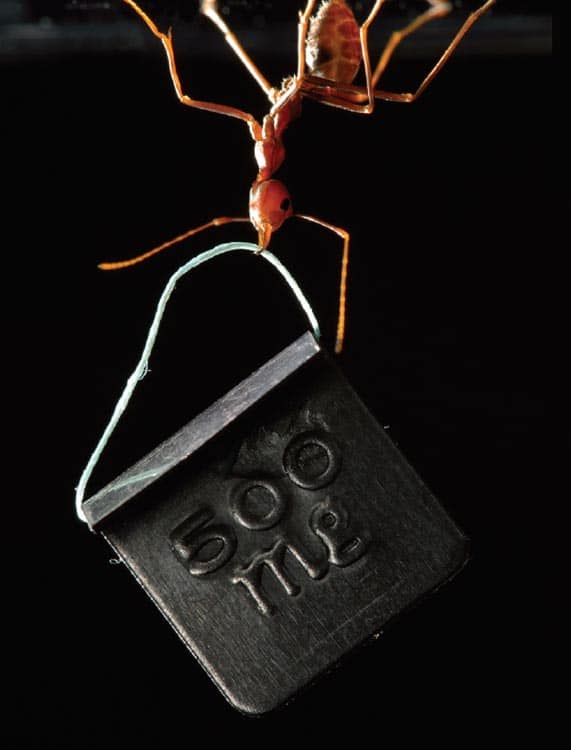
While some insects remain stuck to a single surface for almost their entire lifetime, others run quickly carrying heavy loads or jump between surfaces. This requires their feet to be dynamic – to stick one moment and release the next. An outstanding example of this is the weaver ant Oecophylla smaragdina, whose feet can support a theoretical maximum of 100 times its body weight, according to Walter Federle and Thomas Endlein from the Insect Biomechanics Workgroup at Cambridge University in the UK (figure 2). However, the ant can still almost immediately detach its feet to place its next step.

Endlein has also shown that some insects can mechanically unfold their feet passively – without neuronal signals – in fractions of a second. This overrides any possible delay and is useful in unexpected events of mechanical disturbance, such as raindrops or a gust of wind. However, the details of how insects control their feet so quickly are still not fully understood. In particular, the adhesion control during jumping, which can be a change from firm adhesion to complete detachment within a fraction of a second, is the focus of ongoing research.

Hairy or smooth, but always sweaty

All insect feet have foot pads that can be classed as one of two functional designs: “hairy” or “smooth”. In general, both types let the insect attach itself more strongly to a surface by conforming to substrates with roughness at different length scales. This explains why insects can stick to so many different surface types: from hard to soft; rough to smooth; on stone, glass, plastic and even Teflon.

Smooth adhesive pads can be found in many groups of insects – ants, bees, stick insects, grasshoppers, bugs and cockroaches. These insects possess a specialized organ, the arolium, which is located at the tip of the feet and consists of a very soft, cushion-like sac.

As already described by Hooke more than 300 years ago, the pads on the feet of flies, beetles and other insect groups are densely covered with flexible hairs arranged in arrays. Today, we know that similar structures can be found in many other creatures, such as geckos and spiders, indicating a general favourable design for adhesive structures. Although it is believed that hairy pads have several advantages over smooth ones, there is still an ongoing discussion in the biomechanics community about which is the better system (see, for example, J Bullock, P Drechsler and W Federle 2008 J. Exp. Biol. 211 3333).

Whether they are smooth or hairy, all insect feet have one thing in common: they use a nanometre-thin layer of fluid to help them stick to surfaces. Power already suggested that this is secreted using a “fuzzy kinde of substance like little sponges”, which the fly can squeeze liquid out of “at pleasure”. However, it was only recently that Federle and I were able to show that this 300-year-old idea is actually true for the smooth pads of insects. Using a motorized-stage to repeatedly (and carefully!) press the feet of insects onto smooth glass plates to simulate footsteps, we found that the amount of residue actually decreases with each step. Insects, in other words, have a limited volume of adhesive fluid in their feet. We also repeated the experiment using different walking speeds and it turns out that the sponges always refill at the same rate, no matter how fast the insects run. Nevertheless, it is still not known where the adhesive fluid is actually produced within the insect’s body.

As for the nature of this fluid, it is often thought to be a kind of sticky glue. But if this were the case, how would insects that place their sticky feet down ever lift them up again? The wet-adhesive mechanism is thought to result from three physical principles of fluid mechanics: the forces of surface tension; the pressure difference between the fluid and the surrounding air (Laplace pressure); and the viscosity of the fluid. But as you may know from walking with wet feet beside a swimming pool, a layer of fluid can reduce adhesion and friction forces. So why, then, do insects use fluid-based adhesion at all, if the additional fluid layer bears the danger of reducing their ability to walk on smooth surfaces?

To answer this question, a more detailed knowledge of insect-feet forces is required. Federle, and Patrick Drechsler from the University of Würzburg in Germany, were among the first to actually measure the forces generated by placing single insect feet on well-defined substrates. Using a custom-made force transducer on a 3D motor stage, they gently pushed and pulled insects’ feet along various smooth and rough surfaces. By comparing the forces generated on these substrates the researchers were able to show that an important function of the fluid appears to be filling in the gaps between the pad and the surface. This maximizes the contact area of the adhesive pad and increases adhesion to rough substrates.

Interestingly, Drechsler and Federle found that the sliding friction forces generated by insects’ wet feet were substantially greater than expected. The experiments also revealed a significant static-friction component, which prevents a resting insect from sliding on smooth surfaces. Unfortunately, neither of these friction forces can be explained by assuming a continuous “simple” fluid layer between the feet and the substrates. Chemical analyses of footprint droplets also revealed nothing that might help to explain the high friction observed in fluid layers where one would expect slippage. The fluids appear simply to contain long-chained hydrocarbons, fatty acids, carbohydrates and amino acids.

Not so simple

It was only when the fluid was observed in situ, in the moment it is secreted into the contact zone, that its secret was revealed. In 2002 Federle and collaborators from the universities of Würzburg, Glasgow and Berkeley used interference reflection microscopy to discover that the adhesive fluid of ants and stick-insects is not a simple fluid but consists of two components that together form an emulsion. The experiments demonstrated that the bulk component of this emulsion is an oily substance, which is stable even over several days at room temperature. (This is probably what was discovered in insects’ footprints about 300 years ago.) The second, smaller component is a highly volatile water-like substance that evaporates within fractions of a second when in contact with air, which explains why it had never been found in residues before. Federle and co-workers suggested that this two-phase structure might play an important role in the generation of friction forces.

To test this idea my colleagues and I again measured the forces generated by a single adhesive pad, but this time using a special polymeric surface. This smooth coating works like a selective sponge by only absorbing the short-lived watery phase of the emulsion and leaving the oily part behind. By making thick and thin polymer layers with different absorbing capacities, we were able to compare the forces generated with both fluids present with those with only the oily part present. Our results showed that the friction forces of smooth pads were significantly reduced without the watery phase present: the insects were slipping on their own oil. (We later put this finding to good use – see video.)

It turns out that both phases are vital, and together they form a non-Newtonian Bingham fluid. This means that the fluid behaves like a solid when at rest, but with a viscosity that decreases when it is sheared. It is this property that provides resistance to sliding, complementing the simple capillary adhesion.

• Watch the cockroaches slide like firefighters down a pole with the patented “Insectislide” technology, in this video.

Right from the start

From what we know today, Henry Power was surprisingly accurate with his first observations about the adhesive mechanisms of insects in 1664. Two centuries later, in 1884, the German scientist Hermann Dewitz paid late tribute to Power’s pioneering work by writing “Many different ideas [about insect adhesion] have been expressed so far; oddly enough, the correct one seems to be the oldest of them.”

Insects have been sticking around for the last couple of million years and, although their adhesive organs have been studied for about the last 300 years, their tricks have still not lost any of their fascination. To the attentive observer, and imaginative research-grant applicant, even such a “simple” thing as a fly running across the office window still demonstrates a great selection from nature’s box of tricks.

Stewed and digested

When an insect journeys thorough the world, it has to cope with a variety of different substrates with changing and unpredictable orientation, contamination, roughness and wettability. In fact, there are only a few known natural surface structures that insects cannot stick to – mostly carnivorous plants! One such plant is the carnivorous pitcher – so-named because it looks like a jug. Many varieties of the plant have a hydrophilic rim. When the rim is dry, ants are able to climb in to the pitcher to collect nectar from just under the rim’s mouth and then climb back out again. But as Holger Bohn and Ulrike Bauer from the University of Cambridge showed during their PhD work in the last few years, air humidity or rain can easily form a very thin water layer on the plant’s surface. This layer somehow foils the insect’s usually reliable feet and makes them aquaplane into the bottom of the pitcher, where they are destined to stew in the plant’s digestive juices. But surprisingly, some ants can walk on the plants when they are wet and do not slip at all. They can climb in and out of the pitcher with ease, and even swim within the digestive fluid.

• Watch some unlucky ants meet their fate, while others manage to avoid the deadly trap, in this video by Holger Bohn.


Avoiding an unholy marriage

Hanging on the bare-brick walls in the small, dimly lit basement of St George’s concert hall in Bristol, UK, is a series of 24 artists’ prints by the composer Edward Cowie. They appear in the aptly named Crypt Gallery, where visitors gather before shows, and were drawn especially to accompany each piano piece of Cowie’s latest work Rutherford’s Lights – a set of 24 “studies in light and colour for piano”. But as well as bringing together art and music, Cowie’s latest work seeks to marry together physical theories of light with music. Indeed, the inspiration for each of the 24 piano pieces came from the classic physics textbook The Theory of Light by Thomas Preston, which was first published in 1912.


Wave Motion (the 1st movement)

Cowie is no stranger to physics, having studied the subject at Imperial College London. Speaking to Physics World in the Crypt Gallery, Cowie shoots from the hip when talking about the many attempts to fuse physics and music. He says he likes to recite one of his favourite poems called “The Unholy Marriage”, written by the English poet David Holbrook, which describes a fateful crash when a motorcyclist takes his girlfriend for a ride around town. Holbrook, rather morbidly, describes the pair as having been “married” together by the high-speed collision.

“I would say that a lot of partnerships between art and science are the David Holbrook version,” says Cowie, 67. “If you put a scientist and a composer in a food mixer, would you say they have collaborated?”. One example of such an “unholy marriage”, in his view, was Constant Speed performed by Rambert Dance Company, which was inspired by Einstein’s scientific achievements and was commissioned by IOP Publishing (which produces Physics World) in 2005. “It was a fantastic thing to do and was very inventive,” says Cowie. “But if they ever claimed one was about the other, then they were wrong – the ballet was not about Einstein; the ballet was about ballet and the music was about entertainment.”

Cowie is hopeful that Rutherford’s Lights, released on CD last month by UHR and for which IOP Publishing paid him a composer’s fee, will not be seen as a David Holbrook version of an art–science collaboration – but rather as a musical piece that takes inspiration, as he puts it, from the “language of science”. “I wouldn’t say that physics influences my music,” says Cowie. “But I could not have written the work without my training in physics.”

A journey in music

Rutherford’s Lights has recently been on tour around the UK, including being performed at St George’s and culminating in a performance at the National Portrait Gallery late last month. The work, however, began its journey on the other side of the world, when Cowie was in Australia as director and founder of the Australian Arts Fusion Centre at James Cook University, Townsville. While in Queensland, Cowie was browsing in a bookshop when he was surprised to stumble across a copy of The Theory of Light. But he was in for an even bigger shock when he opened the book to find a message written in 1904 and signed by the nuclear physicist Ernest Rutherford himself to one of his students. Cowie promptly snapped it up – and for only $4.

Preston’s book, which remains one of Cowie’s most treasured possessions, is central to Rutherford’s Lights, and is integral in each of the 24 pieces. “It is a homage to Rutherford,” Cowie says. Each piece in Rutherford’s Lights is, however, based on a specific chapter from Preston’s book. The work is meant to be a journey through the book, beginning with simple descriptions of transverse waves at the beginning to more complicated theories of light later on. “There was an incredible division between the chapters in the book that I could see they were each separate pieces,” says Cowie. “What I liked about Preston’s book is that it is not dry. How he has constructed the language to describe physical properties is beautiful, almost musical.”

Compounding of Simple Vibrations (the 3rd movement)

The first piece in Rutherford’s Lights is called “Wave Motion”. Sitting in St George’s, Cowie pulls out a musical score of the piece in which the opening parts looks like a wave propagating along the page. “It is not difficult to talk about propagation and think acoustically,” says Cowie, who calls Rutherford’s Lights a “major breakthrough” in his music. Indeed, he says he would just sit at the piano with a chapter of Preston’s book open and just attempt to put the equations and meaning of Preston’s words into music. He would study the formulas and attempt to give their musical equivalence. “I am trying to make a piece of music whose quantity and quality is connected to light and its propagation,” he says.

Building bridges

Edward Cowie was born in Birmingham, UK, in 1943. By the age of seven, he had started teaching himself music and the piano. But it was the influence of his parents, who wanted him to do a “proper vocation”, that meant he went to Imperial to study physics. Cowie was still learning the piano and violin in his spare time, as well as doing the odd performance, which earned him money to pay for his education. “I didn’t really see a difference between physics and music,” says Cowie. “Everything has a numerical basis: music is about numbers just as much as maths is.” But Cowie’s love of music was still his driving force, and while at Imperial he also went to the Slade School of Fine Art at University College London to study painting as an external student.

After doing a Bachelors in music, in 1973 Cowie completed a PhD at Leeds University, which included studying music, physics and genetics. He was also awarded a Doctorate of Music by Southampton University in 1976. In the music world, Cowie obtained early recognition with the 1975 BBC Proms commission Leviathan for large orchestra, followed by popular works including the Piano Concerto (1976), the opera Commedia (1976) as well as Concerto for Orchestra (1982).

Various academic appointments in Germany and the US followed, eventually leading Cowie to take up a position as head of the School of Creative Arts at the University of Wollongong in Australia in 1983 and, six years later, as director of the Australian Arts Fusion Centre at James Cook University, Townsville. After losing funding for the centre, he finally returned to the UK in 1996 as director of research at Dartington College of Arts in Devon.

Following his retirement in 2008, Cowie is now hoping to foster more collaborations between science and the arts, beginning with Rutherford’s Lights. “The divisive language between arts and sciences are artificial,” says Cowie. “What we need is a bridge dialogue between them.” Cowie is currently in discussion with the Oxford University particle physicist Brian Foster about making a set of violin pieces that will trace a “timeline” for the subject of particle physics.

Music of the primes

Like many composers working in the early 1970s, Cowie came under the influence of the music of the “Second Viennese School”. This included a method of musical composition invented by the Austrian-born composer Arnold Schoenberg. It employs a row of 12 different notes in the chromatic scale – a musical range with 12 equally spaced pitches, each a semitone apart – that can be permutated and combined to enable a kind of “lattice and grid approach” to the placement of musical pitches. Schoenberg’s pupil, the composer Anton Webern, extended the idea further by applying combinatorial mathematics.

Natural Lights (the 18th movement)

In adopting these techniques, and with his understanding of mathematics, Cowie was able to write complex music. However, he felt that his music at that time was too “system based” and he abandoned the technique in the mid-1970s. However, the use of mathematics in music fostered the notion that they are inextricably linked. “Physics is about patterns, written through equations – the language of mathematics” says Cowie. “Music is also about patterns, so you can relate and link them.”

To demonstrate the links between music and mathematics, Cowie recalls the time in 2003 when he was commissioned by the BBC to produce a “sound portrait” of the Cambridge University physicist Stephen Hawking for the 125th anniversary of the National Portrait Gallery. Cowie travelled to Cambridge to meet Hawking to discuss the piece, who he knew liked music. After talking about music and physics for more than four hours, Hawking concluded that contemporary music had lost its way – it had no structure, he complained – and that he had no time for it. Cowie naturally did not agree. “If music has lost its way, then hasn’t mathematics as well?” he asked. After a pause from Hawking, he slowly typed “Touché”.

In person

Born: Birmingham, 1943
Education: BSc physics, Imperial College, London (1961–1964); Bachelor of music, Southampton (1970); PhD in music, Leeds University (1971–1974); Doctorate in Music, Southampton University (1976)
Career: Professor of composition, University of Lancaster (1973–1983); head of the School of Creative Arts at the University of Wollongong, Australia (1983–1988); director of the Australian Arts Fusion Centre at James Cook University, Townsville (1989–1994); director of research at Dartington College of Arts in Devon (1996–2008)
Family: Married, two daughters
Hobbies: Reading, sailing, bird-watching

Au revoir, kilogram


Once a year, a century-old ritual unfolds at the International Bureau of Weights and Measures (BIPM) outside Paris. It takes place in the basement of the BIPM's main lab building, which houses a vault secured with three locks. Three antique keys, held by citizens of different countries, open these locks. At the annual meeting of the BIPM's governing board – the International Committee for Weights and Measures (CIPM) – the three key holders produce the keys, open the vault, unlock a safe inside the vault and inspect its principal contents: the platinum–iridium cylinder that defines the kilogram.

This year's ritual, on 13 October, was unusual. It was not just that BIPM director Andrew Wallard (UK) and CIPM president Ernst Göbel (Germany) are retiring, making this their last year as key holders. Nor was it that the third key holder, Claire Béchu of the French Archives, was an hour late, delayed by a strike that snarled French traffic for most of the week. The atmosphere was different because a major change is afoot: the cylinder may soon be removed and dethroned.

End of an era?

The BIPM was created by the Treaty of the Metre in 1875, a landmark in the history of measurement, globalization and international co-operation. The ritual began a few years later when the BIPM's two international prototypes – of the metre and kilogram – were moved to the safe. In 1960 the metre was redefined in terms of the wavelength of light, thus dethroning the metre bar as the standard. (The metre was redefined again in 1983 in terms of the speed of light.) For most of the rest of the 20th century, metrologists could not even foresee the possibility of similarly replacing the kilogram with a natural standard.

However, advancing technologies now make this not only possible but inevitable. One agenda item at this year's CIPM meeting, the 99th, was to draft a resolution to be submitted next year to the organization to which the CIPM reports – the General Conference on Weights and Measures (CGPM) – that sets out a plan to redefine the kilogram and three other SI base units. If adopted, all SI units will eventually be defined in terms of natural constants.

In short, the platinum–iridium cylinder may not keep its status in the vault much longer, as it will cease to define the kilogram. Within the next few years, Wallard expects to move it from the safe to a laboratory for measurements in the transition to a new definition.

The 18 CIPM members engaged in last-minute debate on how to phrase the redefinition. Some wanted the language to be aimed at the general public, others preferred technical language for professional metrologists, while still others thought the definition ought to be technical but with accompanying explanations.

In the end, the group agreed on a "statement of intention" to redefine using fundamental constants, but only to proceed when the mise en pratique – in other words, the way in which the definition is to be technologically implemented – is available, agreed and producing consistent results. Furthermore, the group agreed to spread awareness of the potential redefinition and its consequences. Part of this effort will take place at an upcoming meeting of the Royal Society in London next month.

The looming redefinition meant that more than the usual number of spectators lined up to see the kilogram standard; not only CIPM members but BIPM staff and a few invited outsiders, including me. One could not help but be awestruck. For 121 years this cylinder has ruled over an international network of masses and scales that stretches from laboratories in national and local metrology offices into everyday life in the form of grocery stores, post offices and home scales. The cylinder is both a thing and an institution. And its days are numbered.

"It's so small!" exclaimed many of those who squeezed down the narrow staircase into the tiny room containing the safe. The cylinder is, in fact, a mere 39 mm high and as much in diameter. Another surprise for many of the spectators – including me – was that although the cylinder is protected by three bell-jars, it is not in a vacuum. The prototype turns out to be most stable in air, and might outgas in a vacuum. Spectators excitedly held up cameras and mobile phones to take pictures, the way they do at the Mona Lisa, housed at the Louvre across the Seine. Unlike the Mona Lisa, the international kilogram prototype is unharmed by flash photography – though by my extrapolation, Leonardo da Vinci's iconic work suffers more photography in 15 min than the prototype does in a century.

The critical point

The CIPM's draft resolution must still be debated by the CGPM at its 24th meeting in October next year. But two technologies appear on the verge of satisfying criteria for implementation, and the CGPM is expected to take steps towards a revision. "It's a significant step," says Wallard. "It would provide, for the first time, an anchoring of all the base units of SI to fundamental constants, from which we can build up the whole system."

The visitors began to walk back upstairs and headed to the traditional champagne reception in the BIPM's fabulously beautiful gardens overlooking Paris, with the Eiffel Tower in the distance. Wallard, Göbel and Béchu recorded the temperature and relative humidity, and signed a document attesting that they had verified the presence of the international kilogram prototype and its official copies. They secured the safe, and shut and locked the door of the vault with their three keys, securing the cylinder for what may be its last sovereignty as the ruler of the international network of weights, although it will still have a key role to play in implementing a future redefinition.

The kilogram seemed unperturbed.

• A full feature article on the redefinition of the kilogram will appear in the March 2011 issue of Physics World

How the other half lives

This past summer I spent the long US Independence Day weekend at a reunion with three of my undergraduate classmates. All of us went on to earn PhDs in physics, but I am the only practising physicist. The others work in finance – one at a hedge fund, the other two at major banks. They all seem to be enjoying their work, and they have obviously been very successful: our reunion took place near a famous ski resort, where one of the financiers has built a 1200 m2 retreat complete with gym, indoor pool and wine cellar.

Even the brightest graduate students in maths and physics know that their chances of assuming a position like that of their PhD supervisors are slim. For the last 20 years the cream of the crop of physicists leaving the field has gone on to positions in finance, typically in places such as New York or London. Once there, these individuals become hedge-fund managers, derivatives traders and risk managers, to take just a few examples from my own cohort.

So what do these people do? I have always been surprised that scientists in academia are not more curious about the lives of their former peers working in the "real world". For those who are interested, Scott Patterson's The Quants does an admirable job of exploring the increasingly mathematical and technological world of high finance, and the activities of the many physicists, mathematicians and engineers who inhabit it.

Patterson writes for the Wall Street Journal, and regular readers of the newspaper will recognize him as an insightful reporter who has covered a number of important topics over the years, most recently the rise of high-frequency trading. In researching the book, Patterson had access to a Who's Who of prominent "quants", a colourful group of characters with backgrounds and personalities that will be strangely familiar to anyone who has spent time among physicists. The term "quant" is short for "quantitative" and refers to those who apply mathematical or computational methods to finance.

Patterson begins by introducing the reader to ideas ranging from the basics of modern finance theory, such as efficient markets and random walks, to more esoteric topics such as the late Benoît Mandelbrot's use of Lévy distributions, or Gaussian copula and their role in the mortgage meltdown. It is worth noting that Patterson focuses primarily on proprietary trading and hedge funds, while spending much less time on the derivatives business or structured finance, two other areas where quants tend to be employed.

All this information makes an effective backdrop to the book's main story: the August 2007 quant-fund collapse that presaged the mortgage meltdown and subsequent global financial crisis. Patterson chronicles in detail how losses in the mortgage portfolios of banks and hedge funds forced them to sell off liquid assets such as the "vanilla" stocks (those of large Standard & Poors 500 companies) typically traded by large quant funds. This unanticipated deviation from the behaviour of financial models – in particular the wave of fear and paranoia that quickly spread among traders – led to huge losses for the quant funds. One prominent fund, Process-Driven Trading, lost $500m in a single month. This episode reminds us of the central role that human psychology – what the economist John Maynard Keynes called "animal spirits" – plays in markets, rendering them ultimately resistant to mathematical prediction.

To highlight the human element in this tale of financial collapse, Patterson includes many sketches of prominent quants. Among these, Ed Thorpe deserves Patterson's description as the godfather of quants. An academic mathematician who became famous in 1962 for his statistical analysis of the card game blackjack (recounted in his classic book on card counting Beat the Dealer), Thorpe later became one of the earliest and most successful hedge-fund managers. The similarities between games such as blackjack or poker and modern finance are significant: strategies in each can be refined through mathematical analysis, but success is ultimately still dependent on luck and the ability to manage risk.

Perhaps the most successful of all quants is Jim Simons. In the early 1970s Simons was a graduate student of the mathematician Shiing-Shen Chern at the University of California, Berkeley. I doubt he was a physics student, as Patterson states, although Chern–Simons theory does play an important role in theoretical physics. In 1978 Simons left academia in favour of finance. Today, the Renaissance Technologies hedge funds he set up employ mainly former scientists, including mathematicians, physicists and statisticians, and its Medallion Fund boasts consistently positive returns that are unequalled by any other fund. Simons attributes this to his employees' training in science, having once told the Wall Street Journal that "the advantage scientists bring into the game is less their mathematical or computational skills than their ability to think scientifically. They are less likely to accept an apparent winning strategy that might be a mere statistical fluke."

Among the younger quants profiled, Peter Muller seems the most interesting. An idealist who was frequently conflicted about his career in finance, Muller built the Process Driven Trading (PDT) group at Morgan Stanley, which at one point in the late 1990s accounted for a quarter of all profits for the entire firm. During this period, he would sometimes jet off to the Hawaiian island of Kauai for some hiking, leaving his lieutenants and algorithms to manage PDT's multi-billion-dollar financial positions. Like many of his fellow quants, Muller is an avid poker player, but he is also a musician who occasionally performs in the New York City subway and has released two CDs.

The broader financial crisis that followed the quant-fund collapse is not the major focus of this book. Readers seeking a deep discussion of its causes and consequences should look elsewhere. From my own investigations, I would say that while quants played an important role in the crisis, their influence was secondary to other causes, such as a housing bubble, misaligned incentives within banks and imprudence on the part of government-sponsored entities such as Fannie Mae and Freddie Mac, which provided funding for countless high-risk mortgages.

But that does not absolve quants entirely. It is a pity that although Patterson gives us a broad survey of quant finance, he devotes little space to the bigger question: are developments such as the mathematization of markets and the flow of top brains to financial activities good for society? On this matter, perhaps it is best to leave the last word to Charlie Munger, the long-time investment partner of financial guru-in-chief Warren Buffet. Writing in 2006, Munger had the following to say about the "brain drain" of top talent into finance.

"I regard the amount of brainpower going into money management as a national scandal. We have armies of people with advanced degrees in physics and math in various hedge funds and private-equity funds trying to outsmart the market. A lot of…older people…can remember when none of these people existed…At Samsung, their engineers meet at 11 p.m. Our meetings of engineers [meaning our smartest citizens] are also at 11 p.m., but they're working on pricing derivatives. I think it's crazy to have incentives that drive your most intelligent people into a very sophisticated gaming system."

Between the lines: Christmas special

A picture of a dog with a dunce's cap on

Sit! Roll over! Quantum tunnel!

Chad Orzel talks to his dog about quantum physics. It is not clear what the dog gets out of this arrangement, but the rest of us ought to be grateful for it, because Orzel's book about their "conversations" is sure to become a classic. Unlike many accounts of quantum mechanics aimed at the general public, How To Teach Quantum Mechanics to Your Dog avoids giving the impression that all the really interesting stuff happened before 1960. Even in the first few chapters, which discuss familiar topics such as wave–particle duality and the thorny question of wavefunction collapse, Orzel makes it clear that quantum physics is still an active area of research. This is certainly true on the experimental side, where lasers have made it possible to perform some Einstein-era "thought experiments" for real. As an atomic physicist at New York's Union College and author of the Uncertain Principles blog, Orzel is well qualified to explain both old and new findings to a diverse audience. However, he is not the only reason for the book's success. The other is Emmy, his lively and inquisitive German Shepherd mix. For the purposes of the book, Emmy functions as a doggy Greek chorus: popping up to ask naive-but-illuminating questions. Orzel often plays these interruptions for laughs, and his weary patience with Emmy's persistent squirrel/food/ tummy-rubbing obsessions will set many dog owners chuckling. However, her crazy suggestions (like the one about getting through the neighbour's fence using quantum tunnelling) also allow Orzel to counter some common misconceptions about quantum mechanics, and to expand on his explanations without appearing to talk down to the reader. As a quantum physicist, Emmy still has a lot to learn – but as a plot device, she's fantastic.

  • 2010 Oneworld Publications £7.99 pb 224pp

d(y)/d(braaains)

A paper was published last year with the intriguing title "When zombies attack!: mathematical modelling of an outbreak of zombie infection". Its authors modelled the spread of flesh-eating zombies using coupled differential equations, and concluded that "the most effective way to contain the rise of the undead is to hit hard and hit often". Such is the, erm, cerebral flavour of Jennifer Ouellette's The Calculus Diaries: How Math Can Help You Lose Weight, Win in Vegas, and Survive a Zombie Apocalypse. An English graduate, science writer Ouellette has only recently embraced calculus, and can therefore reveal its simplicity without making any assumptions about what the reader should know. Her examples are blended with witty narrative, including Ouellette's adventures with her husband, the California Institute of Technology physicist Sean Carroll. Reading the book is a bit like watching a stand-up comedian: you are never quite sure if the reminiscences are real, but you are willing to suspend disbelief as they are actually quite funny. One example features what is possibly the most underrated theme park ride: the tea cups. Using simple force vectors, Ouellette explains why riding them means hanging on for dear life and trying not to throw up one minute, but feeling perfectly fine as you frantically spin the wheel to reach the same giddy gyration the next. As for the log-flume ride, Ouellette offers useful tips on how to stay as dry as possible. Unfortunately, she and Carroll fail to follow their own advice, and are left sitting in wet clothes, lamenting the exponential decay of water evaporation and asking "Will we forever be slightly damp?".

  • 2010 Penguin £9.46/$15.00 pb 336pp

Who'd be an astronaut?

The hours are long. The work environment is cramped and smelly. You don't see your family much, and your bosses at Mission Control schedule your daily chores and even your bathroom breaks almost down to the minute. So why do so many people want to become astronauts? Mary Roach's Packing for Mars does not really explain this, but it does explore almost every other aspect of astronaut life – particularly the icky ones. No question is too embarrassing or scatological for the intrepid Roach, who asks a Russian cosmonaut about blow-up dolls (vetoed by ground control, he says, because "we would need to put it in your schedule for the day") and cheerfully quizzes astronaut Jim Lovell on what his Gemini VII capsule smelt like when it splashed down after a two week, bath-free mission ("Different than the fresh ocean breezes outside," Lovell replies politely). That Roach gets away with such queries is probably down to the astronauts themselves. With missions on the International Space Station lasting months rather than the days or weeks of the Apollo era, an even temperament and a sense of humour have long since become integral parts of an astronaut's "right stuff". A Mars mission will test those qualities to breaking point, Roach notes, since astronauts bound for the red planet will face all the challenges that their predecessors did (loneliness, space sickness, toilet malfunctions) and more. The underlying seriousness of putting people into space is usually well hidden in this book. However, on the one occasion when it breaks through, the result is deeply moving: as Roach listens to NASA flight surgeon Jon Clark describe what happened to the astronauts on the Space Shuttle Columbia when it disintegrated during re-entry in 2003, she suddenly realizes that Clark's wife Laurel was on board. And for once, this witty and insightful writer is lost for words.

  • 2010 Oneworld Publications/W W Norton £12.99 hb/$25.95 312pp

Top 20 cosmic conundrums

Why has this book got an elasticated cord on the back cover? Sadly, that is not one of the 20 "biggest cosmic mysteries" tackled in The Big Questions: The Universe by UK author and astronomer Stuart Clark. What we get instead is a trawl through some well-trodden territory in cosmology, astronomy and astrophysics, including the age and size of the universe, the origin of the Earth, and the nature of dark matter, dark energy and black holes. Each chapter wisely gives plenty of historical background and the explanations are clear and concise, even if the writing itself is a tad functional. This is a book to be dipped in and out of, which explains that elasticated cord – it is a stretchable book mark to stop you losing your place.

  • 2010 Quercus £12.99 pb 208pp

A tale of three neutrinos

Obituaries are all about endings, but the one that the Oxford physicist (and prolific popular-science author) Frank Close penned for Nobel laureate Ray Davis in 2006 became a beginning as well. In the 1960s Davis began looking for neutrinos produced in solar fusion, but however hard he tried, the number he detected was never more than half the value that theory predicted. It took decades for physicists to determine that the so-called solar-neutrino problem stemmed from an inadequate understanding of neutrino physics; it took even longer for the Nobel committee to reward Davis' efforts. After sketching this story in the obituary, Close decided that Davis' life was worth a whole book. While researching it, however, he found himself increasingly interested in Davis' longtime collaborator John Bahcall, and the Italian–Soviet physicist Bruno Pontecorvo, who suggested that neutrinos could oscillate between three different flavours. The resulting three-part story in Neutrino is fascinating, although occasionally less clear than it could be. The distinction between neutrinos and antineutrinos, for example, is almost as muddled here as it was for the scientists who stumbled upon it in the 1950s. It is perhaps just as well that Close avoids discussing the even more confusing possibility that the neutrino could be its own antiparticle – although it seems a pity that the book leaves out Ettore Majorana, who suggested it. Then again, since Majorana disappeared without trace in 1938, there is no convenient obituary upon which to base his story.

  • 2010 Oxford University Press £9.99/$18.95 hb 176pp

Space-telescope extravaganza

If Physics World's September feature "Hubble's greatest hits" left you hungry for more images obtained by the 20-year-old space telescope, then you are in luck. Two recent books – Hubble: A Journey Through Space and Time and Hubble: Window on the Universe – offer a veritable feast of Hubble photographs, plus a bit of text to explain what you are looking at. In addition to photographs of cosmic wonders, both books contain a fair amount of information on the shuttle missions that serviced the telescope over its lifetime. This is a welcome inclusion, since the first repair mission, in particular, transformed the scope from an orbiting flop to a NASA success story. Journey Through Space and Time is written by NASA astrophysicist Edward Weiler and is slightly more technical than UK science writer Giles Sparrow's Window on the Universe. Both are aimed at the coffee-table-book market, but Window is practically a table in its own right, measuring a whopping 30 × 36.5 cm, compared with the relatively puny 25 × 31 cm of Journey. Either one, though, would make a beautiful addition to the pile of presents under the tree.

  • 2010 Abrams £19.99/$29.95 hb 144pp; 2010 Quercus £20.00 hb 224pp

Fear rises among Iranian physicists

Academics in Iran have been left in a state of critical fear following the murder in Tehran yesterday of nuclear physicist Majid Shahriari and the attempted assassination of another nuclear researcher, Fereydoon Abbasi.

The separate attacks occurred yesterday morning and both were carried out by unidentified assailants on motorbikes who attached explosives to the victims' vehicles as they travelled through the capital. Both scientists were based in the faculty of nuclear engineering at the Shahid Beheshti University in Tehran and they are both said to be key figures in Iran's controversial nuclear programme.

Iranian president, Mahmoud Ahmadinejad, immediately blamed the attacks on foreign enemies saying that "undoubtedly the hand of the Zionist regime and Western governments is involved". As yet, however, no nation or group has claimed responsibility.

"Everyone is shocked. Programmed assassination of scientists is the last thing we could imagine," says Reza Mansouri, a cosmologist at Sharif University in Tehran and a former Iranian deputy science minister. He confirmed that the widely held view in Iran is that this attack was carried out by foreign agents.

Medical physicist?

Shahriari was a nuclear researcher and his publication record suggests that he specialized in medical applications of nuclear physics, with a particular interest in modelling neutron transport processes. His role in Iran's nuclear programme was confirmed by Akbar Salehi, head of Iran's atomic energy agency, who says that Shahriari was involved in "one of the great projects" of the agency. "Majid Shahriari was one of my students for years and had a good cooperation with the organization," Salehi told the Islamic Republic News Agency.

Fereydoon Abbasi, the scientist who survived, appears to have a larger involvement with Iran's nuclear programme. In 2007 his name was added to the United Nations Security Council's sanctions list for his involvement in "nuclear or ballistic missile activities".

Monday's attacks follow the assassination in January of another Iranian physicist, Masoud Alimohammadi, a quantum mechanics and field theory specialist at Tehran University, who was killed by a remote-controlled bomb attached to the side of a motorcycle. The similarities between the attacks have left Iranian academics in an acute state of fear.

Looking for a motive

Despite the government's conviction that the murders have been carried out by Israeli or US special services, there is also speculation that the attackers could have belonged to one of a number of organizations within the Middle East. The speculation is fuelled by the continuing secrecy that surrounds Iran's nuclear programme and the increasingly complicated political situation in the Middle East.

Similarly, the motive for assassinating these particular men is not clear, particularly given their seemingly disparate research interests. One thing they do share is that all three men held roles in SESAME – Synchrotron-light for Experimental Science and Applications in the Middle East – a project that aims to create the region's first major international research centre by building a synchrotron light source in Jordon. Shahriari is listed as having been an adviser to the project, while Abbasi is a member of the Iranian advisory committee to SESAME, and Alimohammadi was a member of the council.

SESAME president Chris Llewellyn Smith, who is also a former director-general of CERN, says that he does not remember Shahriari though the official records state that he did attend one council meeting. Llewellyn Smith does, however, recall meeting Alimohammadi but he, likewise, was only able to attend one meeting before he was killed.

Llewellyn Smith is keen to point out that synchrotrons such as SESAME are not in any sense nuclear facilities. "They are accelerators that are designed to produce intense light with wavelengths ranging from the infrared to X-rays, which are used to study matter on scales ranging from biological cells to atoms," he says.

Big job, long title

PI_design.gif

By Matin Durrani

The BMO Financial Group Isaac Newton Chair in Theoretical Physics at Perimeter Institute.

It's a bit of a mouthful, but sooner or later someone – in fact "a scientist of the very highest international calibre" – will have to squeeze that title onto their business card.

That shouldn't be a problem though as the BMO Financial Group Isaac Newton Chair in Theoretical Physics at Perimeter Institute comes with $4m of funding from the BMO Financial Group, or what used to be the Bank of Montreal. So there ought to be plenty of loose change hanging around for a nice set of cards.

The whopping $4m investment – said to be the biggest in the Perimeter Institute's 10-year history – will be matched by $4m from the institute's existing endowment.

The BMO Financial Group Isaac Newton Chair in Theoretical Physics at Perimeter Institute will in fact be just the first of five new top chairs, with the others named in honour of James Clerk Maxwell, Niels Bohr, Albert Einstein and Paul Dirac.

In case you missed it, the Perimeter Institute is based in Waterloo, Ontario, and was founded in 1999 by local-boy-made-good Mike Lazaridis, who made his fortune as the founder of Research in Motion – the company that makes Blackberry handheld devices.

The institute, which is keen to attract the brightest and best theorists from around the world, is already undergoing a huge expansion that will see it doubling in size by autumn 2011 with the opening of the Stephen Hawking Centre. Hawking's already been over as one of the Perimeter's 20 "distinguished research chairs" after retiring from Cambridge University.

The centre will see Perimeter expanding from its bases in quantum theory, quantum fundamentals, quantum gravity and string theory out into condensed-matter physics, particle physics, cosmology and complex systems.

As for what the BMO Financial Group Isaac Newton Chair in Theoretical Physics at Perimeter Institute will do during their 10-year stint, well, they'll be "free to engage in investigator-driven research, without limits or mandates".

But if you're thinking of applying, don't. The chair will be "identified through a highly competitive international search, and only scientists of the highest international calibre will be considered".

Still, it would be nice to think the future chair is reading this right now.

New particle links dark matter with missing antimatter

Physicists in the US and Canada have proposed a new particle that could solve two important mysteries of modern physics: what is dark matter and why is there much more matter than antimatter in the universe?

The yet-to-be-discovered "X" particle is expected to decay mostly to normal matter, whereas its antiparticle is expected decay mostly to "hidden" antimatter. The team claims that its existence in the early universe could explain why there is more matter than antimatter in the universe – and that dark matter is in fact hidden antimatter.

Dark matter is a mysterious substance that appears to make up about 80% of the material universe. Although its existence can be inferred from its gravitational pull on normal matter, physicists have yet to detect it directly and therefore don't know what it is made of. Antimatter, on the other hand, is easy to create and study in the lab. However, the Standard Model of particle physics cannot explain why antimatter is so rare in a universe that is dominated by matter – a mystery called baryon asymmetry.

Hypothetical and hidden

Now, Hooman Davoudiasl of Brookhaven National Laboratory and colleagues at TRIUMF and the University of British Columbia have proposed a new particle dubbed X that could solve both of these mysteries. X has a mass of about 1000 GeV – making it about a thousand times heavier than a proton. This particle can decay to a neutron or to two hypothetical hidden particles called Y and Φ. Both hidden particles would have masses of about 2–3 GeV. Its antiparticle, anti-X, decays to an antineutron or to the pair anti-Y and anti-Φ.

Physicists have tried to try to explain the baryon asymmetry by invoking a violation of the charge–parity (CP) symmetry – the result being that decaying particles are more likely to generate matter than antimatter. CP violation has been observed in laboratories, but the preference for matter is far too small to account for the proportion of matter in the universe.

X also commits CP violation in a way that author Kris Sigurdson of the University of British Columbia calls a "yin yang" decay pattern. While X decays to neutrons more often than anti-X decays to antineutrons, it is balanced by anti-X, which decays to anti-Y and anti-Φ more often than Y and Φ. When almost all particles with an available antiparticle annihilated one another in the early universe, these discrepancies left a chunk of visible matter and a heavier chunk of dark antimatter to form the cosmos.

Look for proton decays

The team has also thought of how the anti-Y and anti-Φ particles could be detected. Unlike weakly interacting massive particles (WIMPs) – which dominate many theories of dark matter – anti-Y and anti-Φ do not annihilate each other. However, the antiparticles would cause protons to decay, which is forbidden by the Standard Model. If an anti-Y particle collides with a proton, for instance, a virtual interaction with particle X can break the proton apart, transforming it into a positively charged kaon, and turning the anti-Y particle into a Φ particle.

A detector looking for proton decays, such as SuperKamiokande in Japan's Kamioka mine, could catch the kaon. Kaons produced this way would have much higher energies than those generated by proton decays allowed by other theories that go beyond the Standard Model. Although protons are expected to be fairly resilient to this decay process, Sigurdson says, "This scenario could be on the boundary of detectability."

"It looks like a very interesting model," says Dan Hooper of Fermilab. Although at least three more models linking the production of dark matter to the baryon asymmetry are in development, he says that the proton-decay signature sets this scenario apart.

Driven by experiments

Matthew Buckley of Fermilab says that there is a sudden interest in linking dark matter with the baryon asymmetry because of recent experiments that have tried (unsuccessfully) to detect dark matter. Although WIMP models prefer dark-matter particles with masses around 100 GeV, the experiments suggest that dark-matter particles have masses nearer 7 or 8 GeV.

Having such a small mass "definitely isn't what a WIMP is 'supposed to look like'," says Buckley. However, dark matter that also explains the baryon asymmetry seems to be more in line with recent experimental results – which is why Buckley believes it deserves further exploration.

The work is reported in Phys. Rev. Lett. 105 211304.

Guest molecule builds 3D nanostructures

The self-assembly of artificial 3D nanostructures on a surface has been achieved for the first time, claims a team of researchers in the UK. Until now, such assembly was only possible in 2D and the scientists say that the new technique could be useful for creating molecular computers and information storage devices of the future.

Self-assembly is an attractive bottom-up method for fabricating nanostructures. It is simple and quick, and does not require expensive equipment or extreme conditions. Until now, however, the technique has only been used to make simple periodic structures and making more complex architectures remains a major goal in nanotechnology today.

Introducing a guest molecule

Neil Champness and Peter Beton's team at the University of Nottingham has now used self-assembly to build molecules upwards and outwards from a surface by introducing a "guest" molecule onto the surface. When additional "host" molecules are then added, these spontaneously arrange themselves around the guest, forming stable extra layers around the molecule.

"It is the molecular equivalent of throwing a pile of bricks up into the air and then as they come down again they spontaneously build a house," said Champness in a University of Nottingham press release. Before now, the molecular "bricks" could only form flat structures – like patios or paths in the house building analogy.

The Nottingham team employed carbon-60, or buckyballs, as the guest molecules. The researchers introduced the C60 onto a surface patterned by an array of host tetracarboxylic acid molecules. These molecules provide an array of nanopores that are stabilized by hydrogen bonding and they can selectively trap other simple molecules, like C60.

Reversible process

Because the C60 is a spherical-shaped structure, the acid molecules assemble around it, forming a 3D network. The technique is a completely new way to build up additional layers around a molecule, says Champness. The self-assembly process is also reversible – for example, by adding planar molecules such as coronene that displace the C60.

"Our work opens up the possibility of preparing increasingly complex molecular arrangements, whose organization can be controlled," he told physicsworld.com. "This means that the interactions between the molecules, be they magnetic, optical or electronic, can be controlled – something that will be essential for applications in which intermolecular interactions are important."

Magnetic and electronic functionality

The team would now like to extend its work to create structures that assemble into larger arrays away from the surface, and introduce functionality – such a magnetic and electronic properties – into the arrays.

Ultimately, the technique could help to build new responsive materials with potential for sensing and possibly data storage, added Champness. "Such applications of our work are still a long way off though!"

The results were published in Nature Chemistry.

Copyright © 2026 by IOP Publishing Ltd and individual contributors