Search for Martian life tools up

Is there life on Mars? That question could be answered by five scientific instruments that have just been selected to fly aboard the first ExoMars mission to the red planet in 2016. A joint venture of the European Space Agency (ESA) and NASA, ExoMars is short for Exobiology on Mars and is expected to involve at least two missions to the planet.

The five instruments were selected from 19 proposals that were submitted in January 2010. They include three different infrared detectors that will scan the Martian atmosphere for low-concentration molecular constituents as well as dust and water vapour.

‘That most important of questions’

Mission scientists are particularly interested in mapping levels of methane in the Martian atmosphere. “Mapping methane allows us to investigate further that most important of questions: is Mars a living planet, and if not, can or will it become so in the future?” explained David Southwood, ESA director for science and robotic exploration.

The gas was first detected on the planet in 2003 by ESA’s Mars Express mission and its presence was then confirmed by NASA scientists. Martian methane is of particular interest to exobiologists because the gas should be destroyed by solar radiation. Significant amounts of methane could therefore mean that the gas is being produced by living organisms – just as it is on Earth.

The craft will orbit about 400 km above the Martian surface and will also include a camera that will take high-resolution 3D images and will be able to focus in on features of interest as they are discovered. The fifth instrument is a wide-angle multi-wavelength camera that will take global images of Mars in order to direct the activities of the other four instruments.

Roving on Mars

Accompanying ExoMars TGO on its voyage to Mars will be a small ESA-supplied landing craft that will descend to the planet’s surface. The lander was to contain a suite of geophysical and atmospheric experiments, but money problems have forced the ESA to scale back its plans. Instead, the lander is now planned as a “demonstrator” that will contain a limited number of instruments and will inform the development of landing technology for the second ExoMars mission, which is scheduled for 2018.

The main aim of the 2018 mission is to place a rover vehicle on the surface of Mars. The rover will be equipped with a drill for acquiring geological samples, which could be returned to Earth by further joint ESA/NASA missions planned for the 2020s.

Meanwhile, ESA has announced that it has found up to €470m to spend on a “medium-size” scientific mission that will launch in 2022. The agency has issued a call to space scientists to submit proposals for the mission that are in line with ESA’s Cosmic Vision plan for the future of space science in Europe.

Silicon melts in reverse

A bizarre property of silicon could lead to a cheaper way of purifying this most useful of electronic materials. That is according to researchers at Massachusetts Institute of Technology (MIT) who have observed the effect of silicon melting when cooled – a process that results in the separation of silicon from some of its impurities.

This “retrograde melting” has been observed previously in several other materials and it can occur for more than one reason. In the case of silicon, the MIT team led by Steve Hudelson says that the effect results from the material becoming supersaturated when it is cooled. Hudelson’s team was able to track the process with X-ray fluorescence measurements taken at the Advanced Light Source (ALS) at Lawrence Berkeley National Laboratory in California.

The researchers took a sample of silicon deliberately contaminating with traces of copper, nickel and iron, and heated the material to 1000 °C – more than 400 °C below silicon’s melting temperature. Then, as they cooled the mixture below 900 °C, they observed the formation of tiny liquid droplets within the body comprising silicon and the three impurities. As the team continued to cool the material, the impurities became increasingly separated from the silicon within the droplets. Eventually the material became completely solid again once it dropped below a critical point known as its “eutectic temperature” – around 700 °C.

Little vacuum cleaners

The findings could be useful for the semiconductor manufacturing industry where one of the big challenges is to regulate mixtures of silicon and its impurities. “If you can create little liquid droplets inside a block of silicon, they serve like little vacuum cleaners to suck up impurities,” says Tonio Buonassasi, a member of the MIT team.

Also, many electronic applications – including solar cells – involve deliberately introducing impurities into silicon, so the findings could help to researchers to control the chemical interactions within these materials.

The results have just been published online in Advanced Materials.

Urban cool: how to make cities less hot than their surroundings

The picture-perfect summer for many involves dipping toes into the water’s edge on a sandy beach, strolling through a park licking an ice cream or cracking open a bottle of cold beer as gorgeous smells waft from a barbecue nearby. But if you live in a city – and over half the world’s population now do – your enjoyment of the summer is probably reduced by your surroundings. Cities are hot, noisy places with poor air quality that are prone to flash flooding during storms. In cities we are guilty of using huge amounts of energy for cooling in summer, heating in winter and transport the whole year round. Making cities more pleasant and sustainable places in which to live is therefore one of the key goals of environmental research, and it is one that physicists are ideally suited to contribute to, since most urban environmental problems are best understood in physical terms.

Physicists across the world, particularly those working in environmental physics and meteorology, are now collaborating with scientists from other disciplines to study the environmental performance of cities and establish how “green” these urban environments are. One particularly important environmental characteristic of cities is the “urban heat island”, whereby urban areas are hotter than their surrounding countryside. This is a real problem, which will be made even worse by climate change. It has therefore become a prime focus of research.

The urban heat island

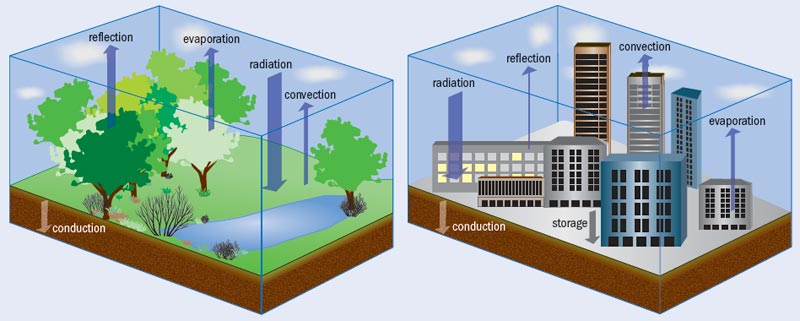
Cities are typically about 4 °C hotter than the surrounding countryside and the larger they are, the bigger the difference. To understand why, we must consider the energy balance of the two areas (figure 1). Although heating, air-conditioning and transport all produce energy in cities, this is a surprisingly small component of their heat balance – only about 50 W m–2. Except for in winter, this is dwarfed by the energy we receive from the Sun, which even in the UK peaks at more than 800 W m–2. The difference between temperatures in a city and the surrounding countryside is therefore mostly due to what happens to the Sun’s energy in the two environments.

In rural areas, vegetation reflects about a quarter of the incoming short-wave radiation (visible light or shorter wavelengths). Of the three-quarters that is absorbed, much of the energy is used to evaporate water from leaves – a process known as “evapotranspiration”. This cools the vegetation, which therefore radiates little long-wave radiation (infrared), and even less energy remains to heat the air by convection and to heat the soil by conduction.

In cities, where vegetation has largely been replaced by buildings and roads, the energy balance is dramatically altered. Dark, artificial materials reflect less – and absorb more – radiation than vegetation. This lower “albedo” means that only about 10% of the Sun’s radiation is reflected; this figure is even lower in high-rise cities where light is reflected down into urban “canyons”. Almost all of this energy goes into heating the dry roads and roofs, where it is either stored in bricks and mortar or heats the air above, thus raising daytime surface and air temperatures well above those of the surrounding countryside.

Figure 1

At night the difference in temperature between the countryside and the urban heat island can become even more pronounced. Cities cool down more slowly because there is more heat stored in its buildings, which continues to dissipate into the night; there is more pollution to trap long-wave radiation; and within urban canyons less of the cool sky is visible, so less radiation can escape.

All this causes major problems for city-dwellers. The rise in urban air temperature above that of the surrounding countryside, which can reach 7 °C in a metropolis like London, makes cities less comfortable places to live in during the summer months. Soaring temperatures increase ill health and can even kill people during heatwaves: it is thought that more than 35,000 people died in Europe as a result of the 2003 heatwave, most of them in towns and cities. The urban heat island also makes cities less sustainable, since it increases the amount of energy used for air-conditioning – energy that is pumped into the open air and just makes the situation worse. Fortunately, physics shows that two very different methods could be used to alleviate the urban heat island: using “cool surfaces”; and using vegetation, or “green infrastructure”.

Cool surfaces

Increasing the albedo of buildings and roads so that they reflect more sunlight is an approach that has been used for centuries in the Mediterranean – think of whitewashed villages in Greece, southern Italy and Spain. At the Lawrence Berkeley National Laboratory in California, the effectiveness of this approach has been investigated by the Urban Heat Island Research Group, led by physicist Hashem Akbari. The cooling effect of a roof’s surface depends on its reflective and emissive properties – its ability to reflect short wavelengths such as visible light and near-infrared radiation, and to emit thermal radiation in the far infrared. While standard white-painted surfaces are good at keeping cool, it is also possible to make medium-to-dark-coloured cool surfaces, which can look more traditional on roofs. These are created by combining a reflective basecoat, such as white titanium dioxide, with a darker pigment that has moderate visible reflectance, such as iron-oxide red or perylene black. As long ago as 1999, Akbari’s group showed that these “cool surfaces” can reduce the peak temperatures of roofs and pavements in California from 50 °C down to about 30 °C.

The same group has also studied the implications of this cooling for individual buildings. First, the researchers compared the thermal performance of conventional buildings with identical ones that had roofs clad in cool surfaces. These tests showed that in summer, cool surfaces typically reduce air-conditioning costs by 20–30%. However, these experiments – by necessity – ignored the cumulative cooling effect that could result from large-scale use of cool materials throughout an entire city.

To study the effect of cool materials on the urban heat island, Akbari’s group had to use more indirect methods, as clearly it is not practicable to perform a controlled experimental study comparing two cities that are identical in all respects bar their surface cover. What the researchers did was simulate air temperatures in the Los Angeles area using complex and computer-intensive regional climate models. The calculations suggested that the urban heat island could be reduced by 2 °C if all buildings and roads were covered by surfaces with an albedo 30% higher than is there now. This would reduce summer air-conditioning costs by a further 2–3%.

Tree-shaded buildings

A potentially even more effective method of preventing the urban heat island than using cool surfaces is to increase both the albedo and evaporative cooling of cities using vegetation and water. Once again, this approach has long been popular in Mediterranean towns, which have cool squares and boulevards shaded by trees and chilled by fountains.

Researchers in the US, such as Akbari’s group and the Forest Service of the United States Department of Agriculture (USDA) led by David Nowak, have mostly concentrated on how tree shade can reduce the air-conditioning costs of buildings. Experiments and computer modelling have shown that several large trees strategically planted on the south and west sides of buildings can cut these costs by about 30%. However, the cooling effect of the existing trees in the city they studied – Chicago – is only about 4–5%, due to limited tree cover in the city, particularly in heavily built-up areas.

Researchers in Germany and Canada, meanwhile, have concentrated on the effects of a different approach: incorporating vegetation onto the roofs of buildings to create “green roofs”. Studies in 2008 by Brad Bass and his group from the Centre for Environment at the University of Toronto showed that by using green roofs, air-conditioning costs can be reduced by up to 70% in single-storey buildings because the vegetation cools the roof by evapotranspiration and because the soil insulates the rooms below from the heat. However, these savings fall to about 30% and 20% for two- and three- storey buildings, respectively.

Tree-lined streets

It has proved harder to determine how effective vegetation is at cooling a city itself, because of its complexity; vegetation increases both albedo and evaporative cooling, and has lots of layers of leaves, which are hard to represent in regional climate models. One attempt has been made by Limor Shashua-Bar and Milo Hoffman of the Technion Israel Institute of Technology, who found that heavily wooded streets in Tel Aviv could have air temperatures up to 4 °C cooler than their surroundings. However, the researchers had to represent the effect of the trees not by a detailed model but by simply reducing the incoming radiation by 40%. Before we can accurately model the effects of vegetation on the urban heat island, we clearly need to know more.

One approach to work out what is happening, taken by a group from the University of Basel, Switzerland, and led by botanist Sebastian Leuzinger and meteorologist Roland Vogt, is to use a high-resolution thermal camera mounted on a helicopter. The researchers measured the surface temperature of parts of Basel on a hot summer’s day when the air temperature was 25 °C. They found that streets reached temperatures of 37 °C and roofs 45 °C, whereas the temperatures of trees were on average only 25 °C and of water bodies just 18 °C. Potentially, these figures could be put into a regional climate model to give an indication of the effects of the trees on air temperatures. However, this would ignore the depth of the tree canopy; the lower layers of leaves, being shaded by the top ones, will be cooler than those above. Trees will therefore provide more cooling than would be predicted from thermal-camera measurements.

To solve this problem, my group at the University of Manchester, which includes physicists, biologists and planners, used a simple energy-balance model to calculate the surface temperatures of typical vegetation, buildings and roads (figure 1). Originally developed by Chih Pin Tso, then at the University of Malaya, Kuala Lumpur, in the 1990s, the model suggested that vegetation is more effective than the thermal measurements of Basel would suggest. On hot days, the predicted maximum temperature of woodland was 18–25 °C cooler than that of buildings and roads.

Our group used the area of Greater Manchester as a case study, which encompasses the city of Manchester and its extended urban sprawl. First, we categorized the area’s pattern of vegetation using aerial photography (figure 2) and found that, surprisingly for a built-up industrial area, 59% of Greater Manchester is covered by evapotranspiring vegetation. Of course the vegetation cover, and hence surface temperatures predicted by the model, was not uniform across the area. Built-up areas such as city centres had vegetation cover of less than 30% and were up to 13 °C hotter than green spaces. We also manipulated the green space in the model to perform “experiments” that would normally be impracticable. For instance, we showed that adding 10% tree cover to city centres would reduce maximum surface temperatures by about 4 °C. The results of our study, however, really need to be put into a regional climate model that can calculate air temperatures.

Figure 2

One other thing scientists need to discover is how good trees and grass are at cooling relative to one another. The best way to do this would be to look at the energy balance of the surfaces more directly. Since plants cool themselves by evapotranspiration, and the heat of evaporation of water is constant at 2.43 kJ per gram, the cooling provided by a plant is proportional to its rate of water loss. One might expect trees to provide more cooling than grass, since their leaves are held higher up above the ground and so should lose water faster, like washing on a clothes line; on the other hand, trees have to pipe that water up to their leaves against gravity. Environmental physicists and botanists have developed techniques to measure water loss, which will allow us to test these ideas.

Water loss from grass is best measured by mounting turf onto a sensitive balance and monitoring weight loss throughout the day. Water loss from trees is measured using sap-flow meters: an electrically heated collar that applies bursts of heat is attached to the trunk of the tree to warm the sap within. Apparatus higher up the trunk monitors the temperature there, allowing the velocity and hence volume flow of water up the trunk to be calculated. Using these techniques, many studies by foresters and agronomists have found that forests and grasslands both give evaporative cooling of 100–200 W m–2. But there is little of this information available for urban grass and trees – and we have no idea how their cooling effectiveness might be limited by drought – so experimental work is urgently needed.

Respite from the Sun

A final climatic benefit of vegetation is to provide cool oases for recreation. Many studies have therefore compared air temperatures in parks with those in surrounding roads, only to find that, except on really windless days, the differences are rather small – usually less than 1 °C – because warm air is blown into the park from the surroundings. So why do we feel cooler in parks, and what effect does tree shading have?

To answer these questions we have to consider the heat balance of a person. At rest, a person’s body produces heat at a rate of about 60 W m–2 of our body surface. How hot we feel depends on how readily we can lose that heat to our surroundings. Surprisingly, except in very high winds, we lose very little heat by convection – only about 9 W m–2 – and about 15 W m–2 by evaporation from our breath. However, all bodies emit far-infrared radiation at a rate proportional to the fourth power of their temperature, but also absorb such radiation from their surroundings. Therefore, if our surroundings are cooler than 37 °C, we have a net radiative heat loss.

Outside in a shady park we feel comfortable because we are surrounded by cool leaves. On an open street, in contrast, we feel hotter for two reasons: first, we are receiving an additional input of up to 120 W m–2 of shortwave radiation from the Sun; second, the surrounding tarmac is also warmer, reducing radiative heat loss by about 6 W m–2 for every temperature increase of 1 °C. In such conditions we may have to sweat to get rid of the additional heat burden.

To investigate the relative importance of the Sun versus shade on the temperature of the surroundings, we carried out a simple experiment in summer 2009. This involved monitoring the radiant temperatures above grass and concrete plots, which were either in permanent sunlight or in the permanent shade of trees. We did this using a globe thermometer, which is basically a thermometer mounted inside a grey plastic sphere. Held at a height of 1.1 m, this mimics the thermal properties of an adult dressed in a suit. We found that being above grass or concrete had little effect on the radiant temperatures; these were far more influenced by shading, which reduced maximum radiant temperatures by up to 9 °C, from 35 °C to 26 °C. Since people tend to feel uncomfortable at radiant temperatures above 24 °C, it is clear that shading can have a large effect on people’s sense of wellbeing, thereby confirming the importance of trees in urban areas.

Influencing policy

All this research is building up a picture of how we can improve cities: trees have the most potential to improve street environments, whereas cool surfaces, green roofs and even “living walls” can improve the environmental performance of individual buildings. In addition, green infrastructure has other benefits, such as a reduction in flash flooding and particulate air pollution. Even so, there is clearly still a vast amount or research to do. We do not know which species of trees might be the best to cool cities and catch pollution particles, whether a single large tree is better than many small ones, or whether deciduous trees are better than evergreens. Nor do we know how the effectiveness of different types of vegetation will alter with climate change.

Nevertheless, we do now know enough to influence policy. The scientists of the USDA Forest Service, for instance, have collaborated with economists to estimate the monetary benefits of planting street trees, from reducing energy costs to reducing the health costs of air pollution. The economic model they have produced – the iTree model – shows that for every dollar put into planting and maintaining street trees, five dollars are saved. In New York, this knowledge, combined with the backing of Mayor Michael Bloomberg, has driven the planting of 20,000 extra street trees a year, while the Mayor of London, Boris Johnson, has also committed to planting 10,000 extra street trees during his term of office. As well as trees, the physical and economic case for green roofs means that they are being retrofitted to ever more buildings. It is good to be able to report that physicists are doing their bit to make our cities greener, pleasanter places in which to live.

Damage limitation


Maybe it is not an experience that other Physics World readers share, but I have become rather resigned to what might be called the “dinner party shutters”. You are introduced to someone whom you recognize vaguely but have never talked to before. At first there is what appears to be real interest when you tell your new acquaintance that you are a physicist working in an exciting field – “Tell me more!” So you do; after all, it is really fascinating work.

But after about a minute the shutters come down, and the other guest is clearly desperate to find a lawyer or doctor to talk to. However, I have recently managed to keep my audience listening for much longer. Is this due to highly effective training in presentation techniques, or maybe some recent dental work? No. It happens because I have become involved in an area of applied physics that people from other walks of life really do find genuinely interesting.

The area of physics with this miraculous property is particle therapy, the method of treating cancerous tumours by exposing them to high doses of ionizing radiation, specifically hadrons such as protons, and light nuclei such as carbon ions. The particles interact with matter in such a way that tumour sites are damaged more, and surrounding healthy tissue is damaged less, compared with standard photon therapies. People are interested because cancer may affect any one of us – and this technique has some fundamental benefits that are simple to explain.

Particle therapy is one of the most obvious and dramatic applications of high-energy physics to medicine. Creating the beam requires a fully fledged particle accelerator – usually a synchrotron or cyclotron – with all its attendant paraphernalia, though this is usually hidden behind discrete panelling and generally not seen by patients. It is not surprising that when people question the cost of big physics, it is often mentioned that particle therapy is a spin-off from leading-edge research at major high-energy physics laboratories. And no subtle interpretation is needed to make this case – the evidence of technology transfer is blatant.

The use of particle beams from an accelerator to treat cancerous tumours inside the body is not new. The first experimental treatments were performed in the 1950s using protons from the cyclotron at the Lawrence Berkeley Laboratory in California. But in recent years there has been a marked upsurge in activity, as commercial suppliers such as Ion Beam Applications, Siemens Healthcare and Hitachi have taken on the task of moving this technique from the research facility into the hospital.

This blossoming industry means that hospitals wanting to offer particle therapy no longer need to collaborate with a local accelerator lab, and stand-alone particle-therapy centres are opening all around the world. The number of patients who have been treated successfully is in the tens of thousands and rising rapidly. But can this technique ever become mainstream, with a particle-therapy system in every major hospital?

The medical challenge

What everyone – patients and doctors alike – wants when it comes to cancer is a mythical magic bullet that targets the cancerous tumour and eliminates it completely, without any damage to healthy tissue or any risk of recurrence. After all, if localized tumours can be detected and treated early, before they grow or spread to other locations in the body, then the chances of a complete recovery are good. But the tumour comprises living cells that are not so different to nearby healthy cells and it is almost inevitable that a treatment effective against cancerous cells will be potentially dangerous to healthy cells too.

Fortunately, there are some factors that work in our favour. First, the tumour location can often be determined with good accuracy. Modern imaging techniques, such as X-ray computed tomography (CT), magnetic resonance imaging (MRI) and positron emission tomography (PET), are able to provide detailed 3D maps to guide the treatment planning. Next, the human body has effective repair mechanisms, so it can tolerate some collateral damage. Third, cancer cells often divide more rapidly than healthy cells and so are particularly vulnerable to DNA damage – which is what both X-rays and particles alike aim to cause.

The three primary established treatments are surgery, chemotherapy and radiation therapy, and these are in fact often used in concert. Surgery is expensive and is never risk-free. Chemotherapy, which uses cytotoxic chemicals that target fast-dividing cancer cells throughout the body, tends to have an impact on other fast-dividing cells – particularly bone marrow (and thus the immune system), hair follicles and the intestinal lining. Radiation therapy, however, is particularly suited to treating localized tumours and has long been used with X-rays that have energies in the mega-electronvolt range, which can penetrate the body completely. Such X-rays can be generated as “bremsstrahlung” when a linear accelerator (linac) fires megavolt-energy electrons at a metal target. The whole assembly is sufficiently compact that it can be mounted on a small gantry system – a device that can rotate the equipment around the patient – allowing different X-ray entry directions that can map out the desired treatment area inside the body. Alternatively, gamma rays from a source like cobalt-60 can be used. These are collimated into narrow beams similarly arranged to converge on the target volume.

These photon-based radiation-therapy methods are effective and widely used. So what is the motivation for using particle beams instead? The reason is clear, and based on the physics of how radiation stops in matter.

Radiation interaction in the body

As a high-energy photon or particle beam propagates through human tissue, it interacts with the molecules in those tissues, primarily via their electrons. The beam’s photons or particles impart kinetic energy to the electrons they interact with – more than enough to release these electrons from atoms and molecules. These free electrons go on to have further local interactions. The result along the path of the beam is the breaking of molecular bonds, ionization and the creation of free radicals – atoms or molecules with unpaired electrons that are highly reactive. The primary target is DNA. If a DNA strand in a cancer cell is broken at multiple places by the loss of bonding electrons or free-radical reactions, then the molecular repair mechanisms, which are typically less effective than in healthy cells, cannot fix it. The cancer cell cannot divide further and its natural “suicide” mechanism (apoptosis) may trigger.

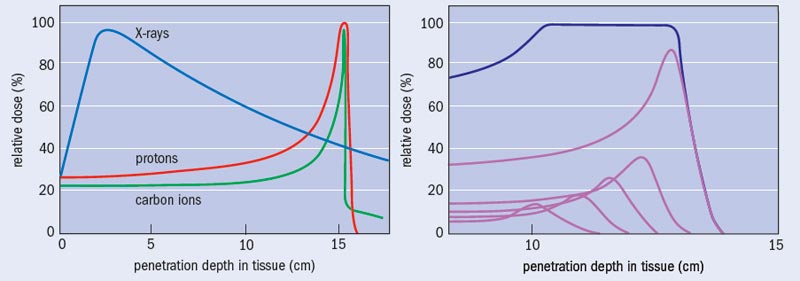
What sets photon and particle therapy apart is where in the body each technique causes damage. To a good first approximation, human tissue can be considered to be water. Indeed, so-called water phantoms – water-filled structures mimicking body parts and containing small radiation sensors – are used to validate the performance of radiotherapy systems and treatment plans. There is a striking contrast between how X-rays and particles like protons and ions deposit their energy as a function of water depth (see “Bragg curves and photon absorption in water”). Photons of a particular energy have a fixed probability of interacting with the electrons of the atoms in a medium, and thus there is an overall exponential fall off in the energy transferred to the medium with depth, except for a shallow zone near the surface where an equilibrium of released electrons builds up. This means that, except for tumours lying just below the surface of the skin, X-rays cause more damage to the surface tissue than to the tumour itself.

Charged particles of a particular energy, however, have a definite range in a particular target medium. The rate of energy loss by the particle is relatively low for much of the penetration depth, but increases rapidly to a maximum near the end of range. This is because the cross-section for interaction with the electrons in the molecules of the body increases as the particle velocity reduces. The result is the well-known Bragg curve, named after William Bragg who first observed it in 1903. When the objective is to deliver a lethal dose of radiation to a tumour but the minimum dose to surrounding healthy tissue, the benefit of this characteristic is clear. Indeed, this obvious merit can make the performing of randomized clinical trials comparing particle and X-ray treatments problematic: is it ethical to deny a therapy that appears so advantageous, in order simply to demonstrate that advantage?

Treatment process

A particle-therapy treatment involves making a diagnosis, agreeing the use of radiation therapy and then creating a treatment plan. To decide on a total dose – and the number of fractions that this dose will be administered in – the doctors use CT, MRI or PET images of the patient together with their clinical experience and published data. Working with medical physicists, they employ a software model to determine the beam parameters to use, including the beam directions. The advantage of particles over X-rays becomes obvious at this stage – generally a higher dose can be delivered to the tumour, in fewer fractions and with less exposure to surrounding healthy tissue (see “Treatment plan: X-rays versus ions”).

This can be critical when a tumour is located close to a vital structure such as the spinal cord, the optic nerve or parts of the brain. Indeed, in some cases, particle therapy may be the only viable solution, even though there have been significant improvements made in X-ray therapy machines, which now use motorized beam collimators and precise control of the beam intensity to conform the dose better to the tumour (so-called intensity-modulated radiation therapy).

The particle beam is generated by an accelerator such as a synchrotron or cyclotron (see “Synchrotron or cyclotron?”). To deposit particles over a complete tumour volume, the beam, which is only a few millimetres wide, must be spread laterally to map out the profile of the tumour shape, and delivered with a range of energies to access different depths. There are two fundamental approaches – scattering and scanning. Scattering uses materials in the path of the beam to scatter it laterally so that it can cover the whole tumour volume at once. Although this is the standard technique – used up to now at the Loma Linda Medical Center in California, for example – it is arguably not very elegant. It requires customized pieces of brass and Perspex to match the irradiation shape and depth to that of the 3D tumour volume, not just for every patient, but for every different direction of irradiation used for each patient. In a scanning system, however, the shape of the tumour is drawn out by deflecting the beam using fast-switching magnets, rather like a cathode-ray tube. By suitable control of the magnets and the beam current, the volumetric map is built up, starting with the deepest layer and then working upwards by reducing the beam energy for each layer. Scanning systems (often called “pencil-beam scanning systems”) were developed extensively at the Paul Scherrer Institute in Villigen, Switzerland, and the GSI Helmholtz Centre for Heavy Ion Research in Darmstadt, Germany, and have the advantage over scattering systems of producing many fewer beam interactions with materials in the treatment room. Scanning also provides improved conformity to the tumour shape, and the ability to create topologically complex shapes if needed.

The more localized dosing by ions relative to X-rays means that it is not as critical to rotate the beam around the patient, and some treatments can be made with a single entrance direction from a fixed beamline. This is fortunate, because the engineering challenge of moving the beam is far greater for ion beams than for X-rays. Nevertheless, large ion-beam gantry systems are used in many facilities, and can be a major factor affecting the size and cost of the facility. The high-energy beam from the accelerator passes through a rotating vacuum joint and is then deflected by a series of electromagnets mounted on the gantry. Rotating the gantry lets the medical staff vary the direction that the beam enters the patient. If the human body were rigid, then none of this would be necessary, as you could simply rotate the patient, and indeed this is done in some cases. But if you, say, moved a patient from their back to their side, gravity would cause their internal organs to move by millimetres or centimetres, thus no longer matching the 3D preparatory image. For this reason, rotating the patient is often unacceptable.

Typical total doses during a treatment are in the range of 10–80 gray, where 1 gray is 1 joule of energy deposited per kilogram. Such doses could be very dangerous if incorrectly administered (they are after all intended to be lethal to the cancer), so the therapy control system must include multiple safeguards and interlocks to ensure that the correct dose is being delivered to the correct place. On a molecular level, the amount of energy deposited is very damaging and can kill if applied to the wrong place, but it is tiny in everyday thermal terms. Therefore, the patient does not feel any sensation during treatment, which typically lasts a few minutes per fraction. One exception is beams that pass through the eye. Then, patients can see intermittent flashes, in the same way that astronauts report flashes due to cosmic-ray events. The most traumatic part of the experience, however, is the immobilization of the head or body that is necessary to ensure that the beam is delivered to exactly the required target volume. The patient will generally be unaware of the large accelerator system that produces the beam, as only the end of the beam pipe protrudes through the wall of the treatment room.

A major challenge that requires further development is how to handle movement of the body during treatment. For eye, brain and brain-stem cancers, the head can be firmly immobilized. But if the target area is in the abdomen, then the movement of organs during the normal breathing cycle is enough to spoil the sub-millimetre accuracy required and so invalidate the treatment plan. One approach that is already available on many systems is to control the beam electronically so that it is only switched on during the end of exhalation, when the organ positions are relatively consistent. This clearly increases the necessary treatment time, so an alternative is to track the motion of the target area, and modulate the beam position in real time to compensate. This is not a simple problem, but it is under active investigation at several treatment centres.

Protons or carbon ions?

During the development of particle therapy, many different particles have been tried, from electrons to pions, protons and various heavier nuclei. Electron therapy is established as a technique in its own right and is used for the treatment of superficial tumours. The electron source is often the same linac used for conventional X-ray radiation therapy but with the metal target moved out of the electron beam and with additional attenuation and collimation. But electrons are not suitable for delivering doses to a tumour inside the body, due to the shape of their stopping curve. The other projectiles that have been investigated are all hadrons, hence the common designation “hadron therapy”.

Treatments using negative pions were performed at the Los Alamos National Laboratory, TRIUMF in Vancouver and at the Paul Scherrer Institute between the mid-1970s and the mid-1990s. Despite some good therapeutic results, the disintegration of pions at the end of their range caused a larger spread in dose than originally hoped. Pions are costly to produce and showed no clear medical benefit over protons, so this work has now ceased and the focus has moved on to protons and heavier nuclei.

In the early days of particle therapy (the 1950s to 1990s), the flexibility of the equipment at accelerator labs allowed treatments with various atomic nuclei to be tried, including hydrogen (protons), helium, carbon, neon, oxygen and argon. As the technology has moved into hospitals, and commercial suppliers are taking over from government labs, protons have emerged as the dominant particle. However, there is a strong argument for using carbon ions, with several new facilities offering both species, such as the Heidelberg Ion-Beam Therapy Center that opened last year in Germany, as well as new systems that are currently being installed in Marburg and Kiel (both in Germany) and in Shanghai, China.

The arguments for using carbon include a much higher linear energy transfer (the amount of energy deposited per centimetre of longitudinal depth) per incident ion, especially at the target depth, and a tighter Bragg peak than protons. Also, carbon ions exhibit less lateral scattering than protons, thus allowing sharper definition of the lateral edges of the treatment volume. The overall result is that it is possible to deliver a higher dose to a very localized volume using carbon ions. This increases the chance that tumour DNA molecules will be broken at multiple sites on both strands of the helix, and thus overcome the cellular repair mechanisms. Indeed, work by researchers at the National Institute of Radiological Sciences in Japan has demonstrated that treatments can be carried out with fewer fractions using carbon ions.

Given such benefits, why are protons still the dominant choice of particle? One downside of carbon ions is that, unlike protons, the energy deposition does not drop completely to zero beyond the target depth, due to forward-directed high-energy products of nuclear reactions between the carbon ions and the target-atom nuclei. There are also higher neutron yields in the target, which produce an untargeted background dose.

But the primary reason is cost. The proton energy needed to give a range of 30 cm in water (or the human body) is about 220 MeV. The corresponding energy for carbon is 430 MeV per nucleon, or 5.16 GeV for carbon-12. Carbon-ion beams are somewhat more difficult to produce than protons, but the primary effect on the cost of the system lies in how resistant the ions are to being deflected at a given radius by a magnetic field. Known as the “magnetic rigidity” of the beam, this is expressed in tesla metres (Tm) and given by p/(nq), where p is the relativistic ion momentum, q is the elementary charge and n is the charge state of the ion. For the two cases here, the rigidities are 2.27 Tm for protons and 6.62 Tm for carbon-12 atoms missing six electrons. Since the iron return yokes of conventional electromagnets saturate at about 2 T, we cannot simply increase the field strength (except by resorting to superconducting magnets), so the magnets needed to deliver high-energy carbon beams must have radii about three times larger than those required for protons. The whole system scales up in size, weight and thus cost. The 600 tonnes rotating beam-delivery gantry for carbon ions at the Heidelberg Ion-Beam Therapy Center provides a dramatic illustration of this (see “Enormous gantries”).

Particle progress

By the end of 2009 about 78,000 patients had been treated by particle therapy since its inception in 1954, and there were 30 centres in operation, with another 15 or so under construction. While these seem respectable numbers, they need to be compared with the figures for X-ray radiotherapy, where the number of therapy units is about 100,000 worldwide and there are hundreds of thousands of treatments performed every day.

But particle therapy is certainly growing rapidly, with new regional centres being brought online in the US, Europe and Asia. These centres are large, typically purpose-built, buildings with three or more treatment rooms using a beam from the same accelerator, and they aim to serve a large population area. The cost of a new facility is in the region of $100–200m. Making particle therapy as widely available as X-ray radiotherapy will require the cost to be reduced by about a third, and it would be preferable to fit the equipment into existing hospital radiotherapy facilities. Several companies and research groups are pursuing this goal. Still River Systems in the US is developing a system based on a very compact superconducting synchrocyclotron, which can be mounted on a gantry and located in the treatment room, analogous to linac-based X-ray systems. ProTom International, also in the US, has teamed with the Lebedev Physics Institute in Moscow to develop the latter’s existing compact synchrotron into a product for the western medical market.

More radical proposals are also being floated that could dramatically reduce the space needed for the equipment. Researchers at both the Los Alamos National Laboratory and at the Forschungszentrum Dresden-Rossendorf research centre in Germany are investigating the use of high-energy lasers to generate the necessary high-energy protons (Physics World December 2009 p5, print edition only). Meanwhile, the Lawrence Livermore National Laboratory, in association the Compact Particle Accelerator Corporation, proposes building a 250 MV DC accelerator using novel dielectric-wall technology. If successful, this would be a radical development, allowing the generation of 250 MeV protons in a machine hardly larger than a typical 25 MV X-ray radiotherapy machine.

For now, the more conventional synchrotron- and cyclotron-based facilities are treating patients successfully and provide a wealth of medical data, plus commercial opportunities for companies that provide the accelerator components, beam diagnostics, control systems and buildings. Some may question whether this is the right way to spend medical budgets as healthcare costs escalate. But when you see a life that has been transformed by the appropriate use of a sophisticated medical technique, it is hard to argue.

Synchrotron or cyclotron?

Most existing particle-therapy facilities use either a small-to-medium-sized synchrotron accelerator (10–70 m circumference) or a cyclotron (4 m circumference and about 200 tonnes in the case of Ion Beam Applications’ 230 MeV proton machine). A cyclotron uses a high-frequency alternating voltage across accelerating gaps. As the charged particles gain energy, they spiral outwards in the magnetic field. A synchrotron, in contrast, accelerates charged particles in a ring, keeping them in a circular path using electromagnets and boosting their energy every revolution using alternating voltage in one small segment of the ring. There are arguments for both systems. The synchrotron is inherently flexible, as it is able to accelerate various ion species to a wide range of final energies. The beam is injected into the ring, then ramped up to the energy needed for a particular depth layer in the patient. It is then “spilled” out of the ring and delivered to the treatment room. The cyclotron is more compact and produces a continuous beam, but it is best operated at a fixed output energy, using energy degraders (layers of material that the beam passes through) and magnetic-momentum analysis to achieve the lower energies. Recently, the fixed-field alternating gradient accelerator (FFAG) has been advocated for use in particle therapy, in particular by the British Accelerator Science and Radiation Oncology Consortium, which is campaigning against a lack of investment in particle therapy in the UK (Physics World April pp10–11, print edition only). The FFAG promises to combine much of the flexibility of a synchrotron with the continuous beam and operational simplicity of a cyclotron. Trials are in progress to assess its true potential.

Progress in particle therapy: key events

1946 First proposal to use high-energy particle beams to treat cancer is made by Robert R Wilson, then at the Harvard Cyclotron Laboratory and later the founder of Fermilab

1954 The famous 184 inch cyclotron at the Lawrence Berkeley Laboratory (LBL) starts being used for pioneering therapeutic work with protons

1957 First patients treated at the Gustaf Werner Institute in Uppsala, Sweden, using protons

1961 Patient treatment begins at the Harvard Cyclotron Laboratory, in collaboration with Massachusetts General Hospital

1968 A particle-therapy facility opens at the Joint Institute for Nuclear Research in Dubna, Russia

1975 The Bevatron at the LBL explores treatments using heavier ions such as helium, neon and carbon nuclei

1989 The Douglas Cyclotron at Clatterbridge Hospital in the UK is converted from neutron therapy to proton therapy, specializing in eye tumours

1990 The first fully dedicated hospital-based facility opens at the Loma Linda University Medical Center in California, using a compact proton synchrotron developed by Fermilab. More than 14,000 patients have been treated to date

1994 Opening of the Heavy Ion Medical Accelerator carbon-ion facility in Chiba, Japan, which has so far treated more than 4500 patients

1996 The Paul Scherrer Institute in Switzerland pioneers scanned beams on a gantry using technology developed during earlier work with pions

1997 Scanned carbon-beam therapy with spot-by-spot modulation of the beam intensity starts at the GSI Helmholtz Centre for Heavy Ion Research in Darmstadt, Germany

2001 A proton-therapy centre opens at Massachusetts General Hospital, using the first fully commercial accelerator system supplied by the Belgian firm Ion Beam Applications (IBA)

2009 More than 78,000 patients so far treated using particle therapy, of which 86% were proton treatments

2009 The Heidelberg Ion-Beam Therapy Center opens in Germany, including a large gantry system for carbon-ion treatment

2010 IBA proton systems are installed or in start-up at 10 sites around the world. Siemens Healthcare’s combined proton and carbon systems are in construction or start-up at three sites around the world

At a glance: Particle therapy

  • Particle therapy is a good example of technology transfer from high-energy physics to medicine
  • Using beams of protons or carbon nuclei, a high dose of radiation can be delivered to a cancerous tumour while minimizing the dose to surrounding healthy tissue
  • The technique is now emerging into the mainstream as commercial suppliers install facilities in hospitals around the world
  • Therapeutic outcomes relative to conventional X-ray radiotherapy are very positive, but the size and capital cost of the equipment must be reduced before particle-therapy systems become common in every major hospital

More about: Particle therapy

B Jones 2006 The case for particle therapy Br. J. Radiol. 79 24–31
T F Delaney and H M Kooy 2008 Proton and Charged Particle Therapy (Lippincott Williams & Wilkins, Philadelphia)
A Slesser 2008 Introduction to Cancer Therapy with Hadron Radiation (Lawrence Berkeley Laboratory)
Particle Therapy Cooperative Group website: a large number of articles on latest results and new facility commissioning


Discovery with statistics

In June I asked readers to collaborate in an “experiment” about scientific discovery as it happens. The discovery concerned dark matter, the yet-to-be-detected, invisible substance that, researchers are convinced, makes up more than 80% of the matter in the universe. My experiment was prompted by a paper submitted last December to arXiv by members of the Cryogenic Dark Matter Search (CDMS-II). That paper announced a finding of two events, compared with 0.5 expected from background, with a confidence level of about 1.3σ or 21% (arXiv:0912.3592v1).

No-one, in or outside the CDMS-II collaboration, considered this a “discovery”, even though they were sure that it – or another experiment – will eventually find dark matter. I therefore asked readers three questions. First, what would count as a discovery of dark matter? Second, what should we call the CDMS-II findings, assuming they are of true dark-matter events? Third, what other findings in physics did readers know of that had grown into discoveries – or non-discoveries – thanks to more statistics?

The several dozen responses, both direct to me and via the online version of my column, were heated and illuminating.

The DAMA effect

Paul Grannis, a physicist colleague of mine at Stony Brook, gave an apparently straightforward answer: “When we see 3σ, we call it evidence; when we see 5σ, we call it a discovery.” Indeed, 5σ seems to be a rule of thumb among physicists of the confidence level required for a discovery. This originated in the mid-1990s, when evidence for the top quark accumulated in the data of two teams at Fermilab. In 1995 the two teams jointly announced the discovery with a confidence level of 5σ, promptly convincing the research community and establishing that as the benchmark confidence level.

Ever since, the role of statistics, and the justification of the 5σ confidence level, have been major topics in particle physics. For example, Oxford University physicist Louis Lyons organized a workshop on the subject at CERN in 2007, and he plans another one on the same topic at CERN early next year. The workshop proceedings reveal just how rich and sophisticated a field the application of statistics to physics has become (see the webpage).

In 2008 Lyons wrote an article, “Open statistical issues in particle physics” (arXiv:0811.1663v1), that included a section entitled “Why 5σ?”. While statisticians invariably say that being so stringent is overkill, Lyons writes, there are several good reasons for it. One is past experience. As he points out, “we have all too often seen interesting effects at the 3σ or 4σ level go away as more data are collected”. A second is the “look elsewhere” effect: the decisions you make in sorting the data into “bins” in a histogram may serve to concentrate fluctuations, meaning that “the chance of a 5σ fluctuation occurring somewhere in the data is much larger than it might at first appear”. Finally, physicists worry that some systematic effect may have been underestimated or even missed altogether.

Nevertheless, 5σ is essentially arbitrary, with many discoveries accepted with considerably less sigma, and some not accepted even with higher sigma. The classic recent instance, numerous respondents reminded me, is the still-disputed claim, made several years ago by the DAMA/LIBRA experiment at the Gran Sasso National Laboratory in Italy, of evidence for the presence of dark-matter particles in the galactic halo at a confidence level of 8.2σ (arXiv:0804.2741). No-one doubts that DAMA has seen something. But the fact that other experiments have not seen anything – even though they should if DAMA did – raises doubts about DAMA’s interpretations, as did a certain chariness by the collaboration about sharing information. The “DAMA effect” underscores that statistics alone do not make a discovery.

One factor is that the translation of sigma into a probability often involves the assumption of a normal distribution of errors. “It is by no means clear how to justify this assumption in many cases,” Charles Jenkins from CSIRO in Canberra, Australia, told me. “And it is certainly not clear that the assumption of normality applies so far out in the wings of the distribution. If we had enough data to draw a histogram and verify the error distribution out to 5σ, we probably wouldn’t be bothering with statistics!” Scientists insist on this apparently extreme level of significance, Jenkins continued, as “an insurance policy against the multitude of error sources that don’t average away quickly and give fat tails to the error distribution”. It is, he continued, a cheap and cheerful way of dealing with the underlying issue, which is that ascribing the significance level to an observation requires an assumption about the error distribution. “One has to view a result as a package,” he wrote, “where the statistical interpretation is one of the things that may be wrong. As a fellow student of mine once asked in a seminar, ‘What are the errors on your errors?’.”

The critical point

Few respondents were excited about the CDMS-II results. “If you roll a dice six times,” says astrophysicist Rafael Lang from Columbia University in the US, “would you be excited if you rolled the ‘four’ twice?”

Nearly everyone I spoke to had tales – many well known – of signals that went away, some at 3σ: proton decay, monopoles, the pentaquark, an excess at Fermilab of high-transverse-momentum jets. Several people reminded me of one case from the story of dark energy – what is believed to be causing the expansion of the universe to accelerate – when Saul Perlmutter and colleagues (Astrophys. J. 483 565) concluded that the mass density (ΩM) of a flat universe was about 1 (and the cosmological constant Ωλ ~ 0) based on their first seven supernovae. This result was, however, 2.3σ away from their later answer, although the inclusion of more supernovae data could have made a big systematic difference.

Some of these tales – such as the latter – were the result of statistical fluctuation. Others, however, were due to faulty analysis. The need to protect against that is, I think, the reason for the otherwise absurdly high confidence level. “The fact is, in high-energy-physics experiments, you sometimes find substantial systematic errors,” says Grannis. “The big fear is: how do I know I have thought of all sources of error?”

Vacuum helps limit greenhouse gases

It is not only energy companies that have to pay attention to their greenhouse-gas output. Next year California is scheduled to complete emission rules under its landmark global-warming law, which will set state-wide emissions limits that require the largest industrial sources to report and verify their greenhouse-gas emissions. With voluntary reduction bills being enacted elsewhere in the world, the chances are that many companies will be directly affected by such measures, especially firms emitting the worst kind of greenhouse gases – known as perfluorinated compounds (PFCs).

The semiconductor industry has long used PFCs to clean chemical vapour deposition (CVD) equipment. Between runs that deposit thin layers of semiconductor material onto substrates, nitrogen trifluoride, carbon tetrafluoride or hexafluoroethane are used to remove contaminants from the sample chamber. “CVD manufacturing requires chamber cleaning between operations to maintain the purity of the deposited layers,” says Phil Chandler, global head of environmental products at semiconductor equipment supplier Applied Materials. “CVD is typically the highest priority abatement application for our users.”

From its California headquarters, Applied Materials supplies semiconductor equipment, including both CVD and gas-abatement systems. The firm is advocating the use of fluorine radicals instead of PFCs in chamber cleaning to eliminate the emissions of these dangerous gases. That approach uses microwave heating to create a plasma from PFCs entering the chamber, dissociating them to create fluorine radicals. The fluorine radicals then clean the chamber, forming non-global-warming gases.

Mike Czerniak, product marketing manager at the vacuum pump and exhaust-management company Edwards, warns that even though technology exists to stop such dangerous PFCs being emitted, there is still more work to be done to control their emission. “Carbon tetrafluoride and sulphur hexafluoride are the real heavyweights,” says Czerniak. “Sulphur hexafluoride has 23 900 times the global-warming potential of carbon dioxide.” At Edwards’ site in Clevedon, UK, where Czerniak is based, the main products made to reduce PFCs are combustors, which do a similar job to plasma-based abatement. However, rather than breaking down PFCs as they enter manufacturing equipment, the combustors break down PFCs in the exhaust gases at the end of the process.

Despite incoming regulations by governments across the globe, Czerniak says that firms have not completely resolved their PFC issues. Whereas CVD tools assemble layers of semiconductor material, PFCs are also used to etch the resulting wafers as they are processed to form final devices. Etching uses just 10% of the amount of gas needed to clean CVD tools, but because it uses carbon tetrafluoride, its emissions are more of a problem than many companies realize. “Although less volume is used, the gases are generally more damaging from a global-warming perspective,” Czerniak says. “Etch processing represents the next significant PFC-reduction target,” Chandler agrees. “Today, etch-manufacturing abatement typically concentrates on toxic and corrosion protection, with less attention paid to the destruction of PFC greenhouse-gas species.”

In the semiconductor industry, systems typically handle gas flows of hundreds of litres per minute, of which PFCs may comprise around 10% and the remainder being nitrogen gas. However, these volumes are modest compared with other manufacturing sectors, such as the liquid-crystal flat-panel display and photovoltaic industries. Here they use gas flows of thousands of litres per minute containing a similar proportion of PFCs for tool cleaning. Governments, under pressure themselves to set and adhere to tough emission standards, are keen to control the global-warming potential of such industries.

“We are seeing increasing numbers of manufacturers of flat panels and solar cells appearing in Asia and in particular in China,” says Czerniak. “Manufacturers there are going to have to meet strict local regulations meaning that they must take a more professional approach to handling their waste gases.”

To help reduce processing emissions even further, firms are also targeting their energy consumption. Abatement systems and vacuum pumps have included energy-saving features for some years, but by bringing them together in a single system Edwards claims that it can further reduce the cost of the methane fuel and electricity used. Similarly, Applied Materials emphasizes that its tools raise processing capacity without increasing energy consumption, leading to an effective reduction in emissions.

Today, the world’s electronic-device manufacturers are being joined by other industries directly exploiting semiconductors to help reduce greenhouse-gas emissions, such as the photovoltaic companies and light-emitting-diode producers. Both Czerniak and Chandler underline that to ensure their environmental credentials are clean, these firms must also exploit gas abatement, marking the start of a greater worldwide awareness of emissions.

Bright future for fusion careers


Roberto Kersevan is a vacuum design engineer in the vacuum group working on the ITER fusion project at Cadarache in France. He is one of two deputy group leaders and is responsible for cryogenic and roughing pumps.

What were you doing before you moved to ITER, and what made you decide to move?

I was head of the vacuum group at the European Synchrotron Radiation Facility (ESRF) in Grenoble, France, after spells working on other accelerators across Europe and the US. I spent 12 years at the ESRF managing a group of 15 people plus various students and contractors. My group was responsible for maintaining the vacuum system of the 6 GeV light source, including solving any vacuum-related problems and installing new components.

I enjoyed my time at Grenoble a lot, and I have fond memories of my former colleagues and the working environment – the excitement in the control room during a night shift after some important interventions had been made, for example. I decided to join ITER for a number of reasons, the most important being that I was at a point in my career where I had the opportunity to move to a really high-profile project. For someone like me who had spent more than two decades working on accelerators, it was also a good opportunity to switch to a different field and to capitalize on the knowledge I had acquired but expand it into the field of fusion.

What is the vacuum group at ITER like?

Currently, the vacuum group consists of 10 permanent staff plus one external contractor. The group’s members come from many countries – the UK, France, Italy, Russia and Germany – and are aged between 27 and 67. The atmosphere of the group is very good; we are all friends and occasionally do fun stuff together outside of work, such as go-karting and rafting with our families.

Our “vacuum” family extends way beyond Cadarache; because of the way that the ITER project is set up, we are in close contact with the domestic agencies in the seven different member states participating in the project. We have regular meetings with them by video and via the Internet. In particular we have close ties with the agency in the US, which is based at the Oak Ridge National Laboratory, and with Europe’s Fusion for Energy, which is based in Barcelona. The US agency is responsible for, among other things, several packages concerning vacuum components, and will therefore grow in size to numbers comparable with those of our group at Cadarache.

What are the opportunities for vacuum scientists at ITER?

There are many. ITER’s vacuum system will be the most complex ever built. It may not have the biggest volume or longest span, but it encompasses the gamut of vacuum technology’s flow regimes, temperatures and pumping arrangements, all in a harsh environment. It needs state-of-the-art vacuum solutions, some of them never attempted at a project of ITER’s size and complexity. Pretty exciting stuff.

Can you describe a typical “day in the life” of an ITER vacuum scientist?

For the time being, there is a lot of design and conceptual work, including writing technical specifications for supplier contracts. I am currently working on the characterization of tritium permeation, the design of a cryogenic vacuum compressor and the design of tritium-compatible dust filters. I am also doing some computer modelling of ancillary vacuum systems using a Monte Carlo simulation code. Some of my time is spent browsing and reading the vast literature on fusion science and technology in order to understand more about ITER as a whole. I also read many papers on the subject of energy in general, including energy policy and climate change, which ties in to ITER’s primary aim of developing clean, abundant energy. However, all this will soon change. When on-site installation begins, all of us in the group will have to spend a considerable amount of our time following up on the fabrication, testing and delivery of vacuum components, and with their installation on the machine. I am looking forward to that.

What makes ITER such an interesting place to work as a vacuum scientist?

ITER’s vacuum system has everything a vacuum scientist could dream of: ultrahigh vacuum; low vacuum; molecular, transition and viscous flow regimes; high temperatures and cryogenic elements; small components and extra-large ones. The vacuum system also interfaces with many other sub-systems, such as superconducting magnets, thermal shields, cryostats, detritiation systems and diagnostics. However, there are some non-technical challenges, such as working in an environment where a large number of different nationalities and cultures are represented.

What opportunities are there at ITER for training and career development?

We all get training on nuclear safety and on the tools and software that are relevant to the design and analysis of the project’s vacuum systems. Our group will grow during the construction phase of the project, so there will be opportunities for all of the current members to become supervisors of smaller groups working on sub-projects.

What advice do you have for new physics graduates who want to get into vacuum research, and nuclear fusion in particular?

My advice to them is never to give up, especially in times of tight budgets, and to join a project where vacuum technology is key, such as accelerators or fusion. Industry too can offer interesting positions for a vacuum scientist, especially in the emerging field of renewable energy sources, such as solar technology, which increasingly employs vacuum techniques. The coating industry, in general, employs vacuum widely, so there are opportunities there, too. From a personal point of view, having completed my physics studies in surface science, I was already aware of the problems involved in the application of vacuum technology, but I would never have imagined that 23 years later I would still be enjoying working with vacuum. I can see that people who are not familiar with it might think of it as a “second tier” physics subject – mostly the application of 19th- and early 20th-century physics – but its relationships with modern physics are many: materials, surface science and nanotechnology to name just a few.

What next and where for you after ITER?

I am now 50 and with a “first plasma” at ITER scheduled for not earlier than 2019, this job could easily be my last. But I always bear in mind the fact that ITER employees only have five-year contracts, which obviously can be renewed but one can never be sure. Ideally, I’d like to have the opportunity to pass on to others the knowledge I have acquired over the past 23 years, tutoring and helping them to learn faster than I was able to do at the beginning of my career. I haven’t ruled out the possibility that some day I may join a different project, but, for now, my place is here at ITER.

Swimming against the unseen tide


“What will our soldiers think when they return to the university and find that they are expected to learn at the feet of a woman?” A University of Göttingen faculty member, describing the German-born mathematician Emmy Noether, circa 1915

“Are photons gendered?” is the title of a chapter written by Yale University astrophysicist Meg Urry in Gendered Innovations in Science and Engineering. Physics is phenomenally successful at taking data on sexless, raceless objects such as photons and transforming that information into mathematical laws with highly accurate predictive power. To be a physicist is to love working in a field where this is possible. So why should there be a paucity of women in physics, at all professional levels and in virtually all industrialized nations?

Some readers may deny that low participation by women in physics is a problem requiring intervention. Some might think it a free choice by women, or else a legacy of past discrimination that will disappear over time. But how can one view data that reveal less job satisfaction, lower pay, slower progress through the ranks and fewer professional resources and opportunities as indicating anything but a problem that begs a solution?

There are many theories to explain this phenomenon, and it is a tenet of gender studies that one should avoid attributing complicated effects to a single cause. For example, biological determinism – that one sex or race is, from the moment of birth, better suited for a tenured professorship at Harvard – was one of several theories once favoured by Larry Summers, director of the US’s National Economic Council and a former president of Harvard University. Gender studies is a field guaranteed to annoy the physicist – where data not only stubbornly confound our ability to write laws but also where unifying principles, when they exist at all, offer much less in the way of accurate predictive power.

Here, I will explore only one cause that could explain the paucity of women in physics: a double standard of professional evaluation for men and women in the sciences. It is well documented in the social-science literature that gender can sometimes enter into professional evaluation. When it does, men fare better than women in high-status fields, like physics, that prize intellect, the ability to analyse and leadership. According to such studies, teaching evaluations and letters of recommendation are quantifiably different for men and women in the sciences. A name change, for example from John to Jane, on identical CVs or preprints can result in different ratings. Particularly interesting are studies finding that women do less well than men, even if they have equivalent experience and qualifications.

Yet while some studies on scientific grants and tenure rates find gender bias, it is certainly not the case that all such studies do so. Moreover, some studies find qualitative and quantitative differences in bias in different branches of science. Esther Duflo, an economist at the Massachusetts Institute of Technology, had applied randomized evaluation to political and economic issues, for example the willingness of voters to elect a woman, in the developing world. According to the New Yorker, one colleague speaking at a session of the World Bank in New Delhi said that Duflo’s methods could be taught and that they “are not nuclear physics”, in response to which a UNICEF official said “Studying human beings is much more complicated than nuclear physics.” Amen!

Caught on camera

With a grant from the Mellon Foundation, I, together with my colleagues Kris Lui and Etsuko Hoshino-Browne, conducted a study to determine how male and female physicists are evaluated in the classroom. We used videotaped lectures in which professional actors – two male and two female – played the role of a physics professor. They each gave a 10-minute physics lecture to a class of students that included blackboard work, a demonstration and a question-and-answer session. None of the actors were trained in physics but all received the same preparation and memorized the same script.

We then showed 126 physics students the lecture by one of the four “professors” and got them to fill out a survey in which they rated various aspects of the lecture using a five-point scale. The students supplied some personal information but not their own gender, which was noted covertly by the person collecting the surveys.

Our study resembles those in which subjects are asked to assign certain qualities, such as leadership, by looking at a photograph of a person. However, one would hope that viewing a lecture would produce a more meaningful evaluation – at least that is the hope of those of us who use student evaluations to decide on hiring, promotion and salaries.

Responses to 15 survey questions were combined to create a single score. We found that, on average, the male professors received higher scores than the female professors. But while female students gave slightly higher marks to the female professors than they did to the men, male students rated male professors vastly better – a result that is reminiscent of studies of science-teacher evaluations from colleges and secondary schools.

We also considered the students’ responses to questions that looked at gender-stereotypical attributes, such as if the lecturer had a “solid grasp of the material”, if they were knowledgeable, or good with equipment. These questions yielded a distinct gender bias, in that both male and female students rated male professors as better. (Female students were, however, more equivocal – the gender gap in their ratings was not significant, as it was for male students.) On the other hand, a group of questions asking whether the professor “teaches in a way that really helps students learn”, is well organized and interacts well with students produced quite a different effect: here, there was a clear own-gender bias, with female students rating the female professors as superior and the male students giving higher marks to the male professors.

We concluded that not only can the gender of the physics professor make a difference to how a lecture is received by students, and in what sorts of strengths and weaknesses students perceive, but also that student gender can play a role. So the male soldiers of Göttingen would, on average, prefer to learn physics at the feet of a man – not at those of a woman speaking the same words, writing the same equations on the board and giving the same answers to questions that the soldiers pose. Were there any female soldiers, their preference would be less clear cut.

A little bias goes a long way

The results we found are consistent with the theory that people have implicit beliefs that associate different genders with different aptitudes and predilections. Even people who consciously believe in gender equality cannot suppress these automatic associations. Indeed, an online test (available here) reveals that I too have a moderate, innate tendency to associate men with science. A set of associations forms a “schema”, which is understandably useful to our survival as a species. However, schemas of gender, race and disability also seep into our professional interactions and judgments. Psychologists like Virginia Valian have argued that an identity that violates such schemas, for example a female physicist or a male nurse, has a negative consequence in terms of the individual’s evaluation and perception.

Further, small disadvantages such as an inferior teaching evaluation or a smaller start-up grant can accumulate over time and have dramatic consequences on a career. To a physicist, this suggests an analogy with a Monte Carlo simulation. A random walker has many important, gender-independent terms in its Hamiltonian. There is also a tiny, implicit bias term that couples to its gender. In each interaction (with a teacher, thesis advisor or tenure committee, for example) a Boltzmann factor determines the likelihood of the walker proceeding in a given direction. The ensemble-averaged flux of male walkers will be greater, when projected onto directions indicating professional success and job satisfaction, than will the flux of female walkers, due to the existence of the gender-biased term. Indeed, no matter how tiny the gender-biased term, a biased random walk will drift according to the direction of the bias.

Recently we have seen huge strides in equity issues in science between men and women. For example, medical researchers Christine Wenneras and Agnes Wold from Göteberg University in Sweden analysed awards handed out in 1994 by the Swedish Medical Research Council and found sexism and nepotism (Nature 387 341). A follow-up study in 2004, however, found no evidence of sexism (though nepotism found in the original study was still present). In the US, we have gone from a “leaky pipeline” at all career stages, overt discrimination and tolerance of harassment to double-digit percentages of women on faculties, hiring and promotion at equitable rates and gender bias that is usually quite subtle.

Today, the big issues are acknowledging and correcting for implicit bias, reforming workplace-policy, bringing in students from under-represented minorities, retaining girls between school and college, and seeking equity in the developing world. I believe that progress will continue, as long as good people are willing to act, rather than saying “it is not my problem to solve”. It will also depend on continued effort by educational and funding institutions and professional organizations, so many of which have engaged in difficult introspection and institutional change. Hopefully, leaders in academia, government and industry will continue to fund research and disseminate results and recommendations – so that eventually women will not need to “swim against the tide” in the physical sciences.

Finding the secrets of life

Scientific biographies work best when the biographer manages to place the individual and their science into a broader intellectual context. The reason for this is simple: however worthy and important their achievements may be, few scientists have led lives that are exciting enough in their own right to capture a reader’s imagination for hundreds of pages.

Take Francis Crick. Together with his collaborator, the biologist James Watson, Crick used images produced by X-ray diffraction patterns of biomolecules to work out the structure of DNA, the molecule that carries heritable information of most life on Earth. He is thus without a doubt someone whose scientific achievements have had an impact far beyond his own area of research. However, he is not as personally colourful as some scientists, although his life does offer some interesting material. But the most significant thing for would-be biographers is that he did his most important work during the period immediately following the Second World War – a time of great turmoil, some of which was linked to the science that engaged Crick and his many collaborators.

In Francis Crick: Hunter of Life’s Secrets, University of Pittsburgh historian Robert Olby does a wonderful job of conveying how Crick’s personality and environment shaped his science. Olby traces Crick’s way of doing research – which appears intimately linked to the way he dealt with his contemporaries – in a nuanced and illuminating manner. He refrains from judging his subject, preferring to imply rather than spell out the sharper edges of Crick’s character, and leaves it to the reader to assess Crick as a scientist and person. Olby’s work is not, however, a hagiography, nor a popular biography that you are likely to pick up in an airport bookshop. Instead, he offers a scholarly and well-researched (though highly readable) account of the life, quests and times of one of the most famous scientists of the 20th century.

After studying physics at University College London, Crick was a year or so into a PhD on measuring the viscosity of water at high temperatures when the war began. Abandoning his PhD in favour of the war effort, he went to work designing mines at the Admiralty. According to Olby, a family friend of the Cricks, it was this diversion, plus the attraction of challenging scientific problems with potentially huge paybacks, that drew Crick away from physics to the fledgling discipline of molecular biology.

After embarking on a PhD in this new subject at the University of Cambridge’s Cavendish Laboratory, Crick honed his analytical skills by determining the structure of several small – but, crucially, helical – proteins. Through a combination of model-building and seemingly endless discussion with Watson and others, he gradually became convinced (somewhat against the Cavendish’s prevailing opinion at the time) that it was DNA and not proteins that carried heritable information. Crick’s expertise was not in experimental crystallography but rather in the building of models, a task that consisted of placing pieces of cardboard or metal on a pipe-and-rod scaffold and calculating the diffraction patterns until he had found a structure that was in agreement with available data. These “modelling” skills and the insights he gained from his conversations proved immensely helpful in deducing the double-helical structure of DNA.

During this period, Crick and the equally driven Watson clearly fed off each other’s ideas. It was this fruitful collaboration that ultimately allowed them to win the race to understand the structure of DNA. The fact that they were able to do so despite formidable opponents (including, among many others, Linus Pauling) also reflects the freedom that they were granted – sometimes grudgingly – by Lawrence Bragg, the Nobel-prize-winning physicist who was director of the Cavendish at the time.

I found the discussion of Crick’s research at the Cavendish the most interesting part of the book. Although this story is well known through previous accounts, including those by Crick and Watson themselves, Olby does a remarkable job of summing up the controversy surrounding Watson and Crick’s decision to use unpublished X-ray diffraction images obtained by Rosalind Franklin and other colleagues. Compared to Watson, Crick perhaps escapes lightly in this account, but the resentment and tension that must have existed between the different players is tangible. The real or perceived slights felt by competing researchers, including Maurice Wilkins who went on to share the 1962 Nobel Prize for Medicine with Crick and Watson, will no doubt continue to attract attention and scrutiny.

Olby shows how in his later career Crick applied the same skills that had enabled him to solve the structure of DNA to a range of other biological problems, including his explanation of the “universal” genetic code, which describes how the 20 amino acids are encoded (or stored) in the DNA sequence: groups of three nucleotides represent an amino acid. This was perhaps his most impressive intellectual feat. Even though the code is not even universally valid for life on Earth (the mitochondrial “power-plants” inside our cells, for example, employ a subtly different code) it continues to intrigue: given that the four nucleotides – A(denine), C(ytosine), G(uanine) and T(hymine) – can be combined to produce 64 possible three-letter codons, it is still unclear why one particular mapping of 64 codons onto 20 amino acids should be used. This remains an active area of research.

One theme that Olby stresses throughout is the importance of younger collaborators for Crick’s way of working. When he was studying the details of the genetic code, Crick surrounded himself with up-and-coming scientists, frequently inviting them to Cambridge to discuss his models and improve them through discussion. These younger scientists, in turn, benefited from his extensive knowledge of the research literature. Many of them ended up with Nobel prizes themselves, including Aaron Klug, Sydney Brenner and, of course, Watson. Clearly, they were more than just sounding boards for Crick’s ideas. Yet relations between Crick and his colleagues (even Watson) were not always cordial. Moreover, while in his work he relished the intellectual challenge posed by younger collaborators, in his extramarital affairs he sought out young women who, by and large, were not in a position to challenge him (or his marriage). Although he maintains a neutral position, Olby skilfully teases out these complex social dynamics.

During the late 1960s, Crick gradually drifted away from molecular biology and moved to the US (the latter apparently for tax reasons). Never one to shy away from big challenges, he eventually decided to tackle the one problem that he considered sufficiently challenging and worthy of his attention: the nature of consciousness. The principle that consciousness must have a biological, biochemical and ultimately physical origin was never in doubt for Crick, who, despite his non-conformist family background, never had much time for religion.

But compared with molecular biology, where experiments to test our ideas are relatively straightforward to conceive and execute, the experimental verification of ideas related to consciousness is an entirely different undertaking. The potential confounding factors are too complex and manifold, while the neurophysiological responses to external stimuli are too variable and subtle. Yet up to his death in 2004 at the age of 88, Crick nevertheless believed that he could make important contributions to the theory of consciousness.

Nobody can doubt the importance of that field, but the lack of hard facts or sufficient amounts of reproducible experimental data – there are no X-ray diffraction patterns here – make it hard to build, calibrate and test models. It is perhaps not surprising, therefore, that Crick did not add much more than ideas to this field. Although he clearly enjoyed this topic, he could not repeat his previous successes, which had been based on his real strengths: formulating, testing and quickly dismissing wrong ideas in the light of data, until he came up with something lasting.

Picking up bad vibrations

When reviewing a book, one naturally wishes to concentrate on positives. For a book about the physics of music, for example, it would be great to be able to describe how the book successfully conveys the complex physics that underpins how musical sounds are produced and appreciated, both in theory and in the practical situation of particular musical instruments. Unfortunately, in the case of Barry Parker’s Good Vibrations: The Physics of Music, this aspiration is difficult to fulfil. The problem is that, despite its title, long sections of this book are utterly devoid of any physics and what little there is can be boiled down to very elementary discussions of transverse and longitudinal wave motion on a stretched string and in pipes. As far as it goes, this discussion is both clear and helpful; however, it does not go very far.

Paradoxically, the successes of this book – and there are some – come in areas relatively far from physics. Parker’s discussions of the physiology of hearing and singing are excellent, despite occasional unexplained features on the diagrams that accompany them. Some of the discussion of specific musical instruments is also informative; for example, I found the author’s explanation of bowing a violin string, with its complex balance between static and kinetic friction in the bow contact, both enlightening and helpful. It is this interplay and the variation of pressure, bow speed and contact point by the player that gives stringed instruments their enormous range of sound quality. However, Parker, a professor emeritus of physics and astronomy at Idaho State University, seems to think that the main purpose of the bass bar and sound post on a violin is structural, to bear the pressure of the strings on the belly. In fact, although strengthening is indeed an important function of the bass bar, the main function of the sound post is – as its name implies – to improve the resonant properties of the instrument by linking together the belly and back into a single vibrating cavity.

One might accept that the page limit of a popular-science book precludes a discussion of many interesting physics topics, but in far too many places this book has been padded out with inessential detail. One example is the plethora of potted biographies of musicians. These profiles are simultaneously too brief to be useful and too long to be entertaining. Also irritating is the author’s tendency to relate bizarre personal anecdotes for no obvious purpose. The beginning of chapter 12 neatly encapsulates both flaws. It starts with a two-page discussion of the career of Elvis Presley, complete with a line drawing of him. Eventually, Parker sees fit to inform us that he “never heard Elvis in person, although he did perform in the city where I was living shortly after he became famous. I delayed and couldn’t get tickets, but he was certainly the talk of the town at the time. I have, however, heard many other singers over the years and have enjoyed all of them.” Although this is perhaps the most banal anecdote in the entire book, it is not untypical.

Another characteristic of this book is its somewhat dated feel. The author’s folksy style reminds me of radio programmes from the 1960s, and at various points he makes curiously out-of-touch statements. His grasp of modern musical genres, for example, seems tenuous: he refers to a Paula Abdul hit recorded in 1991 as “very recent”. In a chapter discussing the complexity of musical sounds, he advises readers that “if you’re not sure what an oscilloscope is, you merely have to look in your living room or den; the heart of your television set is an oscilloscope”. Well, maybe, but with the increasing prevalence of wide-screen liquid-crystal or plasma-screen devices, maybe not.

The final section of the book suffers even more from technological obsolescence. Although it purports to cover “new technologies”, the iPod only makes an appearance in a somewhat bizarre epilogue. Much of the information that is provided is both highly indigestible and impossibly dull; for example, on one half-page the acronym MIDI (short for musical instrument digital interface) appears an amazing 21 times. A great deal of the discussion about recording software packages, meanwhile, is surely already out of date – and in any case, who would choose a book like this to learn how to use software when there are perfectly good and much more detailed manuals available? The author does provide a nice discussion of the operating principles of different types of microphones, but then spoils the effect somewhat by adding a long list of different types of directional microphones without any information on how they operate.

Fortunately, after this dense presentation of abstruse detail, the final chapter on the acoustics of concert halls is both interesting and clear. There is a nice discussion of the absorption coefficients of building materials and the art – in something so complex and dependent on human perception, it is more an art than a science – of optimizing the design of a concert hall.

It is sad that many opportunities for similar enlightenment have been missed. The “new technologies” section would have been an excellent place to discuss some of the more egregious physics misconceptions displayed on the Web discussion pages of hi-fi enthusiasts. The section on the functioning of musical instruments would have greatly benefited from, for example, a discussion of the Chaldni patterns and vibration modes of bowed thin metal plates and how this translates to the vibrations of the wooden plates of instruments. The stroboscopic investigation of such patterns on real instruments is an increasingly fruitful area of collaboration between physicists and instrument builders.

As a physicist and an amateur musician, my problem with this book is the expectation implied by the title. Someone specifically wishing to learn about the physics underlying music will come away disappointed and wanting more. Nor can I strongly recommend the book to a physicist wishing to learn about music. Although the second section is really a partial introduction to music theory, this is much better done in specialist elementary books on this subject. The second half of the book has periods of stultifying tedium; many topics with more substantial physics content could have been included without increasing the book’s length if all the dubious anecdotes and biographical snippets had been excised. At times long-winded, at others infuriatingly lacking in detail, this book may have some good vibrations – but it signally failed to find a resonance with me.

  • You can also enjoy Foster playing a violin duet with award-winning musician Jack Liebeck in this separate video.
Copyright © 2026 by IOP Publishing Ltd and individual contributors