

Cities may be attracting hurricanes

Powerful hurricanes can wreak havoc when they strike heavily populated coastal areas. New research shows that the cities themselves might be partly responsible for attracting these storms, with the extra friction created by “rough” landscapes such as tall buildings significantly diverting the path of a storm.

A hurricane, or tropical cyclone, is a system of winds rotating inwards to an area of low pressure. Stretching hundreds of kilometres across, they feed on the heat given off by moist air as it rises and condenses. As such, they form over large expanses of warm water – normally tropical seas – and lose strength if they reach land.

In May the National Oceanic and Atmospheric Administration (NOAA) in the US said that this season the Atlantic would probably see more hurricanes than normal, giving a 70% probability of between three and seven really big storms in 2010. Currently, the NOAA is able to provide a 24-hour forecast of the position of a hurricane’s centre with a margin of error of about 100 km but it becomes especially difficult to predict the path of hurricanes once they reach land.

Scientists know that wind speeds drop significantly due to the extra friction that a hurricane experiences once it makes “landfall”, and they have also observed how the reduction in moisture inland causes a hurricane to peter out. Now Johnny Chan and Andie Au-Yeung of the City University of Hong Kong in China have extended these analyses to find out the effects of variations in roughness and moisture levels over land.

They did this by using the Weather Research and Forecasting model to simulate a hurricane approaching a north-south coastline from the east and then passing over rough land. Roughness could be generated by tall buildings, hilly terrain or forests; marshland or agricultural land, for example would be smoother.

Rougher land

In one simulation the researchers studied what happened when they made some of the coast rough and some smooth. With the northerly portion rough they found that the hurricane drifted several tens of kilometres northwards and likewise when the southerly section was rough the hurricane shifted southwards. They say that over rougher land, greater friction causes the air to become more compressed, which forces it to rise up and release more of its latent heat. This heating in turn then causes the air to spin faster, which pulls the hurricane in that direction.

Chan and Au-Yeung say that their research shows the importance of including land-surface variation in hurricane forecasting in the future. But they admit that more needs to be done to confirm the results of their study. They say they will now improve their simulations so that they include the very slight variation in rotation that the Earth experiences at different latitudes, which, they say, causes a larger drift in a hurricane’s position than surface roughness. They say they will also put in more detailed features, such as mountains or jagged coastlines.

Harold Brooks of the NOAA’s National Severe Storms Laboratory in Oklahoma says he doesn’t think the research will make much of a difference to forecasting a hurricane’s position but believes it might help us better understand how the intensity of a hurricane changes. “It has been observed that frequently hurricanes lose intensity just before landfall,” he says. “The reason for this is not clear. It is possible that a better understanding of coastal processes could address that question.”

The research has been accepted for publication in the Journal of Geophysical Research (Atmospheres).

A global map of forest heights

By using a satellite that fires the Earth with laser pulses from space, a researcher in the US has created the first global map of forest height. It is hoped that the project can improve climate models by providing a more accurate estimate of the amount of carbon dioxide locked up in the world’s trees.

There are many maps of the world’s forests generated from traditional ground-based surveying techniques as well as observations from space. But while these provide accurate estimates of woodland area they provide only limited estimates of the height of forest canopies.

Michael Lefsky, a geophysicist at Colorado State University, has now produced an accurate map of both these dimensions using a technique known as Light Detection and Ranging (LIDAR). This involved firing a laser beam towards Earth’s surface from space then measuring the time delay between the transmission of the pulse and the detection of the reflected signal to estimate tree heights. Using NASA’s ICESat satellite more than 250 million laser pulses were fired at and retrieved from the tops of trees over a seven-year period.

Narrow survey

Despite the volume of data, the LIDAR measurements only covered around 2.4% of the planet’s forested area, given the narrowness of each survey. So to complete his map Lefsky merged the LIDAR data with measurements taken using the Moderate Resolution Imaging Spectroradiometer (MODIS) aboard NASA’s Terra and Aqua satellites, which scans much broader swathes of the Earth’s surface.

The map reveals that the world’s tallest trees are clustered in the Pacific Northwest of North America and parts of southeast Asia, where temperate conifer forests contain redwoods and sequoias that frequently soar above 40 metres. Shorter boreal forests sprawl over large parts of northern Canada and Europe, where canopies of spruce, fir and pine are typically less than 20 metres.

“This is a really just a first draft, and it will certainly be refined in the future,” says Lefsky, who intends to develop the project by acquiring more accurate measurements of forests and biomass. This may be possible using more advanced LIDAR technologies that would form part of NASA’s Deformation, Ecosystem Structure and Dynamics of Ice (DESDynI) satellite, which will launch by a latter part of this decade.

Missing carbon

The forest-height map could aid the ongoing effort to estimate the amount of carbon tied up in Earth’s forests and to explain what sops up 2 billion tonnes of “missing” carbon each year. Humans release about 7 billion tonnes of carbon a year, mostly in the form of carbon dioxide. Of that, 3 billion tonnes end up in the atmosphere and 2 billion tonnes in the ocean. It is unclear where the last two billion tonnes of carbon go, though scientists suspect that forests capture and store much of it as biomass through photosynthesis.

Taylor Perron, a geophysicist at Massachusetts Institute of Technology (MIT), who uses LIDAR in his own research into Earth surface processes, believes that the project will have wide implications for climate science. “This map will help improve estimates of how much forest biomass exists in different regions, a key step in assessing how forests will respond to increasing atmospheric CO2 concentrations,” he says.

Perron also points out there will be increasing demand for space-based observation of the Earth will be of global benefit. “There are many regions of the world for which airborne LiDAR coverage will not be available any time soon, so space-based platforms will continue to play a critical role.”

This research is published in Geophysical Research Letters.

Of physics and physicians

By Margaret Harris

Should all prospective doctors have to pass a basic physics course as part of their pre-medical training?

I’m guessing that for most physicsworld.com readers, the answer to this question will be a resounding “yes”. Indeed, the idea that physics can be useful in a wide range of careers is a recurring theme in our Once a physicist column, where we profile people who originally studied physics, then went on to other fields.

Yet even though it makes sense for all medical students to be familiar with certain scientific concepts, it does not necessarily follow that this preparation has to take place before they get into medical school. That, at least, is the thinking behind the humanities and medicine programme at Mount Sinai Medical School in New York, the subject of a provocatively titled article – “Getting into med school without hard sciences” – that appeared in yesterday’s New York Times.

(more…)

‘Straintronics’ debuts in graphene


Just when you thought that graphene could do no more, physicists in the US have found yet another new and unique property of the wonder material. The team has shown that when graphene – a sheet of carbon just one atom thick – is strained in a particular way, its electrons behave as though they are in strong magnetic field. The phenomenon, which had been predicted in theory, could be used to modify the electronic properties of graphene to make strain gauges or even transistors and optoelectronics components.

Since graphene was first created in 2004, its unique electronic and mechanical properties have amazed researchers, who have been eyeing up the material for a host of practical applications. In particular, it could be used to make ultrafast transistors because the electrons in graphene whizz through the material at extremely high speeds.

This latest property of graphene was discovered by Michael Crommie and colleagues at the University of California at Berkeley and the Lawrence Berkeley National Labs, who were trying to grow a graphene layer on the surface of a platinum crystal. It turns out that carbon atoms in graphene – which are organized in a hexagonal lattice – do not line up perfectly with the triangular crystal structure of the platinum. The resulting strain in the graphene causes tiny triangular structures to push out of the surface.

Moving in circles

These graphene “nanobubbles” are about 4–10 nm long and about 2 nm high. Because the structures are very small, the electrons within each nanobubble inhabit discrete energy levels. This is unlike electrons in unstrained graphene, which occupy continuous energy bands. These discrete energy levels, or “Landau levels”, are the same as those an electron would occupy if it were moving in circles in an extremely high magnetic field of around 300 Tesla.

The researchers observed the new electronic behaviour using a scanning tunnelling microscope (STM), which is able to determine the electron energy states in very small regions of the graphene’s surface.

A likely explanation for why the electrons orbit in circles, according to Crommie, lies in how the distance between the carbon atoms changes with applied strain. If graphene is strained in just the right way then these differences combine to cause an electron’s motion to bend just as if a magnetic field were present.

‘Pseudo-magnetic’ field

Further study of the effect could prove fruitful for two reasons, says Crommie. “First, it gives us a new way to explore the physics of electrons in graphene when they are subjected to high magnetic fields that could never be achieved in the laboratory,” he told physicsworld.com. Indeed, the “pseudo-magnetic” field experienced by the electrons is about 10 times bigger than the biggest steady state magnetic field ever achieved in a lab.

“Second, we can use the effect to modify the electronic properties of graphene by stretching it in certain ways,” he explains. This could lead to “straintronics” – devices with electronic properties that are engineered through the careful introduction of mechanical deformations in graphene. By using strain to control where the electrons gather – and the nature of their energy levels – devices with useful conductive, optical or microwave properties could be made.

“The effect could also be used to tune graphene’s structure in ways that could be useful for channelling graphene electrons into certain regions – to create dot and ribbon geometries for transport devices, for example”, he explains. “Now we know that such tuning is possible, it will be exciting to explore these different potential applications.”

‘Outside our wildest dreams’

Andre Geim of Manchester University in the UK, who discovered graphene back in 2004 and who was part of the team that recently predicted the very effect now observed by Crommie and colleagues, praises the new findings: “I never expected that our theoretical prediction would become relevant within only a few months and, moreover, in such a spectacular manner. We were hoping that by applying strain we could eventually generate fields of 10 Tesla or so. Although in agreement with the theory, 300 Tesla was outside our wildest dreams.”

Applying strain can do wonderful things to graphene’s electronic properties, he continued. “However, a number of further steps are needed before ‘straintronics’ becomes viable for applications.

“One such application could be using graphene as a strain sensor – an application that could be worth billions of dollars. Crommie’s team’s work puts sky-high limits on what really is possible for such sensors.”

The California team is now trying to better understand how it can control and tune the nanobubbles. “We want to find out what exactly electrons are doing in the nanobubbles and how they respond to different physical environments,” revealed Crommie.

The work is reported in Science 329 544.

Mobile electrons spotted on topological insulator

Researchers in the US have made the most convincing measurement yet of the bizarre electronic property that has earned topological insulators their recent fame. The team has shown that the electron mobility on the surface of bismuth telluride is about 12 times higher than that in the bulk of the material. This is the opposite of what is seen in conventional materials and is the hallmark of the topological insulator – a newly discovered state of matter that has condensed-matter physicists buzzing with excitement.

The strange electronic properties of topological insulators arise because the shape – or topology – of the electron energy bands makes it impossible for electrons moving along the surface to backscatter. As a result, a material that is an insulator in the bulk can be an excellent conductor on its surface. Topological insulators could therefore be used as ultrathin conductors for electronic devices or spintronic devices. They may even harbour new types of quasiparticle that are insensitive to the environmental noise that plagues quantum computers.

Previous studies of topological insulators relied on techniques such as angle-resolved photo-emission spectroscopy and scanning tunnelling spectroscopy – both of which are very good at showing that materials have the electron energy bands expected in topological insulators. However, these techniques do not make direct measurements of surface conductivity. Indeed, making such a measurement on any material is very difficult because even a small amount of conduction in the bulk can swamp the signal from the surface.

Selected crystals

Now a team of scientists at Princeton University have found a way around this problem by studying high-quality single crystals of bismuth telluride. A large crystal of the material was grown by chemist Robert Cava and colleagues, who then cleaved it into smaller pieces to find samples that were particularly good bulk insulators.

The team placed such a sample in a configuration called a Hall bar, whereby four contact electrodes measure the conductivity in the X and Y directions while a magnetic field is applied perpendicular to the surface along Z. The team then used two independent techniques to measure the surface electron mobility – a quantity related directly to the conductivity. In both techniques the presence of the magnetic field was exploited to confirm that the measured conductivity was on the surface rather than in the bulk

Both measurements put the surface mobility at about 10,000 cm2/Vs, which is about 12 times higher than that measured in the bulk of the crystals.

Dirac-like electrons

Two physicists involved in the work, Phuan Ong and Dongxia Qu, told physicsworld.com that the study also shows that the surface electrons are Dirac-like, which means that their energy increases linearly with their momentum. They also found that the surface electrons travel very long distances before scattering. Both of these properties are predicted of topological insulators.

Joel Moore of the University of California at Berkeley described the work as “an important experimental breakthrough that will convince people that topological insulators indeed have some promise for spintronic and other applications”. Moore adds that the experiment suggests that previous attempts at measuring surface conductivity – which do not agree with theory – were actually measuring bulk effects.

The research is described in Science.

How to survive a mission to Mars

By Michael Banks

On 3 June 2010 six people –  Romain Charles, Alexei Sitev, Diego Urbina, Sukhrob Kamolov, Alexei Sitev, Alexander Smoleevsky and Wang Yue – entered a capsule located at the Institute of Biomedical Problems in Moscow.

The crew was heading for a 520-day mission to Mars, but instead of getting ready for launch they were going nowhere. They are part of an experiment conducted by the European Space Agency (ESA) to simulate a manned flight to the red planet.

The crew live and work in a mock-up spacecraft with limited food supplies and even a 20-minute delay in communication with the outside world (which is only possible via e-mail).

While ESA will be carefully studying how the participants respond to being locked away on the ground for more than 500 days, author Mary Roach has written a new book looking into the science of life in space.

Released on 2 August, Packing For Mars attempts to answer some of those questions you always wanted to know such as what happens when you can’t walk for a year or what happens if you vomit in your helmet during a space walk?

I haven’t read the book yet, but if it is anything like the short video posted yesterday by the publishers to promote the book then it will make for an hilarious read.

One only hopes that the ESA participants have better success than the ones in the video; at least they will be able to wash themselves.

Can crowd dynamics modelling help prevent another Duisburg disaster?

By James Dacey

Last Saturday night the Love Parade in Duisburg was supposed to be a celebration of music and revelry, but it turned into one of the most shocking crowd disasters of recent years. 21 people died and hundreds of others were injured as they were crushed trying to escape from a crowd disturbance which escalated into a stampede. Festival planners have come under intense fire for expecting all 1.5 million festival goers to pass through the same tunnel on their entrance to the festival site.

Andreas Schadschneider is a physicist based at Cologne University who specialises in modelling crowds. Since Saturday’s disaster he has been bombarded by inquiries from members of the world’s media who, quite naturally, want to get to the bottom of what happened and whether any of the event’s planning authorities were at fault. I caught up with Schadschneider earlier today to give him a bit more freedom to discuss how the German authorities might respond to this tragedy and how physical modelling might help limit this kind of tragedy in the future.

Early reports have described the panic that broke out just before the entrance to the tunnel, which then triggered a stampede as people tried to escape. As the official inquiries get under way event organizers, the local police and the local planning authorities are all in the firing line. “At the moment, everybody is blaming each other,” he said. Schadschneider feels, however, that we should not jump to any rash conclusions over the specifics of the Duisburg events and who is responsible.

Panic or co-operation?

While Schnadschneider makes it clear that specific details about the Duisburg disaster are not yet available, he does feel that “panic” is an overused term in describing crowd dynamics. This is an issue he explained in a feature article for Physics World in July: “Safety engineers have reviewed hundreds of disasters and found that, in the vast majority of cases, such behaviour has played no – or almost no – role in the tragic events. Instead, the opposite is usually observed, with most people acting co-operatively and altruistically even under extreme conditions”.

(more…)

A brief history of the particle accelerator…

By Hamish Johnston

Thanks to Gabriela Quiros at QUEST – a multimedia science and environment programme from KQED in San Francisco – for forwarding a link to this video, which traces the history of the particle accelerator back to the Bay Area of the 1930s.

While it’s aimed at a general audience, it has some nice archive images of early accelerators – including an ancient copper cyclotron that looks like the sort of plumbing nightmare that still lurks in the lofts of many British houses.

There’s also commentary from some of the Golden State’s most famous particle physicists including Nobel winner Burton Richter and SLAC director Persis Drell.

Rolling rubber bands stretch students

If you roll an elastic band down a slope, you might be amazed at the range of shapes it takes as it gathers speed. While this may sound like a pointless pastime, three students in the US have devised a clever experiment that allows them to explain the complicated physics behind why the shape changes in an unexpected way.

The project was inspired by Christophe Clanet while he was a visiting lecturer at the Massachusetts Institute of Technology. The work has earned Clanet – who is normally at Ecole Polytechnique in Paris – and his former students a publication in the prestigious journal Physical Review Letters.

Clanet asked his students to come up with variations on Galileo’s 17th century study of how a sphere rolls down an inclined plane. One group hit upon the idea of rolling flexible bands, which they made from vinyl polysiloxane. The bands were about 5 cm in diameter and Clanet describes the material as being similar to rubber but softer.

Tumbling bands

Instead of using an inclined plane, the team rolled the bands at a constant speed by placing them inside a hollow drum that spins like a tumble dryer. Each rotating band was photographed from the side to determine its shape, which changed dramatically as the speed of rotation was increased. The team repeated the experiment with a number of rings with differing stiffness.

When stationary or rotating at low speeds, the bands tend to be oval shaped with a slight sag in the middle cause by gravity. As the speed increases the sag becomes more pronounced creating two distinct lobes. At even higher speeds, the sag drops right down to touch the lower portion of the band (see figure).

Energy trade off

Clanet told physicsworld.com that the change in shape is caused by a trade-off involving the gravitational energy, energy of curvature, and rotational energy of the ribbon. Gravity tends to squash the band flat, but this increases the energy of curvature, which is at a minimum when the band is a circle.

One might expect a spinning band to become more circular because of the centripetal force. However, Clanet and team have found that when the effect of the centripetal force is considered at all points along the band, the net effect is a downwards force in the middle of the band that increases the sag.

Armed with this information, the team was able to successfully calculate the shapes of a number of different bands spinning at different speeds.

Reaching equilibrium

While Clanet says that the main goal of the study was to inspire his students, the research has captured the imagination of at least one group of professional physicists who are busy trying to work out how long it takes a rotating band to go from a circular shape to its equilibrium peanut shape.

He adds that the transition from oval to peanut shape is also seen in rolling water droplets and may also explain why blobs of lava sometimes solidify in lobed shapes.

The work is described in Phys. Rev. Lett. 105 044301.

Zooming in on the Martian surface

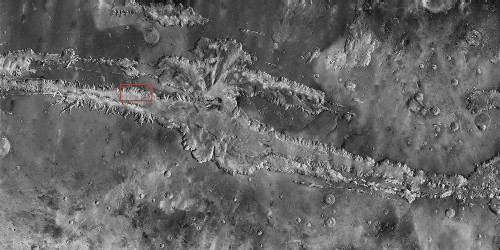
NRU.jpg
Credit: NASA/JPL/Arizona State University

By James Dacey

For a period around the turn of the 20th century, a number of people began to believe that the Martian surface may be patterned with a network of canals created by some kind of intelligent civilization. This theory emerged after primitive observations by the Italian astronomer Giovanni Schiaparelli in 1877 revealed a series of long straight lines around the planet’s equatorial region.

Telescopes have come a long way since then and I think we can say fairly confidently that the surface markings are more likely due to natural geological processes. However – as is often the case in observational astronomy – the truth is just as awe-inspiring.

This image shows Valles Marineris, the “Grand Canyon of Mars”, which sprawls wide enough to reach from Los Angeles nearly to New York City, if it were located on Earth. It is a snapshot taken from a new interactive global map of the Martian surface produced by stitching together nearly 21, 000 images captured by the Thermal Emission Imaging System (THEMIS) – a multiband infrared and visual camera on board NASA’s Mars Odyssey Orbiter.

The map allows you to zoom in on specific geological features, such as craters and volcanoes, to a resolution of 100 m. It could be used by scientists to study the mineralogy and physical geology of the Martian surface.

NASA says that the map will also help with the selection of a landing site for its Mars Science Laboratory (MSL) mission, which is due to launch in 2011. Once this craft has landed, a NASA rover will collect samples to see whether the planet could have supported life at some point in its history. So you never know – it may turn out that the Martian surface has been sculpted by little green men after all.

Copyright © 2026 by IOP Publishing Ltd and individual contributors