Canada aids search for the African Einstein

The Canadian government has pledged C$20 million to help develop a network of specialized science and technology centres across Africa. Canadian Prime Minister, Stephen Harper, made the announcement on Tuesday during a special visit to the Perimeter Institute for Theoretical Physics in Waterloo.

The money will be used to expand the African Institute of Mathematical Sciences (AIMS), which exists to recruit and train African researchers and to promote mathematics and science across the continent.

“Just as ideas and innovation are the foundation of Canada’s new economy, they will be the basis of Africa’s future economic, educational, scientific and governance self-sufficiency,” said cosmologist Neil Turok, director of the Perimeter Institute, speaking yesterday.

Looking for the next Einstein

Turok, who was born in South Africa, founded the original AIMS in 2003 – a small postgraduate centre in Cape Town. In 2008 he went on to instigate the Next Einstein Initiative, which led to the opening of a second institute in the Nigerian capital, Abuja. The initiative seeks to create a network of 15 centres across the African continent by 2020, enabling 750 extra African scientists to complete courses each year at postgraduate level.

The money donated by the Canadian government will support a planned network of five postgraduate schools across Africa, including new centres in Ethiopia, Ghana and Senegal. In his presentation yesterday, the Canadian Prime Minister explained the motivation behind the investment.

“Humanity’s ascent from ignorance and barbarism to enlightenment and equality has been a fitful and uneven process. If there is, however, a universal constant in human affairs, it is that the expansion of knowledge and technology has continuously made life better for more people. That’s why our government is supporting scientific and technological research, as well as development at home and abroad.”

Connecting Africa

I believe that connecting Africans to each other and to the world through science is one of the best investments one can make in Africa’s future. Stephen Hawking

Also in attendance yesterday was cosmologist Stephen Hawking, an AIMS patron as well as a research chair at the Perimeter Institute. “I was lucky to visit AIMS in South Africa, in 2008, to enjoy the remarkable atmosphere, filled with the students’ enthusiasm for math, science and the future of Africa,” he said. “I believe that connecting Africans to each other and to the world through science is one of the best investments one can make in Africa’s future.”

This announcement came on the same day that Mohamed Hassan, the executive director of the Academy of Sciences for the Developing World (TWAS) called for a renewed focus on developing science capacity in Africa. “Africa needs urgently to revitalise its school and university education systems to develop a pool of skilled scientists in partnerships with European universities,” he said during his keynote speech at the Euroscience Open Forum in Turin, Italy.

Hassan believes that the development of scientific academies and electronic libraries will play an important role in developing African science as well as protecting African ideas and traditional knowledge from piracy.


Have you ever wanted to photograph a particle accelerator?

photowalk.jpg
Photograph taken at the 2009 Photowalk at DESY (Courtesy: interactions.org)

By Hamish Johnston

Today I received a press release for an event called the Particle Physics Photowalk.

The idea is that amateur photographers are given access to five of the world’s leading accelerator labs for a day – a “rare opportunity to photograph state-of-the-art accelerators and detectors in all their beauty and complexity”, says the release.

The participating labs are CERN in Switzerland; DESY in Germany; Fermilab in the US; KEK in Japan; and TRIUMF in Canada.

How generous, I thought, for CERN to shutdown the LHC for a day to let in a gaggle of shutterbugs!

I forwarded the press release to a colleague who is a keen amateur photographer and he was on the phone immediately to CERN.

It is bad news, I’m afraid – the LHC will be completely off limits, including the control room.

Of course it’s silly to expect CERN to shutdown the LHC for a bunch of amateur photographers, but barring them from the control room seems a bit mean!

You can register for the Photowalk here.

NRU update: reactor okay to restart

NRU.jpg
Inspection work at NRU: the reactor will restart shortly (Courtesy: AECL)

By Hamish Johnston

There must have been a collective sigh of relief from North American medical physicists yesterday when the Canadian Nuclear Safety Commission said that the NRU reactor can resume operations.

Located at Atomic Energy of Canada’s Chalk River, Ontario lab, the ageing reactor makes Mo-99, which is used to make the medical isotope Tc-99m. NRU normally supplies North America with Tc-99m and accounts for a significant chunk of world production.

Over the past few years the supply of Tc-99m has been interrupted by two unscheduled safety-related shutdowns – with the current shutdown lasting over one year. Yesterday’s announcement means that production should resume by the end of this month.

As well as causing delays for medical procedures the debacle has also had political consequences, with the president of the Canadian Nuclear Safety Commission being sacked in 2008.

It has also encouraged Canadian physicists to think of new ways of making medical isotopes that don’t involve ancient and unreliable reactors. Indeed, the TRIUMF accelerator lab in Vancouver has just announced that it will build an electron linear accelerator that will produce radioactive isotopes. You can read all about the C$63m ARIEL facility here.

Proton is smaller than we thought

The radius of the proton is significantly smaller than previously thought, say physicists who have measured it to the best accuracy yet. The surprising result was obtained by studying “muonic” hydrogen in which the electron is replaced by a much heavier muon. The finding could mean that physicists need to rethink how they apply the theory of quantum electrodynamics (QED) – or even that the theory itself needs a major overhaul.

A proton contains three charged quarks bound by the strong force and its radius is defined as the distance at which the charge density drops below a certain value. The radius has been measured in two main ways – by scattering electrons from hydrogen and by looking very closely at the difference between certain energy levels of the hydrogen atom called the Lamb shift. Until recently the best estimate of the proton radius was 0.877 femtometres with an uncertainty of 0.007 fm

This Lamb shift is a result of the interactions between the electron and the constituent quarks of the proton as described by QED. These interactions are slightly different for electrons occupying the 2S and 2P energy levels and the resulting energy shift depends in part on the radius of the proton.

The heavier the better

However, in muonic hydrogen the Lamb shift is much more dependent on the proton radius because the much heavier muon spends more time very near to – and often within – the proton itself.

Now an international team led by Randolf Pohl at the Max Planck Institute for Quantum Optics in Garching, Germany has measured the Lamb shift in muonic hydrogen for the first time and found the proton radius to be 0.8418 fm with uncertainty 0.0007 fm. While this is by far the most precise measurement to date, it is in striking disagreement with previous measurements, being well outside the error bars of earlier results.

The team measured the shift using a proton accelerator at the Paul Scherrer Institute in Switzerland to create a beam of muons, which was then fired at hydrogen gas. Whenever a muon collides with a hydrogen molecule, it knocks the molecule apart and replaces the electron to create muonic hydrogen. About 1% of the time the muon finds itself in the 2S state, where it can be excited to the 2P state by absorbing a photon from a laser pulse. The 2P state then decays with the emission of an X-ray.

Complicated calculation

By counting the number of such X-rays while scanning the frequency of the laser pulse, the team could make a very precise measurement of the photon energy required to drive the 2S-2P transition. This is then fed into a complicated QED calculation to obtain the radius of the proton.

Pohl told physicsworld.com that the team has been working on the measurement for the past 12 years and got the first inklings of the anomalous result about six years ago. Since then, the researchers have reviewed, repeated and improved their measurements so that they are confident that the results are correct.

According to Jeff Flowers of the UK’s National Physical Laboratory there are three possible explanations for the discrepancy. The most likely is that QED is correct, but has been misapplied in what he describes as a “very difficult calculation”. Alternatively there is a problem with the experiment – but Flowers, who was not involved in the measurement, believes that Pohl’s team has done an excellent job. The least likely – but most exciting explanation – according to Flowers is that there is something wrong with QED.

‘Big philosophical change for physicists’

While QED rests on a weak mathematical foundation, it has been extremely successful in predicting the outcome of experiments. “Changing QED would be big philosophical change for physicists”, says Flowers.

The result has already caused a flurry of experimental and theoretical activity, with some physicists carefully redoing Lamb shift calculations and others trying to improve electron-based measurements of the proton radius.

Meanwhile, Pohl’s team will repeat its experiment and do a new series of measurements on muonic helium to measure the radius of the helium nucleus.

The research is described in Nature.

Efficient nano motor cleverly harnesses light

Researchers at Lawrence Berkeley Labs and the University of California have made a new nanoscale motor that can drive a disc 4000 times bigger than itself. It is powered via the so-called “plasmonic effect” and could be used to manipulate ultra-small objects like DNA and for powering nanoelectromechanical machines (NEMS). At merely 100 nm across the motor looks like a tiny windmill, inspiring the researchers to dub it a “light mill”.

Scientists have long known that light can be used to move nano-objects thanks to the fact that photons have both linear and angular momentum. Transferring the linear momentum from photons to an object results in an optical force that can be exploited for trapping (for example, in “optical tweezers”) and cooling. And the angular momentum carried by photons can induce a mechanical torque via light scattering or absorption.

Being able to generate large optical torques at the nanoscale could benefit a host of applications such as nanomechanical transducers in energy conversion, and also for manipulating and detecting tiny biological molecules. However, the main hindrance is that light–matter interactions are very weak because of the small optical constants of the dielectric materials used in such devices. This means that micron- or even millimetre-sized objects are required to generate a useful amount of torque.

Increasing interaction

In recent years researchers have discovered that they can increase the interactions between light and matter by taking advantage of the electrons that oscillate collectively at the surface of metals – called “surface plasmons”. Light fields are enhanced when they are resonant with these plasmons – an effect that has already been successfully used in techniques like single-molecule detection and surface-plasmon enhanced Raman spectroscopy (SERS).

The Lawrence Berkeley team – led by Xiang Zhang – has now exploited this effect to make a nanoscale plasmonic motor directly driven by light. The motor is made from gold structures that comprise four small circuits whose resonant frequencies depend on the geometry and dielectric properties of the metal. The 100 nm sized device can rotate a silica disc that measures 2 µm across thanks to its strong interactions with light via the plasmonic effect.

By tuning the wavelength of the light used, the motor can be made to rotate in a certain direction or at certain speeds. For example, when illuminated with a 1 mW power light beam at a wavelength of 810 nm, the disc rotates in an anticlockwise direction at a rate of 0.3 Hz. When illuminated by the same power beam but at a wavelength of 1700 nm, the disc rotates clockwise at the same speed.

Simplifying the process

Since the torque results solely from the shape of the plasmonic structure itself (which was a metamaterial-type structure carefully designed by the Berkeley researchers) and its enhanced interaction with light, the device does not require light beams with a predefined angular momentum to work. This is in contrast to previous devices in which the illuminating beam’s polarization had been adjusted for it to be able to rotate objects. Any simple light source, such as linearly polarized or unpolarized beam can thus be used to drive the new set-up.

The motor could be ideal for powering NEMS and for bio-applications, such as DNA winding and unwinding. It might also be useful for harvesting solar energy, after some modifications in design to optimize its performance for such an application – for example, making it more susceptible to a broader spectrum of light wavelengths. “Several motors can also be easily combined for larger power, like the cylinders in a car motor,” team member Ming Liu told physicsworld.com.

The research, which was funded by the US Department of Energy and the National Science Foundation, was published in Nature Nanotechnology.

About this video

Filmed through water, a silica microdisc embedded with a gold, gammadion-shaped light mill nanomotor rotates in one direction under illumination from laser light at 810 nm wavelength. When the wavelength is switched to 1715 nm, the rotational direction is reversed. Torque is produced when the laser light frequencies resonate with the frequency of the metal’s plasmons. (Video courtesy of Zhang group)

'Master of the path integral' speaks in London

lindau3.jpg
Edward Witten at the Institute of Physics

By Hamish Johnston

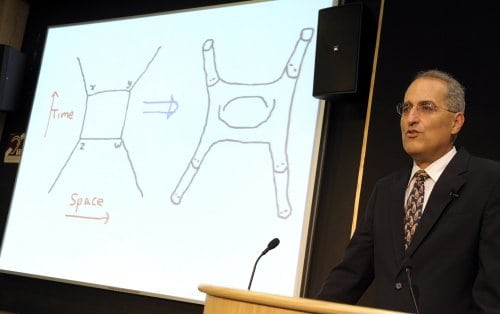
On Friday I took the train up to London to learn about “the theory that nobody wanted”.

That’s how Cambridge University’s Michael Green described string theory in his introduction to a lecture of the subject by Edward Witten.

And how did he describe Witten?

“Master of the path integral”.

Witten was in town to accept the 2010 Isaac Newton Medal from the Institute of Physics – and to give the 2010 Newton Lecture.

Witten is Charles Simonyi Professor of Mathematical Physics at the Institute for Advanced Study in Princeton, New Jersey and a pioneer in what must be the most controversial theory of modern physics.

Instead of plunging the audience into all 10 – or is that 11? – dimensions of the theory, Witten took a very gentle and historical approach to its development.

I entered the lecture hall knowing very little about string theory, so do I feel enlightened?

Well I suppose I have a better understanding of how and why the theory emerged and the various twists and turns it has taken. But I was continually frustrated by a lack of connection to measurements that can be made in the lab or with a telescope. I suppose this could be just a cultural issue – my background is in experimental condensed-matter physics.

The dearth of experimental evidence could soon be over with the emergence of “precision cosmology” – the latest example being the Planck mission’s unprecedented measurements of the cosmic microwave background, which could help to refine string theory.

Witten’s lecture was filmed and this, along with an interview, will soon be released by the IOP. Stay tuned for more.

Birds flock with scale invariance

Rome is famous for its huge flocks of starlings that swerve through the evening sky as if directed by a collective intelligence. While these spectacular displays have fascinated Romans since ancient times, they have yet to be described effectively by a mathematical model.

Now physicists in Italy have analysed 3D photographs of the Eternal City’s famous flocks using techniques borrowed from statistical mechanics. They found that a change in direction of one bird can affect the behaviour of all its companions – regardless of the size of the flock. This, argue the physicists, ensures a maximal response to environmental perturbations such as attacks by predators.

The work is part of an international collaboration between biologists, ornithologists and physicists called StarFlag, which aims to understand the rules of collective animal behaviour.

“Although it is possible to construct models that reproduce flocking behaviour, typically these are not based on an empirical analysis of observational data,” explains StarFlag member Irene Giardina, from Istituto Sistemi Complessi, Consiglio Nazionale delle Ricerche (CNR). “We felt the scientific dialogue between theory and experiment was missing.”

Bird watching in 3D

Even with the latest digital cameras and image-processing software, analysing flocks of birds is no easy task. In order to collect 3D data of the birds, the team used stereoscopic photography. This in itself presented a challenge. “Imagine the difficulty of taking high-resolution photos of thousands of far-away objects that are continually moving,” says Andrea Cavagna, also a physicist at CNR. “Now imagine doing this simultaneously with two fixed cameras you can’t move. Once we were set up, we could only fish in one place.”

You have two pictures, both essentially full of black dots, and you have to tell who is who Andrea Cavagna, CNR

The biggest obstacle, however, was matching data from both cameras. “You have two pictures, both essentially full of black dots, and you have to tell who is who,” says Cavagna. “This problem has arguably held up the entire field for 50 years.” By approaching the issue as an optimization problem, the scientists were able to develop algorithms based on statistical physics, and successfully match thousands of birds.

The result is a large data set describing the motions of individual birds, which was then studied using the mathematics of statistical physics to quantify the interactions among the starlings. Previous flocking models had assumed that an individual bird only interacts with others within a certain radius, but the Italian team found that an individual interacts with a fixed number of nearest neighbours, regardless of the distance to those neighbours. This means that information about the change of direction of any individual is quickly shared throughout the entire flock, and its transmission is not limited by a fundamental distance scale.

The critical point

This “scale invariant” correlation is significant because it is indicative of critical behaviour that occurs at a phase transition – when a material spontaneously transforms from being solid to liquid, for example. At a critical point, the smallest of perturbations can push the system into either one of the two states. In most physical systems, a critical point is reached by changing an external parameter, such as temperature. Cavagna and colleagues speculate that for the birds to flock at a critical point, the relevant external parameter must be evolutionarily hard-wired into the birds’ behaviour to help the creatures avoid predators.

Frank Heppner, an ornithologist from the University of Rhode Island in the US, finds the work of the physicists “remarkable”. He points out, however, that starlings typically do not fly in the spectacular formations seen at sunset at Rome. “Although it is absolutely legitimate to ask ‘How do they do it?’, an equally interesting point from a biological perspective is, ‘Why don’t they do it more often, and why do few bird species do it?'”

Cavagna acknowledges that, as well as contributing to the understanding of collective animal behaviour, his team has a lot to learn from biologists. He told physicsworld.com that he now hopes to apply its methodology to other members of the animal kingdom, such as insects.

The work is described in Proceedings of the National Academy of Sciences.

Name that element, part 2

By Michael Banks

Last year, we asked physicsworld.com readers to submit their best names for element 112, which was discovered in 1996 by Sigurd Hofmann and his group at the Centre for Heavy Ion Research (GSI in Darmstadt, Germany.

The responses ranged from Unobtanium, Collossium and Planckium to Fibonaccium (which was my favourite).

Now, the International Union of Pure and Applied Chemistry (IUPAC, which develops standards for naming new elements and compounds, may be looking for a name for element 114 after researchers at GSI observed 13 atoms of Ununquadium.

Ununquadium was first synthesized in 1999 when Sergey Dimitriev and his team at the Joint Institute for Nuclear Research in Dubna, Russia, claimed to have produced a handful of atoms.

IUPAC states that the production of any new element must be independently verified at another lab first before it can be officially recognized. That happened at the GSI lab last month as well as at the Lawrence Berkeley National Laboratory in the US, which produced two atoms of element 114 in September last year.

IUPAC has not yet officially recognized the element, but when it does it will invite the team in Dubna to submit a name. IUPAC will then publish the name on its website, giving scientists and the public six months to scrutinize and comment on it.

After all the suggestions Hofmann received last year for element 112 he submitted Copernicium, in honour of the astronomer Nicolaus Copernicus. The IUPAC then approved the name and gave it the symbol Cn.

So, physicsworld.com readers, what are your suggestions for element 114?

A scientist born to question

gaiablog.jpg
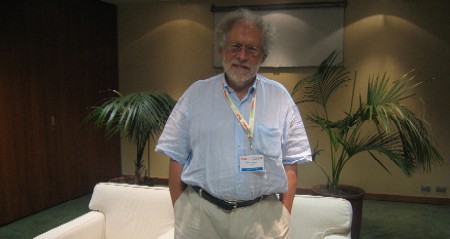
Anton Zeilinger, before giving today’s plenary lecture

By James Dacey in Torino

It’s the end of my third and final day here at the Euroscience Open Forum in Torino and I’m reaching that point of exhaustion you get to after dashing around a huge conference centre for several days straight. These things would be so much easier if you could somehow turn up at several sessions simultaneously. But that’s just the tiredness making me silly, right?

Well one man who would never say the word impossible is Anton Zeilinger, the quantum information luminary from the University of Vienna.

Zeilinger was giving the evening’s plenary lecture and he used the platform to wax lyrical about the beauty of quantum mechanics, but also to remind everyone that no theory is ever perfect and that we always need to think outside the bounds of accepted logic.

Zeilinger of course has been a pioneering figure in many areas of quantum information science including quantum cryptography, teleportation and quantum computing.

Before his lecture the free-thinking Austrian was generous enough to give me an hour of his time for an interview, and it proved most enlightening. He is one of those academics who will happily let his ideas run away with him as he always seems to be looking beyond your question to the bigger implications.

In the hour we discussed many things including Zeilinger’s admiration for Einstein’s stubbornness (even when he was wrong), and his desire for children to be exposed to quantum mechanics from a young age, perhaps through incorporating the concepts into computer games.

The full interview will appear on physicsworld.com in the near future. For now though, from me in Torino, it’s arrivederci.

US physicists call for change in nuclear licensing

The American Physical Society (APS) is urging the US Nuclear Regulatory Commission (NRC) to change its licensing rules over fears that smaller, more efficient ways of enriching uranium will increase the risk of nuclear proliferation. The APS wants the NRC to force anyone applying for licences to submit a “proliferation review” as part of their submission. The NRC, which over the next few years is expected to be reviewing new licence applications for new nuclear technologies including the use of lasers to separate uranium isotopes, has given no immediate reaction. “It usually takes 30 days [to respond] once we receive a petition,” NRC spokesperson Ivonne Couret told Physics World.

The APS’s concern stems from a report – Technical Steps to Support Nuclear Arsenal Downsizing – that its Panel on Public Affairs issued in February. The group put particular emphasis on the separation of isotopes by laser excitation (SILEX) which, the petition states, “is both 75% smaller and substantially more energy efficient than centrifuge technology”. Few details exist on how SILEX works but it involves shining laser light on uranium hexafluoride (UF6) molecules, which then absorb the incoming photon, causing the UF6 molecules to separate to leave a uranium-235 nuclei.

“The study group found that some of the new technologies could represent proliferation game changers because they would lead to smaller, more efficient methods for production and use of nuclear materials that would be more difficult to detect,” the APS’s petition to the NRC states. Other organizations have also recognized the danger. Both the International Atomic Energy Authority and the US National Nuclear Security Agency have established programmes to spot new technologies, including laser enrichment, that have proliferation potential.

It is possible there have been advances that make it a significantly easier prospect for potential proliferators Richard Lester, a nuclear engineer at Massachusetts Institute of Technology

The fact that the SILEX process has only now come close to commercialization indicates that “it is not necessarily an easy technology for countries or sub-national groups to abuse,” says Richard Lester, a nuclear engineer at Massachusetts Institute of Technology, who supports the APS’s recommendation. Lester says he did his PhD on laser enrichment more than 30 years ago just when people were beginning to be concerned with the proliferation risks associated with laser technology. “It is possible there have been advances that make it a significantly easier prospect for potential proliferators so it is entirely appropriate that the NRC pay attention to proliferation possibilities,” he says

But it is not only SILEX that the APS is worried about. “The committee’s concern was not just to identify one technology,” says Francis Slakey, associate director of public affairs at the APS. “We did not identify particular technologies apart from lasers, but we looked at the technology trend: reactors out there will be smaller, more efficient, and more prone to proliferation.”

The APS calls for the NRC to require that licence applications for fuel cycle facilities contain a “proliferation review” that should include “sufficient technical information to permit an assessment of the risks that construction and operation of the proposed facility might pose.” If the NRC accepts the petition, it will probably call for public comments on the proposed new rule. The commission will then analyse the comments and forward the final rule for approval by the five NRC commissioners.

Copyright © 2026 by IOP Publishing Ltd and individual contributors