

Graphene could revolutionize DNA sequencing


By feeding individual strands of DNA through nanometre-sized holes, researchers in the Netherlands say they have proved the principle of a revolutionary new DNA sequencing technique. The breakthrough is part of a worldwide race to develop fast and low-cost strategies to analyse these codes that underpin the chemistry of life.

The genetic profile – or “genome” – of an organism is determined by recording the full sequence of acid base pairs that make up its DNA. In 2003, the Human Genome Project made history by determining the entire human genetic code – 3 billion DNA base pairs that took 13 years to analyse using a technique that has changed very little since the late 1970s.

This pioneering project used a “shotgun” approach, which first isolates a DNA strand and forces it to copy itself millions of times over in a chemical reaction. These strands are then “blasted” into tiny fragments because current techniques can only analyse very short sections of DNA. Finally, a supercomputer matches up overlapping base patterns to piece together the full genome.

However, with the promise of personalized medicine, scientists are working to develop new technologies that could rapidly sequence an individual’s genetic make-up. In addition to the human genome there are also slight variations in DNA sequences and processes that give people their phenotypes such as “blue eyes” or “blond hair”.

Promising idea

In 2008, physicsworld.com reported one promising idea that involves passing DNA through tiny punctures in a sheet of graphene – an extremely strong sheet of carbon just one atom thick. A voltage is applied along the graphene surface as DNA strands are passed slowly through the slit one base at a time. The idea is that each of the four bases – A, C, G and T – will have a unique effect on the conductance of graphene across the gap.

Now, Cees Dekker and his colleagues at the Kavli Institute of Nanoscience are the first team to demonstrate DNA motion through graphene, although their technique cannot yet read the genetic code.

They create a series of pores ranging from 5 to 25 nm in diameter by placing flakes of graphene over a silicon nitride membrane and drilling nanosized holes in the graphene using an electron beam. By applying a voltage of 200 mV across the graphene membrane, a series of spikes are observed in an electric current that scales the gap. These, say the researchers, correspond to drops in conductance when DNA strands slide across the gap via a biochemical process known as translocation.

The researchers intend to develop their research by identifying which spikes correspond to particular bases. Dekker told physicsworld.com that one area of science that could benefit in particular from ultrafast sequencing is epigenetics – that is, the study of changes in phenotypes that are not related to changes in underlying DNA sequences.

Henk Postma, a researcher at California State University, Northridge, who is also developing nanopore sequencing, is excited by the result. “They have demonstrated that DNA does indeed go through little holes in graphene, and that it does so with great speed. Both of these are important advancements towards using graphene for DNA sequencing,” he says.

This research is published in Nano Letters.
Nanofibres power portable electronics

A new kind of miniature energy harvesting device that generates electricity using nanometre-sized fibres has been unveiled in the US. The nanogenerator could harvest energy from human or other motion to power wireless sensors, personal electronics and even medical implants, claim its inventors at Stevens Institute of Technology and Princeton University.

“We are particularly excited about using the nanofibre-based generators in bio-compatible situations, like embedding the devices in shoes and clothing to harvest energy from the motion of the human body to charge personal electronics such as iPod batteries and cell phones,” says team leader Yong Shi, who is a mechanical engineer at Stevens.

The new high power output devices are based on lead zirconate titanate (PZT) nanofibres. PZT has a high piezoelectric voltage and dielectric constants – ideal properties for converting mechanical energy into electrical energy. Unlike bulk thin films or microfibres, PZT nanofibres prepared by electrospinning processes are also highly bendable and mechanically strong.

Embedded in a soft polymer

Shi’s team made the nanogenerator by depositing electrospun PZT nanofibres on preformed arrays of electrodes on a silicon substrate. The nanofibres are around 60 nm in diameter and they were embedded in a soft polymer (polydimethylsiloxane, PDMS) matrix. The finished device can be released from the silicon substrate or prepared on flexible substrates, depending on the application desired.

When mechanical pressure is applied on the top surface of the ensemble, it is transferred to the nanofibres via the PDMS matrix. This results in electrical charge being generated thanks to the combined tensile and bending stresses in the nanofibres as they move. This results in a voltage between two adjacent electrodes.

The researchers say that, for a given volume of nanogenerator, the nanofibre device generates much higher voltages and power than devices made from semiconductor piezoelectric nanowires for the same energy input. In theory, the maximum output power from a piezoelectric nanogenerator depends on the properties of the active materials, so the higher the piezoelectric voltage constant of the material between two electrodes, the higher the output voltage and power. What is more, varying the length of the active materials between the two electrodes will also vary the voltage output and current at the same time, explains Shi.

The devices could be used to power wireless sensors, personal electronics and, in the future, biosensors and bioactuators that are directly injected into the human body.

Powered by blood flow

Arthur Ritter – who is director of biomedical engineering at Stevens and was not involved in the research – said, “One of the major limitations of current active implantable biomedical devices is that they are battery powered. This means that they either have to be recharged or replaced periodically. Shi’s group has demonstrated a technology that will allow implantable devices to recover some of the mechanical energy in flowing blood or peristaltic fluid movement in the gastro-intestinal tract to power smart implantable biomedical devices.”

And, because the technology is based on nanostructures, it could provide power to nanorobots in the blood stream for extended periods of time, he adds. Such robots could transmit diagnostic data, take biopsy samples and/or send wireless images directly to an external database for analysis.

The team now plans to optimize the structure of its nanodevice and simplify the fabrication process. “We are also working hard on implantable bio-applications,” revealed Shi.

The work was reported in Nano Letters.

Memorable climate scientist passes away

By James Dacey

I was surprised this morning to read about the death of Stephen Schneider, the outspoken climate scientist from Stanford University.

I saw Stephen in February giving an impassioned defence of the science of anthropogenic climate change at the AAAS conference in San Diego. He stood out from the other presenters on the panel because of his memorable delivery style – combining a deep, holistic knowledge of climate science with a razor-sharp acerbic wit.

Schneider was a key player in the climate science community. He was the founder and editor of the journal Climate Change, and he authored and co-authored more than 450 scientific papers during his career. Schneider was also enlisted by the Intergovernmental Panel on Climate Change (IPCC), holding roles in the working groups for both the third and fourth (latest) scientific reports.

Physicworld.com recently reported new research co-authored by Schneider, which assessed the credentials of climate scientists. It came to the conclusion that sceptics of the basic tenets of anthropogenic climate change are less credible scientists than those who accept them.

Climate change scepticism was an issue Schneider touched on during his talk in February. He voiced his frustration with media representations of climate science debates, which he felt gave a disproportionate voice to the sceptics in the name of journalistic balance. He pleaded that journalists should be more responsible, and that more climate scientists should engage with the media given the political significance of their work.

Schneider died yesterday of an apparent heart attack.

Entrusted with the key to the free electron laser

By Hamish Johnston
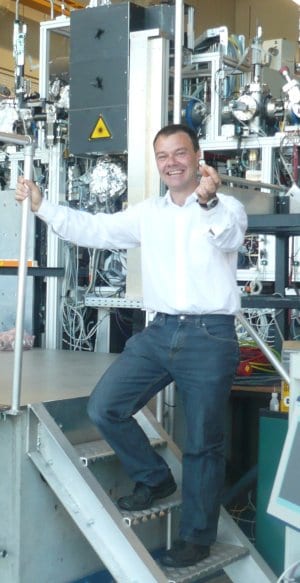
flash2.jpg

On Friday the Physics World video crew was at DESY in Hamburg, Germany to film two interviews, which will be broadcast in September on physicsworld.com.

Our host was DESY’s Christian Mrotzek, who did a fantastic job of setting up the interviews and scouting locations to film.

One such location was the experimental hall of the FLASH free electron laser. Christian is such a trusting soul that he left Joe McEntee and me with a key to the facility while he drove our film crew around the DESY campus.

That’s me with the key on the right.

We were tempted to start up the laser and fire off a few femtosecond pulses, but we couldn’t find the on switch. That’s another reason why Joe and I should have paid more attention to modern languages at school.

In the FLASH hall I spoke to Edgar Weckert, who is director of photon science at DESY. We chatted about plans for the new-and-improved FLASH II and he explained how FLASH is informing the development of the European X-ray Free Electron Laser, which is being built in Hamburg.

My other interview was with DESY’s director Helmut Dosch, who explained how the lab was making the transition from being a particle physics facility to becoming a centre of excellence for “photon science”.

The last particles collided at DESY in 2007, when the HERA ring shut down. By then the lab was already home to FLASH and work had just begun to convert the PETRA injector ring to the PETRA III synchroton light source.

Dosch took over as director in March 2009 and is the first condensed-matter physicist to run DESY.

Now, there seems to be no looking back as the lab plans its future as a leading experimental facility for chemistry, materials and biological science – and of course, condensed-matter physics.

Perhaps that’s not good news for particle physicists in Germany, but it means that a much broader spectrum of science will be done at DESY.

Fibres form all-in-one speaker and microphone

Researchers at the Massachusetts Institute of Technology (MIT) in the US have created a new generation of fibres that, they claim, can both detect and produce sound. The fibres, which contain a tree-ring structure of piezoelectrics, electrodes and polymers, could have a range of applications that include medical imagers and microphones weaved into clothing.

Conventional fibre optics, which transmit light across their length through a process of total internal reflection, have become crucial for modern industry. Without them, we would have none of the long-distance, high-bandwidth communications that we take for granted today.

But over the past decade physicists, including those at MIT, have begun to develop fibres that are more complex than just solid glass. One example is photonic-crystal fibres, which contain holes running throughout their length to exhibit unusual optical properties. Unlike conventional fibres, photonic-crystal fibres can carry light of high power in the infrared, which is particularly useful for cutting tissue in medicine.

Some fibres have even been built to contain a range of conductors, insulators and semiconductors – suggesting the future might see many electronic devices make the transition from chip to fibre.

Pole position

Now, MIT’s Yoel Fink and colleagues have succeeded in what might be the most challenging fibre construction yet: a piezoelectric surrounded by electrodes. Piezoelectrics – materials that respond to stress with a generated electric field, and vice-versa – are tricky to draw into fibres. The process requires heating, and this tends to make a piezoelectric mix with adjacent materials, such as those making the electrodes.

Moreover, once drawn, many piezoelectrics have to be “poled” – that is, have internal molecules lined up in a strong electric field – but metal electrodes are not uniform enough to do this effectively.

The MIT group solved these problems with electrodes made of a conducting polymer, which avoids mixing and which can supply large electric fields. The researchers began with a “preform” of the fibre about the size of a torch, and then heated it to over 200 °C while stretching it to over a thousand times its initial length. Once drawn, they supplied a voltage of several kilovolts to align the molecules and restore the piezoelectric effect.

The resultant fibres can be made to act as a loudspeaker by passing an electric field between the two electrodes around the fibre, which causes the crystal to change shape and vibrate, emitting sound. Conversely, the fibres can act as a microphone because sound makes the crystals vibrate, putting them under stress and so generating an electric field. In both cases, the fibres operate from kilohertz to megahertz frequencies.

Smart clothes

“This is very interesting and innovative research that can have important applications in smart clothes, flexible and wearable sonic-wave detectors, high-performance stereo systems, and sensors and transducers,” says Zhong Lin Wang, a researcher at the Georgia Institute of Technology, US, who showed in 2008 how piezoelectrics could harvest energy in shoes and fabric. “This could inspire much new research in the field.”

Indeed, the MIT group has a host of applications up its sleeve. Wrapped round the body, the fibres could provide a means to map the inside of a body using ultrasound. On much larger scales, the fibres could be strewn through the ocean to monitor water-current flows.

“This paper is a first step to prove the principle of multi-material piezoelectric fibres,” explains MIT group member Zheng Wang. “We’re going to tailor our fibres for many applications…[and] we’re also pursuing ideas of integrating piezoelectric elements with other functional-fibre devices already demonstrated in our group.”

The research is published in Nature Materials.

IPCC warns its scientists to avoid the media

Scientists have reacted with dismay at a letter sent out by the Intergovernmental Panel on Climate Change (IPCC) advising them not to talk to journalists. The letter was published just two days before the publication of a review of the “Climategate” affair that criticized researchers at the University of East Anglia for lacking openness.

IPCC chairman Rajendra Pachauri sent the letter on 5 July to each of the 831 experts selected to take part in preparing the panel’s fifth assessment report (AR5) on climate change. This report is due to be published in 2013 and 2014 and follows on from the fourth assessment released in 2007, which concluded that global warming is real and very likely due to increasing levels of greenhouse gases in the atmosphere due to human activities. The assessment exercise is made up of three working groups that will deal with the fundamental science and impacts of climate change as well as mitigation and adaptation strategies.

In his letter Pachauri wrote that increased scrutiny of the IPCC “imposes on us a heavy responsibility to see that errors of any kind are completely eliminated from the AR5” and that as a result the panel would have to “work diligently and with a level of rigour perhaps not seen in previous reports”. (The IPCC having come under heavy criticism earlier this year for erroneously stating in the 1997 report that Himalayan glaciers could disappear by 2035.) Pachauri then went on to offer his “sincere advice” that researchers “keep a distance from the media” and that any questions about that researcher’s working group be directed to the co-chairs of that group while general queries about the IPCC should be forwarded to the panel’s secretariat.

Peter Cox, a climate modeller at the University of Exeter in the UK and a member of the science working group, believes that Pachauri’s advice is fairly routine. He says that working group members are free to talk to journalists about their own work but that they should avoid talking about IPCC procedure because it is so complex.

However, climate modeller Ben Kirtman, of the University of Miami in the US, also a member of the science working group, describes the letter as “extremely poorly worded” and “poorly timed”. The letter was sent out just two days before the publication of the review of Sir Muir Russell into the Climatic Research Unit at the University of East Anglia following the leak of compromising e-mails sent by members of the unit. Russell concluded that the researchers’ “rigour and honesty as scientists are not in doubt” and that his review team “did not find any evidence of behaviour that might undermine the conclusions of the IPCC assessments” but did admonish the researchers and the university for “failing to display the proper degree of openness”.

Kitman maintains that Pauchari should “have simply reminded researchers that they don’t formally represent the IPCC”, a stance that Pauchari himself took in response to an e-mail from New York Times journalist Andrew Revkin on 9 July. “Most of my colleagues recognize that the world is watching, in fact the world might be spying,” continues Kitman. “We are trying to carry on and be as objective and transparent as humanly possible.”

Writing in his blog, University of South Carolina geographer Edward Carr, a member of the adaptation working group, accused the IPCC of having a “bunker mentality” and said that the only way the organization can avoid future damaging episodes like “Climategate” is to operate with “complete openness”.

Inquiry relights tensions in South African astronomy

A new inquiry into the management of one of South Africa’s biggest science facilities is to be held by the science and technology committee of the country’s parliament. The inquiry will look into the South African Large Telescope (SALT), although there is confusion over the specific allegations and who has levelled them.

This year has been a turbulent time for the South African Astronomical Observatory (SAAO), which operates SALT. In March, the director of the SAAO, Phil Charles, was reinstated to his post after having been cleared of allegations by the National Research Foundation (NRF) of leaking confidential information on telescope and management proposals.

However, on 25 June the chair of the science and technology committee, Nqaba Ngcobo of the African National Congress (ANC) party, told national radio that the committee would begin an inquiry into “possible mismanagement of funds and conflict of interest” within SALT management. He said the inquiry was prompted by a report from the NRF and calls from shadow science minister Marian Shinn of the Democratic Alliance (DA) party.

Yet a spokesperson for the NRF has said it is unaware of any report, while Shinn has said she only ever wanted an investigation into the NRF’s motives behind Charles’s suspension – a decision she claims damaged South Africa’s standing in the scientific community.

“I can only assume that [the inquiry] is an attempt by individuals within the NRF executive management and their ANC proxies in the committee to continue their vendetta against Charles,” wrote Shinn after the radio announcement.

In an interview with Physics World, Ngcobo now claims he had indeed acted on the calls from Shinn, by requesting a report from NRF leadership about Charles’s suspension. Ngcobo says it was on seeing this report that he decided parliament ought to do a full inquiry – one that also tackled potential issues at SALT. “It seems that there are many people who are affected and as parliament we are not going to only investigate what [Shinn] wants, we are going to investigate everything,” he adds. “We are going to call everyone who is affected by this report to tell us what he knows or what she knows.”

Yet Ngcobo refuses to say what specific allegations the NRF report contains. “If you come [to the inquiry], you will know what reports I am referring to,” Ngcobo says, adding: “I’m not going to go into details because some parts of the report are confidential.”

Ngcobo’s words will do little to put the minds of SAAO members at ease. The general allegations of SALT mismanagement are completely different to those previously levelled – and rescinded – at Charles, which raises the question of why they were not investigated before. According to SALT’s financial director, the telescope has received clean audits since its inception.

To complicate matters further, the chair of the NRF board has today published a separate report looking at the circumstances surrounding Charles’s suspension. It refers to none of the new allegations, but – in a move that is bound to win approval from senior astronomers – recommends a revised framework of management for South African astronomy by way of a national Astronomy Advisory Board, chaired by “an independent researcher of stature”. Senior astronomers had feared such a board would be chaired by a non-scientist, such as an NRF employee.

Charles declines to comment on the inquiry, but welcomes the NRF board recommendations as “a very positive step forward” for South Africa’s astronomy governance. “It is particularly gratifying that this comes at the same time as the SAAO has been selected as the site of the International Astronomical Union’s global office for astronomy development, and major repairs and refurbishment to SALT are coming to a successful conclusion,” Charles tells Physics World.

Ngcobo expects to set the inquiry into SALT management in motion at the beginning of next week.

Geologists map likely location of diamonds

An international team of geophysicists has created a map that predicts the locations of diamonds across the Earth. This is the first image of its kind, and it is generated by linking geological processes at the surface with dynamics occurring much deeper in the planet’s interior.

“[The map] is of course very interesting for academics and how our planet works but will prove a useful exploration tool in further search for diamonds,” Trond Torsvik at the University of Oslo, who led the research, told physicsworld.com. He revealed that some of the co-authors have worked with diamond companies in Africa, which have now become of aware of this potentially useful tool.

Upwelling hot rocks

Most natural diamonds are billions of years old and typically formed in the Earth’s mantle under high pressures at depths below 150 km. The rare few diamonds that make it to the surface are elevated through the mantle by rapidly ascending magma, which cools at the surface to form igneous rocks known as kimberlites.

Torsvik and his colleagues suggest that the upwelling magma in the upper mantle is triggered by hot pulses of mantle rock ascended from far greater depths. These features of the mantle, called plumes, are believed to originate at depths of nearly 3000 km – at the boundary between the mantle and the underlying core – and they can remain fixed there for millions of years.

By contrast, the tectonic plates at the Earth’s surface are moving relative to each other by typically 0–100 mm each year. For this reason, Torsvik’s team reconstructed the movement of plates over the past 320 million years to work out the locations at the surface that have been above mantle plumes at certain times during the current geological eon. This enabled them to generate a map of the likely location of kimberlites across the Earth’s surface.

Treasures beneath Africa

The resulting map (above) shows that 80% of kimberlite locations (black dots on the map) should lie within or alongside the African continent in a relatively narrow ring. These locations lie above a stable band at the core boundary (thick red line on the map) believed to be the origin of mantle plumes. The most anomalous kimberlites younger than 320 million years (white dots on the map), are in the Slave geological region of Canada, which was close to a tectonically active continental margin at the origin of their eruption.

David Evans, a geophysicist at Yale University in the US, is impressed by the scale of this research. He cites, among other things, the group’s links with industry as a key to their success. “Torsvik was able to obtain the diamond industry database of precise ages on the kimberlites – still not publicly released in full, but evident graphically from his paper’s figures”.

This research is published in this week’s Nature.

Topological electrons reach the next step

Physicists in the US have shown that electrons in topological surface states keep their high conductivity despite the presence of surface defects. The experiment confirms a key prediction about the behaviour of electrons on the surface of a “topological insulator” – a newly discovered state of matter that promises a wealth of new physics and that could have practical applications in electronics and quantum computing.

Topological insulators are of great interest in condensed-matter physics because of their unusual conduction properties. Although electricity does not flow easily through the bulk of these materials – hence their name – current does flow well on their surface. Topological insulators could therefore be used as ultrathin conductors for electronic devices, and may even harbour new types of quasiparticle that are insensitive to the environmental noise that plagues quantum computers.

The strange properties of topological insulators arise because the shape – or topology – of the electron energy bands makes it impossible for a surface electron to backscatter. If such an electron is on a terraced crystalline surface with successive atomic steps, theory predicts that the electron will not be scattered if it travels perpendicular to the steps. This is unlike electrons on the surfaces of normal metals, which are strongly reflected at steps.

On the terraces

Ali Yazdani and colleagues at Princeton University set out to test this prediction by studying electrons on the surface of a single crystal of antimony. Antimony is a semi-metal and therefore not strictly a true topological insulator, but it does have topological surface states.

The team began by placing an antimony crystal in an ultrahigh vacuum chamber, where it was cleaved to expose a clean terraced surface. The sample was then cooled to 4 K and its surface was analysed using a scanning tunnelling microscope (STM).

The STM measures the density of electron energy states on the surface. These electrons tend to be confined to individual terraces and their energy states are simply the solution to that classic problem of undergraduate quantum physics – the particle in a box.

Half and half

However, because the electrons exist in topological states they can “leak” out of the terraces if they are moving perpendicular to a step. This leakage widens particle-in-a-box energy states, which can be seen in the STM images. By measuring their width, Yazdani and team worked out that electrons in the topological surface states were transmitted across a step edge about 50% of the time, and reflected the other 50%. By contrast, when similar experiments are done using normal metals such as copper there is effectively zero transmission across step edges.

According to Yazdani, the transmission is not 100% because antimony’s electron states are more complicated than topological surface states on other materials. The transport of topological surface electrons is also dependent upon the direction of their spin – and in antimony the band structure and spin properties are such that the surface electrons can both transmit through and reflect from defects. In other materials, reflection can be completely forbidden.

Important feature

Indeed, the ability to measure both transmission and reflection is an important feature of the experiment. While the STM technique works very well on antimony, Yazdani points out that it is not appropriate for studying the surfaces of some other topological insulators where there is little reflection

The work is reported in Nature.

Huge telescope will struggle to find extraterrestrial life

The largest radio telescope ever to be constructed will struggle to listen in on extra-terrestrial civilizations like our own, according to two astronomers in the UK. Their calculations suggest that when the Square Kilometre Array (SKA) starts work in 2022 it will find it difficult to tune into radio signals from alien civilizations with Earth-like technology. The finding, they say, is further evidence that scientists must take a multidisciplinary approach to the hunt for intelligent life that doesn’t just rely on detecting radio signals.

The Search for Extra-Terrestrial Intelligence (SETI) has been patiently eavesdropping on the galaxy for potential alien signals for over 50 years, so far without success. As one of its many scientific objectives, the SKA will join the search in 2022, hoping to answer the age-old question of whether our civilization really is unique.

However, research by Duncan Forgan, at the University of Edinburgh, and Bob Nichol, at the University of Portsmouth, suggest that its chances of finding human-like civilizations are slim: just one in 10 million.

They built a computer model of a mock Milky Way galaxy to see how many intelligent civilizations it could likely support. “We wanted to give as strong as an assessment as we could for using the latest radio telescopes for SETI,” Forgan told physicsworld.com. The pair threw into the mixing pot the latest data on, among other things, stellar evolution, planetary system formation and habitable zones – the area around a star warm enough for a planet to have liquid water on its the surface.

10,000 civilizations per galaxy

To calculate the best-case scenario for SKA success, they optimistically assumed that if an Earth like planet sits in the habitable zone it would always go on to host intelligent life. From this they were able to populate the galaxy with intelligent life by assigning stars random properties from a statistical distribution. Having run the model 30 times they found the average galaxy would be home to about 10,000 intelligent civilizations.

“We now have a data set of galactic civilizations over time and space,” said Forgan. “But there are factors which can prevent a civilization from being eavesdropped on: the civilization could destroy itself or be extinguished by an asteroid impact. However, more likely is that an advance in technology could make them harder to detect, ” he added.

On Earth, we have been leaking radio signals into space for almost a century and any nearby civilization could eavesdrop on our signals. Indeed SKA could detect us if it were placed anywhere up to 100 parsecs – 326 light-years – away. However, as our technology is improving, and the power required to generate such signals is decreasing, we are moving from a “radio loud” to a “radio quiet” planet.

Too old for loud radio

With these factors in mind Forgan and Nichol combined their galactic population findings with the constraints on mass extinction, based on the Earth’s fossil record, and the idea that a civilization is only “radio loud” for its first 100 years. They found the chances of radio communication between us and an Earth-like or a short-lived civilization, within the 100 parsec sensitivity limit of the SKA, to be one in 10 million.

However, this finding only applies to civilizations with technology akin to our own; it does not rule out stumbling across signals from a more highly developed civilization. “This is only one small part of SETI. Other SETI searches work on the assumption that they are looking for longer lived civilizations that emit, for whatever purpose of their own, rather stronger radiation,” stressed Alan Penny, a SETI researcher at the University of St Andrews.

Forgan would like to see more resources put into other methods to sit alongside and complement conventional radio SETI searches. “The way we are approaching SETI is quite one-dimensional. There will always be a place for radio communication but we are getting close to its limit and we should find other ways to try as well,” he said.

The research has been accepted for publication in the International Journal of Astrobiology and a preprint is available on arXiv.

Copyright © 2026 by IOP Publishing Ltd and individual contributors