Speedy star points to more massive Milky Way

The fastest star ever seen in the Milky Way’s ancient halo may boost estimates for our galaxy’s mass, say German astronomers. In order for its gravity to hold on to such a speedy star, the Milky Way must have roughly two trillion times more mass than that of the Sun.

The Milky Way boasts hundreds of billions of stars, but most of its mass is in the enormous – and invisible – “dark halo” that engulfs the bright galactic disc to which the Sun belongs. Thus, the Milky Way’s exact mass is unknown, with most estimates ranging from 1 to 2 trillion solar masses.

Now Norbert Przybilla, Alfred Tillich, and Ulrich Heber of Dr Karl Remeis Observatory in Bamberg and Ralf-Dieter Scholz of the Astrophysical Institute in Potsdam argue that the higher figure is probably correct.

Racing towards us

They studied a star called SDSS J1539+0239, which is racing toward us in the constellation Serpens. This is a horizontal-branch star, which means that it is in a more advanced stage of evolution than the Sun. Whereas the Sun generates energy by converting hydrogen into helium, this star converts helium into carbon and oxygen.

The team determined the star’s velocity in 3D by first working out three parameters. The first, and easiest, is the star’s Doppler shift, which reveals how fast the star moves towards Earth. Xiangxiang Xue of the National Astronomical Observatories in China and colleagues reported this two years ago to an accuracy of 2%.

Przybilla’s team then measured the second quantity: the star’s proper motion, which is the apparent movement, year after year, across our line of sight. By looking at the star’s changing position on photographic plates taken in different years, the astronomers determined the proper motion to an accuracy of about 20%.

Distance a difficulty

The third, and most difficult, quantity is the star’s distance, which the astronomers estimate is 39,000 light-years – plus or minus 20%. Together with the proper motion, the distance reveals the speed at which the star moves across our line of sight.

Relative to the galactic centre, the star is racing through space at roughly 694 kilometres a second. That is three times faster than the Sun and about 60 kilometres a second faster than the previous halo star speed record holder. “It was immediately clear that this star must be something special and interesting,” says Przybilla.

Indeed, the only stars faster are “hypervelocity” stars, shot out of the galactic centre by interactions with the Milky Way’s central supermassive black hole. But such stars may no longer be bound to the galaxy, so they don’t constrain its mass. By contrast, the star in Serpens is probably native to the halo. “It is coming towards us,” says Przybilla, “so the probability that it belongs to the Milky Way is very high.”

The star’s high speed means that the Galaxy must have at least 1.8 trillion solar masses or else the star would have escaped the Galaxy’s grasp. This mass estimate agrees with studies of galaxies orbiting the Milky Way, but it is twice as high as the figure that Xue’s team reached after studying Doppler shifts of halo stars.

‘Interesting and important’

“The result is interesting and important,” says Scott Tremaine, an astronomer at the Institute for Advanced Study in Princeton, New Jersey, who was not involved with the work. However, he does have concerns: “Most of the reason they’re getting this very high velocity for the star is because of the component across the line of sight,” he says. And that is where the greatest uncertainty lies.

Fortunately, help is on the way. In 2012, the European Space Agency will launch Gaia, a satellite to measure precise motions and distances for a billion stars, including the one in Serpens. Says Przybilla: “Gaia will be a revolution in our view of the nearby universe.”

The astronomers will report their work in The Astrophysical Journal and a preprint appears at arXiv: 1005.5026.

Glimpsing the birth of a distant star

Picture-4.png
Courtesy: A Marston (ESTEC/ESA) et al., JPL, Caltech, NASA

By James Dacey

Our telescopes have delivered so many incredible snapshots of the universe that there is a danger of us becoming a bit blasé about new images.

Not so with this one. This image of a future star as it is been born out of a cloud of gas and dust reminds us of just how beautiful the universe can be.

With the rather less inspiring name of L1448-IRS2E, it is located around 800 light-years away in the Perseus star-forming region, and was captured by the Submillimeter Array in Hawaii and the Spitzer Space Telescope.

It could well be the youngest known star, though it is still too dim to be classified as a true protostar by astronomers.

The discovery and characteristics of L1448-IRS2E are described in a recent paper in the Astrophysical Journal.

Neutrino plot gets thicker

Picture-4.png
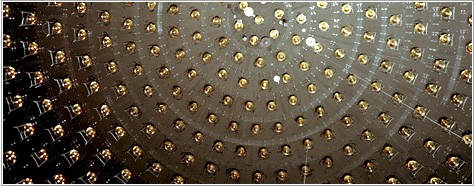
The inside of the MiniBooNE tank (Courtesy: Fermilab Visual Media Services)

By James Dacey

Last week, I reported a result to emerge from the MINOS experiment at Fermilab, which – if confirmed – will add a fascinating new dimension to our understanding of neutrinos. The researchers were looking at a feature known as neutrino oscillation, whereby these elusive particles mysteriously switch identity between the three different flavours of neutrino.

According to all conventional models, the extent to which this process occurs should be the same for neutrinos as it is for antineutrinos. But to their great surprise, the MINOS team discovered that this is not the case. They found that the energy over which this process occurs in muon neutrinos and muon antineutrinos (converting into tau neutrinos and tau antineutrinos, respectively) is different by around 40%.

A MINOS spokesperson, Jenny Thomas of University College London, told me that the audience was “very surprised” by the result when it was presented last week at the Neutrino 2010 conference in Athens, Greece. But the 2 sigma confidence level seems to have restricted the results to causing a minor ripple, not a soaring wave, in the particle-physics community.

Crashing in behind this MINOS announcement, however, is a new result at a fellow Fermilab experiment that will surely add momentum to their findings. Researchers at the MiniBooNe experiment say that they have seen a similar discrepancy but with muon neutrinos – at a lower energy – oscillating into electron neutrinos (and the related process for muon antineutrinos). What’s more, their results are presented to a confidence of 3 sigma.

David Wark, a neutrino physicist at Imperial College, London, says that if either MINOS or MiniBooNE are correct, “it would not be a surprise but an overwhelming shock”. He points out, however, that the experiments take measurements of different oscillations and don’t directly support each other. “In both cases, we need to see more data,” he says.

Fortunately for Wark (or unfortunately, depending on how big that shock is), MINOS and MiniBooNe are both continuing to take data for at least the next couple of years. It will be interesting to see what happens next.

Topological quintet bags Europhysics prize

Five physicists who brought us the quantum spin-Hall effect and topological insulators have been awarded this year’s Europhysics Prize from the European Physical Society’s condensed-matter division. The winners are Shoucheng Zhang of Stanford University; Charles Kane and Eugene Mele of the University of Pennyslvania; and Hartmut Buhmann and Laurens Molenkamp of Würzburg University in Germany.

Since being confirmed experimentally in 2007, the two related phenomena have become major topics of research in solid-state physics with hundreds of papers on the arXiv preprint server covering the subjects. The quintet’s pioneering research could also allow physicists to catch the first glimpse of an elusive particle called the Majorana fermion and lead to noise-resistant quantum computers.

Topological framework

Zhang, Kane and Mele are honoured for their theoretical work on the quantum spin-Hall effect (QSHE), which occurs in certain very thin insulators. It involves spin-up electrons conducting along one edge of the insulator, with spin-down electrons conducting along the opposite edge. The trio’s efforts laid down a theoretical framework for topological insulators – materials that are insulators in the bulk but are good electrical conductors on the surface.

In 2005 Kane and Mele proposed a general theory that predicts which materials are 2D topological insulators. The pair identified graphene – sheets of carbon just one atom thick – as a candidate, although it has not been feasible to establish this experimentally. Working independently, however, Zhang predicted in 2006 that mercury telluride should be a 2D topological insulator. This prediction was confirmed experimentally in 2007 by Buhmann and Molenkamp, the other two winners of this year’s prize.

Joel Moore of the University of California, Berkeley said the award is a “fitting recognition of an exciting discovery that shows the constructive interaction between theoretical predictions and experimental work in condensed matter physics”.

Since extended to 3D

Such materials are called 2D topological insulators because the effect occurs in extremely thin materials where the electrons are confined to two dimensions and the effect is related to the shape (or topology) of the electron wave functions. In 2007 Kane and Mele – and independently Moore, Leon Balents and Rahul Roy – realized that topological insulators can also exist in thicker 3D materials. This was confirmed experimentally in 2008 by Zahid Hasan and colleagues at Princeton University.

Marcel Franz of the University of British Columbia told physicsworld.com that 3D topological insulators “constitute a truly new phase of quantum matter”. “We thought we understood all the aspects of the band theory in solids but these recent developments show that in fact we completely missed some topological aspects that proved to be of fundamental importance,” he added.

Particle and anti-particle

Physicists are particularly keen to see what happens at the interface between a topological insulator and a superconductor. Some physicists believe that such structures could harbour a new type of quasiparticle reminiscent of the “Majorana fermions”, which were predicted in 1937 by the Italian theorist Ettore Majorana but have yet to be seen.

Majorana fermions are electron-like particles that are their own anti-particles. They are neither fermions nor bosons, and instead obey non-Abelian statistics. The quantum states of such particles are expected to be highly resistant to perturbations by environmental noise, making them ideal candidates for quantum computers.

Neutrino surprise emerges from MINOS

Researchers at Fermilab’s MINOS experiment have announced a surprise result that could point to a fundamental difference between neutrinos and their anti particles. The findings, if confirmed by further experimental runs, may help physicists to explore some of the elemental differences between matter and anti-matter.

The MINOS experiment is designed to test the theory that neutrinos can change between types in a process known as neutrino “oscillation”. When this idea was first muted in the 1950s it was controversial because it implies that neutrinos have mass, a feature that contradicts the Standard Model of particle physics. However, the theory has been supported by subsequent experiments, which have found the Sun to be producing fewer electron neutrinos than had been expected. It is also backed-up by an apparent shortfall in muon neutrinos produced by cosmic rays interacting in the Earth’s atmosphere.

It would not just demolish any particular model, it would require revision of the whole way we do particle physics. David Wark, Imperial College

The MINOS experiment was set up to study neutrino oscillation by making the first high precision measurements of a controlled beam of neutrinos produced within a particle accelerator environment. Each experimental run begins at Fermilab near Chicago where a target is bombarded with energetic protons to produce a beam of neutrinos, called the NuMI beam. This is fired through the Earth towards the Soudan mine in Minnesota, some 735 km away. Deep in the mine, the neutrinos interact with the MINOS detector, which consists of a large iron calorimeter in the presence of a magnetic field. MINOS is designed to make highly precise measurements of the energy spectrum of muons, which arise from interactions with the Fermilab neutrinos.

Dips and troughs

Where troughs appear in this energy spectrum, it is an indication that a number of muon neutrinos have oscillated into the less energetic tau neutrinos, which cannot be recorded in the detector. The energy range over which this dip appears can reveal information about the difference between the masses of the two neutrino types. A dip appearing at higher energies corresponds to a larger difference between the masses of the two different types of neutrino. When it began operations in 2006, the MINOS team were initially probing for the mass difference between muon neutrinos and tau neutrinos. After recording firing 7 x 1020 protons at the Fermilab target, they arrived at a result of 2.35 x 10-3eV2, which represents the square of the difference between the mass eigenstates (Δm2) of the two different types of neutrino.

However, more recently the MINOS team has switched its attention to antineutrinos, and the Fermilab NuMI beam was altered to produce a beam of muon antineutrinos. The detector in the Soudan mine operates in the same way except muon antineutrinos produce positively-charged muons rather than negative. Neutrino models suggest that antineutrinos should also oscillate between types, where Δm2 should correspond to the same value as their neutrino counterparts.

To their surprise, however, the MINOS team has recorded a Δm2 value of 3.35 x 10-3eV2 between muon antineutrinos and tau antineutrinos, which is larger than their neutrino result by approximately 40%. The neutrino value and the antineutrino value are inconsistent at a confidence level of 90–95%, which corresponds to a statistical significance of approximately 2 sigma. “While the neutrinos and antineutrinos do behave differently on their journey through the Earth, the Standard Model predicts the effect is immeasurably small in the MINOS experiment,” says Jenny Thomas, a spokesperson for the MINOS team based at University College London.

Out of the blue

Thomas says that the result has come “completely out of the blue”, but she warns that the particle physics community generally expects a statistical significance of 3 or 4 sigma before they start to take serious notice of a result. “Clearly, more antineutrino running is essential to clarify whether this effect is just due to a statistical fluctuation,” she adds.

David Wark, a neutrino physicist at Imperial College, London, shares a similar view. “[The uncertainty] isn’t a concern in the sense that it doesn’t show that they did anything wrong, it just shows that there is not enough data to make a strong conclusion.” Wark points out that if there is a difference in the oscillations of neutrinos and anti-neutrinos, this would have an enormous impact on both the Standard Model and local relativistic quantum field theory. “It would not just demolish any particular model, it would require revision of the whole way we do particle physics.”

The MINOS team will continue to take measurements of anti neutrino mass difference, with the current run coming to an end shortly, and the next one getting underway in September. “If the effect does prove to be real, then we could be looking at a 3 sigma significance by February 2012,” says Thomas.

The results were presented earlier this week at the Neutrino 2010 conference in Athens, Greece.

Condensate created in freefall

A Bose– Einstein condensate experiment – lasers and all – has been dropped repeatedly from a height of 146 m. Designed by an international team of physicists, the experiment has shown that delicate multiparticle quantum systems can be created and analysed in microgravity environments created during freefall. The result also suggests that it is possible to launch similar experiments into space, where they could test predictions of Einstein’s general theory of relativity.

Bose–Einstein condensates (BECs) are formed when identical atoms with integer spin are cooled until all the atoms are in the same quantum state. This means that a BEC comprising tens of thousands of atoms behaves as a single quantum particle. BECs can be used in matter interferometers, in which a quantum particle is “split” and sent along two different paths before being recombined at a detector – just like a pulse of light in an optical interferometer. Although such experiments have been done with single atoms, their precision is boosted significantly when a BEC is used.

Because BECs are massive objects they are particularly suited to interferometry experiments that measure tiny differences in gravity between two paths. Placing BEC interferometers in microgravity environments such as drop towers or parabolic flights, would allow physicists to test aspects of general relativity to much higher precision than is possible today. These include the geodetic effect and the Lense–Thirring effect, which describe the space-distorting effects of the Earth’s mass and rotation respectively.

Huge technical challenges

However, launching a BEC into space – or even dropping it a few hundred metres – involves huge technical challenges because the BEC must be prepared and maintained in ultrahigh vacuum at ultracold temperatures in a process involving the precise application of magnetic fields and laser light.

Now, Ernst Rasel and colleagues at Leibniz University in Hanover, Germany have built an entire BEC experiment that can be dropped repeatedly from a height of 146 m. The team, which also includes researchers from other universities in Germany, the UK and France, begins with collection of about 10 million cold rubidium-87 atoms. These are loaded into a magneto-optical trap within the drop capsule – a 215cm-long cylinder with a 60 cm radius. The capsule is positioned at the top of the ZARM drop tower in Bremen. When in freefall, gravity inside the capsule can be as little as 10–5 of terrestrial gravity.

The capsule is released and the team allow it to drop for 1 s to allow for the initial vibrations of the capsule to dampen out. The freefall continues as the atoms are further cooled by a laser technique called “optical molasses”, followed by evaporative cooling to create a BEC of about 10,000 atoms at a temperature of about 10 nK.

Expanding BEC

Next, the BEC is released very gently from the magnetic trapping potential, putting it in a state of very slow expansion. This is necessary for long observation times since faster expansion would quickly make the condensate too dilute for imaging – which is done by shining a laser on the BEC and looking at the shadow it casts on a CCD camera.

The team were able to track the motion of the BEC relative to the capsule as the freefall continued for another 1 s. They found that the centre of mass of the BEC moved about 3 mm relative to the capsule over this time. This motion is not of gravitational origin. Instead, the team has shown that most of this effect is caused by tiny residual magnetic fields inside the experiment.

Analysis of the expansion of the BEC also revealed the presence of residual fields, which stretched the BEC along the vertical direction and squeezed it horizontally.

Rasel told physicsworld.com that the team will soon repeat their measurements using a BEC made from atoms in a slightly different quantum state. These are not affected by stray magnetic fields and will therefore lead to a better tool for making gravitational measurements.

Atom interferometer planned

Looking further into the future, the team also plans to build a microgravity atom interferometer in which the atoms are split into two states and then recombined by the absorption and emission of photons. They also plan to create BECs containing two types of atom to see if both behave in the same way.

The research is partially funded by the German Space Agency, and Rasel hopes that it could lead to BECs being studied in space. Such experiments could be used to detect gravitational waves and the comparison of experiments in space and Earth could provide very precise tests of the equivalence principle of general relatively.

Holger Mueller of the University of Calfornia, Berkeley, said that the experiment “represents a very important milestone” in the development of atom interferometers that can be deployed in space. “Space operation requires new technology that is very, very challenging to develop”, he added.

The work is described in Science.

Brazil and Spain top the table

Picture-4.png
Ibero-America Courtesy: Wikimedia Commons

By James Dacey

Academic institutions in Spain and Brazil account for nearly 70% of all scientific papers from Ibero-America published during the period 2003–2008. This political region incorporates Spain, Portugal and countries in the Americas that are former colonies of these two European nations.

The study, carried out by the SCImago Research group, found that Spain and Brazil each produced around 200,000 papers during this period, while Portugal was lagging in third place with just 50,000.

There are nearly 670 higher-education institutions within Ibero-America, with nearly 50% of these in Brazil, Colombia and Spain. Colombia’s relatively modest scientific output – just 9792 papers – is attributed to the country’s high number of small academic institutions.

The study also ranked the nations on other factors, including quality of publications (based on citations) and extent of international collaboration.

The full report (in Spanish) is available here.

Jinxed isotope reactor could soon be running

nru.jpg
NRU could be up and running soon

By Hamish Johnston

The shortage of medical isotopes caused by the year-long shutdown of Canada’s NRU reactor could soon be over.

Atomic Energy of Canada (AECL) – which operates the 53-year-old facility in Chalk River, Ontario – will appear before the Canadian Nuclear Safety Commission on 28 June to ask permission to restart the reactor.

If it gets the thumbs up, AECL says that isotope production could resume by the end of July.

Over the past few years the supply of Mo-99, which is used to make the medical isotope Tc-99m, has been threatened by two safety-related shutdowns of the ageing reactor. Normally, NRU supplies North America with Tc-99m and accounts for a significant chunk of world production.

The first shutdown began in December 2007 and lasted one month. The second started in May 2009 and is ongoing.

You can read more about how AECL plans to restart NRU here .

‘Dark pulse laser’ could improve telecoms

A new type of laser that emits “dark” pulses could provide better signals for telecommunications, according to physicists in the US who have created the device. The dark pulses, which consist of intensity dips in an otherwise continuous beam of laser light, are effectively the opposite of the bright bursts in a normal pulsed laser.

“The laser emits a brief pulse of darkness, if you will,” explains one of the researchers Richard Mirin, who is at the National Institute of Standards and Technology (NIST) in Boulder, Colorado. “And so you can think of it as a continuous-wave laser that has a really fast shutter in front of it.”

Dark lasers are not entirely new. For some 20 years, physicists have been able to create so-called dark soliton lasers. Solitons are light pulses that propagate without spreading, and are often used in fibre optics. Their dark counterparts are simply gaps in a continuous beam that do not spread either. But dark solitons are difficult to create and, when they are created, it is done outside the laser using a combination of tricky pulse-shaping techniques.

The new dark pulse laser, on the other hand, forms the dark pulses inside the laser itself. “We believe ours is the first example of a direct generation of a dark pulse,” says Mirin.

Quantum-dot diode laser

We believe ours is the first example of a direct generation of a dark pulse Richard Mirin, NIST

Mirin, whose colleagues work at NIST and JILA, a joint institute of NIST and the University of Colorado at Boulder, based his dark pulse laser on a standard quantum-dot diode laser. This type of device contains a tiny junction between a positively doped semiconductor (p-type) region, which has holes in its normal electronic structure, and a negatively doped semiconductor (n-type) region, which has a surplus of electrons.

When an electric current is driven through the junction, electrons and holes recombine inside the quantum dot, releasing energy in the form of light. This light is amplified using an adjacent cavity, thereby generating a laser beam.

Negative solutions

Quantum-dot diode lasers can be made to produce pulsed or “mode-locked” light rather than continuous light by tailoring the cavity, and this is governed by the Haus equation, named after the late Slovene-American physicist Hermann Haus. Pulses are described by solutions to the equation, which includes terms that relate, for example, to current injection and efficiency. In the past, researchers have generated bright pulses by considering the positive solutions to the equation. But now, Mirin and colleagues have looked at the negative solutions to generate dark pulses.

For tests, the NIST/JILA team built a quantum dot from indium gallium arsenide and topped it with a 5 mm long semiconductor waveguide. Measuring the output with a fast photodetector, they recorded a train of dark pulses, each of which was 90 × 10–12 s (90 ps) wide and just 30% of the normal intensity.

“Mode-locked lasers, – that is, pulses of light on zero background – have been along for quite a while now and have very wide applications, both in science and technology,” says Andy Weiner, a researcher at Purdue University, US, who has done previous work on dark soliton lasers. “So there is some intrinsic interest if you discover a different operation mode for a mode-locked laser, such as dark pulse mode as in this paper.”

Will it catch on?

Mirin suggests that his group’s dark pulse laser could find applications in telecommunications, because the dark pulses are less prone to disperse than regular, bright pulses. But Weiner thinks it is unlikely to catch on. “Current practice and directions in lightwave communications are such that I don’t think it likely there will be practical interest in dark pulse lightwave communication systems.”

The research is published in Optics Express.

Stretched molecule puts a new spin on electrons

Physicists in the US have invented a way of measuring the magnetic properties of a single molecule as it is being stretched. The technique provides a new approach for studying quantum chemistry and how the spin of an electron affects its passage through tiny structures. The technique could one day even be adapted for use in spintronic devices, which use the spin of the electron to process and store information.

The technique explores an effect first explained in 1964 by the Japanese physicist Jun Kondo. He showed that, at very low temperatures, a conduction electron in a metal such as gold can pair up with an electron of opposite spin associated with a magnetic impurity (such as iron). This tie-up curtails the electron’s ability to conduct current, resulting in a drop in the conductivity of the metal in these chilly conditions.

Physicists have observed this low-temperature fall in conductivity – known as the “Kondo effect” – in a number of bulk materials. However, something very different can happen when electrons confront just a single magnetic impurity, such as a magnetic molecule or a magnetic quantum dot. Studies of electrons flowing from one metallic electrode to another via the magnetic impurity reveal a sharp peak in the conductance of the dot or molecule at zero voltage – dubbed a “Kondo resonance”.

Jumping the barrier

For non-magnetic molecules or quantum dots, conduction is governed by the repulsive electrostatic force between an electron in the metal and an electron in the molecule or dot. Any electron wishing to hop from an electrode and into a molecule or dot must overcome this barrier. In a magnetic system, however, the same pairing interaction described by Kondo lowers this barrier, allowing an electron to jump onto the molecule or dot – and then jump off the other side.

Although this effect has already been seen in dots and molecules with one magnetic electron (spin ½ systems), studying it in higher-spin systems could shed further light on how conduction electrons behave in magnetic materials. Now, a team led by Dan Ralph at Cornell University has studied a Kondo resonance for the first time in a spin 1 molecule. The researchers have also shown that the resonance can be modified by stretching the molecule along one direction.

Triplet state

In the experiment, the team used lithography to first create a gold bridge just 500 nm long and a few tens of nanometres thick and wide on a silicon substrate. A section in the middle of the bridge was removed and a single molecule, comprising one magnetic atom (cobalt) and six pyridine rings, was put in its place.

Cobalt has two magnetic electrons that arrange themselves into a triplet state – a set of three quantum states with identical energies. Both spins point in the same direction, giving cobalt a total spin of 1. When the sample was cooled to about 1.6 K, the team noticed a big drop in the electrical resistance of the molecule at zero applied voltage – the hallmark of a Kondo resonance.

Ralph and colleagues then stretched the molecule by as much as 0.08 nm by bending the silicon substrate. The Kondo resonance was seen to split into two peaks, one on either side of zero applied voltage. According to Ralph, this splitting occurs because stretching the molecule breaks the cubic symmetry of the molecule that is responsible for the triplet states all having the same energy. Instead, one state drops in energy and the size of the drop is related to the size of the splitting.

The team confirmed the magnetic nature of the splitting by repeating the experiment in an applied magnetic field. When the field was applied perpendicularly to the direction of stretch, the splitting gradually got bigger as the field strength was turned up. However, when the field was applied parallel to the stretch, the size of the splitting changed significantly as the field strength was varied. According to Ralph, this behaviour confirms that they are observing a Kondo resonance in a spin 1 molecule.

Ralph and colleagues also looked at how the conductance at zero voltage changes as the sample is warmed from 1.6 K to about 30 K. The drop in conductance was that expected for a spin 1 Kondo resonance.

‘Important experiment’

Pablo Jarillo-Herrero of the Massachusetts Institute of Technology describes the work as “an important experiment” that could lead to better quantum-chemistry calculations, which yield the spin states of a molecule. He also believes that the work could result in the development of tiny magnetic memories that store information in terms of the spin state of the molecule. The work could even lead to the development of new sources of spin-polarized electrons and switches that can turn spin currents on and off.

Ralph told physicsworld.com that the team is now trying to repeat the experiment using electrodes made from a magnetic metal rather than gold. This would allow spin-polarized electrons to be injected into the molecule – which could be an important first step towards the creation of “spintronic” devices.

Copyright © 2026 by IOP Publishing Ltd and individual contributors