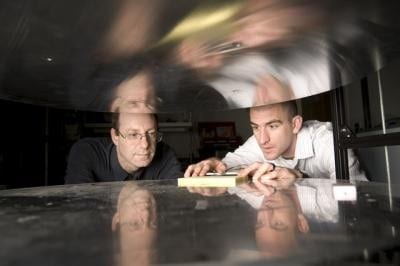
David Smith (left) is philosophical about metamaterials
By James Dacey
In March, a group of researchers in the UK and Germany grabbed the science headlines when they unveiled the world’s first optical cloak that could hide an object in three dimensions. Okay, the thing they hid may only be a microscale bump but the researchers say their design could in principle be scaled up into a full Harry Potter-style invisibility cloak.
A new paper, however, on the arXiv preprint server has poured cold water on the breakthrough by pointing out a slight flaw in the cloak design – namely that it doesn’t really hide things.
Cloaking requires special materials known as metamaterials, which possess unique optical properties. The trick is to create a material whose optical properties are constantly changing so that it “steers” waves around an object as if it were not there.
This recent breakthrough involves a type of cloak known as a “carpet cloak” because it involves smoothing out a bump on a surface as if flattening out a ruck in a rug. The researchers stacked nanofabricated silicon wafers on top of one another to produce a distribution of refractive indices. As light reflected off the surface, it appeared as if the device (and the bump it was hiding) was not there.
To engineer the carpet cloak, the researchers had to modify a conducting surface to create a grid in which the mechanical and optical properties are uniform in all directions. And this is the point where the technology breaks down – claim a trio of researchers in this arXiv paper.
Bae-Ian Wu and his colleagues at Massachusetts Institute of Technology are concerned that a cloak that is isotropic could never truly hide an object. Instead, it shifts an object to the side by an amount related to the angle of incoming light: change your viewing angle, you still see the object.
To illustrate their point, they trace a ray of light as it approaches a bump of 0.2 units from an angle of 45 degrees. According to the calculations, the ray is shifted laterally by 0.15 units.
The solution, they say, is to create a cloak whose optical properties are anisotropic, i.e. they vary depending on orientation.
I got in touch with John Pendry of Imperial College in London who was involved in the recent cloak design to get his reaction. “We already knew that the isotropic cloak was not exact, the question is by how much,” he said. “The first step [in the research] was the exact specification of the cloak which made objects truly invisible when viewed against a mirror background. However this exact prescription requires anisotropic optical materials and would be very difficult to manufacture.”
I also got in touch David Smith, at Duke University in the US, who is credited with creating the first metamaterial cloak back in 2006. “The carpet cloak is not really a cloak, as we know, but a different example of a transformation optical structure,” he said.
Smith was philosophical, however, about the achievements in metamaterial research so far. “The optics world has lived for 100s of years with imperfect optics! If our goal is not to make something perfect, but make something that is less poor than what exists, our chances of success are much greater. Transformation optics and quasi-conformal techniques help us do just that.”
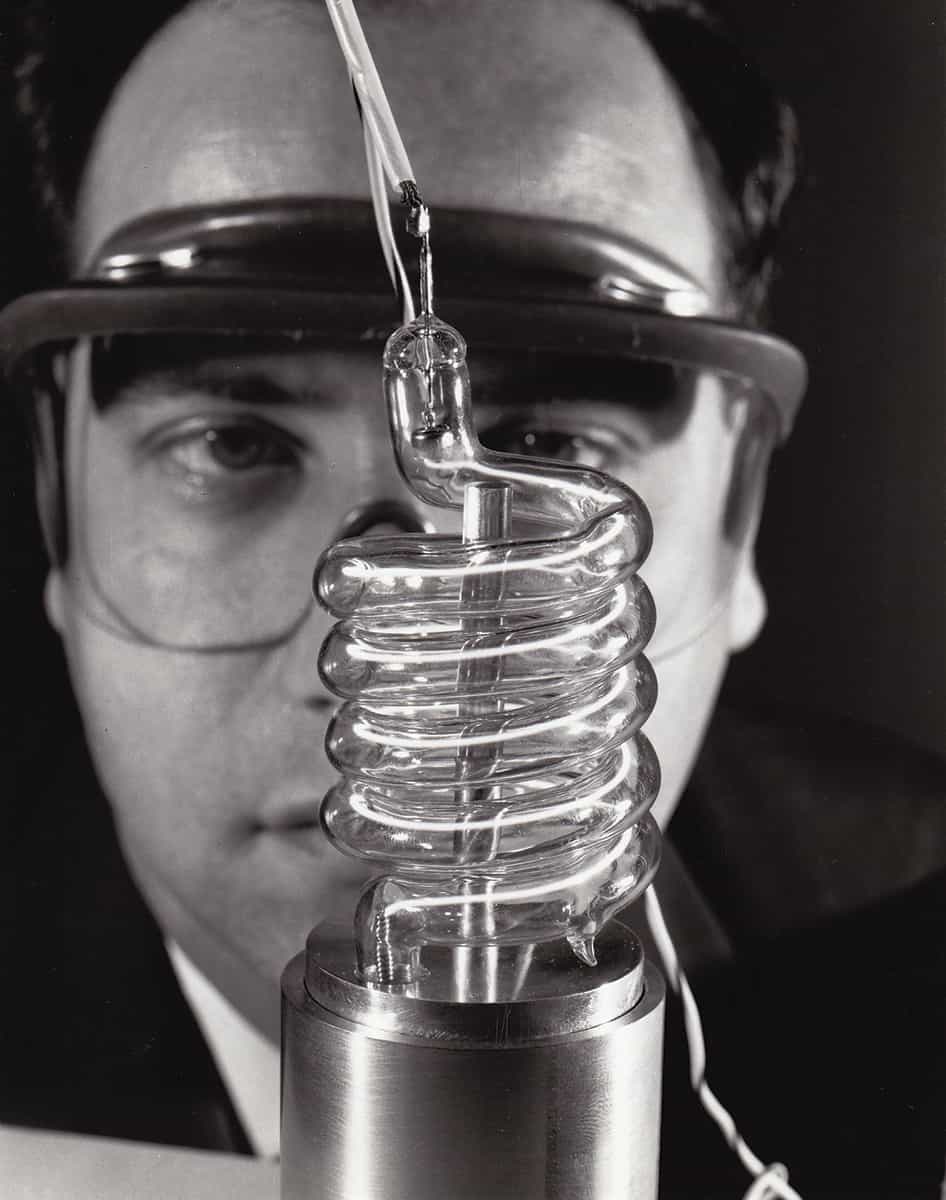
The real thing Ted Maiman with the first laser prototype. (Courtesy: Theodore Harold Maiman)
The race to make a laser began with Bell Laboratories. In the late 1950s the then Bell Telephone Laboratories was a well-funded research institute in Murray Hill, New Jersey, that already had a string of high-profile achievements to its name – including the transistor, which was invented in 1947 by John Bardeen, Walter Brattain and William Shockley. A few years later, a Bell Labs research group led by Charles Townes proposed a device that could produce and amplify electromagnetic radiation in the microwave region of the spectrum. By 1953 the researchers had turned their theory into a working device, which they called a maser – an acronym for microwave amplification by stimulated emission of radiation. And in December 1958, Townes and his brother-in-law Arthur Schawlow wrote a famous paper (Physical Review112 1940) describing how the maser concept could be extended into the optical regime, to make the first “infrared and optical maser” – in other words, a laser.
So if there was going to be a race to build a laser, it was a race that Bell Labs fully expected to win. But the favourites quickly faced competition. Townes had been consulting at Bell Labs, but by the time his 1958 paper was published he was back at Columbia University. There, he began trying to make a laser using hot potassium vapour – the medium described in the paper. Schawlow decided not to go into direct competition with Townes, and so selected ruby as an alternative potential laser material, in part because Bell Labs had a good supply of synthetic rubies for maser research. A second Bell Labs team was studying visible emissions from calcium-fluoride crystals doped with various rare-earth metals; a third, led by Townes’ former graduate student Ali Javan, was trying to build a gas laser using helium and neon.
Beyond Bell Labs, other research institutes around the world soon joined the race. In the US alone, there were major research efforts going on at General Electric, IBM, the Massachusetts Institute of Technology’s Lincoln Laboratory, RCA Laboratories and Westinghouse Research. Another strong contender was Townes’ former student Gordon Gould, who had independently come up with an idea for a sodium-vapour-based device in 1957 – coining the term “laser” in the process. The following year Gould abandoned his PhD thesis and joined TRG, a private research company, so he could pursue his ideas. The company won a $1m grant from the defence-related Advanced Research Projects Agency to work on the laser, but Gould was barred from taking part in the project because it was classified and he could not get security clearance.
Late entry
The dark horse in the race was Theodore Harold Maiman, who was then at Hughes Research Laboratories, the research arm of the Hughes Aircraft Company. Maiman was an engineer by training who had switched to physics, studying the fine-structure splittings of energy levels in excited helium atoms at Stanford University under Willis Lamb, who had won the 1955 Nobel Prize for Physics. In the quest to make a laser, Maiman’s engineering and physics experience would both prove essential.
Maiman entered the race late, at the point when many researchers appeared to be on the point of giving up. Moreover, Hughes took some persuading to fund his interest in lasers. After all, it was in the aerospace business. What would it do with a beam of light? However, Hughes did have a contract with the US Army Corps of Engineers to make a maser. This turned out to be Maiman’s opportunity.
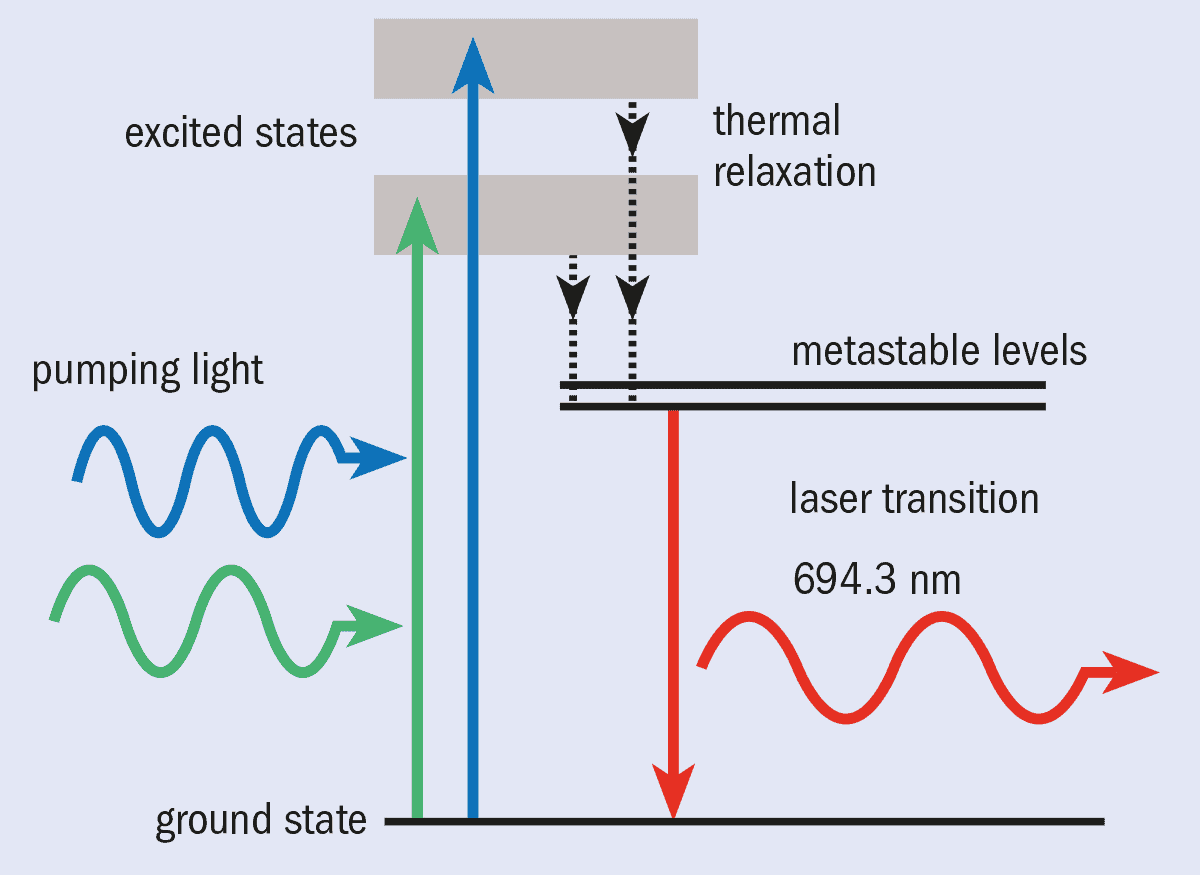
1 A three-level system in pink ruby Chromium ions in pink ruby absorb light in the green and blue regions of the spectrum. In the presence of this pumping light, electrons in the ions are promoted to excited states, where they then rapidly decay to one of two metastable levels. The unusually long lifetime (about 4 ms) of these levels allows more than half of the available electrons to build up there, creating a population inversion – the condition needed for lasing to occur.
“Ted struck an agreement with Hughes,” Maiman’s wife Kathleen recalled during an interview with Physics World (Maiman died in 2007, aged 79). “If he was successful in delivering the maser for the Army Corps of Engineers, he would be given nine months and $50,000 to actually make coherent light. He went to work to make the maser more practical, and took it from 5000 lbs to 2.5 lbs and also improved the linewidth. Because of that, he was able to do a dedicated project on the laser.”
Like Schawlow, Maiman started investigating ruby as a laser material because he was familiar with its properties from his maser work. Ruby is a crystal of aluminium oxide containing a tiny amount of chromium – about 0.5% in the case of gemstone ruby, and about a 10th of that in “pink” ruby used for industrial applications. As well as emitting microwaves, pink ruby also strongly absorbs light in the green part of the optical spectrum, and fluoresces in the red. Such behaviour is a consequence of pink ruby’s three-level energy system (figure 1). When pink ruby absorbs green light, electrons are promoted from the ground state to a higher energy level. The electrons then lose energy through thermal relaxation (lattice vibrations), ending up in an intermediate, metastable energy level. Decay from this metastable level back to the ground state is responsible for the red fluorescence, and this was the transition Maiman hoped to use in his laser.
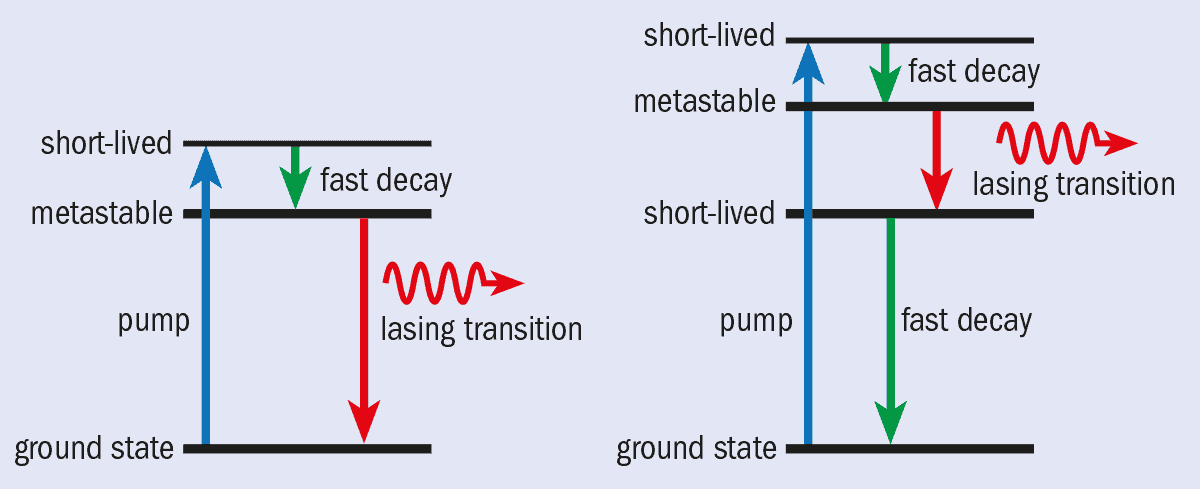
But in September 1959, shortly after Maiman started his project, Schawlow publicly declared that pink ruby could not possibly work as a laser. For stimulated emission to occur, more electrons need to reside in the upper energy level than a lower one – a condition known as a population inversion. Schawlow argued that it would be too difficult to achieve this inversion in a three-level system because the ground state in such a system is usually full of electrons. He maintained that it would be much easier to achieve population inversion in a four-level system containing an empty energy level between the ground state and the metastable level (figure 2).
With respected scientists counselling against pink ruby, Maiman’s employer was reluctant to continue funding his idea, which it was doing out of its own pocket. But Maiman was not deterred, because it was clear from Schawlow’s comments that he was considering a cryogenically cooled laser. As Maiman wrote in his memoirs, The Laser Odyssey (2000 Laser Press), “the possibility of room-temperature operation had been dismissed out of hand”.
2 Three- and four-level laser systems In a three-level laser system, more than half of the particles in the laser medium must be pumped out of the ground state and into the metastable state (via the short-lived excited state) for a population inversion to occur. Achieving this requires a very intense pumping light. Population inversion in a four-level laser system, in contrast, occurs whenever the population of the metastable state exceeds that of the lower short-lived state. Hence, only a few particles need to be excited before stimulated emission can take place.
Maiman’s only moment of real doubt came when a scientist he had personally trained, Irwin Wieder, published a paper claiming that the quantum efficiency of ruby fluorescence was just 1% – in other words, only one absorbed photon in 100 results in an emitted photon (Review Scientific Instruments30 995). If true, this would mean it would be impossible to pump enough energy into ruby to achieve stimulated emission. But instead of giving up, Maiman devised experiments to determine why the quantum efficiency of ruby fluorescence should be so low, in order to guide his search for a suitable alternative. Finding no answers, in the end he made his own measurements on ruby, which showed that the quantum efficiency was actually closer to 75%.
This was typical of Maiman’s approach to research, according to Kathleen. “Ted was a very, very careful scientist, and very precise in his work,” she says. “He didn’t take anything at face value. He calculated and recalculated until he was absolutely sure it was correct.”
Even with 75% quantum efficiency, Maiman’s calculations indicated that he would need a very bright pump light to deliver enough energy to the pink ruby to achieve stimulated emission. His “eureka” moment came from reading an article about photographic strobe lamps, which could achieve “brightness temperatures” of 8000 K, albeit only for a moment. (Brightness temperature is a measure of radiation intensity in terms of the temperature of a hypothetical black body. For reference, the Sun’s brightness temperature is about 5500 K.) This was a departure from the methods of other researchers, who were working with continuous illumination.
The next problem was how to concentrate the light onto the ruby. According to Maiman’s calculations, lamps shaped like straight tubes – which could be positioned at the focus of an elliptical mirror – would not be powerful enough. The most powerful strobe lamps of the time had a spiral shape, and so he decided to “stick with what was available”. The spiral shape of the lamp meant he could not use a simple lens to focus the light onto the ruby crystal, so Maiman positioned the ruby as close to the light source as possible. This meant putting the 1 × 2 cm ruby inside the lamp spiral, and placing the entire arrangement inside a polished aluminium cylinder to help gather the light (see image at top of article). Thick silver coatings on the ends of the ruby were used to create the optical cavity, leaving a small hole in the coating at one end to allow light to escape.
On 16 May 1960 his work paid off. Maiman and his assistant Irnee d’Haenens observed the first evidence of laser action: a large decrease in the ruby’s fluorescence lifetime as seen in the device’s spectral output, once the flash-lamp input was increased to more than 950 V. Below this threshold, the only light-emission mechanism is normal fluorescence. Above it, however, stimulated emission becomes the dominant process, and the metastable energy level empties much faster, leading to a reduction in the fluorescence lifetime.
In a second experiment performed a few days later, Maiman used a spectrograph to measure narrowing in spectral linewidth above the laser threshold – another characteristic of stimulated emission. Furthermore, pink ruby’s red fluorescence consists of two closely spaced spectral lines, and Maiman had calculated that only one of these lines would actually lase – and that is exactly what he saw.
Into the limelight
Having fought to obtain funding to carry out his research in the first place, Maiman then faced an uphill struggle to get his discovery acknowledged. When he submitted a paper to Physical Review Letters, it was rejected as “just another maser paper”. Maiman quickly penned a shorter, 300-word version of his article and sent it to Nature, where it was accepted (187 493). Before it could be published, however, Hughes decided to hold a press conference. As a scientist, Maiman wanted to publish first, but Hughes was becoming nervous: the Bell Labs groups might be really close, and there would be no prize for second place.
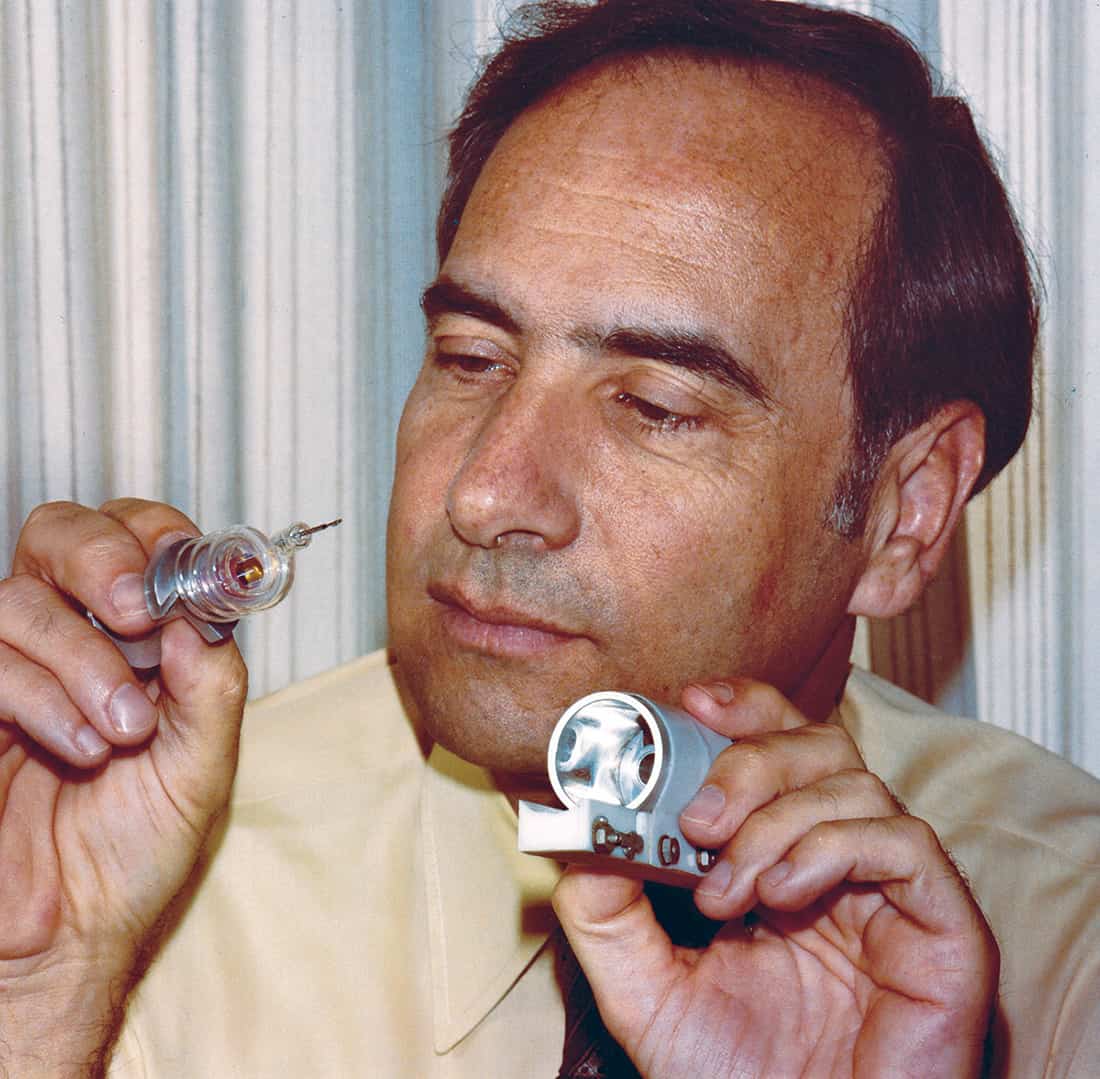
The Hughes public-relations machine swung into action ahead of the press conference, which it had scheduled for 7 July 1960. The photographer hired to take the shots was not impressed by the first laser – it was too small (see image at top of article). Looking around the lab, he picked up a later prototype with a medium-sized flash lamp and 5 cm-long ruby rod, telling Maiman to “Hold this in front of your face and I know this will be picked up by every news outlet, but if we print this, this first laser, it won’t go anywhere.” The photographer was right. The day after the press conference all the major newspapers carried the photograph – along with, in one case, the melodramatic headline “LA man discovers science-fiction death ray”.
Better than the real thing? The photograph issued at the 7 July 1960 Hughes press conference showing Maiman with a later prototype laser – not the first one – led to melodramatic newspaper headlines and confusion among other researchers. (Courtesy: Hughes Research Laboratories)
Within the academic community, though, there was a certain amount of scepticism and confusion about what Maiman had achieved. The optical quality of the crystal in his first laser was poor and so he had not observed the characteristic “pencil beam”. Instead, his early results were based on sensitive spectroscopic measurements. Maiman also faced some degree of prejudice: people expected the advance to come from Bell Labs or one of the other well-funded research efforts, not from an unknown working for an aircraft company. The biggest problem, however, was that Maiman’s detailed scientific results were not available for scrutiny when the press conference was held. Worse, the Nature paper – when it was finally published on 6 August – was so brief that it failed to convince his critics.
Despite the uncertainty, Hughes’ press conference infused the laser research community with new vigour and new funding. Scientists around the world returned to their work with fresh conviction that it was actually possible to make a laser. In fact, the concept and design of Maiman’s laser proved so simple that it was only a matter of weeks before his results had been reproduced by several other researchers – most prominently those at Bell Labs, who demonstrated a pencil beam from their ruby device on 1 August 1960. Taking their cue from the publicity photograph showing “not the first” laser (see image left), the Bell Labs researchers used a 5 cm-long ruby rod with an identical model of strobe lamp.
By then, Maiman had also observed a pencil beam, thanks to three new ruby crystals that had been specially grown to the dimensions he required (the ruby in the first laser, by contrast, had been cut from a larger boule). On the day the new crystals arrived, 20 July 1960, Maiman inserted them into his device and observed sharp threshold behaviour and a bright spot on the wall.
First light: key dates in the invention of the laser
15 December 1958 Arthur Schawlow and Charles Townes’ paper on “Infrared and optical masers” appears (Phys. Rev. 112 1940)
15 July 1959 Ali Javan publishes his proposal for making a gas laser (Phys. Rev. Lett. 3 87)
16 May 1960 Theodore Maiman observes pulsed lasing in pink ruby
7 July 1960 Hughes Research Laboratories holds a press conference announcing Maiman’s laser
20 July 1960 Maiman improves his ruby laser design and observes a pencil beam
1 August 1960 Donald Nelson and colleagues at Bell Labs create a pulsed laser beam from a ruby rod in a configuration similar to the one shown in press photographs of Maiman’s device
6 August 1960 Maiman’s short letter “Stimulated optical radiation in ruby” is published (Nature187 493)
25 September 1960 Nelson and his team at Bell Labs flash a laser beam 25 miles from Crawford Hill to Murray Hill in New Jersey
1 October 1960 Publication of Bell Labs’ ruby-laser paper (Phys. Rev. Lett. 5 303)
5 October 1960 Bell Labs holds a press conference to announce its ruby laser
12 December 1960 Javan and his team create the first gas laser
30 January 1961 Javan’s paper on the gas laser appears (Phys. Rev. Lett. 6 106)
31 January 1961 Bell Labs holds a press conference announcing the gas laser
1961 Willard Boyle and Nelson create the first continuously operating ruby laser (Appl. Opt. 1 181)
Still controversial
In the years that followed, Bell Labs researchers achieved many laser “firsts”, including the first gas laser, which Javan and co-workers demonstrated successfully in December 1960. Other successes included the first continuously operating ruby laser, made by Willard Boyle and Donald Nelson in 1961; the first carbon-dioxide laser, invented by Kumar Patel in 1964; and a string of other innovations, including refinements to the now-ubiquitous semiconductor diode laser.
Maiman, for his part, left Hughes in 1961 to join a venture-capital-funded start-up called Quanatron, where he was in charge of laser activities. The following year Union Carbide provided the funds to set up his lab as an independent business. Thus Maiman became president of the newly formed Korad Corporation, which invented the Q-switched laser and became a supplier of the highest power lasers in the industry.
Over the laser’s 50-year history, Maiman’s place as inventor of the laser has sometimes been acknowledged. In 1984 he was inducted into the National Inventors Hall of Fame – meeting Kathleen, who became his second wife, on the flight home afterwards. Most significantly, in 1987 he was awarded the Japan Prize, which is often considered the Eastern equivalent of the Nobel.
But at other times, Maiman felt his role was downplayed. It was Townes who shared the 1964 Nobel Prize for Physics with two Russian theorists, Nicolay Basov and Aleksandr Prokhorov, for “contributions to fundamental work in quantum electronics leading to the development of the maser–laser principle”. And in 1998, Bell Labs honoured Townes’ work again with a major celebration to mark “the 40th anniversary of the laser” – a reference to the 1958 “optical maser” paper, rather than to the invention of a working device two years later.
For Maiman, the lack of recognition hurt, and it prompted him to write a memoir presenting his side of the story. “Ted wrote his book because he felt that his place in history was not being properly addressed,” explains Kathleen. “And I still offer [anyone who asks] The Laser Odyssey because it was directly from him and it’s correct.”
In the book, Maiman hits back at his critics, asserting that Bell Labs has little claim on inventing the laser because its proposal never worked: nobody has ever been able to make a potassium-pumped potassium-vapour laser as described in Schawlow and Townes’ 1958 paper, and the patent based upon it never earned any money. Indeed, Maiman attributes his success to the fact that he did not follow the teachings of Schawlow and Townes; if he had, he would never have considered pink ruby as a suitable laser medium.
Maiman’s attitude may sound harsh, but the uncomfortable truth is that for some of the people involved, even 50 years after the fact, the invention of the laser is still controversial. In a feature article published in the January issue of Physics Today magazine, Nelson, Robert Collins and Wolfgang Kaiser – three Bell Labs researchers who worked on early laser projects – describe “the work at Bell Labs in the summer of 1960 that led to the creation of the first ruby laser”.
Those claims disconcert Kathleen, who believes that Maiman’s position as creator of the first laser is beyond dispute. “The Bell Labs scientists had a photo of Ted’s laser from the newspaper [and] the account that his pink ruby crystal worked,” she says. “And Schawlow had obtained from Ted a copy of his unpublished submission to Physical Review Letters describing the construction of his laser. All of these facts combined would clearly mean that any subsequent construction and operation of a laser at Bell Labs was purely imitating what Ted had already done.”
Kathleen still keeps a notebook from the day, 16 May 1960, when Maiman made his laser breakthrough. She acknowledges there have been some “sour grapes” over the years. Yet she has even stronger feelings about the positive contribution Maiman made to society.
“I had great appreciation for Ted Maiman the man, a loving husband and a delightful companion,” she says. “But what I’m really finding extraordinary right now is Ted Maiman the scientist. I’m beginning to appreciate how there are moments in the history of humanity when an advance occurs that is so extraordinary and unexpected that the world for better or worse is changed forever. I think the invention of the laser on 16 May 1960 marks one of these times.”
Physics World’s Laser at 60 coverage is supported by HÜBNER Photonics, a leading supplier of high performance laser products which meet the ever increasing opportunities for lasers in science and industry. Visit hubner-photonics.com to find out more.
Who uses lasers? What can we do with them? How have they changed physics? And what’s in store for their future?
Here at Physics World, we have been thinking about these questions for months now, as we prepared to celebrate an important milestone in the history of science and technology: the 50th anniversary of the invention of the laser.
In our search for answers, we spoke to more than 20 experts in a wide variety of disciplines, including astronomy, biophysics, communications, defence, manufacturing, medicine, optics and space science (to name just a few).
You’ll find some of their responses in our May special issue – which you can download for free here – but for a more personal look at how lasers are shaping different areas of science and technology, check out our series of five exclusive video interviews:
above, Tom Baer of the Stanford Photonics Research Center reviews 50 years of laser physics, and makes some predictions about the next 50;
Tom Hausken of the market-research firm Strategies Unlimited discusses how lasers are used in optical communications;
medical physicist Brian Pogue of Dartmouth College describes laser-based cancer treatments and the rewards of working with lasers in an interdisciplinary field;
Andreas Tünnermann explains how researchers at the Fraunhofer Institute for Applied Optics and Precision Engineering are developing fibre lasers for use in manufacturing;
Narasimha Prasad of NASA’s Langley Research Center talks about using space-based lasers to gather data about the climate on Earth – and perhaps beyond.
All of the interviews were filmed during the 2010 Photonics West conference, which saw more than 20,000 photonics scientists and engineers from all over the world gather in San Francisco to share their latest results.
Stay tuned for more laser coverage over the next few weeks as we continue to celebrate 50 years of an amazing technology and its contributions to the world of physics.
The laser at 50: the laser is a major force in medicine, with clinicians exploiting the technology across all manner of cosmetic, therapeutic and diagnostic applications. Right now, one of the biggest growth areas is in vivo diagnostics – the use of laser-based technologies to diagnose early-stage disease and treat that disease before it becomes incurable. Brian Pogue, professor of engineering at the Thayer School of Engineering, Dartmouth College, US, explains what laser scientists and innovators can do to ensure that today’s ground-breaking research makes it out of the laboratory and into the hospital.
The laser at 50: cutting, drilling, welding, materials processing – the laser is ubiquitous in modern manufacturing. Andreas Tünnermann, director of the Fraunhofer Institute for Applied Optics and Precision Engineering, Germany, reckons that the “next big thing” in laser manufacturing will be the ultrafast fibre laser, a technology that’s been successfully transferred out of the research laboratory and on to the factory floor.
The laser at 50: semiconductor lasers and optical fibres are the core building blocks of today’s optical communications networks, the physical layer that supports the Internet. With more and more data being squeezed down those fibres, Tom Hausken, lead analyst at US technology consultancy Strategies Unlimited, argues that fundamental science and basic research remain crucial differentiators for laser manufacturers working on the next generation of optical devices.
The laser at 50: what can you do with a laser in space that you can’t do on the ground? Narasimha Prasad, aerospace technologist at NASA Langley Research Center, US, explains how lasers can be used for planetary studies and deep-space communication to help us better understand our place in the solar system.
Researchers in China have created what they claim is the most “detailed and realistic” model of HIV to date, and say that it could help in the creation of a vaccine for the deadly virus. However, immunologists warn that the model is yet to catch up with modern clinical trials.
According to the World Health Organization, HIV is one of the world’s biggest health challenges, infecting almost three million people and killing some two million people every year. When a person is infected, HIV enters into the immune system’s crucial T lymphocytes – or T cells – and replicates itself by integrating with the DNA. As a result the cells die and the immune system slowly weakens until it can no longer fight off opportunistic infections, a status classified as AIDS.
The scale of the AIDS epidemic has prompted many scientists to search for an HIV vaccine, but this has proved difficult. HIV is different from other viruses in that it can mutate very quickly, thereby evading the normal immune-system defences. Some scientists think that a vaccine will only become available once there is a leap in the theoretical understanding of the virus.
‘Detailed and realistic’
Physicist Jianwei Shuai and chemical biologist Hai Lin of Xiamen University now think they have a model that will help with that understanding. “We propose a more detailed and realistic HIV model than previous models, by incorporating many important features of HIV dynamics,” says Shuai.
In the model, single HIV particles, known as virions, sit on lattice sites alongside two types of T cell: CD4+ T cells, which direct other immune-system cells, and CD8+ T cells, which kill infected cells. The virions and cells take a “random walk” around the lattice sites until two meet each other, at which point they interact in one of several ways. At the same time, the model takes into account the virions’ mutations and the responses of the T cells.
One of the results of the researchers’ model concerns the so-called asymptomatic phase in HIV-positive patients – the period from which they are infected with HIV to when they begin to develop AIDS. Although for the majority of people this phase is 5–10 years, it can be 15 years or longer. Physicians had thought the discrepancy was due to the abilities of different patients’ immune systems, but Shuai and Lin think the reason could simply be a product of the immune system’s random response.
Decisive role
A potentially more important result, however, comes in the way that the two types of T cell react to HIV. In their model, Shuai and Lin found that it is the CD8+ T cells that play a decisive role in suppressing the virus. “This observation implies that CD8+ T-cell response might be an important goal in the development of an effective vaccine against AIDS,” explains Shuai.
Yet some researchers claim that this result is nothing new. “The model makes a large number of assumptions, none of which are examined by comparison to [clinical] data,” says Alan Perelson, a theoretical immunologist at Los Alamos National Laboratory, US. “That CD8+ T cells might be important in suppressing viral load is not novel, and in fact was the basis of the large trial that failed to provide protection.”
Mathematical exercise?
David Ho, an AIDS scientist at the Aaron Diamond Research Center in New York, is also critical of the results. “Playing with math to fit clinical data is just an exercise,” he says.
Still, Shuai and Lin are planning to take their model further. By modelling the effects of different drugs, they hope to find an optimal therapy to fight HIV.
Who uses lasers? What can we do with them? How have they changed physics? And what’s in store for their future?
Here at Physics World, we have been thinking about these questions for months now, as we prepared to celebrate an important milestone in the history of science and technology: the 50th anniversary of the invention of the laser.
In our search for answers, we spoke to more than 20 experts in a wide variety of disciplines, including astronomy, biophysics, communications, defence, manufacturing, medicine, optics and space science (to name just a few).
You’ll find some of their responses in our May special issue – which you can download for free here – but for a more personal look at how lasers are shaping different areas of science and technology, check out our series of five exclusive video interviews:
• Tom Baer of the Stanford Photonics Research Center reviews 50 years of laser physics, and makes some predictions about the next 50
• Tom Hausken of the market-research firm Strategies Unlimited discusses how lasers are used in optical communications
• Medical physicist Brian Pogue of Dartmouth College describes laser-based cancer treatments and the rewards of working with lasers in an interdisciplinary field
• Andreas Tünnermann explains how researchers at the Fraunhofer Institute for Applied Optics and Precision Engineering are developing fibre lasers for use in manufacturing
• Narasimha Prasad of NASA’s Langley Research Center talks about using space-based lasers to gather data about the climate on Earth – and perhaps beyond
All of the interviews were filmed during the 2010 Photonics West conference, which saw more than 20,000 photonics scientists and engineers from all over the world gather in San Francisco to share their latest results.
Stay tuned for more laser coverage over the next few weeks as we continue to celebrate 50 years of an amazing technology and its contributions to the world of physics…
Earlier this month, I and some of my colleagues – Kate Gardner, Margaret Harris and Dens Milne – braved the back streets of Bristol on a very important mission: to bring the readers of Physics World magazine a slightly-more-innovative-than-usual image on the front cover.
We were looking for something a bit different for the May issue of Physics World. This month we are marking the 50th anniversary of the laser by bringing readers top features from a host of eminent laser scientists, as well as a snazzy laser timeline. We needed a front cover that would do it justice.
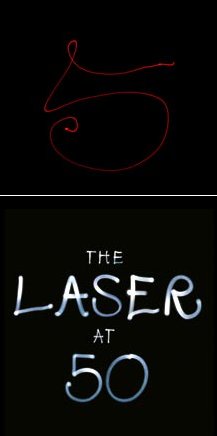
Our brain wave was “laser-writing”. It would involve the four of us congregating in a darkened room, photographing a blank wall using a camera set to have a long exposure. We would write our chosen phrase on the wall using a red laser pen and capture this on camera. The relevancy would be immense – an image made of pure laser light, just the thing to introduce our laser special issue. Great idea, right?
Full of anticipation, after a drawn-out meal at the local curry house while we waited for darkness, we embarked on our mission. In a dark room we set up our digital SLR camera on a tripod. We used an exposure of tens of seconds to capture each individual alphanumeric character that we needed; these could then be later combined into words. And hey presto! … Hey presto? … Peering at the camera’s digital display, we realised that the effect was not as good as we’d hoped. The laser dot was so small in comparison to the size of the characters that the result appeared spindly.
But fret we did not, as we had back-up. We also tried using a torch (see I ♥ LASER image, top), and an array of bluish-white LEDs. The LEDs became the tool of choice that would eventually make the front cover with the “The laser at 50” image shown right. Note that the issue itself is available as a free pdf download.
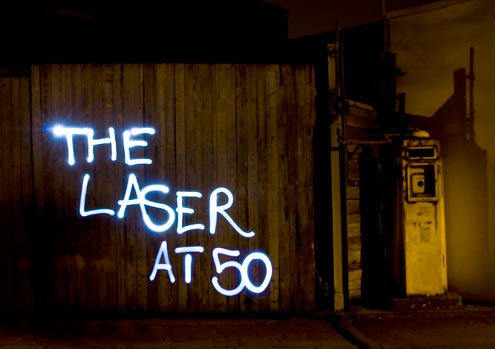
We also tried to go a bit more arty, and took to the dimly lit streets. Our best outdoor shot is shown above; the venue was a fenced-up disused garage. If you are interested in trying this sort of thing yourself, take a look at this great guide to light-graffiti.