The BBC's history of the Royal Society

bragg.jpg
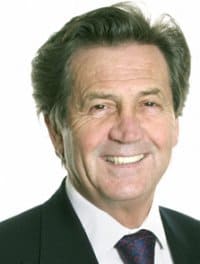
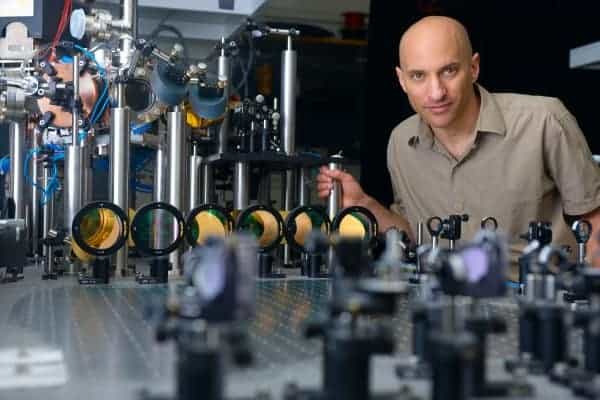
Melvyn Bragg (Courtesy: BBC)

By Hamish Johnston

BBC Radio’s Melvyn Bragg has embarked on a four-part series on the history of the Royal Society and its impact on British science and society.

2010 marks the 350th anniversary of the Royal Society, which was founded by a dozen or so academics in Oxford as “a Colledge for the Promoting of Physico-Mathematicall Experimentall Learning”. The society was granted a royal charter two years later.

In the first episode “Melvyn travels to Wadham College, Oxford, where under the shadow of the English Civil War, the young Christopher Wren and friends experimented in the garden of their inspirational college warden, John Wilkins”.

You can listen to that episode here.

The next installment will be broadcast later this evening.

Making a Big Bang on the small screen

While the quality of some TV sitcoms can leave viewers feeling cheated out of 30 minutes of their lives, audiences and critics are raving about the science-themed US comedy The Big Bang Theory. First shown on the CBS network in 2007, the series focuses on two brilliant postdoc physicists, Leonard and Sheldon, who are totally absorbed by science. Adhering to the stereotype, they also share a fanatical interest in science fiction, video-gaming and comic books, but unfortunately lack the social skills required to connect with their 20-something non-academic contemporaries.

The Big Bang Theory is now in its third season, with a fourth already commissioned by CBS. The show has also aired in the UK on Channel 4, while last month E4, Channel 4’s digital network, started showing the third season. Despite a dialogue peppered with references to physics and mathematics (and, to a lesser extent, biology and chemistry), over 13 million US and 1 million UK viewers have been tuning in to follow the adventures of Leonard and Sheldon, together with their buddies, fellow physicist Raj and engineer Howard, and their “normal” neighbour, Penny.

Set mostly in the characters’ apartment complex in Pasadena, California, Penny, played by Kaley Cuoco, is a wannabe actress who hangs out with her geeky neighbours. Although she has no understanding of their research, the “guys”, in turn, generally fail to fit into her pop-culture-centred world, and therein lies much of the show’s comedic appeal.

Kunal Nayyar, 28, who plays Raj, felt the show was destined to become a hit early in the first season. “The writing was brilliant and the show was funny, but it wasn’t just about a bunch of scientists making jokes,” says Nayyar. “The characters were going through life and trying to fit in. I think many people have probably felt like that at some point in their lives and can relate to it.”

Big impact

One fan of The Big Bang Theory is Jeff Tseng, a particle physicist from Oxford University in the UK, who stumbled upon the show accidentally and began noticing that the whiteboards in the background of scenes actually showed accurate physics equations. “There was a good first-order calculation of W-boson branching functions, plus some well-drawn quark flow and Feynman diagrams,” he says. Getting the science right is almost unheard of in TV land, but series creator, writer and executive producer, Chuck Lorre, says that accuracy is important to the show. “It is those details that colour the tone of the show and contribute to its popularity, so we have a real physicist for help in that area,” he told Physics World.

That “real” physicist is astrophysicist David Saltzberg from the University of California, Los Angeles (UCLA). The producers first contacted Saltzberg to see if he knew of any graduate students who could advise the show, but he saw the job as being a lot of fun and took up the offer for himself. Before the acting starts, Saltzberg receives scripts about a month in advance and fills in the science as required. For example, in the first season, when the four guys buy a model of a time machine, Saltzberg wrote the equations for theoretical time travel using wormholes on the whiteboard in their apartment. In season two, the writers wanted a science project for Leonard to show his mother when she came to visit him at the lab. Saltzberg suggested that Leonard talks about the DAMA project at the Gran Sasso laboratory in Abruzzo, Italy, which searches for what constitutes dark matter.

Saltzberg is even on the set for the shooting of most episodes; so, if any technical questions do come up, he is on hand to answer them immediately. After colleagues and viewers wanted to know more about the show’s science, Saltzberg started a blog in time for the third season in September 2009 called thebigblogtheory to explain the science behind each new episode.

“One of the roles of a university is to reach back into the community and give people a glimpse at what we are doing,” says Saltzberg. “With 13 million viewers watching a sitcom that references current physics research, maybe the show will do for physics what Indiana Jones did for enrolment in archaeology departments!”

Jan Hall from the University of Colorado, who shared the 2005 Nobel Prize for Physics with Roy Glauber and Theodor Hänsch for their work on quantum optics and laser spectroscopy, is another for whom The Big Bang Theory is his favourite TV programme. “My wife gave me the first season on DVD as a Christmas present in 2008 and we have been cracked up laughing ever since,” says Hall. “The science chatter is mostly accurate, providing a technical backdrop to the interplay of personalities. Each individual is appealing in specific ways and contributes to the overall effect – it’s just so damn funny!”

As a result of Saltzberg’s input, Lorre says that the reception from the scientific community has been largely positive but that the show also appeals to audiences outside the scientific world. “It’s not just a show about science. It’s also about the characters’ lives – their families, friends, hopes and romantic relationships,” says Lorre.

Physics 101

The idea for The Big Bang Theory sprang from co-creator Bill Prady’s experiences working as a computer programmer in New York in the 1980s. Lorre says Prady worked with people who were clearly very intelligent, but who were completely lost when it came to the mundane things in daily life. It was a paradox, and a terrific idea for a series.

“We wanted to avoid a show that was set in the world of computing – the computer-geek theme sounded too tired,” explains Lorre. “So we put the characters in a setting of pure research.” Building a sitcom around physicists, rather than any other discipline, was, for Lorre, an obvious choice. “There was just something fascinating about a show that looks at the world through physics and mathematics. These guys are trying to unravel the secrets of the universe – that’s pretty big! You’re not going to do that with biology or chemistry.”

In an interview with Physics World, actor Johnny Galecki, 34, who plays Leonard, says he and the cast constantly receive positive comments from teachers and scientists. “We got a letter from Isaac Asimov’s daughter telling us how much she liked the show,” he said during a break in rehearsals. “George Smoot even wrote to us asking if he could be on the show, and he appeared in a season-two episode. He was quite a character!”

As a tribute to Smoot, who shared the 2006 Nobel Prize for Physics with John Mather for their work on the anisotropy of the cosmic microwave background (CMB) radiation, a whiteboard during that episode contained a diagram of a differential radiometer that was used in the discovery of the CMB radiation.

To prepare for their roles, Galecki says he and Jim Parsons, who plays Sheldon, visited the physics department at UCLA with Saltzberg. “Our biggest lesson was that scientists are a diverse bunch,” says Galecki. “While we saw some people who were somewhat like the Leonard and Sheldon characters, there were people from all cultures, female physicists, and even the cool surfer physicist, with bleached blonde hair, sunglasses, shorts and sandals.” Galecki adds that he and Parsons have also read a lot of popular science and watched science documentaries on TV. “You just try and surround yourself with the things your character would be interested in. For an actor, you research your role to gain confidence and hope the audience will find you credible.”

Simon Helberg, 28, who plays Howard, says the show’s popularity suggests that the cast has successfully created extreme but believable characters. “Unlike their research, there are no equations these guys can formulate to help them understand the world outside the lab. But they somehow manage to muddle through the more mundane aspects of life.” Although the characters may seem quirky and stereotyped, Saltzberg believes the show demonstrates the joy that scientists have for their work. “The characters are extreme and have their flaws, but that’s necessary for the comedy to work,” he says. “The characters have a real passion for science, but that’s not made fun of – I see that as being celebrated in the show.”

How people work

Put down the magazine at the end of this paragraph and walk around. First walk normally, with your arms swinging. Then try it with your arms folded. Finally, do it with your arms and legs on each side in phase, swinging forwards and back at the same time – a “tick-tocking” motion. Ignore any strange looks from passers-by. After all, you are doing this in the name of physics.

If you have carried out this little experiment, then you will probably have noticed that the second and third ways of walking are more difficult. But why? The answer – as it is for many important questions in biomechanics – is more complicated than you might think. Much biophysics research focuses on how physicists are helping biologists to study the workings of cells (see Physics World‘s July 2009 special issue). In many ways this is not surprising. Sophisticated biophysical techniques are often required to probe the workings of things operating at micro- and nano-scales, and metabolic processes can even be influenced by quantum effects.

In contrast, one might assume that we already know all about how the organs and whole bodies of organisms – particularly Homo sapiens – work. Movements and forces at the macroscopic scale are, after all, relatively straightforward to measure and subject only to the laws of classical physics. Moreover, the anatomy of our bodies has been mapped for hundreds of years compared with the 10 years for which we have had comprehensive guides to the human genome. Surprisingly, however, research by biomechanics – people who combine expertise in both biology and physics – continues to uncover and fill hitherto undreamed-of areas of our ignorance about ourselves.

The key to understanding how our bodies work is to alter our viewpoint: to see the world with new eyes and thereby ask and answer new and awkward questions. Why, for example, do we swing our arms back and forth while we walk? Why do our teeth have notched blades, and why do we chew our food anyway? Why don’t our nails break into the quick? And why exactly do we have fingerprints? These are just some of the questions that have recently been raised by biomechanics. The answers to these questions may appear obvious or even trivial, but further thought and experiment is revealing that our world is far more fascinating than we could have dreamed.

Why do we swing our arms?

The basic process of walking has been understood for some time. At each step, we vault over the standing leg, our bodies moving like an inverted pendulum with the stationary foot as a pivot. The amount of energy required to move is minimized because there is a continual interconversion of kinetic and gravitational potential energy: we slow down as the body rises at the middle of each step, then speed up again as the body falls towards the end of the step. A small amount of energy is inevitably lost through sound and heat when we put each foot down on the ground, but basically we carry on moving more or less continuously, requiring only a small push-off from our feet to keep going.

So where do the arms come into the picture? Surely swinging them just uses up energy unnecessarily? Once Steven Collins and colleagues at the departments of medical and mechanical engineering at the University of Michigan in the US posed this question (most recently in 2009), they were able, fairly readily, to come up with alternative hypotheses to explain it. It could be, they reasoned, that the arm-swing helps to reduce vertical movements of a person’s centre of mass, and hence minimizes the forces on the feet. Alternatively, the arm-swing might help counter the inertial effects of the legs that would otherwise cause torques about the body’s vertical axis.

Testing these two hypotheses involved getting people to walk in three different ways, just as I suggested at the beginning of this article: with arms swinging normally; with them held or bound to stop them swinging; and with arms swinging in the same phase as the legs, or “tick-tocking”. Collins’ group filmed 10 subjects walking, while also measuring their oxygen consumption and the forces produced by their feet as they walked over specially designed “force plates” sunk into the floor. These plates use electronic strain gauges to measure instantaneous forces in all three planes, as well as the torque or twisting moment about the vertical axis.

The oxygen measurements showed that the subjects used about 10% more energy to walk without swinging their arms than when they swung them normally, while tick-tocking increased energy consumption by 26%. The next step was to explain why. Filming revealed no changes in the movements of the legs or body, but the force-plate records showed that while the forces involved did not change, the torques about the body’s inertial axis were twice as high with no arm swing and three times as high during tick-tocking than during normal swinging. It is clear, therefore, that swinging our arms reduces the torques we need to apply to counter the inertia of our legs, and so reduces both the energy needed to walk and the twisting forces on our knees.

Why do we have notched teeth?

The mechanics of eating is another area where asking the right questions has transformed our outlook. People have long talked about our “cutting” incisors, “stabbing” canines and “grinding” molar teeth. But these terms are vague and tell us nothing about the relationship between tooth shape and the sorts of food they can break up. When it comes to advancing our understanding of teeth, it is much more helpful to consider the mechanical and fracture properties of different foods, as Peter Lucas of the department of anthropology at George Washington University demonstrated in his book Dental Function Morphology (2004, Cambridge University Press). Incisors, for example, should be good at driving cracks through soft but tough foods such as meat and vegetables, but would be blunted by bones or nuts. These stiff but brittle foods are much easier to break by using blunt-cusped molars, which allow such foods to be loaded in bending and so be snapped. Biological materials that are both stiff and tough, such as wood, should be impossible to break down; indeed, most animals seldom use them as food.

These explanations seem to make sense, but why do so many cutting teeth, including our own premolars, have notched blades? Once again, alternative hypotheses can be put forward. A notched blade might help to trap the food, preventing it from being flattened as it is cut, or perhaps it could give the tooth an oblique slicing action. Both effects could reduce the energy needed to cut the food.

To test these possibilities, in 2009 palaeontologist Philip Anderson from the department of Earth sciences at Bristol University in the UK carried out experiments on two foods: salmon and asparagus. He measured the energy needed to cut through salmon (very deformable) and asparagus (much less so) using sharp blades held in four different arrangements (see “Munch, slice, trap” figure) In the first, two sharp blades were held parallel to each other. In the second, the top blade was angled at 30°, producing a slicing cut. In the third, the blades were parallel but the food could not become flattened as it was held at the sides by two vertical “traps” made of the backs of blades. In the fourth test, the top blade was notched, providing both a slicing and trapping action.

Anderson found that using the notched blades greatly reduced the energy required to cut both foods. In salmon, this was partly because the food was prevented from deforming: the side traps were just as efficient as slanting blades at reducing the energy required. For asparagus, in contrast, using an inclined blade reduced the energy just as much as using the notched blade, thus showing that the energy reduction was due to the slanting action of the cut alone. So the next time you tuck into a nice meal of salmon and asparagus, it might be worth investigating whether your own notched premolars are better at cutting up these foods than your incisors.

Why do we chew our food?

But why do we chop up our food anyway? Most textbooks say that it is to increase the surface area and so speed up digestion, and to make chunks of food small enough to swallow without getting stuck in the oesophagus. These assumptions were challenged in the mid-1990s by Jon Prinz and Lucas, who were then working at the University of Hong Kong’s anatomy department. They pointed out that when mammals swallow, food passes over the airway on its way to the stomach, so there is a potentially fatal risk of choking if stray food particles go down the wrong way. They suggested, therefore, that chewing allows us to press our food into a firm blob – technically known as a bolus – at the top of our mouth with our tongue. It can then be safely swallowed.

To test this idea, they got volunteers to eat diced carrots and nuts, counting the number of times the subjects chewed the food before swallowing it. They then modelled the cohesive strength of the bolus after different numbers of chews, by calculating the viscous forces needed to separate the ever-smaller particles. They found that for both foods, the bolus strength initially increased with the number of chews, because the smaller particles had a greater surface area, meaning that the bolus was held together by increased viscous forces. As chewing progressed, however, more saliva was pressed into the bolus, which eventually increased the distance between the particles, thus reducing viscous forces and weakening the bolus. Left to chew their food naturally, unencumbered by prying researchers, people swallowed the bolus at around the time when it was strongest – more support for Prinz and Lucas’s theory.

Why don’t our fingernails break into the quick?

My research group at Manchester University in the UK has shown that a similar approach of just asking the right questions can also revolutionize our understanding of the design of our fingertips. All of us either bite our fingernails or experience them breaking, yet the broken nails almost never tear into the quick. Instead, they break straight across, self-trimming the nail. But why? When I first posed the question 10 years ago, it seemed to be a new one; here, again, was a phenomenon that everybody has experienced but no-one had investigated further.

I set the problem to a group of second-year biology undergraduates – who rapidly came up with the answer. It turns out that the main, central part of the nail has all its keratin fibres arranged parallel to the “half-moon” at the nail base (see “Hangnail prevention” figure), so cracks travelling towards the base of the nail are instead deflected around the nail edge. We subsequently carried out tests to investigate how much energy it takes to cut nail clippings in different directions. These tests, which used scissors and nail clippers mounted in a universal mechanical-testing machine, showed that it takes twice as much energy to cut nails inwards towards the base of the nail as opposed to sideways around their edge.

However, if a nail were only made up of fibres oriented parallel to the half-moon, then it would keep on breaking all the time. To prevent this, the nails also have thin upper and lower layers in which the fibres are oriented in all directions. These layers gave the nail bending strength, and since they wrap around the edge of the nail, they also help prevent cracks from forming in the first place. There is only one design flaw in this clever sandwich construction: since the outer edge has no middle layer, cracks there can run in any direction. This is why nail fractures can run inwards at the very edge, causing the side of our nail to bleed – often painfully.

Why do we have fingerprints?

Now to the other side of our fingers. We all know that everyone’s fingerprints are different and consequently that they are useful in crime detection. It has also long been assumed – at least by the writers of medical textbooks – that fingerprints help us grip to objects by increasing the friction coefficient of our fingers.

Unfortunately, tribology – the science of interacting surfaces in relative motion – has shown that having a rough surface does not increase the friction of soft materials such as rubber and skin. That is because friction in rubber-like materials is not caused – as it is in stiff materials – by the jamming of rough, pointy structures. Instead, these softer materials deform easily, flowing into irregularities; friction between rubber and other materials is therefore due to short-distance molecular attraction or Van der Waals’ forces. What this means is that friction increases with the contact area, not with the normal force as it does in stiff materials.

To test whether our fingers behave like rubber, my group measured the friction of fingertips against an acrylic glass sheet while changing the normal force and contact area independently. To do this, the finger was held at different angles and the friction against sheets of different widths was measured. We found that friction increased with contact area, showing that our fingers do behave like rubber. Since fingerprints actually reduce the contact area, they must reduce friction too.

So why, then, do we have fingerprints? We are currently testing several alternative hypotheses. It could be that prints do increase friction against rough surfaces – just not against smooth ones like glass. More intriguingly, they might act like the treads on tyres, which remove water and so increase friction under wet conditions. Prints might also make the skin more flexible and so help prevent it blistering.

Initial tests have indicated that friction between fingers and surfaces actually falls as surface roughness increases. This casts doubt on the first hypothesis, although it is possible that smooth fingers might be even worse. Other work by Thibault Andre of the physical-medicine unit at the Catholic University of Louvain in Belgium has shown that grip is maximized at intermediate skin-moisture levels. This suggests that water removal might indeed play a role. However, the fact that we tend to get blisters mostly in areas of our hands that lack prints suggests that the antiblister effect is also important. Only time and more experiments will tell.

More awkward questions

As these examples have shown, it is rapidly becoming clear to those of us who work on the boundary between physics and biology that we have a lot more to find out about ourselves than one might think. But there is even more to be learned from other organisms: we are still trying to glean more information from how geckos walk on walls or how snakes slide over the ground, for instance. Both of these animals are being extensively studied, largely because we could use the knowledge to, for example, create glueless “gecko tape” or more freely sliding artificial joints. Ever since the advent of Velcro, which copied the gripping action of hooked plant seeds, the ever-expanding field of biomimetics has been seeking new inspiration from the natural world.

But, of course, applications are not the only reason to do such research: the pure joy of finding out is also a considerable prize. And unlike many areas of physics, this sort of research need not be expensive or mathematically difficult. Indeed, much of it can be done by any open-minded physicist. All you need is an enquiring mind, a bit of ingenuity and the courage to ask awkward questions.


Priority battles

As a philosopher of science, I love priority disputes. They invite one to ask “How can it be that brilliant scientists agree that they’ve discovered something, but not when?” The answer instructs philosophers about the nature of discovery – and no true scientist can object to learning more about that. Indeed, the discovery of dark energy has been so contentious that debate over who did what and when still rumbles on a dozen years after the event.

Such were the disputes over the matter that a previous column by me, which earnestly tried to do justice to the topic, went through more than 20 drafts (December 2007’s “Dark Energy”). The most recent resurgence of the squabble was instigated by a seemingly innocuous column in the January 2009 issue of APS News. Entitled “This month in physics history”, it stated that word of “accelerating expansion” emerged after a press conference at the January 1998 meeting of the American Astronomical Society in Washington, DC.

The February issue of APS News carried a letter disputing that remark. It was written by Robert Kirshner from Harvard University, who was a member of the High-Z Supernova Search Team – one of the two teams of supernova hunters that discovered that the expansion of the universe is accelerating. “We should mark the dates of scientific discoveries from the submission of refereed publications,” Kirshner wrote, “not commemorate the extrapolations of reporters who get ahead of prudent scientists in drawing reliable conclusions.” The High-Z team’s submission date, as the reader may guess, was earlier than that of the other discovery team, the Supernova Cosmology Project (SCP).

The April 2009 issue of APS News carried replies. One, by Penn State University astronomer Ruth Daly, quoted her press release for the meeting explicitly stating that her results show that the universe “will expand at a faster and faster rate”. The other was by historian Michael Riordan from the University of California, Santa Cruz, who recalled being present at a still earlier event – a physics colloquium in December 1997 – at which SCP member Saul Perlmutter exhibited data indicating expansion, and hearing an audience member state that “these results implied the previously unthinkable: the need for a cosmological constant”.

Kirshner replied in July. The editors of APS News allowed Riordan a reply, before they declared the discussion closed. I am hoping it will continue elsewhere, for the debate reveals some fascinating insights into the role of techniques and technique-borrowing in discovery.

Perspectives on discovery

Kirshner is the principal warrior in this dispute, with virtually all others in both collaborations willing to share credit. From his perspective, publication is the sole indicator of discovery. The argument in favour of using a paper’s submission date to establish priority is that publication is a time stamp indicating that the results have been carefully checked. It is a sign that the results can be trusted. It is not an absolute guarantee – trust never is – but it is the firmest possible statement that “we did all the checks” by those in a position to make them.

Riordan’s letter, however, suggests that publication is not the sole indicator of discovery. Publication is retrospective; it says, “we already did the checks”. Moreover, a publication date is often artificial; these days, by the time a paper is published a preprint version has already been posted and circulated. Moreover, checks can drag on – when, for instance, you have to wait until supernovae die so that you can get a good background to subtract, and when, as in the SCP group’s case, you have more data to evaluate than other teams.

This can make it arbitrary to pin the complex discovery process solely to date of publication – like saying you only know how to drive when you get your licence. In essence, the dispute is not empirical but conceptual. The issue of exactly when dark energy was discovered will not be settled by more letters about submission dates and priority, nor by further details of when members of the SCP collaboration saw and transmitted news that their data showed accelerating expansion.

At the heart of this episode is an ambiguity in the meaning of discovery. Historians have long known that discoveries are not simple, unitary events made by a specific person or group at a specific place or time. Discovery is often distributed among groups, and in space and time, in a way that makes pinning it down contrived.

The philosopher Thomas Kuhn once described two kinds of discovery cases, “simple” and “complex”. In simple cases, what is discovered is predicted by theory; discoverers know pretty much what to look for and the criteria are clear for knowing when the goal is reached. Here, priority debates tend to be few. (Think of, say, the discovery of Pluto.) Complex cases catch the profession by surprise. Something emerges into scientific awareness slowly and confusedly, like when we first catch sight of something from a bad angle and have to shift position several times before we can confidently recognize it. (Think of the cosmic microwave background.) These cases do not involve confirming a prediction, and signs for completing a discovery can be unclear.

So where on the continuum between these two cases does the dark-energy discovery fit, and why? Part of the answer has to do with the growing role of statistics and systematics in astronomy discoveries. When a discovery emerges slowly from statistics along with uncertainties, as it did in this case, it is particularly hard to pin down the moment of discovery.

The critical point

The dispute invites us to ask one final question: “Why is it sometimes not easy for scientists to share credit, or to follow the adage that, if you really want to get something done, let others take credit?” The answer has to do with the role of prestige and reputation in science. These play a role in getting prizes, and – especially when funding for expensive future projects is involved – securing the resources for doing more and better science. Which true scientist is not interested in that?

• See “Dark energy: how the paradigm shifted” pp32–37, print edition only.

The giant and the thief

In 1696 Isaac Newton made what seems like a bizarre career move. Abandoning Cambridge University and the mathematical pursuits that made him famous, the 53-year-old scientist upped sticks for London to become warden of the Royal Mint. Part administrator, part coining expert, and part criminal prosecutor, this new role would occupy Newton for the remaining three decades of his life.

In Newton and the Counterfeiter, Thomas Levenson explores one of the most intriguing stories from these later chapters in Newton’s career: the great scientist’s dogged pursuit of a master criminal through the streets of London in the late 1690s. London was a toxic, throbbing city in those days, already boasting about 10% of the entire British population. An additional 200–300 new arrivals wandered into its confines every day. Many of them, including Newton, were seeking new lives, careers and fortunes.

Levenson, a professor of writing at the Massachusetts Institute of Technology, establishes the story by first taking readers on a rapid romp through the first 50 years of Newton’s life. He covers the common biographical highlights, including the 1687 publication of Principia. He also touches on some of the more obscure elements of Newton’s life – his alchemy, his mysterious illness of 1693 and his curious friendship with the Swiss mathematician Nicolas Fatio de Duillier.

After these first few chapters, the reader will have enough of a portrait of Newton to appreciate his motivations in pursuing the other main character in the book – a counterfeiter and criminal mastermind named William Chaloner. The son of an impoverished weaver from the Midlands, Chaloner started out as an apprentice nail-maker. However, he soon found that hammering coins was more profitable than hammering nails. He was a master craftsman, known for his skilful counterfeits and forgeries, and in his heyday he became quite rich. He was also notoriously slippery. More than once he was thrown in prison, and more than once he managed to beat the charges and walk out a free man.

Dashing as these actions may seem, readers of Levenson’s book will not likely be left rooting for Chaloner. He was a despicable character. In addition to counterfeiting, he stole property from people and sold it back to them. He also ran a thriving sideline betraying criminals and innocent associates alike. When he lacked a conspiracy to report to the authorities, he sometimes fabricated one. Numerous people went to the gallows while Chaloner bragged openly about his rewards.

As chief prosecutor of counterfeiters, Newton was certain to clash with Chaloner sooner or later. Newton’s appointment came at a critical time for the Royal Mint. Thanks to the efforts of Chaloner and lesser crooks, the circulation of fake coins had reached epidemic proportions: by 1696 Newton himself estimated that 10% of the coins then in circulation were counterfeit.

In his efforts to rectify this, Newton exerted the same sort of profligate enthusiasm that characterized most of his career, wading “hip deep into London’s underworld”, as Levenson puts it. Newton hired undercover operators to trawl pubs and prison cells to gather information. He had himself appointed justice of the peace in seven counties so that he could operate freely in all of them. He arrested, coerced and oversaw the execution of criminals. Perhaps most importantly, he helped persuade the British government to embark on a complete recoining of the realm’s currency. The old hand-hammered coins, which were easier to fake, were taken out of circulation and replaced with the more modern industrially milled coins.

Some counterfeiters might have been deterred by this new technology. Not Chaloner. Instead, the wily criminal hatched one of the boldest criminal conspiracies in history: he petitioned parliament for access to the Mint, arguing that the new coins were insufficiently protected against counterfeiting. He suggested that he, Chaloner, be allowed to inspect the coining machines and make alterations to them as necessary – a ruse simply meant to give him unfettered access to the equipment. He was so convincing that he almost succeeded, and no doubt he would have – had it not been for Newton.

The scientist-turned-civil-servant saw right through this proposal, and Newton began a relentless campaign to bring Chaloner down. As ever, Newton approached his task with a single-minded determination. He spent months deposing witnesses and tirelessly piling up evidence against his nemesis. As Levenson puts it, Newton regarded Chaloner as “someone not merely to be stopped, but crushed”. Even so, he nearly met his match in Chaloner, who repeatedly wriggled out of seemingly impossible legal tangles.

As a backdrop to his main narrative, Levenson presents a grim but compelling picture of London life at the close of the 17th century – from the open sewers in the mean streets to the incomparably brutal Newgate Prison. He also introduces numerous colourful characters along the way. There is Jonathan Wild, who controls the London underworld; and Obadiah Lemon, a street thug who specializes in using a fishing pole to snag hats off rich people passing in the streets below. We meet Kathy Coffee, one of the chief witnesses against the counterfeiter, and the irascible “hanging judge” Salathiel Lovell. And the book is filled with many criminals like Chaloner who came willingly to London seeking their fortunes, and who (also like Chaloner) only left when they were dragged through the dirt to the hangman’s tree.

In the end, the only character in the book who really seems to prosper is Newton. In his later years he is rich, knighted and head of the Royal Society. In London, he keeps the highest company and is surrounded by admirers and fiercely loyal supporters. Chaloner, on the other hand, winds up desperate and poor, and he eventually comes to a sorry end because of the ineptitude and disloyalty of the criminal company he keeps.

Yet Newton’s nemesis remains a colourful figure. Many writers have touched upon him in books covering the end of the 17th century, and of course anyone who has read a comprehensive biography of Newton will already be acquainted with “the man clever enough to challenge Newton”, as Levenson calls him. But this fascinating new book is the first to really explore Chaloner as a compelling character in his own right – and to great effect.

Chasing nuclear rainbows

Expeditions in search of a rainbow’s end never reach their goal. Efforts to solve the problem of nuclear-waste disposal have not had much success either – perhaps because they have been addressing questions the wrong way round. There are two basic challenges of waste disposal. The first is scientific: the waste must be kept somewhere out of harm’s way, where it does not incur major risks to current or future residents of the planet. The second is political: scientists must persuade and reassure the community as a whole that the waste is being handled, stored and disposed of safely. In The Road to Yucca Mountain, author J Samuel Walker gives a historical account of the politics of nuclear waste from the early 1940s to mid-2008. Despite the title, however, the waste-storage project at Yucca Mountain, Nevada, is barely mentioned until the last few pages. Instead, most of the book concerns earlier attempts to arrive at a waste policy. In particular, the machinations that accompanied initial proposals to bury high-level waste in salt mines in Kansas are described in some detail. These mines were supposed to be dry. But even before tests showed that water could transport material within the mined area, such geological questions had become rather irrelevant in the face of the strength of the political opposition.

Walker is the US Nuclear Regulatory Commission’s historian, and within his chosen remit his research is careful and thorough – witness the 35 pages of notes and references in a book where the main text covers only 186 pages. But his book has one great shortcoming: an almost total absence of science. In The Road to Yucca Mountain – as in the waste debate it describes – the science plays a secondary role compared with the interstate squabbling and the jockeying with the US government over where waste should be stored.

In some ways, this is a true reflection of the cut and thrust of the political story. In addition to the Kansas salt-mine debacle, Walker describes other federal initiatives that also foundered, as plans for test drilling in Michigan were aborted, and local objections were raised to sites in Louisiana, South Dakota and Vermont. Even in New Mexico, Washington and Nevada, where there was some public acceptance due to existing nuclear programmes, projects ran into serious local opposition.

Nonetheless, the book would have done a service if it had reflected on the scientific reasons why progress has been frustrated. The truth is that until recently, many important questions surrounding waste disposal could not be answered adequately. Some of these questions were biological. For most of the period after the Second World War, we did not understand the effect of radiation on life well enough to be sure what radiation levels were safe. Only in recent decades have the radiobiology and the epidemiology become sufficiently well established for us to be confident about the risks from low doses – whether acute, chronic or repeated.

This meant that in the earlier years the “experts” were not able to answer with confidence when pressed for firm reassurance on matters of radioactive waste. Politicians and activists pounced on this uncertainty. Consequently, a planned waste repository, though seen as “safe” in one decade, would be deemed “unsafe” before it could be built in the next. The tension that this created between experts and politicians led to claims of deception, which eroded mutual trust. By 1974 the political credibility of the US Atomic Energy Commission had fallen so low that President Gerald Ford disbanded it, dividing its responsibilities between the Nuclear Regulatory Commission and the Energy Research and Development Administration. However, as Walker records, these administrative changes were not enough to avoid the stalemate that then took place.

Now that the epidemiology of radiation is better understood, the most important decisions for nuclear experts concern the reprocessing of the waste and the need to keep it secure after disposal. It is widely acknowledged that nuclear waste should be placed where it is irrecoverable, thus reducing any chance of its use by terrorists. Many deep burial sites would provide natural security over the few hundred years needed – particularly if the waste is reprocessed, since reprocessing reduces both the volume of waste and its decay half-life. However, thanks to its association with the manufacture of weapons-grade fuel, reprocessing has had a bad press, and in 1977 President Jimmy Carter decided to defer it “indefinitely” – a serious backwards step for nuclear-waste disposal.

Ultimately, finding a solution to the nuclear-waste problem requires a degree of political confidence and trust that the right steps are being taken. In the past, these conditions have not been met, as Walker recounts all too clearly. Recently, however, scientists and policymakers have come under increased pressure to solve the problem, thanks to a need for the carbon-neutral baseload energy source that nuclear power provides. Any such solution will require a better appreciation of the science, widespread public re-education and more altruistic decision making.

In its scientifically superficial account, The Road to Yucca Mountain does not really face up to these underlying issues. Fortunately, history does not stop at the foot of the final page of any book. Since it was written, the future of Yucca Mountain and the ban on reprocessing (or “recycling”) have both been thrown into doubt by the new US administration. The matter of nuclear waste has already been on the table for more than 60 years, and its next chapter has yet to be written. But one thing is clear: if the science is put first, the problem can be solved.

Web life: Galaxy Zoo Mergers


So what is the site about?

Many readers will already be familiar with the Galaxy Zoo, a project that allows members of the public to trawl through images of galaxies obtained by the Sloan Digital Sky Survey (SDSS) and classify them according to their shape and features (see “Eyeballing the universe”). The image-processing power of the site’s 150,000 “citizen scientists” has already helped astronomers pick out interesting spiral and elliptical galaxies for further study. Now a new offshoot – dubbed Galaxy Zoo: Understanding Cosmic Mergers – aims to use similar “crowdsourcing” methods to enhance our knowledge of interacting galaxies.

How does it work?

Out of more than 900,000 images in the original Galaxy Zoo data set, volunteers identified about 3000 that showed two galaxies merging or colliding. Now the site’s developers want visitors to compare these real mergers with the results of collision simulations. By selecting the simulations that look most like the actual merging galaxies, and discarding those that appear different, users will be helping astronomers refine their models of how galaxies form. Weeding out “bad” simulations and highlighting “good” ones in this way might even allow researchers to estimate how much dark matter is present in the interacting regions.

What if none of the simulations look like the real thing?

“Getting a perfect result is hard,” acknowledges Chris Lintott, one of the Galaxy Zoo’s co-founders. “But getting close is easy.” If a simulation looks promising, users can “enhance” its outcome by tweaking parameters such as galaxy mass, speed and angle. This is where the real fun begins. For the most part, making a small change in, say, the mass of one or both of the merging galaxies has little effect on the result. Yet with a little tinkering, one can often find narrow regions of the parameter-space where the simulation is finely balanced between wildly divergent outcomes. In some ways, this is just a nifty trick; children of all ages will doubtless enjoy pulling and stretching their simulated galaxies into funky shapes. But it also shows just how important – and difficult – it is to develop models that offer realistic results.

Who is behind it?

The Galaxy Zoo team is a self-described “motley collection” of astronomers, computer scientists, Web developers and outreach specialists based at various institutions in the US, the UK and Europe. Prominent “Zookeepers” include Lintott, who also co-presents the BBC’s Sky At Night TV series; and Bob Nichol, a University of Portsmouth cosmologist and senior member of the SDSS. Most of them work on the site part-time, and as of early January, they are looking to hire new staff for both the technical and outreach-related aspects of the project.

How often is the site updated?

At the moment, the Zookeepers are adding a new merging-galaxy image to the site every day, although older ones will remain available for a short period so that users can revisit their favourites. If you get tired of galaxy-matching, take a look at the site’s official blog and forum, which are great places to learn more about the science behind the project and to share strategies with fellow users.

Can you give me a sample quote?

“For me, this project started 20 years ago when I was in graduate school,” writes Galaxy Zoo member John Wallin, an astronomer at George Mason University in the US. “I wrote a Fortran code to do some of this modelling work. You would set up a run, then wait hours to see the result. If it didn’t match, you had to wait hours for the next attempt…Our understanding of galaxy collisions has been limited by the lack of dynamical models…[But] with your help, we can create the models we need to understand the histories of hundreds of galaxy collisions. These models will be more reliable than any that a single scientist could create.”

Making a Big Bang on the small screen

BBT2.JPG
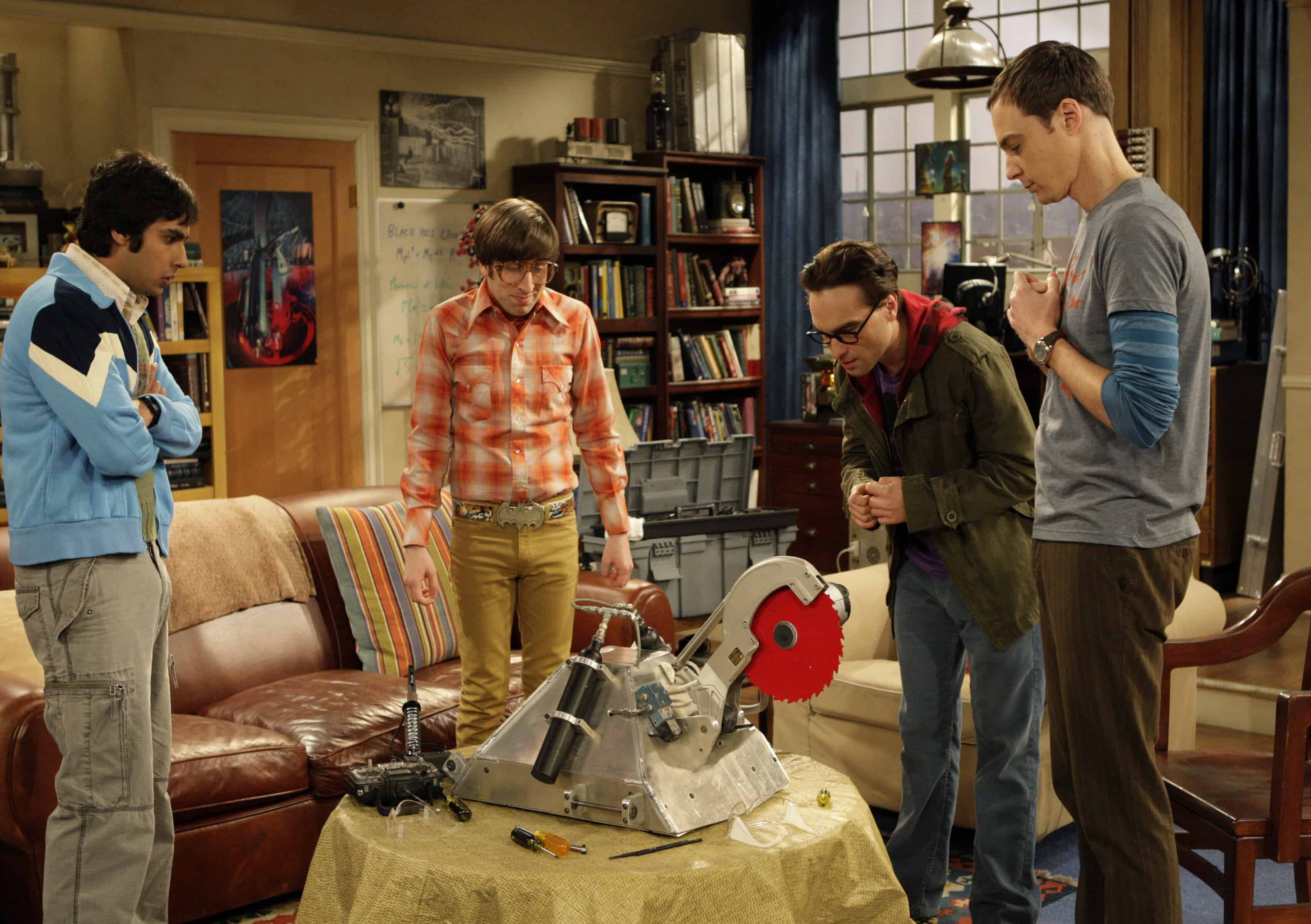
Stars of the show From left to right, Raj, Howard, Leonard and Sheldon build a robot to enter a fighting-robot competition (credit: Warner Bros Television Entertainment)

By Michael Banks

You may have heard of, or possibly seen, the hit TV sitcom The Big Bang Theory, which features two brilliant postdoc physicists, Leonard and Sheldon, who are totally absorbed by science but fail to fit in with their 20-something non-academic contemporaries.

Now in its third season on the CBS network in the US and with a fourth commissioned, the show has over 13 million US viewers. The sitcom also airs in the UK on Channel 4 and last month E4, Channel 4’s digital network, started showing the third season.

In the January edition of Physics World, Nick Thomas from Auburn University at Montgomery, talks exclusively to the show’s stars and creators about why the series, which has a dialogue peppered with references to physics and mathematics, is such a roaring success with viewers.

Click here to read the full story.

Newton tribute helps ward off New Year blues

newton10-tree.jpg
Newton celebrated in the latest “Google doodle”

By James Dacey

Welcome back to physicsworld.com for what will hopefully be another exciting year of research breakthroughs and technological innovations. That said, if you’re returning to work after a Christmas break of festivity and overindulgence, the first few days back can be more than a little gloomy. At least the folks at Google are doing their bit to try to lift the spirits of down-in-the-dumps physicists.

Attentive users of the popular internet search engine will have already noticed its tribute to Isaac Newton, the great English physicist who would be celebrating his 366th birthday were he still alive today. The iconic Google logo has been draped with the branch of an apple tree, which drops a fruit when you hover your cursor over it – a tribute, of course, to the incident that allegedly inspired Newton’s theory of gravitation and his Principia Mathematica first published in 1687.

Newton’s much anticipated follow-up Opticks, released to the public 17 years later, also has great resonance this year, as 2010 marks the 50th anniversary of the invention of the laser. physicsworld.com will be joining the celebrations with a series of video interviews with leading laser physicists and engineers, and there will also be a laser special for the May print issue of Physics World magazine.

So whether you’re returning to the office, to the lab, or anywhere else in between, try to ride out those New Year blues, as the celebrations and exciting breakthoughs are just around the corner!

Breakthrough of the year

The first complete ‘quantum computer’

For decades physicists have dreamed of building a quantum computer that could solve certain problems faster than a conventional counterpart. Actually building such a thing has proven extremely difficult, but in August Jonathan Home and colleagues at NIST unveiled the first small-scale device that could be described as a “quantum computer”. The chip can perform a complete set of quantum logic operations without significant amounts of information being lost in transit.

Over the past few years, Home’s team has used ultracold ions to demonstrate separately all of the steps needed for quantum computation. But in 2009, the group made the crucial breakthrough of combining all these stages on a single device, which was, in our view, such a significant piece of work that we felt compelled to pick it as our “breakthrough of the year”.

The device even looks a bit like an early computer chip – but don’t expect it to be running a quantum version of Windows any time soon. Its overall accuracy of 94% is impressive for a quantum device, but this must be boosted to 99.99% before it could be used in a large-scale quantum computer comprising many such processors.

What do the quantum computing experts have to say? “A great step forward and most impressive,” said Hans Bachor, at the Australian National University. “A tour de force,” said Boris Blinov of the University of Washington.

Home was back in the news in November, when he teamed up with David Hanneke and others at NIST to create a quantum computer from two trapped ions. The device can perform at least 160 different quantum-computing operations.

Much more work must be done before quantum computers become a commercial reality – but real progress was made in 2009.

The best of the rest for 2009

Top results from Tevatron

The Large Hadron Collider may have been hogging the limelight in 2009, but physicists on Fermilab’s Tevatron kept churning out a tremendous number of results. Indeed, it seemed that every week, at least one or two papers from Tevatron’s two main experiments (CDF and D0) were published in Physical Review Letters. While it’s tough to pick out the most important result, our favourite is the double act in March when CDF and D0 experiments independently reported unambiguous evidence that top quarks, the heaviest of the six known quark flavours, can be produced individually rather than in pairs as had been observed until now.

Spins spotted in room-temperature silicon

For several decades, physicists have promised smaller, faster and more efficient electronic devices that use electron spin to store and process information. But with the exception of giant magnetoresistance read heads in hard drives, physicists have struggled to create practical ‘spintronic’ devices. In November, Ron Jansen and colleagues at the University of Twente in the Netherlands made an important move in this direction by showing that spin-polarized electrons can be injected into silicon at room temperature. The spins endured long enough to suggest that spintronics circuits could include silicon features that are nanometres in size and operate at frequencies of 10–100 GHz – just like today’s integrated circuits.

Graphane makes its debut

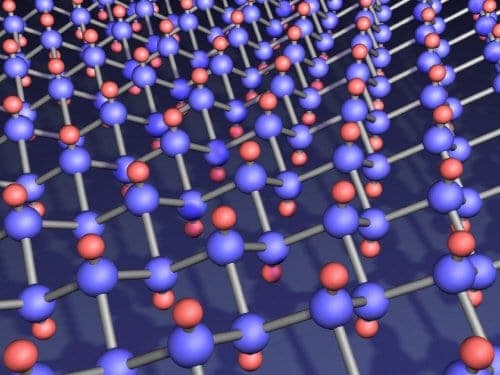
Graphane

The “wonder material” graphene burst onto the scene five years ago – and the sheet of carbon just one atom thick continues to wow physicists with its growing list of remarkable properties. In January, a team including the UK-based research group that discovered graphene announced a new material called graphane, made by adding hydrogen atoms to their original discovery. As well as being an insulator that could prove useful for creating graphene-based electronic devices, graphane might also find use as a hydrogen-storage medium that could help hydrogen-powered vehicles travel further before refuelling.

Magnetic monopoles spotted in spin ices

Ever since magnetic monopoles were first predicted by Paul Dirac in 1931, physicists have looked in vain for these elusive entities. In September, two independent research groups claimed to have caught sight of monopoles – essentially magnets with only one pole – in magnetic materials called spin ices. The spin-ice monopoles have very different origins from those predicted by Dirac, and therefore are unlikely to help physicists develop grand unified theories of particle physics or string theories. But because the monopoles occur in magnetic materials, understanding their properties could help with the development of magnetic memories and other spintronic devices.

Water on the Moon

The surface of the moon as seen by the Moon Mineralogy Mapper

We can see the surface of the Moon with the naked eye and some people have even driven on its surface – but until September we weren’t sure how much water is on our nearest neighbour. That’s when scientists working on the Indian space mission Chandrayaan-1 revealed a wealth of data suggesting that there is much more water than previously thought. And then a week or so later, NASA’s LCROSS probe smashed into a crater at near the lunar south pole, throwing up about 100 kg of water. The presence of water makes the long-term colonization of the Moon a little bit easier and such a colony could be a proving ground for a station on Mars – which we know has lots of water. I’m sure we will hear more in 2010 from NASA, ESA and other space agencies about future manned space missions.

Atoms teleport information over long distance

Once the stuff of science fiction, teleportation is now part of the physics lexicon. In January, Christopher Monroe and colleagues in Maryland and Michigan told us how to teleport quantum information between two atoms separated by a significant distance – an advance that could be a significant milestone in the quest for a workable quantum computer. The ions were one metre apart and until this work, teleportation had only been achieved between photons, and between two nearby atoms through the intermediary action of a third. Quantum teleportation is a “spooky” form of transport whereby quantum information such as the spin of a particle or the polarization of a photon can be transferred between particles without the movement of the particles or the transmission of information.

Black-hole analogue traps sound

Technion's Jeff Steinhauer

Is there anything that can’t be simulated using ultracold atoms? In June, Jeff Steinhauer and colleagues at Technion University in Israel added black hole to that growing list. The team’s black-hole analogue can trap sound in the same way that an astrophysical black hole can trap light. But instead of a collapsed star, it involves a Bose–Einstein condensate – a collection of atoms so cold that they move coherently in the same quantum state. The next step is to see if the analogue emits something resembling Hawking radiation – particles that are created near to black holes and manage to escape, but have yet to be observed.

Dark matter spotted in Minnesota?

The physics community is still digesting this week’s news that the CDMS-II collaboration has come tantalizingly close to detecting dark matter. The team has found two events that fit a dark-matter constituent known as a weakly interacting massive particle, or WIMP. The probability that these could be radioactive decays or cosmic rays is 23% so much more work needs to be done. Will CDMS-II or perhaps another experiment make a stronger case for dark-matter detection in 2010?

And finally, a big bang at the LHC

No list would be complete with out a mention of the 2.36 TeV proton collisions earlier this month at the LHC – the highest energy ever. You can read about that and lots more in our look ahead to all the exciting physics that could be done in 2010.

Copyright © 2026 by IOP Publishing Ltd and individual contributors