

Europe launches cosmic explorers

Two groundbreaking missions to map the geometry of the universe and study the formation of the earliest galaxies have successfully launched onboard an Ariane–5 rocket from French Guiana. The Herschel and Planck satellites, which have been built by the European Space Agency (ESA), took off at 13:12 local time from the Guiana Space Centre in Kourou.

Their destination is an area in space some 1.5 million kilometres further out from the Sun beyond the Earth. Known as Lagrange point L2, it is where a space probe can usefully hover, little disturbed by stray signals from home and without having to use much fuel to keep it in position.

First to arrive, in roughly two months’ time will be Planck – a microwave observatory like NASA’s Wilkinson Microwave Anisotropy Probe (WMAP), which is also at L2. Planck will probe the geometry and contents of the universe by finely measuring the cosmic microwave background (CMB) radiation – a remnant of the Big Bang.

“Planck will provide a big jump in knowledge,” says Nazzareno Mandolesi of the Institute of Space Astrophysics and Cosmic Physics in Bologna, principal investigator for one of Planck’s two instruments, which will together measure the CMB at frequencies between 27 GHz to 1 THz.

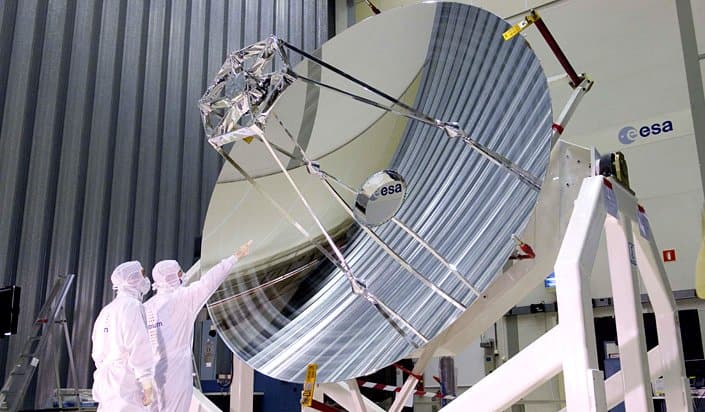
More than a month later, Herschel, named after the German-born astronomer who in 1781 discovered Uranus, will join the group in a much wider orbit around L2 than Planck. This far-infrared and submillimetre telescope will study the universe’s coolest objects, from the era when the first stars and galaxies were formed to the present day.

For the first time we will get a proper sense of star formation in [other] galaxies Michael Rowan-Robinson, Imperial College London

“Herschel is the first really big infrared telescope,” says astrophysicist Michael Rowan-Robinson of Imperial College London. “For the first time we will get a proper sense of star formation in [other] galaxies.”

Cosmic echo

The Planck mission has a more focused goal than Herschel: to map out the CMB in the finest detail yet. The CMB was created 400,000 years after the Big Bang, when primordial protons, neutrons and electrons formed neutral atoms that allowed photons to finally move freely. The photons have continued to do so ever since, being stretched to microwave frequencies due to the expansion of the universe.

The European Space NASA’s Cosmic Background Explorer (COBE) set the field alight in 1992 when it revealed that the CMB is not uniform but has slight variations that carry information about the early universe.

“It transformed the field completely,” says astrophysicist Pedro Ferreira of the University of Oxford. Researchers set to work on a raft of new instruments, ground-based, airborne and in orbit, including WMAP and Planck.

[Planck will be able to] distinguish between different theories of inflation and decide what theories are actually viable Pedro Ferreira, University of Oxford

The value of Planck and other CMB experiments is that they provide some of the only hard data about the very early universe. Cosmologists believe that the nascent universe underwent a period of extremely rapid growth called inflation and Ferreira says that Planck will be able to “distinguish between different theories of inflation and decide what theories are actually viable”.

The Degree Angular Scale Interferometer, sited at the South Pole, found the first evidence that the CMB photons are polarized; and Planck will measure that polarization in more detail than was possible before.

The big challenge for Planck will be to detect a so far unobserved type of polarization known as “B-modes”, which date back to the period of inflation and are determined by the density of primordial gravitational waves.
“This is a signal that has gone unobstructed since the Big Bang,” says Ferreira. If they could be detected, thinks Ferreira, such waves might tell us what mechanism generated them in the universe’s first moments, what caused inflation, and even if there was something before the Big Bang.

Eye in the sky

Herschel has two goals: to study star formation in our galaxy; and galaxy formation across the universe. It is hard to see star-forming regions at visible wavelengths because they are usually shrouded in gas and dust that block visible light. Infrared light pierces this veil and Herschel has the resolution to reveal the details of how clouds of cool atoms and molecules coalesce into stars.

As water vapour in the atmosphere absorbs much of the infrared radiation from space, astronomers have long been trying to get telescopes above the atmosphere. IRAS, a US- UK-Netherlands mission in 1983, was the first to map the entire sky, followed by ESA’s Infrared Space Observatory (ISO) in the 1990s and NASA’s current Spitzer Space Telescope.

All of these missions, however, are limited by their cooling systems. Because any warm object emits radiation in the infrared, these telescopes and their detectors must be chilled close to absolute zero using liquid helium.

Helium is heavy to hoist into orbit, which limits the size of any mirror that can be launched to less than 1 m, in turn restricting angular resolution. Moreover, helium eventually boils off, thereby limiting mission lifetimes to just a few years.

As Herschel is viewing slightly longer wavelengths than previous infrared missions, it can get by with its mirror and telescope just being “passively” cooled to 80 K by the coldness of outer space, leaving just the detectors bathed in liquid helium.

This allows Herschel to have a mirror that is 3.5 m across, the largest yet deployed in space. The satellite will investigate light with wavelengths of 55–670 µm. On a larger scale, Herschel will look back to the early universe to see galaxy formations that are invisible to the likes of the Hubble Space Telescope because of gas and dust.

“We will find out how all the galaxies we see today came into being,” says Matt Griffin of the University of Wales, Cardiff, principal investigator on one of Herschel’s three instruments. It will also probe the planet-forming regions around stars in our Milky Way, the gas giants of our solar system, and comets and objects in the Kuiper Belt.

Mott insulator stores light

Physicists have stored pulses of light in a cloud of ultracold atoms for up to 240 ms — about 40 times longer than the previous record. They did this by arranging the atoms into a lattice-like structure in which the atoms are prevented from moving around. This state, known as a Mott insulator, can then re-emit the pulses on command.

Although light has previously been stored in solids for several seconds, the advantage of atomic gases is that light can be stored just one photon at a time, which could come in handy for building quantum information systems. Another important bonus of atomic gases is that physicists have lots of quantum-optical techniques at their disposal to control the storage process.

Indeed in this latest work, Immanuel Bloch of the Johannes Gutenberg University in Germany and colleagues were also able to control the direction that the pulse was re-emitted from the ultracold gas.

No hopping allowed

The team — which also included physicists from Israel’s Weizmann Institute of Science and Harvard University — began with an ultracold gas of about 90,000 rubidium–87 atoms in an optical lattice formed by crisscrossing laser beams. The wavelengths of the laser beam are set so they don’t correspond to the wavelengths of light that are absorbed and emitted by the atoms.

Each lattice site is occupied by one atom and the lasers are adjusted such that an atom would have to overcome a significant energy barrier to hop into a neighbouring lattice site. This configuration is dubbed Mott insulator because it is analogous to those solids in which the conduction electrons are localized due to the strong interactions between the atoms.

The researchers then applied a magnetic field to the atoms, which let them isolate a particular three-state system comprising two different sublevels of the ground state and an excited state. Transitions between one sub-level and the excited state could be triggered using a relatively weak “probe” laser, while transitions from the other other sub-level were driven using a more intense “coupling” laser.

Opaque becomes transparent

The researchers found that when the probe laser is fired on its own, the light is absorbed by the gas and therefore blocked. But if the coupling laser is fired at the same time, the probe laser passes through unhindered thanks to an effect called electromagnetic transparency (EIT), which was first seen about 20 years ago.

The trick to storing a light pulse is to turn off the coupling laser as the probe pulse is in the gas. The probe pulse is absorbed by gas, creating a spatially-varying pattern of atomic spins — a “spin wave” that is imprinted on the atomic gas. If the coupling laser is switched back on again, the probe pulse is “recreated” from the spin wave. The team used this technique to store pulses for up to about 240–ms

In other atomic gas experiments, the motion of the atoms degrades the spin wave pattern rapidly – the upshot being that the light pulse can only be stored for a few milliseconds. But because the atoms in the Mott–insulator state are not moving around, the stored pulse lasts much longer.

Several seconds possible

Indeed, Bloch told physicsworld.com that the technique could be refined to get storage times as long as several seconds by adjusting the wavelengths of the lasers that form the optical lattices so this light is further away from the wavelength of the atomic resonance.

The team also showed that the pulse can be re-emitted in a direction different to its original trajectory. This was done by first storing the pulse in the medium and then firing a third laser beam, which changed the atomic spin wave in a controlled way. By doing this they managed to deflect the original pulse by more than 20 millradians — about one degree.

Single photon source

Bloch also believes that atomic Mott insulators could also be used as a source of single photons by exciting tiny spin waves in the gas via Rydberg atoms. These are atoms with electrons that have been excited into very high energy states — and lead to a Rydberg blockade mechanism, whereby the presence of a Rydberg atom prevents the excitation of nearby atoms.

Atomic gases also allow for strong interactions between the atoms, which could be used to create efficient quantum gates for the atomic spin states — and thus the creation of photonic quantum logic gates for quantum computing.

A preprint describing the work is on arXiv.

What do they think at CERN?

angels.jpg
Far too much antimatter — and her hair looks too thick and shiny to be believable

By Hamish Johnston

No, not about the Austrian pull-out — Angels and Demons of course.

The BBC sent a reporter to Geneva for a special screening last night of the film Angels and Demons for CERN physicists.

The film — based on a book by Dan Brown — involves a plot to destroy the Vatican using anti-matter produced at CERN’s Large Hadron Collider.

The LHC does produce antimatter, but one CERN physicist told the BBC it would take ten times the age of the universe to accumulate enough antimatter to do the dastardly deed.

The Vatican is of course in the Eternal City, so perhaps the plotters have time on their side.

What did the physicists think of the rest of the film? You can listen to their comments here

By the way, 13,381 folks have signed the online petition to keep Austria at CERN.

Astronauts set to upgrade Hubble

Astronauts are preparing for a set of spacewalks to repair and upgrade the Hubble Space Telescope, which will enable the 19–year-old instrument to carry on taking images of the early universe until 2014.

Late yesterday, space shuttle Atlantis, together with seven astronauts, successfully blasted off from the Kennedy Space Centre, Florida, to carry out Hubble’s fourth and last service mission.

Taking 11 days, the mission will aim to improve Hubble’s optics “observational power” by up to a factor of 100. Five space walks are planned in total — each lasting more than six hours.

Hubble has had a wonderful life and it’s proven to be one of the wonders of the modern world Kimberly Weaver, NASA

The main feature of the upgrade will be the replacement of the wide-field camera on Hubble. The new camera, which will operate in the ultraviolet through the visible and into the infrared, will allow Hubble to see fainter and more distant galaxies that formed a few hundred million years after the Big Bang.

Improved optics

“Right now Hubble can see galaxies as old as 12.9 billion years”, says Kimberly Weaver, an astrophysicist at NASA’s Goddard Space Flight Centre in Maryland. “With the new instruments Hubble can look further back and perhaps see the first galaxies form 500 million years after the Big Bang.”

A separate spacewalk will install a new instrument – the Cosmic Origins Spectrograph — on Hubble that will reveal information about the temperature, density, velocity and chemical composition of the objects it observes.

Astronauts will also repair the Space Telescope Imaging Spectrograph, which is designed to operate at ultraviolet and optical wavelengths but broke down in 2004 following a power failure. The instrument will reveal information about the temperature and motion of stars and gases.

Atlantis astronauts will also try to revive the Advanced Camera for Surveys instrument, which stopped working in 2007 when a short circuit in the electronics took it out of action. The camera increases the resolving power of the main wide-field camera by a factor of 10.

Hubble trouble

The final servicing mission was initially scheduled for last October. It was delayed in late September following problems with Hubble’s onboard computer, which will be mended during the mission.

There is a chance that, budget permitting, Hubble could extend its lifetime beyond 2014. However, by then it should be superseded by the James Webb Telescope, which will mainly work in the infrared range and is planned to launch in 2014. “Hubble has had a wonderful life,” says Weaver, “and it’s proven to be one of the wonders of the modern world.”

Sexy physicists and a plot to destroy the Vatican

angels and demons.jpg
CERN at Hollywood Credit: Sony Pictures

By James Dacey

Physicist Leonardo Vetra smelled burning flesh, and he knew it was his own. He stared up in terror at the dark figure looming over him.
‘What do you want!’
La Chiave” the raspy voice replied. ‘The password.’

For those of you not familiar with Dan Brown’s flamboyant writing style, these are the opening words of his novel Angels and Demons – a no-holds-barred thriller involving a sexy Harvard physicist, crafty assassins, and a plan to obliterate the Vatican with antimatter stolen from CERN.

Tom Hanks and Ewan McGregor star in a film adaptation, which in on general release in the US this week.

I must confess I haven’t actually read the book (the prequel to the Da Vinci Code), but my friend told me about an event called Angels and Demons – the Science explained and I was sufficiently intrigued to pop along. There was some free wine and snacks too… but that had no bearing 😉

The idea of the evening was to come meet some CERN physicists based at the University of Bristol and ask them absolutely anything at all about particles, the universe and everything.

I was at a table with James Jackson, a Z boson specialist who was certainly made to work for his free Chardonnay and peanuts. For over an hour he was grilled with “ok, this might sound silly but what if…” type questions, which invariably strayed into the realms of the metaphysical.

The event was organized by the Centre for Public Engagement at the University and is part of their twilight talks series.

Meanwhile yesterday at the real CERN, a very real drama was unfolding in the aftermath of Austria’s proposed withdrawal from the facility. They will be only the second existing country to do so since CERN was created as an act of European solidarity in the Post War years (Spain left in 1969 but then rejoined in 1983). In the past 24 hours alone, over 4000 people have added their names to an online petition against the proposal.

Naively assuming that all physicists would have heard this news, I found myself delivering a Dan Brown style page-turner when I mentioned it. The Bristol researchers seemed a lot more shocked than I would have expected.

“Austria may only be minor financial contributor but there is a danger this will set a precedent,” said Nick Brook, head of High Energy Particle Physics Group at Bristol.

Nano-lamp illuminates quantum-classical boundary

With just a single carbon nanotube for a filament, the world’s smallest incandescent lamp has been made by physicists in the US. The team are using the tiny light to study the murky boundary between quantum mechanics and thermodynamics — and to their surprise, they have found that Planck’s theory of blackbody radiation, which should only apply to large objects, is also relevant at the nanoscale.

Planck’s blackbody radiation law describes thermal radiation emitted by large objects — including light bulbs, the Sun, and the early universe. The law was developed over a century ago using thermodynamics principles, plus one revolutionary new postulate — the idea that light was quantized.

This ultimately led to the development of quantum mechanics, which works best when describing just a few tiny particles. Conversely, thermodynamics concerns systems with many particles — all the molecules in a litre of air, for instance.

Just 100 atoms wide

The new incandescent light bulb was made by Chris Regan and colleagues at the University of California at Los Angeles. The filament is a single carbon nanotube just 100 atoms wide and as such straddles both classical and quantum regimes thanks to its small size. With less than 20 million atoms, the nanotube filament is both large enough for statistical thermodynamics laws to apply, and small enough to be a molecular, or quantum mechanical system.

“Our goal is to understand how Planck’s law gets modified at small length scales,” says Regan. “Since both the topic (blackbody radiation) and the size scale (nano) are on the boundary between the two theories, we think this is a very promising system to explore.”

The researchers constructed the tiny light bulb with the same fabrication tools that the semiconductor industry uses to make computer processors. They lithographically patterned gold wires to connect to a single carbon nanotube suspended over a hole in a silicon chip. They then placed the chip in a vacuum chamber, which serves as the light bulb, protecting the filament from burning.

Driving an electrical current through the filament causes the it to heat up and glow. When off, the filament is too small to be seen, even in an optical microscope, but when energized it appears as a tiny point of light that is visible to the naked eye.

Testing Planck’s law

The team studied the light emitted by the carbon nanotube filament using an optical microscope with various colour filters. “Planck’s law tells us what light intensity to expect as a function of wavelength and temperature,” Regan told physicsworld.com. “By changing the colour filter and the applied electrical current, we can alter both the wavelength and temperature respectively. This allows us to compare Planck’s prediction with what we detect coming from the carbon nanotube lamp.”

The carbon nanotube makes an ideal light bulb filament because it is both very small and stable at extremely high temperatures. Using carbon as a light bulb filament is not a new idea: Thomas Edison’s first commercial light bulbs contained carbon filaments. Indeed, the new bulb is similar to Edison’s except that the filament is 100,000 times narrower and 10,000 times shorter.

Coherent light source?

Looking forward, the team now hopes to investigate the coherence properties of the light emitted by the tiny lamp. Light from quantum sources (such as a laser) can be coherent, but incandescent lamps normally produce incoherent light. “In our case all the incandescence photons are created within a wavelength of each other,” explains Regan, “so we don’t expect them to be as uncorrelated as in a normal light bulb.”

Super-thin supersolid points to superglass

By Hamish Johnston

After a buzz of activity in 2004-2008, it looked like it was going to be a quiet year for supersolid enthusiasts — until about two weeks ago, when two papers appeared in Science on that mysterious state of matter that may (or may not) exist.

One of the papers (by Seamus Davis and crew at Cornell) suggested that supersolids may in fact be “superglasses”.

Now, supersolid pioneer Moses Chan and colleagues at the Pennsylvania State University have published a paper in Physical Review Letters that seems to back-up the superglass theory.

The first evidence for a supersolid was seen in 2004 by Chan and Eun-Seong Kim, who noticed that around 1% of the atoms in a sample of solid helium seemed to “decouple” and flow effortlessly through the rest of the mass like a superfluid.

While this effect has been reproduced in several other labs — the relative size of the decoupling has varied from 0.02% to 20% in different samples.

One common thread through these experiments seems to be the amount of disorder in the solid helium — with nearly-perfect crystals showing relatively small amounts of supersolidity and disordered solids showing lots.

Another thing is that the solids with the highest decoupling are very thin. Indeed, the 20% figure was seen by John Reppy and Sophie Rittner at Cornell in a film just 150 μm thick. This seemed to suggest that there is an ideal surface-to-volume ratio for supersolidity.

In their latest work, Chan and team also looked at a 150 μm thick film of solid helium — and saw a decoupling of about 1%.

So what was different?

Because of their experimental set-up, Reppy and Rittner froze their helium in about one minute, whereas Chan’s samples took at least 4 hours to solidify. Chan believes that the rapid cooling of the Reppy/Rittner film could leave it in a (highly disordered) glassy state , which seems to boost supersolidity.

Things are heating up again for supersolids!

Austrian physicists protest at CERN pull-out

Researchers in Austria have started an online petition in protest at the country’s decision to withdraw from the CERN particle physics lab. So far over 1500 people have signed the petition, which will be sent to Johannes Hahn, the Austrian science minister, who announced on Thursday that the country would cut its funding for CERN worth around €20m per year.

The decision to pull out from CERN after being a member for exactly 50 years comes only months before the Large Hadron Collider (LHC) — the world’s biggest particle accelerator — starts up.

The decision now has to be approved by Austria’s government, parliament and then president. If it is signed by the president then Austria will cancel the membership of CERN by the end of 2010. The decision could affect up to 170 Austrian-based particle physicists.

Budget concerns

Austria currently supplies 2.2% of CERN’s budget with the rest coming from the lab’s other 19 member states. However, the €20m that Austria spends on CERN makes up 70% of Austria’s funding for international research.

Physicists in Austria are particularly angry as the science budget has been increased by 15% this year, while the cost of membership at CERN currently amounts to around 0.5% of the total science budget.

“I am really disturbed that the decision was taken by the ministry without any consultation,” says Christian Fabjan, director of the Institute for High Energy Physics at the Austrian Academy of Sciences in Vienna.

“The pullout would be a serious blow for academic research,” says Fabjan, “and it sends a terrible signal to the international community and to researchers in Austria doing basic research.”

Fabjan said that his institute has been promised funding for a few more years if the decision is made to pull out, but he admits that Austria would become “second-class” citizens at CERN if the decision is taken.

A “grotesque” affair

Austria has mostly contributed to building the Compact Muon Solenoid, one of the four big detectors at the LHC, which will search for the Higgs boson and look for evidence of physics beyond the Standard Model, such as supersymmetry, or extra dimensions. Here they have designed systems to detect and measure the momentum of individual particles resulting from the high-energy collisions.

“I find the pullout grotesque,” says Anton Rebhan, a theorist at the Vienna University of Technology who has previously worked in the CERN theory department as a postdoc. “I profited enormously from the possibility to carry out research at CERN, which would no longer be open for young Austrian physicists [if the decision is made].”

Austria would only be the third country to leave CERN. Yugoslavia, one of the 12 founding members left in 1961 and never rejoined, while Spain joined in 1961, left in 1969 and then rejoined in 1983.

Large graphene samples could boost carbon electronics

Researchers in Texas are the first to produce centimetre-sized samples of graphene — sheets of carbon one atom thick and dubbed the “wonder material” on account of its unique physical properties. This is significantly larger than existing samples that are typically at the micrometer scale. Richard Piner and his team at the Univeristy of Texas have employed a chemical deposition technique to grow their graphene on thin films of copper.

Graphene holds the promise of revolutionizing electronics over the coming years. One of the main reasons is that electrons travel through graphene with significantly higher mobility than they do in conventional circuits made from silicon. Engineers have already created some rudimentary graphene components, such as transistors and frequency multipliers. However, making carbon-based circuits will require large and high-quality samples of graphene that can be integrated with silicon.

Wondrous production

Since its discovery in 2004, there have been a range of approaches to isolating graphene from larger samples of carbon. One of the favoured techniques is mechanical exfoliation in which flakes of graphene are stripped from graphite with “sticky tape”. However, due to the delicacy of a material that is just one atom thick, exfoliation typically produces flakes at the nano-scale.

“They say a 30 cm graphene sample is the Holy Grail for carbon electronics but reaching the same order of magnitude is a significant step,” said Richard Piner, one of the researchers at the University of Texas.

Piner and his colleagues take a different approach by growing graphene on a substrate using chemical deposition. Taking a piece of copper foil 25 µm thick, they add a mixture of methane (CH4) and hydrogen, then heat the apparatus to 1000 degrees Celsius. Single layer graphene is then deposited on the copper in patches up to 1 cm by 1 cm.

Drop the copper

“This very important result may represent the missing link in the industrial fabrication of large area graphene for applications in graphene-based integrated electronics,” said Roman Sordan, a materials researcher at the Politecnico di Milano.

Previously, researchers had used chemical vaporization but with different metals and this have hindered the quality and scale of carbon growth. For example, nickel has been touted as promising, but carbon is highly soluble in this metal and multiple layers of graphene tend to build up at the grain boundaries.

Now that the team from Texas have produced a large sample of graphene, the next step is to develop a technique for carefully transferring the carbon sheet from the copper to a semiconductor — like silicon. Piner told physicworld.com that initial attempts have resulted in limited success. “We are working on the fact that graphene is extremely hydrophobic and can float to the surface of a liquid… but it is also extremely delicate,” he said.

This research was published in Science

Nano-box breaks size records

Researchers in Denmark and Germany have used an origami technique to make a nanometre-sized box with a lid that can be locked and unlocked. The box is made of DNA and measures 42 × 36 × 36 nm, which means that it can easily carry various kinds of tiny cargo such as a single virion or ribosome. It might be used as a container for drug delivery or as a new type of biosensor, say the scientists.

The DNA box is the largest and most complex artificial self-assembled structure reported to date, explains Jorgen Kjems of Aarhus University. It is also the smallest box ever made.

The DNA origami method was developed in the US by Paul Rothemund at Caltech in 2006 and was originally used to construct 2D DNA structures. Origami is the Japanese word for paper folding — and the DNA technique involves folding a large single-stranded DNA genome into a sheet. This is done by adding more than 200 small synthetic DNA sequences called “staple strands”.

Kjems and colleagues have now extended this technique by developing software that can fold any 2D nanostructure, and recently also 3D structures such as their nano-box.

Enough room for a ribosome

The box is large enough to hold a single ribosome or poliovirus and its six faces are formed from parallel, interlinked DNA helices folded into shape thanks to 220 short synthetic nucleus strands (or oligonucleotides).

The lid of the box closes when two DNA sequences in the lid recognize two complementary sequences inside the box. The two DNA helices that subsequently form close the box.

However, something else can happen too: two specific external RNA or DNA sequences can form longer helices with the two DNA locks inside the box. These two external sequences “out compete” the helices inside the locks and release the lid. “The lid will then automatically open thanks to repulsion between all of the negative charges in the box,” Kjems said.

New type of sensor

As well as being able to carry and deliver drugs inside cells, the box might also act as an amplifier. This is because the presence of only two DNA molecules can lead to the release of a large number of reporter compounds inside the box, says Kjems. It could thus be used to develop a new type of biosensor.

The team, which includes researchers from the Max Planck Institute for Biological Chemistry and the University of Göttingen, both in Germany, will now test drug delivery inside cells using the nano-box.

The work was reported in Nature.

Copyright © 2026 by IOP Publishing Ltd and individual contributors