Weird, but it might just work

exhibition.jpg
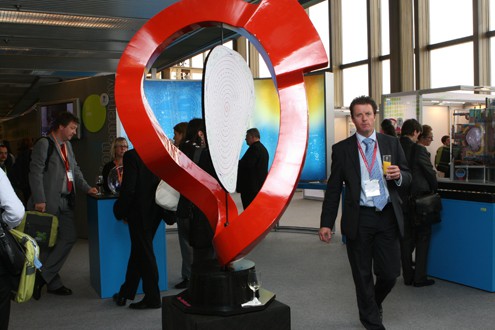
Weird stuff: a model of the Wendelstein 7-X outer magnet

By Matin Durrani

It’s amazing who you can meet at a conference.

At a sumptuous four-course dinner at Prague’s Kaiserstenjsky Palac last night – held as part of Europe’s Research Connection conference — I sat next to an Italian architect called Pietro Laureano, who researches the ancient tradition of digging tunnels in the Saraha desert.

Sounds a bit mad, but as he explained to me through mouthfuls of “saffron risotto with smoked salmon and red parmesan pancakes”, the water condenses underground, creating pools from which you can drink or use to irrigate crops. He’s funded by UNESCO and has written a book all about it.

On my right was another Italian architect and anthropologist, who has written, among other things, a book on the history of pasta. He reckons that pasta was never a tradiational Italian dish but has only became so after being eaten by Italians who left for new lives in other countries. Pasta came to embody what it meant to be Italian, apparently.

Anyway, back to physics.

Out in the exhibition at the conference, I caught up with physicists from a couple of projects we’ve been following on Physics World over the last few years. One is ASPERA – a European group seeking to improve the continent’s work in astroparticle physics.

As Thomas Berghöfer from the DESY lab in Hamburg explained, they’ve been funded through cash from the European Commission to form what is known in the jargon as a European Research Area Network (ERA-NET). With seven big new facilities on the drawing board, it’s a concrete example of what the European Research Area is all about – enhancing Europe’s strengths in science through co-ordinated action.

Meanwhile, Patrizio Antici was on hand to talk about Europe’s plans for a European Light Infrastructure – a planned exawatt laser that would be a thousand times more powerful than Megajoule in France or the National Ignition Facility in the US. (Memo to Physics World’s news editor: this is something we need to keep readers updated on.)

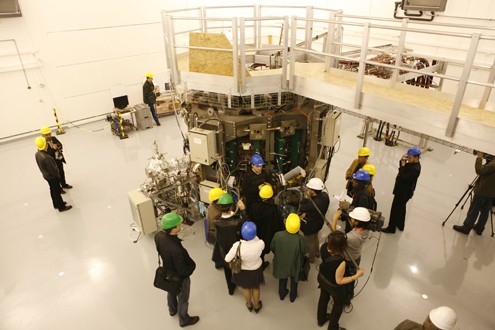
I also bumped into Chris Ibbott, a mechanical engineer who, working closely with physicists, helped to design one part of the ITER fusion reactor that’s currently being built in France. In front of a scale-model of the experiment, he explained just how complex this facility will be, not least trying to keep the plasma stable.

That’s why the Wendelstein 7-X reactor in Greifswald, Germany, is interesting: it can keep a plasma stable without needing a central solenoid. The snag is it’s got an outer magnet bent into a really weird shape, as the model in the photo above shows.

Like digging water-gathering tunnels in the Sahara or trying to get 27 separate European nations to collaborate, the Wendelstein 7-X reactor seems weird, but it might just work.
‘Chorus’ generates mystery space hiss

If it weren’t there, astronauts and satellites might well be showered with electrons at lethal energies. It’s “plasmaspheric hiss” — a natural radio wave that lies in just the right place outside the Earth to deflect high-energy electrons out of space and safely into the atmosphere. Since its discovery more than 40 years ago no–one has been sure of its origin, but now researchers from the US, Sweden and France claim to have the answer.

Having analyzed data from NASA’s THEMIS mission, Jacob Bortnik of the University of California at Los Angeles and colleagues think plasmaspheric hiss is generated by secondary “chorus” emission of electromagnetic waves from unstable electrons farther out. “I personally thought we would not be able to find such an observation,” says Bortnik. “Turns out I was pleasantly surprised.”

Helpful hiss

Scientists have long known that the Earth’s magnetic field traps high-energy particles, including electrons, into rotating regions that envelop the planet, called Van Allen belts. There are two belts and they are separated, between 10,000 and 20,000 km beyond the Earth, by the plasmasphere, where low-energy plasma rotates in the opposite direction. The plasmaspheric hiss is an electromagnetic wave of frequencies from 200 Hz to 2  kHz, and the magnetic component of it adds to the Earth’s magnetic field, thereby deflecting electrons from their normal trajectory and into the atmosphere.

There are three main hypotheses to describe how the hiss arises. The first is lightning, which with every strike creates an intense radio wave that can leak into space. The second, although unlikely, is that it comes from background magnetic turbulence, which gives energy in the form of unstable electron distributions that amplifies background radio noise. The third idea is also that the hiss grows from unstable electron distributions, but that these distributions reside just outside the plasmasphere and generate chorus hiss — a more intermittent type of hiss — that propagates inwards.

This last idea was developed by Bortnik’s group into a coherent theory last year, and it is the one the team now claim to have verified. They have analysed data from THEMIS, a constellation of five satellites that have different orbits around Earth and collect measurements of the electromagnetic environment. The researchers found that the hiss is not stronger over land, which is what one might expect if lightning were the cause because that is where there is more lightning activity. However, during a chance six–minute period when one satellite was monitoring in the plasmasphere region and another was monitoring farther out, they did find a correlation in modulation between plasmaspheric hiss and chorus hiss, which suggests the two are linked.

‘A large order’

Bortnik told physicsworld.com that it was “really tricky” to find this correlation. “We needed at least two satellites to be recording in high-resolution simultaneously — one in the distant chorus region, and the other in the nearby hiss region,” he explains. “We needed the waves to be present so we could observe them, and we needed the satellites to be oriented correctly with respect to Earth and each other. Quite a large order.”

However, he adds that many will not be satisfied with his group’s findings: “This has been an open problem for so long, and it has been so controversial, that to have a resolution is almost unpalatable.”

“I think we are only scratching the surface here and are about to get a truly Twenty-first Century view of the space environment we have been visiting since the 1960s,” he adds.

The research is published in Science.

Worldwide quantum security

A team of physicists from Austria has sent pairs of entangled photons, which can be used to encrypt messages with complete security, between telescopes spaced 144km apart in the Canary Islands. The researchers say that preserving entanglement over this distance shows the feasibility of carrying out quantum cryptography using a worldwide network of satellites.

Quantum cryptography exploits the laws of quantum mechanics to create uncrackable keys for encoding and decoding messages. Such keys are made up of the states of quantum particles, such as the polarization of photons, and their values are therefore not independent of observation. So any eavesdropper hoping to read off the value of a secret key will reveal his or her presence in the process.

Anton Zeilinger and colleagues exploit a bizarre feature of quantum mechanics called “entanglement” whereby the act of measuring the state of one particle can instantaneously change the state of another. This effect can be used for cryptography because measuring the polarization of one entangled photon will induce the same state in the other entangled photon. If individual photons from each pair are sent to two different locations, the same security code can be shared across a network of people.

Entangled Canaries

Two year’s ago, Zeilinger’s group showed it was possible to send one photon from an entangled pair between two observatories on separate Canary Islands separated by 144 km. However, it was hard to develop their system because of the distorting effects of the atmosphere, making it hard to distinguish the photons in the beam from stray light.

Now, the researchers have upgraded their source and transmitted both entangled photons using two separate telescopes on La Palma. They produced the entangled photons by firing a laser beam into a crystal to create pairs. A very slight time delay between the transmission of each photon within a pair then allowed the individual photons to be identified when arriving at a receiving telescope on Tenerife.

Vienna team member Rupert Ursin told physicsworld.com that this distance is more than enough to establish the feasibility of satellite-based quantum cryptography. However, the difficult part is preserving entanglement as the beams travel through the Earth’s atmosphere. But Ursin believes this could be overcome by sending beams from satellite to satellite and then vertically down to the receiver — then they would only need to traverse a few kilometres of the atmosphere.

“If you want to do worldwide quantum cryptography then you need to go to space. This is the final proof of principle demonstration,” says Ursin, who adds that fibre-optic cable is not a viable alternative to this free-space communication because entangled-particle beams are completely attenuated after passing through anything more than about 100km of cable.

The Austrian researchers are now working with physicists in Spain to develop a prototype source of entangled photons that Ursin says could be put into space by around 2014. He adds that the rocket used to carry the equipment, to be launched by the European Space Agency, could also accommodate a source of single photons, providing a test of a rival approach to quantum-key distribution.

This research was published in Nature Physics.

The third industrial revolution

potocnikandrifkin.jpg
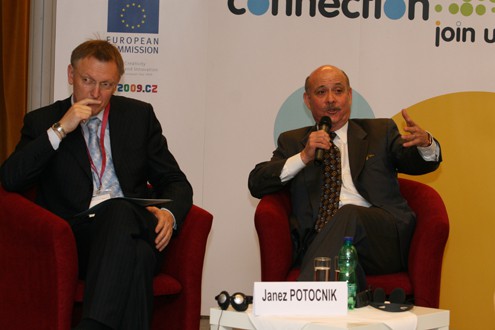
Revolutionary thinker: Jeremy Rifkin (right) with European research commission Janez Potocnik

By Matin Durrani

I can’t say I was hugely inspired by the opening address here in Prague at the Research Connection conference by European Commission science and research commissioner Janez Potocnik.

There was lots of hot air about “synergy leading to new quality”, “capacity building”, “structural and cohesion funds” and “community instruments”. I almost fell asleep.

To be fair to the Slovenian former economist, he admitted that while the conference features some top speakers, he wasn’t sure “it is polite to include myself in this category”. Refreshing honesty from a politician.

Much more interesting was the main plenary address on sustainable energy by Jeremy Rifkin, president of the Foundation on Economic Trends and advisor to the European Union. He’s also head of a group of 100 industrial bosses committed to “address the triple challenge of global economic recovery, energy security and climate change”.

So clearly a guy with fairly small ambitions.

In a doom-laden first half of his talk, Rifkin warned how too many politicians have completely underestimated how bad climate change will be — his talk was of anything up to 70% of species going extinct, oil supplies peaking within the next decade, and plenty of floods, storms and disaster.

Thankfully Rifkin has a solution — distributed energy.

Just as the computing Grid can carry out massive calculations by farming out chunks of processing to individual computers around the world, so distributed energy would involve individual houses and factories generating electricity using solar panels and wind turbines.

It’s revolutionary stuff — gone would be big, centralized oil-, gas-, or nuclear-powered stations. In would be small scale production, distributed around the world.

Better still, if it works, the idea is that people would sell unused energy to other people connected to the Grid.

It’s what Rifkin calls the “third industrial revolution”.

I was interested that Rifkin reckons the European Union is at the forefront of this idea — he hopes the EU will champion it at this year’s Copenhagen climate-change conference — whereas the US is still more resistant to it.

But as he pointed out at a later press conference, Obama has twigged what he’s on about and once the US sets itself a challenge, it could end up implementing distributed energy much faster than Europe’s fragmented nation states could.

Rifkin’s a polished performer and a man for the soundbite. Potocnik – take note. It might get you noticed.

Right, where’s that solar cell…

Kondo effect spotted in tiny magnetic wires

Electrons in magnetic wires just one atom thick behave very differently than those in bulk magnets. So say researchers in Spain, who have observed the ‘Kondo effect’ in tiny wires made of iron, nickel or cobalt — a phenomenon that does not occur in larger samples of these materials.

The effect — which arises from electron–electron interactions not present in pure bulk materials — must be considered when developing future technologies based on nanoscale magnetic structures, says the researchers.

In the first half of the 20th century, physicists were surprised to find that the electrical resistance of extremely cold samples of some metals increased rapidly with falling temperature — the opposite of what is observed at higher temperatures.

Screened impurities

This was explained in 1964 by the Japanese physicist Jun Kondo who showed that at low temperatures conduction electrons in a metal such as gold could become “stuck” to magnetic impurities (such as iron) present in the metal. This curtails the electron’s ability to conduct current and screens the magnetic moment of the impurity.

More recently, physicists have discovered that a similar effect can occur in tiny bits of semiconductor called quantum dots, where an electron spin trapped at the dot takes the place of the magnetic impurity. Now Carlos Untiedt and colleagues at the University of Alicante have seen the effect in atomic-scale ‘wires’ for the first time.

The wires were created using two different techniques. One involved stretching a metal contact with a scanning tunnelling microscope until it is one atom thick, while the other used electromigration to reduce the thickness of a metal contact to just one atom. Different wires were made from iron, nickel and cobalt — all ferromagnetic materials in which the spins of some of the electrons are responsible for magnetism.

Telltale signs

The team then measured the conductance of the wires as a function of temperature and applied voltage. They saw features at zero voltage called “Fano–Kondo” resonances, which are telltale signs of the Kondo effect.

They were surprised to find this effect because there are no impurities or trapped spins in the wire. Instead they believe that interactions between electrons in two different energy states – the localized magnetic “d” electrons and the conducting non-magnetic “sp” electrons – results in the Kondo-like screening of atoms in the wire. The team believes that the interation is enhanced in the wire — as compared to the bulk — because of the lack of neighbouring atoms.

“Our finding shows that, at the nanoscale, electron–electron interactions, which we often neglect, can be extremely important,” said Untiedt.

Big impact on magnetism

The finding means that scientists modelling magnetic properties of nanostructures will need to take these comparatively strong interactions into account, he adds. “The atomic-scale details of magnetic surfaces can have a big impact on how magnetism works at these scales.

The work was published in Nature.

Water dance enhances microbial reproduction

They say love teaches even asses to dance; well it seems the proverb holds true even for some microscopic organisms. Colonies of the common algae Volvox have been observed locked together in “waltz” and “minuet” in an attempt to boost chances of fertilization. That is according to a team of physicists from Tohoku University and the University of Cambridge.

These findings provide valuable new information to both biological fluid dynamics and the evolution of Volvox algae, say the researchers. It could also further our understanding of the mechanics inside the human body. “The flagella with which Volvox swims are essentially identical to the cilia that operate within the reproductive and respiratory systems,” said Raymond Goldstein, one of the researchers at Cambridge.

Pond celebratory

In the history of science Volvox hold an important place, being closely linked with the birth of microbiology in the late 17th century. The alga was discovered by Antony van Leeuwenhoek using a very early microscope, and constituted a surprising first in taxonomy — spinning via a fixed body axis.

This new research now describes the discovery of two different types of algal movement, and gives quantitative evidence that the “dances” are a result solely of hydrodynamics. All other mechanisms including chemical signalling, behavioural responses, and the nervous system, are ruled out by the physicists.

Goldstein and his team noted that at certain points in the Volvox life cycle, two algae lock together and rotate in stable bound states. Short-range lubrication combines with hydrodynamic forces causing paired algae to rotate. Near the water surface, lighter couples rotate about each other as in waltz, whilst lower down in the water column heavier pairings spin laterally out-of-phase as in minuet.

Critical audience

The physicists studied the 48 hour Volvox life cycle and linked these unusual movements with the reproductive phase. “The [hydrodynamic] flows will tend to speed up the process by which a sperm packet can find a female Volvox,” Goldstein told physicsworld.com.

Cristian Solari, an experimental biologist at the University of Buenos Aires believes these findings are also significant for evolutionary biologists. “In this scenario, physical forces seem to have moulded the evolutionary transition to higher biological complexity,” he said.

Goldstein told physicsworld.com that these findings add to a body of knowledge concerning a model organism in zoology. He also hopes it can have some secondary significance to our picture of human biomechanics. “The waltzing and all of that would not have a parallel within us, but the coordinated beating of those flagella is common to all situations,” said Goldstein.

This research was published in Phys. Rev. Lett.

COMPASS points to ITER

compass.jpg
Fusion followers: the COMPASS reactor in Prague with delegates to the Research Connection conference

By Matin Durrani

When they reach retirement age, physicists in many countries are simply told to pack their bags and go.

Not so for Jan Stoeckel, former head of tokamaks at the Insitutute for Plasma Physics (IPP) in Prague. When he turned 65, he simply stepped down from the hotseat, found a successor in Radomir Panek, and carried on working.

At least that’s what he told me yesterday on a fascinating guided tour of the institute’s COMPASS reactor, organized as part of the European Commission’s massive 2009 “Research Connection conference”:Research Connection conference here in Prague.

In a sort of parallel with Stoeckel’s career, the COMPASS reactor, which used to be based at the UK Atomic Energy Authority’s based in Culham, was all set to be mothballed until the IPP stepped in with an offer to rebuild it in Prague.

As Stoeckel explained to me as he took me round the brand new building in which COMPASS is housed, the reactor was originally built in the late 1980s, but was sold to the IPP for one pound in 2007, shipped to Prague and rebuilt over the last 18 months.

What makes COMPASS still useful is it that it is essentially a scaled down, one-tenth version of the ITER fusion reactor being built in Cadarache in southern France.

Although COMPASS initially won’t actually fuse nuclei together – deuterium-tritium reactions can be dangerous and expensive – the reactor will still be useful to study turbulence in hydrogen plasmas. And because it’s basically a tiny version of ITER, that work should give invaluable insights into how to keep ITER’s plasma stable.

(more…)

Prague here we come

orchestra.jpg
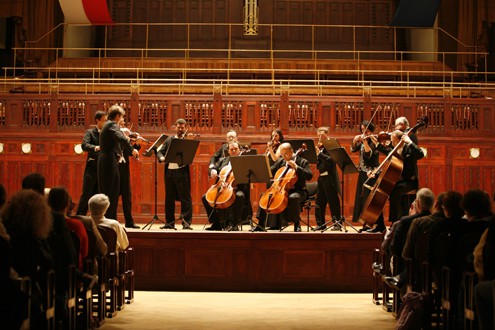
No expense spared: the Janacek Chamber Orchestra

By Matin Durrani

To adapt the immortal words of the singer Billy Bragg, if you’ve got a gravy train, I want to be on it.

It was in that spirit — and the quest for journalistic truth of course — that I accepted an offer from the European Commission for Physics World to go on an all-expenses trip to its 2009 Research Connection conference in Prague in the Czech Republic. The country currently holds the rotating presidency of the European Union.

The offer looked too good to refuse with over 1500 European researchers convening on the Prague Congress Centre for an event designed to showcase the best of European research funded by the Commission’s massive €50bn, seven-year Seventh Framework research programme.

Two nights in the luxury Corinthia Towers hotel didn’t sound too bad either.

Clearly the Commission is not short of cash – it has invited about 100 other journalists from across Europe to attend as well – and laid on a concert by the Janacek Chamber Orchestra at Prague’s Municipal House last night, followed by a lavish “cocktail dinner”, which was a kind of topnotch buffet.

I was taken to the venue by the very kind physicist Jan Stoeckel, former head of the Institute of Plasma Physics at the Czech Academy of Sciences in Prague. He had shown me round the COMPASS fusion reactor earlier in the day, which I’ll say more about in my next posting.

Lights out on dark matter?

fermipic.jpg
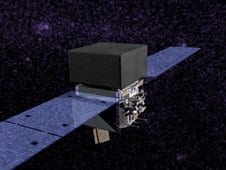
The Fermi space telescope

By Hamish Johnston

“…2009 promises to be an illuminating year for dark matter”.

So wrote this sage of physics, just before Christmas.

It turns out that my crystal ball got one thing right — we will learn something important about dark matter this year, and that is we are going to have to look even harder for direct evidence of the elusive stuff.

Two papers published earlier this week provide pretty convincing evidence that ‘direct evidence’ is not going to be forthcoming from current measurements of how many high-energy electrons and positrons are whizzing around our little patch of the universe. One paper is from the Fermi telescope group and the other is from the HESS collaboration.

The papers offer strong evidence that these fluxes can be explained without the need of dark matter — and in particular the annihilation of dark-matter particles in the halo of our galaxy.

The excitement began last summer when ‘physics paparazzi’ photographed a slide of data from the PAMELA detector showing what appeared to be an excess of high-energy positrons. This lead to a flurry of activity as some physicists analysed the unpublished results and pointed to DM annihilation.

Then in November physicists working on the ATIC experiment published results suggesting an excess of high-energy electrons — which they suggested could come from DM annihilation.

However, a few weeks earlier the PAMELA team posted a paper that should have dampened my spirits — but I foolishly ignored it, something that at least one reader has since pointed out to me.

PAMELA should have also seen a bump in the ratio of anti-protons/protons in the cosmic ray flux caused by dark matter annihilating to create anti-protons. But the bump wasn’t there.

Now, data from two new detectors — Fermi and HESS — have been analysed and there seems to be no evidence of dark matter annihilation.

If you are interested in the nitty gritty, Tommas Dorigo has a data-point-by-data-point commentary on data from both detectors on his blog.

Wave power slithers ahead

snake.jpg
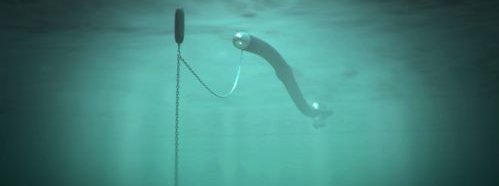
Anaconda prototype in action

By Hamish Johnston

Last year we told you about the Anaconda — a giant rubber tube that could generate about a megawatt of electricity from ocean waves.

The mouth of the beast faces the wave front, which creates a bulge in the tube that grows as it propagates to the tail. There, it is converted to electricity by a conventional turbine.

This morning on BBC Radio 4 I heard an interview with Paul Auston of the UK-based company Checkmate Seaenergy — which has been testing an 8-metre-long prototype in a wave tank owned by the defence technology company Qinetiq.

Auston told the BBC that tests prove the device works and the firm is now looking for more cash so it can build full-sized Anacondas — 200 metres long — for testing in the ocean.

Apparently, an Anaconda can provide electricity for about 1000 homes.

In the spirit of David MacKay, I reckon 6000 kilometres of tubing would be required to supply all homes in the UK with electricity.

That’s a lot of rubber — and Auston seemed to suggest that the tubes would be made from natural rubber (he didn’t say if it would be organic).

About 10 million tonnes of natural rubber is produced every year — a back-of-the-envelope calculation suggests that this is more than enough to make all that tubing.

So, it looks possible!

You can read a print version of the interview here

If you want to listen to the interview, it’s in the first hour of today’s programme. Unfortunately the BBC does not create snippets of first-hour interviews so you will have to listen until it comes up.

Copyright © 2026 by IOP Publishing Ltd and individual contributors