No sleep at the synchrotron

ESRF_booster-ring_003 [].jpg
Booster-ring

By James Dacey

Phew, they certainly don’t believe in wasting any time here at the European Synchrotron Radiation Facility (ESRF).

Day one of my synchrotron sojourn involved a medley of information from key staff, a whistle-stop tour of the 844m storage ring, an afternoon excursion to one of the most intense neutron sources on the planet…

… finished off by dinner with the ESRF scientists.

I think this sense of urgency must be fuelled by the annual turnover of over 6000 scientists who travel from across the 12 member countries (and beyond) to use the facility.

Many of these scientists are PhD students from wide-ranging disciplines, including biology, chemistry and the earth sciences, who come along with thier pre-prepped samples and probe them with this brilliant light source to hopefully reveal some interesting things.

Passing through the central coffee square, you certainly get the impression that this is a lively, creative environment for young researchers to come and share ideas with peers from across Europe.

In the morning I also managed to catch up with Harald Reichert, the new head of research at the ESRF, who compared the facility to a Swiss army knife. “We serve almost every branch of science, all you need is a good idea,” he told me.

After scurrying along the beamlines (I’ll be spending more time there today), I then spent the afternoon at the Institut Laue-Langevin (ILL), which neighbours the ESRF.

A neutron source, the ILL was founded over 40 years ago as the first large research collaboration between France and Germany after World War II, and in many ways it sees itself as the older, wiser brother of the ESRF.

And time on the neutron beam seems to be equally as precious as time with the ESRF X-rays; the head of science, Andrew Harrison, told of how he used to try and sleep amongst the machinery back in his student days.

I saw some pretty cool experiments including a group who were using the neutron beam to look at how different types of molecule react at a surface of water. “Across nature, surfaces are being created then destroyed again,” said the group leader.

To test a surface under stable conditions, they had created a water fountain whose flat surface was perfectly renewed every second – you really couldn’t tell anything was changing!


Neutron-rich and doubly magic: nucleus is a first

An international team of physicists has found strong evidence for the existence of a new ‘doubly magic’ nucleus with an unconventional configuration of neutrons. The oxygen–24 nucleus is also the first doubly-magic nucleus that is very unstable against radioactive decay. In addition to shedding further light on the structure of exotic nuclei, its discovery could help physicists gain a better understanding of neutron-rich environments such as neutron stars and supernovae.

Physicists have long known that protons and neutrons in nuclei occupy discrete orbitals — in much the same way as electrons do in atoms. Magic nuclei are those having the precise number of protons or neutrons required to fill a spherical set of related orbitals called a ‘shell’. Nuclei with magic neutron or proton numbers are characterized by a stronger binding, greater stability, and, therefore, are more abundant in nature. In doubly magic nuclei, both proton and neutron shells are filled, making the binding even stronger.

Doubly magic abundance

“It’s thanks to the doubly magic numbers that nuclei such as oxygen and calcium are abundant making it possible for us to exist on earth.” explained Rituparna Kanungo, a member of the team at St Mary’s University in Halifax, Canada. “There are very few doubly magic nuclei in nature, and they form benchmark points for the nuclear shell model,” added Kanungo.

The magic numbers in stable nuclei — which have similar numbers of protons and neutrons and don’t undergo radioactive decay — are known to be 2, 8, 20, 28, 50, 82 and 126. However, less is known about magic numbers in unstable nuclei in which the ratio of neutrons to protons is significantly greater.

“One of the most important quests in modern nuclear physics is whether these magic numbers remain the same in exotic unstable nuclei,” explained Yuri Litvinov, another member of the team at the GSI accelerator in Darmstadt, Germany.

Looking for spherical symmetry

To answer the question, Kanungo, Litvinov and their colleagues examined how the neutrons in oxygen–24, the last bound isotope of oxygen, are arranged. A beam of oxygen–24 nuclei was produced at the GSI accelerator by smashing calcium–48 nuclei into a fixed target. This produced about three oxygen–24 nuclei per second, which where aimed at a stationary carbon target.

The resultant scattering removed one neutron leaving oxygen–23 nuclei, which were detected by the team. By measuring the momentum distribution of the oxygen–23 nuclei, the team deduced both where the missing neutron was located in the original oxygen–24 as well as how the orbitals are arranged within the nucleus. The results confirmed that the arrangement was spherically symmetric — a hallmark of doubly magic nuclei.

This makes oxygen–24 the first doubly-magic nucleus with one conventional magic number (8 protons) and an unconventional magic number (16 neutrons). It is also the first doubly-magic nucleus to be established for an unstable isotope.

Understanding stardust

According to Litvinov, the results should aid in our understanding of the nuclear forces and nuclear astrophysics, where the evolution of shell closures can dramatically affect stellar nucleosynthesis. In particular, understanding the shell structure in lighter nuclei can help researchers develop models and understand heavier nuclei.

“Nuclei such as oxygen–24 possibly exist in neutron-rich cosmic objects such as the neutron star crust,” says Kanungo. “Our world-wide collective effort to understand the physics behind the extremes of our universe is bringing many pieces of the puzzle together slowly.”

Other nuclear physicists have welcomed the result. “This is very relevant and a nice confirmation of other results, such as the measurement of the first excited 2+ state in oxygen–24, that are also strong evidence for the existence of the shell gap,” says Michael Thoennessen at the National Superconducting Cyclotron Laboratory in Michigan, USA.

The research is published in Physical Review Letters

In search of a giant polo

grenoble3.jpg
Buzzing around Grenoble

By James Dacey

I’ve come to France this week to acquaint myself with one of the world’s “big 3” synchrotrons — the European Synchrotron Research Facility (ESRF) in Grenoble.

The serious science starts today but j’adore my European getaways so I arrived a day early for a bit of exploring.

Doing the classic tourist thing I headed to the highest point, in this case — via a cable car — to La Bastille, a series of fortifications dating back to the middle ages.

There were some fantastic views of the city sprawling out along the flood plain of the Isere.

Unfortunately, Mont Blanc to the east was covered in cloud, but I got some great shots looking down at the ESRF – aka “the giant polo” (below).

One other wonderfully French feature was “apiview” – a viewing slot fronted by a tank of bees (above).

The idea is to gain an original view of Grenoble and its surroundings by looking out “as if one were a bee” – it is part of a local project to combine art with science.

Right, I’m of now to interview Harold Reichert, the director of research here at the facility.

grenoble1.jpg
The giant polo

Bubbles burst in the hospital

Having an operation in hospital is no fun and you certainly don’t want to catch a bug while under the knife. That is why one of the most critical tasks faced by medical staff is to ensure that equipment used in surgery is always completely free of contaminants. Although the cleaning process, which involves using ultrasonic waves, has been honed over many years, the means for testing its effectiveness has remained fairly primitive.

Ultrasonic cleaning involves immersing surgical instruments in a disinfecting liquid and firing high frequency acoustic waves through the mix, which causes tiny bubbles in the liquid to implode – a phenomenon known as cavitation. The force created when these bubbles collapse is enough to remove contaminants on the surface of the surrounding material. Given that each implosion leads to new bubbles, and that there are over 200, 000 sites in one teaspoon of water where bubbles can emerge, cavitation is believed to provide a very effective mechanism for cleansing.

However, there are no established means of quantifying cavitation, and so the alternative is to measure the usefulness of bubble collapse indirectly. The favoured means at present is to simply dunk a sheet of aluminium foil into the liquid and observe the number of “dents” caused by bubble implosions. The major limitations with this approach are that is it only qualitative, and that it lacks repeatability: it cannot reliably resolve the “hot and cold” regions where cavitation (and hence cleaning activity) varies within the liquid.

To overcome these limitations, and to provide a quantitative measure, researchers at the National Physical Laboratory (NPL) in the UK have developed a sensor that can monitor the amount of cavitation produced in cleaning vessels. The sensors, which are hollow cylinders fabricated from a thin layer of piezoelectric material sandwiched between special absorbers, are designed to sit in the liquid and record the spatially-variant, high-frequency “noise” of bubble implosions.

“Occasionally, there are cases where medical facilities can become contaminated but it can be very difficult to trace the source. This device, and the capability it provides is a step in the right direction to improve the application of ultrasonic cleaning,” says Mark Hodnett, one of the researchers at NPL.

The team now plan to conduct further trials and will launch a new reference facility for acoustic cavitation at NPL within the next few months. “We’ve already sold half a dozen devices to ultrasonic equipment manufacturers that supply hospitals, and we’re now looking to get the product fully commercialized,” adds Hodnett.

World’s brightest synchrotron powers up

Physicists at the DESY research lab in Germany have successfully accelerated the first beam of electrons into what is set to be the world’s most brilliant X-ray light source. The €225m PETRA III synchrotron in Hamburg will allow researchers to study nanometre-scale objects such as quantum dots and to resolve the structure of proteins. The first user experiments are set to start in early 2010.

The PETRA-III synchrotron is a third-generation light source that produces intense beams of X-rays from electrons circulating in its 2.3 km circumference storage ring. Electrons are fed into the ring after having first been accelerated to 450 MeV in a linear accelerator and then injected into a particle accelerator, DORIS, which increases their energy to 6 GeV.

The electrons in the PETRA storage ring emit X-rays as they are passed through “undulators”, which force the electrons to travel along a sinusoidal path. The X-rays from PETRA will be fed into 14 beam lines housed in a 300 m experimental hall connected to the storage ring, which will operate up to 30 experiments in biology to condensed-matter physics.

With wavelengths ranging from 6.2 nm to 0.03 nm, the X-rays will be used by researchers to probe the structure and properties of materials. “PETRA will focus on hard X-rays science especially in the wavelength range of 200 keV,“ says Edgar Weckert director of photon science at DESY.

PETRA-III will also be able to produce X-ray beams with a diameter of 1 nm even at such high electron energies. “This is what makes the facility so unique,” says Weckert, “PETRA will enable us to resolve the structure of very small objects.”

PETRA-III’s storage ring was originally built in 1978 as an electron-positron collider and in 1979 researchers used it to obtain the first direct evidence for gluons — carriers of the strong force. In 1990 PETRA was then used as an accelerator for the 6.3 km circumference HERA collider before it closed in June 2007. The upgrade began shortly afterwards.

Mapping the evolution of ideas

graph1997.jpg
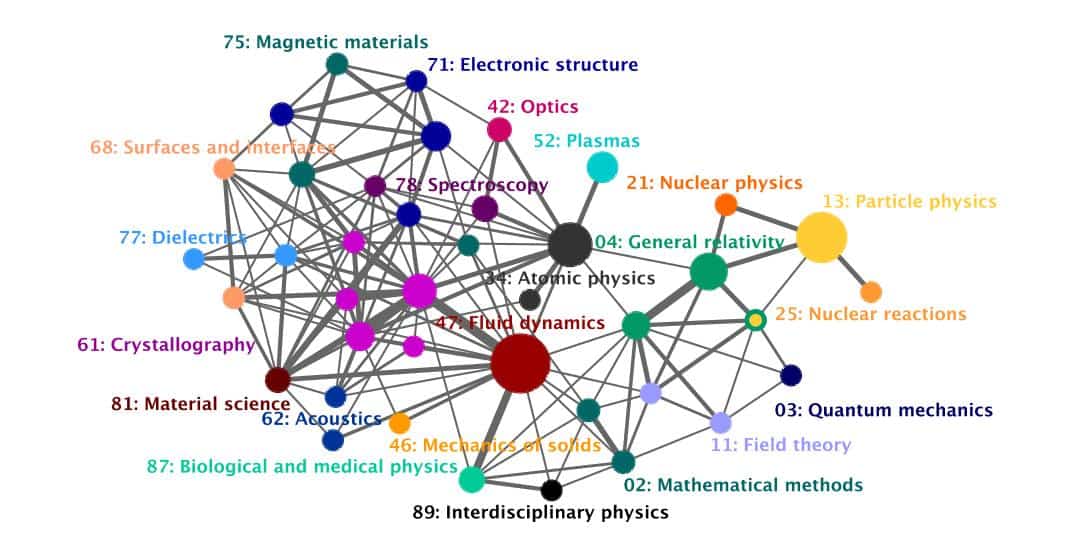
Map of physics in 1997…

By Michael Banks

Producing maps of science seem to be a popular pastime for researchers these days.

Only last month we reported a map made by using over a billion so-called “click-throughs” – produced when going from a web portal like Elseiver’s Science Direct to the full text of a paper or to the abstract on the journal’s website.

Now physicists have made a map using the Physics and Astronomy Classification Scheme (PACS) codes produced by the American Institute of Physics (AIP).

PACS codes contain four numbers and two letters, which are used to classify papers according to the research they contain. Each paper usually includes two or three PACS numbers listed just after the abstract.

The first two numbers of a PACS code denote the subject area, which are grouped in tens. For example, 20-29 is nuclear physics and 30-39 is atomic and molecular physics while 60-69 is condensed matter: structure, mechanical and thermal properties.

Then within nuclear physics, say, there are up to 10 subfields such as nuclear structure (21) and nuclear astrophysics (26). These subfields are also split in tens, so nuclear structure runs from 21.10 (properties of nuclei; nuclear energy levels) to 21.90 (other topics in nuclear structure).

Bear with me a little longer, nearly there. Next is where the letters come in. Within, say, 21.10 there are then a list of topics, such as 21.10.Tg (lifetimes, widths) or 21.10.Dr (binding energies and masses).

Taking papers from the last two decades in the AIP’s database, Mark Herrera from the University of Maryland, David Roberts from Los Alamos National Laboratory and Natali Gulbachce from the Northeastern University in Boston, have created a map using the links between different PACS numbers.

For example, when a paper quotes two PACS codes, these topics are then linked. Running all this data through an algorithm then sorts and finds clusters of nodes and groups them.

The above images show the full maps from 1997 and 2006 with subfields of a subject area shown (that is the first two numbers in a PACS code). The nodes represent the subject area, and its size is proportional to the amount of single PACS codes it contains. The thickness of the links indicates how many papers have PACS codes corresponding to both nodes.

According to the researchers, the map lets you see how areas shrink and grow and how they merge with one another.

For example, in 1997 crystallography (61) was one central node, but in 2006 it had split into five (as deduced by the algorithm). Even though each one is strongly linked with the others, the algorithm didn’t deem it one single node, which may indicate five separate fields emerging within this area.

Physicists distinguish between the indistinguishable

Spurred on by their work on building one of the world’s most accurate atomic clocks from strontium–87 atoms, researchers in the US have now discovered that “forbidden” collisions can occur between these atoms.

Strontium–87 atoms belong to a class of objects known as fermions and according to quantum physics; fermions cannot occupy the same energy state and location in space at the same time. Fermions in identical energy states are therefore not meant to collide. Collisions perturb the internal energy levels of the atoms, and therefore such fermions should have very stable energy levels.

This property was exploited last year by Jun Ye and colleagues at NIST and JILA, who built an atomic clock based on around 2000 ultracold strontium atoms trapped in an optical lattice of overlapping infrared laser beams. The atoms are bathed in light from a separate red laser at a frequency that corresponds to an atomic transition in strontium. This makes the light “lock into” the precise frequency of the transition and it thus oscillates between energy levels, just like the ticking of a clock.

Tiny shifts appear

But, now Ye and colleagues have seen tiny shifts in the frequencies of the clock ticks caused by collisions between atoms.

The researchers are able to measure these tiny interactions because their clock is extremely precise (accurate to about one part in 1016, or neither gaining or losing a second in more than 200 million years). They do this by exciting the transition between clock states and measuring the frequency shift of the atomic transition as the density of the atomic ensembles in the optical lattice is varied.

More precisely, Ye’s team measured the frequency shift as a function of temperature, the excitation probability and the alignment of the probe laser beam to investigate the origin of these interactions. The scientists discovered that when the laser-atom interaction introduces a very small degree of inhomogeneity, previously indistinguishable fermions become slightly distinguishable. The fermions are no longer identical and collisions can occur.

No longer identical

Gretchen Campbell of JILA explains that at the beginning of the measurement, all of the atoms are in the same atomic state. However, during the transition from the ground state to the excited state, using a laser pulse, light-atom interactions are not uniform across the entire atomic sample. This means that different atoms are excited at slightly different rates. These atoms are therefore no longer identical.

The probability that atomic collisions will occur depends on how the atoms in the ensemble are excited. Indeed the JILA team determined that when the atoms are excited to roughly halfway between the ground state and excited state, the collision-related shifts in the clock frequencies drop to zero. The technique has allowed the team to improve the accuracy of its clock by 50% so that it now neither gains or loses a second in more than 300 million years.

As well as improving atomic clocks, the study also helps clarify how fermions interact, which is of fundamental interest, Campbell told physicsworld.com.

The team now plans to confine the strontium atoms in a 3D optical lattice, as opposed to just a 1D one. “The collision-enabling mechanism can be strongly suppressed in 3D,” said Campbell.

The research is published in Science.

Research revolution in the palm of your hand

iphone revolution.jpg
Coup d’etat in physics?

By James Dacey

Even its fiercest critics will struggle to argue that open-access publishing has not brought about a revolution in the way scientists engage with the latest research findings.

Driving the reformation in physics and maths is the arXiv preprint server, which was pioneered by Paul Ginsparg at the Los Alamos National Laboratory and is currently hosted by Cornell University.

Now the revolution continues apace as a new innovation will enable frontline physics to be winged straight into the palms of researchers.

ArXiview is a new iPhone application billed as “a very easy way to surf the last few weeks of arXiv postings.”

This new innovation was designed by Dave Bacon, a theoretical physicist at the University of Washington, during a recent spell between jobs.

I ran a quick search of the Apple store website and found a couple of rival arXiv app’s but this seems to be the first to enable users to order results by date.

It remains to be seen whether arXiview will be a bit hit amongst physicists but I can already picture a handful of the uber keen ones wowing their colleagues at conferences as they reel off the days latest findings.

Thankfully, long gone are the days where findings took months, years even, to see the light of day. But let’s just hope this mania for faster, round-the-clock access to physics doesn’t start to chip away at the rigour and depth of the subject.

So what next in the research revolution – Stephen Hawkings tweeting about his favourite formulae?

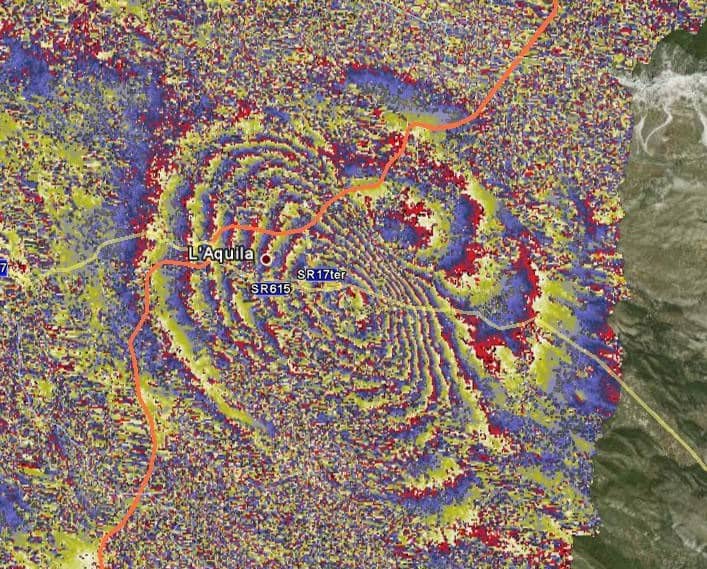
Satellite images show the effect of the L’Aquila earthquake

lquila.jpg
Earthquake shockwaves (credit: IREA-CNR)

By Michael Banks

Researchers have released the first satellite images showing the effect of the L’Aquila earthquake that struck central Italy earlier this month.

Measuring 6.3 on the Richter scale, the earthquake killed over 290 people with an epicentre only a few kilometres away from the Gran Sasso National Laboratory located between L’Aquila and Teramo, which is best known for studying the properties of neutrinos and searching for dark matter.

Scientists at the Instituto per il Rilevamento Elettromagnetico dell’ Ambiente in Napoli have now started analysing data taken from the Environmental Satellite (Enivsat) operated by the European Space Agency (ESA).

Launched in 2001, Enivsat carries ten instruments for Earth observation, which can measure, for example, sea surface temperatures and the amount of sunlight transmitted, reflected and scattered by the Earth’s atmosphere.

Enivsat’s on board radar can detect changes in the Earth’s surface with millimetre accuracy. Data taken just after the earthquake on 6 April and compared to an image made a few months before show a set of nine fringes originating a few kilometres from L’Aquila.

Each fringe on this ‘interferogram’ represents a ground movement of 2.8 cm, meaning the ground moved by 25 cm at the centre of the earthquake a few kilometres from L’Aquila.

The results from Envisat have also been confirmed by the movement of five GPS receivers located around the affected area that were moved as a result of the earthquake.

ESA is also making the satellite’s data taken in the L’Aquila region freely available for scientists to analyse, which is available to download here.

Bouncing spins flip direction

Physicists in Canada and Germany have invented new a way of changing the direction of electron spins by bouncing them along a tiny semiconductor channel. Unlike other schemes for spin flipping in a semiconductor, it does not involving applying an oscillating electric or magnetic field. As a result it could be easier to implement in “spintronic” devices of the future.

Electron spin can take on two values — “spin up” or “spin down” — and some physicists believe that this property could be used in spintronic circuits that process information faster and more efficiently than today’s computer chips. But before this can happen, researchers have to work out a simple and reliable way to flip spins that can be implemented in tiny mass-produced chips.

The new method was created by Joshua Folk and colleagues at the University of British Columbia and University of Regensburg. It works by injecting electrons into a gallium arsenide channel, which is about 1 μm wide and 100 μm long. The electrons move easily through the channel but reflect off the walls — so electrons injected at an angle to the direction of the channel bounce back and forth as they travel through (see figure).

Alternating torques

The team used a tiny piece of semiconductor called a quantum point contact (QPC) to inject electron spins that all point in the same direction. When an electron bounces off one wall, its spin feels a torque because of an effect called spin-orbit (SO) coupling — and when it bounces off the opposite wall it feels a torque in a different direction. This alternating torque has a frequency defined by the speed of the injected electrons, their angle of injection and the width of the channel.

A fixed magnetic field is applied across the width of the channel, which causes the electron spins to wobble like spinning tops around the direction of the field. The team found that when the frequencies of the alternating-torque and the wobble were exactly the same, the spins flipped.

The team has dubbed this effect “ballistic spin resonance” because the electrons move through the channel like bullets — and because the effect is similar to electron spin resonance, where the alternating torque is provided by an oscillating magnetic field.

There are, however, several shortcomings that must be overcome before ballistic spin resonance can be used in practical devices.

Impurities are a problem

One problem is that electrons can scatter from impurities in the channel resulting in additional random torques. As a result spin-flipping process is not coherent and the electron spins are not left in a specific orientation.

Another shortcoming is that the electrons are injected at a range of angles, which means that not all spins will experience the same alternating-torque frequency.

These problems could be alleviated by using semiconductors with fewer impurities, and by collimating the injected electrons, say the researchers.

The results are published in the journal Nature.

Copyright © 2026 by IOP Publishing Ltd and individual contributors