Ions keep their cool at crossroads

Physicists in the US have created a junction through which single ultracold ions can pass without having their temperature raised. The junction is contained within a 2D ion trap and could be useful in building large-scale quantum computers.

Quantum computers, like classical computers, work by processing of bits of information. In classical computers such bits can take on only the values 0 and 1, but in quantum computers they can also take on “superpositions” of both 0 and 1. When many of these quantum bits or “qubits” are combined, a quantum computer can process them simultaneously. In principle, this would enable a quantum computer to work exponentially faster than its classical counterpart for certain operations — however many technical challenges must be overcome before practical quantum computers become a reality.

Scientists are working on many devices to take on the role of qubits, but one of the most promising are trapped ions. Inside a trap, the position and ordering of the ions could be changed by running them through a junction, at which point they can be encouraged to go in one direction or the other. However, it is important that this switching does not result in any heating, because that tends to take the ions out of the required electronic ground state.

Off the heat

Now, Brad Blakestad and colleagues at the National Institute of Standards and Technology (NIST) in Boulder, Colorado have created a junction in an ion trap in which there is practically no heating. Constructed from laser-machined alumina, it contains 46 gold-coated electrodes surrounding an X-shaped junction. When the researchers apply a series of voltages to the electrodes, ions are encouraged through the junction a little at a time.

The NIST group managed to get ions through the junction with a 99.99% success rate, and with seven orders of magnitude reduced heating than previous trapped ion systems .

Christopher Monroe, a physicist at the University of Maryland in the US who has worked extensively with trapped ion systems, told physicsworld.com that although it is not surprising that the researchers have shuttled ions without losing coherence of their internal states, it is surprising that the ions have not lost any coherence in their motion.

Exquisite control

“Moreover, to shuttle ions around a multitude of electrodes and around corners requires exquisite control of the applied electrical potentials so that the ions surf smoothly without getting lost (or agitated),” Monroe adds. “The NIST experiment accomplishes all of this, and thus marks an important milestone in one of the only known realistic architectures for a large-scale quantum computer.”

Bernhard Roth, a quantum physicist at the Heinrich Heine University of Düsseldorf, Germany, also thinks the work is important. “In particular the work might be relevant toward efficient large-scale quantum information processing, the main challenge in the field,” he says. “The authors have significantly increased the reliability of the ion transport through an array, have reduced energy gain and preserved coherence. These are all things which are considered essential for the realization large-scale systems.”

The research will be published in Physical Review Letters and a preprint of the paper is available on arXiv.
Radio all-stars

astro art fin.jpg
Techno. Science. Art

By James Dacey

One aim of this International Year of Astronomy (IYA2009 is to ground astronomy in popular culture and inspire people to consider the role that star-gazing has played throughout history.

“Astronomy is not just a modern science but a fundamental reflection of how all people, past and present, understand themselves in relation to the Universe,” reads the Astronomy and World Heritage website.

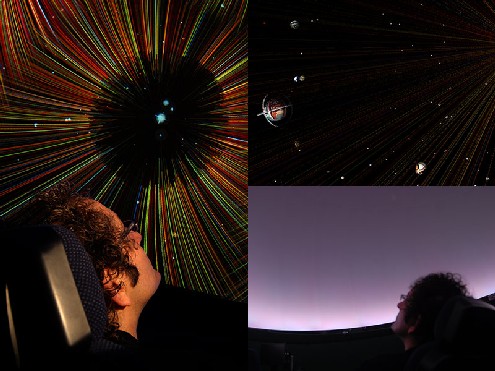
Inspired by this grandiose mission, artist and researcher Michael Takeo Magruder has represented the influence of broadcast technology on the near-Earth environment by creating a visual representation of the Radiosphere.

The geometry of “Data_set” is derived from the positions of all the stars listed by astronomers in catalogues like Hipparcos. Star types are represented by shape, with living stars appearing as spheres, brown dwarves as incomplete spheres, and white dwarves as compressed crosses.

These stellar nodes are then connected to a central spherical body representing our solar system, by lines coloured according to the spectral class of the individual stars.

to heighten the sensory experience, images and sounds – streamed live from the BBC world service – are layered on top of the 3-D light show.

“The televised broadcast of the Berlin Olympics in 1936 was humanity’s first media transmission powerful enough to pass through Earth’s ionosphere and travel into deep space… in the 73 years since that defining moment, our communications have reached nearly two thousand other known star systems,” reads the press release.

“Data_set” has been created especially for IYA2009 and is hosted now at the Thinktank Planetarium in Birmingham, UK.

Where does space begin?

paylaod.jpg
The Supra-Thermal Ion Imager

By Hamish Johnston

Where does Earth’s atmosphere end and space begin?

The answer is 118 km above sea level, at least according to physicists in Canada and the US.

In 2007 the team sent their Supra-Thermal Ion Imager into space aboard the JOULE-II rocket. The instrument was able to detect the precise altitude at which the rocket left the cocoon of Earth’s atmosphere and was subject to the blast of charged particles found in space.

They have just published a paper describing their findings. You can read more about it here

Graphene made easy

Since its discovery in 2004, graphene continues to fascinate physicists with its growing list of exceptional electronic and mechanical properties. While small pieces of the material — which is a sheet of carbon just one atom thick — are easy to make, it has proven more difficult to make large-area, high-quality samples that could be used in graphene-based devices.

Now researchers in France may have come up with a simple way of making relatively large pieces of graphene. Abhay Shukla and colleagues of Pierre and Marie University in Paris show that bulk graphite can be bonded onto borosilicate glass and then cleaved off to leave a single layer of graphene on the substrate.

The most common “peeling-off” method to produce graphene is only useful for making small-scale prototype devices but the new method makes it possible to apply this approach on a larger scale while preserving high sample quality, says Shukla.

Sticking to glass

The researchers used a technique known as anodic bonding, which sticks a conductor or semiconductor onto a glass substrate using large electrostatic forces that come from the ionic conductivity of the substrate. This means that no adhesive is required. The method is widely used in the microelectronics industry to bond silicon wafers to glass.

“This technique had never been tried on layered substances, like graphene, presumably because they do not stick but peel off, but we turned this phenomenon to our advantage” explained Shukla. “Only the first or first few atomic layers remain bonded to the substrate while the bulk can be peeled off.”

Because the samples are bonded to a rigid glass substrate, this produces larger surface area samples of high quality in an efficient and simple way. The method might be used for other layered materials as well.

So far, the researchers have produced millimetre-sized samples but say that they could improve on this. “Materials other than graphene will produce bigger samples still, making possible applications in microelectronics and fundamental experiments limited by sample size,” said Shukla.

Suspended atomic layers

The team would now like to extend the method to other substrates. It would also like to use appropriately micropatterned substrates to make suspended atomic layers.

Shukla says that he already uses the technique for making X-ray mirrors by bonding single crystal silicon onto glass substrates for use in X-ray spectrometers at synchrotrons. “When I heard of graphene, I immediately thought of trying to use the method for making this material.”

The work was reported in Solid State Communications.

Curved light bends the rules

Everyone knows that light travels in a straight line — right? A couple of years back, however, physicists discovered something very different for certain laser pulses that have one intense peak next to a series of smaller peaks. The brightest part of these lopsided “Airy” pulses, they found, appear to follow a curved trajectory.

Researchers in the US have now found that sufficiently intense Airy pulses can ionize the surrounding air molecules and create curved filaments of plasma. What’s more, Airy pulses interact with air such that the pulses are continually focused and so can travel long distances without being dispersed.

The bright white light given off by the plasma filaments could be used make remote spectroscopic measurements of the atmosphere — and the bending effect itself could be exploited in new kinds of waveguide.

Bend it like Airy

The bendy behaviour of Airy pulses was first discovered in 2007 by Demetrios Christodoulides and colleagues at the University of Florida. Interference between the peaks causes the intense peak to veer off in one direction, while the other peaks move in the opposite direction. Although the total momentum of the pulse travels in a straight line, its brightest part appears to follow a curved path.

Christodoulides and his colleagues have now teamed up with Pavel Polynkin and others at the University of Arizona to create curved “filaments” of plasma using Airy pulses. The key to their success, according to Jerome Kasparian of the University of Geneva who was not part of the group, is their ability to — for the first time — create Airy pulses of extremely high intensity.

The team began with an intense infrared laser pulse that is about 35 fs in duration. The initially pancake-shaped pulse, which is symmetric around its direction of propagation, is then passed through a “phase mask” and then a lens, giving it a chevron shape with an intense peak at the vertex (see figure). This Airy pulse then travels about 1 m through air to a fluorescent screen where the light is detected.

Curved filaments

As well as confirming that extremely intense Airy pulses appear to curve, the pulses also produced curved filaments of plasma by ionizing nearby molecules in the air.

Although physicists have long known that symmetric laser pulses can create such filaments, the process has proved very difficult to study. This is because symmetric laser pulses travel in the same direction as the white light given off by the plasmas they create, which means that any device that attempts to detect this light is dazzled or even destroyed by the pulse.

With Airy pulses, however, Polynkin, Christodoulides and colleagues discovered that the plasma light travels in straight lines tangentially to the curvature of the bright peak. The plasma light can therefore be detected — and perhaps even be used as a source of white light for spectroscopy.

Firing intense and long-range pulses into the air, for example, could allow researchers to make remote spectroscopic measurements of the atmosphere.

Polynkin also speculates that intense pulses could be fired into thunderclouds to create filaments that “guide” lightning to safe locations on the ground.

Studying the plasma light itself could even help physicists gain a better understanding of the complicated non-linear optics that define how intense laser beams travel through air. These include a “self-healing” effect whereby the beam is continually refocused by the plasma — rather than being dispersed — allowing intense pulses to travel very long distances.

The team are now studying the creation of curved filaments in water rather than air.

I'll take Brookhaven for $1200 Alex

jepra.jpg
On location at Brookhaven

By Hamish Johnston

‘What is a petaflop?’

That was the only wrong ‘question’ given by contestants in a round of the US game show Jeopardy that focussed on the Brookhaven National Lab in New York.

The ‘answers’ were posed by video by two presenters who seemed to be on a grand tour of the facility.

You can test your knowledge of what goes on at Brookhaven in this clip of the show.

Sadly, one of the answers wasn’t:

‘He is a philosopher and historian of science at Brookhaven who writes an entertaining yet erudite column for the best physics magazine in the world.’

Who is…?

Metamaterial focuses ultrasound

Physicists in the US have built an acoustic lens from artificial “metamaterials” and used it to focus ultrasound waves to a tight spot. They say that modifying their apparatus could lead to very-high resolution ultrasound imaging, for use in medicine and non–destructive material testing. It could even lead to the development of an acoustic cloak that can be used to hide objects from sonar, says the team.

Several research groups have already been successful at building “superlenses” for electromagnetic waves. Such a device forms an image of an object with perfect resolution, using materials with a negative refractive index to recover the sub–wavelength information about an object that is conveyed by the “evanescent” waves that decay within a very short distance of the object.

Sub-wavelength resolution

Encouraged by this success, researchers are also trying to build the acoustic equivalent. Such a device would allow ultrasound waves to be focused with sub-wavelength resolution, therefore providing much more detailed ultrasound images.

Researchers have already shown how to focus ultrasound waves using negative refractive devices built up from phononic crystals, which contain a series of air gaps that scatter sound in such a way that it refracts in the reverse direction. However, the spacing of the air gaps within such crystals has to be of the same order of magnitude as the wavelength of sound being focused, which would make these devices impracticably large.

Now, Shu Zhang, Leilei Yin and Nicholas Fang of the University of Illinois at Urbana-Champaign have focussed ultrasound using a network of Helmholtz resonators, cavities with short necks that house resonating waves.

Helmholtz resonators

The Illinois device consists of an aluminium plate — 1 cm thick, 15 cm wide and 30 cm long — machined into which are two adjacent 40×40 arrays of Helmholtz resonators, each of which is less than 3 mm in size. The fluid-filled resonators are connected by a network of channels, and in the left-hand array the volume of the resonators is around ten times that of one section of the connecting channels, while in the right–hand array the volume of the channels is some ten times greater than that of the resonators.

The difference in the way that the pressure gradient builds up in these two differently-constructed arrays means that when a sound wave travels through the fluid in the left-hand array it is positively refracted, whereas sound travelling through the right-hand one is instead negatively refracted. Zhang and colleagues were able to demonstrate this by emitting ultrasound waves at 60.5 KHz from a transducer with a 3 mm tip inserted into a hole in the left-hand array.

Converging waves

They then mapped the resulting pressure field in the right-hand array by mounting a hydrophone – which converts pressure differences into electrical signals — onto a mechanical stage and then moved the stage around the array. They found that the converging waves from the left–hand array reached the interface with the right–hand array then reconverged to form an image of the transducer point source with a resolution of half a wavelength of ultrasound in water (about 12 mm at 60 KHz), dimensions that agreed with a computer simulation of the experimental set up.

Fang says that if his team can achieve sub–wavelength imaging then they might be able to reduce the minimum spot size to about 0.1 mm, which he points out is about as small as early-stage tumours, potentially allowing ultrasound diagnosis and therapy of cancer (particularly breast and prostate cancer) much earlier than is currently possible. However, doing so means having a ratio of refractive indices of the two arrays of –1, so that the angles of incidence and refraction are equal for all rays and the rays can therefore be brought to a single focus. This is not possible in the current set up owing to machining errors but Fang believes that these errors can be largely smoothed out.

‘Acoustic cloak’

The researchers say that their device is compact, and therefore practical, because the unit cell of the device is just one eighth of the operating wavelength. They also point out that their flat lens does not require obtaining precise spherical shapes, as is the case with traditional lenses. In addition, the focal length of the lens — the distance from the interface to the focus — can be varied with frequency, allowing superior 3D imaging to conventional ultrasound. Finally, they say that their device could be used as the basis for an “acoustic cloak” that steers sound waves round an object and therefore renders it invisible to sonar.

The team has reported its findings on the arXiv preprint server.

LHC delay rumours

By Hamish Johnston

Physicists like a bit of gossip — especially if it’s about when the Large Hadron Collider will be back in action after its catastrophic failure last year.

That’s why I was fascinated by a post on Peter Woit’s Not Even Wrong blog suggesting that the LHC start-up will be delayed by four weeks beyond its current September 2009 target.

Woit refers to a “draft” of the latest repair schedule that was presented by LHC operations leader Roger Bailey at a recent conference in Oxford. The document clearly shows that the first beam will be circulated during week 43 of 2009 — which begins on Monday 19 October.

By contrast, the schedule released in February says the beam should be commissioned the week of 21 September.

The draft schedule seems to suggest that the problem is related to repairing sector 34, the section of the accelerator where the disaster occurred.

I asked CERN spokesman James Gillies what was going on. He said like any major project, “time is lost and time is gained” in various aspects of the repairs and there is no point in putting out a new schedule every time this happens.

He also said that CERN is now looking for ways to make up the extra time identified by Bailey and he said that the repair team are confident of having the LHC running towards the end of September as planned.

Atomic quartets spotted in ultracold gas

Physicists in Austria have confirmed that four atoms can be coaxed into forming bound states in an ultracold gas — even though pairs of the same atoms do not bind together.

The loosely bound quartets had been predicted just six months ago and their discovery is another reminder of just how useful ultracold gases can be in exploring fundamental aspects of quantum physics.

Understanding how two objects interact with each other is fairly easy — Newton’s theory of gravity, for example, can describe how a single planet orbits the Sun. But when more than two objects are involved things becomes very complicated. Just adding another planet to the system makes the equations of Newtonian gravity impossible to solve exactly.

However, nearly 40 years ago the Russian physicist Vitali Efimov was able to calculate that three atoms should, in principle, be able to form quantum states that are loosely bound together — despite the absence of bound states of any two pairs of atoms in the system. This counterintuitive situation only occurs for atoms that are bosons; that is, atoms that have integer values of intrinsic angular momentum, or spin.

Three-body Efimov state

In 2006 Hanns-Christoph Nägerl of Innsbruck University and colleagues spotted such a three–body Efimov state in a gas of ultracold caesium atoms. They did this by cooling the gas to just 10 nK to create a macroscopic quantum state called a Bose-Einstein condensate (BEC). A magnetic field was used to carefully tune the interaction strength between the atoms. The creation of trimers was inferred because the BEC lost atoms in groups of threes — so-called “recombination losses”.

What the team didn’t know at the time is that their data also suggested that four caesium atoms were forming loosely bound quartets. They didn’t consider this because no-one thought it was possible. But then in 2008 Javier von Stecher and colleagues at the University of Colorado calculated that the Efimov trimer seen in 2006 could capture an extra atom to become one of two different bound quartets.

Lurking in the data

When the Colorado group took a closer look at the 2006 experimental data they saw a clear signature of one of the two possible quartets. Now, Nägerl and colleagues have repeated their experiment — and have found both quartets just where von Stecher predicted.

As well as illustrating how ultracold gases can be used to simulate few–particle interactions that could occur in systems as diverse as quantum dots and nuclei, this latest discovery offers physicists a way of studying Efimov trimers by how they interact with four–body states.

The research is reported in Physical Review Letters

Could the lives of the L’Aquila earthquake victims been saved?

lab-esterno.jpg
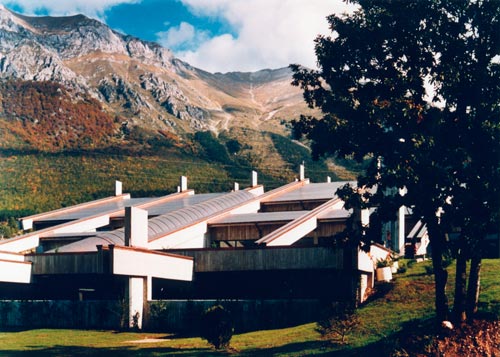
The Gran Sasso National Laboratory (credit: LNGS)

By Michael Banks

Researchers at the Gran Sasso National Laboratory in central Italy are best known for their experiments that are designed to study the properties of neutrinos and search for dark matter.

The underground lab, however, also lies around 20 kilometres away from the town of L’Aquila, which was hit by an earthquake in the early hours of Monday morning. Measuring 6.3 on the Richter scale, the earthquake has so far killed over 200 people. But there are reports saying that Giampaolo Giuliani, a physicist based at Gran Sasso, predicted the earthquake would happen more than a month ago.

Predicting earthquakes is a tricky business as a feature we ran in January points out. But developing a system that could predict when and where they happen, although being a pipe dream at the moment, could save thousands of lives per year.

Reports yesterday say Giuliani predicted the earthquake would happen after nearby sensors picked up excess radon gas escaping from the ground last month.

There is, however, no reliable proof that radon emitted by smaller tremors could be used to predict an earthquake. Guiliani was also apparently told to remove videos and information from the internet warning that an earthquake could hit the region.

Physics World is currently looking into the full details of Guiliani’s story, so stay posted for updates.

Copyright © 2026 by IOP Publishing Ltd and individual contributors