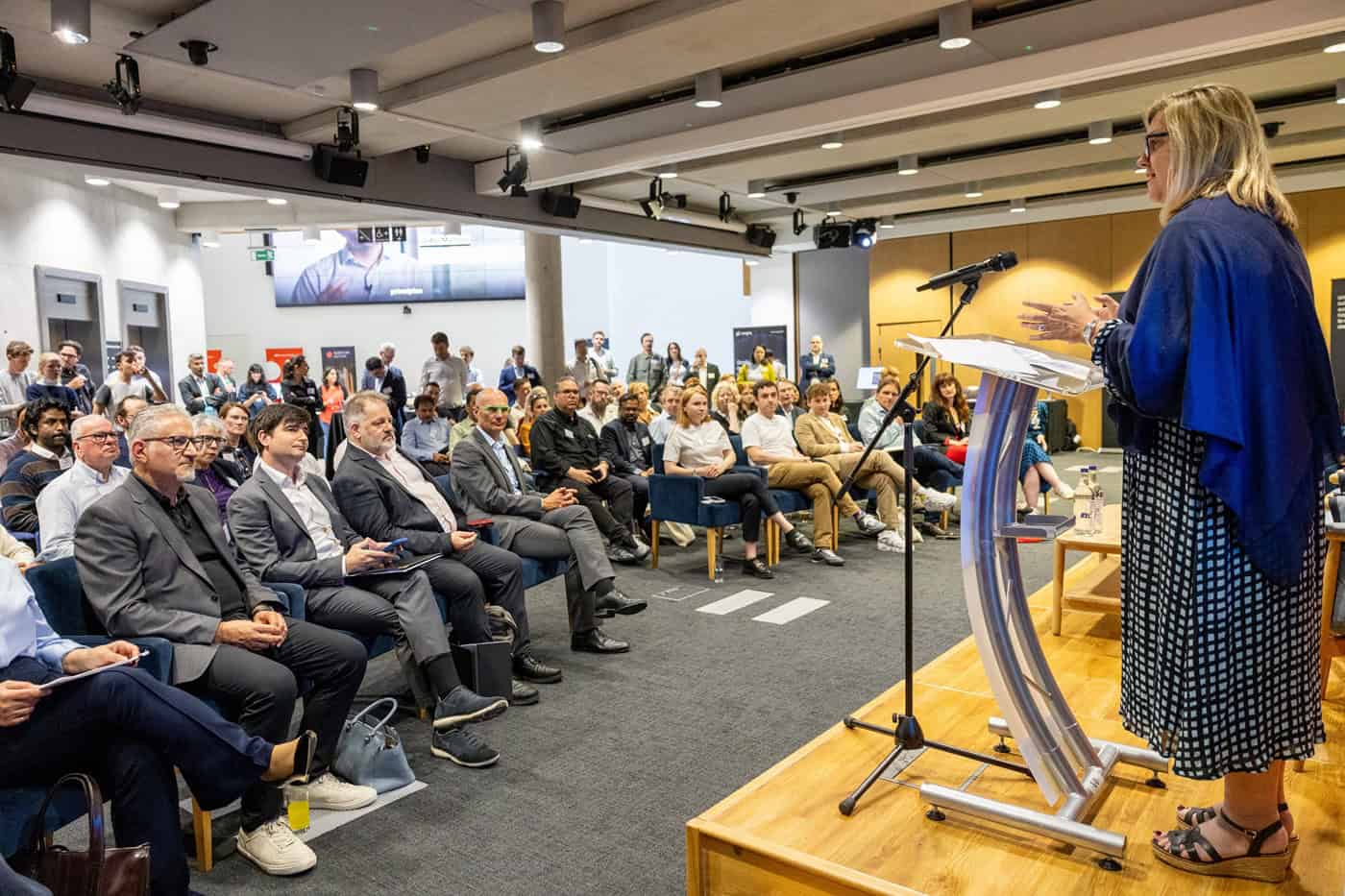
Capital connections Janet Coyle from London and Partners addressing delegates at a meeting at the Institute of Physics to mark the first anniversary of the London Quantum Cluster. (Courtesy: Carmen Vilano)
“There are two types of people when it comes to quantum,” joked Howard Dawber, deputy mayor of London for business and growth at a meeting at the Institute of Physics last night to celebrate the first anniversary of the London Quantum Cluster.
“There are those who understand quantum mechanics. There are those who don’t. And there are those who are in superposition of understanding and not understanding until they are observed.”
It was a light-hearted remark that matched the mood of what was essentially an evening of boosterism for quantum technology in London ahead of London Tech Week next week.
As chair of London and Partners – the growth agency for London – Dawber told the gathering of more than 100 “quantum influencers” that the organization was “100% behind the London Quantum Cluster”.
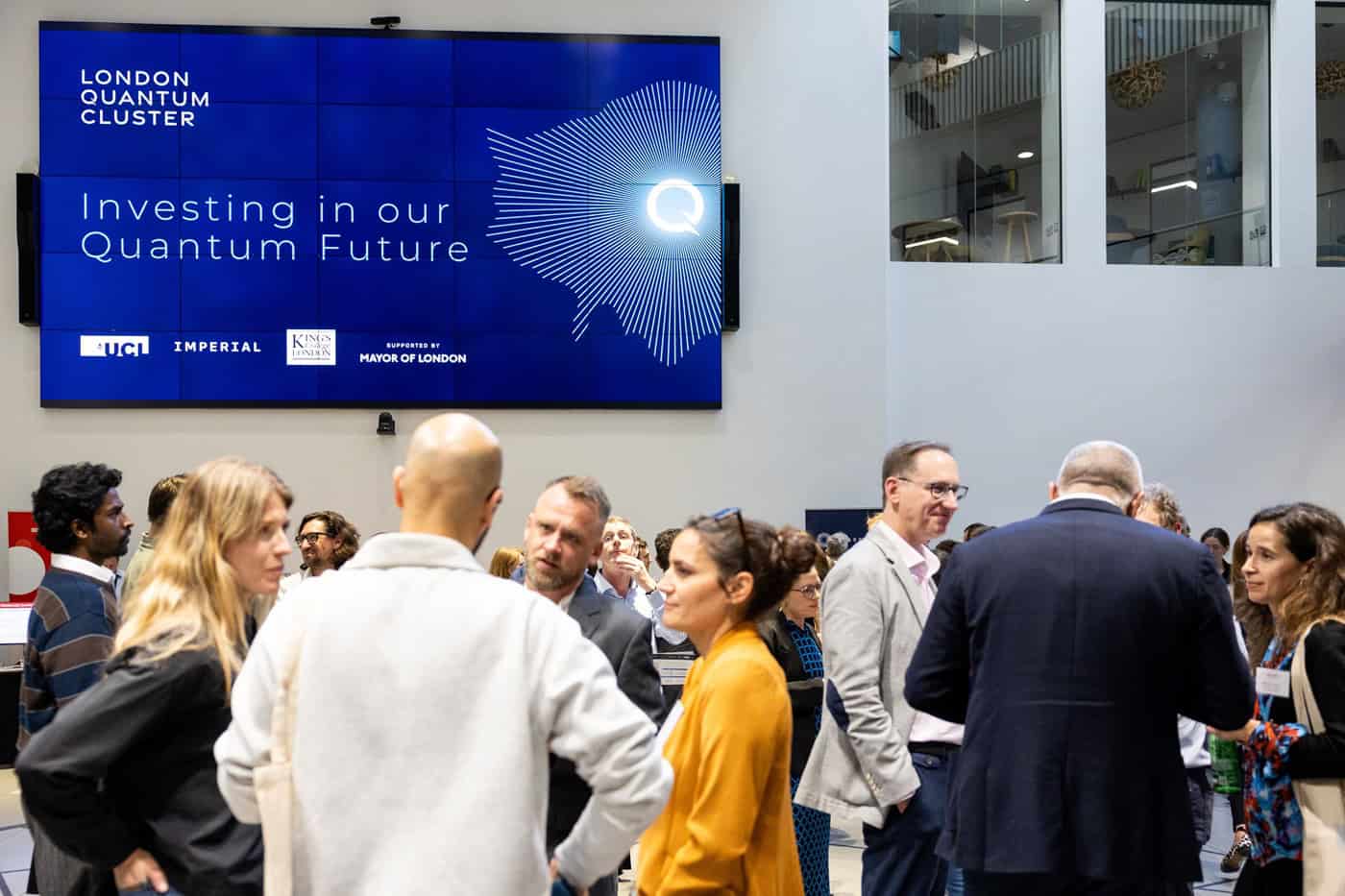
Founded in 2025 by University College London, King’s College London and Imperial College London, with support from the Mayor of London and the UK government, the cluster seeks to establish the capital as a powerhouse of quantum tech.
Georgia Siora from Warwick Economics and Development presented data to show that London is already doing well in the sector, being home to more than 160 quantum companies, with seven of the top 10 UK quantum firms based in the city. Small- and medium-sized quantum firms in the capital, she added, contribute an estimated £153m annually to the economy.
Happy anniversary The London Quantum Cluster is now one year old. (Courtesy: Carmen Vilano)
“Quantum and deep tech are at the heart of the capital’s 10-year growth plan,” added Janet Coyle, managing director of London and Partners.
Geraint Rees, vice-provost for research, innovation and global engagement at UCL, said his aim was “to make London the best place on the planet for serious quantum companies”. He pointed to UCL spin-out Quantum Motion, which has just won $160m of venture-capital funding, as an example of the kind of firm making a name in the city.
The evening ended with a panel debate chaired by Jess Wade from Imperial College London, featuring Maria Maragkou from Nu Quantum as well as Richard Murray, founder of ORCA Computing, who drew a distinction between universities being all about expanding the frontiers of knowledge, whereas for start-ups “the aim is to win”.
Also on the panel was physicist Alejandro Montblanch – head of quantum communication and networking at banking group HSBC – who made it clear that what he wanted to know was: “How can your quantum company help HSBC make more money?”
A welcome note of caution came from London-based venture-capital investor Eloisa Angeles, who pointed out that while the UK has a good track record of government-funded research, the UK is weak at “follow through”, with the government not focused on procurement and not having the end customer of the research in sight.
Confine a liquid to a region a millimetre or less in size, and you’re in the weird world of “microfluidics” – where surface tension and capillary action dominate in ways we easily overlook from our macro-scale vantage point. Despite being a term that was coined only in 1992, the underlying phenomena have been with us for millennia, as Albert Folch argues in How the World Flows: Microfluidics From Raindrops to COVID Tests.
Folch, who is a professor of bioengineering at the University of Washington in the US, has spent his career developing microfluidic devices that exploit the peculiar properties of flows at this scale. In this book, he now steps back to admire the full scope and impact of microfluidics, revelling in droplets that form rainbows, deliver inhalable asthma medications, make up salad dressings and cosmetics, and print scaffolds of living tissue to aid patients’ healing.
I particularly enjoyed Folch’s ode to the Olmec – Indigenous people who lived in Central America from about 1200 BCE to 400 BCE. They would harvest latex from Panama rubber trees by tapping the bark and collecting the liquid drop by drop before the day’s heat caused the latex to coagulate and seal the cut. The Olmec even had their own version of vulcanization – the process that makes rubber elastic – using the juice of morning glory vines to process the sap into bouncy elastic balls, stretchy bands, shoe soles and raingear.
The Olmec spread their knowledge to neighbours as well. In fact, the name “Olmec” comes from the Aztec language and literally means “the rubber people”. Like the maple sugar industry – which gets its own historical treatment from Folch – the Olmec latex harvest relied on a tree’s vascular system, made up of narrow 25 µm capillaries that carry liquids like water, sap, resin and latex to nourish and defend the tree. Although the Olmec civilization eventually declined, their technology and ingenuity lived on, impacting the entire world.
Folch walks readers not just through the physics and biology of these systems – capillary rise, photosynthesis, transpiration – but through their human impact, too. He includes wonders, such as natural rubber powering a Victorian-era craze that brought us tyres, inflatable boats, children’s dummies (pacifiers) and other objects. Folch also covers darker stuff, such as the British businessman Henry Wickham (1846–1928) who smuggled thousands of rubber tree seeds out of the Brazilian Amazon to establish plantations in Africa and Asia, where he could exploit cheaper labourers.
Another chapter begins in the mountains near Granada, Spain, where villagers are rebuilding acequias – open-air waterways originally built by the Moors in medieval times. For nearly 1000 years, acequias turned the arid slopes into terraced fruit gardens by diverting snowmelt toward agriculture and recharging the groundwater. Water seeps downward through the acequia’s dirt bottom, protecting it from evaporating in the hot Sun and feeding aquifers.
As Folch notes, aquifers contain nearly 30% of Earth’s freshwater – far more than is found in rivers and lakes, which make up less than 1% of the total. But in the US alone, industrial agriculture has been draining aquifers at rates as high as 60 cm per year, far exceeding the slow percolation of rainfall into these underground reservoirs.
In fact, aquifers take hundreds or thousands of years to recharge, which, Folch notes, means a depleted aquifer effectively ceases to exist for those of us living now. Without acequias and other dedicated efforts to replenish aquifer levels through microfluidic flow, today’s corn fields will soon turn to dust.
Candles to kidneys
How the World Flows charts the history of other unexpectedly microfluidic technologies too. Candles, for example, carry their fuel to the flame by capillary action along the wick. Then there’s paper, which soaks up ink through capillary action. Among more recent microfluidic inventions, Folch offers special laurels to the ballpoint pen, of which BIC alone has sold over 100 billion units since 1950.
Folch also takes care to introduce readers to many microfluidic medical devices, which might not be as widespread as ballpoint pens, but are perhaps more important. They range from dialysis machines that clean blood for failing kidneys, to COVID tests and continuous glucose monitors that let diabetics manage their blood glucose levels – a microfluidic technology that’s critical in my own home.
Folch describes the microfluidic devices that enable the Human Genome Project, as well as prototype instruments that could one day catch cancer cells through a simple blood screening. He also covers devices that could pick the perfect personalized drug cocktail for treating a patient’s tumour by studying their biopsied cells.
The most stunning microfluidic device Folch describes may be us
But the most stunning microfluidic device Folch describes may be us. As he argues, we ourselves are microfluidic. From our lungs to our cardiovascular system, from our lymphatic system to our sweat glands, our bodies rely on flow through tiny vessels.
Our bodies make up for diffusion’s slow pace by operating in parallel. Like the many co-operating central-processing units in a supercomputer, our bodies absorb oxygen through 500 million micro-sized alveoli in our lungs. We hear through ears equipped by microfluidics to act as both microphones and accelerometers. Our kidneys clean some 200 litres of blood a day – sending two litres of urine to our bladders as they do – through massively parallelized filtration.
Throughout How the World Flows, Folch’s enthusiasm for his subject shines. His approach is that of a storyteller, rather than a scientist, and the book is all the better for it. Whether readers are microfluidics experts or not, they will walk away with new stories to tell. (Don’t skip the footnotes…)
Although Folch’s stories are wide-ranging and entertaining, he stumbles at times with the overarching narrative. Some transitions are rough, and it’s not always clear why he’s chosen to order the stories in the way they’re presented. Nevertheless, his book is a fun and highly readable introduction to microfluidics that’s sure to entertain lay readers and excite a new generation of microfluidic engineers.
2025 Oxford University Press 306pp £22.31hb £19.16ebook
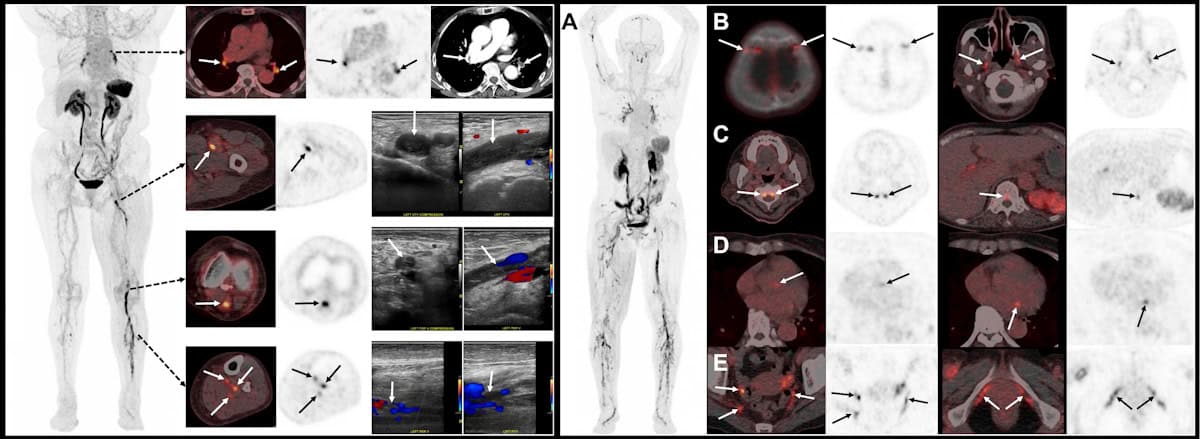
Image of the year Left: 18F-GP1 PET/CT images showing multiple blood clots in the deep veins of the left leg, plus several clots in the right calf and clots in both lungs. Right: 18F-GP1 PET/CT images showing widespread blood clots throughout the body. (Courtesy: S Han et al. Asan Medical Center, Seoul, Korea)
A PET radiotracer that can detect deep vein thrombosis (DVT) in the legs and clots that have travelled to the lungs has been chosen as the “Image of the Year” at the Society of Nuclear Medicine and Molecular Imaging (SNMMI) 2026 annual meeting. Developed by Sangwon Han and colleagues at the Asan Medical Center, University of Ulsan College of Medicine, in Korea, the novel tracer enables whole‑body imaging of blood clots (thrombi) in the legs and lungs in a single scan.
A DVT is a blood clot that forms in a deep vein, usually in the legs. It’s a common condition, with an incidence of roughly half that of all cancers, and it can lead to serious complications. Clots can break off and travel to the lungs, which could cause a potentially life‑threatening pulmonary embolism (a blockage in the artery supplying blood to the lungs). Early detection of DVT is therefore critical for determining the most appropriate treatment for each patient.
Currently, the standard imaging method for diagnosing DVT is venous ultrasonography (VUS). But while this works well for detecting clots in the thigh-to-knee region, whole-leg VUS requires skilled operators and advanced machines, takes longer, and has lower diagnostic sensitivity in the calf. In addition, conventional imaging techniques such as VUS and CT rely on indirect structural changes rather than directly visualizing the clot.
Aiming to enable faster and more efficient DVT diagnosis, Han and his research team are studying fluorinated GP1 (18F-GP1) a novel thrombus-targeted PET tracer. The tracer selectively binds to specific receptors on activated platelets (the cell fragments that cause blood to clots), allowing direct visualization of active thrombus formation.
“In our Phase 1 study, 18F-GP1 PET/CT showed 100% detection rate in 20 patients with confirmed DVT or pulmonary embolism,” Han told the SNMMI delegates. “But that study was limited by its small sample size and an absence of negative groups so specificity could not be assessed at that time.”
So in this latest work, Han and his team performed a phase 2, non-randomized study investigating the ability of 18F-GP1 PET/CT to identify acute lower-extremity DVT in 46 symptomatic patients. This included 22 patients with proximal DVT and 24 with none or distal DVT, as diagnosed using VUS.
The researchers acquired chest-to-feet PET/CT scans approximately 2 h after intravenous administration of 250 MBq of the radiotracer. The images were assessed by three blinded nuclear medicine physicians from different institutions, who assigned focal 18F-GP1 uptake higher than background activity as positive for thrombosis. They classified proximal DVT as clots involving the iliac (pelvic), femoral (thigh) and popliteal veins (behind the knee), and distal DVT as clots confined to the calf veins.
“Our primary objective was to assess the sensitivity and specificity of qualitive 18F-GP1 PET/CT interpretation for proximal DVT,” Han explained. “Secondary objectives included assessing the agreement between PET/CT and VUS for distal DVT, inter-reader reproducibility, exploring the detection of pulmonary embolism and assessing safety.”
When evaluated against VUS as a reference standard, 18F-GP1 PET/CT exhibited high diagnostic accuracy for detecting clots, demonstrating a sensitivity of 95% and a specificity of 92% for proximal DVT. “For distal DVT, both positive and negative agreement between PET/CT and VUS were strong,” added Han. “Inter-reader agreement was also excellent.”
The scans also identified concomitant pulmonary emboli in some patients, as confirmed by CT pulmonary angiography, illustrating the advantage of simultaneously assessing DVT and pulmonary embolism in a single scan. The researchers noted that the radiotracer was well tolerated, with no drug-related adverse events observed.
Speaking in the plenary session when his award was announced, Han shared a “striking image” recorded using 18F-GP1 PET/CT, which showed extensive blood clots, not only in the leg and lungs, but also in many unusual sites, including cranial and spinal vessels, cardiac valves, and vessels in the pelvic region. “This image clearly shows the remarkability ability of fluorinated GP1 to visualize thrombi throughout the body,” he explained.
“We believe this represents an important step towards thrombus-specific imaging,” Han concluded. “The potential of GP1 PET can expand beyond DVTs to many other thrombotic diseases such as embolic stroke or other cardiovascular diseases.”
The SNMMI Image of the Year is the society’s highest award, and the most anticipated, given out in recognition of an image that’s truly cutting-edge and representative of the future of nuclear medicine. This year’s winning image was chosen from nearly 1500 abstracts submitted for the meeting.
“It is truly a great honour to receive the Image of the Year award,” said Han.
Rectification is the process of turning alternating current (AC) signals into direct current (DC), and it underpins technologies such as wireless power transfer, photodetection, terahertz sensing, and energy harvesting. To generate a one-directional current, a material normally needs a built-in directional preference for electron motion. This preference usually arises from broken inversion symmetry, meaning that the material is not identical under spatial inversion. For example, graphene has inversion symmetry, while materials with inequivalent sublattices, intrinsic electric dipoles, surfaces, or interfaces naturally break it. When inversion symmetry is broken, electrons can respond differently to opposite directions of an applied light field, allowing oscillating optical fields to generate a DC current.
In this work, the researchers show that this rule has an important exception. Even centrosymmetric bulk materials can rectify light through third-order nonlinear optical effects. Linear optical responses scale with the applied light field. Second-order responses depend on the square of the electric field and can mix frequencies or generate harmonics, but they are usually forbidden in centrosymmetric bulk materials. Third-order responses, however, are symmetry allowed and can generate DC photocurrents even when inversion symmetry is present. These currents are controlled by the shape of the Fermi surface, disorder, and the geometry of electronic bands. This means that materials once considered unsuitable for bulk optical rectification, including common metals, doped systems, and two-dimensional materials, can be engineered to convert oscillating light into DC electrical signals.
Quantum transport and theory group at IIT Kanpur, celebrating the discovery of third-order rectification (Courtesy: Amit Agarwal/Indian Institute of Technology Kanpur)
This research expands the material platform for optical rectification. Instead of relying only on noncentrosymmetric crystals, it shows that common centrosymmetric materials can also be used for light-to-DC conversion through third-order nonlinear response. This opens a route to energy-efficient photodetectors, terahertz technologies, and future energy-harvesting devices based on materials such as graphene.
In condensed matter physics, driving a material with an external stimulus can push it into new nonequilibrium states that reveal hidden properties or create entirely new, potentially useful behaviours. These stimuli can include optical driving, where strong oscillating light is applied to the material, or periodic forcing, which refers to any repetitive push such as acoustic waves, modulated electric fields, or oscillating magnetic fields.
In this work, the researchers wanted to understand how shining bright, oscillating light on a material can make it behave in unexpected ways, sometimes even resembling a superconductor. They used a theoretical model to study what happens when the system is periodically driven, allowed to exchange energy with a heat bath, and coupled to electromagnetic fields. When the drive is strong enough, the system can spontaneously organise into different kinds of ordered states: uniform order, spatially patterned order, or timeoscillating order.
Ordered phases can repel magnetic fields in the same way a superconductor does, through the Meissner effect, where the electromagnetic field behaves as if the photon has gained an effective mass and therefore cannot propagate inside the material. In some driven phases, however, not all of the magnetic field is expelled: part of it enters the material but only as a standing wave, forming a hybrid light-matter excitation known as a Meissner polariton. Additionally, strong fluctuations near the onset of ordering can make the material’s optical conductivity appear superconducting, causing experiments to detect superconductinglike signals even when no true superconducting phase is present, helping explain why light‑driven systems sometimes show ambiguous signs of superconductivity.
Overall, the researchers developed a unified theoretical picture showing how periodic driving can create or mimic superconducting behaviour, including predicting a new hybrid light-matter mode (the Meissner polariton), offering insight into puzzling experimental results in lightdriven materials.
Experimental attosecond science is built around the ability to generate and control light flashes lasting billionths of a billionth of a second. Such extreme pulses can be created through high harmonic generation (HHG), where an intense laser field drives electrons out of atoms or solids and then forces them back, releasing bursts of extreme ultraviolet radiation. Techniques like this have transformed our ability to observe electron motion on its natural timescale.
To extract information from such ultrafast processes, physicists often rely on attosecond interferometry. By combining a strong laser field with a weaker second colour, different electron trajectories are made to interfere, imprinting timing and phase information onto the emitted harmonics. Over recent years, these schemes have become standard tools for attosecond metrology and spectroscopy.
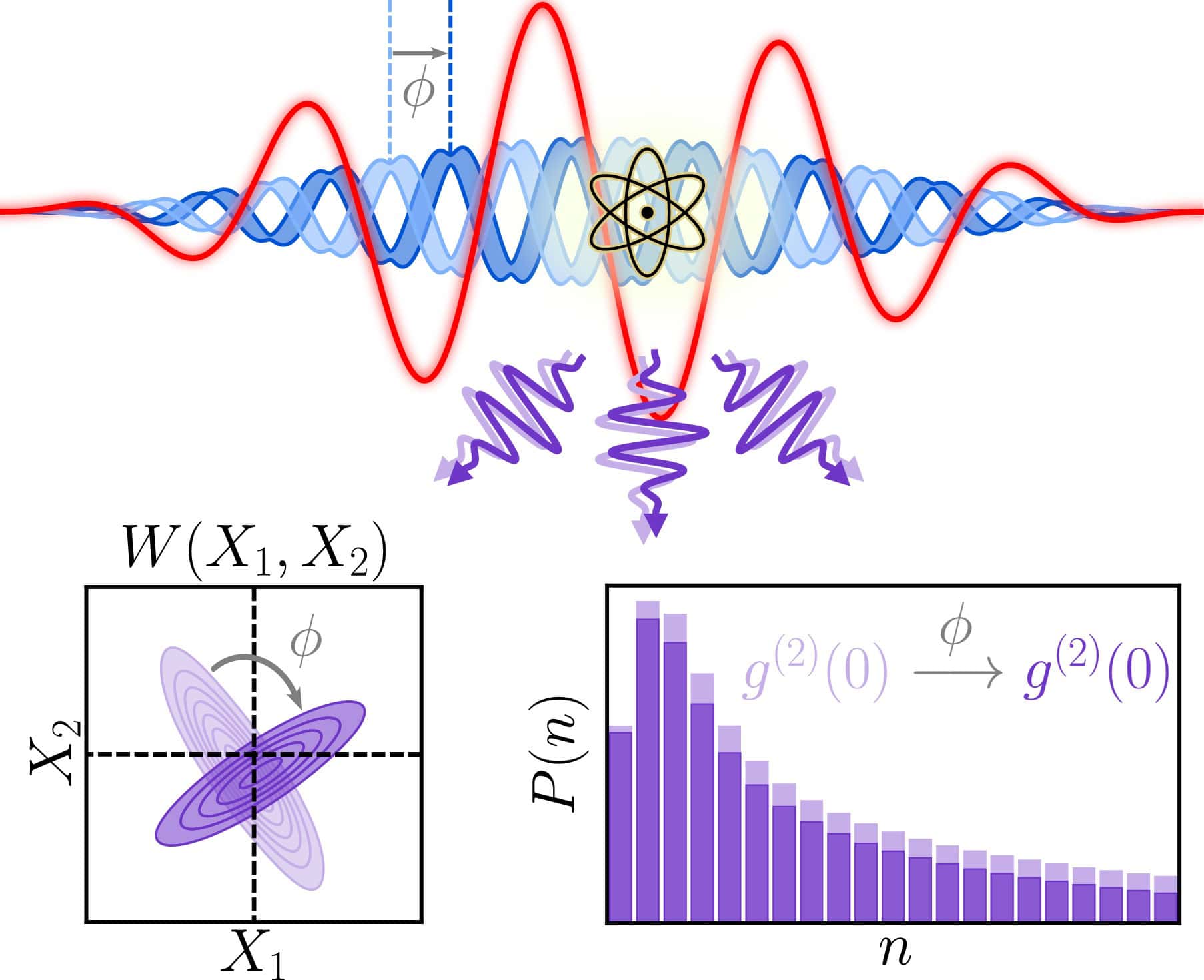
In a recent paper published in Reports on Progress in Physics, Javier Rivera Dean et al, revisited this idea from a quantum optical perspective. Treating both the driving fields and the emitted harmonics as quantum rather than classical objects, they analysed how attosecond interferometric control influences the photon statistics, correlations and phase space structure of the generated light. Their calculations show that even when harmonic radiation appears classical in its average properties, its underlying quantum state can carry rich and measurable structure.
The study also explores how interferometric phase control can be repurposed as a practical probe of quantum optical features in spectral regions where standard techniques, such as homodyne detection, are unavailable. This represents a new approach for measuring phase-space distributions through tomographic reconstruction: attosecond quantum tomography.
Illustrative image new of experimental scheme proposed in their paper (Credit: J. Rivera-Dean).
By combining quantum optics with common attosecond techniques, the work shows how ultrafast science is increasingly becoming a platform not just for watching electrons move, but also for studying light itself at the shortest timescales accessible in the laboratory.
Astronomer Jessica Dempseyhas become director-general of the Square Kilometre Array Observatory (SKAO), which will be the world’s largest and most sensitive radio telescope when it opens next year. Dempsey will now serve a five-year term as director-general and succeeds Philip Diamond, who held the role since 2012.
Three decades in the making, the SKAO is based in South Africa and Australia and consists of 197 dishes and 131 072 antennas to study how galaxies form, the nature of dark matter, and whether life exists on other planets.
The Australian side, known as SKA-Low, will focus on low-frequency obervations, while South Africa’s SKA-Mid will observe mid-range frequencies.
The headquarters of the organization is based in the UK at Jodrell Bank and SKAO has 13 full members, which includes China, Germany and India.
From film star to the stars
Dempsey studied both astrophysics and theatre and film science as an undergraduate at the University of New South Wales before becoming an actor in the late 1990s.
Dempsey then did a PhD in astronomy at UNSW, graduating in 2007 before working at the James Clerk Maxwell Telescope at Mauna Kea Observatory in Hawaii, becoming operations manager in 2012 and then deputy director of the telescope in 2016.
In 2022 Dempsey became director of the Netherlands Institute for Radio Astronomy and throughout her career has championed more equitable opportunity and experience for women and all underrepresented individuals in science, in 2023 becoming professor of ethics in astronomy at Radboud University.
Dempsey says it is “humbling” to lead the organization and is “passionately dedicated” to its success.
SKAO is currently preparing for the start of “science verification”, in which astronomers will gain access to the first SKAO data. This is due to begin for the SKA-Low telescope in Australia in the second half of 2027.
“As someone who loves nothing more than building and running telescopes, there is not a better time to be asked to take up this role – we are just getting to the cool stuff,” adds Dempsey. “This is a daring project, unprecedented in scale and scope, and it will need the skills of every single team member on three continents and all the support of our broad global partnership to see it come to light.”
Diamond, meanwhile, noted that the observatory is in “very good hands” with Dempsey’s appointment.
“This is a demanding role, with the need to balance scientific, political, diplomatic, financial and many other considerations,” adds Diamond. “I have full faith in [Dempsey’s] ability to lead this extraordinary organization through its next chapter.”
From heatwaves to extreme rainfall, the impact of climate change is rapidly becoming a reality in our daily lives and a danger to our planet. But physicists are in a great position to help, with physics-based research bringing about practical, real-world solutions, whether it’s more efficient solar cells, better climate models, or novel materials for capturing carbon dioxide from the atmosphere.
There are huge economic and commercial benefits from such work too. A 2023 report from the Institute of Physics (IOP), entitled Physics Powering the Green Economy, estimates there are almost 1800 companies in the UK and Ireland taking green technologies to market with a combined turnover of £750bn.
Last year a follow-up IOP Impact report entitled Unleashing Physics to Power the UK Energy Sector identified the most promising physics technologies for transforming the UK’s energy system. These fall into three main areas: energy generation (nuclear power, photovoltaics), storage (batteries) and transmission (high-temperature superconductors).
The clean-energy revolution will not be easy, however. As the IOP report points out, the UK has a strong research base, good international collaborations, and a growing pipeline of spin-out and early-stage companies. But the country doesn’t invest enough in technology scale-up facilities, faces critical skill shortages, and isn’t great at recycling either.
To discuss how physicists are supporting the green economy – and what more they can do – a panel debate was recently held at the IOP in central London. Attended by Prince Edward, the Duke of Edinburgh, as well as about 100 business leaders, policy chiefs, senior physicists, and IOP and IOP Publishing staff, it was chaired by Tara Shears, the IOP’s vice-president for science and innovation.
The panel featured ex-BP boss John Browne, who now works in green energy, Emily Nurse from the UK’s Climate Change Committee, former Sizewell C energy-strategy director David Cole, solar-cell physicist Jenny Nelson from Imperial College, and Nellie Technologies founder Stephen Milburn. The following is an edited extract of the discussion.
Physicists for a greener future
Green game-changers Tara Shears (far left) chairing the panel debate at the Institute of Physics in London on how physics can support the green economy. It featured (from left to right) John Browne, Emily Nurse, David Cole, Jenny Nelson and Stephen Milburn. (Courtesy: Carmen Valino)
John Browne is chair of BeyondNetZero, a climate-growth equity venture firm. He was group chief executive of energy giant BP from 1995–2007, having joined the firm in 1966 after studying natural sciences.
Emily Nurse, who was originally an experimental particle physicist, is the director of net zero at the UK’s Climate Change Committee, which advises the UK government on reducing emissions and adapting to the impacts of climate change.
David Cole, an engineer by training, was at the time of the discussion director of energy strategy at the Sizewell C nuclear-power plant, which is being built in Suffolk in the UK. When complete, it is expected to meet up to 7% of the UK’s total electricity demand. He is now executive president, consulting, at energy firm Wood.
Stephen Milburn is a physicist who is founder and chief executive of the firm Nellie Technologies in South Wales. It removes carbon dioxide form the atmosphere using biomass, which can then be used as animal feed or construction material.
What role are physicists currently playing in our quest for a greener economy?
John Browne: I made a wonderful decision 60 years ago, when I was 18, which was to read physics. After graduating, I became an engineer, but over the last 30 years physics has come back in to my life as I’ve found myself doing something very important – trying to get to net zero. Physics, you see, touches absolutely everything.
All that I’ve ever done – whether it’s renewable energy or “old energy” [fossil fuels] in my old life – starts with physics. Whether you’re involved in chemistry, biology, electronics or engineering, it could not exist without a much deeper understanding of physics. We have to make sure everybody knows that – but I don’t think people currently do. They tend to think engineering is the only enabler for commercialization, but physics is there.
Emily Nurse: I started out as a particle physicist working at CERN on the Large Hadron Collider but for the last four years, I’ve been involved in climate policy and now work with the UK’s Climate Change Committee. We are the UK government’s official advisers on its climate targets – and assessing progress towards meeting those targets. As we celebrate global decarbonization to date, we need to remember it’s all underpinned by physics.
Take the rise of solar power for example, which has been the fastest growing source of global electricity generation for the last 20 years in a row. Solar installations in 2024 were double those in 2022. Along with wind, solar has led to a reduction in electricity from fossil fuels. We’re seeing the costs of solar plummeting and they just keep falling further.
In the UK, solar power has been growing more slowly, but it’s starting to pick up and is going to be a really important part of the electricity mix. We’ve also got a lot of wind here in the UK – it’s a very windy island after all. I would also like to give a shout out to heat pumps: as a physicist, how can you not love their efficiency?
David Cole: I am an engineer, not a physicist, but I’ve spent my career in lots of different sectors and been fascinated with the role that energy plays in creating a better society. What’s really interesting at Sizewell C is the ownership structure, which involves both state and private investment. It’s the first time private investment has been used for a new nuclear build in the UK.
I hope it leads to a virtuous circle, in which the more plants we build, the more we can reap from that investment
David Cole
Getting this hybrid financial structure over the line was not trivial – it took a lot of effort – but I think it will drive great performance. We’re also trying to use as much UK content in the plants as possible, whether that’s materials, skills or technology. I hope it leads to a virtuous circle, in which the more plants we build, the more we can reap from that investment. Sizewell C will, in other words, bring down energy costs, which is fundamental to economic growth.
Jenny Nelson: I have been active in research into solar photovoltaic (PV) materials and devices for over 30 years and we should celebrate how much has happened in the field during that time. In the last 10 years, we have seen capacity increase globally by more than a factor of 10, we’ve seen the efficiency of solar cells increase, and we’ve seen the cost come down almost by a factor of eight, all of which is remarkable.
Those innovations are firmly rooted in physics – whether it’s changes in device structure… or of the optical properties of materials
Jenny Nelson
The cheapest form of electricity globally, in other words, is now from solar PV, which was not the case 30 years ago. These developments have come partly from economies of scale and partly from technological innovations that have now fed through into production. Those innovations are firmly rooted in physics – whether it’s changes in device structure due to our understanding of semiconductor physics or new developments in the optical properties of materials.
The next generation of PV cells, which are likely to be silicon-based tandem devices, will also depend on scientific breakthroughs and innovations.
Stephen Milburn: I’m chief executive of Nellie Technologies, which is based in South Wales on the site of a former chemical-weapons storage facility. We’re using biomass waste for removing atmospheric carbon dioxide, and if you visit us, you’ll see all kinds of activity: in one corner there’s chemistry, in another engineering and in the next there’s biology and biochemistry. But physics is at the heart of the technology. Physicists are a bit arrogant when we say we think we can do everything, but the fact is we probably can.
But we should also celebrate the work that has gone on to create a market in which carbon-emission credits can be bought and sold. Trading carbon credits has been a bit of a dark activity over the last 10 years, with double counting and bad things happening purely by firms wishing to make a profit. However, the market does have the power to regulate itself – in fact the alignment we’re starting to see between the UK and the EU will help greatly.
Challenging times Technologies to store, generate or transmit energy are rooted in physics. (Courtesy: iStock/Galeanu Mihai)
What are the biggest growth opportunities for the green-economy sector?
John Browne: First, we can do much more with what we’ve already got – for example we could increase our offshore wind or rethink whether we should go back into onshore wind. Second, we can improve what we’re doing – for instance, by increasing the efficiency of solar panels to their theoretical maximum, which would make rooftop solar economically attractive. Third, there are new opportunities, such as metallic organic frameworks and nuclear fusion.
What we do here in the UK needs to move the needle globally, which means thinking about how to scale and finance it properly
John Browne
However, the UK needs to avoid doing things that others are doing much better. The race for the best battery in the world is, for example, probably going to be won elsewhere. What we do here in the UK needs to move the needle globally, which means thinking about how to scale and finance it properly. The UK shouldn’t end up as a secondary player.
Emily Nurse: The UK has made a lot of progress in our quest to reach net zero by 2050. Since 1990, for example, we’ve halved our carbon emissions, mainly by decarbonizing electricity – phasing out coal, reducing gas generation, while significantly increasing wind, solar and other renewables. Electricity generation now accounts for only around 7% of UK emissions, which are dominated by transport (cars and vans) and heating (oil and gas boilers).
Reducing emissions still further will predominantly come from moving to electric technologies, including electric vehicles and heat pumps, and by further decarbonizing the electricity supply. There will be a backbone of wind and solar, but to ensure a secure supply, we’ll need nuclear, carbon capture and storage, hydrogen and batteries. We’ll have to reduce emissions from agriculture and land use too.
A report from the Confederation of British Industry (CBI) last year estimated that the net-zero economy grew by 10% in 2024, which is three times faster than the rest of the UK. But we’ll need more innovations to continue to bring costs down – and we’ll also need to provide incentives to boost the take-up of electric technologies. If we do that, there’ll be an overall saving to the UK economy in about 15 years’ time, our analysis suggests. There are huge opportunities for green growth to come from this investment.
David Cole: I agree that for the UK to be competitive, the cost of energy has to come down – not just for domestic customers but businesses too. In fact, there are two main opportunities First, we have to adopt a “whole-systems” approach. If we’re building a power station, for example, can we use every bit to its maximum potential?
Let’s say I’m running a direct air-capture plant operating at 25–30 ºC – can I use the waste flow from my coolant system to encourage new industries? Can it support nearby hydrogen generation plants or companies making, say, synthetic aviation fuel? Those questions involve thinking about physics and engineering as well as materials science, which is also super important.
Whichever way you look at it, we’re talking about building a lot of hardware, which involves materials. How much energy per unit mass are they using? Can we recycle those materials? What can we do with the waste products? Ultimately, what is really important is energy security: where does your energy come from, who made it and what impact does it have on the environment?
Jenny Nelson: The net-zero economy is growing significantly faster than the rest of the economy and I think that will continue. But decarbonizing the power sector only addresses part of the problem and we’re going to see a big transition across the rest of industry, agriculture and elsewhere that will generate a wide range of opportunities and stimulate the economy too. I’m not just talking about rolling out more renewables, but about integration – bringing together the generation and storage of energy, ensuring that we are managing demands and have the right infrastructure.
As for my area of photovoltaics, we’ve seen great ideas and technologies come out of the UK that are very likely going to be developed outside the UK because the manufacturing capacity isn’t here. Nevertheless, those ideas and innovations can still benefit the country through licensing, partial manufacturing and new technology.
One thing to remember about solar power is it’s distributed. You can have solar generation without being connected to the grid. That not only opens some markets for certain applications where you want to generate electricity locally, but it also provides a route to energy security through back-up generation, towards which solar power will be an important part.
Stephen Milburn: Having a strong green-technology manufacturing base is a huge opportunity for the UK. My company is based in South Wales, where we have lots of highly skilled people who used to work in traditional industries but now don’t have many places to go. Yes, there’s a fantastic semiconductor industry here, but when it comes to deploying green technology we cannot outsource that responsibility to other parts of the world.
Green tech needs to be deployed in the UK’s industrial heartlands… if we don’t nurture jobs and skills here there’s a real risk they will be gone forever
Stephen Milburn
Green tech needs to be deployed in the UK’s industrial heartlands to take advantage of the skills we already have, but which we are at risk of losing. In fact, if we don’t nurture those jobs and skills here there’s a real risk they will be gone forever. Having a strong green-technology manufacturing base is a huge opportunity for the UK.
Deep thinkers Combining analytical minds with great problem-solving skills, physicists are well placed to tackle the challenges of climate change. (Courtesy: iStock/MTStock Studio)
What needs to happen so that these opportunities can be put into practice?
Stephen Milburn: Many science graduates leave university equipped with solid academic rigour and a great scientific understanding, but they often lack practical green-technology skills. This summer my company is therefore hoping to launch a climate apprenticeship programme, which will allow graduates to pick up those skills. We need to build green-tech skills in the real economy, in particular those that will deal with climate change.
Jenny Nelson: The UK must do more to support its own innovations. We need better regulations to avoid unnecessary bottlenecks. We need to invest in infrastructure like the grid. We should completely avoid subsidizing fossil fuels and instead divert any subsidies into alternative economies. Finally, we need to train and educate people, showing the public the potential of green technology so that they become part of the transition, for example by generating their own electricity.
David Cole: We need to integrate our policies on industry, energy, land use and AI so that we can invest in them all as growth areas. In particular, I’d like to see a long-term nuclear programme in which we build a fleet of new reactors all of the same design, which will drive down costs by letting us replicate a particular technology. It’s also vital that we get a high proportion of UK content and technology into these reactors, which will lead to a virtuous circle, with money coming back into the economy that we can re-invest in industrial and academic partnerships.
Emily Nurse: What’s vital is consistency in policies; we need certainty. In the UK, we are fortunate to have world-leading climate legislation in the form of the 2008 Climate Change Act, which does not just make it a legal requirement to reach net zero by 2050 but also gives us targets along the way. It means we know what we need to do in both the medium- and long-term, which gives certainty to investors, businesses, innovators and consumers.
What’s really important is communication – supporting communities through the transition and making sure they realize the benefits
Emily Nurse
So the first thing we need to do is keep the Climate Change Act. Then, of course, we’ve got to address barriers to delivery, including having the right incentives to electrify the economy. And what’s really important is communication – supporting communities through the transition and making sure they realize the benefits, not just in terms of reducing carbon production but of having cleaner, better and more efficient technologies too.
John Browne: First, we must never stop investing in people who can discover things and translate them into real commercial products. Second, we need to understand how to scale things, which means focusing on the winners and getting rid of things that are “nice to have” but aren’t going anywhere. That’s not easy because you have to push people to say, “You’ve done great work, but you’ll have to stop”.
What’s more, to scale new technology, people have to learn what it takes. When I’m in the US, I often speak to chief executives who can explain their technology to the financier who’s supporting it, whereas here in the UK that often doesn’t happen.
Third, we need to maintain confidence in what we’re doing. I often talk to people who think that it’ll be really expensive to get to net zero, but in fact estimates suggest that each household would only have to spend an average of about £150 a year to get there. So it’ll be less than the cost of a TV licence to get to net zero.
Of course the investment needed will be “lumpy” – it’s not as simple as just levying a fee – but the point about governments is that they can smooth things out. That is what they have done in the past and it’s what they should continue to do.
For more information about the IOP’s work on the green economy, click here. You can also keep up to date with the all latest research in the field through IOP Publishing’s series of open-access Environmental Research Journals at this link.
Photonic glasses containing gold-cored, silica-shelled nanoparticles can produce high-purity colours across the visible spectrum. Crucially, the colours are independent of viewing angle. Developed by researchers in Korea, their design avoids the short-wavelength scattering that has prevented the attainment of a true red – and blurred other colours – in previous photonic glasses.
Synthetic materials are usually coloured using pigments, such as those found in dyes or paints. A pigment has a chemical composition that causes it to reflect light at certain wavelengths and absorb light at other wavelengths. Nature, however, makes widespread use of structural colour, whereby the physical structure of a material dictates which wavelengths are reflected and which are absorbed. A familiar example is iridescence, which is responsible for rainbow-like colours on some plants and animals.
Creating colour using structure rather than chemistry has several advantages. One is that there are no chemical chromophores to be bleached by sunlight, so the colour tends to be more durable. Another benefit is that there is no dye to leach if the material comes into contact with water or another solvent.
While structural colour can be created using traditional photonic crystals, these can be tricky to produce controllably. Moreover, a surface that relies on interference effects is inevitably iridescent – which means that its colour changes with the viewing angle.
Short-range order
One solution is colloidal photonic glasses, which are not physically textured but have particles such as silica or polymers dispersed throughout them with short-range order. These can be produced simply by solution processing, and their colour does not vary with viewing angle. The principal problem with these glasses is the attainment of colour purity – especially in the red. The challenge is that the glasses scatter light more effectively at shorter (bluer) wavelengths owing to Rayleigh scattering. This effect makes the sky appear blue and adds unwanted blue light to structural colour.
In the new work, nanophotonics expert Seungwoo Lee of Korea University in Seoul and colleagues synthesized 230 nm core–shell nanoparticles in which silica surrounds a 20 nm gold cluster. This has a plasmonic resonance that absorbs shorter wavelengths. The researchers then dispersed the nanoparticles in ethoxylated trimethylolpropane triacrylate. This is a photocurable resin that has a very similar refractive index as the nanoparticles. The resin was applied to surfaces by painting or solution deposition and then cured under ultraviolet light.
The resulting photonic glass scatters red light randomly, while absorbing shorter wavelengths. Lee stresses that this is different from a traditional paint. “The reflected colour is determined by particle size, spacing, refractive-index contrast, and the degree of structural order, rather than by a molecular chromophore alone,” he says. When the researchers reduced the size of the nanoparticle shells, first to 180 nm and then to 160 nm, they found that they packed more closely together, producing first green and then deep blue colours.
The explanation for the blue scattering is more subtle than for the red: “The gold core is not needed to ‘make’ blue in the same way that a blue dye would,” explains Lee. “However, the gold core can still improve perceived colour purity by reducing broadband diffuse scattering and nonresonant background light.” explains Lee “Without this suppression, silica-only photonic glasses tend to look milky or whitish because many wavelengths are scattered together.”
Durable coatings
The researchers are now exploring several possible extensions of their research. They believe that the work could provide easily applied coatings that are durable as the light scattering comes from within the material structure rather from than a surface pigment.
They also believe it could have anti-counterfeiting properties: “In a normal ink or paint, its colour mainly originates from chemical pigments or dyes,” says Lee; “Our material produces a nanoscale structural signature: a specific reflectance spectrum, bandwidth, angular response, and microstructural arrangement determined by the particle diameter, core–shell geometry, refractive-index matching, volume fraction, and assembly pathway. This gives several possible authentication handles.”
Lee believes that it should be possible to reduce the cost of the material using a metal that is cheaper than gold. However, the precious metal is only 0.022% of the film by weight, so the technology may already be economically viable.
“I think it’s really neat,” says materials scientist Aaswath Raman of the University of California, Los Angeles. “The concept of structural colour has been around for a really long time but to me it’s, like, the last steps before we see it out it the real world.”
He says the largest problems he foresees are the simple economics of competing with industrially-optimized paint industry – even if the technology is, in principle, superior. Nevertheless, he says, “of the technologies we see in research this is likely quite a good candidate for commercialization”. The next step, he says, is to actually find a “first use” application – he suspects the aerospace industry, which values ultralight, durable coatings, could be a candidate.
In today’s technologies, mechanical mechanisms generally provide the brawn while electronics supplies the brains. This is partly because it is challenging to write information into mechanical memories without resetting each bit individually. However, that could change as researchers led by Pedro Reis at École Polytechnique Fédérale de Lausanne in Switzerland and Martin van Hecke at AMOLF in the Netherlands have now found a practical means of writing mechanical bits. Their technique, which they describe in Science Advances, uses structures that resemble children’s slap bracelets placed on a rotating turntable. While they acknowledge it is unlikely to replace electronic memories, they argue that it could have specialist applications and might produce insights that translate into electronic innovations.
“The framework we propose could be very useful, for example, in the domain of physical intelligence, where you provide hardware with capabilities that don’t require essentially a brain or an electronic control system to do individual tasks,” Reis says.
Mechanics for memory
Reis and van Hecke’s interest in mechanical memory stems from their research on metamaterials, which are materials that are defined not just by their composition, but also by the structures within them. Mechanical systems offer a tangible means of getting to grips with the complex behaviour of these metamaterials. “Often, all sorts of things that we do rely on nonlinear responses,” van Hecke notes, adding that such responses are much easier to study in mechanical systems than in optical devices.
A metamaterial made up of an array of switchable mechanical elements could function as a form of mechanical memory. However, to be practical, it needs to be possible to flip the states of individual mechanical bits using global controls, as opposed to addressing them individually. Otherwise, writing data will be very fiddly.
A solution emerged from Reis’ interest in rotating platforms, which he describes as “a very versatile way of loading mechanical systems”. While the pair had been friends for more than two decades, they had been working independently until, during a visit, the penny dropped and they realized that placing the metamaterial array on a rotating platform could provide the control they needed.
Because the angular velocity of the platform sends its momentum outwards, each mechanical object experiences a force in the radial direction, known as the centrifugal force. If this angular velocity is not constant, the object will experience an additional force in the orthogonal azimuthal direction, known as the Euler force. “So you have a complex force and bi-directional field that is highly tuneable,” says Reis. “And this tuneability is what we realized is very powerful.”
A rotating array
To construct their array, the researchers used clamped beams with two stable mechanical states – a little like a slap bracelet can be coiled up or flat, except these beams could either curve to the right or to the left. To individually address different beams, they ensured that each beam was unique in its width, the angle it was clamped at, and so on, all of which affect how much force is needed for a beam to ping into the opposite state. By tuning the parameters of each clamped beam and the angular acceleration of the rotating platform, they could engineer the applied force to switch (or not switch) specific beams, thereby writing data into the array purely by rotating the platform.
Doing this accurately requires a level of precision in acceleration control that surpasses what standard lab motors can achieve. However, the researchers say they were able to team up with a local company that had designed high-spec rotating platforms for its high throughput silicon chip production process. By programming platforms with five tailored clamped beams and the right rotation functions, they showed they could write the letters of the alphabet in ASCII script.
“This is a significant advance because it points toward future smart devices and robots that can be reprogrammed remotely without complex wiring or electronics, using only carefully designed motion‑based signals driven by a sole dynamic driving strategy,” explains Damiano Pasini of McGill University, Canada, who studies systems for mechanical computing but was not involved with this work directly.
Reis says he is excited about the scalability of the approach and its potential in high throughput experiments. Meanwhile, van Hecke is looking into how the idea might transfer to other systems, such as applying engineered force functions to crumpling sheets of complex glasses. “It just opens up possibilities for both studies, really fundamental studies of complex systems, but also real applications where you use this dynamic idea,” he tells Physics World.