‘Viscous shear’ wears down sound waves

Noisy aircraft can make life miserable for people living near airports and concerns about increased noise can restrict airport operations and plans for expansion. As a result, aircraft manufacturers are keen on finding new technologies to reduce noise emissions — and this has led researchers in the US to develop a new lightweight material that takes an altogether different approach to absorbing sound.

Unlike traditional soundproofing materials, which absorb sound in structures that resonate at acoustic frequencies, the new “honeycomb” material dissipates sound by passing it through narrow tubes, the sides of which gradually absorb sound energy in a process called “viscous shear”.

The material was invented by Jason Nadler and colleagues at the Georgia Institute of Technology. According to Nadler, one of its key benefits is that it can absorb sound over a wider range of frequencies than traditional materials.

Most existing approaches to sound reduction work on the principle that a material is most efficient at dissipating energy when it oscillates at its resonant frequency. When sound waves enter foams and other cavity-riddled porous materials, waves of certain frequencies force the air in the cavities to resonate, dissipating energy. This method — the “Helmholtz resonator” — is well established in architecture to remove unwanted frequencies from buildings.

A major limitation with this approach is that it only works for certain frequencies, which are determined by the size of cavities. There is great practical difficulty in constructing a porous material that can accommodate the kind of frequency array emitted by an aircraft engine during take-off.

Shearing sound

The viscous shear method gets around this problem because it functions independent of frequency. It works due to the interaction of porous media with the air through which sound propagates. Sound waves are forced into the parallel tubes which make up the honeycomb-like structure where they shear against the sides losing energy through friction and compressive stresses.

Nadler described the process as “fundamentally different from traditional techniques that absorb sound using a more frequency-dependent resonance”. “It’s the equivalent of propelling a little metal sphere down a rubber hose when the sphere is just a hair bigger than the rubber hose”, he added.

To determine the optimum dimensions for his honeycomb structure, Nadler and colleagues began with a prototype made from ordinary capillary tubes physicsworld.com. “Classical analytical calculations showed us that certain geometric configurations at the micron scale minimize resonant effects and maximize absorption”, he told physicsworld.com.

’Super alloy micro honeycomb’

The next challenge was to find a material that could withstand the high temperatures and turbulence inside an aircraft engine. Nadler also claims to have developed the world’s first “superalloy micro honeycomb” using a nickel-based superalloy. The advantage for aircraft application is that the material is strong, sufficiently heat resistant and also very lightweight.

Acoustic metamaterial researcher Huanyang Chan of Hong Kong University of Science and Technology said, “Developing these new materials further will present interesting physics for people working with classical waves. The concept of the phononic crystal could be used in studying the properties of these materials.”


arXiv thrives

Ginsparg.jpg
Paul Ginsparg, creator of the arXiv e-print server

By Jon Cartwright

The electronic dust may have only been settling on arXiv for 17 years or so, but the world’s favourite e-print server has already amassed half a million papers.

arXiv started out life in 1991 as xxx.lanl.gov, a server created by Paul Ginsparg, then at Los Alamos National Laboratory in New Mexico, to share preprints among a small number of high-energy physicists. It was a simple yet surprisingly popular idea, receiving some 400 subscriptions in its first six months alone. By 1999 when xxx.lanl.gov had changed its name to arXiv, the repository was accumulating almost two thousand new articles every month. In 2001, when Ginsparg headed to Cornell University, arXiv went too, and continued to grow.

“arXiv began its operations before the World Wide Web, search engines, online commerce and all the rest, but nonetheless anticipated many components of current ‘Web 2.0’ methodology,” said Ginsparg in a statement on Friday, when the server officially passed the 500,000 mark. “It continues to play a leading role at the forefront of new models for scientific communication.”

• If you are interested to read Ginsparg’s thoughts on the development of scientific communication on the Web, why not read Physics World‘s online feature

Scientists solve fluid puzzle

Scientists in the US have solved a problem in fluid dynamics that dates back more than 100 years, namely how to model precisely what happens when a layer of air or water detaches itself from a moving object. They have developed a theory to predict exactly where such separation should occur and confirmed these predictions experimentally, suggesting that vehicle manufacturers in the future might build cars that continually change shape very slightly in order to minimize drag.

When a solid object moves through a fluid, either liquid or gas, any variation in acceleration of the air over different parts of the object will create pressure distributions that affect how the air flows in the boundary layer immediately surrounding the object. A large enough pressure gradient can decelerate this boundary layer sufficiently so that it stagnates and then detaches itself from the object leading edge of the object — where the air hits the object full on.

According to Bernoulli’s principle, the lower velocity of the detached air layer will increase its pressure, so when the layer detaches itself from the leading edge of a moving car it will increase the pressure over the front of the vehicle and so oppose its forward motion (known as increasing drag). As regards to a moving aeroplane, the extra pressure over the wings will lead to a loss of lift, forcing the aircraft to lose altitude.

German physicist Ludwig Prandtl derived the mathematics of this flow separation in 1904. But his equations were restricted to steady two-dimensional flows — flows that move around objects with a constant velocity. As a result, his method cannot describe many real-world scenarios, such as cars accelerating or decelerating, or planes taking off and landing.

Success with dynamical systems theory

In 2004 George Haller at the Massachusetts Institute of Technology (MIT) and colleagues described mathematically how unsteady flow separation could occur in two dimensions, and his group has now extended this analysis to three dimensions ( Phys. Fluids 20 097101). Whereas Prandtl used traditional fluid mechanics to describe the state of a fluid at particular instances of time in terms of macroscopic quantities such as velocity, Haller instead applies a branch of applied mathematics known as dynamical systems theory to chart the evolution of individual parcels of fluid. This allows Haller to identify the exact location of structures within the fluid that guide the parcels away from the solid surface in question.

This theory has been at least partially validated by a group led by one of Haller’s colleagues at MIT, Thomas Peacock. Peacock and co-workers filled an acrylic 40 cm-long tank with the liquid glycerol, sandwiching it between layers of electric coolant below and vegetable oil above. They then set the fluid in motion by placing a tube in the middle of the tank and then using a motor to rotate the tube and move it from one side of the tank to the other.

By inserting dye into the tank and then watching how this dye dispersed by illuminating it with a laser beam (which caused it to fluoresce), Peacock’s team were able to locate exactly where the glycerol separated from one of the side walls of the tank. This location matched very closely that predicted using Haller’s 2D theory when simulating the conditions within the tank, and showed, surprisingly, that even within a highly chaotic flow this location is fixed ( J. of Fluid Mech. 611 1).

Adjusting the shape of your car

According to Peacock this work could ultimately be used to improve vehicle performance by allowing a series of sensors and actuators to be distributed across the surface of a vehicle at those points where the theory predicts separation of the boundary layer should occur. Information about the air flow across the sensors would be used to make tiny adjustments to the shape of the vehicle body so as to delay or prevent this separation.

However, Peacock points out that this would only make sense if the energy saved more than made up for the extra cost and weight imposed by the high-tech gadgetry. He also notes that the theory in its present form cannot account for certain types of flow that were investigated in the tank — such as those due to disturbances with randomly varying periods of oscillation — but adds that Haller is working on extensions to the theory in order to address this. Peacock and colleagues also plan to test Heller’s 3D theory.

Knot very funny

knots.jpg
Some of Raymer and Smith’s knots — prepare yourself to laugh and then think. (Courtesy: UCSD).

By Hamish Johnston

Call me a killjoy, but I don’t find this year’s Ig Nobel prize in physics particularly amusing. It certainly doesn’t live up to to the award’s mandate of highlighting “Research that makes people LAUGH and then THINK”.

I didn’t laugh at Dorian Raymer and Douglas Smith’s study of why knots form spontaneously in lengths of “agitated” string — which won them this year’s prize, and seems like a perfectly reasonable, even practical topic.

And all I could think was “I’m sure this sort of work has been done before”.

So I typed “knot” into our site search engine and sure enough this article came up. Now I’m no string theorist, but it looks like Jens Eggers at the University of Bristol published a similar study a year before Raymer and Smith. I tried to call Eggers to see if he was miffed about being passed over for the Ig Nobel, but there was no answer. I guess he was all tied up!

(more…)

UK physics ‘damaged’ by £80m funding shortfall

A review into the health of UK physics states that “significant damage” has been done to the UK’s international reputation in physics research as a result of an £80m shortfall in the budget of the Science and Technologies Facilities Council (STFC). The review, chaired by Bill Wakeham, vice-chancellor of Southampton University, also criticizes how the STFC communicates with the physics community. However, the review says that physics is nevertheless in a “good state of health”.

The Wakeham review was commissioned last December after an outcry by physicists at the £80m deficit in the STFC’s budget. The shortfall caused the UK to pull out of the International Linear Collider — the next big particle physics experiment after the Large Hadron Collider near Geneva — as well as reducing its observing time at the Gemini telescopes in Hawaii and Chile.

Although the nine-member review was not charged with making specific funding recommendations, it does express concern “at the structure of the STFC council, in terms of the impact it may have on the council’s ability to engage with the broad community it serves”. The review also calls for the council to be strengthened through appointing additional scientists.

It is disappointing that there is no recommendation for a financial uplift to alleviate planned cuts to research grants Paul Crowther, Sheffield University

Paul Crowther, an astrophysicist from Sheffield University, says that extra council members would be a welcome step that will better increase communication. “But it is disappointing that there is no recommendation for a financial uplift to alleviate planned cuts to research grants,” says Crowther.

Although the panel says that UK university departments are performing research at the highest quality, it notes that “educationally, the discipline faces enormous challenges”. It points out that physics in the UK has seen a year-on-year decrease for the last 20 years in the number of students taking the subject as well as a decline in the number of university physics departments.

Careers advice is lacking

”Many students aren’t aware of the diversity of opportunities physics presents,” says Mark Lancaster, a particle physicist from University College London, who has been campaigning against the STFC cuts, “but getting appropriate careers advice into schools is vital.”

The panel also calls for funding for solar-terrestrial physics to be transferred from the STFC to the Natural Environmental Research Council (NERC). “This will potentially give a boost to our subject area which has suffered in recent years due to the decline in funding support from the STFC” says Farideh Honary at Lancaster University who leads the UK’s Sub-Auroral Magnetometer Network (SAMNET).

The Royal Astronomical Society welcomes the acknowledgement of solar-terrestrial physics as an important cross-disciplinary area and “cautiously agree[s]” that responsibility for some of this area should move from STFC to NERC.

[The review] has identified the challenges physics faces and the issues that need to be addressed Mark Lancaster, University College London

Overall, however, there is little that is contentious in the review. “It has identified the challenges physics faces and the issues that need to be addressed — the surprise is there isn’t a surprise,” says Lancaster.

Jocelyn Bell Burnell, the Institute of Physics’ new president said “if the recommendations for greater consultation with the science community are all acted upon, they should go a long way to ensure that we do not encounter similar difficulties in the future.”

Who will win the 2008 Nobel prize?

nobel.jpg
(Courtesy: Nobel Foundation).

By Hamish Johnston

The 2008 Nobel Prize for Physics is set to be announced at 10.45am BST on Tuesday 7 October and we are starting to get excited here at Physics World about who will scoop this year’s gong.

Here are a few of our picks…

News Editor Michael Banks is putting his money on Daniel Kleppner at MIT for inventing the hydrogen maser.

Reporter Jon Cartwright is tipping Berkeley’s Saul Perlmutter and Brian Schmidt at the Australian National University for their discovery that the universe’s rate of expansion is increasing…leading to the concept of dark energy.

(more…)

The mystery of the varying nuclear decay

It is well-known that a radioactive substance follows a fixed exponential decay, no matter what you do to it. The fact has been set in stone since 1930 when the “father” of nuclear physics Ernest Rutherford, together with James Chadwick and Charles Ellis, concluded in their definitive Radiations from Radioactive Substances that “the rate of transformation…is a constant under all conditions.”

But this is no longer the view of a pair of physicists in the US. Ephraim Fischbach and Jere Jenkins of Purdue University in Indiana are claiming that, far from being fixed, certain decay “constants” are influenced by the Sun. It is a claim that is drawing mixed reactions from others in the physics community, not least because it implies that decades of established science is flawed.

It’s a gigantic effect…It sounds as though it’s related to solar activity, but it really can’t be John Barrow, Cambridge University

Annual modulation

Fischbach and Jenkins first began looking for fluctuations in nuclear decays in 2006 after they came across the report of an experiment performed at Brookhaven National Laboratory (BNL), New York, between 1982 and 1986. The BNL team found that over that period the decay constant of silicon–32 — relative to a long-lived standard — modulated around its usual value of about 172 years by the order of 0.1%. What is more, the modulation appeared to be almost in phase with the varying distance of the Earth to the Sun: in January, when the Earth is closest, the decay rate was faster; in July, when the Earth is farthest, it was slower.

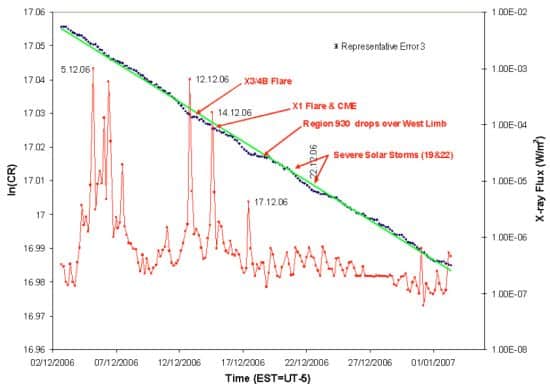
The Purdue researchers were intrigued by the modulation in the BNL data, and in late 2006 began monitoring another nuclear isotope, manganese–54, for unexpected fluctuations. Initially the manganese’s decay seemed to closely follow the usual exponential law. But on 13 December Jenkins caught a story by chance on FOX News about an unusually large solar flare, prompting him and Fischbach to compare their manganese data with X-ray readings from satellites.

They discovered that a spike in X-ray flux associated with the flare roughly coincided with a dip in the manganese’s decay rate. Two days later, an X-ray spike from a second solar flare coincided with another, though very faint, dip. Then, on 17 December, a third X-ray spike accompanied yet another dip, which was more prominent (see above figure).

The Purdue researchers submitted a paper on the solar flare correlations to Physical Review Letters but it was rejected, they say, because there was no mechanism to back it up (they have since uploaded the preprint to arXiv:0808.3156). Undeterred, they began searching the literature for other records of fluctuating decay rates, and indeed this year they found another example in a 15 year-long experiment completed in 1998 at the Physikalisch–Technische Bundesanstalt (PTB) in Germany. As in the BNL experiment, the PTB experiment showed an annual modulation in a decay constant, though this time for the nuclear isotope radium–226. “We were hoping that the identification of fluctuations in other data would lend support to the idea that solar activity could influence decay rates,” explains Fischbach.

What we are showing is that decay constants are apparently not fundamental constants of nature Ephraim Fischbach, Purdue University

New physics?

Fischbach — who made a name for himself in the late 1980s by claiming the presence of a “fifth force” in addition to the four fundamental forces of nature — says he and Jenkins have had “enormous interest” from international colleagues who have jumped at the possibility of new physics. Yet many are not convinced there is anything to be excited about. “It is often difficult for an outsider — i.e. someone who has not built and run an experiment — to consider all possible systematic effects,” says Michael Smy of the University of California, Irvine. “Long-range time variations are notoriously difficult measurements vulnerable to systematic effects.”

Even if the decay-rate correlations with solar flares and the Earth–Sun distance are more than a coincidence, they raise the question of precisely what solar activity is causing the effect. In a more recent paper submitted to Physical Review Letters (preprint at arXiv:0808.3283), the Purdue researchers suggest that the radioactive nuclei are somehow affected by solar neutrinos.

The trouble with this interpretation is that neutrinos are only susceptible to the weak interaction, which governs beta decay. Although the silicon in the BNL experiment beta decays, the radium in the PTB experiment alpha decays — a process that is governed by the strong interaction. Nonetheless, Fischbach and Jenkins think radium exhibits the modulation because many of its decay products — such as lead–214 and bismuth–214 — do in fact beta-decay.

The Purdue researchers use this reasoning to explain why Peter Cooper, a physicist from Fermilab, Illinois, found no decay-rate fluctuation in an extraterrestrial version of the BNL and PTB experiments in a preprint uploaded last week (arXiv:0809.4248). Taking data from NASA’s Cassini probe, Cooper noted that the decay of the plutonium–238 thermoelectric generators on board scarcely veered from the usual exponential law as the spacecraft went as close to the Sun as Venus and as far as Saturn. But Fischbach and Jenkins point out that, considering the plutonium–238 decay chain, it would take a very long time for Cassini’s generators to build up any isotopes that beta-decay.

Long-range time variations are notoriously difficult measurements vulnerable to systematic effects Michael Smy, University of California in Irvine

‘Wild explanations’

As more scientists hear about the claimed relation of decay constants to solar activity, reactions vary from disbelief to rejection. “I don’t understand this at all, what it could possibly be,” says John Barrow of Cambridge University. “It’s a gigantic effect…It sounds as though it’s related [to solar activity], but it really can’t be.”

“If a student brought this to me I would advise them to understand their experiment before they start coming up with wild correlations of detector noise with natural phenomena picked at random,” says David Wark of Imperial College London. “You have to prove that something needs to be explained before you come up with wild explanations.”

Meanwhile, the Purdue researchers have just found yet another example of the decay-rate annual modulation — this time by a US paediatrician who was investigating the decay of plutonium–238–beryllium in 1990. “What our data are showing is that the half lives, or the decay constants, are apparently not fundamental constants of nature, but appear to be affected by solar activity,” says Fischbach. “To summarize, what we are showing is that the decay constant is not really a constant.”

Invisibility cloak for water waves

It should be possible to protect coastlines from tsunamis by making the land invisible to the incoming waves. That’s the claim of a group of physicists in France and the UK, which has built a cylindrical “invisibility cloak” that shields objects from water waves by directing those waves around the object as if it weren’t there.

Researchers have already built so-called invisibility cloaks to shield objects from electromagnetic radiation. Two years ago a group led by David Smith at Duke University in North Carolina demonstrated a how a cylinder built from artificial materials known as metamaterials can make an object almost invisible to microwaves, by steering the waves around the object as if those waves had propagated forward without interruption.

That concept has now been extended to water waves by Stefan Enoch of the University of Aix-Marseille and colleagues. Enoch’s colleague, Sebastien Guenneau of Liverpool University, explains that the mathematics behind the invisibility cloak involves a geometric transform – which takes a point, inflates it and renders anything that lies inside the resulting bubble unreachable by the waves — which holds true for water waves just as does for electromagnetic waves.

Works just like a whirlpool

The cloak built by the French-UK team is a shallow metal cylinder, measuring 10 cm across. The cylinder does not have solid walls but instead consists of a series of rods arranged in 100 identical sectors and seven concentric rings (Phys. Rev. Lett. 101 134501 ). Guenneau says that the object functions just like a whirlpool, and indeed generates the same solutions to the Navier-Stokes equations of fluid dynamics as a whirlpool does.

The liquid enters through the gaps between the rods (ie. from the side of the cylinder), swirls around the concentric rings and then enters the far side of the cylinder so as to leave the central region entirely free of liquid. The trick, says Guenneau, is to transform the waves so that they have a greater velocity along the circumference of the rings than along the radii, therefore slowing down the liquid as it approaches the centre and forcing it out the far side. “We are encouraging waves to travel in non-Euclidean space,” he says. “To travel in curved trajectories rather than straight lines.”

To demonstrate their invisibility cloak, Enoch and colleagues filled a tank with the liquid methoxynonaflourobutane and then created waves along the surface of the liquid by sending pulses of air through a tube located on one corner of the tank. They were unable to use water in their experiment because it is too viscous and would have got stuck between the tiny rods. And even then they were limited by the size of their tank to recording the reduction in diffracted waves on the near side of the cloak [see figure 3 left and right in the paper], but they say that numerical simulations prove the cloak would have reconstructed the waves on the far side as predicted if their tank had been big enough.

Protecting coastlines

Although the effects of viscosity prevented the team from demonstrating their device in water, Guenneau points out that this problem no longer holds when on larger scales such as coastlines (indeed, he says cloaks as small as a metre in diameter should demonstrate the effect). He believes that authorities could build one half of a cloak around a beach or other stretch of coastline that needs protecting from dangerous waves, in order to bend the waves around that bit of coast. He points out that this would be preferable to simply breaking the waves by building a dyke as waves’ amplitude increases when they break, leaving the beach vulnerable when the sea level rises significantly.

He does, however, concede that people building protective invisibility cloaks would need a certain amount of faith that a series of posts would protect them more effectively than a solid wall. “You have to believe in Navier-Stokes,” he adds.

The 'Magnificent Seven' of European astroparticle physics

underwater.jpg
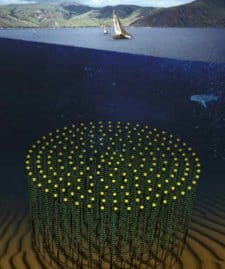
Artist’s impression of a possible KM3NeT detector configuration. (Courtesy: ASPERA).

By Hamish Johnston

In July 2007 Europe’s astroparticle physicists drew up a wish list of research projects that they would like to see funded.

Dubbed the “Magnificent Seven” by ASPERA — a consortium of national agencies that fund astroparticle physics research — the projects aim to answer the fundamental questions facing astroparticle physicists.

This wish list has been through the wringer of European consulation processes and earlier this week a final roadmap document was released. It’s a 61-page report and you can find the PDF here .

The document recommends that seven projects be supported by European funding agencies , and gives three projects “priority” status.

These three are the Cherenkov Telescope Array (CTA) for detecting of cosmic high-energy gamma rays; KM3NeT, a cubic kilometre-scale neutrino telescope in the Mediterranean Sea; and the Pierre Auger North array for the detection of charged cosmic rays.

(more…)

NMR reaches the nanoscale

Two independent teams of physicists, one in the US and the other in Germany, have measured magnetic fields on the nanoscale at room temperature for the first time. Both techniques rely on exploiting “nitrogen-vacancy” defects in diamond and can sense the magnetic signals from individual electrons and atomic nuclei placed nearby. Being able to detect such tiny magnetic fields under ambient conditions opens the way to applications in biology but also in materials science, spintronics and quantum information.

The new techniques are based on nuclear magnetic resonance (NMR) and magnetic resonance imaging (MRI) — methods routinely used to image inside the human body. NMR and MRI work by scanning the magnetic activity of billions of nuclear spins but because such a large number of spins are required, conventional NMR cannot be used to study extremely small features.

Now, Mikhail Lukin of Harvard University and colleagues and Fedor Jelezko of the University of Stuttgart and co-workers have developed a new approach that exploits a single spin associated with a special “flaw” in diamond – called a nitrogen-vacancy centre — to detect magnetic fields on the nanoscale (Nature 455 644 and Nature 455 648).

The single spin acts as a very sensitive magnetic probe that can be positioned to within a few nanometres. For example, it can be placed on the tip of a scanning probe microscope to pick up signals generated by the spin of an electron or an atomic nucleus placed nearby.

‘Feeling’the presence

The probe spin can “feel” the presence of any magnetic fields created by nearby electrons or nuclei, which cause a shift in its electron spin resonance (EPR) frequency. This shift can then be detected, for instance, by monitoring the spin resonance transition with a microwave field and tracking the change in photoluminescence of the probe spin.

Moreover, owing to the ultralong relaxation times of nitrogen-vacancy electron spins (on the order of a millisecond) in diamond, single spin MRI is possible under ambient conditions. Until now, cryogenic temperatures were needed to stabilize spins in other materials.

Together [these two results] really jump-start a new research field Mikhail Lukin, Harvard University

Lukin’s team managed to detect 3 nT magnetic fields at kilohertz frequencies using its technique. These fields are equivalent to those present about 100 nm from a single electron or 10 nm from a single proton. Meanwhile, Jelezko’s group succeeded in using such a magnetometer to obtain the first scanned images of a sample. For example, the researchers were able to locate the position of the nitrogen-vacancy centre itself with a spatial resolution of just 5 nm.

Taking MRI to the nanoscale

One important application for a nitrogen-vacancy probe is in nanoscale-resolution MRI. Indeed, MRI with single-spin sensitivity brings a tremendous improvement in spatial resolution down to the nanometre or even Angstrom level, explains Jelezko. “Hence, when a single nanocrystal containing a nitrogen-vacancy defect is attached to biomolecules, it can be used to investigate the structure of a single protein or DNA molecules,” he told physicsworld.com.

Other applications for the sensor include detecting individual electron and nuclear spins in complex biological molecules and as a “quantum magnetic head” for addressing and readout of quantum bits of information encoded in an electron or nuclear spin memory, says Harvard team member Ronald Walsworth.

The Stuttgart and Harvard results are very much complementary, adds Lukin. “Together they really jump-start a new research field.”

Copyright © 2026 by IOP Publishing Ltd and individual contributors