The Kyrenia Ship is an ancient merchant vessel that sank off the coast of Cyprus in the 3rd century BCE. Through fresh analysis, a team led by Sturt Manning at Cornell University has placed tighter constraints on the age of the shipwreck. The researchers achieved this through a combination of techniques that improve the accuracy of radiocarbon dating, and reversing wood treatments that make dating impossible.
In the late 1960s, a diving expedition off the coast of Kyrenia, Northern Cyprus, uncovered the wreck of an ancient Greek merchant ship. With over half of its hull timbers still in good condition, the wreck was remarkably well preserved, and carried an archaeological treasure trove of valuable coins and artefacts.
“Ancient shipwrecks like these are amazing time capsules, since their burial in deeper water creates a near oxygen-free environment,” Manning explains. “This means that we get a remarkable preservation of materials like organics and metals, which usually do not preserve well in archaeological contexts.”
Following the discovery, the Kyrenia ship was carefully excavated and brought to the surface, where its timbers were treated to prevent further decay. In accordance with preservation techniques at the time, this involved impregnating the wood with polyethylene glycol (PEG) – but as archaeologists attempted to determine the age of the wreck through radiocarbon dating, this approach soon created problems.
To perform radiocarbon dating, researchers need to measure the amount of carbon-14 (14C) that a sample contains. This isotope is created naturally in the atmosphere and absorbed into wood through photosynthesis, but after the tree is cut down, it gradually decays into more stable isotopes (mainly 12C and 13C). This means that researchers can accurately estimate the age of a sample by measuring the proportion of 14C it contains, compared with 12C and 13C.
However, when samples from the Kyrenia ship were treated with PEG, the wood became contaminated with far older, petroleum-derived carbon. “Initially, it was not possible to get useful radiocarbon dates on the PEG-conserved wood,” Manning explains.
Reconstructed wreck Remains of the Kyrenia Ship hull shortly after reassembly of the timbers recovered from the seabed excavation. (Courtesy: CC BY 4.0/Kyrenia Ship Excavation team)
Recent archaeological studies indicate that the Kyrenia ship had likely sunk between 294 and 290 BCE. But radiocarbon dating using the most up-to-date version of the radiocarbon “calibration curve” for this period – which accounts for how concentrations of 14C in the atmosphere vary over time – still didn’t align with the archaeological constraints.
“With the current internationally approved methods, radiocarbon dates on some of the non-PEG-treated materials, such as almonds in the cargo, gave results inconsistent with any of the archaeological assessments,” says Manning.
To address this disparity, the researchers employed a combination of approaches to improve on previous estimates of the Kyrenia ship’s true age. Part of their research involved analysing the most up-to-date calibration curve for the period when the ship sank, and comparing it with wood samples that had been dated using a different technique: analysing their distinctive patterns of tree rings.
Tree-ring patterns vary from year to year due to short-term variations in rainfall, but are broadly shared by all trees growing in the same region at a given time. Taking advantage of this, Manning’s team carried out radiocarbon dating on a number of samples that had already been dated from their tree ring patterns.
“We used known-age tree-rings from the western US and the Netherlands to redefine the atmospheric radiocarbon record in the northern hemisphere over the period between 400 and 250 BCE,” Manning explains. Variations between atmospheric concentrations of 14C differ between Earth’s hemispheres, since the northern hemisphere contains far more vegetation overall.
In addition to revising the radiocarbon calibration curve, the team also investigated new techniques for cleaning PEG from contaminated samples. They tested the techniques on samples dating from around 60 CE, which had undergone radiocarbon dating before being treated with PEG. They showed that with the appropriate sample pretreatment, they could closely reproduce these known dates.
By combining these techniques, the researchers had all the tools that they needed to constrain the age of the Kyrenia ship. “With a technique called Bayesian chronological modelling, we combined all the tree-ring information from the ship timbers, the radiocarbon dates, and the ship’s archaeological time sequence – noting how the ship’s construction must predate its last cargo and sinking,” Manning describes.
“The date for the ship is most likely between 293 and 271 BCE: confirming other recent arguments that the original late 4th century BCE date for the ship needs a little revision,” he says.
By constraining this date, Manning’s team hopes that the work could enable researchers to better understand where the Kyrenia ship and its numerous artefacts fit within the wider chronology of ancient Greece. In turn, their discoveries could ultimately help archaeologists and historians to deepen their understanding of a fascinating era in history.
The researchers report their findings in PLOS ONE.
A compact, integrated titanium:sapphire laser that needs only a simple green LED as a pump source has been created by researchers at Stanford University in the US. Their design reduces the cost and footprint of a titanium:sapphire laser by three orders of magnitude and the power consumption by two. The team believes its device represents a key step towards the democratization of a laser type that plays important roles in scientific research and industry.
Since its invention by Peter Moulton at the Massachusetts Institute of Technology in 1982, the titanium:sapphire laser has become an important research and engineering tool. This is thanks to its ability to handle high powers and emit either spectrally pure continuous wave signals or broadband, short pulses. Indeed, the laser was used to produce the first frequency combs, which play important roles in optical metrology.
Unlike numerous other types of lasers such as semiconductor lasers, titanium:sapphire lasers have proved extremely difficult to miniaturize because traditional designs require very high input power to achieve lasing. “Titanium:sapphire has the ability to output very high powers, but because of the way the laser level structure works – specifically the fluorescence has a very short lifetime – you have to pump very hard in order to see appreciable amounts of gain,” says Stanford’s Joshua Yang. Traditional titanium:sapphire lasers have to be pumped with high-powered lasers – and therefore cost in excess of $100,000.
Logic, sensing, and quantum computing
If titanium:sapphire lasers could be miniaturized and integrated into chips, potential applications would include optical logic, sensing and quantum computing. Last year, Yubo Wang and colleagues at Yale University unveiled a chip-integrated titanium:sapphire laser that utilized an indium gallium nitride pump diode coupled to a titanium:sapphire gain medium through its evanescent field. The evanescent component of the electromagnetic field does not propagate but decays exponentially with distance from the source. By reducing loss, this integrated setup reduced the lasing threshold by more than an order of magnitude. However, Jelena Vučković – the leader of the Stanford group – says that “the threshold was still relatively high because the overlap with the gain medium was not maximized”.
In the new research, Vučković’s group fabricated their laser devices by creating monocrystalline titanium:sapphire optical resonators about 40 micron across and less than 1 micron thick on a layer of sapphire using a silicon dioxide interface. The titanium:sapphire was then polished to within 0.1 micron smoothness using reactive ion etching. The resonators achieved almost perfect overlap of the pump and lasing modes, which led to much less loss and a lasing threshold 22 times lower than in any titanium:sapphire laser used previously. “All the fabrication processes are things that can be done in most traditional clean rooms and are adaptable to foundries,” says Yang – who is first author of a paper in Nature that describes the new laser.
The researchers achieved lasing with a $37 green laser diode as the pump. However, subsequent experiments described in the paper used a tabletop green laser because the team is still working to couple the cheaper laser into the system into the system effectively.
Optimization challenge
“Being able to complete the whole picture of diode to on-chip laser to systems applications is really just an optimization challenge, and of course one we’re really excited to work on,” says Yang. “But even with the low optimization we start with, it’s still able to achieve lasing.”
The researchers went on to demonstrate two things that had never been achieved before. First, they incorporated the tunability so valued in titanium:sapphire lasers into their system by using an integrated heater to modify the refractive index of the resonator, allowing it to lase in different modes. They achieved single mode lasing in a range of over 50 nm, and believe that it should be possible, with optimization, to extend this to several hundred nanometres.
They also performed a cavity quantum electrodynamics experiment with colour centres in silicon carbide using their light source: “That’s why [titanium:sapphire] lasers are so popular in quantum optics labs like ours,” says Vučković; “If people want to work with different colour centres or quantum dots, they don’t have a specific wavelength at which they work.” The use of silicon carbide is especially significant, she says, because it is becoming popular in the high-power electronics used in systems like electric cars.
Finally, they produced a titanium:sapphire laser amplifier, something that the team says has not been reported before. They injected 120 pJ pulses from a commercial titanium:sapphire laser and amplified them to 2.3 nJ over a distance of 8 mm down the waveguide. The distortion introduced by the amplifier was the lowest allowed by the laws of wave motion – something that had not been possible for any integrated amplifier at any wavelength.
Yubo Wang is impressed: “[Vučković and colleagues have] achieved several important milestones, including very low-threshold lasing, very high-power amplification and also tuneable laser integration, which are all very nice results,” he says. “At the end of the paper, they have a compelling demonstration of cavity-integrated artificial atoms using their titanium:sapphire laser.” He says he would be interested to see if the team could produce multiple devices simultaneously at wafer scale. He also believes it would be interesting to look at integration of other visible-wavelength lasers: “I’m expecting to see more results in the next few years,” he says.
All of today’s quantum computers are prone to errors. These errors may be due to imperfect hardware and control systems, or they may arise from the inherent fragility of the quantum bits, or qubits, used to perform quantum operations. But whatever their source, they are a real problem for anyone seeking to develop commercial applications for quantum computing. Although noisy, intermediate-scale quantum (NISQ) machines are valuable for scientific discovery, no-one has yet identified a commercial NISQ application that brings value beyond what is possible with classical hardware. Worse, there is no immediate theoretical argument that any such applications exist.
It might sound like a downbeat way of opening a scientific talk, but when Christopher Eichler made these comments at last week’s Quantum 2.0 conference in Rotterdam, the Netherlands, he was merely reflecting what has become accepted wisdom within the quantum computing community. According to this view, the only way forward is to develop fault-tolerant computers with built-in quantum error correction, using many flawed physical qubits to encode each perfect (or perfect-enough) logical qubit.
That isn’t going to be easy, acknowledged Eichler, a physicist at FAU Erlingen, Germany. “We do have to face a number of engineering challenges,” he told the audience. In his view, the requirements of a practical, error-corrected quantum computer include:
High-fidelity gates that are fast enough to perform logical operations in a manageable amount of time
More and better physical qubits with which to build the error-corrected logical qubits
Fast mid-circuit measurements for “syndromes”, which are the set of eigenvalues that make it possible to infer (using classical decoding algorithms) which errors have happened in the middle of a computation, rather than waiting until the end.
The good news, Eichler continued, is that several of today’s qubit platforms are already well on their way to meeting these requirements. Trapped ions offer high-fidelity, fault-tolerant qubit operations. Devices that use arrays of neutral atoms as qubits are easy to scale up. And qubits based on superconducting circuits are good at fast, repeatable error correction.
The bad news is that none of these qubit platforms ticks all of those boxes at once. This means that no out-and-out leader has emerged, though Eichler, whose own research focuses on superconducting qubits, naturally thinks they have the most promise.
In the final section of his talk, Eichler suggested a few ways of improving superconducting qubits. One possibility would be to discard the current most common type of superconducting qubit, which is known as a transmon, in favour of other options. Fluxonium qubits, for example, offer better gate fidelities, with 2-qubit gate fidelities of up to 99.9% recently demonstrated. Another alternative superconducting qubit, known as a cat qubit, exhibits lifetimes of up to 10 seconds before it loses its quantum nature. However, in Eichler’s view, it’s not clear how either of these qubits might be scaled up to multi-qubit processors.
Another promising strategy (not unique to superconducting qubits) Eichler mentioned is to convert dominant types of errors into events that involve a qubit being erased instead of changing state. This type of error should be easier (though still not trivial) to detect. And many researchers are working to develop new error correction codes that operate in a more hardware-efficient way.
Ultimately, though, the jury is still out on how to overcome the problem of error-prone qubits. “Moving forward, one should very broadly study all these platforms,” Eichler concluded. “One can only learn from one another.”
More than 13 million eye tests are carried out in the UK each year, making it one of the most common medical examinations in the country. But what if eye tests could tell us about more than just the health of the eye? What if these tests could help us spot some of humanity’s greatest healthcare challenges, including diabetes, Alzheimer’s or heart disease?
It’s said that the eye is the “window to the soul”. Just as our eyes tell us lots about the world around us, so they can tell us lots about ourselves. Researchers working in what’s known as “oculomics” are seeking ways to look at the health of the body, via the eye. In particular, they’re exploring the link between certain ocular biomarkers (changes or abnormalities in the eye) with systemic health and disease. Simply put, the aim is to unlock the valuable health data that the eye holds on the body (Chronic Disease. Ophthalmol. Ther.13 1427).
Oculomics is particularly relevant when it comes to chronic conditions, such as dementia, diabetes and cardiovascular disease. They make up most of the “burden of disease” (a factor that is calculated by looking at the sum of the mortality and morbidity of a population) and account for around 80% of deaths in industrialized nations. We can reduce how many people die or get ill from such diseases through screening programmes. Unfortunately, most diseases don’t get screened for and – even when they do – there’s limited or incomplete uptake.
Cervical-cancer screening, for example, is estimated to have saved the lives of one in 65 of all British-born women since 1950 (Lancet364 249), but nearly a third of eligible women in the UK do not attend regular cervical screening appointments. This highlights the need for new and improved screening methods that are as non-intimidating, accessible and patient-friendly as a trip to a local high-street optometrist.
Seeing the light: the physics and biology of the eye
In a biological sense, the eye is fantastically complex. It can adapt from reading this article directly in front of you to looking at stars that are light-years away. The human eye is a dynamic living tissue that can operate across six orders of brightness magnitude, from the brightest summer days to the darkest cloudy nights.
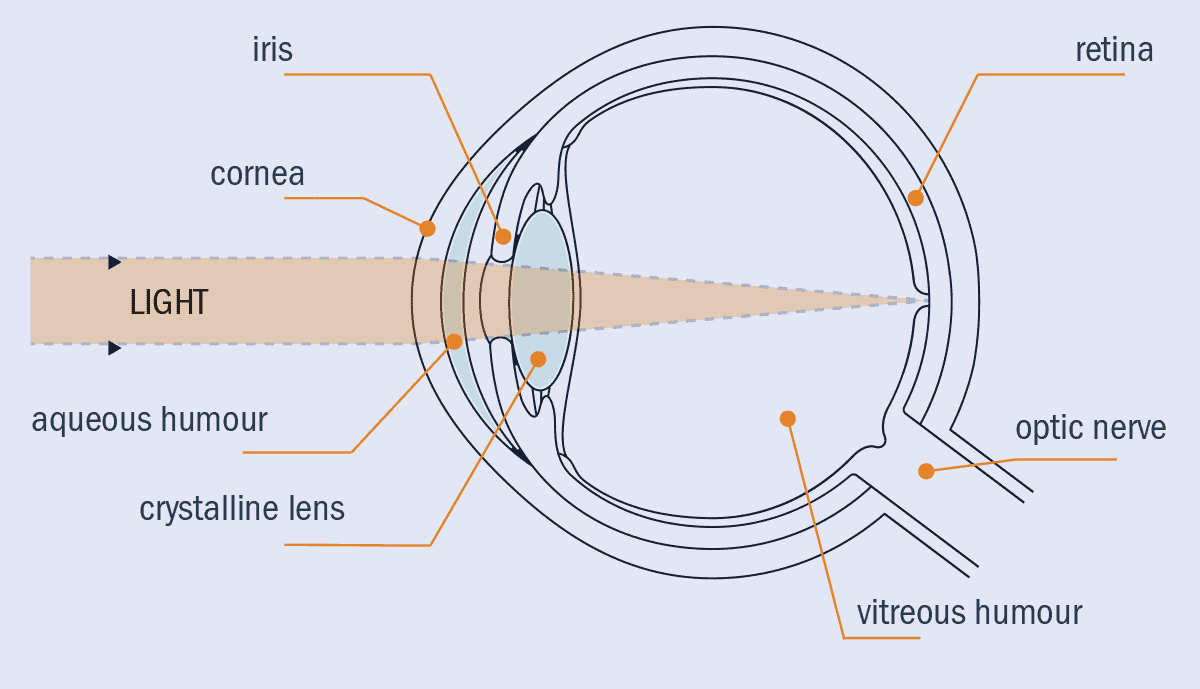
The eye has several key structures that enable this (figure 1). At the front, the cornea is the eye’s strongest optical component, refracting light as it enters the eye to form an image at the back of the eye. The iris allows the eye to adapt to different light levels, as it changes size to control how much light enters the eye. The crystalline lens provides depth-dynamic range, changing size and shape to focus on objects nearby or far away from the eye. The aqueous humour (a water-like fluid in front of the lens) and the vitreous humour (a gel-like liquid between the lens and the retina) give the eye its shape, and provide the crucial separation over which the refraction of light takes place. Finally, light reaches the retina, where the “pixels” of the eye – the photoreceptors – detect the light.
1 Look within
(Courtesy: Occuity)
The anatomy of the human eye, highlighting the key structures including the iris, cornea, the lens and the retina.
The tissues and the fluids in the eye have optical characteristics that stem from their biological properties, making optical methods ideally suited to study the eye. It’s vital, for example, that the aqueous humour is transparent – if it were opaque, our vision would be obscured by our own eyes. The aqueous humour also needs to fulfil other biological properties, such as providing nutrition to the cornea and lens.
To do all these things, our bodies produce the aqueous humour as an ultrafiltered blood plasma. This plasma contains water, amino acids, electrolytes and more, but crucially no red blood cells or opaque materials. The molecules in the aqueous humour reflect the molecules in the blood, meaning that measurements on the aqueous humour can reveal insights into blood composition. This link between optical and biological properties is true for every part of the eye, with each structure potentially revealing insights into our health.
Chronic disease insights and AI
Currently, almost all measurements we take of the eye are to discern the eye’s health only. So how can these measurements tell us about chronic diseases that affect other parts of the body? The answer lies in both the incredible properties of the eye, and data from the sheer number of eye examinations that have taken place.
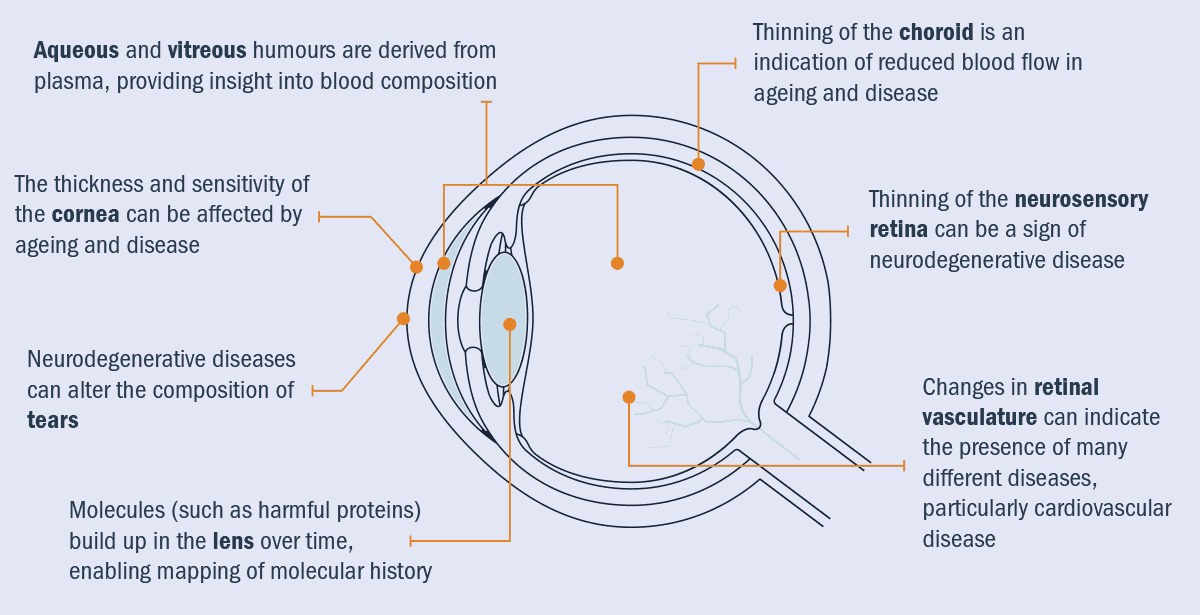
Chronic diseases can affect many different parts of the body, and the eye is no exception (figure 2). For example, cardiovascular disease can change artery and vein sizes. This is also true in the retina and choroid (a thin layer of tissue that lies between the retina and the white of the eye) – in patients with high blood pressure, veins can become dilated, offering optometrists and ophthalmologists insight into this aspect of a patient’s health.
For example, British optometrist and dispensing optician Jason Higginbotham, points out that throughout his career “Many eye examinations have yielded information about the general health of patients – and not just their vision and eye health. For example, in some patients, the way the arteries cross over veins can ‘squash’ or press on the veins, leading to a sign called ‘arterio-venous nipping’. This is a possible indicator of hypertension and hardening of the arteries.”
Higginbotham, who is also the managing editor of Myopia Focus, adds that “Occasionally, one may spot signs of blood-vessel leakage and swelling of the retinal layers, which is indicative of active diabetes. For me, a more subtle sign was finding the optic nerves of one patient appearing very pale, almost white, with them also complaining of a lack of energy, becoming ‘clumsier’ in their words and finding their vision changing, especially when in a hot bath. This turned out to be due to multiple sclerosis.”
2 Interconnected features
(Courtesy: Occuity)
Imaging the eye may reveal ocular biomarkers of systemic disease, thanks to key links between the optical and biological properties of the eye. With the emergence of oculomics, it may be possible – through a standard eye test – to detect cardiovascular diseases; cancer; neurodegenerative disease such as Alzheimer’s, dementia and Parkinson’s disease; and even metabolic diseases such as diabetes.
However, precisely because there are so many things that can affect the eye, it can be difficult to attribute changes to a specific disease. If there is something abnormal in the retina, could this be an indicator of cardiovascular disease, or could it be diabetes? Perhaps it is a by-product of smoking – how can an optometrist tell?
This is where the sheer number of measurements becomes important. The NHS has been performing eye tests for more than 60 years, giving rise to databases containing millions of images, complete with patient records about long-term health outcomes. These datasets have been fed into artificial intelligence (AI) deep-learning models to identify signatures of disease, particularly cardiovascular disease (British Journal of Ophthalmology 103 67; J Clin Med. 10.3390/jcm12010152). Models can now predict cardiovascular risk factors with accuracy that is comparable to the current state-of-the-art. Also, new image-analysis methods are under constant development, allowing further signatures of cardiovascular disease, diabetes and even dementia to be spotted in the eye.
But bias is a big issue when it comes to AI-driven oculomics. When algorithms are developed using existing databases, groups or communities with historically worse healthcare provision will be under-represented in these databases. Consequently, the algorithms may perform worse for them, which risks embedding past and present inequalities into future methods. We have to be careful not to let such biases propagate through the healthcare system – for example, by drawing on multiple databases from different countries to reduce sensitivities to country-specific bias.
So how far can oculomics go? What other diseases could be detected by analysing hundreds of thousands of images? And, more importantly, what can be detected with only one image or measurement of the eye?
Ultimately, the answer lies in matching the imaging technique to the disease. It is critical to choose the measurement technique that fits the disease. So, if we want to detect more diseases, we need more measurement techniques.
At Occuity, a UK-based medical technology company, we are developing solutions to some of humanity’s greatest health challenges through optical diagnostic technologies. Our aim is to develop pain-free, non-contact screening and monitoring of chronic health conditions, such as glaucoma, myopia, diabetes and Alzheimer’s disease (Front Aging Neurosci.13 720167). We believe that the best way that we can improve health is by developing instruments that can spot specific signatures of disease. This would allow doctors to start treatments earlier, give researchers a better understanding of the earliest stages of disease, and ultimately, help people live healthier, happier lives.
Currently, we are developing a range of instruments that target different diseases by scanning a beam of light through the different parts of the eye and measuring the light that comes back. Our first instruments measure properties such as the thickness of the cornea (needed for accurate glaucoma diagnosis); and the length of the eyeball, which is key to screening and monitoring the epidemic of myopia, which is expected to affect half of the world’s population by 2050. As we advance these technologies, we open up opportunities for new measurements to advance scientific research and clinical diagnostics.
Looking into the past
The ocular lens provides a remarkable record of our molecular history because, unlike many other ocular tissues, the cells within the lens do not get replaced as people age. This is particularly important for a family of molecules dubbed “advanced glycation end-products”, or AGEs. These molecules are waste products that build up when glucose levels are too high. While present in everybody, they occur in much higher concentrations in people with diabetes and pre-diabetes – people who have higher blood-glucose levels and are at high risk of developing diabetes, but largely without symptoms. Measurements of a person’s lens AGE concentration may therefore indicate their diabetic state.
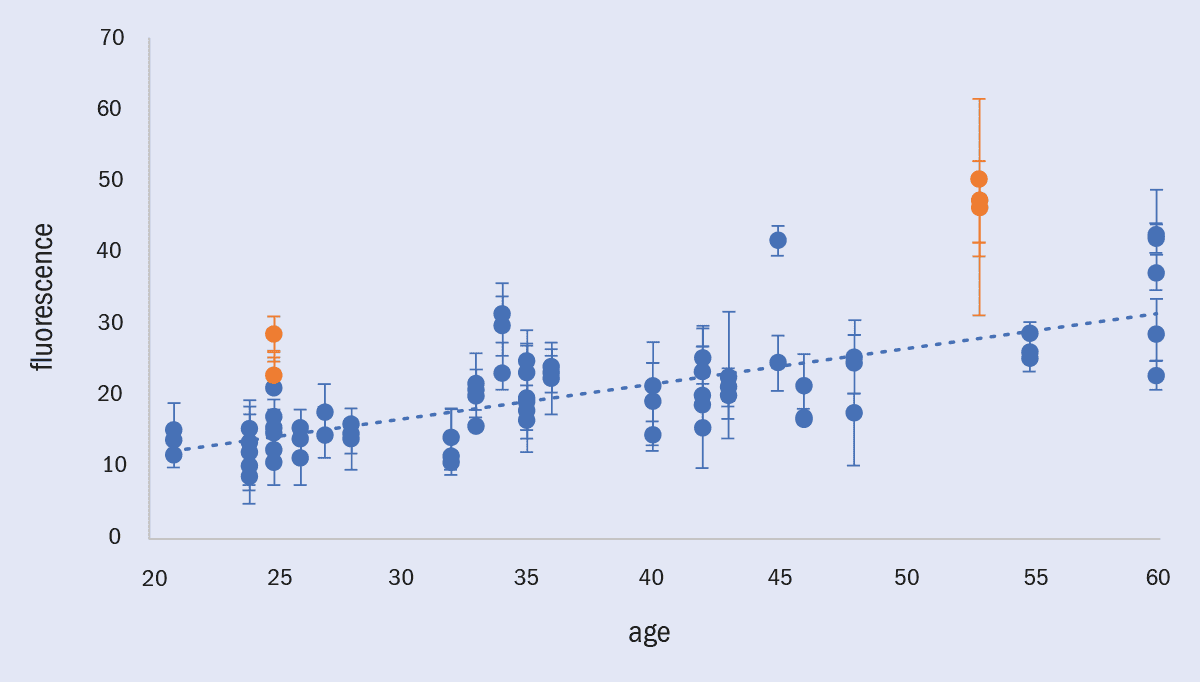
Fortunately, these AGEs have a very important optical property – they fluoresce. Fluorescence is a process where an atom or molecule absorbs light at one colour and then re-emits light at another colour – it’s why rubies glow under ultraviolet light. The lens is the perfect place to look for these AGEs, as it is very easy to shine light into the lens. Luckily, a lot of this fluorescence makes it back out of the lens, where it can be measured (figure 3).
3 AGEs and fluorescence
(Courtesy: Occuity)
Fluorescence, a measure of advanced glycation end-products (AGE) concentration, rises as people get older. However, it increases faster in diabetes as higher blood-glucose levels accelerate the formation of AGEs, potentially making lens fluorescence a powerful tool for detecting diabetes and pre-diabetes. This chart shows rising fluorescence as a function of both age and diabetic status, taken as part of an internal Occuity trial on 21 people using a prototype instrument; people with diabetes are shown by orange points and people without diabetes are shown by blue points. Error bars are the standard deviation of three measurements. These measurements are non-invasive, non-contact and take just seconds to perform.
Occuity has developed optical technologies that measure fluorescence from the lens as a potential diabetes and pre-diabetes screening tool, building on our optometry instruments. Although they are still in the early stages of development, the first results taken earlier this year are promising, with fluorescence clearly increasing with age, and strong preliminary evidence that the two people with diabetes in the dataset have higher lens fluorescence than those without diabetes. If these results are replicated in larger studies, this will show that lens-fluorescence measurement techniques are a way of screening for diabetes and pre-diabetes rapidly and non-invasively, in easily accessible locations such as high-street optometrists and pharmacists.
Such a tool would be revolutionary. Almost five million people in the UK have diabetes, including over a million with undiagnosed type 2 diabetes whose condition goes completely unmonitored. There are also over 13 million people with pre-diabetes. If they can be warned before they move from pre-diabetes to diabetes, early-stage intervention could reverse this pre-diabetic state, preventing progression to full diabetes and drastically reducing the massive impact (and cost) of the illness.
Living in the present
Typical diabetes management is invasive and unpleasant, as it requires finger pricks or implants to continuously monitor blood glucose levels. This can result in infections, as well as reduce the effectiveness of diabetes management, leading to further complications. Better, non-invasive glucose-measurement techniques could transform how patients can manage this life-long disease.
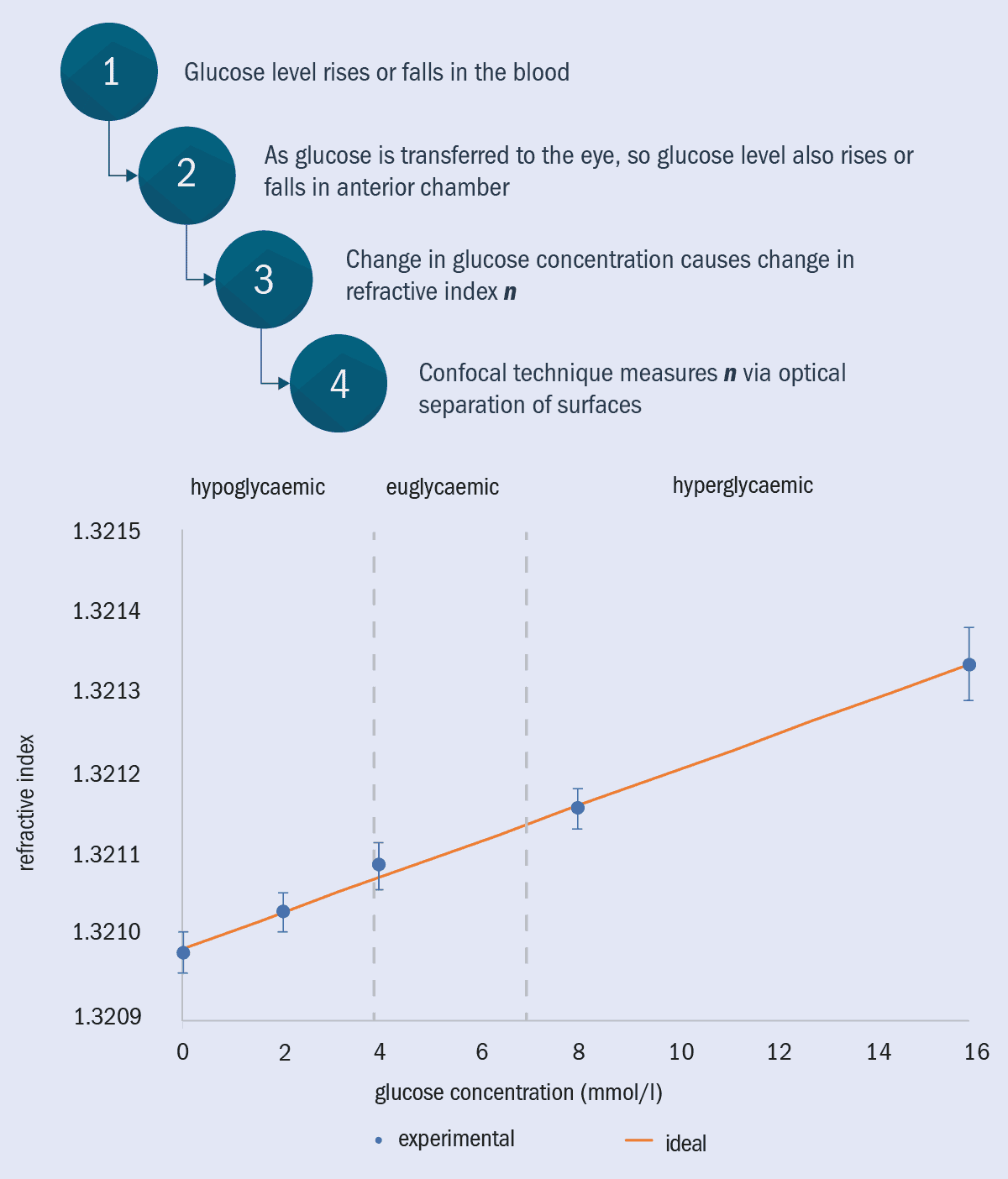
As the aqueous humour is an ultra-filtered blood plasma, its glucose concentration mimics that of the glucose concentration in blood. This glucose also has an effect on the optical properties of the eye, increasing the refractive index that gives the eye its focusing power (figure 4).
4 Measuring blood glucose level
(Courtesy: Occuity)
The relationship between blood glucose and optical measurements on the eye has been probed theoretically and experimentally at Occuity. Their goal is to create a non-invasive, non-contact measure of blood glucose concentration for diabetics. Occuity has shown that changes in glucose concentration comparable to that observed in blood has a measurable effect on refractive index in cuvettes and is moving towards equivalent measurements in the anterior chamber.
As it happens, the same techniques that we at Occuity use to measure lens and eyeball thickness can be used to measure the refractive index of the aqueous humour, which correlates with glucose concentration. Preliminary cuvette-based tests are close to being precise enough to measure glucose concentrations to the accuracy needed for diabetes management – non-invasively, without even touching the eye. This technique could transform the management of blood-glucose levels for people with diabetes, replacing the need for repetitive and painful finger pricks and implants with a simple scan of the eye.
Eye on the future
As Occuity’s instruments become widely available, the data that they generate will grow, and with AI-powered real-time data analysis, their predictive power and the range of diseases that can be detected will expand too. By making these data open-source and available to researchers, we can continuously expand the breadth of oculomics.
Oculomics has massive potential to transform disease-screening and diagnosis through a combination of AI and advanced instruments. However, there are still substantial challenges to overcome, including regulatory hurdles, issues with bias in AI, adoption into current healthcare pathways, and the cost of developing new medical instruments.
Despite these hurdles, the rewards of oculomics are too great to pass up. Opportunities such as diabetes screening and management, cardiovascular risk profiling and early detection of dementia offer massive health, social and economic benefits. Additionally, the ease with which ocular screening can take place removes major barriers to the uptake of screening.
With more than 35,000 eye exams being carried out in the UK almost every day, each one offers opportunities to catch and reverse pre-diabetes, to spot cardiovascular risk factors and propose lifestyle changes, or to identify and potentially slow the onset of neurodegenerative conditions. As oculomics grows, the window to health is getting brighter.
The increasing deployment of extensive space-based infrastructure is predicted to triple the number of objects in low-Earth orbit over the next century. But at the end of their service life, decommissioned satellites burn up as they re-enter the atmosphere, triggering chemical reactions that deplete the Earth’s ozone layer.
Through new simulations, Joseph Wang and colleagues at the University of Southern California have shown how nanoparticles created by satellite pollution can catalyse chemical reactions between ozone and chlorine. If the problem isn’t addressed, they predict that the level of ozone depletion could grow significantly in the coming decades.
From weather forecasting to navigation, satellites are a vital element of many of the systems we’ve come to depend on. As demand for these services continues to grow, swarms of small satellites are being rolled out in mega-constellations such as Starlink. As a result, low-Earth orbit is becoming increasingly cluttered with manmade objects.
Once a satellite reaches the end of its operational lifetime, international guidelines suggest that it should re-enter the atmosphere within 25 years to minimize the risk of collisions with other satellites. Yet according to Wang’s team, re-entries from a growing number of satellites are a concerning source of pollution; and one that has rarely been considered so far.
As they burn up on re-entry, satellites can lose between 51% and 95% of their mass – and much of the vaporized material they leave behind will remain in the upper atmosphere for decades.
One particularly concerning component of this pollution is aluminium, which makes up close to a third of the mass of a typical satellite. When left in the upper atmosphere, aluminium will react with the surrounding oxygen, creating nanoparticles of aluminium oxide (AlO). Although this compound isn’t reactive itself, its nanoparticles have large surface areas and excellent thermal stability, making them extremely effective at catalysing reactions between ozone and chlorine.
For this ozone–chlorine reaction to occur, chlorine-containing compounds must first be converted into reactive species – which can’t happen without a catalyst. Typically, catalysts come in the form of tiny, solid particles found in stratospheric clouds, which provide surfaces for the chlorine activation reaction to occur. But with higher concentrations of AlO nanoparticles in the upper atmosphere, the chlorine activation reaction can occur more readily – depleting the vital layer that protects Earth’s surface from damaging UV radiation.
Backwards progress
The ozone layer has gradually started to recover since the signing in 1987 of the Montreal Protocol – in which all UN member states agreed to phase out production of the substances primarily responsible for ozone depletion. With this new threat, however, Wang’s team predict that much of this progress could be reversed if the problem isn’t addressed soon.
In their study, reported in Geophysical Research Letters, the researchers assessed the potential impact of satellite-based pollution through molecular dynamics simulations, which allowed them to calculate the mass of ozone-depleting nanoparticles produced during satellite re-entry.
They discovered that a small 250 kg satellite can generate around 30 kg of AlO nanoparticles. By extrapolating this figure, they estimated that in 2022 alone, around 17 metric tons of AlO compounds were generated by satellites re-entering the atmosphere. They also found that the nanoparticles may take up to 30 years to drift down from the mesosphere into the stratospheric ozone layer, introducing a noticeable delay between satellite decommissioning and eventual ozone depletion in the stratosphere.
Extrapolating their findings further, Wang’s team then considered the potential impact of future mega-constellation projects currently being planned. Altogether, they estimate that some 360 metric tons of AlO nanoparticles could enter the upper atmosphere each year if these plans come to fruition.
Although these estimates are still highly uncertain, the researchers’ discoveries clearly highlight the severity of the threat that decommissioned satellites pose for the ozone layer. If their warning is taken seriously, they hope that new strategies and international guidelines could eventually be established to minimize the impact of these ozone-depleting nanoparticles, ensuring that the ozone layer can continue to recover in the coming decades.
Talented mind As an engineer at Rolls-Royce in Derby, UK, Catherine Phipps tests how aircraft-engine components behave in extreme conditions. (Courtesy: Catherine Phipps)
What skills do you use every day in your job?
I originally joined Rolls-Royce to use my physics skills in an engineering environment and see them applied in the real world. My plan was to work in the materials department, thinking that would align with my degree. But after completing the graduate training scheme, I chose to join the mechanical-integrity team working on demonstrator engines. A few years later, I moved to Berlin to focus on small engines for civil aerospace before returning to Derby in the UK, where I’m now a mechanical integrity engineer working on large civil engines.
A large part of my job involves understanding how materials behave in extreme conditions, such as high temperature or extreme stress. I might, for example, run simulations to see how long a new component will last or if it will corrode.
I’ll also design programmes to test how components behave when the engine runs in a particular way. The results of these tests are then fed back into the models to validate predictions and improve the simulations. Statistical analysis skills are vital too, as is the ability to make rapid judgements. Above all, I need to consider and understand any safety implications and consider what might happen if the component fails.
It’s a team role, working alongside people from numerous other disciplines such as aerodynamics, fluid mechanics and materials, and everyone brings their own skills. We need to make sure our designs are cost-effective, meet weight targets, and can be manufactured consistently and to the right standard. It’s immensely challenging work, which means I need to collaborate, communicate and – where acceptable – compromise.
What do you like least and best about your job?
Best has to be the people. It’s inspiring and motivating to work day in, day out in an international environment with talented, innovative and dedicated colleagues from varied backgrounds and with different life experiences. Sharing knowledge and coaching younger members of the team is also rewarding. Plus, seeing an aircraft take off and knowing you contributed to the engine design is an amazing feeling.
I did have a seven-year career break to have children, after which I was shocked at how much my colleagues had progressed. I felt in awe and inadequate. It was challenging to return, but everyone assured me the laws of physics hadn’t changed and I soon got back up to speed. The hardest time for me, though, was working from home during COVID-19. Meetings continued online, but I missed the chance conversations with colleagues where we’d run ideas past each other and I’d learn useful information. I felt siloed and it was hard to share knowledge. The line between work and home was blurred and it was always tempting to leave the laptop on and “just finish something” after dinner.
What do you know today you wish you knew when you were starting your career?
First, don’t think you always have to know the answer and don’t be afraid to ask questions. You won’t look stupid and you’ll learn from the responses. When you start working, it’s easy to think you should know everything, but I’m still learning and questioning all these years later. New ideas and perspectives are always valuable, so stay curious and keep wondering “Why?” and “What if?”. You may unlock something new. Second, just because you start on one route, don’t think you can’t do something different. Your career will probably span several decades so when new opportunities arise, don’t be afraid to take them.
The work examines the termination of relativistic electron beam events that occurred during experiments on JET, which was operated at the Culham Centre for Fusion Energy until earlier this year. A better understanding of such dynamics could help the successful mitigation of plasma disruptions, which lead to energy losses in the plasma. The work could also be useful for experiments that will take place on the ITER experimental fusion tokamak, which is currently under construction in Cadarache, France.
Awarded each year, the PPCF prize aims to highlight work of the highest quality and impact published in the journal. The award was judged on originality, scientific quality and impact as well as being based on community nominations and publication metrics. The prize will be presented at the 50th European Physical Society Conference on Plasma Physics in Salamanca, Spain, on 8–12 July.
Jonathan Graves from the University of York, UK, who is PPCF editor-in-chief, calls the work is “outstanding”. “[It] explores state of the art simulations with coupled runaway electron physics, presented together with convincing comparison against disrupting JET tokamak plasmas,” he says. “The development is critically important for the safe operation of future reactor devices.”
Below, Bandaru talks to Physics World about the prize, his research and what advice he has for early-career researchers.
What does winning the 2024 PPCF Outstanding Paper Prize mean to you?
The award means a lot to me, as a recognition of the hard work that went into the research. I would like to thank my co-authors for their valuable contributions and PPCF for considering the paper.
How important is it that researchers receive recognition for their work?
Receiving recognition is encouraging for researchers and can give an extra boostand motivation in their scientific pursuits. This is more so given the nature and dynamics of contemporary research work. This new initiative from PPCF is very welcome and commendable.
What advice would you give to early-career researchers looking to pursue a career in plasma physics?
Having worked in a few different fields over the years, I can say that plasma physics is one area that entails significant complexity due to the shear range of length and timescales of the physical processes involved. This not only offers interesting and challenging problems, but also allows them to choose from a variety of problems over the course of one’s research career.
How so?
Fusion science has now reached an inflection point with enormous ongoing activity involving research labs, universities as well as start-ups all over the world. With several big and important projects underway such as ITER and the planned Spherical Tokamak for Energy Production in the UK, plasma researchers can not only make important, concrete and impactful contributions, but can also have a relatively visible long-term career path. I would say these are really exciting times to be in plasma physics.
This episode features an in-depth conversation with Shrinivas Kulkarni, who won the 2024 Shaw Prize in Astronomy “for his ground-breaking discoveries about millisecond pulsars, gamma-ray bursts, supernovae, and other variable or transient astronomical objects”. Based at Caltech in the US, he is also cited for his “leadership of the Palomar Transient Factory and its successor, the Zwicky Transient Facility, which have revolutionized our understanding of the time-variable optical sky”.
Kulkarni talks about his fascination with astronomical objects that change over time and he reveals the principles that have guided his varied and successful career. He also offers advice to students and early-career researchers about how to thrive in astronomy.
This podcast also features an interview with Scott Tremaine, who is chair of the selection committee for the 2024 Shaw Prize in Astronomy. Based at the Institute for Advanced Study in Princeton, New Jersey, he talks about Kulkarni’s many contributions to astronomy, including his work to make astronomical data more accessible to researchers not affiliated with major telescopes.
This podcast is sponsored by The Shaw Prize Foundation
Quantum technologies have enormous potential, but achieving that potential is not going to be cheap. The US, China and the EU have already invested more than $50 billion between them in quantum computing, quantum communications, quantum sensing and other areas that make up the so-called “second quantum revolution”. Other high-income countries, notably Australia, Canada and the UK, have also made significant investments. But what about the rest of the world? How can people in other countries participate in (and benefit from) this quantum revolution?
In a panel discussion at Optica’s Quantum 2.0 conference, which took place this week in Rotterdam in the Netherlands, five scientists from low- and middle-income countries took turns addressing this question. The first, Tatevik Chalyan, drew sympathetic nods from her fellow panellists and moderator Imrana Ashraf when she described herself as “part of the generation forced to leave Armenia to get an education”. Since then, she said, the Armenian government has become more supportive, building on a strong tradition of research in quantum theory. Chalyan, however, is an experimentalist, and she and many of her former classmates are still living abroad – in her case, as a postdoctoral researcher in silicon photonics at the Vrije Universiteit Brussel, Belgium.
Another panellist, Vatshal Srivastav, followed a similar path, studying at the Indian Institute of Technology (IIT) in Kanpur before moving to the UK’s Heriot-Watt University to do his PhD and postdoc on higher-dimensional quantum circuits. He, too, thinks things are improving back home, with the quality of research in the IIT network becoming high enough that many of his friends chose to remain there. Countries that want to improve their research base, he said, should find ways to “keep good people within your system”.
For panellist Taofiq Paraiso, who says he was “brought up in several African countries” before moving to EPFL in Switzerland for his master’s and PhD, the starting point is simple. “It’s about transferring skills and knowledge,” said Paraiso, who now leads a team developing chip-based hardware for quantum cryptography at Toshiba Europe’s Cambridge Research Laboratory in the UK. People who return to their home countries after being educated abroad have an important role to play in that, he added.
Returning is not always easy, though. The remaining two panellists, Roger Alfredo Kögler and Rodrigo Benevides, are both from Brazil, and Kögler, who did his PhD in Brazil’s Instituto Nacional de Ciência e Tecnologia de Informação Quântica, said that Brazilians who want to become professors in their home country are strongly urged to go abroad for their postdoctoral research. But now that he has seen the resources available to him as a postdoc in nano-optics at the Humboldt University of Berlin, Germany, Kögler admitted that he is “rethinking whether I want to go back” even though he worries that staying in Europe would make him “part of the problem”.
It’s much easier to freely have ideas if you have a lot of money
Rodrigo Benevides
Benevides, whose PhD was split between Brazil’s University of Campinas and the Netherlands’ TU Delft, elaborated on the reasons for this dilemma. In Brazil, he and his colleagues “used to see all these papers in Nature or Science” while they were “in the lab just trying to make our laser work”. That kind of atmosphere, he said, “leads to a lack of self-confidence” because people begin to suspect that they, and not the system, are the problem. Now, as a postdoc working on hybrid quantum systems at ETH Zurich in Switzerland, Benevides wryly observed that “it’s much easier to freely have ideas if you have a lot of money”.
As for how to remedy these challenges, Benevides argued that the solutions will be diverse and tailored to local circumstances. As an example, Paraiso highlighted the work of an outreach organization, Photonics Ghana, that motivates students to engage with quantum science. He also suggested that cloud-based quantum computing and freely available software packages such as IBM’s Qiskit will help organizations that lack the resources to build a quantum computer of their own. Chalyan, for her part, pointed out that a lack of resources sometimes has a silver lining. Coming up with creative work-arounds, she said, “is what we are famous for [as] people from developing countries”.
Finally, several panellists emphasized the need to focus on quantum technologies that will make a difference locally. Though Kögler warned that it is hard to predict what will turn out to be “useful”, a few answers are already emerging. “Maybe we don’t need quantum error correction, but we do need a quantum sensor that brings better agriculture,” Benevides suggested. Paraiso noted that information security is important in African countries as well as European ones, and added that quantum key distribution is one of the more mature quantum technologies. Whatever the specifics, though, Srivastav recommended identifying the problems your society is facing and figuring out how they overlap with your current research. “As scientists, it is our job to make things better,” he concluded.
For the first time, two researchers in the US have observed the intricate folding and unfolding of “cellular origami”. Through detailed observations, Eliott Flaum and Manu Prakash at Stanford University discovered helical pleats in the membrane of a single-celled protist, which enable the organism to reversibly extend to over 30 times its own body length. The duo now hopes that the mechanism could inspire a new generation of advanced micro-robots.
A key principle in biology is that a species’ ability to survive is intrinsically linked with the physical structure of its body. One group of organisms where this link is still poorly understood are protists: single-celled organisms that have evolved to thrive in almost every ecological niche on the planet.
Although this extreme adaptability is known to stem from the staggering variety of shapes, sizes and structures found in protist cells, researchers are still uncertain as to how these structures have contributed to their evolutionary success.
In their study, reported in Science, Flaum and Prakash investigated a particularly striking feature found in a protist named Lacrymaria olor. Measuring 40 µm in length, this shapeshifting organism hunts its prey by launching a neck-like like feeding apparatus up to 1200 µm in less than 30 s. Afterwards, the protrusion retracts just as quickly: an action that can be repeated over 20,000 times throughout the cell’s lifetime.
Through a combination of high-resolution fluorescence and electron microscopy techniques, the duo found that this extension occurs through the folding and unfolding of an intricate helical structure in L. olor’s cytoskeleton membrane. These folds occur along bands of microtubule filaments embedded in the membrane, which group together to form accordion-like pleats.
Altogether, Flaum and Prakash found 15 of these pleats in L. olor’s membrane, which wrap around the cell in elegant helical ribs. The structure closely resembles “curved crease origami”, a subset of traditional origami in which folds follow complex curved paths instead of straight ones.
“When you store pleats on the helical angle in this way, you can store an infinite amount of material,” says Flaum in a press statement. “Biology has figured this out.”
“It is incredibly complex behaviour,” adds Prakash. “This is the first example of cellular origami. We’re thinking of calling it lacrygami.”
Perfection in projection
A further striking feature of L. olor’s folding mechanism is that the transition between its folded and unfolded states can happen thousands of times without making a single error: a feat that would be incredibly difficult to reproduce in any manmade mechanism with a similar level of intricacy.
To explore the transition in more detail, Flaum and Prakash investigated points of concentrated stress within the cell’s cytoskeleton. Named “topological singularities”, the positions of these points are intrinsically linked to the membrane’s helical geometry.
The duo discovered that L. olor’s transition is controlled by two types of singularity. The first of these is called a d-cone: a point where the cell’s surface develops a sharp, conical point due to the membrane bending and folding without stretching. Crucially, a d-cone can travel across the membrane in a neat line, and then return to its original position along the exact same path as the membrane folds and unfolds.
The second type of topological singularity is called a twist singularity, and occurs in the membrane’s microtubule filaments through their rotational deformation. Just like the d-cone, this singularity will travel along the filaments, then return to its original position as the cell folds and unfolds.
As Prakash explains, both singularities are key to understanding how L. olor’s transition is so consistent. “L. olor is bound by its geometry to fold and unfold in this particular way,” he says. “It unfolds and folds at this singularity every time, acting as a controller. This is the first time a geometric controller of behaviour has been described in a living cell.”
The researchers hope that their remarkable discovery could provide new inspiration for our own technology. By replicating L. olor’s cellular origami, it may be possible to design micro-scale machines whose movements are encoded into patterns of pleats and folds in their artificial membranes. If achieved, such structures could be suitable for a diverse range of applications: from miniature surgical robots to deployable habitats in space.