Tech phoenix: how electric-vehicle manufacturer Nikola Corporation is rising from the ashes

Nikola Corporation is a US electric-vehicle company that once – briefly – had a market capitalization even greater than that of Ford. It was founded in 2014 by Trevor Milton, who served as chief executive and then executive chairperson when the company went public in 2020. In December 2023, however, Milton was jailed for four years after being found guilty on three counts of criminal fraud for lying about “nearly all aspects of the business”, as US federal investigators put it.

Milton’s firm had also been slammed for excessive hype and fake promotional videos – one of which showed its prototype hydrogen-powered lorry rolling downhill rather than moving under its own power. Given the scandal and the jailing of the owner, you might think it would be impossible for Nikola to survive. However, the company is bouncing back.

With new management in place, Nikola is now on a genuine path to produce trucks powered by electric batteries and hydrogen fuel cells. In May the California-based logistics company Ailo placed an order for 100 of Nikola’s hydrogen fuel-cell electric trucks. Deliveries are scheduled for 2025, marking a remarkable phoenix-like transformation for Nikola.

It’s a fascinating story with one overarching theme: if there is a strong enough demand for a company’s products, investors will continue to invest despite any hurdles standing in the way. Of course, all hi-tech businesses have their ups and downs. But Milton hid the firm’s fraudulent activities – first when it was a private company with large and seemingly distant investors and then when it was publicly listed, where it was easier to keep things secret.

How it all began

Milton, now 42, founded Nikola in Salt Lake City in 2015, naming it in honour of the scientist and inventor Nikola Tesla. The choice was obviously a nod to the already well established electric-car company Tesla – nothing wrong with a bit of imitation of course. Milton himself had already been a successful entrepreneur, previously starting, running and exiting several companies.

Milton was good at articulating his vision and raising capital for Nikola. In 2015 Worthington Industries – a company that Milton had sold a previous gas-storage business to – invested $2m in Nikola. Worthington had its own high-pressure gas-storage products and presumably wanted to be involved in a new market for storing hydrogen.

Then, between 2016 and 2020, Nikola Motors presented several vehicle concepts. The most notable of these was Nikola One – a heavy-goods vehicle with an electric motor running on a gas-powered generator. The company boasted of it having a large battery and a regenerative braking system and claimed the truck could go for almost 1200 miles on a single gas fill up.

The marketing was fantastic, with amazing renders, great press reviews and bold claims that the vehicle had half the fuel costs of a diesel truck. It all looked very convincing – there were even online “payback calculators” where customers could work out when they’d start saving money compared to buying a conventional vehicle.

In June 2016 – six months before the vehicle was due to hit the market – Nikola said it had received more than 7000 pre-launch reservations worth $2.3bn in just a single month. The company claimed to be 10–15 years ahead of its competitors – not bad for a business that was then just two years old. It all looked too good to be true.

Of course, all start-ups need to market themselves and their products by drawing up concepts, visions and technology roadmaps. Yes, you’ll need to sprinkle a bit of fairy dust, but you have to be crystal clear to investors and customers about what’s required to develop the technology or product prototypes. You’ll also have to be sure how much money from investors you’ll need.

As anyone who’s worked in a product or engineering environment will probably know, things are usually more complex and take longer to achieve than envisaged. So that’s the challenge for people of integrity: how do you manage those conflicting aims with investors, customers and staff? Because if you don’t have strong grip on what’s going on, at some point reality and hype collide. And when that happens, there’s only one winner.

Rolling forwards

By August 2016 the Nikola One concept vehicle had morphed from being gas-powered to running on a hydrogen fuel cell. In November of that year, the firm claimed pre-orders had risen to over $3bn, while at a launch event the following month, Nikola said it would start shipping its first trucks within three or four years. It also claimed three further vehicle concepts were in the works.

At that December 2016 launch event, Milton stressed that the Nikola One was “not a pusher” but “a fully working prototype”. It seemed an odd thing for him to say several times especially as many onlookers spotted an electrical cable under the stage, emerging next to the vehicle’s rear wheel. But Milton’s showmanship and charisma wowed the crowd and the company rolled forward.

Nikola even said it had earmarked locations for more than 350 US-wide hydrogen filling stations, which would start being built in 2019. It also agreed to give free hydrogen fuel for the first million miles driven by Nikola customers. Overall, Milton raised several hundreds of millions of dollars of investment from private backers as well as a $1.7m grant from the US Department of Energy.

Milton seemed to be living the life of a successful and visionary chief executive. He bought a 2670-acre ranch in Utah for $32.5m – a record-breaking amount for the state – and acquired 389 acres of land in Arizona for a factory. He even launched a law suit against Tesla, in which he sought $2bn in damages after alleging that the Tesla Semi lorry had infringed six design patents. (Tesla said the claims were baseless and the case was dropped in 2022.)

Milton also oversaw the design of new models, notably the Badger fuel-cell pickup truck. When it was unveiled in February 2020, the company said it had a range of 900 km and could go from zero to 60 miles per hour in under three seconds. Nikola even said the fuel cell could produce drinking water. The renders and design were excellent and in June 2020, the firm claimed it had already received $10bn worth of pre-launch orders.

In the same month, Nikola Motors merged with VectoIQ Acquisition Corporation – a publicly traded special-purpose acquisition company (SPAC) – to form Nikola Corporation, listed on the NASDAQ stock exchange. Three months later, it announced a $2bn deal that gave the US car giant GM an 11% stake in Nikola to supply battery and fuel cell technologies as well as produce the Badger.

Downward spiral

It was then that things started going wrong. On 10 September 2020, financial investigators Hindenburg Research published a report called Nikola: How to Parlay An Ocean of Lies Into a Partnership With the Largest Auto OEM in America. It claimed, among other things, that Milton had made false statements over the course of a decade to create a $20bn public company and make himself rich way ahead of delivering on promises to shareholders. It was also Hindenburg that said the Nikola One video was a fake.

Days later, GM pulled out of the deal, scaling back its involvement. BP backed away from a partnership to develop hydrogen fuelling stations, Milton resigned as executive chairperson, and the company’s share price collapsed. The Department of Justice investigated and Milton was charged and later found guilty in October 2022. Milton was fined $1m and sentenced to four years in jail.

Prosecutors had urged the judge to sentence Milton to 11 years in prison to mirror that handed to Theranos founder Elizabeth Holmes who was similarly found guilty of defrauding investors in her blood testing start-up. Milton, however, asked the judge to be sentenced only to probation, claiming he was “not a very seasoned CEO”.

Defence lawyer Marc Mukasey said Milton’s communications were driven not by greed but by his “true belief” in the company, with Bloomberg News reporting Mukasey as saying: “It was not a nefarious attempt to take advantage of people.” Milton himself tried to paint his actions as heroic. “I obviously feel awful for all the resources and time this has caused everybody,” he told the court. “I don’t think you can feel human without feeling terrible for everyone involved. My intent was not to harm others.”

Speaking personally, I have limited sympathy for someone who obviously made this much stuff up.

Rising force

The aftermath of Milton’s jailing took its toll on the company. It is now on its third chief executive after Milton, the current boss being Stephen Girsky, who led the SPAC. In October 2023 Nikola won $165m from Milton – enough to cover the $125m fine the company received from the Securities and Exchange Commission. In March this year, Nikola then sued Milton and is after more as Milton still has about 20% of the shares of the company.

However, the company from Phoenix – seemingly like its namesake – is rising from the ashes. It is now delivering hydrogen fuel cell trucks to customers and has recently begun opening its commercial hydrogen fuel stations. It’s an amazing and inspirational turn around, all things considered. Although it’s still its early days in the electrification of transport. Nikola, with its 900 employees, is a company to watch.
Nanostring sensor loses ‘almost no energy’ while vibrating

A new “nanostring” has the highest quality factor ever recorded for a room-temperature mechanical resonator, vibrating for unprecedented periods of time while dissipating hardly any energy. The device, which measures centimetres in length but just nanometres in diameter, could be used to detect ultra-small forces such as gravity.

Nanomechanical resonators are tiny vibrating beams that oscillate at very high resonant frequencies – often in the megahertz or gigahertz range. They are employed in wireless communication for signal processing, and in basic research for detecting and determining the mass of tiny objects such as single DNA molecules or viruses. The latter application works on the principle that whenever a small particle is absorbed onto the beam, the frequency at which the beam vibrates will change in a way that can be monitored and used to calculate the particle’s mass.

Long, thin resonators are more sensitive than resonators with a lower aspect ratio, but they are hard to fabricate. In the latest work, a team led by Richard Norte of TU Delft in the Netherlands, together with Miguel Bessa of Brown University, US, overcame this challenge by using machine learning to design the resonator and advanced nanofabrication processes to make it. The resulting “nanostrings” are three centimetres in length but just 70 nm thick – “equivalent to suspending a freely-standing 1 mm thick guitar string made from a ceramic material over half a kilometre with almost no sag,” Norte says. “Such a structure would be impossible to produce at our everyday macroscales.”

The new vibrating sensor can register some of the smallest forces in science, at levels of sensitivity that have only previously been possible at temperatures near absolute zero, Norte adds. This sensitivity stems from the device’s extremely high quality factor (Qm), which at kilohertz frequencies can be up to 10 billion – meaning that the nanostring can vibrate 100 000 times per second while losing very little energy.

Unprecedented levels of sensitivity

To make the sensor, the researchers chose a high-stress material, silicon nitride (Si3N4), that is commonly used in resonators. An algorithm known as multi-fidelity Bayesian optimization helped them find a good design quickly and efficiently, having first specified that the algorithm should consider devices made from a slab of Si3N4 tens of nanometres thick, freely suspended over a length of several centimetres and placed on a microchip of silicon.

The algorithm suggested a resonator with a length of 3 cm and aspect ratios greater than 4.3 x 10⁵. To make a device according to this exacting specification, the researchers deposited the Si3N4 on 2-mm silicon wafers manufactured with low-pressure chemical vapour deposition (LPCVD). They then used electron beam lithography or photolithography to pattern a “scaffolding” layer that they subsequently removed using chemical etching. This last step produces a string that has not been subjected to any additional forces during manufacturing, which could otherwise lead it to collapse or fracture, Norte says.

Record-breaking quality factor

To characterize the device, the team set it vibrating with piezoelectric stages and used an optical interferometer to measure the time it took for the vibrations to stop. These “ringdown” measurements provide information about how fast the resonator’s amplitude decays, and thus the rate at which it dissipates energy – values that are then used to calculate Qm. For a 3-cm-long Si3N4 string, they achieved a Qm exceeding 6.5 × 10⁹ at room temperature, which is the highest value ever recorded for a mechanically clamped resonator of this kind.

Writing in Nature Communications, the researchers report that almost no energy is lost to the exterior of the microchip-based resonator. This is because vibrations get trapped in the middle of the string, they say. “It also means that noise from our hot, everyday environment cannot enter the centre of the string either, so shielding it and allowing it to sense even the smallest forces,” Norte explains. “It is somewhat like a swing that, once pushed, keeps swinging for almost 100 years because it loses almost no energy through the ropes.”

The researchers would now like to make more complex structures such as membranes or drumheads. They are also studying ways of using high-aspect-ratio nanotechnology to make ultra-thin lenses and mirrors. “These have applications in imaging, sensing and even ambitious space missions like Breakthrough Starshot that aim to send reflective sails into interstellar space,” says Norte. “We think this is really just the beginning of new playground that mixes nanotechnology and machine learning.”

Equal1 wins IOP’s qBIG Prize for quantum innovation

Equal1, which makes a hybrid quantum-classical computing chip, has won the 2024 quantum Business Innovation and Growth (qBIG) Prize. Awarded by the Institute of Physics, the annual prize is given to a small or medium-sized company in the UK or Ireland that is focusing on the commercialization of quantum technology products or solutions.

Equal1 receives a £10,000 cash prize along with 10 months of mentoring from the UK-based venture capital firm Quantum Exponential – which sponsors the award. The company will also have access to the IOP Accelerator office space and business network in central London.

The award was given to Equal1 “for the development of a compact and energy-efficient silicon-based quantum computer designed for seamless integration into data centre infrastructure”.

Based in Dublin, Equal1 is developing rack-mountable quantum computers that are powered by its UnityQ device. This is a quantum system-on-a-chip (QSoC) that integrates quantum and classical components onto a single silicon chip using commercial fabrication processes. The company says that its approach will enable the development of quantum computers that are very compact in size.

Stimulate support

The award was presented yesterday in London at Economist Impact’s Commercialising Quantum Global conference. Accepting the prize on behalf of the company, Equal1’s CEO Jason Lynch said, “Winning the qBIG prize marks a significant milestone for Equal1, affirming our forward-thinking approach to quantum computing.” He added, “We believe that this recognition will stimulate increased industrial and governmental support as well as expedite our market readiness.”

Two runners-up for the award were also announced at the conference by Louis Barson, who is the IOP’s director of science, innovation and skills.

One is Leeds-based NIQS Tech, which was cited for “the development and commercialization of a revolutionary non-invasive, accurate glucose sensor which will support better diabetes management practices and reduce the impact of diabetes on individuals and healthcare providers”.

The other runner-up is Aquark Technologies, which is based near Southampton and was cited for “innovative contributions to quantum technology notably for their development of an advanced, accessible and robust cold matter platform based on the world’s first Supermolasses trap”.

“Today marks a momentous occasion as we celebrate the remarkable achievements of Equal1 and all the participants of the IOP qBIG Prize. Their dedication and innovation are integral to driving progress in the UK and Ireland’s economy and technology sector,” said Barson.

A love of triangles, the physics of spin, volcanic science and Pascal’s papers: micro reviews of the best recent books

Love Triangle: the Life-changing Magic of Trigonometry
By Matt Parker

Comedian and science author Matt Parker is on a mission to elevate the reputation of the humble triangle. Despite dealing with what might be familiar concepts, Love Triangle shows that geometry and trigonometry can pop up in exciting and unexpected places. From cosmology to skateboarding, Parker argues that triangles underpin both the epic and the everyday. The book, which is funny and accessible, would also be suitable for keen teenage readers. Katherine Skipper

  • 2024 Penguin Random house

The Science of Spin: the Force Behind Everything – From Falling Cats to Jet Engines
By Roland Ennos

We’ve all had fun with spinning tops, pushed each other on playground swings or relied on washing machines rotating at high speeds to wring dry our wet clothes. In The Science of Spin, University of Hull visiting professor Roland Ennos examines the myriad ways spin affects our lives. From the movement of cricket balls to the shielding of the Earth’s atmosphere and even black holes, this delightful and easy-to-follow book won’t leave your head spinning. Matin Durrani

  • 2023 Oneworld

Adventures in Volcanoland: What Volcanoes Tell Us About the World and Ourselves
By Tamsin Mather

University of Oxford earth scientist Tamsin Mather explains the science of volcanoes through her fascination and career with them in Adventures in Volcanoland. She describes visits to volcanoes large and small, and traces how we humans have understood (or failed to understand) what volcanoes are since ancient times. From gods and fire to radioactivity and tectonics, and from her current research on volcanic gases to future possibilities such as harnessing their power as a renewable energy source, this is an accessible and enjoyable read. Kate Gardner

  • 2024 Abacus Books

A Summer With Pascal 
By Antoine Compagnon
Translated by Catherine Porter

Based on a radio series on France Inter, in A Summer With Pascal literary critic Antoine Compagnon analyses Blaise Pascal’s major philosophical and theological works Pensées and Lettres Provinciales. Short chapters cover topics including “the art of persuasion”, predestination and uncertainty. References to Pascal’s scientific and mathematical work are few, but this close analysis may still be of interest to Physics World readers who want to know more about the 17th-century polymath. Kate Gardner

  • First published in French 2020 by Éditions des Équateurs
  • 2024 Harvard University Press

Silverstone racetrack hosts Institute of Physics summer festival

The 2024 summer festival of the Institute of Physics (IOP), which publishes Physics World, took place on 5 June at Silverstone racetrack, the home of the British Grand Prix and MotoGP.

Entitled “A celebration of physics: on the road to a sustainable world”, the event was held to celebrate the achievements of the IOP’s 2023 award winners and to recognize the work of the IOP’s members.

The day was opened by IOP chief executive Tom Grinyer, who discussed the IOP’s new five-year strategy and outlined its efforts to get science on the agenda during the UK’s general-election campaign.

Over 150 local school children heard University of Surrey physicist Elizabeth Cunningham, the IOP’s vice-president for membership, speak about the many career opportunities on offer for physicists.

Current IOP president Keith Burnett handed out medals and prizes to more than 40 of the 2023 award winners before speaking about his career, the IOP’s new strategy, and its new Physics Inclusion Award.

Mark Richards, a new honorary fellow of the IOP, spoke about his research career as a spectroscopist and his efforts as a Black physicist to improve diversity in physics.

Laura Tobin from ITV’s Good Morning Britain, who studied physics and meteorology, talked about her career as a TV weather broadcaster and her book Everyday Ways to Save the Planet, which offers practical ways to deal with climate change.

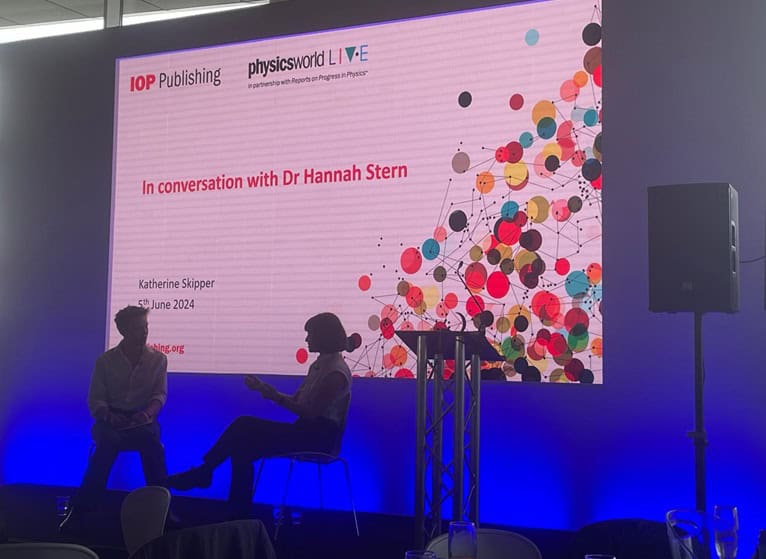
Katherine Skipper talking to Hannah Stern at the IOP Summer Festival

Liv Davies from IOP Publishing spoke about the impact of AI on research integrity, while Physics World features editor Katherine Skipper interviewed Hannah Stern, who won the Henry Moseley medal and prize for her work on novel magneto-optic materials.

There were also talks from James Davies from the UK Atomic Energy Authority about fusion; James Binney (winner of the Isaac Newton Medal) about his studies of galaxies; and David Homfray, chief technology officer at Space Solar, which wants to beam sunlight to Earth to generate electricity.

Science writer Kit Chapman, author of the book Racing Green: How Motorsport Science Can Save the World, discussed how technology from racing can make the world cleaner and safer.

Alongside the main stage was an exhibition of companies and organizations ranging from British Airways to Quantum Gas Lasers, while delegates were able to enjoy a Formula 1 VR simulator and sitting in a replica of 1989 Batmobile.

Among the many people I personally bumped into were Clare Harvey, chief executive of the Ogden Trust, which promotes the teaching and learning of physics, and Hugh Deighton, chair of the IOP’s history of physics group, which has some seriously in-depth newsletters on offer. Sadly, Hollywood’s Brad Pitt, who happened to be filming his new movie at Silverstone, was unavailable.

Teaching nuclear physics using data rather than models, recovering helium from party balloons

What is the best way to teach nuclear physics? Is the discipline more difficult than particle physics? What does a nuclear physicist make of the film Oppenheimer? These are just three of the questions addressed by David Jenkins in this episode of the Physics World Weekly podcast. A nuclear physicist and author based at the UK’s University of York, Jenkins is in conversation with Physics World’s Matin Durrani.

Also featured in this episode is Dale Keeping, who is helium recovery manager at the UK’s ISIS Neutron and Muon Source. He explains how helium is used at the facility; where the helium supply comes from; and how he and his colleagues manage this non-renewable resource. Keeping also chats about an outreach initiative that involves collecting used party balloons so the helium can be re-used at ISIS.

Climate physicist Claudia Sheinbaum Pardo elected Mexican president in landslide win

The physicist Claudia Sheinbaum Pardo has been elected president of Mexico following a landslide victory on 2 June. She gained more than twice as many votes as her nearest opponent, the computer engineer Xóchitl Gálvez Ruiz. When she takes up office on 1 October, Sheinbaum Pardo will become Mexico’s first female president.

Sheinbaum Pardo, 61, was born on 24 June 1962 and both of her parents were scientists. Her mother, Annie Pardo Cemo, is a biochemist while her father, Carlos Sheinbaum Yoselevitz, is a chemical engineer.

Both she and her brother, Alex, followed their parents into science and became physicists. Sheinbaum Pardo earned a physics degree from the National Autonomous University of Mexico (UNAM) in 1989 before carrying out a PhD in energy engineering at UNAM.

Her PhD research, which focused on energy consumption in Mexico and other countries, was mostly carried out at the Lawrence Berkeley National Laboratory in the US. After graduating in 1995, Sheinbaum Pardo joined UNAM’s Institute for Engineering where she worked on the transition to renewable energy sources.

From science to politics

Sheinbaum Pardo’s political activities began during her undergraduate years at UNAM. In the early 1990s she joined a protest about the university’s tuition fees and later helped set up the left-wing National Regeneration Movement (Morena) party in 2011.

When Andrés Manuel López Obrador became mayor of Mexico City in 2000, he selected Sheinbaum Pardo as environment secretary. The pair remained politically close, but when López Obrador lost the 2006 presidential election, she returned to UNAM as a researcher.

Sheinbaum Pardo co-authored sections of the United Nations Intergovernmental Panel on Climate Change (IPCC) fourth assessment report, which warned that the warming of the climate is “unequivocal”. For their work on climate change, the 2000 members of the IPCC shared half the 2007 Nobel Peace Prize with former US vice-president Al Gore.

When López Obrador finally won Mexico’s presidency in 2018, following another failed attempt in 2012, Sheinbaum was elected mayor of Mexico City by a landslide. In that role, she did a lot for the environment, including electrifying the metropolis’s bus fleet, starting  construction of a photovoltaic plant to cut emissions of carbon dioxide and boosting the conurbation’s bicycle lanes.

While López Obrador largely favoured the country’s oil industry and cut science funding during his six years in office, Sheinbaum Pardo has said that she intends to focus on renewable energy technologies and “to make Mexico a scientific and innovation power”.

Yet Mexico’s scientific community questions whether she will be able to achieve this. Some political commentators have expressed doubts that she will be able to escape the shadow of her mentor and govern in her own style.

Embracing Neurodiversity in Research: How does academic publishing need to change?

Want to learn more on this subject?


To have an accessible and inclusive environment where everyone can thrive can only be achieved if we collectively address the barriers that stand in the way.

In academia there are many challenges that often hold back neurodivergent individuals from reaching their full potential, and this has to change.

In this webinar, the expert panel will be discussing the current state of play, their experiences of working in academia or industry as a neurodivergent person, and what the needs of neurodiverse individuals are.

We’ll then focus in on academic publishing and what more publishers need to do and change in their processes. Are practices clear and easy to understand? What additional support should be provided and where? How do publishers ensure neurodivergent individuals have access to opportunities that will allow them to pursue their research careers without jeopardising their wellbeing?

Want to learn more on this subject??

Sharon Zivkovic is the founder and CEO of the social enterprise Community Capacity Builders, Adjunct Research Fellow at Torrens University Australia and member of Emerald Publishing’s Impact Advisory Board. As an autistic social entrepreneur and systems thinker, Sharon has used her innate bottom-up and associative thinking skills, and systemizing capabilities, to develop and commercialize a number of social innovations. Community Capacity Builders has recently established a Centre for Autistic Social Entrepreneurship, which aims to build the capacity of disability service providers, social enterprise support organizations, and business advisors to support autistic social entrepreneurs in a neurodiversity-affirming manner.

Angela Carradus is an academic and business owner specializing in relational and systems approaches to leading and managing business. In 2022 she reached burn out in her academic career following a diagnosis of ADHD and Long COVID. This continuing battle has enabled her to consider her rich and varied path professionally, which has included training as an actor and achieving a PhD at Lancaster University. Following her diagnosis of ADHD she has had the opportunity to consider how the current academic environment can often make it very difficult for the neurodivergent community and is now a passionate advocate to explore a new approach that can better support neurodivergent students and staff in academia.

Vicky Mountford-Brown is an assistant professor in entrepreneurship at Northumbria University and vice-president-elect for Enterprise Educators UK. Vicky’s research interests centre largely around identities, social inequalities and pedagogies, with current projects exploring imposterism and neurodiversity in academia, neurodiversity and (entrepreneurial) learning, and neurodiversity and entrepreneurship.

Kellie Forbes-Simpson is an assistant professor in entrepreneurship at Newcastle Business School, Northumbria University, and is an experienced and award-winning entrepreneurship educator. Kellie’s interest in neurodiversity comes from her programme leader role, where in some years more than 50% of the nascent entrepreneurs on her programme have identified as neurodivergent. Kellie is now researching how and why her programme seems to provide support to neurodivergent entrepreneurs. Kellie also has personal experience of neurodiversity, after a late diagnosis on dyslexia during her PhD studies.

Vicky Williams is chief executive of Emerald Publishing, a UK business founded in 1967. She has worked in academic publishing for more than 20 years, with C-suite responsibility for a range of business areas in that time – business development, M&A, marketing, digital, and HR. She has been chief executive of Emerald since 2018, and is proud to be part of a business that innovates, takes risks, responds to its communities, and really values its people. Both in and out of work, Vicky is a keen advocate for gender diversity, having launched Emerald’s Equality, Diversity and Inclusion programme in 2016, and speaks widely on this topic at global forums and events. She holds advisory board and non-executive roles in academia and publishing, and is the trustee responsible for social mobility at the Keith Howard Foundation, which supports charities across Yorkshire.

Sujeet Jaydeokar is a consultant psychiatrist and director of research at the Cheshire and Wirral Partnership NHS Foundation Trust. He, along with Mahesh Odiyoor, was instrumental in setting up the Centre for Autism, Neurodevelopmental Disorders and Intellectual Disabilities (CANDDID), for which he is also the clinical director and chair. Sujeet is a parent carer of a boy with multiple neurodevelopmental issues. His lived experience and clinical work drives his interests in research and education. He is a programme lead for the post-graduate qualifications in neurodevelopmental conditions at the University of Chester. He is a fellow of the Royal College of Psychiatrists. His particular areas of interest are in health inequalities, service development and the phenomenology of neurodevelopmental conditions.

This webinar is being made in partnership with Emerald Publishing and NEA (Neurodiversity & Entrepreneurship Association)


Simple equation predicts how quickly animals flap their wings

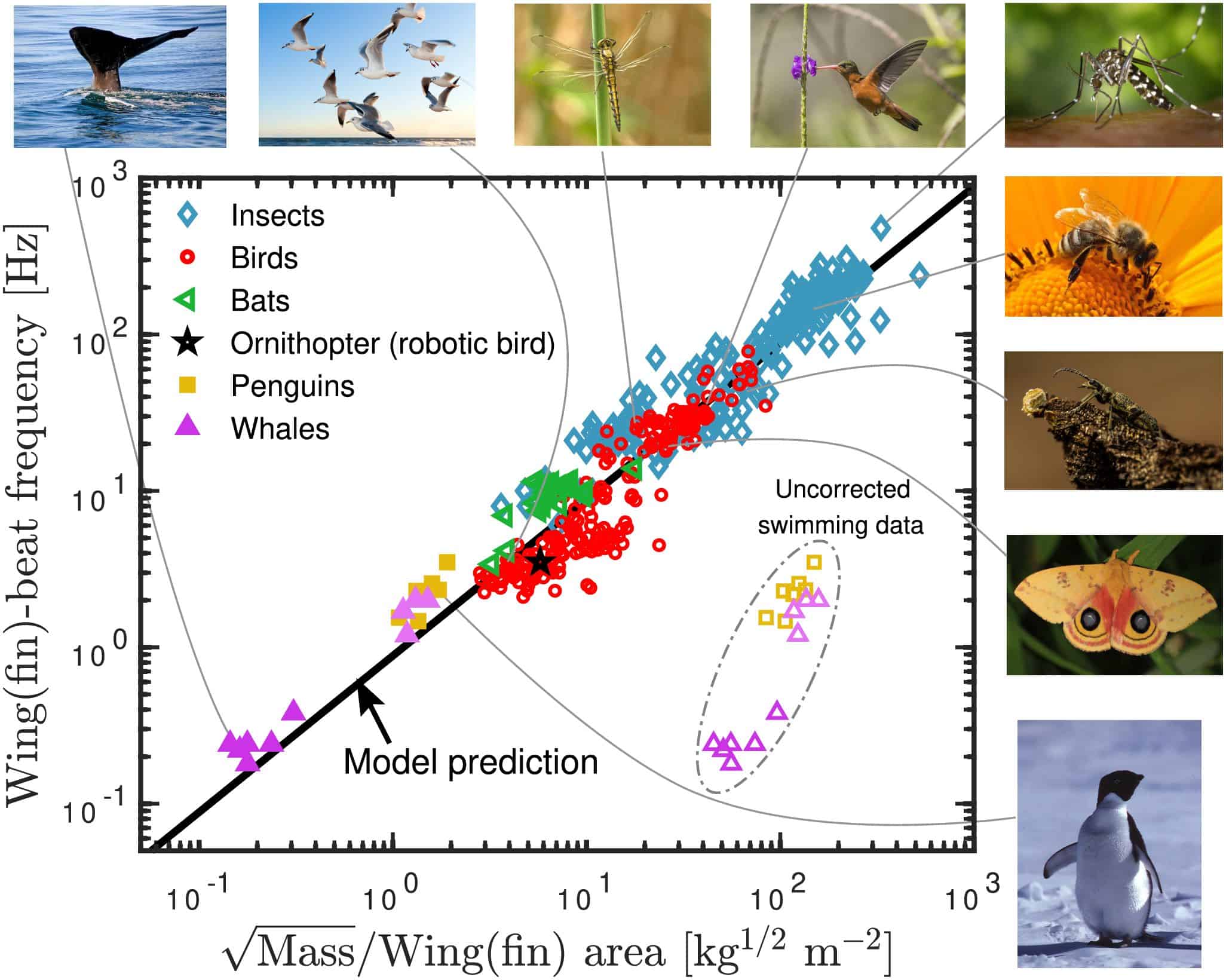
 A plot of wingbeat frequency against the square root of mass divided by wing area for many animals, including insects, birds, bats, penguins and whales, plus an orinthopter. The plot is a diagonal line with a small amount of scattered data points above and below it. Around the plot are pictures of some of the animals in the dataset.

Whales gotta swim, and birds gotta fly – and when they do, they flap their wings and fins at a rate determined by the same simple mathematical expression and coefficient of proportionality. The expression, which relates wingbeat frequency to body mass and wing area, is valid regardless of the animal’s size or flying style, and the physicists who derived it say it matches biological data on insects, bats and flapping robots as well as birds and whales.

“We were surprised to see how well the data follows the prediction and kept expanding the data set to include other flying animals to see how far this universality goes,” says study leader Tina Hecksher of Roskilde University, Denmark. “When we saw that even swimming/diving animals follow the same line, we thought that this may interest a broader audience.”

Scientists have long searched for universal patterns in animal flight. In 1990, for example, the British biologist Colin James Pennycuick related wingbeat frequency f to a bird’s body mass and wing area via the expression f = 1.08(m1/3g1/2b-1A-1/4ρ-1/3), where m is the mass, g is the acceleration due to gravity, b is the wing span, A is the wing area and ρ is the density of air. His work followed that of the Australian mathematician and educator Michael Deakin, who in 1970 derived a simpler relationship for insects. Both analyses, however, were partly based on empirical observations, and neither sought to generalize them to other flying animals.

Dimensional arguments

The latest work was inspired by an exam question that asked students to explain how quickly a bird should flap its wings if it wants to remain hovering. The course was designed to teach students to “think like physicists,” Hecksher tells Physics World, and after the exam she and her Roskilde colleagues Jens Højgaard Jensen and Jeppe Dyre began to wonder whether the formula they derived using dimensional analysis would apply to real-world flight.

On the face of it, it might seem unlikely that any simple expression could capture much about an animal flapping its wings. Writing in PLOS One, the Roskilde team acknowledge that there is “obviously a significant difference” between the flight of a dragonfly and that of a bat, so past researchers had “good reasons” for focusing on similar species. Previous studies also showed that the shapes and angles a wing assumes during flight – which can be highly complex and vary widely across species – play a role in determining flapping rate.

Shapes and angles, however, are dimensionless quantities. The Roskilde physicists therefore folded these and other unknown dimensionless functions of dimensionless quantities into a single constant of proportionality. By hypothesizing that this constant must be the same for all flying animals, and ignoring minor variations in air density and gravitational field strength, they arrived at their expression: f ~ m1/2/A.

Empirical tests

To test the validity of this expression, the Roskilde team collected 414 data points from published studies that reported wing area, mass and wingbeat frequencies of birds ranging from swans to hummingbirds; flying insects such as bees, moths, dragonflies, beetles and mosquitoes; and a flapping robot called an ornithopter. The team also included data from whales and penguins. Unlike fish, which use air-filled bladders to regulate their position in the water, these animals have a positive buoyancy, and must swim to stay submerged. The physics governing their fin- and fluke-flapping frequencies should therefore be similar to the physics of wingbeat frequencies, barring a correction factor for the different densities of air and water.

When the Roskilde physicists plotted f against m1/2/A for all the animals (plus one robot) in their dataset, the result was a straight line with only a small amount of scatter in the data points. According to the team, this means that, despite huge physical differences, flying animals must have evolved in a way that keeps the relationship between their mass, wing area and wingbeat frequency relatively constant. “We were initially surprised that the data fall on the same line,” Hecksher says. “The basic relationship follows from physics. But the constant of proportionality could in principle be different for different flying styles.”

Matt Wilkinson, who did his PhD on pterodactyl flight and is now a director of studies in natural sciences at Cambridge University, UK, was also surprised, at first, that an analysis based on hovering, rather than forward flight, is so widely applicable. “There is a highly constrained relationship between wingbeat frequency and wingspan due to the enormous drop-off in efficiency when operating the wings away from their resonant frequency, but for larger flying animals, that frequency isn’t enough to support the animal’s weight on its own – some minimum forward velocity becomes essential,” he explains.

After some reflection, however, Wilkinson, who was not involved in the Roskilde study, suspects that this size-dependent factor “must be another phenomenon buried in the proportionality coefficient”. Identifying this coefficient is, he says, the study’s most important contribution. “Unpicking that, despite the enormous differences in wing shape and flight kinematics, is where the real insights will be found,” he concludes.

As for why no-one had uncovered this simple relationship before, Hecksher cites the study’s interdisciplinary nature. “Our formula is theoretically derived based on physics principles [and it] also devises how to compare swimming/diving animals in the same plot as the flying animals,” she notes. “This approach is less common among biologists…it takes the combination of physics and a large amount of empirical data to arrive at this result.”

The art of cosmic simulations: can we build a universe on a computer?

As I write this, I’m immersed in the excitement surrounding the upcoming solar eclipse in parts of North America. In Chicago, my home, we’re poised to experience 90% of the eclipse’s totality, a spectacle that has sparked enthusiasm among my undergraduate students, especially since we will be watching it during class.

We are not, however, the first to be drawn to these remarkable astronomical events, as Romeel Davé – a theoretical astrophysicist at the University of Edinburgh in the UK – explains in Simulating the Cosmos: Why the Universe Looks the Way It Does. In third-century China, eclipses were seen as important omens by the emperor, and astronomers developed remarkably precise methods to predict them.

The stakes were high for these early theorists – inaccuracies once resulted in the execution of two astronomers, turning the refinement of their predictive techniques into a quest for survival.

In his book, Davé traces a direct link between these ancient celestial predictions and modern cosmologists who use powerful supercomputers to model the universe. He explains how “numerical cosmology” can be used to compensate for our inability to experimentally manipulate the cosmos, and asks whether it will ever be possible to capture the entire universe in a simulation.

To recreate the cosmos on a computer, we first need to know what it’s made of. Davé sets the scene by clearly explaining the so-called “concordance model”, which tells us that the universe is 68% dark energy and 27% dark matter, with visible matter making up only 5%. In this framework, dark energy drives the accelerating expansion of the universe, while the gravitational pull of dark matter assembles galaxies and galaxy clusters into large-scale structures.

The book also offers theoretical insights into the Big Bang and the rapid expansion of the early universe, woven with engaging anecdotes. While explaining why those of us on Earth don’t notice the universe expanding, Davé recounts a memorable t-shirt worn by one of his professors during graduate school, featuring a whimsical question: “If the universe is expanding, why can’t I ever find a parking space?”

With the concordance model as our guide, Davé explains how, by inputting laws of physics and the conditions of the early universe into computer simulations, we can understand how and why the universe evolved to its current state.

Even with a simplified model that includes only gravitational effects, an accurate simulation of the entire universe would require far more computing power than exists on Earth. Astronomers must therefore accept some level of inaccuracy, and Davé dedicates considerable attention to the compromises and innovations that are made to optimize these simulations. He explains, for example, how astronomers have developed sophisticated algorithms to group nearby masses together, considerably simplifying the calculation of gravitational forces.

Davé does not shy away from technical explanations, but though the book includes equations, they’re presented in a way that shouldn’t be daunting to the general reader

Armed with this toolbox of simulation techniques, Davé then discusses in detail his main area of research – galaxy formation and its simulation. Pioneering theories of galaxy formation were developed in the 1970s and 1980s, but early simulations were beset by challenges – most notably the “overcooling problem” where the simulated universe cooled too quickly, and produced far more galaxies than are observed in real life.

But Davé believes that the field is now in a “golden age”. He explains how cosmologists developed corrections to the overcooling problem by including small-scale effects like black holes and supernovae. Once believed to be isolated entities floating through space, simulations suggest that galaxies form a vast, interconnected structure called the “cosmic web”. Towards the end of the book, Davé is optimistic about the future of cosmic simulations, predicting that the advent of machine learning and artificial intelligence will bring us even closer to building a working, evolving universe on a computer.

This book will be of particular pedagogical significance to students who are interested in numerical cosmology. Davé does not shy away from technical explanations, but although the book includes equations, they’re presented in a way that shouldn’t daunt the general reader. He also uses illustrations to guide the reader through this complex topic.

The final chapter is undoubtedly bold, but I found it somewhat disjointed and abrupt. The author’s discussion of the possibility that our world is a simulated reality feels forced, while the introduction of Stephen Wolfram’s speculative “theory of everything” is insufficiently tethered to the preceding chapters. Though speculative thinking has its place, I found myself wishing for a more solid motivation for the scientific groundwork laid out in the rest of the book.

Nevertheless, these criticisms are minor in the context of the book’s broader contributions. Today, our quest to simulate the universe is driven not by the immediate threat of an emperor’s wrath, but by a deep curiosity about our place in the cosmos. While many popular science books focus exclusively on early-universe phenomena like inflation and the Big Bang, there’s a noticeable gap in literature addressing computational physics and numerical cosmology, and this book fills a crucial void.

  • 2023 Reaktion books 200pp £15.95/$22.50hb
Copyright © 2026 by IOP Publishing Ltd and individual contributors