Sunday 14 April 2024 will be the third World Quantum Day. An annual celebration “promoting public awareness and understanding of quantum science and technology around the world”, it’s a bottom-up initiative from scientists in more than 65 nations from Algeria to Zambia. The day of 14 April has been chosen because “4.14” are the first three digits of Planck’s constant when rounded up: 4.14 × 10⁻¹⁵ eVs.
The pedant in me is irked a bit by the date. Unless you live in the US, 14 April is surely 14.4 not 4.14. Plus, I’ve always known Planck’s constant as 6.63 × 10⁻³⁴ Js not 4.14 × 10⁻¹⁵ eVs. Putting that aside, World Quantum Day is a brilliant initiative. These are great times for quantum physics, with burgeoning applications of “quantum 2.0” technology such as quantum computing, sensing and cryptography.
As James McKenzie describes in his recent feature article, overall private investment in quantum tech stood at $1.2bn in 2023 according to the State of Quantum 2024 report. Sure, that figure has dropped sharply since 2022, but up to $50bn in public cash has already been ploughed into quantum science. In fact, 33 countries around the world have government initiatives in quantum technology, including 20 with full-scale national strategies.
One person with an overview of the quantum-technology landscape is Mauro Paternostro from Queens’ University Belfast, editor-in-chief of the IOP Publishing journal Quantum Science and Technology. In a wide-ranging interview to be published next week, he argues that the most advanced quantum technology is actually quantum sensing.
In fact, as Steve Brierley – chief executive of Riverlane – points out in his recent opinion article, quantum computers will only ever be properly useful once we can properly deal with error correction.
But quantum tech holds great promise, including in Africa, where “steady progress” is being made, according to Farai Mazhandu and Mhlambululi Mafu. Output from African researchers in quantum-related fields is relatively small, but with a young, digitally native population and a burgeoning quantum workforce, they believe the continent is “poised to take advantage of the coming ‘second quantum revolution’”.
If all this talk of technology is too much, check out the feature by Philip Ball, who looks at the work of “quantum plumbers”. Meanwhile, Robert P Crease, Jennifer Carter and Gino Elia examine “Wigner’s friend” – a quantum thought experiment that has stumped physicists and philosophers for more than 60 years. And why not try our quantum-physics cryptic word search and see if you can reveal the hidden message.
Finally, do check out the Physics World quantum channel as well as a special collection of quantum-themed research articles, focus issues and ebooks from IOP Publishing, which publishes Physics World.
In this short video filmed at the 2024 March Meeting of the American Physical Society in Minneapolis, Minnesota, Erkki Soininen, product director at Bluefors, introduces its newly developed gas handling system and control software.
Headquartered in Finland and with local offices in the US, Germany and Japan, Bluefors makes cryogenic measurement systems for use in quantum technology, ultralow-temperature research and other industries such as life sciences and clean energy.
As Soininen explains, the new-generation gas handling system has seen a redesign of both the hardware and software to make it safer, more reliable and easier to use. He adds how it uses the latest generation of pumps and sensors and is also more modular than previous designs – with a booster unit that can be floor- or ceiling-mounted or integrated directly into the core unit.
The system includes an option for a fully automated cool down plus a new, automated fast-sample exchange unit. It’s also been designed and tested to comply with all relevant safety and electromagnetic requirements.
Soininen points out how Bluefors recently integrated its Cryomech PT 310 pulse tube into its dilution refrigerator measurement systems to improve cooling performance. In February, it launched a new microwave read-out module with a built-in travelling wave parametric amplifier. And this spring, Bluefors launched its new Cryomech NMR single helium reliquefier, to support helium recovery for the nuclear magnetic resonance community.
This episode of the Physics World Weekly podcast features an interview with Tannie Liverpool, who uses statistical physics to explore outstanding questions in biology. Based at the UK’s University of Bristol, where he is professor of theoretical physics, Liverpool explains how complex biological behaviours can be described at a very fundamental level using statistical physics.
He chats with Physics World’s Katherine Skipper about own research into cells and tissues, including the mathematics of wound healing. Liverpool also explains how physicists, materials scientists and mathematicians working in other fields are being inspired by the statistical physics of life.
Looking further into the future, on 2 July the first instalment of Physics World Live will look at the burgeoning field of quantum sensors. This live online panel debate will feature leading experts in quantum sensors. Register here to take part and put your questions to the panellists.
Because there’s not much oxygen deep underground, the bacteria that live there have evolved other ways to get rid of the electrons they produce when they “breathe”. One of these workarounds involves sending out conductive filaments – nanowires – into the soil to disperse the electrons, but important details of this process have eluded biophysicists’ understanding.
Researchers at Yale University, US and NOVA University Lisbon in Portugal have now found that for bacteria in the genus Geobacter, a single protein family acts like a series of electrically connecting “plugs” for charging these microbial nanowires. The finding greatly simplifies the model of how these bacteria export electrons, and the team say this “minimal wiring machinery” may be common among bacterial species.
Bacteria that live in soil have two ways of donating the electrons they produce to external electron acceptors. The first involves transferring the electrons to soil minerals and is known as extracellular electron transfer (EET). The second, direct interspecies electron transfer (DIET), involves partner species. Both processes are vital for the microbes’ ability to survive and form communities, but they can be inefficient. Bacteria like Geobacter have therefore evolved to produce conductive nanowires that facilitate faster, long-range EET.
Five proteins
The protein family the Yale–NOVA team identified as key to the operation of these nanowires contains five proteins. All of them reside in the space between the bacteria’s inner and outer membrane – the bacterial periplasm – and they are known as periplasmic cytochrome ABCDE (PpcA-E). These proteins inject electrons into filaments on bacterial surfaces that act as nanowires, creating an electric connection for “metal breathing” Geobacter.
This electrical connection allows Geobacter to transfer excess electrons produced during metabolism to minerals in soil without the need for intermediaries, explains Yale’s Nikhil Malvankar, who co-led the study with Carlos Salgueiro at NOVA. In essence, the proteins act as plugs within a natural soil-based “electrical grid”. This grid may be responsible for allowing many types of microbes to survive and support life, the researchers say.
Microscopic pistons push filaments made of cytochromes
Though bacterial filaments were first observed in 2002, scientists initially thought they were made up of so-called pili proteins (“pili” means “hairs” in Latin). Many bacteria do have pili on their surface, and genetic data suggested these hairlike filaments could play a similar role in Geobacter, Malvankar says. In 2021, however, researchers in Malvankar’s lab solved the atomic structure of pili and showed that they instead act as pistons that push filaments made up of cytochromes. In addition, the atomic structures of cytochromes known as OmcS and OmcZ includes a chain of metal-containing heme molecules that carry electrons (red in the image above).
While these atomic structures explained how nanowires transport electrons, the connection between the nanowires and the bacteria’s surface remained a mystery, he adds. This is because most cell surfaces are electrically non-conducting.
“It was thought that another family of proteins embedded in the bacterial membrane, called porin cytochromes, was responsible for this connection despite bacteria being able to transmit electricity even in their absence,” Malvankar explains. “The presence of periplasmic proteins transferring electrons to nanowires eliminates the need for any intermediate electron carriers and explains how cells transmit electrons at a remarkably fast rate (a million electrons per second), even though electrons in proteins can move at rates at least 10 times slower.”
Working out the relationship between PpcA-E and OmcS
The researchers began by measuring the energy of electrons in OmcS. They found it was the same as in PpcA-E, which team member Catharine Shipps says was surprising because the OmcS measurement was expected to differ by 0.1 V. “At the time of the first measurements on OmcS (in 2011), we did not know that OmcS formed nanowires,” says Shipps, who performed this part of the work. “These previous measurements were made by treating the cytochromes as non-filamentous, something that could explain this large discrepancy.”
In 2015, Salgueiro and colleagues at NOVA hypothesised that PpcA-Es could transfer electrons to OmcS. However, testing this hypothesis was not feasible at the time because of the difficulty in obtaining purified OmcS nanowires. Malvankar says that Shipps’ finding added to the picture by suggesting that PpcA-E could donate electrons directly to OmcS – something that another team member, Vishok Srikanth, proposed after noticing that OmcS and PpcA-E stay together when extracted from bacteria. “All these results led us to propose that PpcA-E could pass electrons to nanowires,” he says. The two groups then confirmed their hypothesis using nuclear magnetic resonance spectroscopy.
“Our discovery greatly simplifies the model of how bacteria export electrons by overcoming slow electron flow among individual proteins,” Malvankar tells Physics World. “The discovery by another of our team members, Cong Shen, that this protein family is evolutionary and conserved across many species, not just Geobacter, means that this minimal wiring machinery could be ubiquitous in many bacteria.”
The researchers, who report their work in Nature Communications, are now engineering the newly discovered mechanism into bacteria that are important for the climate or capable of making biofuels. The aim is to help these beneficial organisms grow faster. “We are also working on how another nanowire of cytochrome OmcZ is charged and identifying the role of porin-cytochromes in these processes,” Malvankar says.
A new laser-driven device that can both confine and accelerate electrons over distances of about a millimetre has been developed by researchers in the US. By combining advances in nanoscience, lasers and vacuum technology, Payton Broaddus and colleagues at Stanford University say they have developed the highest-performing dielectric laser accelerator (DLA) to date.
As well as driving charged particles like electrons to high kinetic energies, a useful accelerator must also be able to confine the particles into a narrow beam. Furthermore, the beam must also be as close to monoenergetic as possible.
In modern facilities, this is usually done using radio-frequency (RF) cavities that are coated with copper or more recently with a superconductor such as niobium. When driven by powerful RF signals, these resonant cavities develop very high voltages that accelerate particles a very specific energies. However, there are physical limits on the maximum particle energies that can be achieved in this way.
“Making the electromagnetic fields too large can result in damage to the [cavity] walls, which ruins the machine,” Broaddus explains. “This is currently a major limitation in all conventional accelerators and limits the safe acceleration gradient to tens of megaelectronvolts per metre.” Indeed, this is the main reason why accelerators keep getting bigger and more expensive in order to achieve higher particle energies.
Alternative accelerator designs
To create more compact devices, researchers worldwide are exploring a variety of alternative accelerator technologies, with the goal of achieving the highest possible acceleration gradient over the shortest distance.
One promising technology is the DLA, which was first conceived in the 1950s. Instead of directing an RF signal at a conducting cavity, a DLA involves firing a laser across a tiny channel within a dielectric material. This creates an alternating electric field within the channel, which acts as a resonant cavity. By optimizing the nanostructure of the cavity and by the careful timing of when electrons are sent through the channel, the particles are accelerated.
While the physics of this setup is broadly similar to more conventional accelerator designs, it offers a vastly higher acceleration gradient. This could be used to shrink the size of accelerators – at least in principle.
“The fields these dielectrics can survive from lasers are one to two orders of magnitude higher than what copper can handle from RF waves, and thus, theoretically, can have an acceleration gradient one to two orders of magnitude higher,” Broaddus explains. However, he points out that shrinking the width of the cavity down by six orders of magnitude introduces challenges – including how to keep the electrons confined in a beam, and not having them crash into the walls of the cavity.
Now, Broaddus and colleagues have addressed this challenge by drawing on three technological advances. These are the ability to create very precise semiconductor nanostructures; the ability to produce bright, coherent femtosecond laser pulses with stable repetition rates; and the ability to maintain ultrahigh vacuum within millimetre-length semiconductor cavities.
New nanostructures and pulses
By the careful design of the nanostructures and the use of specially-shaped laser pulses, the team was able to create electric fields within their new cavity that focus electrons into a beam.
This allowed the team to accelerate a confined beam of electrons a distance of 0.708 mm, boosting its energy by 24 keV. “This represents an order of magnitude increase in both figures of merit compared with previous accelerators,” explains Broaddus.
Based on their latest achievement, the team are confident that DLAs could vastly improve researchers’ ability to achieve sub-relativistic electron energies. “DLAs can now be treated as an actual accelerator technology, where we can extract traditional accelerator parameters from our devices and which can be compared to other accelerator technologies,“ Broaddus explains.
In turn, these improvements could pave the way for new discoveries in fundamental physics, and may even offer new benefits in fields including industry and medicine.
Next year sees the centenary of the summer in which German theoretical physicist Werner Heisenberg sought refuge from hay fever on the North Sea island of Helgoland. There, he figured out how to express the perplexing spectroscopic observations of atoms – whereby they absorbed and emitted light at well-defined, characteristic frequencies – in mathematical form. Heisenberg’s mentor, Danish physicist Niels Bohr, had proposed that the spectra could be understood on the assumption that an atom’s electrons may possess only specific energies, switching from one energy level to another by emitting or absorbing a single “quantum” of light with an energy proportional to its frequency. That quantum hypothesis for light had been proposed by Albert Einstein in 1905, and Bohr had developed it into a new theory of the atom – albeit one that made no sense in classical terms.
By expressing the permitted energies of these “quantum jumps” as a matrix of experimentally observed values, Heisenberg transformed the ad hoc, nascent quantum theory into a genuine quantum mechanics. His matrix algebra implied that it was not possible to simultaneously know both the position and the momentum of a particle with arbitrary accuracy. This “uncertainty principle” suggested that quantum physics imposed limits on the knowledge we can have about the atomic world.
Bohr, Heisenberg and their collaborators in Copenhagen went on to argue that this restriction is fundamental. It is not that we are doomed to remain ignorant about exactly how things are, but rather that there is no meaningful “how things are” until they are measured. The suggestion sparked a good-natured but trenchant argument between Bohr and Einstein that lasted for much of their shared lifetime. “Einstein could not make the concession. It would rub out separate, individual objects, essential traits of an acceptable world picture,” write John Heilbron and Jim Baggott in their new book Quantum Drama: From the Bohr-Einstein Debate to the Riddle of Entanglement. Baggott, a physicist and science writer, and Heilbron, a historian of science who died in 2023, tell the history of quantum mechanics, from its inception to today’s cutting edge of quantum information technology.
Friendly foes Whilst at the 1930 Solvay Conference in Belgium, Albert Einstein confronted Niels Bohr with a paradoxical thought experiment. (Courtesy: CC-BY-SA-2.0/PIXEL17.com)
Einstein never tired of concocting new objections to the “Copenhagen” view. At the Solvay Conference of 1930 in Belgium, which brought together the leading physicists of the day, he confronted Bohr with a paradoxical thought experiment involving a heavy box hanging from a spring, containing a photon (that escapes) and a fixed clock. Bohr produced a response to the puzzle that assuaged many doubts but seems not to have satisfied Bohr himself. “He fretted over it for the rest of his life,” say Heilbron and Baggott. “A rough sketch of the apparatus was on his blackboard the day he died.”
Einstein’s opposition exposed the deeply counterintuitive nature of quantum mechanics – most famously in a thought experiment devised in 1935 with his younger colleagues Boris Podolsky and Nathan Rosen. This “EPR [Einstein–Podolsky–Rosen] experiment” showed that, once two particles have interacted, quantum mechanics seemed to insist that their properties thereafter remain interdependent, such that a measurement elicits impossible instantaneous signalling between the two. Erwin Schrödinger, who shared Einstein’s antipathy to the Copenhagen view, named this effect “entanglement”.
To Einstein, the EPR paradox could be resolved only by assuming that the entangled particles had fixed properties all along, albeit ones that were unobservable and thus characterized by “hidden variables”. The problem was that both Bohr’s and Einstein’s interpretations made identical experimental predictions. With no obvious way to resolve the question, it was set aside, and many researchers in the 1940s and 1950s deemed such “foundational” questions pointless or even unseemly. Who cared, when quantum mechanics worked so well in practice? This was the attitude famously characterized by American physicist David Mermin as “shut up and calculate”, which was particularly dominant in the pragmatic US. Taking an interest in such issues could be tantamount to career suicide. “You’ll never get a PhD if you allow yourself to be distracted by such frivolities,” Mermin was told at Harvard, according to the book. He remarks that “it was a very unphilosophical time”.
Nobel laureate Murray Gell-Mann charged Bohr with having brainwashed a generation of physicists into thinking that the puzzles of quantum mechanics had all been long solved
In her 1999 book Quantum Dialogue, historian of science Mara Beller accused Bohr and his colleagues of imposing their Copenhagen orthodoxy and marginalizing or ridiculing alternative interpretations such as David Bohm’s “pilot waves” and Hugh Everett’s “universal wavefunction”, also known as the “many worlds” interpretation of quantum mechanics. Nobel laureate Murray Gell-Mann charged Bohr with having brainwashed a generation of physicists into thinking that the puzzles of quantum mechanics had all been long solved. But Heilbron and Baggott show that it’s fairer to lay the blame on the apathy of the community at large. As Paul Dirac said of the theory’s metaphysical conundrums: “Many people live long and fruitful lives without ever worrying about [them].”
That attitude began to change, however, in 1964 when the Northern Irish physicist John Bell figured out a way to distinguish the so-called hidden-variables models from no-frills quantum mechanics. All it needed was some serious thought – “There was nothing in Bell’s inequality that was not known to the quantum founders,” the authors say.
Ironically, Bell came up with his celebrated test because he wanted to find a flaw in Bohrian quantum mechanics. So did the first person to conduct the test experimentally, John Clauser, working with Stuart Freedman at the University of California at Berkeley. Yet that experiment, and the many others later carried out, have unfailingly supported quantum mechanics alone and ruled out any hidden variables – at least those that apply locally to assign each particle fixed properties at a given position before measurement. (That does not mean Bohr is right, although it seems nearly impossible to salvage Einstein’s position.) The book gives a superb account of the resurgence of interest in quantum foundations that followed from the work of Bell and Clauser, involving in particular Clauser’s fellow 2022 Nobel laureates Anton Zeilinger and Alain Aspect. Far from being empty philosophizing, such studies now undergird technologies such as quantum computing and quantum cryptography.
Quantum Drama tells a complex story with a vast cast. While the authors sometimes demand a lot from their readers, I have never read a better account: balanced, authoritative and spiced with elegant wit. Describing a trip to Japan made by several of the early quantum pioneers, Heilbron and Baggott describe how on a walk past a pagoda “Heisenberg spontaneously climbed it and, standing on its very apex (width ∆q) on one foot in a howling wind, happily maintained an uncertainty ∆p too small to knock him over.”
This book won’t be all things to all people. As with Heilbron’s earlier book Niels Bohr: A Very Short Introduction, its description of the Bohr atom is so technical as to be nigh impenetrable to all but specialists, creating a formidable hurdle so early in the book. And there are other occasions, such as in the descriptions of Bell tests, where one longs for a pithy summary of qualitative meaning among the details. At times the reader is thrown a succession of comments from experts without much indication of how to navigate their contradictions.
But if this makes the book occasionally challenging for the general reader, the payoff for perseverance is considerable. As the author of a popular-level account of quantum mechanics, I hesitate to suggest leaving such efforts aside in favour of this more substantial volume – but I would certainly recommend treating all such accounts with caution until you have read this one.
A new imaging technique gives scientists the 3D position of individual atoms within an optical lattice for the first time, surpassing previous methods that provide only 2D images. Developed by a team at the University of Bonn, Germany and the University of Bristol, UK, the technique could improve the precision of atom-based quantum simulators and aid the development of new quantum materials.
“We are now able to take a single snapshot of the atoms in an optical lattice and see exactly where they are in all three dimensions,” explain Carrie Weidner and Andrea Alberti, who co-led the technique’s development. “Previous optical detection techniques were limited to taking ‘flat’ pictures of the atoms, but atoms do not live in a flat world.”
Experiments on atoms in optical lattices typically begin by using laser light to cool the atoms to temperatures just above absolute zero. This slows them almost to a halt and allows them to become trapped in a standing wave of laser light – the lattice. Once trapped, the atoms are exposed to an additional beam of laser light that makes them fluoresce. By imaging this fluorescence, researchers can determine the atoms’ position.
This imaging process is known as quantum gas microscopy, and it was developed more than a decade ago by physicists at Harvard University in the US and at the Max Planck Institute of Quantum Optics in Germany. The standard method, however, provides only the x and y coordinates of each atom. Information on the atoms’ position in the z direction – that is, their distance from the objective within the imaging system – was lacking.
Phase changing
The new method remedies this by taking the light emitted by the fluorescing atoms and modifying it before it reaches a camera. More specifically, the method changes the phase of the emitted light field so that the atom image appears to rotate in space as a function of its position along the imaging system’s line of sight.
“Instead of the typical round specks usually produced in quantum gas microscopy, the deformed wavefront produces a dumbbell shape on the camera that rotates around itself,” Alberti explains. “The direction in which this dumbbell points is dependent on the distance that the light had to travel from the atom to the camera.”
The dumbbell thus acts a bit like the needle on a compass, allowing researchers to read off the z coordinate according to its orientation, adds Dieter Meschede, who leads the Bonn laboratory where the experiments took place.
An idea with a long history
According to Weidner, the original idea for the study came from William Moerner and Rafael Piestun at the universities of Stanford and Colorado, respectively. Alberti adds that it is “fascinating” that no one else had previously thought of using the phase of the light field to obtain information about the z-position of the light-emitting particle. Controlling the phase of the light field is certainly not new, he says.
“It has actually a long history: in fact, to obtain sharp (and not blurry) images, all well-designed imaging systems are constructed to make the phase of all light rays reaching the camera surface (or the retina in our eyes) the same – this is the famous Fermat’s principle,” he explains. “Equalizing all of these phase differences is what corrects optical aberrations. This is essentially what we do when we wear eyeglasses to improve our vision.”
One of the biggest challenges with the technique, Alberti adds, was finding a capable experimenter who could work full-time to bring it to fruition. “We were lucky that Tangi Legrand, a master’s student, decided to take on this challenge,” he says. “Without him, we would not be reporting on our successful results today.”
Precise locations with a single image
Being able to precisely determine the 3D positions of atoms with a single image could be useful in several contexts. It could make it easier to trigger specific interactions between atoms, and it might help scientists develop new quantum materials with special characteristics. “We could investigate the types of quantum mechanical effects that occur when atoms are arranged in a certain order,” Weidner suggests. “This would allow us to simulate the properties of three-dimensional materials to some extent without having to synthesize them.”
A further advantage is that the technique, which is detailed in Physical Review A, is very general. “Our method can be applied to many systems, including molecules, ions, really, any quantum emitter,” Weidner says. “We hope to see this method applied in 3D quantum simulation efforts around the world.”
In the longer term, the researchers say their “dream” is to reconstruct the 3D positions of large arrays containing several thousand atoms. These large arrays require a large field of view, which entails optical aberrations, they explain. “We hope that improved reconstruction methods will be able to deal with these aberrations and therefore extend the field of view over which our technique can be applied,” they say. “They might also help find the 3D positions of atoms located above each other in more densely filled lattices.”
Born on 29 May 1929 in Newcastle-upon-Tyne in north-east England, Higgs attended Cotham Grammar School in Bristol, UK, where his father was stationed as an engineer for the BBC during the Second World War. He later enrolled as a physics undergraduate at King’s College London, where he also did a PhD on the theory of molecules. Higgs then worked at several British universities before settling at the University of Edinburgh in 1960, where he remained until retirement in 1996.
It was at Edinburgh where Higgs did his ground-breaking research. In 1964 he and Englert published papers independently of each other about a mechanism that could give rise to the origin of mass of subatomic particles. It arises from a symmetry-breaking event that occurred in the very early universe that created a uniform scalar field known as the Higgs field that pervades all space. Elementary particles such as leptons, quarks and the W and Z bosons conveying the weak force “acquire” their distinctive masses by virtue of their unique and different couplings to this field.
Wave–particle duality, which lies at the heart of quantum mechanics, dictates that vibrations in this field should give rise to a spin-0 particle known as the Higgs boson. Just as vibrating the electromagnetic field generates waves corresponding to photons, so should shaking the Higgs field create such bosons. The work by Higgs and others triggered a long quest to discover the particle using huge particle colliders.
But the tricky aspect that faced particle physicists is that the energy required to create detectable quantities of Higgs bosons was unknown. The answer, however, came in 2012 at CERN’s Large Hadron Collider (LHC), which had first switched on just four years earlier. Physicists working on the LHC’s giant ATLAS and CMS detectors analysed vast numbers of proton–proton collisions at 8 TeV and found strong evidence for the Higgs boson with a mass of about 125 GeV.
Without his theory, atoms could not exist and radioactivity would be a force as strong as electricity and magnetism
John Ellis
A year following CERN’s discovery, Higgs shared half of the 2013 Nobel Prize for Physics with Englert. The Royal Swedish Academy of Sciences awarded it to the pair “for the theoretical discovery of a mechanism that contributes to our understanding of the origin of mass of subatomic particles, and which recently was confirmed through the discovery of the predicted fundamental particle, by the ATLAS and CMS experiments”.
As well as the Nobel prize, Higgs won many other awards including the Paul Dirac Medal and Prize from the Institute of Physics in 1997, the Wolf Prize in Physics (2004) and the American Physical Society J J Sakurai Prize (2010).
In 1999 Higgs turned down a knighthood, but in 2012 he accepted membership of the Order of the Companions of Honour. The following year he was granted the Freedom of the City of Bristol and in 2014 he was awarded the Freedom of the City of Newcastle and the Freedom of the City of Edinburgh.
Modest and remarkable
Tributes to Higgs have flowed in from the world of physics. “Besides his outstanding contributions to particle physics, Peter was a very special person, an immensely inspiring figure for physicists across the world, a man of rare modesty, a great teacher and someone who explained physics in a very simple and yet profound way,” said CERN director general Fabiola Gianotti. “An important piece of CERN’s history and accomplishments is linked to him. I am very saddened, and I will miss him sorely.”
Particle physicist John Ellis from King’s College London, who has spent most of his career at CERN, told Physics World that “a giant of particle physics has left us”.
“Without his theory, atoms could not exist and radioactivity would be a force as strong as electricity and magnetism,” adds Ellis. “His prediction of the existence of the particle that bears his name was a deep insight, and its discovery at CERN in 2012 was a crowning moment that confirmed his understanding of the way the universe works.”
“Higgs’s legacy as the proposer of the Higgs boson and as the joint winner of the Nobel Prize for Physics made him one of the most significant figures in world science,” notes Burnett. “His life’s work is certain to continue to inspire, inform and advance our understanding of the universe for many generations to come.”
Peter Mathieson, principal and vice chancellor at Edinburgh, said Peter Higgs was a “remarkable individual”. He was “a truly gifted scientist whose vision and imagination have enriched our knowledge of the world that surrounds us [whose] pioneering work has motivated thousands of scientists, and his legacy will continue to inspire many more for generations to come.
Shunning the limelight
In an interview with Physics World in 2012 shortly before the discovery of the Higgs boson was announced, Higgs expressed his embarrassment at having a particle named after him. Always self-effacing, he felt it placed too much credit on him at the expense of other theorists, constantly referring during the interview instead to the “so-called Higgs boson”. Higgs also admitted that he did not want to write an autobiography as he was “too lazy”.
Particle physicist Frank Close, who wrote a biography of Peter Higgs in 2022 called Elusive: How Peter Higgs Solved the Mystery of Mass, told Physics World how Higgs disliked the limelight and that his style was to work in isolation. Yet Close adds that Higgs was “comfortable in the company of friends and colleagues, and always a delight to talk with”.
“We shared the [COVID-19] lockdown in 2020 by talking on the phone every Friday or Saturday for one or two hours, from which I gradually put together the story of how his life changed when the boson became headline news following its description as The God Particle – a moniker that Peter, an atheist, disliked,” notes Close. “I was astonished when he admitted to me ‘It ruined my life’ – a quote that I double checked with him before including it [in the book].”
If you’re standing under a trickling shower lamenting your low water pressure, a back-of-the-envelope calculation will give you the relationship between water viscosity, pressure and the size of your water pipes. If your pipes were scaled down to a few microns wide, you’d also need to know how much friction there is between the water and the pipe itself, which becomes significant at the microscale.
But what would happen if your pipes were so narrow that only a few water molecules could fit through at once? While nanoscale plumbing might sound both impractical and impossible, it’s something we can actually build thanks to carbon nanotubes. Soon after Japanese physicist Sumio Iijima discovered multi-walled carbon nanotubes in 1991 (Nature354 56), researchers began to wonder if these tiny structures could be used as molecular-scale tubes to suck up and transport liquids.
Carbon nanotubes have walls that repel water, leading scientists to suppose that water might zip through these structures almost friction-free. With such efficient flow, there was talk of using the nanotubes for water desalination, water purification and other “nanofluidic” technologies.
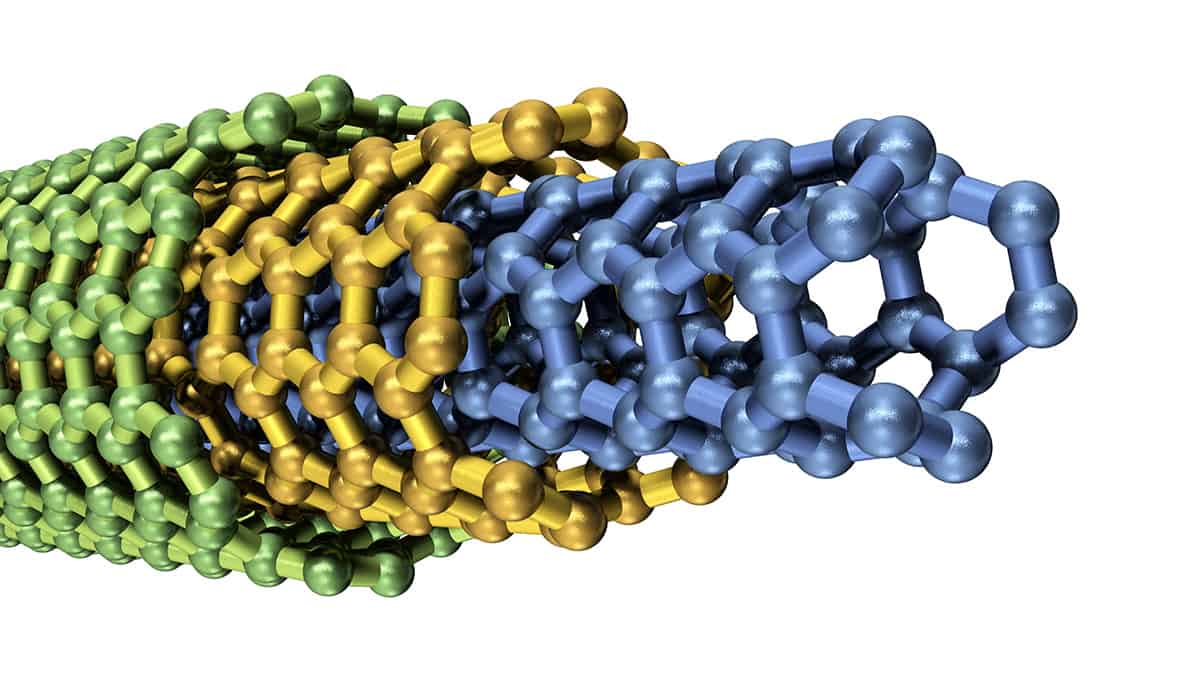
Wrapped up Artist’s impression of the concentric graphene layers in a multi-wall carbon nanotube. (Courtesy: iStock/theasis)
According to standard fluid dynamics, the friction between a flowing liquid and the pipe wall shouldn’t change as the pipe gets narrower. However, experiments have shown that when water flows through a carbon nanotube, the slipperiness of the tube depends on its diameter.
It turns out that at the nanoscale, the laws of fluid mechanics are governed by the quantum-mechanical aspects of the interactions between water and carbon
It turns out that at the nanoscale, the laws of fluid mechanics are governed by the quantum-mechanical aspects of the interactions between water and carbon, and can give rise to a new phenomenon dubbed “quantum friction”. Friction is often a nuisance, but whether it’s a problem or an opportunity here depends on our ingenuity.
Quantum friction might be exploited to develop nanoscale flow sensors or to make ultra-tiny valves for nanofluidics. The discovery of this surprising quantum effect – which even works at room temperature – has opened up a toybox for practical nanotechnology applications and theoretical molecular physics alike. For “quantum plumbers”, we’re only at the beginning of finding out what’s inside.
Slippery tubes
The story begins in earnest in the early 2000s, when computer simulations of water flowing through carbon nanotubes (Nature438 44 and Nature414 188) showed that water molecules indeed move with very low friction past the tube wall. This creates impressive flow rates, even faster than through the specialized nanoscale protein channels that regulate water levels in animal and plant cells.
Other simulations, carried out by Ben Corry at the Australian National University, suggested that if the nanotubes are only a few ångstroms across – so that just a few water molecules fit within the diameter – the structures could filter out salts (J. Phys. Chem. B112 1427). That’s because dissolved salt ions are surrounded by a “hydration shell” of water molecules, which should be too big to pass through the tube. This finding raised the possibility of creating desalination membranes from arrays of aligned nanotubes, with the low friction ensuring high water flow rates.
Early experiments on such membranes (Science312 1034) in the 2000s by Olgica Bakajin’s group at the Lawrence Livermore National Laboratory in California showed promise (figure 1). But the practicalities of fabricating robust, cost-effective membranes with nanotubes that are all the same size have led to rather slow progress.
1 Need for speed
(Originally published in Nature537 210. Reproduced with permission from Springer Nature)
The hydrophobic surface of graphene makes it an attractive material for low-friction nanoscale pipes, but it turns out that the flow is also sensitive to the size of the nanotube.
A closer look at the water flow in nanotubes made things even more complicated. In 2016 physicist Lydéric Bocquet of the Ecole Normale Supérieure in Paris and his co-workers carried out experiments showing that water flowing under pressure through carbon nanotubes gets faster as the tube diameter gets smaller than about 100 nm (Nature537 210). In other words, nanotubes seem slippier the tinier they become. Yet for nanotubes made from boron nitride, the flow rates didn’t depend on tube diameter at all, which is just as one would expect from simple classical models.
Carbon nanotubes are made from concentric layers of graphene, which consists of carbon atoms arranged in a 1D honeycomb lattice. Graphene sheets are electrically conducting – they have mobile electrons – whereas boron nitride is insulating, despite also having a hexagonal lattice structure.
This difference made Bocquet and colleagues suspect that the unexpected behaviour might be somehow connected to the electron states in the tube walls. To add to the mystery, other experiments showed that water flows faster down nanoscale channels made of graphene than ones made of graphite – which is just stacked layers of graphene. The concentric layers of graphene in a carbon nanotube give them a graphite-like structure, so this could be key to understanding how water is transported through the nanotubes.
Resolving this tantalizing theoretical puzzle could have important implications for practical uses of nanotube membranes. “Such flows are at the centre of all sorts of processes in membrane science,” says Nikita Kavokine, a physicist at the Max Planck Institute for Polymer Research in Mainz, Germany. “We want to be able to make materials that perform better in terms of water permeability and ion selectivity.”
In 2022 Bocquet proposed a solution with chemist Marie-Laure Bocquet and Kavokine (who was then at the ENS) – the notion of quantum friction (Nature602 84). They argued that water flowing over graphite can be slowed by a kind of drag created by the interaction of charge fluctuations in the water with wave-like excitations in the mobile electrons of the graphene sheets.
At first glance, it seems unlikely that very light electrons should interact with much heavier atoms and molecules, given that they move at such different speeds. “The naïve idea is that electrons move much faster than water molecules,” says Kavokine, “so they’ll never talk to each other dynamically.”
The big difference in timescales between the movements of electrons and atoms is after all the basis of the Born–Oppenheimer approximation, which lets us calculate the electronic states of atoms and molecules without having to worry about the effect of atomic motions. As Bocquet admits, when he and his co-workers first decided to explore the possibility of such an interaction, “we started with very vague ideas and not optimistically”.
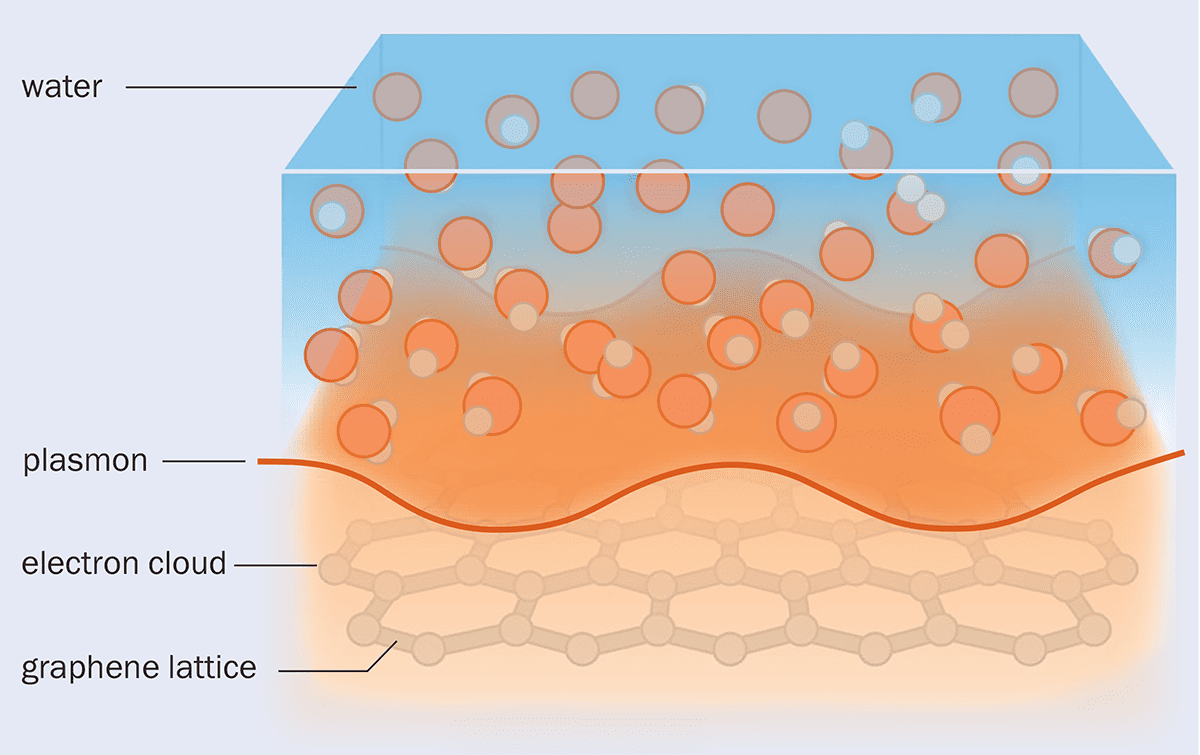
But when the researchers did the calculations, they found that there was a way for the electrons in graphite and the molecules in water to feel one another. That’s because the thermal motions of water molecules create short-lived differences in density from place to place. And because water molecules are polar – they have an asymmetric distribution of electrical charge – these density fluctuations produce corresponding charge fluctuations called Debye modes within the liquid. The electron cloud in graphite also exhibits wave-like charge fluctuations, which behave as quasiparticles known as “plasmons” (figure 2).
According to statistical physicist Giancarlo Franzese of the University of Barcelona, the key to understanding quantum friction is to recognize that the properties of water must be treated as a many-body problem: the fluctuations that cause the Debye modes are collective, not simply the sum of single-molecule properties.
When water flows over a graphene or graphite surface, the electronic excitations called plasmons in the carbon lattice couple to the density fluctuations in the liquid, meaning that momentum and energy can be transferred between the two.
Bocquet and colleagues found that both plasmon waves in graphite and Debye modes in water may occur with frequencies of around several trillion per second – in the terahertz range. This means that there can be a resonance between the two, so that one can be excited by the other, just as singing a note loudly can set an undamped piano string vibrating if it has the same pitch.
In this way, water flowing over a graphite surface can transfer momentum to the plasmons within the graphite and thereby be slowed down, experiencing drag. In other words, the Born–Oppenheimer approximation breaks down here: an effect that Bocquet calls “a huge surprise”.
Crucially, the plasmons in graphite that couple most strongly to the water are caused by electrons jumping between the stacked graphene sheets. They don’t therefore occur in single sheets of graphene (figure 3). That, Bocquet and colleagues figured, would explain why water flows more slowly over graphite than over graphene – because only in the former case is there strong quantum friction.
3 Electron hopping
(Originally published in Nature602 84. Reproduced with permission from Springer Nature)
A schematic of the structure of graphite, and the interlayer plasmons that are associated with strong quantum friction. The “A” and “B” sublattices characterize the graphite structure, where “A” atoms sit directly between atoms in the neighbouring layers. The plasmon modes in graphite that couple most strongly to the charge fluctuations in water are caused by electrons jumping between the graphene sheets. Here the binding parameters describe the energy needed for electrons to tunnel between adjacent or second-nearest sheets.
But would it explain how the flow rate of water in a carbon nanotube depends on the tube diameter? In large nanotubes with diameters above about 100 nm, where the walls have relatively low curvature, the coupling of the electronic states between the stacked graphene layers is much the same as it is in normal graphite with flat sheets, so the quantum friction experienced by water flow is at its maximum strength.
But as the tubes get narrower and their walls become more strongly curved, the electronic interactions between the layers in their walls get weaker, and the layers behave more like independent graphene sheets. Below about 100 nm diameter the quantum friction declines, and if the tubes are narrower than about 20 nm there is none at all – the tubes are as slippery as the classical theories predict. So rather bizarrely, in this case, there seems to be less “quantumness” in the system as it gets smaller.
Rather bizarrely, in this case, there seems to be less “quantumness” in the system as it gets smaller
“Lydéric’s work is super-exciting,” says Angelos Michaelides, a theoretical chemist from the University of Cambridge in the UK, whose detailed computer simulations of the water–graphene interface confirmed that quantum friction occurs (Nano Lett. 23 580).
One of the strange characteristics of quantum friction is that, unlike its classical counterpart, it doesn’t rely on direct contact between the two substances in relative motion. Quantum friction would slow the water down even if there was a thin vacuum layer between it and the carbon nanotube. Sandra Troian from the California Institute of Technology in Pasadena, who studies the fluid mechanics of interfaces, says that this “friction at a distance” is related to a much earlier idea proposed in 1989 by the Russian physicist Leonid Levitov (EPL8 499).
Fluctuations in the electron distribution around atoms means that neutral atoms, molecules and materials can exert a weak electrostatic force on each other called the Van der Waals force. Levitov argued that this could create a drag on the objects moving past each other, even when separated by a vacuum. “Levitov set the whole conceptual ball in motion by proposing that quantum effects acting at a distance can generate a frictional force without direct physical contact,” says Troian.
Plumbing the nanoscale
It all sounds good in theory, but could the idea be put to an experimental test? To do that, Kavokine has teamed up with Mischa Bonn, also in Mainz, an expert in using spectroscopy to probe the dynamics of water. At first, Bonn admits, he was sceptical. “I was like, guys, this is a really cool theory, but there’s no way you’ll see it at room temperature.” But he agreed to give it a try.
“Friction is momentum transfer,” explains Bonn. “But how can we measure that? Well, I can measure energy transfer – that’s what we typically do in spectroscopy.” So Kavokine rewrote the theory for quantum friction so that it quantified the energy transfer, rather than the momentum transfer. Then they set out to see if they could spot such energy transfer between the electron and water dynamics.
The calculations predicted that quantum friction is weaker in graphene than graphite, but Bonn’s team devised an experiment with graphene because they had already studied its electron dynamics. Bonn explains that the graphene monolayer has an in-plane plasmon that the water fluctuations can couple to, so quantum friction should still be present, though it will be a weaker effect than in graphite.
The researchers used optical laser pulses to excite the electrons in a single sheet of graphene immersed in water, in effect abruptly raising the “electronic temperature” so that it was out of equilibrium with the water (Nature Nanotechnol. 18 898). “There’s a certain intrinsic cooling time,” Bonn says – this is taken to be the cooling rate in a vacuum. “But if there’s significant energy transfer [between the graphene plasmons and the Debye modes of water] then that cooling rate should increase when there is water present.”
And that’s exactly what they saw. As the electrons cool, their ability to absorb light in the terahertz frequency range increases. By monitoring the absorption of terahertz pulses fired at different times after the initial exciting laser pulse, Bonn and colleagues could deduce the cooling rate. In this case, there seemed to be energy transfer between the water and the electrons – a signature of quantum friction – even for just a monolayer of graphene (figure 4).
A technique called “terahertz spectroscopy” was used to look for quantum friction. This technique measures the cooling rate of a material (in this case a sheet of graphene) after it is heated by a laser pulse. As the thermal excitation declines, the material’s ability to absorb radiation changes. By monitoring the absorption of a series of terahertz pulses, the cooling rate is calculated. Terahertz spectroscopy can be performed in a vacuum, or in a liquid bath. If the presence of a liquid causes the graphene to cool more quickly than in the vacuum, this indicates that there is quantum friction.
In contrast, when the graphene was immersed in methanol or ethanol, the cooling rate of the electrons was slower than in a vacuum. These are polar liquids but they don’t have Debye modes at the appropriate frequencies, and they merely inhibit the thermal relaxation of the electrons.
“My initial instincts were wrong,” Bonn admits merrily, “so it was a very pleasant surprise when it worked.” But while he says that the results are quantitatively consistent with the theoretical predictions, further experiments are needed to clinch it. What’s more, they have so far only looked at flat graphene sheets in contact with bulk water. “We really want to go to nanoconfined water,” he says – an extension they have already begun.
Beyond a pipe dream
Can quantum friction be put to good use? Kavokine hopes so, and has coined the term “quantum plumbing” to describe efforts to do so. “We can see how mechanical work [like fluid flow] can speak directly to electronic motion,” says Bocquet. “For example, if you move a liquid, you can induce an electronic current.”
The researchers are now thinking about how to exploit the direct conversion of energy between mechanical work and electron motion – for example, by harvesting the energy of waste flows to generate electronic currents, or using electronic control to alter flow rates and thus create nanoscale valves or pumps. “That is not impossible,” Bonn attests.
Kavokine points out that biological systems are – thanks to the fine structural tunability of proteins – very good at controlling flows on very small scales. While he thinks it “unlikely” that anyone could achieve that degree of structural tunability, “[our work] shows we can play instead with the electronic tunability to achieve similar functions with very different physics” – what he dubs an “anti-biomimetic route” to flow nanoengineering.
Understanding quantum friction could be useful for making low-friction materials, says Franzese. “Lubricants are often used as a solution, but many of them are not sustainable,” he says – so designing a material with intrinsically low friction would be a better option. What’s more, the approach of considering the nature of the water–solid interface as a many-body problem “could have implications in other fields such as filtering and separation of fluid mixtures”.
Meanwhile, Michaelides and Bocquet are exploring the idea of using the electronic excitations of a sheet of graphite as an intermediary to allow two flows on either side of it to communicate, such that one might induce the other: what they call flow tunnelling. Their simulations show that it should be possible in principle.
“I envision many important applications of this work [on quantum friction],” says Troian, “ranging from biological systems to those involving membrane-based separation, desalination, liquid batteries, nanomachines and more.”
Regardless of what quantum plumbers ultimately produce, as Bocquet neatly concludes, “it’s a very nice playground”.
Physics World’s office is a long way from the path of totality for yesterday’s solar eclipse, which covered a swathe of North America from the Pacific coast of Mexico to Newfoundland in Canada. Here in Bristol, UK, we didn’t even get to see a partial eclipse, thanks to the heavy cloud that often afflicts the UK at this time of year. But some of our readers were more fortunate, so here’s a quick round-up of their experiences.
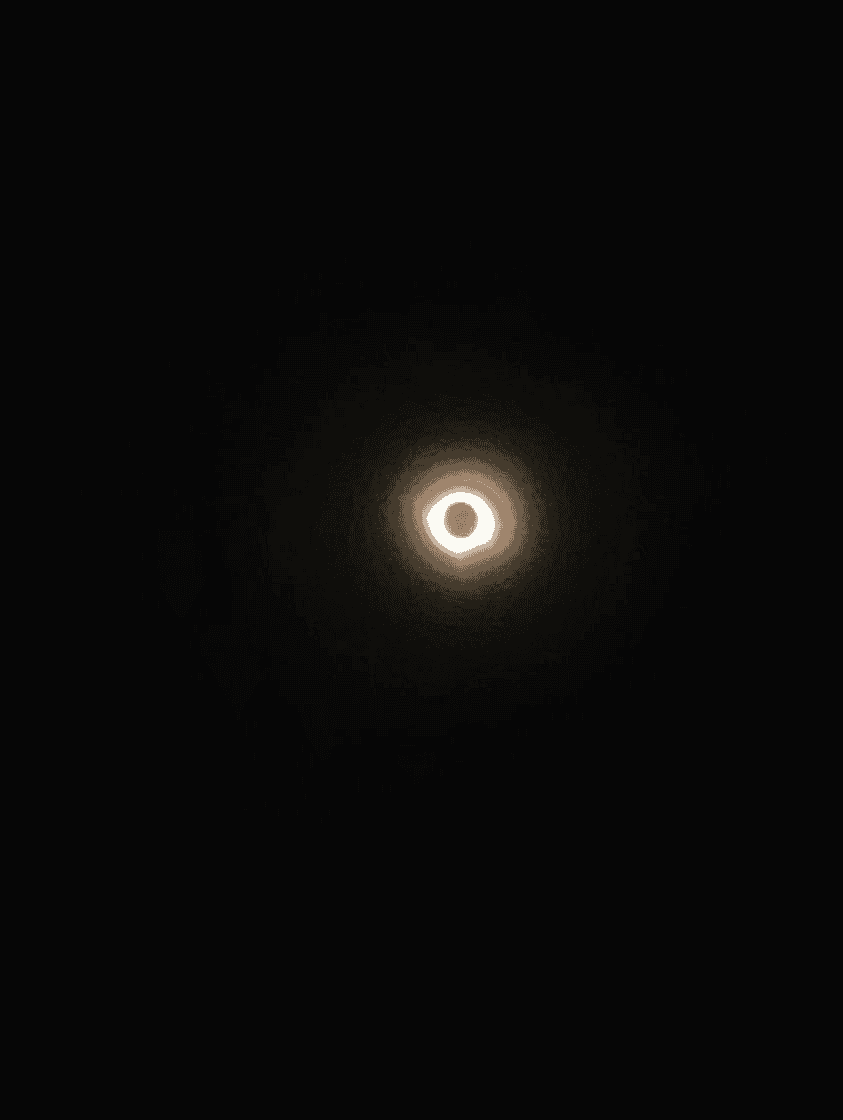
Anillo del fuego: The 8 April 2024 eclipse as seen from Torreón in Coahuila, Mexico. (Courtesy: Adrian Carreón)
The first of our correspondents to see the Moon’s shadow slide across the face of the Sun was Adrian Carreón, who observed the eclipse in Torreón, a city in the southwestern corner of Coahuila state, Mexico. “It was my first eclipse that I’ve seen, or at least that I remember, but it was awesome,” he says. “The best part was when day turned into night in just minutes, and in the sky I could see a light ring over my head.” Carreón captured a shot of this famous “ring of fire” on his phone.
Next up were John, Barb and Kirsten Harris (my uncle, aunt and cousin), who travelled to Little Rock, Arkansas from their homes in Chicago and New York for a better view. An hour or so before totality, things were looking good. According to my uncle, who has an ironic sense of humour, the sky above their chosen viewing spot in a University of Arkansas car park was “clear except for the chemtrails”.
Afterwards, he was full of praise for university staff who put on the event. “They had several rows of telescopes for kids, plus more for adults,” he reported. “Their biggest telescope was feeding a big screen so everybody could see the action.”
The telescopes, he added, will be ready again for the next total solar eclipse in Little Rock on 12 August 2045, when the city should experience 5 minutes and 39 seconds of totality instead of a mere two and a half – “which will be good, as we will all be slower then,” he concluded.
Waiting for totality: Kirsten Harris watches the progress of the eclipse from Little Rock, Arkansas, US. (Courtesy: John Harris)
Our next correspondent – a friend of Physics World’s resident Canadian, Hamish Johnston – didn’t have quite so far to travel. A 20-minute drive to a friend’s cottage on the northern shore of Lake Erie was enough to put Peggy Shepherd Johnson in the zone of totality. At that location, the Sun was fully obscured for less than a minute, but she says it felt like longer.
“It was absolutely beautiful,” she told Johnston by email. “We were able to clearly view the ‘ring of fire’ around the Sun and see a few stars and (we believe) a planet at the totality. The temperature dropped significantly – a local brewery recorded a drop from 24 °C down to 12 °C – and it was eerie. We could view areas that were [outside full totality] in the near distance and see brightness and sunset-like views, but we were dark. The birds went quiet, and we heard what sounded like a very loud rumble of thunder with no storm system around. We’re all absolutely amazed – intellectually, we knew what to expect, but it was so much more to experience. We were simply blown away.”
Even those who couldn’t travel far managed to get in on the action. Norm Johnston, Hamish’s 90-year-old father, noticed some extra traffic in the streets from people headed out to view the eclipse from Canada’s Lake Ontario shoreline, but chose to watch television coverage of the eclipse from a viewing site at Niagara Falls rather than going out. “The streetlights came on,” he reported laconically. “Hope this helps!”