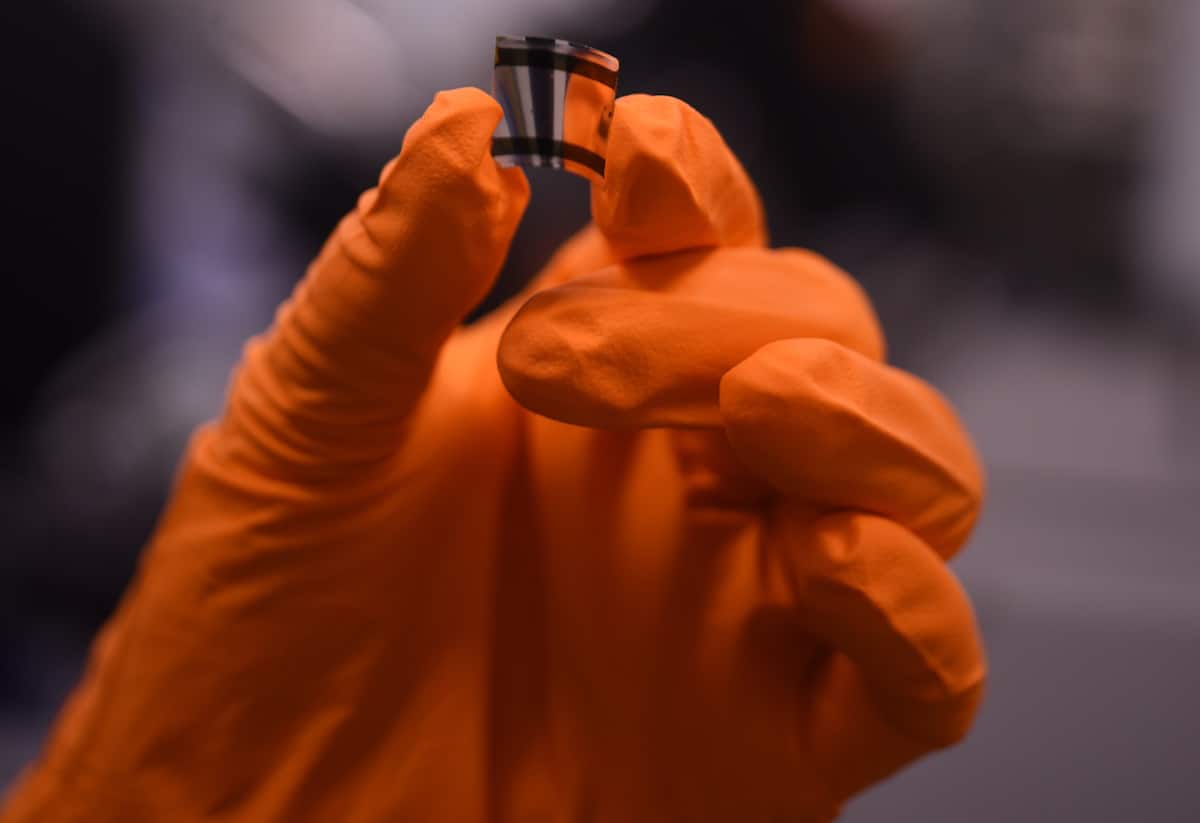
Tissue-equivalent detector Flexible X-ray detectors based on organic semiconductors modified with high-Z heteroatoms could prove ideal for a wide range of medical imaging, radiotherapy and dosimetry applications. (Courtesy: Prabodhi Nanayakkara)
X-ray detectors play a key role in a wide range of medical applications, including diagnostic imaging, radiotherapy dosimetry and personal radiation protection. Many of these applications require large-area detectors that can flexibly conform to curved surfaces. But most commercial X-ray detectors are stiff, power-hungry and expensive to fabricate into large areas.
One alternative is organic semiconductors, which can be used to create large-area optoelectronic devices via environmentally friendly, low-cost manufacturing techniques. Organic materials, however, exhibit low X-ray attenuation, resulting in detectors with low sensitivity. A team headed up at the University of Surrey’s Advanced Technology Institute aims to solve this problem. By adding small amounts of high-Z elements to an organic semiconductor, the researchers created organic X-ray detectors with high sensitivity and high flexibility.
“This new material is flexible, low-cost and sensitive. But what’s exciting is that this material is tissue equivalent,” explains first author Prabodhi Nanayakkara in a press statement. “This paves the way for live dosimetry, which just isn’t possible with current technology.”
Heavy heteroatoms
To fabricate the new X-ray absorber material, the researchers modified the polymer chain of an organic semiconductor with high-Z selenium heteroatoms to create a p-type polymer, P3HSe, and blended this with an n-type fullerene derivative, PC70BM. They created the X-ray detector on a glass substrate using a 55 µm-thick absorber layer.
Nanayakkara and colleagues evaluated the response characteristics of the new detector, comparing its performance to that of their previous curved X-ray detector candidate, made using bismuth oxide nanoparticles integrated into an organic bulk heterojunction (NP-BHJ).
They first measured the dark current, which determines a detector’s limit of detection, signal-to-noise ratio and dynamic range – crucial parameters in dosimetry and medical imaging. The P3HSe:PC70BM detectors demonstrated an ultralow dark current of 0.32 pA/mm2 under an applied bias of −10 V, well within the industrial standard of 10 pA/mm2 and comparable to that of the NP-BHJ detectors. The researchers point out that these two X-ray detectors display the lowest dark currents reported to date of all organic, hybrid and perovskite detectors in the literature.
To evaluate the sensitivity of the detectors, the team exposed them to various X-ray sources. When exposed to 70, 100, 150 and 220 kVp X-ray radiation, the P3HSe:PC70BM detectors exhibited sensitivities of 22.6, 540, 600 and 550 nC/Gy/cm2, respectively. Again, these values are similar to those observed from the NP-BHJ detectors.
The heteroatom-based detectors also displayed excellent dose and dose rate linearity, as well as high reproducibility under repeated X-ray exposure. The researchers note that “despite the relatively low thickness of these absorbers, P3HSe:PC70BM and NP-BHJ detectors display a satisfactory performance compared to more established, state-of-the-art detector technologies”.
The new detectors also exhibited long-term stability. After 12 months storage in nitrogen in the dark, they showed a slight increase in dark current (although remaining well within industrial standards) and no noticeable variation in X-ray photocurrent response. Repeated X-ray exposures to a cumulative dose of 100 Gy did not degrade detector performance.
Creating the curves
Next, the researchers used the new material to fabricate curved X-ray detectors. As the P3HSe:PC70BM films exhibited similar stiffness and hardness to NP-BHJ films, they employed the same 75 µm-thick polyimide films previously used with the NP-BHJ system as flexible substrates.
To assess the response while deformed, the team exposed P3HSe:PC70BM detectors with bending radii from 11.5 to 2 mm to 40 kVp X-rays. At a bending radius of 11.5 mm, the detectors had a sensitivity of 0.1 µC/Gy/cm2 and a dark current as low as 0.03 pA/mm2 when biased at −10 V. Up to a threshold radius of 3.5 mm, the detectors did not display significant change in sensitivity, but beyond this limit, the photocurrent reduced considerably from the sensitivity in pristine condition.
Examining the performance before, during and after bending the detector to a radius of 2 mm revealed that its sensitivity decreased by about 20% during bending, then recovered to near its initial value after relaxation.
Finally, the researchers assessed the mechanical robustness of the device. After 100 bending cycles down to a radius of 2 mm, the curved detectors showed no signs of mechanical failure and less than 1.2% variation in sensitivity. The team concludes that heteroatom incorporation provides a successful strategy for creating high-performance X-ray detectors based on organic semiconductors.
“This is another route to making flexible X-ray detectors, staying firmly only with organic materials,” Ravi Silva, director of the Advanced Technology Institute, tells Physics World. “Both systems show X-ray detectors with broadband high sensitivity and ultralow dark current response. This system based only on organic semiconductors fully preserves the tissue equivalence and will give highly accurate mapping of the X-ray signal, which may not need post-processing so can be used with AI for early detection of tumours.”
Silva adds that this new technology could be used in a variety of settings, including radiotherapy, scanning historical artefacts and in security scanners. “The University of Surrey, together with its spin out SilverRay, continues to lead the way in flexible X-ray detectors – we’re pleased to see the technology shows real promise for a range of uses,” he says. “Mammography and real-time therapeutics including surgery will also be possible. SilverRay is looking at some of these possibilities as we speak.”
The flexible organic X-ray detector is described in Advanced Science.
In this short video, filmed at the ASTRO 2023 conference, Elena Nioutsikou, global programme director for MRI in RT, explains how Siemens Healthineers can make an impact on patient outcomes across the whole continuum of cancer care, by providing the flexibility to choose the imaging that best suits the user’s needs.
She goes on to outline how MR and CT can work together, with MR providing information about anatomy, but also unlocking functional information that could, for example, supply insights into the inhomogeneities in the tumour and potentially also help to adapt dose prescriptions.
Sabine Bernard, senior manager of product marketing radiation therapy solutions at Varian, a Siemens Healthineers company, then talks about new innovations, including HyperSight on TrueBeam and Edge radiotherapy systems (now 510(k) pending). She explains that a year ago, HyperSight was launched on Halcyon and Ethos, bringing image quality, precision and speed. Now this is available on TrueBeam and Edge as well, the company is looking forward to seeing how people will use those images to go beyond IGRT.
Ethos 2.0, also launched in 2023, will use the HyperSight images in a unique way to directly calculate the dose on HyperSight images acquired during the treatment – to increase both precision and speed. Bernard says that the company believes that HyperSight on TrueBeam, on Halcyon, on Edge, as well as on Ethos, will help users increase their confidence to deliver the best treatment to their patients. In addition, Siemens Healthineers also launched the MAGNETOM Free.Max RT edition, the industry’s first 80 cm-bore system. The MRI system has a low total cost of ownership, and as it doesn’t have a quench pipe, can be installed easily in radiotherapy bunkers.
Innovation is not only applicable to products, concludes Bernard, it also applies to how innovations are implemented in the clinic, which is why the company is sponsoring clinical trials and creating working groups to discuss the next steps in the radiotherapy journey.
The FIA is the independent business association for privately financed fusion-energy companies. We have 38 members, all of whom have different approaches to reaching commercial fusion energy.
How do you become a member?
You need to have raised private capital and demonstrate a plan for building a fusion power plant that will sell the power it generates. All of the FIA companies think that they can get there within the coming decades and have investors who believe it is possible.
Why fusion?
Fusion energy is clean, safe, sustainable, always on and always available with a fuel source that is virtually unlimited. By unlimited I mean that we have hundreds of millions or even billions of years of fuel here on Earth. Fusion creates no carbon emissions, no greenhouse-gas emissions and has no long-lived nuclear waste. There’s also no threat of having a nuclear meltdown so there is no safety impact to the public. It’s basically everything you could want from an energy source.
So why don’t we have it already?
It is scientifically very hard to do. We’re still at the point where we need to do a lot of engineering and still some science to get there. The challenge is not just to create fusion, but to create fusion with net energy – to get more energy out of the fusion reaction than you put in. But we believe we’re on the way to doing this and we believe the signposts are there that show we’re not in the realm of science fiction. In a decade or so we can have commercial fusion energy, putting clean, safe, sustainable fusion energy into the grid.
What other applications are there?
One is to use fusion to generate medical isotopes, which can be very helpful for certain forms of cancer treatment or in medical imaging. These are things that are happening right now. Another is fusion propulsion for space applications, which could mean getting from low-Earth orbit to Mars in a matter of weeks or a month instead of years. But the real “killer app” is energy production. We need alternative approaches and fusion is the ultimate energy source. What we need to meet the climate challenge is to have always on, always available, zero-carbon energy.
What are some of the ways to generate fusion?
On one end is laser inertial fusion energy. This involves using a laser or other driver to put a lot of energy onto a very small target, creating an extreme pressure situation where fusion happens. At the other end of plasma physics is magnetically confined fusion, using powerful magnets to contain the plasma in a steady state, which also takes a lot of energy.
And laser fusion has seen some recent success?
Yes, last year physicists and engineers at the laser-based National Ignition Facility in California reported an energy gain in one of their fusion shots. We really see this as a Wright brothers moment. The Wright brothers understood that planes would fly and it took a whole new area of science – aeronautical engineering – to be able to do this. Likewise, we think we’re there with fusion and the plane has flown. We’re not selling it yet, but we’re on our way.
Fusion ambassador Andrew Holland believes that fusion will eventually be able to produce electricity at market-competitive prices. (Courtesy: Andrew Holland)
What do you think of other large-scale experiments, such as ITER, which is currently being built in Cadarache, France, and has been beset by delays and cost hikes?
ITER is being built with a very different need or approach than that of private approaches to fusion. ITER is, of course, an essential science experiment and an important example of how countries can work together. ITER was put together as low risk in terms of technology, but not low risk in terms of cost. ITER was designed with 1990s technology, but things have advanced so much since then. If you were building a computer today, you would build it with today’s technology, not 1990s technology. There is really important science that is going to come out of ITER but because of the huge costs involved it is too big to fail.
But private companies also don’t want to fail, right?
That’s right, but the way the markets work is: you try things and you fail. If you talk to a venture capital investor, they don’t want any of their investments to fail, but also they kind of expect them to. They look for that one out of 10 or even one out of 100 that will pay for the whole investment fund. So it’s a very different model.
Companies are coming into fusion because there is a market need, and on the supply side, the science is ready
In the FIA’s Global Fusion Industry in 2023 report, you identify 43 fusion companies, up from 33 in 2022. What is driving this growth?
Companies are coming into fusion because there is a market demand, and on the supply side, the science is ready. It is not like these companies are all doing the same thing; they’re all racing against each other and other technologies to meet the climate challenge.
Why is it important to have a wide range of approaches?
We don’t want to down-select too early. We shouldn’t say that one approach is going to be the only approach that’s going to work. The lesson from other technologies is that you need the market for it to work and you need to have competition to see what is the appropriate way forward.
The report also highlights that many in the industry expect to deliver electricity to the grid by 2035. What needs to happen to achieve this?
You have to do multiple things in parallel instead of in a sequential order. Many companies are building their proof-of-concept machine to prove net energy in a commercially relevant fusion plasma. If they can do this within the next four years, then they can move on to building a pilot plant.
And what then?
A pilot plant will do the science plus integrate the important engineering, such as being able to generate its own fuel through the interactions of neutrons with the wall. Just being able to have a pilot plant generating electricity, either at first in minutes and hours but then ultimately weeks, months and years is going to be a process. The first electricity to be produced in the 2030s won’t be cheap but we think that there is a pathway towards ultimately producing cheap electricity.
You can listen to a longer version of this interview in the 12 October episode of the Physics World Weekly podcast
Plan comparisons Example dose and LETD distributions for clinical IMPT and shoot-through proton FLASH plans for two patients with brain tumours. (Courtesy: CC BY 4.0/Phys. Med. Biol. 10.1088/1361-6560/ad0280)
Proton therapy is an increasingly popular cancer treatment that offers superior dose shaping to conventional photon radiotherapy. This high-precision dose delivery, however, means that target margins are needed to account for range uncertainties, exposing more healthy tissue to radiation. In addition, uncertainties in linear energy transfer (LET) and relative biological effectiveness (RBE) at the end of the beam range can increase irradiation of healthy tissue behind the target.
A team from the GROW School for Oncology and Reproductionat Maastricht University in the Netherlands has now shown, through an in silico planning study, that proton therapy using shoot-through proton FLASH beams could avoid these uncertainties. Furthermore, the technique provides adequate target coverage and at least as good normal tissue sparing as clinical proton therapy.
Conventional clinical proton therapy uses a series of Bragg peaks (the depth at which the beam deposits most of its dose) to irradiate the tumour volume. The shoot-through technique, on the other hand, employs high-energy proton beams that travel straight through the patient, depositing dose along their entire track, with the Bragg peaks positioned outside of the body.
This approach removes uncertainties on LET and proton range. However, it also eliminates the favourable dose deposition characteristics of protons. To compensate for this loss, the researchers turned to FLASH radiotherapy, in which radiation delivered at ultrahigh dose rates – 40 Gy/s or more – offers potential to destroy tumours while sparing surrounding normal tissue. In particular, they investigated the FLASH protective effect in neurological tumours, where proton therapy has been observed to cause radiation-induced contrast enhancements (RICE) in the brain.
“In the follow-up of patients with neurological tumours there is a concern about the potential effect of high LET on brain tissue,” explains first author Esther Kneepkens. “RICE in the brain, as visible on MRI scans, has shown correlation to areas with increased LET values.”
While RICE lesions are often asymptomatic, they cause stress for the patient and treatment team since they mimic tumour progression. Kneepkens notes that higher LET has also been seen to cause brainstem toxicity in paediatric patients, albeit a minor effect. “Although the correlations reported are not strong enough to establish the risk of high LET in the treatment of brain tumours, they certainly warrant further research,” she says.
To test their hypothesis, Kneepkens and colleagues – in collaboration with RaySearch Laboratories – created shoot-through proton FLASH plans for five patients with neurological cancer who had previously received intensity-modulated proton therapy (IMPT). To ensure that the beam travelled straight through the patient, they used a proton energy of 227 MeV, the highest produced by the Mevion Hyperscan S250i.
Assuming a FLASH protective factor (FPF) of 1.5 for normal tissues outside the target, the shoot-through plans delivered comparable target coverage to the original IMPT plans and met the same number of clinical goals. Doses to many organs-at-risk (OARs) including brainstem, hippocampi, pituitary and optical nerves were lower in the shoot-through than the IMPT plans.
In clinical proton therapy, RBE – the ratio of the dose of photons to the dose of protons that causes the same level of damage – is generally assumed to be 1.1 along the entire proton track. But RBE actually depends on a number of parameters, including the LET, which is highest at the end of the beam range. Kneepkens notes that, in addition to brain toxicities, researchers have seen a possible correlation between high LET and end-of-range rib fractures in breast cancer patients. “This indicates that the currently assumed fixed RBE of 1.1 could be insufficient to understand the full impact of proton therapy, as is recognized by the community,” she explains.
As a computable surrogate for RBE, the researchers calculated dose-averaged LET (LETD) distributions for all plans. The IMPT plans showed large variations in LETD around the clinical target volume (CTV) compared with the shoot-through plans, which also had lower average LETD for all structures. In the brainstem, for example, the average LETD was 4.0 keV/µm for IMPT and 0.9 keV/µm for shoot-through proton FLASH.
The team also examined how a 3% variation in density affected the dose distributions. The FLASH shoot-through plans were more robust, with a maximum variation in D2% dose to OARs of 0.57 Gy and a maximum drop in D98% dose to the CTV of 0.20 Gy. For the IMPT plans, the maximum drop in CTV dose was 0.56 Gy, while changes in OAR doses varied, with the highest differences in the hippocampus (3.04 Gy) and cochlea (5.72 Gy).
This robustness to density uncertainties demonstrates how dose distributions for shoot-through proton beams are less dependent on the tissues they pass through. This is particularly important for patients with brain tumours, the researchers explain, as tumours close to sinuses and cavities could be deemed ineligible for proton therapy, due to changes in sinus filling or the need for time-consuming imaging and adaptation.
The researchers are now looking to install equipment for preclinical FLASH research in rodents. “We believe that the FLASH phenomenon is very complex – and has, up to now, not been explained fully – and that many parameters need to be investigated in preclinical models first,” team leader Frank Verhaegen tells Physics World. “Once we have the novel equipment, we will start an extensive preclinical research program.”
This episode of the Physics World Stories podcast features an interview with Kai Bird, co-author of the book that inspired the recent blockbuster film Oppenheimer, directed by Christopher Nolan. Winner of the 2006 Pulitzer Prize in Biography, American Prometheus: the Triumph and Tragedy of J. Robert Oppenheimer is an exploration of the brilliant and enigmatic physicist who led the project to develop the world’s first atomic weapons.
Oppenheimer is a fascinating but complicated character for a biographer to tackle. Despite excelling in his leadership of the Manhattan Project, Oppenheimer’s conscience was torn by the power he had unleashed on the world. “Now I am become Death, the destroyer of worlds,” is the line he infamously recalled from the Hindu scripture the Bhagavad Gita, upon witnessing the Trinity Test fireball in 1945.
Parallels between the nuclear dawn and AI today
The physicist’s relationship with politics was also fraught and difficult to define. Oppenheimer held personal connections with Communist Party members prior to the Second World War, and spent the post-war years warning against nuclear proliferation – provoking the ire of McCarthy Era politicians and ultimately having his security clearance revoked in 1954.
Unsurprisingly, American Prometheus is receiving a resurgence of interest following the success of Nolan’s film. Readers are fascinated once again with the dawn of the nuclear age, which Bird says has parallels with where we are today with AI and the threat of climate change. He also sees the political threads from McCarthyism to the post-truth tactics and populist playbook deployed in US politics today.
Aeroplane contrails are being deliberately loaded with an extraterrestrial, disease-causing, silicon-based life form: such was the claim back in 2006 by Bill Deagle, a Canadian medical doctor and self-proclaimed “prophet”. “This is a silicon-based life form that is intelligent like bees or ants and it fights back,” he warned. Despite no evidence for silicon-based life, Deagle’s claim has continually resurfaced on social media. In March this year, one Facebook post about it received more than 37,000 likes and 33,000 shares amid a flood of endorsing comments.
Before social media came along, we might have thought that making it easier for people to debate would bring us all together and promote consensus. In reality, the opposite seems nearer the mark: people appear to be angrier, and their opinions more polarized than ever. Social media is widely believed to have helped foment the 2011 UK riots, for instance, and more recently the storming of the US Capitol following the 2020 US presidential election. Naturally, there is a keen interest in understanding what is driving these divisions and what – if anything – can be done about them. As it turns out, physics may have some answers.
The idea of applying physics to describe social phenomena extends back at least as far as the 17th-century philosopher Thomas Hobbes, who attempted to describe the “physical phenomena” of society in terms of Galileo’s laws of motion. In recent decades, the development of physical models has grown into a formal field of research known as “sociophysics” (J. Mathematical Sociology9 1) – encouraged by what appears to be the successful prediction of election results, the demonstration of how polarized views can take hold, and even proposals for how to de-polarize them.
Dangerously alike
For over a decade, political and social scientists have ascribed an increase in division to the effects of social-media bubbles and echo chambers, and the idea that the absence of interactions with people who oppose our views can make our views more extreme. However, when physicists have modelled social behaviour by, for instance, making opposing views repulsive, they fail to replicate this polarizing effect. Indeed, the models even suggest the outcome would be a greater consensus.
In 2020 physicist Michele Starnini at Polytechnic University of Catalunya, Spain and CENTAI, Italy, and colleagues attempted to settle what is driving polarization, by modelling the strength of the opinions held by people as a function of the strength of the opinions they are directly exposed to (Phys. Rev. Lett.124 048301). Earlier models were usually based on “constructive opinion dynamics”, where unrestricted modes of interaction would eventually lead to a consensus, even on controversial issues. Their new model, however, introduces the dynamics of radicalization as a reinforcing mechanism, so that connections became more likely between people with like views. Starnini’s work shows how extreme opinions can evolve from moderate initial conditions.
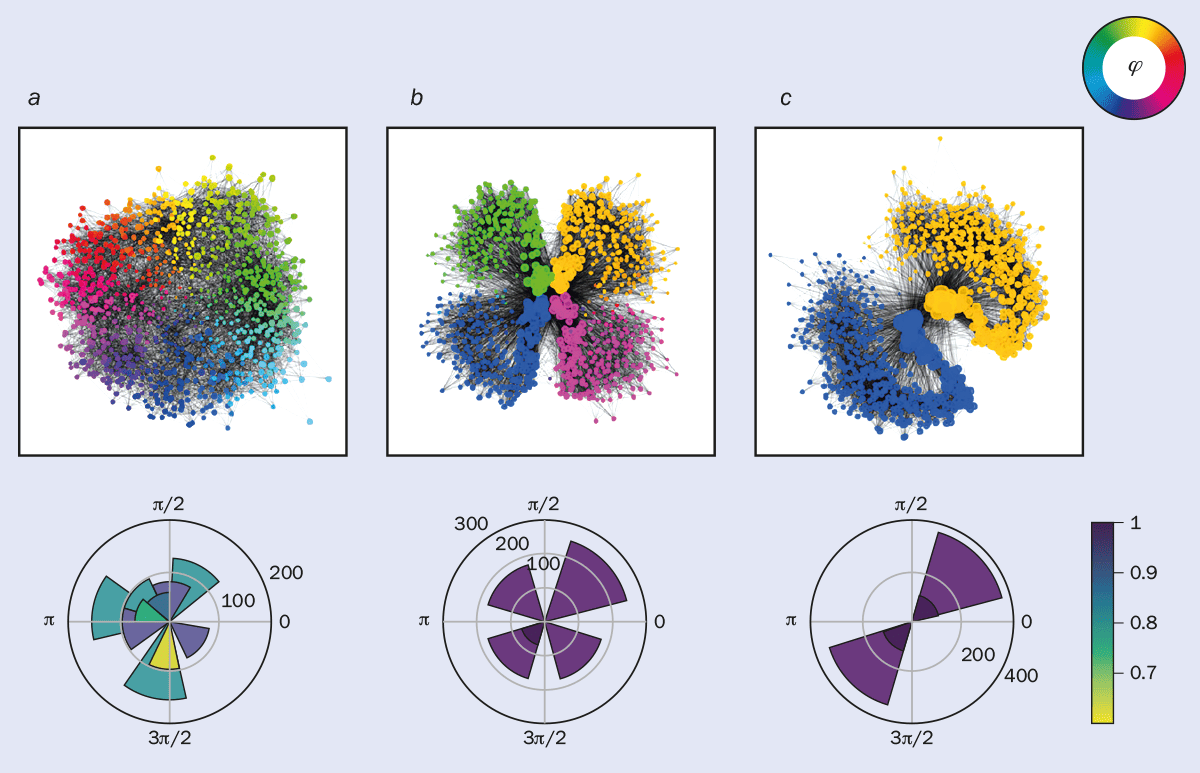
The researchers’ model led to three possible states: a consensus, polarized views or radicalized views – the last involving people holding extreme views at one end of the spectrum but not the other (Phys. Rev. X11 011012). Their analytical solutions reflected what we see empirically – when people’s views are strongly influenced by others, and the issue at stake is controversial, those opinions become more extreme. Add in a strong tendency for people to form connections with others who are like-minded, and the overall network becomes not radicalized, but polarized (figure 1). Indeed, Starnini’s team found that the modelled polarized distribution of opinions agreed with an analysis of real social-media data from users engaged in debates on abortion, Obamacare and gun control on X (formerly known as Twitter), as well as additional user opinion data taken from other social-media sites, such as Facebook and YouTube.
1 Social structure
(Reprinted from Baumann et al. 2021 Phys. Rev. X11 011012. Published by the American Physical Society under a CC BY 4.0 licence)
Michele Starnini from the Polytechnic University of Catalunya and colleagues have shown how opinions polarize on social media. Their model indicates opinions on social networks for three different dynamical regimes: (a) approaching consensus, (b) uncorrelated polarized state and (c) ideological state (where opinion polarization aligns for apparently unconnected topics). In the network illustrations (top), each node is coloured according to its opinion angle φ, and its size is proportional to its conviction. Communities that exist within each social network are represented in the polar bar plot below each network, with the radius showing how big it is and the colour and width corresponding to the average cosine similarity between all pairs of agents in the community. The orientation represents the average opinion angle φ of all agents within the community. Communities containing less than 5% of the total number of nodes are not shown.
Their conclusions might seem obvious. But replicating known behaviour in a model is a first step towards less intuitive insights. For instance, Starnini and colleagues’ analysis showed that while the middle ground of opinion is occupied mostly by users with low levels of activity, the extremes are mostly represented by the most active users, as their opinions receive the most energetic reinforcement from like-minded individuals.
Polarized to depolarized – a phase transition
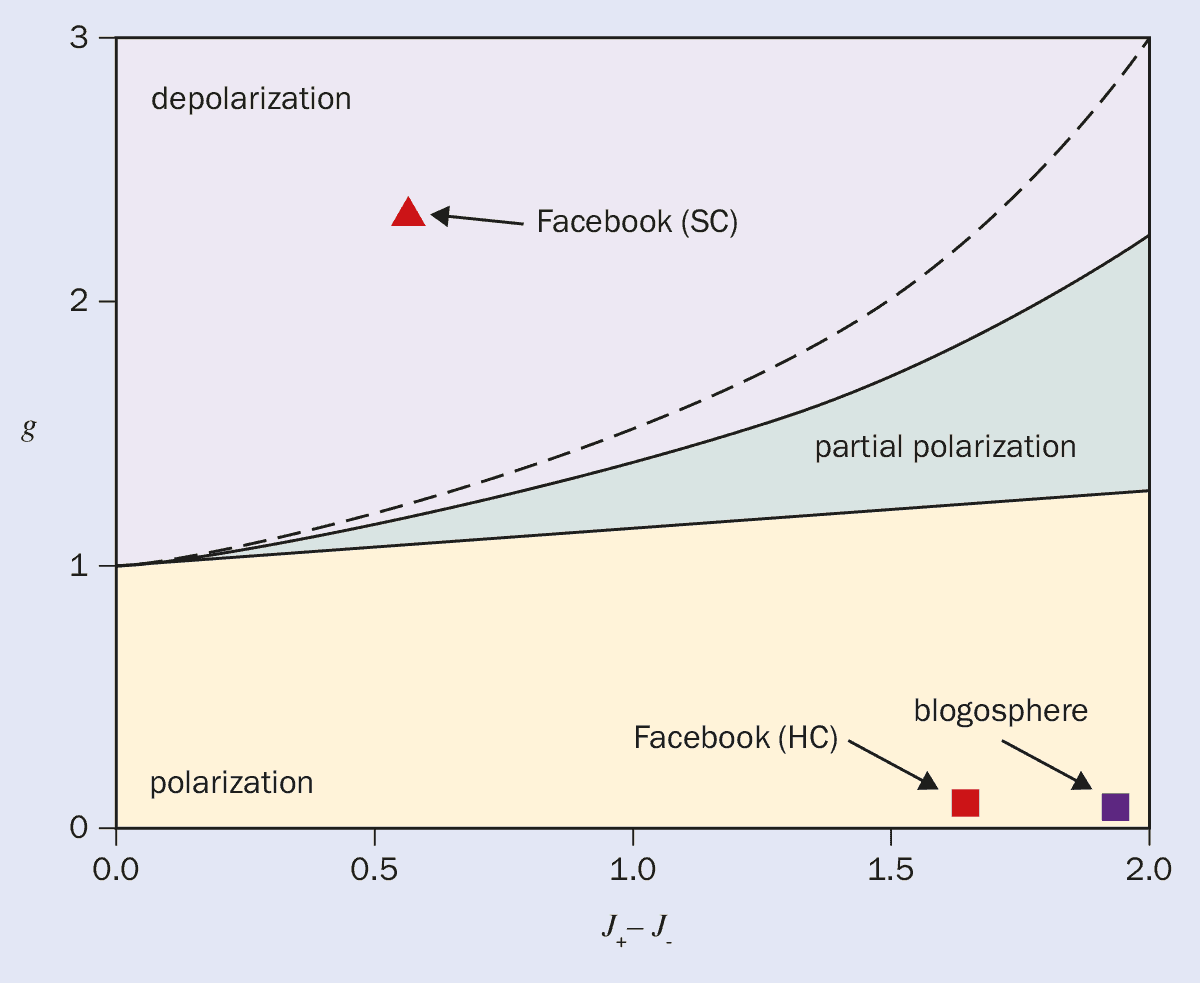
Social-media data have given other insights into increasing polarization. In January 2023 a group including Chaoming Song, a statistical physicist from the University of Miami, along with his student Jiazhen Liu, compared the strengths of user opinions on Facebook posts related to “hard” content (politics) and “soft” content (sport and entertainment). As expected, they found that hard-content opinions are clustered around the extremes, reflecting a polarized state, whereas soft-content opinions are more weighted towards the middle ground (Phys. Rev. Lett.130 037401, using data collected for Science 348 1130) (figure 2).
Crucially, Song and colleagues showed that these opinion distributions follow a scaling law. There are three stable phases: a converging of opinion on the centre ground; a spreading of opinion evenly across the spectrum with a slight increase, or “partial polarization”, towards the extremes; and full-on polarization. Framing these opinion distributions as phases introduces a potentially valuable concept when looking at the key question of how these opinion distributions might change: the phase transition. Song and colleagues were able to show how phase transitions in online social behaviour – just like those in condensed-matter physics – are characterized by critical points in an order parameter, in this case the most probable or commonly held opinion.
2 Passing phase
(Reprinted with permission from Phys. Rev. Lett.130 037401. Copyright 2023 by the American Physical Society)
Chaoming Song from the University of Miami and colleagues have shown how the evolution of opinion distributions can be described in terms of phase transitions. In this phase diagram, the parameter g is the rate at which opinions align multiplied by the ratio of connections being created versus those destroyed. The parameter J+–J– is the difference between the strength with which like-minded users tend to form connections and the strength with which we tend to break connections with users who hold different views. The red square indicates hard content (HC), such as politics, on Facebook; and the red triangle the soft content (SC) such as sport and entertainment.
Keen to understand how a shift towards depolarization might manifest itself, Starnini and colleagues devised another model that showed how the nature of the phase transition depends on whether an opinion on one topic is correlated, or not, to opinions on other topics (Phys. Rev. Lett.130 207401). Turning to polls conducted by the American National Election Studies, the researchers identified several statements to which responses appeared to be correlated based on the distribution of the opinions expressed, such as “Religion [provides] guidance in day-to-day living” and “Business owners are allowed to refuse services to same-sex couples if they violate their religious beliefs”. But the same poll also provided statements that appeared to elicit uncorrelated responses, such as “Children of unauthorized immigrants born in the US should automatically get citizenship” and “The US should send troops to fight Islamic militants”. The researchers then modelled how such distributions of opinions would evolve in response to the opinions of everyone else in the network, taking into account the “strength of social influence” and how stubbornly those opinions were held.
They found that when opinions are correlated, the transition from a polarized to a depolarized (i.e. consensus) phase is likely to be smooth, like the second-order phase transition that occurs between different magnetic phases in condensed matter. On the other hand, the model showed that when opinions are uncorrelated, the transition is likely to be abrupt, like the first-order phase transition from a liquid to a gas.
In 2015 sociologists Daniel DellaPosta and colleagues at Cornell University in the US provided evidence that political partisanship is increasingly defining the views of individuals across a host of seemingly unconnected areas – from leisure activities and aesthetic taste, to food consumption and personal morality. Crudely, for instance, you can say that liberals like lattes, while conservatives like bird hunting (American Journal of Sociology120 1473). If our views are becoming more correlated, as DellaPosta and colleagues suggest, we might expect smoother, more second-order phase transitions from polarized to unpolarized states.
But what could initiate depolarization in the first place, and would that be desirable? One could argue that a monoculture of universally held opinions is not great as it’s unlikely to embrace any diversity or deviation from the norm. According to DellaPosta, social and political theorists have long found that arguments favour “cross-cutting lines of conflict and disagreement found in pluralistic societies” (American Sociological Review85 507). So how then can we reach a more tolerant society? Here, fortunately, a different field of physics has some interesting points to make.
Interventions to unite
Earlier this year, physicist Neil Johnson and colleagues at George Washington University in Washington DC formulated an equation to model the evolution of online “anti-X” communities, where X can be anything, such as a race, a religion or an ethnicity. The equation bore a glaring resemblance to one of the fundamental equations in fluid dynamics – namely the Burgers’ equation, which describes the evolution of a waveform. The connection makes a lot of sense, since the most common characteristic distinguishing these extremist communities from their more benign counterparts is their emergence as “rogue waves”. No matter what the extremist view – be it people who were garnering ISIS support in 2016, or white nationalists today – they seem to “come out of nowhere”, says Johnson. This is likely because they operate for a long time below the radar, before suddenly gaining traction in the mainstream.
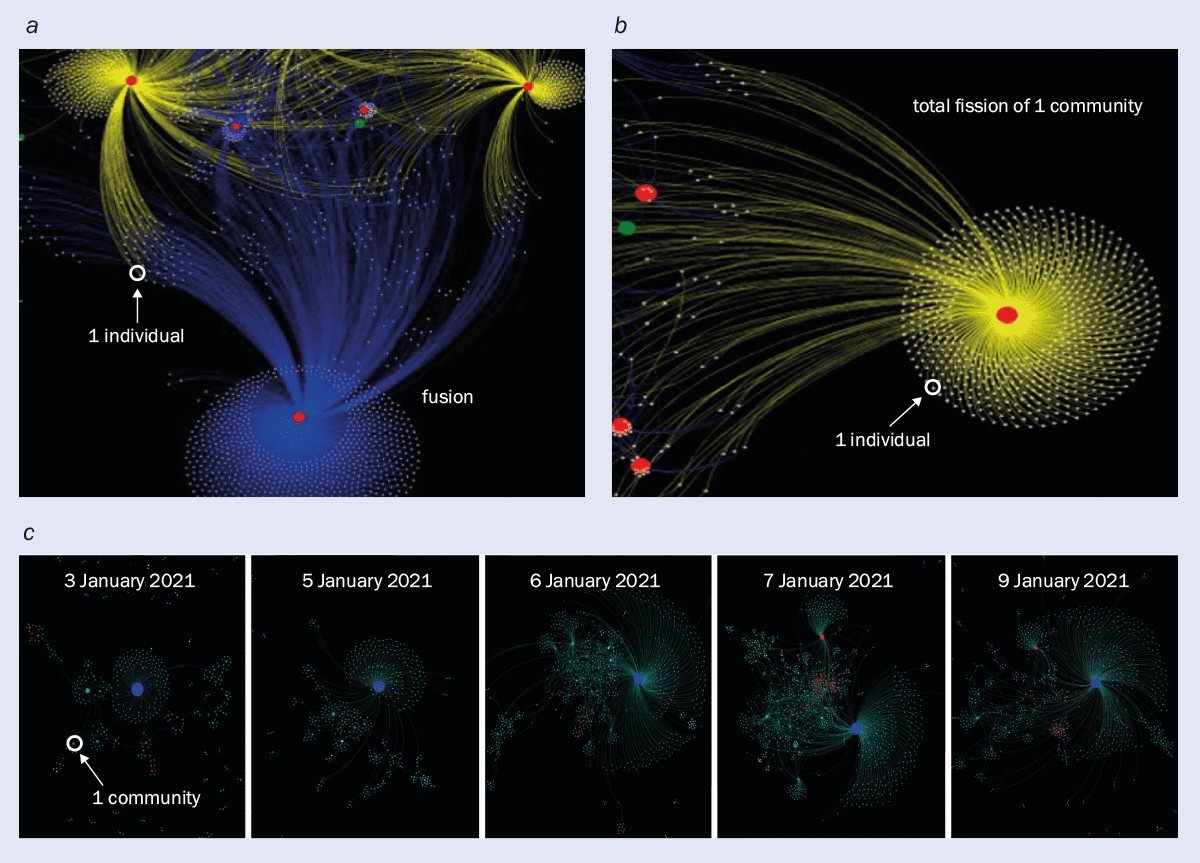
In their study (Phys. Rev. Lett.130 237401) Johnson and colleagues modelled individuals or groups of individuals as vectors, so that their different personal experiences could be imprinted in the vector’s multiple dimensions. The probability of individuals joining a group, or of groups fusing to form a larger group, is then a matter of how well their vectors align (figure 3) – something the researchers call “online collective chemistry”. Their model suggests that to slow down the sudden emergence of anti-X groups, the trick is to flood a network with more diverse users, so that like-vectors do not find each other so easily. This advice goes against the use of algorithms that block users who appear to be trouble, since these would actually filter out diversity.
3 Community clusters and collective chemistry
(Reprinted with permission from Phys. Rev. Lett.130 237401. Copyright 2023 by the American Physical Society)
Neil Johnson from George Washington University and colleagues have empirically observed (a) fusion and (b) total fission of communities featuring anti-US hate on Russian social-networking service VKontakte, between day t (yellow) and t+1 (blue). Red nodes represent anti-US communities that later got shut down (total fission), while green nodes are those still not yet shut down as of June 2023. The yellow links point to individuals (white dots) removed from the anti-US community on day t+1; while blue links point to individuals added to the anti-US community on day t+1. Spatial layout results from plots (a) and (b) are close-ups of a fuller network that was mapped using ForceAtlas2, meaning that nodes appearing closer together are more interconnected. Plot (b) also shows that in the case of total fission, very few individuals of that community are simultaneously also members of other communities. (c) Empirically observed clustering of anti-government communities across platforms around the US Capitol riot.
Equally, being too proactive about exposing social-media users to opposing views can backfire. In 2018 a study led by sociologist Chris Bail and colleagues at Duke University in the US suggested that this type of effort to puncture the bubbles of echo chambers can increase polarization (PNAS115 9216). The following year Johnson, Song and colleagues showed that certain algorithm updates by Facebook could have the same counterproductive effect. Although designed to forge new bonds between users and foster new communities, the updates – they said – were likely to lead to the emergence of isolated extremes. Ultimately, this creates a network that more generally evolves in fits and starts, with a vulnerability to fragmenting (Scientific Reports9 11895).
Yet confronting differently minded individuals is beneficial in the real world. Not everyone we stumble upon day to day is likely to share our views on everything, but while our views may clash on one issue, we can still find common ground on another. Last year, a study by Petter Törnberg, a computational social scientist at the University of Amsterdam in the Netherlands, showed that this varied and stable “patchwork” of differences is not naturally generated in the virtual world by social media, which balloons our potential pool of contacts so that it is far easier to form like-minded connections. With no intrinsic moderation, our opinions are driven to be less mixed, and more partisan (PNAS119 e2207159119).
One attempt to develop less-divisive social-media platforms is being driven by Luke Thorburn, who is doing a PhD in informatics at King’s College London in the UK, and Aviv Ovadya, a former computer scientist who now studies the societal implications of emerging technology. Together, they are working on a project called “Bridging Systems”, which is finding new ways to rank social-media posts beyond the usual “likes” and reposts. Instead of unthinkingly confronting people with posts from the opposite side of the opinion spectrum, the idea is to recommend posts in which a difference of opinion is sweetened with some explicit point of commonality – what Thorburn refers to as “diverse approval”. For instance, you might not blithely invite a latte-drinking liberal to connect with a grouse-hunting conservative. But you might invite two people on the opposite sides of the political spectrum to engage based on a mutual interest that transcends the usual party lines – be it condensed-matter physics or a particular sport.
Beyond social media
Like in any area of physics, the key test of a good model is not just explaining existing data, but the ability to make correct predictions, and that is what makes physicist Serge Galam’s work so striking. Now based at Sciences Po in Paris, Galam has been involved in sociophysics since its emergence in the 1970s, when it was strongly rejected by physicists (Physics A336 49). “Atoms never excited me – but humans, yes!” he says.
His models apply a “majority rule” approach to update the opinions of groups of people to gradually adopt the side of the majority, just as daily group-chats over coffee might gradually sway the opinion of someone with no inherent prejudices. After all, it is less taxing to maintain a position on an issue that coincides with those of the people around you. Indeed, Galam suggests that this draws on the principles of energy minimization – as seen elsewhere in physics, from spin alignment in magnets to the folding of proteins in living cells.
Galam considers discrete opinions where the issue is not the strength of an opinion held, but its essential direction one way or the other – a vote in an election, for example. In the evolution of group opinion, he calls the final proportion of opinions for each side the “attractor”. For a simple system tending towards a consensus there are two attractors: everybody sharing one opinion, or everybody sharing its opposite. The result is then determined by the initial proportions of opinions on either side, such that a 50:50 mix of initial opinions is the tipping point, where the final outcome could go either way. For polarization to occur, a group with one established consensus must come into contact with another group with the opposite established consensus.
Burning conviction On 6 August 2011 a demonstration in London against police violence turned into riots (top) that lasted several days and spread to other British cities. On 6 January 2021 supporters of Donald Trump attacked the US Capitol Building in Washington, DC (bottom) in an attempt to prevent Congress formalizing the victory of Joe Biden as president-elect. Both incidents involved significant use of social media in fomenting extreme political opinions. (Courtesy: Frontline Pictures/Alamy Stock Photo; CC BY 2.0 Tyler Merbler)
But the path to consensus is not always straightforward – people have doubts where both choices seem equally acceptable. A selection is then made by “chance” with no argument needed to justify it. Here, Galam hypothesized that indeed this “chance” is biased by the strongest prejudice within a group (European Phys. J. B25 403), which in turn replicates what he calls “democratic minority spreading”, where the strongest prejudice within a group, rather than the opinion with the most numbers, swings things one way or the other. In fact, Galam suggests such prejudices were the determining factor in the 2016 US presidential elections, in which the Republican candidate Donald Trump beat the Democratic candidate Hilary Clinton. In addition to prejudice, Galam’s model includes the existence of other psychological traits, such as contrarianism, and just being plain stubborn, both of which can shift the attractors and the tipping point (Int. J. Modern Phys. B 31 1742015).
Galam notes that where the psychological trait added is stubbornness, the result is a rigid system, which leads to an atmosphere of hate and rejection. Conversely, when more contrarians are added, the proportion of people in favour of each side of an issue will change – the atmosphere will be more tolerant and accepting – even if they started off the same as in the mix of stubborn people. In a 2023 analysis, Galam describes the distinction in terms of entropy with fluid versus frozen polarization (Entropy25 622), which highlights how the nature of the individuals in a group can matter more than the distribution of voters one way or the other.
Indeed, given enough contrarians there is no tipping point: the outcome always gravitates to a stable 50:50 proportion of opinions held one way or the other, with no hope of consensus. With enough stubborn people the tipping point disappears again – but this time the attractor shifts to have a majority, rather than a 50:50 proportion. “This creates a disturbing, even unethical viewpoint about what is a winning strategy in a campaign,” says Galam. To win an election, a candidate need not aim to persuade the most voters, but only a handful of the most stubborn – and make them stubborn in their favour.
These insights apply whether it is voting on your ballot paper or with your wallet, and could be really powerful for marketing, advertising and similar kinds of manipulation where knowing the targets of your campaign – the key influencers of the net majority – is half the battle. However, Galam emphasizes that it can also be used to prevent a “deadlock”, particularly in view of the difficulties of today’s social dynamics, such as fake news.
“This is like any scientific discovery,” he says. “It can be used in a good way or in a bad way.”
In this video filmed at the ASTRO 2023 conference in San Diego, Rob Morrison, managing director for PTW North America, talks about PTW – a family-owned radiation dosimetry manufacturing company supplying products from radiation detectors and electrometers to water phantoms and patient dosimetry systems.
With headquarters in Freiburg, Germany, and 11 PTW subsidiaries across the world, Morrison explains that PTW is always looking to develop new and innovative products to enable technological advancements in patient treatment.
He outlined some of PTW’s key products: the OCTAVIUS 4D 1600 SRS system, which enables true 3D SRS/SBRT plan QA; the modular RUBY phantom for end-to-end QA; the BEAMSCAN water phantom for legacy linacs and bore linacs, which saves time while retaining quality and accuracy. In addition, he continues, are the BEAMSCAN MR water phantoms used to commission MR linacs and finally the new VERIQA software for performing true Monte Carlo 3D dose calculations.
Morrison then introduces other members of the team, including Raj Narayanan, director of sales and Muthu Manavalan, director of physics, service and support.
Morrison ends by describing PTW’s goals to establish a fully rounded service group in the North American market where they can service all of their products with a short turn-around time within the regulatory framework demanded by the market.
A system that recognizes the distinctive electrical signals in the brain that are associated with large ischaemic strokes has been developed by Jonathan Coutinho at the University of Amsterdam and colleagues in the Netherlands. The portable system has been used successfully in ambulances and with further improvements, the team says that the technique could find widespread use.
An ischaemic stroke is a serious condition that is triggered when a blood clot blocks the flow of blood to part of the brain. Ischaemic strokes account for about 85% of strokes in the UK and are treated using clot-busting medication, or in the case of large-vessel occlusions, (LVOs), the mechanical removal of the clot. But time is of the essence and treatment must start as soon as possible to minimize damage to the brain.
Today, medical imaging techniques like X-ray computed tomography (CT) and magnetic resonance imaging (MRI) are used to determine the type and severity of stroke a patient is experiencing.
The right hospital
“When it comes to stroke, time is literally brain,” Coutinho explains. “The sooner we start the right treatment, the better the outcome. If the diagnosis is already clear in the ambulance, the patient can be routed directly to the right hospital, which saves valuable time.”
Unfortunately, however, mobile facilities available today are not good enough to reliably diagnose strokes before patients reach the hospital. Now, Coutinho’s team have developed a new approach that involves monitoring patients’ brainwaves.
Brainwaves are rhythmic patterns in electrical activity caused by the synchronized oscillations of neurons in the brain. Their frequencies are closely tied with different states of consciousness and mental activity. In patients suffering from brain disorders, the synchronization between neurons can be thrown out of balance, altering the amplitudes and frequencies of the brainwaves produced. This is true for stokes because cutting off blood flow to a part of the brain affects the production of brainwaves there.
In some cases, these changes can be monitored using electroencephalography (EEG). This is a well-established technique whereby the subject wears a cap with holes for electrodes that contact the scalp and monitor the brain’s electrical signals in real time.
Today, EEG is mostly used to monitor the brainwaves of patients with epilepsy. Yet in their study, Coutinho and colleagues altered the cap’s design to detected signals unique to patients experiencing stroke symptoms. Their approach allowed them to determine whether or not a stroke is ischemic, while also indicating the size of the blocked blood vessel.
Very good news
“Our research shows that the brainwave cap can recognize patients with large ischemic strokes with great accuracy,” Coutinho explains. “This is very good news, because the cap can ultimately save lives by routing these patients directly to the right hospital.”
The team tested their brainwave cap in 12 ambulances in the Netherlands. Over four years, they collected data from over 400 patients – identifying LVO ischemic strokes with an impressive accuracy.
“This study shows that the brainwave cap performs well in an ambulance setting,” says Coutinho. “For example, with the measurements of the cap, we can distinguish between a large or small ischemic stroke.”
For now, further improvements will be needed before the team’s brainwave cap is approved for use in ambulances. Yet based on their early results, the researchers are confident in its potential to save the lives of many stroke patients, and to help minimize the risk of permanent brain damage.
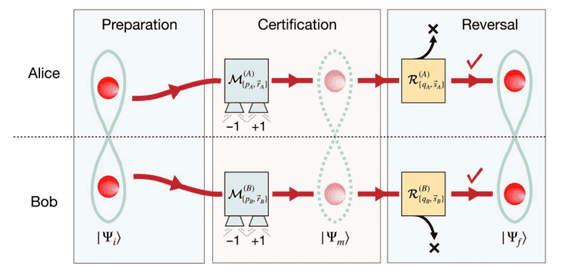
Certified entangled In this entanglement certification scheme involving weak certification and reversal measurements, two parties (traditionally known as Alice and Bob) sitting in their respective laboratories share a potentially entangled pair of systems in the shared state |Ψi⟩. In the certification step, they subject their local systems to weak certification measurements to obtain statistics. In each run, they obtain outputs (±1) and the corresponding output state |Ψm⟩ that still has some entanglement. After passing the certification test, the post-measurement state |Ψm⟩ is subjected to reversal measurements in the last step to obtain the original state |Ψf⟩ = |Ψi⟩ probabilistically. (Courtesy: Recovering quantum entanglement after its certification 2003 Science Advances9 40 doi:10.1126/sciadv.adi5261)
Compared to scribbling mathematical expressions for entangled quantum states on a sheet of paper, producing real entanglement is a tricky task. In the lab, physicists can only claim a prepared quantum state is entangled after it passes an entanglement verification test, and all conventional testing strategies have a major drawback: they destroy the entanglement in the process of certifying it. This means that, post-certification, experimenters must prepare the system in the same state again if they want to use it – but this assumes they trust their source to reliably produce the same state each time.
In a new study, physicists led by Hyeon-Jin Kim from the Korea Advanced Institute of Science and Technology (KAIST) found a way around this trust assumption. They did this by refining conventional entanglement certification (EC) strategies in a way that precludes complete destruction of the initial entanglement, making it possible to recover it (albeit with probability < 1) along with its certification.
A mysterious state with a precise definition
Entanglement, as mysterious as it is made to sound, has a very precise definition within quantum mechanics. According to quantum theory, composite systems (that is, two or more systems considered as a joint unit) are either separable or entangled. In a separable system, as the name might suggest, each subsystem can be assigned an independent state. In an entangled system, however, this is not possible because the subsystems can’t be seen as independent; as the maxim goes, “the whole is greater than its parts”. Entanglement plays a crucial role in many fields, including quantum communication, quantum computation and demonstrations of how quantum theory differs from classical theory. Being able to verify it is thus imperative.
In the latest work, which they describe in Science Advances, Kim and colleagues studied EC tests involving multiple qubits – the simplest possible quantum systems. Conventionally, there are three EC strategies. The first, called witnessing, applies to experimental situations where two (or more) devices making measurements on each subsystem are completely trusted. In the second, termed steering, one of the devices is fully trusted, but the other isn’t. The third strategy, called Bell nonlocality, applies when none of the devices are trusted. For each of these strategies, one can derive inequalities which, if violated, certify entanglement.
Weak measurement is the key
Kim and colleagues reconditioned these strategies in a way that enabled them to recover the original entanglement post certification. The key to their success was a process called weak measurement.
In quantum mechanics, a measurement is any process that probes a quantum system to obtain information (as numbers) from it, and the theory models measurements in two ways: projective or “strong” measurements and non-projective or “weak” measurements. Conventional EC strategies employ projective measurements, which extract information by transforming each subsystem into an independent state such that the joint state of the composite system becomes separable – in other words, it completely loses its entanglement. Weak measurements, in contrast, don’t disturb the subsystems so sharply, so the subsystems remain entangled – albeit at the cost of lesser information extraction compared to projective measurements.
The team introduced a control parameter for the strength of measurement on each subsystem and re-derived the certifying inequality to incorporate these parameters. They then iteratively prepared their qubit system in the state to be certified and measured a fixed sub-unit value (weak measurement) of the parameters. After all the iterations, they collected statistics to check for the violation of the certification inequality. Once a violation occurred, meaning that the state is entangled, they implemented further suitable weak measurements of the same strength on the same subsystems to recover the initial entangled state with some probability R (for “reversibility”).
Lifting the trust assumption
The physicists also demonstrated this theoretical proposal on a photonic setup called a Sagnac interferometer. For each of the three strategies, they used a typical Sagnac setup for a bi-partite system that encodes entanglement into the polarization state of two photons. This involves introducing certain linear optical devices to control the measurement strength and settings for the certification and further retrieval of the initial state.
As predicted, they found that as the measurement strength increases, the reversibility R goes down and the degree of entanglement decreases, while the certification level (a measure of how much the certifying inequality is violated) for each case increases. This implies the existence of a measurement strength “sweet spot” such that the certification levels remain somewhat high without too much loss of entanglement, and hence reversibility.
In an ideal experiment, the entanglement source would be trusted to prepare the same state in every iteration, and destroying entanglement in order to certify it would be benign. But a realistic source may never output a perfectly entangled state every time, making it vital to filter out useful entanglement soon after it is prepared. The KAIST team demonstrated this by applying their scheme to a noisy source that produces a multi-qubit mixture of an entangled and a separable state as a function of time. By employing weak measurements at different time steps and checking the value of the witness, the team certified and recovered the entanglement from the mixture, lifting the trust assumption, and using it further for a Bell nonlocality experiment.
It is not often that a campaign launched by a scientific learned society finds itself featured on the front page of the Daily Star. But that is what happened, not once, but twice over the past year when the paper responded to a call from the Institute of Physics (IOP), which publishes Physics World, for the media in the UK and Ireland to “Bin the boffin”. The campaign aims to persuade journalists to stop using the outdated slang term “boffin” as a catch-all to describe any scientist, technician, researcher or expert who happens to be the subject of their coverage.
As boffin is mostly a term used by the red-top tabloids, we initially directed our call towards them (although it is worth mentioning there are other offenders – the Economist is also rather fond of the term, for example). The impact of the campaign was greater than we could have hoped. There was a quick win when the editor of the Daily Mirrorclarified that the word should not be used by its reporters, while the Daily Star ran a defence of the word on its front page and continues to use it. Only the Sun refused to engage.
We believe that boffin is a lousy way to talk about scientists. The term has negative impacts – it is poorly understood, strongly associated with the male gender and is confusing. When we surveyed our members last year, they told us that the term was unhelpful and inaccurate, with younger members stating it actively puts them off science. To be clear, the IOP isn’t seeking to ban the word. If a pub quiz team, say, wants to be called “Brilliant boffins” that’s fine and if scientists don’t mind the word, then we would consider that a matter of personal taste.
Doubling down The Daily Star response to the IOP “Bin the boffin” campaign was to use the word boffin prominently on its front page – twice in specific reference to the campaign. (Courtesy: Daily Star. Reused with permission)
But when it comes to reporting important discoveries, trends in science, breakthroughs and new techniques, we believe the media should use something more accurate, such as “scientist”. It’s worth recalling that in the early 19th century the term “scientist” was considered by the British press as an ugly Americanism, with a preference instead for “man of science”, which goes to show that times and language can and do change – often for the better.
Our good-humoured call to bin the boffin is intended to start a conversation about how the media portrays scientists and science. This has already had an impact, with follow-up interviews on national radio where we could make broader points about how media stereotypes shape perceptions. By raising concerns about that one word, we also had the chance to talk, for example, about the way stock photos are used, with their tendency to focus on single, heroic scientists, rather than teams, which further cements the tendency to assume that physicists are likely to be white men. The campaign is also designed to draw attention to the IOP’s new guidelines on science reporting, which otherwise might have gone under the radar.
Hopefully, this effort can help increase the diversity of the scientific population. We all know that physics has a representation and equity problem. It is why the IOP launched its Limit Less campaign, of which the boffin-binning initiative is a part, to break down the prejudice and stereotypes that leave too many young people with misconceptions about what physics is. The campaign works with schools, educators, parents, opinion-formers and politicians to create an environment where the message every young person hears is that physics is for you; people like you study physics and you can do well and thrive.
The IOP represents, supports and celebrates members as well as fosters their career development and offers networking opportunities, awards and lectures. We get involved in these issues because we have a duty of care for the future of our community of physicists. It is why we argue for greater government resources for R&D as well as for the UK to rejoin the Europe Union’s Horizon Europe scheme and why we continue to raise the issue of the shortage of physics teachers in our schools. But research funding, extra teachers, generous grant funding packages and national plans can only get you so far. We also need a pipeline of bright, engaged young people from all backgrounds and life experiences, who see physics as the right choice for them and choose science as a way to make a mark on the world.
When young people are deterred from studying physics, which still happens far too often, they are missing out on the many benefits it brings. They are denied the opportunity to explore how their world works and to contribute to shaping the future as informed citizens, as well as losing the opportunity to play a role in the technological and scientific challenges of our age.
That’s why we will continue to campaign and why we will ask, politely but firmly, for the media to “Bin the boffin”.