Perhaps the most iconic map ever is Harry Beck’s depiction of the London Underground, which first appeared in the 1930s. Now, Transport for London (TfL) – which runs the Underground – has partnered with the Royal Academy of Engineering to create a Tube-themed map that depicts famous people in the history of engineering. Created to celebrate National Engineering Day on 1 November, the entire map can be viewed here.
The American artist Jackson Pollock was famous for abstract paintings made by dripping paint onto canvasses. It turns out that there is a lot of physics in Pollock’s technique. As viscous liquids are poured, there is a rich range of behaviour that can occur. A thin stream of paint can twist around in circles like a coiling rope, and a broad sheet of paint can fall in a cascade of folds.
Apparently, Pollock was a master of manipulating these effects to create his stunning paintings. Now, the applied mathematician L Mahadevan has come up with a way to use some of the same effects with a 3D printer. Based at Harvard University in the US, Mahadevan and colleagues were able to use their system to create a range of complicated 3D shapes.
Fluid instabilities
The work is based on two decades of fluid-dynamics research by Mahadevan, which explains how instabilities in fluid flow result in effects like coiling and folding. “We wanted to develop a technique that could take advantage of the folding and coiling instabilities, rather than avoid them,” says Gaurav Chaudhary, who worked on the project.
The team designed an algorithm that worked out how to manipulate the printer nozzle using a technique called deep reinforcement learning. As well as creating Pollock-style paintings, the team also used their technique to decorate a cookie with chocolate syrup.
Canada made the transition from imperial measurements to the metric system in the mid-1970s. So fellow Canadians my age were taught both systems at school – and are very good at converting between systems. However, our neighbours to the south have so far resisted the metric system, much to the amusement of the rest of the world – and the consternation of some Americans.
The above comedy sketch from Saturday Night Live explores America’s relationship with imperial measures at the founding of the nation. George Washington expounds on the virtues of having 5280 feet in a mile. He also touches on the puzzling fact that (in the future) soda pop in the US will often be sold by the litre, whereas paint and milk will be sold by the gallon.
I think the writers missed a trick by mentioning the ultimate irony of Washington’s enthusiasm for the imperial system – the fact that it was invented by his arch enemy, the British.
Physicists in Japan and Lithuania have found evidence that tellurium is produced in neutron star mergers. Their findings bolster the idea that neutron star mergers are responsible for most of the heavy elements in the universe.
The synthesis of heavy nuclei – those heavier than silver – is described by a set of nuclear reaction know as the “r-process” or rapid neutron-capture process. First proposed in 1957, it occurs in an environment with a large density of free neutrons, whereby nuclei begin to capture neutrons much faster than the rate at which they can beta-decay. This produces a characteristic distribution of neutron-rich nuclei, with peaks around certain atomic mass numbers such as 80, 130 and 196.
The abundance patterns in our solar system clearly show these r-process peaks, suggesting that this process is the origin of all heavy elements on Earth. It had been proposed that this process mainly occurs in “whipped-out” matter from neutron star mergers, producing an event called a kilonova – named because it is as bright as a thousand novae, yet not as bright as a supernova.
Previous studies had found absorption signatures of strontium, cerium and lanthanide elements throughout the initial spectrum of GW170817’s kilonova, while spectra taken later became dominated by emission features. The radiative properties of this “nebular” phase remained poorly understood because these conditions are difficult to replicate in experiments on Earth.
To get around this issue, researchers modelled emission lines of several heavy elements by applying certain selection rules to experimentally known energy levels. Their model predicted a strong emission line at 2.1 micrometres from a forbidden transition in doubly ionised tellurium, exactly matching a previously unexplained feature of GW170817’s spectrum (Monthly Notices of the Royal Astronomical Society526 L155). The strength of the emission line indicates that one-thousandth of a solar mass of tellurium was produced in the kilonova.
Webb joins the fray
In a separate study, observations by the James Webb Space Telescope (JWST) provide further evidence for r-process in neutron star mergers. The observatory carried out follow-up observations of the exceptionally bright gamma-ray burst GRB230307A. JWST took infrared spectra at 29 and 61 days following the burst, which showed an uncanny similarity to GW170817, including the same 2.1 micrometre feature attributed to tellurium – indicating another kilonova (Nature).
Given that GRB230307A is a billion light-years away – nearly an order of magnitude further away than GW170817 – this feat is a testament to the sensitivity of JWST. “JWST could obtain a spectrum of the kilonova when no other telescopes could even detect it,” Andrew Levan from Radboud University Nijmegen, who led the JWST study, told Physics World.
Levan adds there is more to come when observing kilonovae with the JWST. “The ultimate goal is to unpick the full details of all the different nuclei that are being created in these mergers so we can finally fill in the origin of all the elements in the periodic table,” he says.
Kenta Hotokezaka of the University of Tokyo, who was lead author of the GW170817 study, told Physics World that they are looking forward to observing the next neutron star merger with the JWST. “We will learn much more from such observations,” he says, “for example, elemental identification in infrared, plasma conditions and the kilonova energy source.”
The Korotkoff sounds heard through a stethoscope are routine in non-invasive clinical blood pressure measurement. For over a century since the sounds were discovered, however, scientists have debated what causes them. Are there cavitation bubbles in the brachial artery? A “water hammer” type phenomenon? Most posited theories looked toward a source of sound inside the arteries and related to blood flow.
But perhaps Korotkoff sounds aren’t sounds at all.
That’s according to scientists at the Institute Physics for Medicine Paris. In a recent study detailed in Science Advances, postdoctoral researcher Jérôme Baranger and his colleagues in Mickael Tanter’s group found that Korotkoff sounds may not be a sound wave at all, but a vibration of the arterial walls that transmits into surrounding tissues, a bit like a seismic wave.
“Our main finding was that Korotkoff sounds are not sounds, which is kind of funny,” says Baranger.
The researchers used ultrafast ultrasound to image Korotkoff sound generation. Ultrasound is like a digital camera that uses sound waves instead of light to take pictures. Ultrafast ultrasound takes these pictures at high frame rates – thousands of images per second – allowing researchers to see transient phenomena happening inside the body in real time.
When analysing their data, which was acquired from 15 healthy volunteers, and applying the results of physical modelling, Baranger found that Korotkoff sounds are paradoxically not sound waves emerging from the brachial artery, but rather shear vibrations conveyed in surrounding tissues. The shear vibrations were correlated and comparable in intensity with Korotkoff sounds.
“I remember the first time I opened our data set, and I saw this huge wave propagating into tissue around the artery,” says Baranger. “I thought ‘what is this?’, because I used to see arteries with a pulse wave propagating in the walls, but it was very subtle. Here, we could see the whole tissue dancing around the artery. And it seemed to correlate with what we could hear in the stethoscope. I was really excited – it was completely unexpected.”
Arterial motions are usually smaller than a millimetre, but displacements of the brachial artery – which can exceed five millimetres – are readily visible on ultrasound. As a blood pressure cuff inflates and presses on the brachial artery, the artery softens. When the heart contracts, the instantaneous increase in blood pressure propagates through the arteries in a pulse wave. When the wave reaches the softened portion of the brachial artery, it slows down and distends the soft arterial walls, making them vibrate, and as the pulse wave propagates under the cuff, it gradually transforms into a shock wave.
Vibrations of the artery transmit to surrounding muscles in the form of a shear wave, like an earthquake. When this earthquake reaches the arm’s surface and the stethoscope, it causes the stethoscope to vibrate, which produces the Korotkoff sounds.
Alternative theory (A) Comparing the time-of-flight (TOF) between potential sources of Korotkoff sounds and the stethoscope revealed that the radial shear wave mechanism was compatible with the observed timings, while the sound wave hypothesis was not. (B) 3D representation of the pulse wave in the artery and the shear wave in the tissues. (Courtesy: J Baranger et al Sci. Advances 10.1126/sciadv.adi4252)
“In previous studies, there was no chance to think about this possible mechanism as a shear wave, or a seismic wave, into tissues, because they were either resolved in space or time, so we were always missing one of the two dimensions. I think the technology of ultrafast ultrasound enabled us for the first time to study this problem with a very good resolution, both in space and time,” says Baranger. “I hope our alternative theory will stand, because we directly observe the quality of sound.”
While the research group’s study suggests a plausible physical mechanism of Korotkoff sounds, they are hesitant to claim causality until they confirm their results in a larger study and compare the physical phenomenon measured with ultrafast ultrasound with invasive blood pressure measurements. Understanding this mechanism could ultimately improve blood pressure measurements and provide additional understanding of arterial mechanical properties.
“We want to get a deeper understanding of the physical phenomenon being observed – spectral properties of the wave are changing with propagation, which carries a lot of information about the mechanical properties of the arteries,” Baranger says. “We hope that by knowing the phenomenon we could maybe have a better way of defining diastolic blood pressure, not only based on the way you perceive it, hear it, in your ear, but maybe based on a physical measurement.”
Some of the biggest mysteries of physics – including the nature of dark matter and dark energy, and the origin of the universe – are in the sights of cosmologists and astroparticle physicists.
In this episode of the Physics World Weekly podcast I am in conversation with three editorial board members of the Journal of Cosmology and Astroparticle Physics (JCAP) which is celebrating its 20th anniversary.
They are the cosmologist and theoretical physicist Licia Verde who is at the Institute of Cosmos Sciences at Spain’s University of Barcelona; Erminia Calabrese, who is an observational cosmologist at the UK’s Cardiff University; and the astroparticle physicist Anne Green, who is at the University of Nottingham in the UK.
We chat about major breakthroughs in cosmology and astroparticle physics over the past two decades and look forward to the future of the fields.
JCAP has published a special retrospective collection of some of the leading papers that have been published in the journal since 2003. Next week, the journal will publish a special anniversary issue of new papers.
More than 750 people have signed a petition against the planned closure of the Joint European Torus (JET), a major fusion experiment that has been running in the UK for almost 40 years. The UK Atomic Energy Authority (UKAEA), which operates JET, plans to shut down the nuclear fusion reactor in early 2024. The petition says the closure of JET would be “a serious scientific blow” that will have a “negative impact” on the worldwide fusion community.
JET has been carrying out fusion experiments since it opened in 1984. Over the past decade or so it has been doing “ITER relevant” experiments, in anticipation of the opening of the ITER fusion reactor, which is currently being built in Cadarache, France. In 2011, for example, JET had a refit of its plasma wall to include a mixture of tungsten and beryllium tiles so that scientists can gain a better understanding for how ITER’s beryllium plasma wall will perform.
The decision to shut JET was originally made in 2016 by the UK and EUROfusion – an umbrella organization for fusion labs around Europe. The plan had been to close it this year because it was thought that ITER would be running, or about to open, by now. But with ITER not scheduled to come online until late 2025 – a date that is likely to be hit by further delays – those behind the petition warn that JET will now be turned off years before ITER fires up.
This gap will be worse given that ITER will begin with a hydrogen-deuterium plasma and only start using deuterium and tritium (D-T) in 2035. Under current plans, therefore, no D-T experiments will be carried out for at least a decade, with the final D-T tests on JET ending in mid-October. “ITER has always been seen as the successor of JET,” says petition co-founder Emilia Solano, a fusion researcher at the Madrid-based National Fusion Laboratory of Spain. “But now we are facing a huge gap in time between the two fusion experiments. We need to bridge that gap.”
Record breaker
The picture is complicated by the UKAEA becoming the sole owner of JET in 2021 and by the UK’s recent decision not to associate with the European Union’s nuclear-energy initiative EURATOM (to which EUROfusion belongs) and instead fund its own domestic fusion programme. The petition now wants the UKAEA to work with the European fusion community to find a way of bridging this gap between JET closing down and ITER starting up.
“JET still has a lot to offer,” Solano claims. In February 2022, for example, JET produced 59 megajoules (MJ) of fusion energy from a single five-second shot, beating the previous record in 1997 of 22 MJ. The petition also states that if JET is kept open, it should be upgraded to include a full tungsten plasma wall. ITER will use beryllium, which is “plasma friendly” but toxic and tricky to handle. There are proposals for ITER to instead use a full tungsten plasma wall.
“If we also equip JET with a full tungsten wall, we can study the effect of this modification on the plasma in advance, and reduce the risks in ITER,” says petition co-signatory Jef Ongena, a fusion researcher at the Laboratory for Plasma Physics of the Royal Military Academy in Belgium. That view is backed Richard Buttery, another signatory who leads the DIII-D National Fusion Facility in San Diego, the largest magnetic-fusion facility in the US. “JET would provide valuable work that could ease challenges for ITER, and so bring this high value project to fruition more quickly, and with less risk,” he says.
Keeping JET open would also maintain know-how and ensure that fusion researchers can continue to be trained, with Ongena claiming that JET’s international team is a blueprint for how a future ITER team should operate. But Buttery says there will be challenges for staff if JET does close, with jobs already having been lost and maintenance deferred. “It would require a considerable effort and redirect of resources to claw some of this back,” he warns.
Today and tomorrow, a mansion on London’s leafy outskirts is, for the second time in its history, the focus of a global endeavour to deploy technological advances for global security. Where Alan Turing and his team of code breakers once struggled to defeat fascism during the Second World War, Bletchley Park is now hosting the world’s first major AI Safety Summit.
The need for international accord could scarcely be more obvious. At times of war and conflict, as the old proverb goes, a lie can travel halfway around the world while the truth is still putting on its shoes. But now it isn’t just a lie. Misinformation may be complex – deep fakes and the manipulation of images and data carry live risks. We worry if we have opened our own equivalent of Pandora’s box.
But there is so much more than politics at stake. AI brings with it many potential benefits for humanity. It could help us deliver healthcare and improved agriculture, understand climate change and enhance our cities. It could be a power to a better and more prosperous society, although we ask how and for who this might all work.
A changed world
There are now very few of us who haven’t tried to use one AI app or another and been shocked by how it responds to the task we set it. Most of us have also heard about how it may take jobs away from people and wonder if will be our role that is gone with the wind of AI.
This is not the first new technology to be greeted with a mix of celebration and fear. Physics-powered technologies have driven successive economic revolutions – mechanical, electrical, atomic – which have brought great opportunity and prosperity, but also significant risks, change and disruption, some of which I have experienced first-hand.
Keith Burnett, president of the Institute of Physics. (Courtesy: Institute of Physics)
The phenomenon of AI is rightly exercising the minds of scientists and non-scientists alike. In the US, Fei-Fei Li – a computer scientist at Stanford University who is sometimes called “the godmother of AI” – has long championed human-centred computing and the use of AI for public benefit. Here in the UK, the Ada Lovelace Institute is working with industry, public institutions and academia to ensure the ethical implications of AI are properly considered.
But physicists have a special contribution to make to this moment of change. For while AI is grounded in computer science, physics has been central to its development and application. For decades, physicists have been at the vanguard of using AI: to improve models and make discoveries – often in very sensitive areas, from defence, to materials science, to nuclear fission and fusion.
So, physicists have real-world experience of some of the crucial questions the summit is considering. It’s all very well talking about algorithmic transparency, explicability and bias in the abstract, but when that algorithm is helping you design a fusion reactor, it focuses minds.
Decision maker: The office of British intelligence officer and codebreaker Alastair Denniston, who managed the decryption effort at Bletchley Park during its early years. (Courtesy: Bletchley Park Trust)
A tool with enormous potential
In a recent survey of 2086 adults in the UK, the polling firm YouGov found that 74% felt that “preventing AI from quickly reaching superhuman capabilities” was an important goal of AI policy, with only 13% disagreeing. But the fears and biases associated with AI often lie in what we as human beings have provided as the sources of information to be amplified, and the dilemmas about its application have as much to do with the political or commercial instincts of humanity as with technological change.
The truth is that AI amplifies possibilities and speeds processes for good and ill. It anticipates based on what it knows of what has gone before, and so now we are faced with both the potential for enormous good, or to replicate our own social failings at previously unimaginable speed and scale.
How we think we might help is for the physics community in all its expertise and diversity to come together, putting political, financial or national interests aside to create change that is good for all. But we also want to listen and learn as the questions and possibilities change. This year at the Institute of Physics, we’re preparing to embark on a new “impact project”, working with our membership and the wider community to explore the opportunities and risks of AI in a physics context – to explore cross-domain opportunities, support policymakers and ultimately leverage this technology for positive impact.
What next?
The path ahead is uncertain, to say the least. What should one do when we know too little about what the impact will be? How should we respond to the changes ahead? We need to focus on our children and the world they can build with the new technology. And we need to ensure each of them, regardless of background, has access to it.
I do think as many people as possible need to see how the latest technology will affect their lives and so I believe giving access to the new techniques to as many of our citizens as possible is crucial. We have by no means settled on what or who will be the winner in this race, but the clear danger is that it becomes a domain for those who can afford it. Only if we make this new technology available to the widest range of people, along with any training that is needed, will we give the best AI future to our children.
Bletchley was a place where experts helped win a war. Our aim is to help secure the peace and benefits for all. We hope the big technology companies and politicians who will be in Bletchley, and those who will pick up the hard work of development once the politicians return to their desks, plan on doing the same. We are ready to play our part in a technological revolution that is bound to impact all of our lives.
Researchers at Rice University in the US have developed a wireless implant that stimulates neurons in response to magnetic pulses. To enable remote operation, the team designed a novel metamaterial that converts external magnetic fields into electrical signals that can be transmitted by nerves. In a study reported in Nature Materials, first author Joshua Chen and colleagues demonstrate that the device can restore nerve function in rats. They propose that this new class of materials could facilitate less invasive medical treatments for neurological and mental health conditions.
Stimulation of the nervous system with electrical fields has been explored to treat a range of disorders including Parkinson’s disease and depression. An electrode is implanted into the brain or nerve, and connected by wires to an external device that sends electrical signals to the target tissue. The aim of this latest research was to build an implant that would operate remotely, requiring less invasive surgery.
“There’s a therapeutic benefit that we’re trying to achieve, without a big device that we put inside the body,” explains neuroengineer Jacob Robinson who led the project.
Such an implant would need to send a signal to cells in response to an external stimulus, and to do this with millisecond lag times, whilst also being small enough to deliver a targeted response. This combination of properties is not found in nature, or in existing engineered materials.
Meeting the requirements of remote neural stimulation
Magnetic fields penetrate deep inside the body but stimulate cells less efficiently than electrical fields. To enable remote cell response, the team designed a magnetoelectric metamaterial that converts an alternating magnetic signal into an electric field. On either side of the device is a layer of material that produces a strain in response to a magnetic field, and at the centre is a piezoelectric material that produces an electric field in response to strain.
Other scientists have studied magnetoelectric materials for remote stimulation of neurons, but these devices have been too slow to mimic neural signalling. To minimize lag times, the material should be driven at its resonant frequency, which is generally a few hundred kilohertz. The membranes of nerve cells, however, filter out high-frequency signals, so previous devices have been driven far from resonance.
The idea the team developed was that the implant could be engineered to stimulate cells whilst driving the material at resonance by converting the current in the device from AC to DC. To achieve this, they deposited a thin film diode on the metamaterial such that the current during AC operation would flow mostly in one direction, resulting in a DC bias.
Implant shows in vivo promise
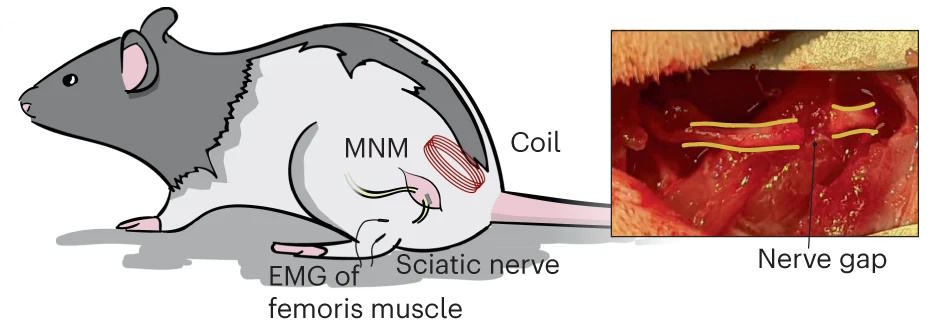
As a proof-of-concept, the researchers demonstrated that the device could be used to restore nerve function in an animal model. They attached the implant to a severed sciatic nerve in the leg of a rat and showed that applying a magnetic pulse stimulated the muscles in the animal’s foot. The implant achieved a target lag time of 5 ms, which is equivalent to neural communication speeds in the body.
Bridge the gap Schematic showing how the implant can support the restoration of conduction across a severed sciatic nerve in vivo (Courtesy: J C Chen et al Nat. Mater. doi.org/10.1038/s41563-023-01680-4)
The device accomplishes electromagnetic manipulation that cannot be replicated with naturally occurring materials. The researchers plan to investigate whether the implant can be miniaturized to the micro or nanoscale, enabling it to be used in the brain and potentially in an injectable form.
Robinson adds that they are also considering other applications, such as power sources, where novel magnetoelectric effects could be harnessed. “There is I think, a whole class of meta materials that we can create, where the relationship between the magnetic field and the electric field is ours to engineer,” he says.
Humane and human Albert Einstein the person is revealed via anecdotes and his relationships, including with his sister Maja (left, pictured with Einstein c.1893) and his friend and colleague Kurt Gödel (right, pictured with Einstein in 1954). (Courtesy: Hebrew University of Jerusalem Albert Einstein Archives/AIP Emilio Segrè Visual Archives; Richard Arens/AIP Emilio Segrè Visual Archives)
There are already so many books about Albert Einstein that each time another is published, you can almost hear the collective groan of popular-science book reviewers. And yet, gems about this icon of modern physics continue to be written because he is such a rich subject, with more original sources referring to him becoming public every year. Still, it does take a new angle on Einstein to get publishers and reviewers excited. Samuel Graydon – science editor of the Times Literary Supplement – has achieved just that in his book Einstein in Time and Space: a Life in 99 Particles.
Rather than trying to cover Einstein’s entire life or work, or choosing one aspect to focus on, Graydon has done something different. He has written 99 very short chapters that each looks at a detail that might not have been considered weighty or relevant enough by other biographers. These are often anecdotes from letters, diaries or memoirs that, while being small moments individually, add up to a portrait of Einstein who is recognizably human, not just an icon. Meanwhile, other chapters concentrate on a person who was important to Einstein – from his sister Maja to one of the last friends he made, mathematician Kurt Gödel.
Graydon does not skip the physics, however. He provides concise explanations of Einstein’s scientific work that are clear and well contextualized. He tells the reader which papers were revolutionary, which were incremental and which were just plain wrong. Graydon also includes many of Einstein’s scientific collaborators, including his first wife Mileva Marić who for years checked his work before he submitted it for publication.
This is not a book revering Einstein, but neither is it a character assassination. The Einstein in these pages is a brilliant theorist who is terrible at mathematics. He is friendly and charming but also a flirt who cheats on both his wives repeatedly. He is a vocal supporter of civil rights in the US but writes some very racist things during his travels in Asia. He is so firmly anti-establishment that he turns down an offer to be the second president of Israel. And he is so determined to continue smoking against his doctors’ advice that he convinces himself it is acceptable if he steals the tobacco from friends and colleagues.
And if a chapter whets a reader’s interest, then Graydon’s detailed acknowledgements section provides yet another fantastic resource.
The automation of core processes in the radiation oncology workflow is accelerating, creating the conditions for technology innovation and clinical upside – at scale – across the planning, delivery and management of cancer treatment programmes. Think tumour and organ segmentation, optimized treatment planning, as well as a range of diverse tasks spanning treatment plan QA, machine QA and workflow management. The rulebooks, in every case, are being rewritten thanks to the enhanced efficiency, consistency and standardization promised by automation and machine-learning technologies.
That’s a broad canvas, but what about the operational detail – and workforce impacts – when deploying automation tools in the radiotherapy clinic? This was the headline question preoccupying speakers at a dedicated conference session – Challenges to Automation of Radiation Oncology Clinical Workflows – at the ASTRO Annual Meeting in San Diego, CA, earlier this month.
Zoom in to that radiotherapy workflow and the questions proliferate. Long term, what do the human–machine interactions look like versus the end-game of online adaptive radiotherapy tailored to the unique requirements of each patient? How will the roles of clinical team members evolve to support and manage increasing levels of automation? Finally, how do end-users manage the “black-box” nature of automation systems when it comes to the commissioning, validation and monitoring of new-look, streamlined treatment programmes?
Knowledge is power
When deploying automation and machine-learning tools in a radiotherapy setting, “we should have the right problem in mind – building things that are clinically relevant – and also have the right stakeholders in mind,” argued Tom Purdie, a staff medical physicist in the radiation medicine programme at Princess Margaret Cancer Centre in Toronto, Canada. At the same time, he noted, it’s vital to address workforce concerns about the perceived “loss of domain knowledge” that comes with the implementation of automation in the clinic, even when the end-user oversees and manages automated tools while still completing portions of the workflow that are yet to be automated.
As such, medical physicists and the wider cross-disciplinary care team will need to reimagine their roles to optimize their contribution in this “offline” mode. “So instead of looking at every patient and being able to deal with them,” Purdie added, “our contribution is going to be on how [machine-learning] models are built – to ensure there’s data governance, the right data’s going in, and that there’s data curation. This is the way to maintain our domain knowledge and still ensure quality and safety [for patients].”
David Wiant “A clinic needs to have a clear plan how to implement automated planning…If not, you can run into problems quickly.” (Courtesy: Cone Health)
Meanwhile, the technical and human factor-related challenges around adoption of automated treatment planning provided the narrative for David Wiant, a senior medical physicist at Cone Health, a not-for-profit healthcare network based in Greensboro, NC. The motivations for automated planning (AP) are clear enough – the relentless upward trajectory of cancer diagnoses in all the forecasts for the coming years. “It’s important that we treat these people as fast as we can,” Wiant told delegates.
The key to clinical success with AP lies in recognizing – and systematically addressing – the hurdles to its deployment. Workflow integration is a case in point. “A clinic needs to have a clear plan how to implement AP – who runs it, when it is used, on what cases,” Wiant noted. “If not, you can run into problems quickly.”
Then there’s reliability and the fact that AP can produce unexpected results. “There’ll be cases where you’ll put in what you think is a good, clean set of standard patient data and you’ll get a result you’re not expecting,” he continued. That’s almost always because the patient data have some unusual features – for example, implanted devices (or foreign objects) or perhaps a patient that’s undergone a previous course of radiation treatment.
The answer, posited Wiant, is to ensure the radiation oncology team has intimate knowledge of the AP to understand any reliability issues – and to use this knowledge to identify cases that need manual planning. At the same time, he concluded, “it’s important to identify sources of random error that may be unique to AP and add checks to mitigate [while] continuing to extend AP to handle non-standard cases.”
Guarding against complacency
Further downstream in the workflow, there are plenty of issues to consider with the roll-out of automated treatment planning QA, explained Elizabeth Covington, associate professor and director of quality and safety in the radiation oncology department at Michigan Medicine, University of Michigan (Ann Arbor, MI).
Elizabeth Covington “For now, automation can solve some problems but not all problems.” (Courtesy: Michigan Medicine)
To avoid what Covington calls “imperfect automation” in treatment planning QA, it’s vital to understand the risk factors upfront, prior to implementation. Chief among these are automation complacency (the failure to be sufficiently vigilant in supervising automation systems) and automation bias (the tendency for end-users to favour automated decision-making systems over contradictory information, even if the latter is correct).
“It’s important when you start using these [automated plan QA] systems to understand the limitations,” said Covington. “[For example], you don’t want to release autochecks too soon that are going to give false-positives because users are going to get desensitized to the system flags.”
Granular software documentation is also mandatory, argues Covington. “Documentation is your friend,” she told delegates, “so that the whole team – physicists, dosimetrists, therapists – knows what these autochecks are doing and understands fully what the automation is telling them.”
The final “must-have” is prospective risk analysis of the automation software – whether it’s custom-built in-house code or a third-party product from a commercial vendor. “Before you release the software,” noted Covington, “you really need to understand what the risks and dangers are of integrating this software into your clinical workflow.”
With this in mind, Covington explained how she and her colleagues at Michigan Medicine quantify the risks of automation tools in terms of the so-called “software risk number” (SRN). The SRN is essentially a matrix of three discrete inputs: population (a direct measure of the patient population that the tool will impact); intent (how the software will be used in clinical decision-making and its ability to acutely impact patient outcomes); and complexity (a measure of how difficult it is for an independent reviewer to find an error in the software).
Covington concluded on a cautionary note: “For now, automation can solve some problems but not all problems. It can also cause new problems – issues you don’t anticipate.”
In recent years, greater understanding about how people learn has led to the development of more effective approaches to teaching large classes, often making use of new technologies. In this webinar, we will give a brief introduction to effective teaching in large STEM classes, based on the book of the same title. The webinar is aimed at higher education teachers from across the STEM subjects, at all stages of their careers, who want to provide the most effective teaching and learning experiences for their students.
Left to right: Anna Wood, Ross Galloway, Alison Voice and Sally Jordan
Anna Wood is an education researcher at the University of Edinburgh. Based in the School of Mathematics. She has a a PhD in physics (2000, University of Durham) and an MSc in e-learning (2013, University of Edinburgh). Her research interests include understanding teaching and learning in large STEM classes, and the use of dialogue in large class teaching. She has researched, written, and run workshops about peer instruction, the use of electronic voting devices, lecture capture, and the interactions in large classes, and has developed the FILL (Framework for Interactive Learning in Lectures) tool for accurately characterising activities in lectures. She has published widely on these topics and is the editor of Effective Teaching in Large STEM Classes.
Ross Galloway is a senior lecturer in the School of Physics and Astronomy at the University of Edinburgh. He teaches on the undergraduate programmes in physics and astronomy and conducts pedagogic research as the leader of the Edinburgh Physics Education Research group (EdPER). His research interests include the development of student problem solving skills, diagnostic testing, active learning and flipped classroom pedagogies.
Alison Voice is head of the Physics Education Research Group in the School of Physics & Astronomy at the University of Leeds, a group that she founded in 2016. She is a national teaching fellow and SFHEA, and has interests in the teaching and learning of STEM disciplines, and in supporting the development and success of students more generally in both the transition to university and in preparing students for their onward journey into employment or further study.
Sally Jordan is professor of physics education at the UK Open University (OU). She has extensive experience of teaching large OU classes in physics, interdisciplinary science and mathematics. She was the first person at the OU to use interactive online computer-marked assessment in her teaching. Her research interests include demographic outcome gaps in physics, authentic remote experimentation, the use of concept inventories and the impact of assessment on students.
About this ebook
Effective Teaching in Large STEM Classes. This book provides an accessible and research-informed introduction to teaching large classes, aimed at teachers from across the STEM subjects, at all stages of their careers, who want to provide the most effective teaching and learning experiences for their students.