One topic covered in the briefing is the world of quantum sensors. Over the years, physicists have developed some amazing quantum sensors, but many of the technologies have stayed in the lab because of the challenges of miniaturizing key components. With ultrahigh vacuum (UHV) playing an important role in quantum sensors based on cold atoms, Florence Concepcion of the UK-based firm Aquark talks about her mission to reduce the size and energy consumption of UHV systems.
Elsewhere in the issue, we look at how manipulating individual living cells plays an important role in biology and medicine. Trouble is, cells tend to stick together when grown in vitro and separating them often involves using harsh chemicals that can damage cells or modify their properties. In a special interview, Luke Cox, who co-founded the UK-based firm Impulsonics, discusses its system that uses ultrasound to gently separate living cells.
Another entrepreneur featured in this briefing is Brian Pogue, co-founder of DoseOptics. The US-based company has developed a system that detects the extremely faint Cherenkov light that is emitted when a radiotherapy beam strikes a patient’s skin. This allows the radiotherapy to be monitored in real time, ensuring that the beam passes through the target tissue and avoids healthy areas of the body.
Finally, you can explore some of the curiosities of the International System of Units (SI), which is the bedrock of metrology. Although SI and its predecessors have been honed and re-defined over the centuries, it still has some surprising quirks. Ben Stein from the US National Institute of Standards and Technology explores some of these oddities including how the candela was derived from the brightness of a candle made from whale fat and beeswax – and the ongoing debate about using the dimensionless radian as the SI derived unit for planar angle.
A collaboration of researchers in North America has reported their findings from the first diagnostic X-ray imaging performed in space. X-ray images recorded during an orbital spaceflight exhibited similar overall quality to those taken preflight on Earth, demonstrating the feasibility of adding radiography as a diagnostic tool for crew health.
With humans venturing further into space and spending more time in this harsh environment, the risk of adverse medical events increases. Accurate and timely diagnosis and treatment is a must-have. Currently, the only reliable medical imaging modality available to astronauts in spaceflight is ultrasonography – which is operator dependent, requires substantial training and relies on limited acoustic windows.
X-ray imaging, on the other hand, benefits from low operator dependence, rapid acquisition and typically higher spatial resolution than ultrasound. Digital radiography could also offer superior diagnostic capabilities for many medical conditions of concern during spaceflight, including dental disease, musculoskeletal trauma, inhalational injury, collapsed lung and arthritis.
Traditional X-ray scanning systems are bulky, produce a lot of radiation and are sensitive to motion – making them less than ideal for sending into space. But a new generation of portable X-ray scanners shows potential to survive the spaceflight and be operated by crew members with minimal training.
“It’s been a dream for aerospace medicine to have more than one imaging modality for diagnosing illnesses and injuries in space,” says lead researcher Sheyna Gifford, an assistant professor of aerospace medicine at the Mayo Clinic in Rochester, MN, in a press statement.
Scanning in space
In a study led by co-author David Lerner, the researchers first demonstrated the feasibility of X-ray imaging in simulated microgravity in 2022. During a parabolic flight, they used a commercial off-the-shelf digital radiography system to successfully capture radiographs of a human subject and a phantom during lunar gravity (1/6g), Martian gravity (1/3g) and microgravity.
In this latest project, reported in in Radiology, Gifford and her team investigated the performance of a similar portable digital radiography system aboard the Dragon spacecraft, during the Fram2 spaceflight mission, a 3.5-day polar orbital flight launched on 31 March 2025 on a SpaceX Falcon 9 rocket. The imaging system comprised a commercial off-the-shelf, FDA-cleared, portable, digital X-ray generator (Impact Wireless; MinXray) along with an FDA-cleared flat-panel detector.
Chest radiographs Representative X-ray images acquired preflight by a crewmember (A), in-flight on day 3 after launch by a crewmember (B, C) and postflight by a non-crew operator using the same imaging protocol (D). (Courtesy: RSNA)
Prior to the mission, three crew members received 4 hr of training on the portable X-ray system and acquired preflight X-ray images of the hand, forearm, abdomen, pelvis, chest and a quality control phantom. They then recorded the same anatomic and phantom images whilst in space, and also imaged a smartwatch to investigate the potential for non-destructive testing.
During anatomic imaging, the devices were handheld by the crew members, while the phantom and smartwatch were secured to the detector for imaging. The crew reported that they found it easy to use the X-ray system and follow the imaging protocols.
Back on Earth
To assess the quality of the seven X-ray images acquired by the crew, three independent radiologists evaluated and compared the preflight and in-flight anatomic radiographs, finding no differences in overall image quality, contrast resolution or spatial resolution. For central-body radiographs (chest, abdomen and pelvis), image positioning was worse in-flight than preflight. Despite this, all X-rays achieved good or near-excellent diagnostic quality (rated on a 5-point Likert scale).
Phantom radiographs recorded in space exhibited good spatial and contrast resolution, imaging low-contrast targets down to the smallest 2-mm target and easily visualizing high-contrast meshes ranging from 20 to 60 lines per inch, with 80 lines per inch remaining visible. The smartwatch radiograph clearly showed the watch’s internal components at the submillimetre scale.
The research team found that the X-ray generator had sustained minor re-entry damage, but its internal components and X-ray output were not affected. Similarly, the detector passed visual inspection and quality control tests. The researchers also recorded a set of postflight X-rays (on non-crewmembers) following the same in-flight protocols. These showed no qualitative differences from the preflight or in-flight radiographs.
“By acquiring the first human and equipment X-rays in space, our study demonstrates the feasibility of in-orbit radiography and expanded diagnostic capabilities for crew health and hardware evaluation,” says Gifford. “Acquiring diagnostically useful X-rays in space is something that anyone can do. Three very talented nonmedical people with four hours of training in one of the harshest environments did it right and did it well.”
Gifford points out that a spaceflight-ready radiography system could also prove indispensable for mission-critical non-medical tasks. “For sustained human presence in space, X-rays are critical not just for crew members but also for other mission components like electronics and spacesuits. The only way to look inside these objects without taking them apart is to X-ray them,” she explains.
Quantum mechanics has two seemingly competing rules. Firstly, a system evolving without measurement follows a continuous, deterministic evolution governed by the Schrödinger equation, with dynamics determined by a Hamiltonian. Secondly, when a measurement occurs, the wavefunction collapses, producing a sudden, discontinuous change that is not derived from a Hamiltonian. Several approaches attempt to reconcile these behaviours, including the Copenhagen interpretation (which does not explain the mechanism of collapse), decoherence theory (which does not provide a single definite outcome), stochastic collapse models, and continuous measurement theory.
In this work, measurement is not treated as fundamentally different. Instead, it is described using stochastic (random) Hamiltonians that generate continuous evolution of the quantum state. In this picture, collapse emerges from noisy dynamics. The authors show that these dynamics can be understood as double-bracket gradient flows, where the system is driven to align with a measured observable, steadily reducing uncertainty until it reaches a definite outcome. Thus, wavefunction collapse can be viewed as coarse-grained continuous dynamics that minimise the variance of the observable. By interpreting this as a gradient flow, the same mechanism can be exploited using feedback to drive a system into desired states, including entangled ones.
This approach provides a continuous and physically interpretable picture of wavefunction collapse. Compared to decoherence theory, it explains the emergence of a single outcome but does not specify when measurement dynamics begin. More broadly, it replaces the notion of collapse with a dynamical process, making the theory more internally consistent, while also offering practical tools for controlling quantum systems, which is important for quantum computing and experiments.
“These geometric connections between Hamiltonian dynamics and quantum measurements open the door to exciting new approaches to quantum algorithm design.” – Aaron Villanueva, Radboud University
Percolation studies how small connections can group together to form a larger connected system, known as a cluster. In a grid where sites can be turned on or off, turning on more sites leads to the formation of clusters, and at a certain point a giant cluster spanning the system emerges. This behaviour is relevant to many real-world systems where local interactions lead to global effects, such as power grids, disease spreading, forest fires, and brain activity. While percolation is often studied using theoretical models or simulations, real systems are more complex. Nonlinear effects, noise, imperfect connections, and time-dependent dynamics can all shift the tipping point and change how clusters form.
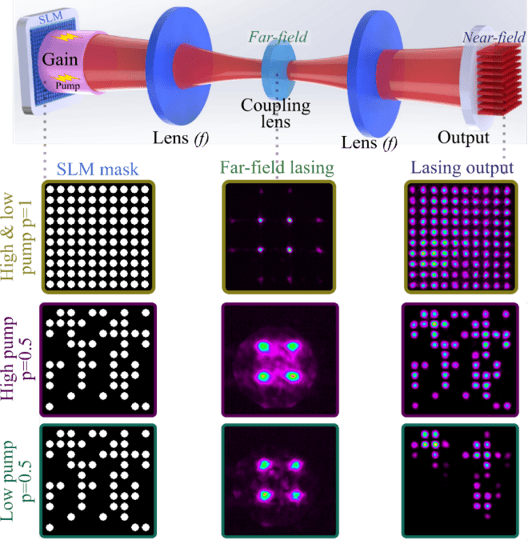
Schematic diagram of the experimental setup for implementing percolation using coupled lasers, along with the corresponding lasing output for different percolation mask realizations. Figure 1 from Simon Mahler et al 2026 Rep. Prog. Phys. 89 067901 (Courtesy: Mahler/Weizmann Institute of Science)
In this work, the researchers built a physical system using a 2D array of 100 coupled lasers to study percolation experimentally. Each laser acts as a site that can be turned on and interacts with its neighbours, making the system a controllable realisation of a percolation grid. They found that when a large connected cluster forms, the lasers also begin to phase-lock, meaning that connectivity and synchronisation emerge together. Normally, these effects are studied separately.
At high pump power (the energy supplied to the lasers), the system behaves like an ideal percolation model, with a clear critical threshold and a smooth (second-order) transition, consistent with theory. However, at low pump power, nonlinear effects become important. The lasers compete more strongly, meaning more active sites are needed to form a spanning cluster, and weaker clusters are suppressed. This shifts the percolation threshold and alters the cluster size distribution, contrary to the usual expectation that nonlinear effects are stronger at higher power.
To explain this, the researchers introduced a simple model where a site only remains active if it has enough active neighbours, effectively modifying the connectivity rules. This reproduces the observed behaviour and shows how nonlinear effects can reshape percolation. Overall, the work demonstrates that real physical systems can significantly modify ideal percolation behaviour, and provides a controllable platform for studying how connectivity, competition, and synchronisation interact in complex networks.
Private fusion companies have raised almost $4.5bn in funding over the past year – a 70% increase year-on-year. That is according to a report on the state of the fusion industry, which was published yesterday by the Fusion Industry Association (FIA). The report – The Global Fusion Industry in 2026 – also finds that private fusion endeavours now employ over 16,000 people worldwide.
Magnetic confinement, in which magnetic fields are used to contain a high-temperature plasma, is the most popular fusion technique, being used by 48% of firms according to the report. Inertial confinement, which uses rapid compression, usually by lasers, to create a confined plasma for a short period of time, is employed by 21% of firms – with other techniques such as magneto-inertial making up the remainder.
While electricity generation is a main target for private fusion companies, many also see the technology being applied to space propulsion, with other markets including marine propulsion, hydrogen fuel and industrial heat.
The funding boost for this year’s figures has come from major funding rounds, with CFS raising $863m in August 2025 while Inertia Enterprises, Helion Energy and Proxima Fusion have raised about $1.5bn in total this year.
Ambitious goals
The first FIA report on the fusion industry was published in 2021, where it found that private fusion endeavours had received over $1.8bn of funding since the 1990s.
The 2021 report discovered that over two-thirds of the 35 companies surveyed thought that electricity generated from fusion would enter the grid in the 2030s, with a further 20% thinking it would more likely come in later decades.
That confidence, however, has grown – with this year’s report finding that 71% expect the first fusion plant to deliver commercial electricity by the 2030s.
Indeed, FIA chief executive Andrew Holland says he is “confident” that commercial fusion will be delivered in the 2030s.
“Alongside private investment, fusion companies still need the support of governments to address common challenges including the availability of resilient materials and the fusion fuel cycle,” he says. “The governments that update their programmes and funding priorities to meet the sector’s needs today will be the ones to capitalize on this vital emerging industry.”
The report comes as General Fusion has become the first fusion company to be publicly listed. It joined the Nasdaq exchange with $150m in fresh funding, which is expected to go towards the firm’s Lawson tokamak programme that is expected to be complete in 2028.
In The Hitchhiker’s Guide to the Galaxy, Douglas Adams imagined a supercomputer called Deep Thought, built by a race of hyper-intelligent beings to calculate the Answer to the Ultimate Question of Life, the Universe and Everything. After a mere seven and a half million years of computation, the machine finally revealed its answer: 42.
There was just one problem. Despite their hyper-intelligence, none of those beings understood what the question had been. The joke was that any answer – no matter how precise – is meaningless without a thorough understanding of both the question and the route taken to obtain the answer.
Yet what was once purely science fiction is beginning to sound unexpectedly relevant to modern research. From structural biology to particle physics, artificial intelligence (AI) systems are increasingly involved in research, providing results of remarkable power and accuracy. They are being used to identify hidden patterns in vast datasets, to generate hypotheses, to accelerate simulations and to guide experiments.
As AI becomes increasingly embedded in the scientific process, could we be entering an era of discoveries without understanding?
But in some cases, even the creators of those AI systems are struggling to explain exactly how the AI arrives at its conclusions. All of which raises an uncomfortable possibility. As AI becomes increasingly embedded in the scientific process, could we be entering an era of discoveries without understanding? And if so, what happens when science starts producing its own versions of the answer “42”?
AI terms and conditions
Artificial intelligence (AI)
Intelligent behaviour exhibited by machines. But the definition of intelligence is controversial so a more general description of AI that would satisfy most is: the behaviour of a system that adapts its actions in response to its environment and prior experience.
Machine learning
As a group of approaches to endow a machine with artificial intelligence, machine learning is itself a broad category. In essence, it is the process by which a system learns from a training set so that it can deliver autonomously an appropriate response to new data.
Artificial neural networks
A subset of machine learning in which the learning mechanism is modelled on the behaviour of a biological brain. Input signals are modified as they pass through networked layers of neurons before emerging as an output. Experience is encoded by varying the strength of interactions between neurons in the network.
Training data
A set of real or simulated data used to train a machine-learning algorithm to recognize patterns in data indicative of signal or background.
Generative AI
A type of machine-learning algorithm that creates new content, such as images or text, based on the data the algorithm was trained on.
Computer vision
A branch of AI that analyses, interprets and extracts meaningful data from images to identify and classify objects and patterns.
Natural language processing
A branch of AI that analyses, interprets and generates human language.
AI and accelerated particle searches
For particle physicists, this question is no longer hypothetical. At CERN, the home of the Large Hadron Collider (LHC), AI is already woven into day-to-day research, subtly reshaping how physics research is carried out. Indeed, machine learning (ML) – one of the main pathways through which AI is achieved – has long played a role at the LHC.
Back in the early 2010s physicists working at the CMS and ATLAS experiments, routinely used ML in their search for the Higgs boson. The ML algorithms separated rare signals – a Higgs boson decaying either into two photons or into four leptons via Z bosons – from far more common Standard Model processes that produced similar signatures in the detector.
Machine learning did not discover the Higgs boson by itself, but it accelerated the search by making analyses more sensitive. In fact, achieving the same sensitivity without ML would have required between 15% and 125% more data, according to a review of Higgs-decay measurements (Nature560 41). Some measurements would even have needed more than double the data.
But the scope of AI in particle physics has been expanding rapidly since then. Neural networks are now used to compress enormous datasets, accelerate simulations, and identify unusual events hidden among billions of particle collisions. By learning directly from examples, neural networks can uncover complex correlations in detector data that would be difficult for physicists to unravel using conventional analysis techniques.
Caterina Doglioni, an experimental particle physicist from the University of Manchester, UK, who uses ML for data compression as part of the ATLAS collaboration, says that deployment of AI is becoming difficult to separate from particle-physics research itself. “It’s pretty much everywhere,” she says, especially when it comes to experimental high-energy physics. “It’s critical at the LHC where far more data is created than can realistically be stored.”
When it comes to compressing detector data, for example, one option is to use neural networks to force information through a computational “bottleneck” that preserves the most important features while dramatically reducing the storage required. The original data can then be reconstructed from this compressed summary, either exactly or approximately depending on the application (Rep. Prog. Phys.84 124201).
This is different from the ML techniques used during the Higgs search. Whereas Higgs analyses relied on supervised algorithms that had been trained to distinguish known signals from background noise, these data-compression methods typically use “self-supervised” learning. They identify and preserve important patterns – without requiring labelled examples.
Algorithms learn what ordinary collisions look like and then flag events that deviate from those expectations
More recently, researchers have begun applying ML to a very different challenge. In the Higgs search, algorithms were trained to recognize signatures predicted by theory and distinguish them from background processes. But now, instead of having algorithms that search for a specific predicted signal, those algorithms learn what ordinary collisions look like and then flag events that deviate from those expectations.
In what is essentially a clever form of anomaly detection, the hope is that new physics might reveal itself as something unusual, even if physicists do not yet know exactly what form it will take. In a nutshell, ML used to be applied to problems where physicists knew what they were looking for; now it is applied to problems where we don’t know what we’re looking for just yet.
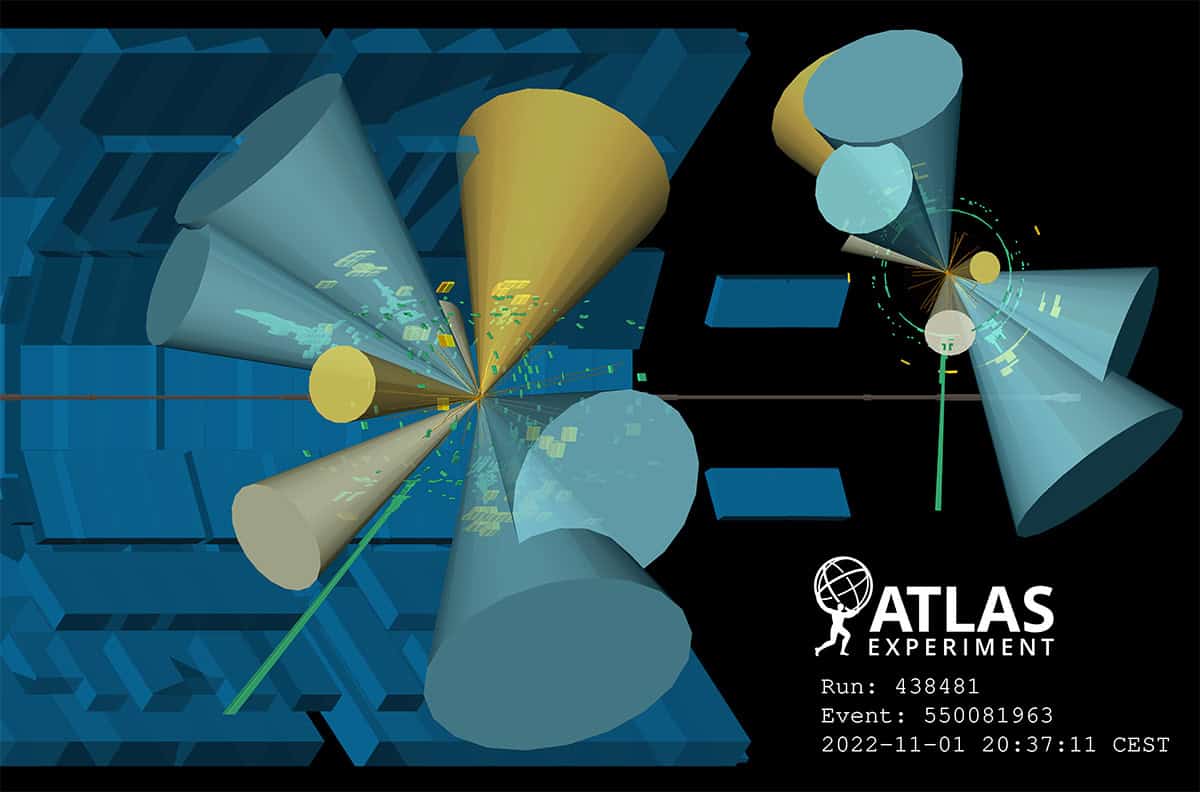
While no new particles have yet been spotted with these anomaly-detection techniques, they have progressed from theoretical proposals to real experimental searches. In 2024, for example, the ATLAS collaboration reported the results of an unsupervised anomaly-detection search using Run 2 data. No significant deviation from Standard Model expectations was observed, but the study proved that such methods can be deployed successfully on real collider data (Phys. Rev. Lett.132 081801).
The black box problem
Yet the very feature that makes these systems so powerful – their ability to rapidly identify patterns humans may miss – also raises one of the most persistent concerns surrounding AI in research: the black box problem. Modern ML systems can uncover complex relationships in data, but researchers may struggle to understand exactly how a model arrived at a particular result. In particle physics, where extraordinary claims require extraordinary evidence, that lack of transparency can create unease.
For David Sutherland, a theoretical physicist at the University of Glasgow, the greater concern is not necessarily whether researchers can interpret every internal feature of a model – but whether they can trust and reproduce its outputs. “I would certainly say reproducibility [is more important] than interpretability,” he says.
That distinction matters. Science has always relied on the principle that results should survive scrutiny, be independently verified, and withstand repeated testing. A model does not need to reveal every detail of its inner workings – but researchers must be able to demonstrate that it behaves robustly across datasets and conditions.
Particle physics, in particular, has built extensive safeguards around that process. “We have very large review committees that check basically everything that goes on,” Doglioni says, with those structures providing an additional layer of protection against over-reliance on opaque systems.
Reliability and reproducibility
Yet as AI systems become increasingly embedded in research workflows, ensuring that reliability may become more difficult. Reproducing results may require not only access to data and code, but also to model architectures, training conditions and computational environments.
Unlike many commercial AI systems, the ML tools used in particle physics are often developed by particle physicists and shared openly with the scientific community. Even so, reproducing results may require access not only to data and code, but also to model architectures, training conditions and computational environments, all of which can influence an AI system’s behaviour.
The growing use of AI could also begin to change how physicists work and even how scientific value is measured. Christoph Weniger, a physicist at the University of Amsterdam who applies ML and AI techniques to particle physics and cosmology, argues that AI systems are likely to take on an increasingly active role in navigating complex analyses. Researchers, he believes, will shift into “a supervisory role in steering these different agents”, fundamentally changing how scientists interact with data.
AI and materials science
Closed loop The autonomous AI system at Argonne National Laboratory can speed up materials discovery. The AI proposes candidate materials, which can then be created and tested by robotic laboratories, with the results fed back into the system to guide the next round of experiments. (Courtesy: iStock/K-Kwanchai)
Particle physics is far from the only field exploring how AI might reshape scientific discovery. Researchers at Argonne National Laboratory in Illinois, US, recently developed what they describe as an AI adviser for designing advanced electronic materials.
Normally, materials discovery proceeds through a slow cycle of trial and error. Scientists propose a candidate material, synthesize it in the laboratory, test its properties and then refine the design. Each iteration can take days or weeks.
The Argonne system closes that loop. AI proposes candidate materials, robotic laboratories create and test them, and the results are fed back into the system to guide the next round of experiments.
Rather than analysing data after experiments are complete, AI becomes involved in deciding which experiments to perform in the first place, an early glimpse of what future “AI scientist” systems might look like.
The approach has already demonstrated its potential. In 2023 researchers at Argonne and collaborators reported that their autonomous A-Lab platform conducted 355 experiments in just 17 days and successfully synthesized 41 novel materials (Nature 624 86). The work provided one of the clearest demonstrations that AI systems can help guide experimental discovery rather than simply analyse data after the fact.
Creative impact
Such changes could extend beyond day-to-day workflows. Traditionally, the currency of academic research has been publications. But Weniger suggests that AI may shift the emphasis away from productivity alone and towards something harder to quantify: originality.
Scientific value may increasingly depend not on how many papers a researcher produces, but on the creativity and impact of the questions they ask
As routine technical barriers to experiments and theoretical work become easier to overcome, he argues that scientific value may increasingly depend not on how many papers a researcher produces, but on the creativity and impact of the questions they ask.
The effects may also extend to how scientific knowledge is communicated. The scientific literature has long been criticized for being difficult to navigate, not simply because of its volume, but also because of the way researchers write. Nichol Furey, a mathematical physicist at Humboldt University of Berlin whose work explores whether there is an underlying algebraic logic to the structure of the Standard Model, believes AI could help bridge that gap.
“Authors in maths and physics often write in ways that are overly opaque,” she says. “AI systems write with their audience in mind, whereas human authors often don’t.” Yet that possibility creates a tension. The same tools that can make research more accessible can also make scientific text dramatically easier to produce.
Communities are already beginning to grapple with the unintended consequences of widespread AI adoption. Recently, arXiv, one of the world’s largest repositories for physics and mathematics preprints, announced a crackdown on unchecked AI-generated submissions. It said it was introducing one-year bans for authors who upload papers containing obvious signs of unverified AI content, such as hallucinated references or leftover chatbot instructions.
The move reflects growing concern about the quality of AI-assisted scientific writing. Although arXiv’s new policy is too recent for its impact to be fully assessed, the threat of a one-year ban marks one of the strongest responses yet by a major scientific repository to unchecked AI-generated content.
The concern is not simply that AI can generate poor research. Now that producing scientific text is an almost frictionless exercise, the burden of judgement shifts increasingly onto readers, reviewers and future researchers trying to separate genuine insight from noise.
Training future physicists
Another potential problem with AI’s infiltration in many areas of research is training the next generation of physicists. This is generally a long process, where expertise is built gradually through years of practice and failure. If AI automates many of those steps, researchers may eventually face an uncomfortable question: how do you train future experts if the work that once trained them disappears?
This challenge extends far beyond physics. Across the education sector, schools and universities are already grappling with the ease with which generative AI can produce essays, solve problem sheets and complete programming assignments in seconds.
Education gap How do you reliably train the next generation of physicists when generative AI can produce essays, solve problem sheets and complete programming assignments in seconds? The problem is compounded if AI takes over the repetitive routine tasks historically given to students and postgrads to hone their skills. (Courtesy: iStock/Thai Liang Lim)
In fact, Wrishik Naskar, a particle theory postdoc at the DESY laboratory in Germany, wonders if research habits are also beginning to change. “When I get stuck, I go to my supervisor,” he says, “[but] many people, the first thing they ask is ChatGPT.” That approach might speed things up, but does it really help a researcher learn and grow? As Naskar puts it: “Focus on the learning. Results will follow if you have skills.”
Despite the many concerns, not everyone sees the transition to AI as a threat, and framing AI as a competitor to researchers may miss the point entirely. For example, Admir Greljo, a particle theorist at the University of Basel, believes the real shift is not replacement but collaboration. “It’s not that they will compete against AI. Entering into theoretical physics is still going to be very interesting and very important. AI is not competition, it’s a new tool.”
That perspective echoes a broader historical pattern. Physicists once calculated by hand, then with slide rules, then with computers. Each technological leap changed how research was done and prompted fears about what skills might be lost along the way. Yet rather than eliminating physicists, those tools expanded what physicists could ask.
Towards an AI scientist?
AI may simply be the next step in that progression. But it also presents something new. Unlike previous tools, AI can suggest ideas, identify patterns and increasingly participate in parts of the scientific process that once seemed uniquely human. So might that participation one day become independence? Could AI move beyond assisting physicists and begin carrying out the entire research process itself?
For Sutherland, a future in which AI systems perform the entire research cycle, from generating hypotheses to collecting data and even writing papers, is not difficult to imagine. But he still envisages a human “steering it” and acting as a “sanity check”, much like the relationship between a senior researcher and a PhD student.
Others go further. Greljo believes that fully autonomous scientific systems may not arrive in the near future, but sees no fundamental reason why they could not emerge eventually. Because science ultimately depends on reproducible results, he argues, humans could simply repeat calculations and test predictions to verify whether the AI had reached the right answer. Such a future, he says, is “not something that is impossible”.
We may be entering a world where machines help us uncover truths about the universe faster than we can fully understand them
We may be entering a world where machines help us uncover truths about the universe faster than we can fully understand them. But that need not signal the end of scientific inquiry. It is important to remember that AI models, much like many of the models used throughout scientific research, are imperfect and may always remain so. But perhaps they do not need to be perfect.
Science has always involved navigating uncertainty, constructing incomplete models and refining them over time. AI may help us discover things faster than ever before. It may reshape how future generations of physicists learn, work and think. But science has never simply been about generating results. It has also been about explanation, curiosity and deciding which questions are worth asking in the first place.
We should not treat AI as an oracle that bypasses the scientific method. Instead, we should view it as another tool in the physicist’s arsenal – a powerful one, certainly, but still a tool, helping researchers explore possibilities, test ideas and refine their models of reality.
After all, the problem with Deep Thought was never that it gave the wrong answer. It was that nobody knew what question they had asked.
The challenge for the next generation of physicists may not be deciding whether AI can discover new truths about nature. It may be making sure we still know which questions are worth asking.
How do you think AI is changing the face of physics? What are the threats and opportunities it poses – and what happens if AI produces answers we cannot understand?
A compact optical technology that has already proved its worth in Earth-bound applications could be on its way to space after researchers at the University of California San Diego, US showed that it can map the Sun’s magnetic field just as well as traditional instruments. By making polarization gratings from specially engineered metasurfaces rather than a complex assembly of optics, the researchers say that future solar-observing missions could benefit from reduced complexity and cost as well as size.
“Our work makes use of recent advancements in nanoscale optical technologies to help improve the hardware for making astronomical observations of the Sun,” says study leader Noah Rubin of UC San Diego’s Jacobs School of Engineering. “We believe this is one of the first times that metasurface optics – which have been a subject of intense interest in both academic research and industry for about a decade – have been used to improve scientific instrumentation of any kind outside of a lab/academic proof-of-concept.”
Polarized light and solar magnetic fields
Although light emitted by the Sun is generally unpolarized – that is, the light waves do not vibrate along a particular axis – strong magnetic fields that develop near sunspots can polarize this light via the quantum mechanical Zeeman effect. These magnetic fields are closely associated with space weather events such as solar storms that can damage electronic infrastructure both on Earth and in orbit. Studying the Sun’s magnetic activity by monitoring areas of polarized light is thus an important step towards detecting or predicting such storms in time to take protective action.
Usually, measuring the polarization state of light means analysing different polarization directions using a device such as a waveplate that mechanically rotates between exposures. Rubin compares this process to taking several photographs through polarized sunglasses held at different angles, then combining them to obtain a fuller picture of what’s going on.
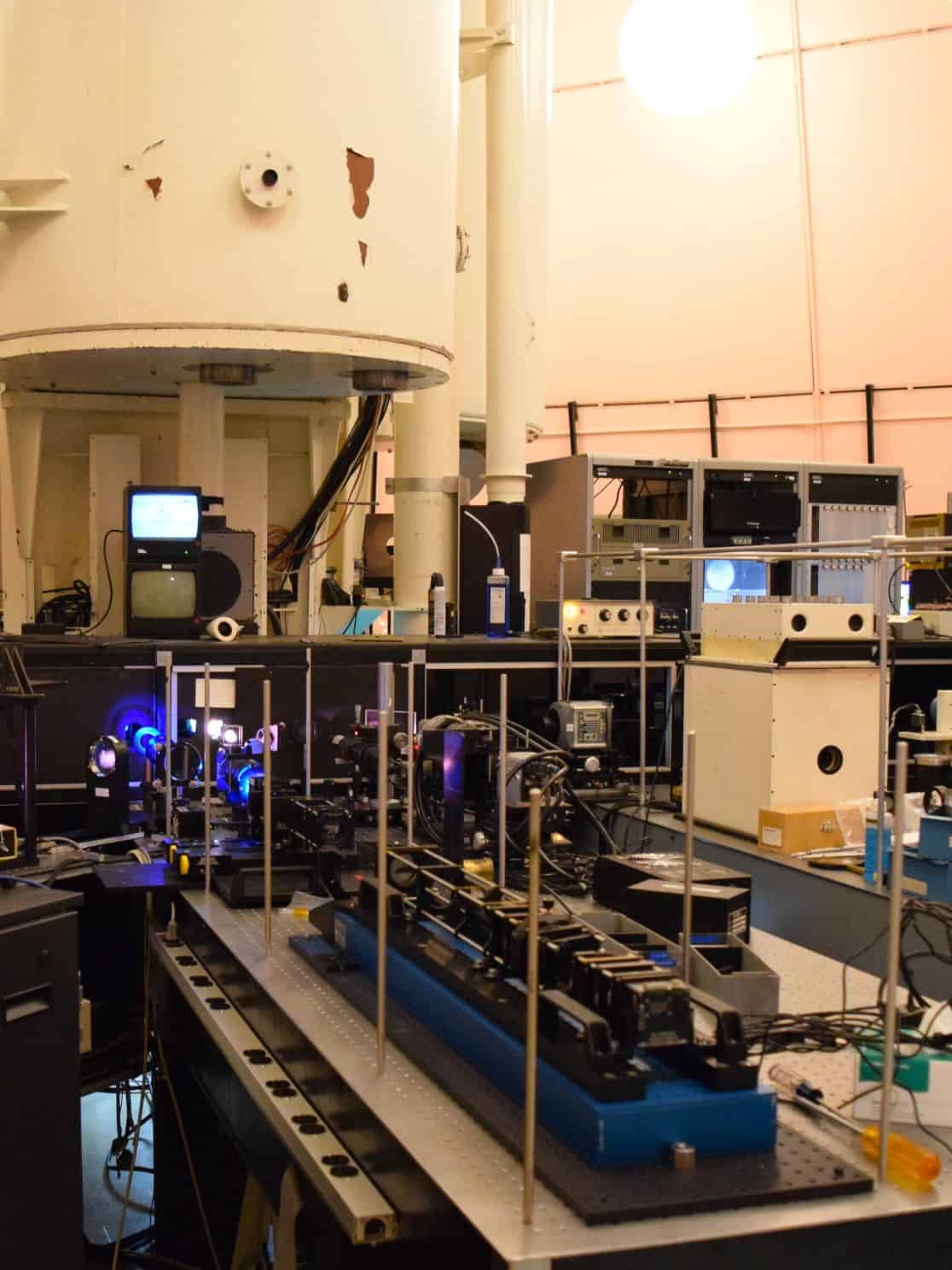
Test rig: Sunlight from the top of the Dunn Solar Telescope’s 136-foot-tall tower travels 228 feet underground and is reflected back up to this room at ground level, where it passes through an optical system (blue lights, background) before reaching the team’s custom-built telescope (foreground). (Courtesy: Noah Rubin)
While this technique works, and instruments that use it have already been sent into space, the image analysis process is very time-consuming. It also requires an external power source, and the need to mechanically rotate the waveplate introduces extra complexity and cost, says Rubin.
“In space-based applications, a satellite itself can be moving while this component reorients, causing a highly undesirable blurring effect,” he explains. “As a result, designers of these systems often invest considerable resources into mechanical remediation and engineering to correct the motion of the telescope on the satellite, and this frequently ends up being substantially more expensive than the telescope optics themselves.”
A metasurface solution
In the new study, which is detailed in Science Advances, Rubin and colleagues solved this problem by creating a polarization-sensitive metasurface that splits light into its different polarization components. A camera-like system containing this metasurface polarization grating can then form multiple images of a scene in parallel. Rubin explains that each image in this scene is analysed with respect to a different polarization state, meaning that the system can measure the polarization of light simultaneously and passively in a single camera frame.
Working with industrial partners at BAE Systems Space & Mission Systems in Colorado, US (formerly known as Ball Aerospace, which Rubin describes as “well-known for its involvement in the development of the James Webb Space Telescope, Hubble and countless other NASA missions”), the team designed a specialized telescope built around such a metasurface polarization grating. They also deployed their instrument on the Dunn Solar Telescope in New Mexico, US, and showed that they could quantitatively map the magnetic fields in sunspots by capturing simultaneous polarization images of these spots.
The researchers report that their results were comparable to those obtained by the state-of-the-art NASA Solar Dynamics Observatory mission in-orbit, highlighting what Rubin calls “the significant advantages that these metasurface components can offer when designed in conjunction with more traditional optical systems”. The UC San Diego team is now exploring ways of integrating its technology into future NASA solar-observing space missions.
For decades, the Outer Space Treaty (OST) has prevented any nation from placing nuclear weapons in space. To date, however, no mechanisms have been put in place to determine whether a signing member’s satellite may be violating this treaty, or even developing other nuclear capabilities that the original treaty never considered.
Through new analysis of the problem, Areg Danagoulian at MIT suggests a safe and feasible approach to monitoring suspicious satellites, using neutrons emitted as radioactive material is impacted by naturally occurring protons in the Van Allen radiation belt.
At the height of the Cold War in the 1960s, there seemed a growing possibility that space could be used as a platform for developing nuclear weapons. With the prospect of nuclear strikes being launched from orbit with practically no warning, both the US and Soviet governments recognised the possibility of miscalculations by either side leading to a catastrophic nuclear conflict.
In 1967, this led to the signing of the OST: which in part, demands that no signing member should ever deploy nuclear weapons in orbit, on celestial bodies or in outer space. Today, it has been signed by 117 countries, including the US, Russia and China. However, in the decades since the treaty’s origins, both political and technological landscapes have profoundly transformed, creating entirely new concerns that nobody could have conceived in the 1960s.
“In 2022, Russia launched the Kosmos 2553 satellite, which the US has determined is a platform for testing components for a future nuclear anti-satellite weapon,” Danagoulian says. With the ability to target orbiting satellites, such a programme could ultimately destroy vital communication and navigation systems – bringing society to a standstill without any direct strike on the ground.
Despite this threat, no robust mechanism has ever been developed for verifying whether a country is violating the OST, and to date, very little research has even considered the problem.
To Danagoulian’s knowledge, the only related study was an undergraduate thesis by Stanford University student Isobel Portenous – who proposed that suspicious satellites could be probed for nuclear material by measuring radioactivity in the vicinity. However, not only is space already highly radioactive, likely drowning out the signal from a single satellite; it would also require spacecraft to closely approach the satellite, which could be interpreted as a hostile act.
To address this challenge, Danagoulian considered how satellites could instead by probed by naturally occurring, highly energetic protons in the Van Allen radiation belt: which mostly originate from the solar wind, and become trapped by Earth’s magnetosphere.
When interacting with nuclear material in a suspect satellite, “these protons would trigger a process known as spallation in the uranium radiation case of the thermonuclear weapon,” Danagoulian explains. “This would produce a large flux of neutrons that can be detected and used as a fairly specific signature of a nuclear weapon.”
Crucially, the kind of device needed to detect these neutrons wouldn’t need to be too close to the satellite. From a distance of 4 km, Danagoulian calculated that a standard CubeSat detection platform could accurately determine the composition of the nuclear payload of a satellite like Kosmos 2553, within just a week of measurement time.
For now, much more work will be needed before this kind of mechanism can be realistically applied. “Uncertainty remains regarding whether this approach will be practical, so much work is still needed,” Danagoulian says. “Can one build a reliable detector array to perform this measurement? That’s to be determined.”
Yet if these hurdles can be overcome, they could provide a valuable new layer of security in a fast-changing world, and could potentially guide new international policy decisions. “The required physics and basic technology are available to solve this problem,” Danagoulian continues. “If an inspector satellite can be built, it will finally create a mechanism for verifying the OST.”
In 2008 the US author Neal Stephenson published a speculative fiction novel called Anathem. Set on the fictional planet of Arbre, the story follows an order of monks, mostly isolated from the rest of the world, who every so often open up their doors to receive information on the state of the outside world.
In the book, Stephenson explores a Dark Age of the Internet, in which companies flood the network with plausible-sounding-but-false information in a ploy to force consumers to buy the firms’ own tools for distinguishing truth from falsehood.
Initially, this “crap”, as Stephenson calls it, had to be made by humans, but eventually the process is run by a so-called “Artificial Inanity”, which is able to create hundreds or thousands of bogus versions, or “bogons”, for every legitimate document.
Today, we face our own version of Stephenson’s Dark Age as our information landscape increasingly fills with AI slop, now going beyond AI-generated videos of uncanny kittens or images depicting politicians and celebrities in outlandish situations.
With the rise of chatbots powered by large language models (LLMs), our search results, social-media feeds and even scientific journals are getting polluted with data that, at first glance, appears relevant and plausible but contains no value beneath its gilded veneer.
As LLM-generated slop infects our previously trusted knowledge base, we face an information landscape that is quickly rotting beneath us.
As scientists, we must position our work in relation to other recent research. Yet that task gets harder when we have to sort out the real from the hallucinated. As LLM-generated slop infects our previously trusted knowledge base, we face an information landscape that is quickly rotting beneath us.
Where we could once track an idea to a paper with human authors (who bore consequences for acts of fraud), we face a future where we have to question whether an article’s authors, institutions or experiments ever existed, on top of evaluating its scientific merits.
This is not a hypothetical danger. In 2024 a team led by medical researcher Almira Osmanovic Thunström at the University of Gothenburg invented a fictitious medical condition called “bixonimania” and publicized it through posts on Medium and two pre-printpapers.
Their goal was to test whether AI chatbots would pick up and propagate word of the fake disease, which they duly did. The researchers even tried to insert information that made the work obviously fake. This included acknowledging a colleague from Starfleet Academy, thanking the University of Fellowship of the Ring for funding, and even writing early on in the article that “this entire paper is made up”.
Trapped in a bog
As physicists, we are not immune to the dangers of information rot. A flood of LLM-generated articles prompted arXiv in May to announce consequences for authors whose submissions have “incontrovertible evidence that the authors did not check the results of LLM generation”, including having “hallucinated references”. Those consequences include a one-year ban from arXiv and the requirement, thereafter, that any submitted paper must already be accepted at a “reputable peer-reviewed venue”.
I initially welcomed the news. Harsh consequences are one way to discourage LLM usage, especially for sloppy shortcuts. But the more I reflect on it, the more I realize that arXiv’s consequences could eventually fall even on those who are not using LLMs to write their papers.
Relying on shortcuts is easy. Say you’re writing a literature review and paper A, which you’ve read and trust, has a fact you want to cite – but you notice that paper A cites paper B for this fact. It’s simple to scroll down to the reference section and copy paper B’s citation into your own citations (I would be lying if I said I’ve never done this myself).
But as the information landscape rots, this shortcut could run you afoul of policies like arXiv’s. What appears to be a valid citation – maybe even containing the names of authors you know personally – can be hallucinated.
We must double down on the skills that make us experts – our scientific judgement, information literacy, communication skills and careful scholarship.
Or it could be entirely fake, as a team of researchers who cited one of the “bixonimania” pre-prints in a peer-reviewed article discovered. Their paper was justifiably retracted by the journal editor, over their objections. By simply copying a reference without double-checking it, you can unintentionally join ranks alongside LLM users. Worse, you open yourself and all of your co-authors to being banned from arXiv.
I am not suggesting that arXiv’s policy is flawed. Rather, I argue that those who intend their writing to be AI-free must be vigilant. We must double down on the skills that make us experts – our scientific judgement, information literacy, communication skills and careful scholarship. We should lean into practising these skills – and teaching them – even though they are precisely the skills that AI companies claim LLMs can replace.
In Anathem, a character simply hand-waves away their Internet full of bogons, but we have no such solution. Instead, as our information landscape rots, we find ourselves trapped in a bog. To get out, we must plan each step carefully and take none for granted. What appears to be solid ground may well prove treacherous. Moving safely is a slow process, full of checking and double-checking as we painstakingly build out paths and tools we can trust.
Simply choosing not to use an LLM when writing is no longer enough. We have only our own scholarly skills to sort the bogons from the ground truth. We will all have to slow down if we want out of the bog.
Specially engineered materials known as metamaterials can boost heat transfer over nanoscale distances compared with conventional materials, thanks to the coupling of quasiparticles known as surface phonon polaritons. This new result, from researchers at Carnegie Mellon University, Stanford University and Purdue University, all in the US, could help improve technologies such as on-chip cooling and thermophotovoltaic systems.
The maximum radiative heat transfer between two macroscopic-sized objects at different temperatures can be estimated by assuming that the objects are “black bodies”. These are ideal entities that absorb all the radiation falling on them and emit thermal radiation according to Planck’s law. This approximation breaks down, however, when the objects are placed within a few hundred nanometres of each other. In this case, they begin to exchange heat much more strongly thanks to a phenomenon known as near-field enhancement, which can exceed the far-field black body limit by several orders of magnitude. This effect is already put to good use in technologies such as heat extraction and thermophotovoltaic systems.
Until now, near-field enhancement had only been observed and studied in naturally occurring materials, such as polar dielectrics, doped semiconductors and metals, explain the study leaders, mechanical engineer Sheng Shen at Carnegie Mellon and electrical engineer Shanhui Fan from Stanford. Although theoretical studies have predicted that metamaterials could surpass the performance limits of naturally occurring materials, there had not previously been any experimental demonstration of metamaterial-enhanced near-field radiative heat transfer. Identifying such metamaterials would be of great use as it would allow the effect to be exploited more widely.
Heat transfer increased by up to four times
Shen, Fan and colleagues observed enhanced near-field radiative heat transfer in a nanodevice platform comprising metamaterials based on arrays of gold split-ring resonators patterned on silicon nitride membranes. The researchers positioned the metamaterials so that they faced each other across a nanoscale gap, observing that heat transfer between them increased by as much as four times compared with similar setups using ordinary materials.
As well as confirming that radiative heat transfer is enhanced over short distances for these metamaterials, the results suggest that the interaction between metamaterials and surface phonon polaritons is responsible for the increase. These quasiparticles are produced by phonons, which are vibrations of the crystalline lattice, as they interact with oscillating electromagnetic fields at the material surface – in this case, those at the surface of the gold metamaterial structures. This coupling allows heat to tunnel across the gap between them and the silicon nitride membranes more efficiently – something that increases the energy flow between the two, explains Shen.
Heat management applications
According to the researchers, the effect could help enhance and manipulate heat exchange at the nanoscale and could find applications in next-generation cooling for high-performance microelectronics, thermophotovoltaic systems for waste-heat harvesting and high-sensitivity infrared detection.
There are still a number of challenges to overcome before such applications see the light of day, however. On the theoretical side, notes Fan, the complex interactions between the metamaterial units and their supporting substrate make numerical calculations and analyses exceptionally difficult. “To address this difficulty, we have developed a numerical tool based on fluctuational electrodynamics to design the structures, alongside a coupled-mode theory model to fully elucidate the underlying physics,” he says.
Experimentally, measuring nanowatt-level radiative heat exchange across a sub-micron gap also demands extreme precision. The researchers tackled this challenge by designing an on-chip device using a “suspended thermal bridge” method that transforms the minute heat exchange into a measurable temperature rise. Indeed, they succeeded in detecting heat flow of less than 1 nW in these nanodevices.


 Another entrepreneur featured in this briefing is Brian Pogue, co-founder of DoseOptics. The US-based company has developed a system that detects the extremely faint Cherenkov light that is emitted when a radiotherapy beam strikes a patient’s skin. This allows the radiotherapy to be monitored in real time, ensuring that the beam passes through the target tissue and avoids healthy areas of the body.