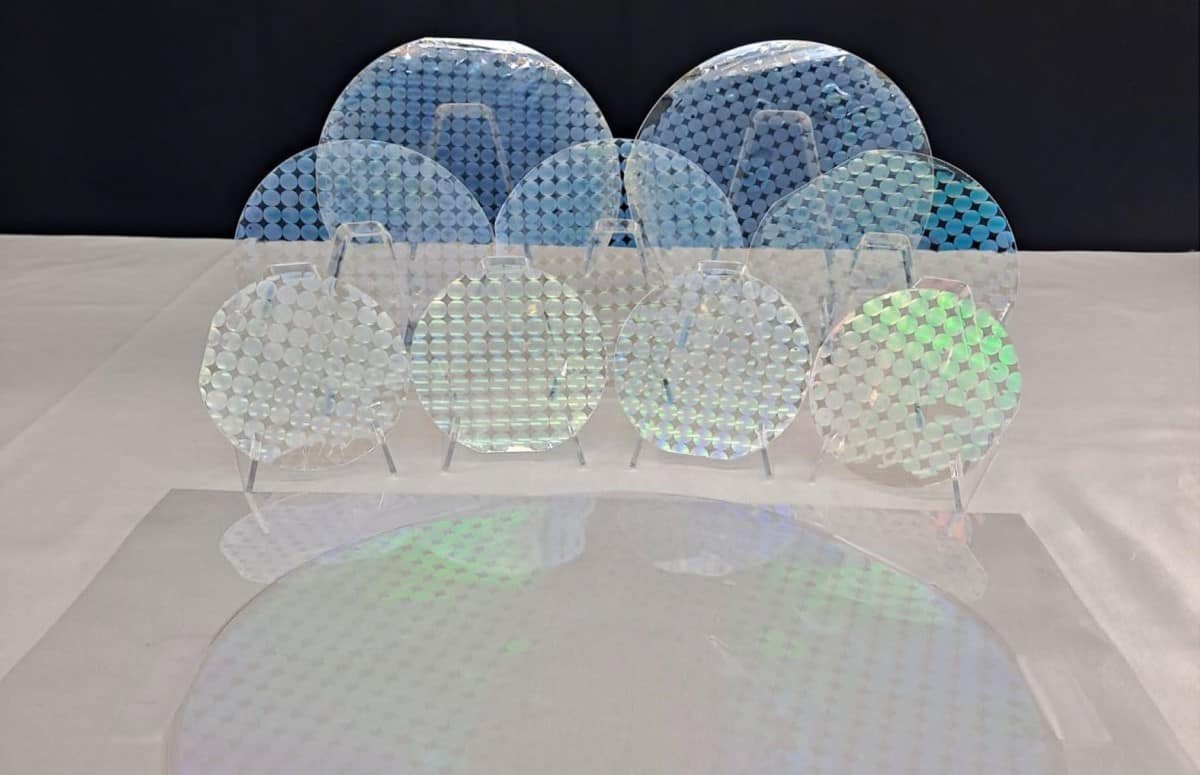
On display: photograph of scalable 1-cm diameter metalenses on 4, 6, 8 and 12-inch wafers. (Courtesy: Joohoon Kim/Nature Materials)
From eyeglasses to space telescopes, lenses play crucial roles in technologies ranging from the mundane to the cutting edge. While traditional refractive lenses are a fundamental building block of optics, they are bulky and this can restrict how they are used. Metalenses are much thinner than conventional lenses and in the last two decades plenty of light has been shone on the potential of these devices, which sparkle as a promising alternative.
Metalenses are thin structures made of arrays of “meta-atoms”, which are motifs with dimensions that are smaller than the wavelength of light. It is these meta-atoms that interact with light and change its direction of propagation.
Unlike conventional refractive lenses, metalenses can be less than one micron thick, reducing the overall volume of optical systems. They can also provide ideal diffraction-limited focusing performance, while avoiding some problems associated with refractive lenses such as aberrations.
As a result, metalenses show great promise for shrinking optical devices, which could be useful in a range of applications from better mobile-phone cameras to less bulky wearable displays. However, due to the nature of their intricate design and their material requirements, metalenses have yet to reach mass-manufacturing at reasonable feasibility and cost. Now, a team of researchers in Pohang University of Science and Technology (POSTECH) in South Korea, led by Junsuk Rho, has developed a new method of fabricating hundreds of centimetre-sized metalenses all at once. In a paper published in Nature Materials, they describe how they used several different lithography techniques and hybrid materials to create metalenses for use in displays and virtual reality (VR) devices. In particular, they show how nanoimprint lithography, or nanostamps, can provide a low-cost scalable way of producing metalenses.
When conventional thick lenses are used in optics, light is refracted as it travels between air and the lens material, and vice versa. It is this refraction that changes the path of the light and therefore it is the shape of the lens and its refractive index that is the basis for controlling light.
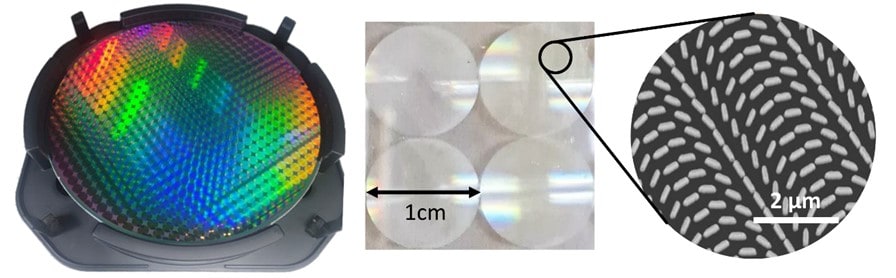
Production process: the silicon master stamp (left), metalenses (centre), and SEM image of the metalenses (right). (Courtesy: Joohoon Kim/Nature Materials)
Refractive index and shape still matter in metalenses. But, because a metalenses is macroscopically flat, it is the shape and composition of the meta-atoms that define a device’s optical properties.
The team’s hybrid meta-atoms are made of a titania-covered resin that is moulded onto the surface of glass substrates of various size as shown in the figure “On display”. The meta-atoms are 900 nm tall, 380 nm long, and 70 nm wide. The titania coating is only 23 nm thick. This type of high-resolution nanopatterning is traditionally expensive and can only be used to cover small areas at one time.
Silicon technology meets nanostamping
Now, Rho and colleagues have simplified the production of metalenses by integrating three already mature fabrication technologies. These are photolithography, nanoimprint lithography and atomic layer deposition. Photolithography involves using deep-ultraviolet lasers to create patterns on silicon wafers. This is a standard technique in the electronics industry and it can also be used to make small-scale metalenses. However, it is an expensive process that is not viable for the large-scale manufacturing of metalenses.
Instead of using deep ultraviolet photolithography to make the metalenses, it was used by the team to pattern a master stamp that was 12 inches (30 cm) across and had a feature resolution of 40 nm (see figure “Production process”). The stamp was used to imprint the inverse of the meta-atom structure in a replica mould made of soft silicone. Liquid resin was then poured into the silicone mould, where it flowed into the nanogrooves before hardening. This allowed the team to make hundreds of metalenses (the 1 cm cylinders in figure 2) at the same time. Indeed, the sophisticated surface structures shown in the scanning electron microscope image (see figure “Production process”) can be made in less than 15 minutes.
Prototype display: VR images produced using a passive display using metalenses. (Courtesy: Joohoon Kim/Nature Materials)
The refractive index of the resin is too low to provide the desired control of light, so a thin layer of titania was deposited on top of the resin to increase the index of refraction as well as to boost the mechanical strength of the structure.
Let there be light VR
To demonstrate the potential of the metalenses, the team integrated them in a prototype VR display. Commercial VR devices use reflection or diffraction to project virtual images to the eyes of the user – and this results in bulky devices that must accommodate the appropriate focal length for the optics. Their metalens-based VR display reduces the distance the light has to travel by using a transmission-based design. This makes the display lightweight and comfortable to wear. Although the team only tested the display with static images, the device showed promise by creating images using red, green and blue light; the building blocks of all-colour displays (see figure “Prototype display”).
The researchers say that their scalable fabrication method produces metalenses with higher performance than devices made using more traditional methods. While there is still a lot of room for progress, the advent of mass-produced metalenses opens the door for their use in biosensors, colour printing and holograms – as well as VR displays.
MRI-guided radiotherapy systems offer the ability to visualize tumour targets and surrounding organs with high accuracy, with the potential to perform real-time treatment adaptation based on anatomical changes. And for moving tumours, imaging during treatment can ensure that the radiation beam remains focused on the target to maximize healthy tissue sparing.
To mitigate the impact of respiratory motion, for example, one option is to perform gating. The Elekta Unity MR-linac is equipped with an automatic gating functionality in which a comprehensive motion management (CMM) system continuously monitors the 3D tumour motion. Radiation is only delivered when the target lies within a specified gating envelope – when it moves outside of this region, irradiation is paused.
“Although this is highly effective, it means that treatment time is drastically increased,” said Prescilla Uijtewaal from the University Medical Center Utrecht. “Therefore we would like to do multileaf collimator [MLC] tracking instead of gating.”
Speaking at the recent ESTRO 2023 congress in Vienna, she described the new MR-linac tracking approach. The idea is to use the position of the tumour measured by the CMM not to gate the beam, but to move it towards the tumour location using MLC tracking (in which the collimator leaves are shifted to match each new position).
To validate this workflow, Uijtewaal and colleagues developed a dosimetric insert jointly with Medscint and ModusQA that contains gafchromic film plus an array of eight plastic scintillation detectors positioned at the centre and edges of the target. Film dosimetry is low cost and can create 2D dose maps, while scintillators enable instantaneous dose read-out and time-resolved dosimetry. “Combining the two in a single insert provides great dosimetric analysis,” Uijtewaal pointed out.
The insert is designed to fit inside the MR-compatible Quasar MRI4D phantom, which can be programmed to move with patient-derived respiratory motion patterns. The researchers created an intensity-modulated radiotherapy (IMRT) plan for delivery to a 3 cm spherical target in the phantom. They used the dosimetric insert to compare the planned versus the measured dose, for static delivery, motion with MLC-tracking and motion with no-tracking scenarios.
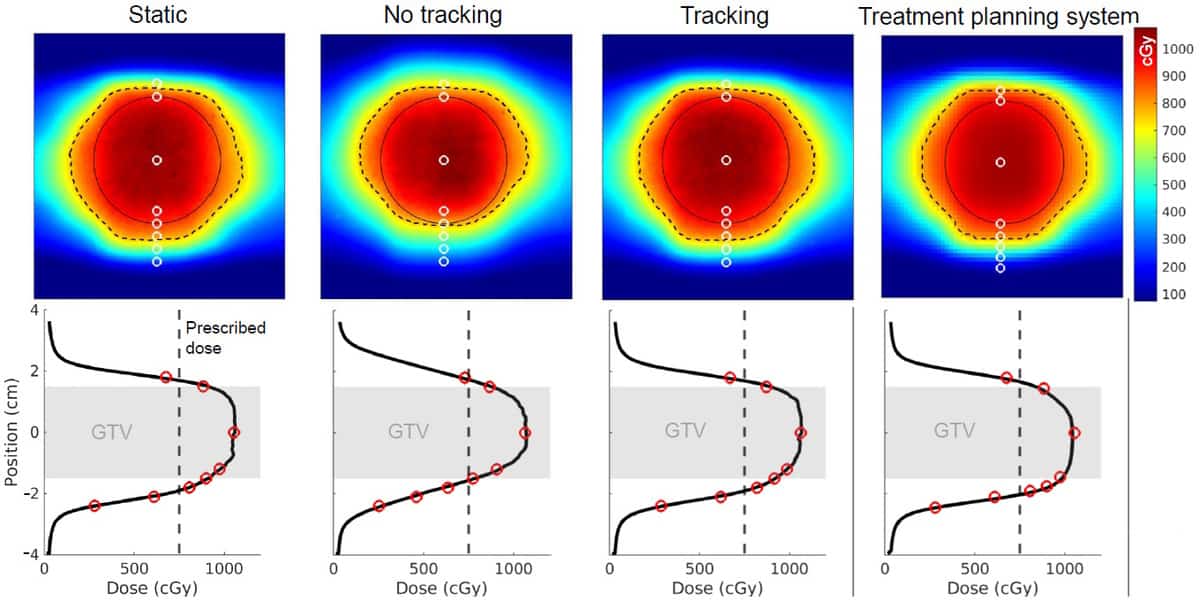
Dual dosimetry Measurements from the film (top row) and scintillators (bottom row) in the dosimetric insert. The scintillator positions are shown as white circles on the dose maps. (Courtesy: Prescilla Uijtewaal)
Film measurements revealed that dose maps from plans delivered without tracking differed significantly from the static dose map, with large hot and cold spots at the edges of the target. Applying MLC tracking based on the CCM’s motion vector restored the dose map back to that seen with static delivery, with extremely small differences between the delivered and the planned dose.
The dose measured by each scintillator matched well with the value at the corresponding location on the 2D dose maps. The researchers also used the time-response component of the scintillators to analyse the dose over 400 s with 15 Hz temporal resolution. They assessed the dose measured by all eight scintillators, again in static, tracking and no-tracking scenarios.
“We saw that the tracking dose followed the static dose really well, which means that the tracking was really effective,” said Uijtewaal. “We also saw that both the static and the tracking dose agreed well with the treatment planning system.” Without tracking, measurements deviated significantly from the planned dose, particularly for scintillators located at the caudal edge of the target.
Uijtewaal concluded that “the MR-linac’s comprehensive motion manager is compatible with MLC tracking, facilitating a pre-clinical MLC tracking workflow”. Next, she said, her research group (headed by Martin Fast) plans to enhance the tracking workflow to work towards clinical implementation of MLC tracking on the MR-linac. The team also hopes to increase the number of scintillation detectors, to increase coverage and ultimately implement 3D dosimetry.
This short video, filmed at the APS March Meeting in Las Vegas, focuses on the developments in quantum computer technology at HRL Laboratories. As Eric Williams, the company’s director of talent acquisition, explains, HRL Laboratories used to be known as Hughes Research Laboratories. With headquarters in southern California, HRL’s achivements include the development of the first-ever laser in 1960.
Teresa Brecht, a research scientist at HRL Laboratories, then explains the company’s contributions to finding a fault-tolerant quantum computer for the future. She talks about the variety of semiconductor qubit-in-silicon that she works on, called the exchange-only qubit. This qubit, she says, is small and similar enough to classical transistors that it can be manufactured at scale – and has a similar control paradigm to classical computers too, in that it operates by turning pulses on and off.
Another advantage is that, relative to other qubit approaches, the exchange-only qubit largely avoids the problems of cross-talk – meaning that it can do individual exchange pulses with “five nines of fidelity, 100 million times a second”. Brecht also points out that HRL Laboratories’ recent Nature paper shares their multi-qubit results with 97% fidelity.
The silicon-based exchange-only qubit approach that HRL Labs has demonstrated at small scale, Brecht concludes, may be a very promising pathway towards operating a fault-tolerant quantum computer for the future.
“You owe me a new mobile,” grumbled Samuel J M M Alberti’s colleague after his daughter spotted her iPhone model in the new collection of National Museums Scotland. Like most people, the girl associated museums with historical artefacts and had concluded her phone was a relic that needed replacing right away. “Never mind that the exhibit was showing contemporary technology,” says Alberti in the introduction to his new book Curious Devices and Mighty Machines: Exploring Science Museums. “In her mind the museum was indelibly associated with bygones.”
But they have a wider remit, according to Alberti, who is director of collections at National Museums Scotland. As he goes on to explain, “Museums collect old and new, tangible and intangible, but most of all, they collect stories.” In fact, the organization, which oversees four museums including the National Museum of Scotland in Edinburgh, has been acquiring iPhones for a decade as an extension of its existing collections on communication, which begin with telegraphy.
Curious Minds and Mighty Machines is an experienced and enjoyable exploration of diverse aspects of the past and present of science museums
So how did curators choose from the two dozen iPhone models available and the billion handsets sold? In his chapter on collecting, Alberti explains that they went for handsets with stories. This thinking follows the example of, say, the National Museum of American History, where one of the most significant Apple products on display out of over a hundred is a simple Apple adapter that was found at the site of the World Trade Center following the attacks of 11 September 2001.
Thus each iPhone that National Museums Scotland has collected has a story. One was a prize in an online competition, shipped to Scotland in November 2007, just before the launch of the first-generation iPhone in Europe – making it perhaps one of the earliest examples to be used in the UK. Another handset was used by prominent videogame designer Mike Dailly, of YoYo Games, to develop Simply Solitaire (released in 2010), which was once Apple’s most popular free app. Meanwhile, an iPhone 3GS in the collection belonged to the photojournalist David Guttenfelder, who used it to take award-winning photographs of conflict zones for online channels such as Instagram, on which he was an early pioneer.
Curious Minds and Mighty Machines contains many such stories. Alberti covers the ins and outs of how a science museum functions and the qualifications of curators. He talks about how objects are presented in permanent displays, temporary exhibitions and on the Internet to engage visitors of all ages, including young children. He also examines how science museums can be used to campaign against, for example, climate change and racism. In addition, we discover the treasures of museum storerooms, ranging from the microscopic to the mighty. Throughout, Alberti refers to most sciences and many collections, both well-known and not so familiar, but he keeps mainly to Europe, the US and Canada, with a particular focus on Scotland.
Given such a rich and varied subject, it is inevitable that certain museums, collections and objects are not included, but some of these omissions seem odd considering their significance. There is, for example, surprisingly little coverage of the history of computing. Indeed, the word “computing” does not even appear in the book’s index. Pioneers of computing such as Ada Lovelace and Alan Turing go unmentioned, while there is no reference to the National Museum of Computing at Bletchley Park.
The History of Science Museum in Oxford – located in the world’s oldest surviving purpose-built public museum building – is underestimated. Its early history from 1924 is only briefly touched upon, and little is said of its distinguished objects. Indeed, the most famous item in its collection, the blackboard that Albert Einstein used in Oxford in 1931 for his lecture on relativity and the age of the universe is completely neglected in Curious Minds and Mighty Machines.
The omission is ironic given Alberti’s talk of museums collecting stories because the blackboard is linked to a wonderful tale that began with some Oxford dons wanting to immortalize the legendary scientist’s visit. Their desire prompted historian of science Robert Gunther – who was pivotal in establishing the History of Science Museum – to request the lecture organizers to donate the blackboards. Einstein firmly opposed the idea and was annoyed when two ephemeral blackboards were taken after his second lecture. No doubt he would have found it amusing had he learned that one of them is now blank – having been accidentally cleaned in the museum! You can read about it in my Physics World feature on Einstein’s unique trip to Oxford.
Despite these questionable omissions, Curious Minds and Mighty Machines is an experienced and enjoyable exploration of diverse aspects of the past and present of science museums. The book lives up to the intriguing photograph on its cover, which a journalist described as looking like “a copper robot from the golden age of sci-fi”. It is in fact a radio-frequency accelerating cavity from CERN’s Large Electron–Positron collider, which operated from 1989 to 1995 and was donated by CERN to National Museums Scotland.
Researchers from Singapore and China have developed a swallowable X-ray dosimeter the size of a large pill capsule that can monitor gastrointestinal radiotherapy in real time. In proof-of-concept tests on irradiated rabbits, their prototype proved approximately five times more accurate than current standard measures for monitoring the delivered dose.
The ability to precisely monitor radiotherapy in real time during treatment would allow evaluation of the in situ absorbed radiation dose in dose-limiting organs such as the stomach, liver, kidneys and spinal cord. This could make radiation treatments safer and more effective, potentially reducing the severity of side effects. Measuring the delivered and absorbed dose during radiotherapy of gastrointestinal tumours, however, is a difficult task.
The new dosimeter, described in Nature Biomedical Engineering, could change this. The 18 x 7 mm capsule contains a flexible optical fibre embedded with lanthanide-doped persistent nanoscintillators. The ingestible device also incorporates a pH-responsive polyaniline film, a fluidic module for dynamic gastric fluid sampling, dose and pH sensors, an onboard microcontroller and a silver oxide battery to power the capsule.
Look inside The components within the capsule dosimeter. (Courtesy: Nature Biomedical Engineering 2023)
First authors Bo Hou and Luying Yi of the National University of Singapore and co-researchers explain that the nanoscintillators generate radioluminescence in the presence of X-ray radiation, which propagates to the ends of the fibre via total internal reflection. The dose sensor measures this light signal to determine the radiation delivered to the targeted area.
As well as X-ray dosimetry, the capsule also measures physiological changes in pH and temperature during treatment. The polyalinine film changes colour according to the pH of gastric fluid in the fluidic module; the pH is then measured by the colour contrast ratio of the pH sensor, which analyses light after it passes through the film. Additionally, the afterglow of the nanoscintillators after irradiation can be used as a self-sustaining light source to continuously monitor dynamic pH changes for several hours without the need for external excitation. The researchers point out that this capability is not yet available with existing pH capsules.
The photoelectric signals from the two sensors are processed by an integrated detection circuit that wirelessly transmits information to a mobile phone app. Once activated, the app can receive data from the capsule in real time via Bluetooth transmission. Data such as the absorbed radiation dose, and the temperature and pH of the tissues, can be displayed graphically, stored locally or uploaded to cloud servers for permanent storage and data dissemination.
Prior to in vivo testing, the researchers assessed the dose response of the nanoscintillators. They used a neural network-based regression model to estimate the radiation dose from the radioluminescence, afterglow and temperature data. They developed the model using over 3000 data points recorded while exposing the capsule to X-rays at dose rates from 1 to 16.68 mGy/min, and temperatures of 32 to 46℃.
The team found that both radioluminescence and afterglow intensities are directly proportional to dose variations, suggesting that combining the two will lead to more precise estimates of absorbed dose.
Next, the researchers validated the dosimeter’s performance in three anaesthetized adult rabbits. Following surgical insertion of a capsule in the stomach of each animal, they performed CT scans to identify the capsule’s precise position and angle. They then irradiated each animal multiple times over a 10 hr time period using a progressive X-ray dose rate.
“Our wireless dosimeter accurately determined the dose of radiation in the stomach, as well as minute changes in pH and temperature, in real time,” the team reports. “The capsule inserted in the gastrointestinal cavity was capable of rapidly detecting changes in pH and temperature near irradiated organs.”
Before the dosimeter capsule can be clinically tested, a positioning system needs to be developed to place and anchor it at the target site after being swallowed. Better and more accurate calibration of the conversion from optical signal into absorbed dose is also needed prior to clinical evaluation.
The potential of the new dosimeter extends beyond gastrointestinal applications. The researchers envision its use for dose monitoring of prostate cancer brachytherapy, for example, using a capsule anchored in the rectum. Real-time measurements of absorbed dose in nasopharyngeal or brain tumours may also be feasible if a smaller sized capsule can be placed in the upper nasal cavity.
Researchers in the US have developed a machine learning algorithm that accurately reconstructs the shapes of particle accelerator beams from tiny amounts of training data. The new algorithm should make it easier to understand the results of accelerator experiments and could lead to breakthroughs in interpreting them, according to team leader Ryan Roussel of the SLAC National Accelerator Laboratory.
Many of the biggest discoveries in particle physics have come from observing what happens when beams of particles smash into their targets at close to the speed of light. As these beams become ever more energetic and complex, maintaining tight control over their dynamics becomes crucial for keeping the results reliable.
To maintain this level of control, physicists need to predict beam shapes and momenta as accurately as possible. But beams may contain billions of particles, and it would take vast amounts of computing power to calculate the positions and momenta of each particle individually. Instead, experimenters calculate simplified distributions that provide a rough idea of the beam’s overall shape. This makes the problem computationally tractable, but it also means that much useful information contained in the beam is thrown away.
“In order to develop accelerators that can control beams more precisely than current methods, we must be able to interpret experimental measurements without resorting to these approximations,” Roussel says.
AI assistance
For the team at SLAC, the predictive power of AI, plus advanced methods for tracking particle motions, offered a promising potential solution. “Our study introduced two new techniques to efficiently interpret detailed beam measurements,” Roussel explains. “These physics-informed machine learning models need significantly less data than conventional models to make accurate predictions.”
The first technique, Roussel continues, involves a machine learning algorithm that incorporates scientists’ present understanding of particle beam dynamics. This algorithm allowed the team to reconstruct detailed information about the distributions of particle positions and momenta along all three axes parallel and perpendicular to the beam’s direction of travel, based on just a few measurements. The second technique is a clever mathematical approach that enabled the team to integrate beam simulations into the models used to train the machine learning algorithm. This improved the accuracy of the algorithm’s predictions even further.
Roussel and colleagues tested these techniques using experimental data from the Argonne Wakefield Accelerator at the US Department of Energy’s Argonne National Laboratory in Illinois. Their objective was to reconstruct the position and momentum distributions of energetic electron beams after the beams pass through the linear accelerator. “We found that our reconstruction method was able to extract significantly more detailed information about the beam distribution from simple accelerator physics measurements than conventional methods,” Roussel says.
Highly accurate predictions
After training their model with just 10 samples of data, the researchers found that they could predict the electron beams’ dynamics in a further 10 samples extremely accurately, based on simple sets of measurements. With previous approaches, several thousand samples would have been needed to yield the same quality of results.
“Our work takes significant steps towards achieving the accelerator and beam physics communities’ goals of developing techniques to control particle beams down to the level of individual particles,” Roussel says.
The researchers, who report their work in Physical Review Letters, hope the flexibility and detail of the new approach will help future experimenters extract the maximum amount of useful information from experimental data. In time, such tight control could even bring physicists a step closer to answering fundamental questions about the nature of matter and the universe.
Artificial eye: schematic of the proposed 2D mid-infrared optoelectronic retina connected to s spiking neural network. (Courtesy: Fakun Wang et al/Nature Communications/CC BY 4.0)
In the push to develop new computing systems that mimic the brain, researchers in Singapore and China have devised an artificial retina device for the perception and recognition of objects emitting mid-infrared radiation (MIR). Inspired by how human eyesight works, the neuromorphic device is a step towards better MIR machine vision, which is an important technology for medical diagnosis, autonomous driving, intelligent night vision and military defence.
Current infrared machine vision has physically separated sensory and processing units, which creates large amounts of redundant data. This is not ideal because it results in computing and energy inefficiencies. In contrast, the human visual sensory system is very efficient, with a compact retina that perceives and processes visual data – more than 80% of our brain’s receive — which is then transmitted to the visual cortex of the brain for further processing. The retina’s photoreceptors receive continuous light stimuli ,which are converted into electrical potentials, and the latter are then encoded into trains of electrical pulses called spikes. A train of spikes containing the stimulus information then travels to the visual cortex.
Inspired by the biological retina, Fakun Wang and Fangchen Hu at Nanyang Technological University in Singapore, together with colleagues, have invented an optoelectronic retina based on a 2D van der Waals heterostructure. This heterostructure consists of a layer of black arsenic phosphorus (b-AsP) on top of a layer of molybdenum telluride (MoTe2). These materials were chosen for their fast response to light and their high absorption efficiency.
Optically driven
Previous studies focused on developing neuromorphic devices that are sensitive to light with visible and near-infrared (NIR) wavelengths. This study extends the range of wavelengths to the MIR. Another important novelty of this latest research is that the encoding function is driven optically, rather than electrically, which is promising for high-speed operation.
Programmable NIR laser pulses, applied simultaneously with MIR laser pulses, encode the information into spike trains. The stochastic NIR pulses change the MIR-excited current in the device, where a spike is generated when the current exceeds the threshold value. This emulates the encoding in the human retina. The device gives a stable response to light even for a NIR pulse frequency of 100 kHz, which guarantees high-precision MIR intensity coding.
Adaptive systems
Another important feature of intelligent systems is adaptation. To adapt to its visual environment the MIR vision system should have a wide dynamic working range of MIR intensities, and high encoding precision. The researchers tested their device with a metal mask with nine hollow figures of the number “3” illuminated by a MIR laser . This was used to imitate the real MIR targets such as a tissue sample. They found excellent encoding precision, with the encoded image matching the original image at a precision of over 97%. The team also showed that the NIR pulse parameters can be used to control the dynamic working range and precision.
Furthermore, they connected their device to what is considered one of the most efficient and brain-like artificial neural networks (ANNs) called a spiking neural network. In this ANN, neurons communicate by sending and receiving spikes as information carriers, much like in the brain. They used this system to classify MIR images of numerical figures in the MNIST data set, which is used to train image processing systems, and achieved an accuracy greater than 96%.
Wang, who led the research, says that their artificial retina is compatible with CMOS technology, and suggests two ways to further the research: “One is to improve device functions, such as integrating the memory function into this device, to realize the integration of perception, encoding, memory and processing. The other is to combine the device with guided-wave nanophotonics in order to achieve faster operating speeds and lower energy consumption.”
A study of how light from a distant supernova was gravitationally lensed as it travelled to Earth has been used to calculate a new value for the Hubble constant – an important parameter that describes the expansion of the universe. While this latest result has not surprised astronomers, similar observations in the future could help us understand why different techniques have so far yielded very different values for the Hubble constant.
The universe has been expanding since it was created in the Big Bang 13.7 billion years ago. In the 1920s, the American astronomer Edwin Hubble observed that galaxies further away from Earth appear to be moving away from Earth faster than galaxies that are closer to us. He did this by measuring the redshift of the light from these galaxies — which is the stretching of the wavelength of light that occurs when an object recedes from an observer.
The linear relationship between distance and speed that he measured is described by the Hubble constant and astronomers have since developed several techniques to measure it.
Astronomers are puzzled, however, because different measurements have delivered very different values for the Hubble constant. Measurements of the cosmic microwave background (CRB) radiation by the European Space Agency’s Planck satellite give a value of about 67 km/s/Mpc. However, measurements involving observations of the type 1a supernovae done by the SH0ES collaboration give a value of about 73 km/s/Mpc. The uncertainties in these measurements are about 1–2%, so there is a clear tension between the two techniques. Astronomers want to know why, and to find out they are developing new ways to measure the Hubble constant.
Now, astronomers have measured the Hubble constant using light from a supernova that exploded 9.34 billion years ago. On its way to Earth, the light passed through a galaxy cluster and was deflected by the cluster’s immense gravitational field, which focused the light towards Earth. This effect is called gravitational lensing.
Lumpy mass distribution
The lumpy distribution of mass in the cluster created a complex gravitational field that sent the supernova’s light along several different paths towards Earth. When the supernova was first observed in 2014, it appeared as four points of light. As the four points faded, a fifth appeared 376 days later. This light was delayed by the longer path it had taken through the cluster.
During those 376 days the universe had expanded, which means that the wavelength of the late arriving light was redshifted. By measuring this extra redshift, a team led by Patrick Kelly of the University of Minnesota was able to calculate the Hubble constant. Using several different mass distributions models for the clusters, the team came up with values for the constant of either 64.8 km/s/Mpc or 66.6 km/s/Mpc.
The supernova time-delay measurement would at first glance seems to favour Planck’s value of the Hubble constant over SH0ES. However, previous time delay measurements of quasar light observed by the H0LiCOW collaboration give a value 73.3 km/s/Mpc – so closer to SH0ES.
While this might seem confusing, Kelly’s colleague Tommaso Treu of the University of California, Los Angeles points out that the latest results are not surprising.
“They are not very different,” he says. “Within the uncertainties, this new measurement is consistent with all three [Planck, SH0ES and H0LiCOW].”
Sherry Suyu of the Max Planck Institute for Astrophysics in Germany, who leads the H0LiCOW project and was not involved in these new time-delay measurements, also doesn’t necessarily see a paradox.
Future promise
“This value [from the supernova] is from a single lens system, and given its error bars, the measurement is statistically consistent with the results from H0LiCOW’s lensed quasars,” she says.
The uncertainty in the supernova time-delay measurement comes is related to how mass is distributed in the galaxy – how much dark matter and baryonic (normal) matter is present and how it is spread throughout the cluster. Kelly and Treu’s team used a variety of models, and the differences between the models forms a large part of the uncertainty in their values for the Hubble constant.
“The precision of the low Hubble constant measurements presented here just isn’t enough to argue against the higher SH0ES value,” says Daniel Mortlock of Imperial College, London, who was also not involved in the research.
Still, Mortlock thinks that this calculation of the Hubble constant from the time-delay measurement of a supernova is a landmark. So far, only a couple of lensed supernovae have been discovered, but in the coming years when the Vera C. Rubin Observatory in Chile, which sports a giant 8.4-metre survey telescope, comes online the number of lensed supernova discoveries should dramatically increase.
“Lovely” work
“Overall I think it’s a lovely piece of work to make this measurement, but perhaps the most exciting aspect of this is future promise, since surveys like Rubin will discover many more systems of this type,” Mortlock says.
With increased numbers of lensed supernovae will come greater precision in the measurements of the Hubble constant, which will help reduce the error bars and confirm whether these data support the Planck or SH0ES results. Some theorists have even suggested that new physics may be required to explain the Hubble tension, assuming that it is real and not an unrecognized systematic error in the observations.
“Clearly more precision is needed to contribute to the resolution of the Hubble tension,” concludes Treu. “But this is an important first step.”
The UK government has pledged up to £20bn for projects that could capture and store up to 30 million tonnes of carbon dioxide (MtCO2) annually by the end of the decade. The government has also announced details of eight industrial plants that will likely be the first to capture carbon for storage in the UK. Despite the ambitious plans, however, some are unconvinced that the initiative will be enough to help the country meet its net-zero carbon ambitions.
The UK’s strategy for carbon capture and storage was originally unveiled in an energy security plan published in October 2021. But there are currently no commercial carbon-capture-and-storage facilities in the UK and funding to support the initiative was only announced in the budget in March. As well as aiming to capture and store 20–30 MtCO2 each year by 2030, the government claims the UK’s continental shelf could store 78,000 MtCO2, equating to around 200 years of the UK’s annual emissions.
The government’s plans are based on four industrial clusters that will link different carbon-capture sites and be responsible for transporting and storing carbon dioxide. The first two clusters – HyNet in north-west England and North Wales, and the East Coast Cluster in Teesside and Humber – have already been approved and are due to start up by the mid-2020s. In its updated energy security plan released in March, the government announced details of eight projects that could be the first to capture carbon in these two clusters.
The eight projects cover industries such as hydrogen production, energy from waste, a gas-fired power station, and cement and lime works. The projects will now enter negotiations to agree contracts with the government, but funding is not yet guaranteed for any of them. If approved, however, they would capture carbon dioxide from these industrial processes and put it into pipelines for transport to offshore storage sites, such as depleted oil and gas fields.
According to the UK government, its plans could – when combined with private investment – create up to 50,000 jobs and lead to a new sustainable industry. The strategy also includes a process to identify and establish the two other industrial clusters, which are due to come online by 2030. It is thought that these are likely to be the Acorn cluster in north-east Scotland and the Viking project based around the port of Immingham in Lincolnshire.
The government hopes the four clusters will eventually capture and store up to 6 MtCO2 from industry every year. They will also aim to remove at least 5 MtCO2 from the atmosphere per year through techniques such as direct air capture with carbon storage (DACSS) and bioenergy with carbon capture and storage (BECCS). As part of these objectives, the government says that power plants and hydrogen-production facilities equipped with carbon-capture technology will help decarbonize the UK’s electricity system and create a source of low-carbon “blue” hydrogen.
It is not clear, however, where the remaining 9–19 MtCO2 will come from to make up the 20–30 MtCO2 target. There is also concern that the UK will continue to extract oil and gas from the North Sea. In March almost 700 scientists signed an open letter written by Emily Shuckburgh from the University of Cambridge and Bob Ward from the Grantham Research Institute on Climate Change and the Environment, which warned that new oil and gas fields would undermine the UK government’s claimed global leadership on net-zero emissions and make it harder for the world to limit warming to 1.5 °C.
It is hard to see how the UK can meet its 2050 net-zero target if new oil and gas sites are licensed
Naomi Vaughan, a climate scientist from the University of East Anglia, told Physics World that carbon capture and storage is “needed” to get to net zero in the UK. But she believes it is hard to see how the UK can meet its 2050 net-zero target if new oil and gas sites are licensed. Vaughan claims that the £20bn investment “looks like a bit of a headline-grabbing figure” and that the government’s plans lack detail on timelines and how that figure will be reached.
She also believes that even when everything technologically feasible to decarbonize has been achieved, net zero is still likely to require re-engineered forms of atmospheric greenhouse-gas removal like BECCS and DACSS. Vaughan adds that good oversight and regulation will be needed to ensure carbon capture is only used where needed, and not as a shortcut.
Stuart Haszeldine, a climate scientist from the University of Edinburgh, however, thinks the UK’s plans are “terrific”. He believes the UK has no choice but to use carbon capture and storage, but believes the target of 30 MtCO2 by the end of the decade is “only about half of what we need to do” to tackle climate change. While Haszeldine welcomes the range of projects put forward for approval, he wants a shift from government to industry so that progress can accelerate.
Topological manipulations: A graphic representing non-Abelian braiding of graph vertices in a superconducting quantum processor. (Courtesy: Google Quantum AI)
Errors are the Achilles’ heel of quantum computation, cropping up at random and threatening to ruin calculations. But they might, in principle, be tamed by encoding quantum information in a type of quasiparticle called a non-Abelian anyon. Evidence that such quasiparticles may exist has now been reported independently by teams at Google, Microsoft, the quantum-computing firm Quantinuum, and Zhejiang University in China.
The new reports “make a very intriguing advance in quantum computing”, says Jiannis Pachos, a physicist the University of Leeds, UK. “They are all things we have been waiting a long time to see,” agrees Steven Simon, a theorist at the University of Oxford, UK. “It’s a very exciting time for the field.” Still, Simon cautions that none of the results will transform quantum computing yet. “They all have shortcomings, which means there is lots of room for further work,” he says.
Errors in quantum computing
Quantum computers encode binary information in quantum bits, or qubits, which can take on values of 1, 0 or a superposition of the two. Various physical systems can act as qubits, including ions, photons and tiny components made from superconducting material. Quantum computations are performed by entangling many qubits so that their states are interdependent, then manipulating them according to some algorithm before reading out their final states.
The trouble is that random noise in the environment can change qubit states during the computation, making the calculation less reliable. This can happen in classical computers too, but there the problem is relatively easy to solve, for example by keeping several copies of each bit and assigning its value by majority rule. That won’t work for qubits, however, because quantum mechanics prohibits the copying of unknown quantum states, while the very nature of quantum computing requires that the qubit states remain unknown during the computation. As a result, researchers have had to search for more complicated methods of error correction.
Majorana particles to the rescue
An alternative approach is to use qubits that are more resistant to errors. In a paper written in 1997 (and published in 2003), physicist Alexei Kitaev showed that it might be possible to create error-protected qubits from hypothetical entities called Majorana particles. First proposed in 1937 by the physicist Ettore Majorana, these particles have a peculiar property: they are their own antiparticle.
No-one knows whether Majorana particles exist as fundamental particles. However, Kitaev showed that they can, in principle, be created from collective states of electrons called quasiparticles. He also showed that, if used as qubits, these states would be “topologically protected”, meaning that they can’t be randomly flipped by noise without “breaking” the quasiparticle, just as you can’t get rid of the twist in a Möbius strip without cutting it. Kitaev later proposed that these Majorana quasiparticles might be engineered as electronic defect states at the ends of quantum nanowires made from (for example) a semiconductor situated close to a superconductor.
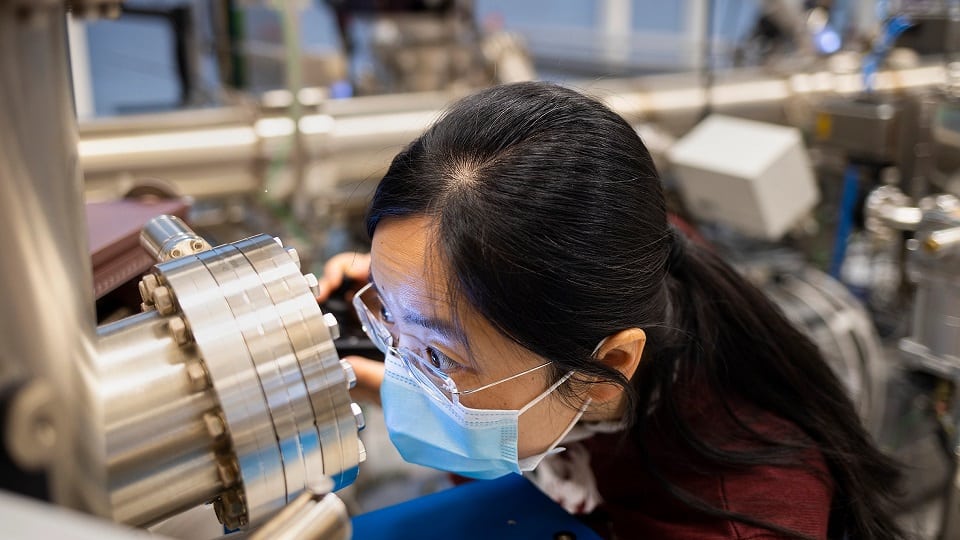
Hunting for MZMs: Azure Quantum Hardware engineer Ajuan Cui works on equipment in Microsoft’s Quantum Materials Lab (Courtesy: John Brecher/Microsoft)
These defect states are known as Majorana zero modes (MZMs), and they belong to a class of hypothetical (quasi)particles termed non-Abelian anyons. The “anyon” part signifies that the particles are neither fermions nor bosons – a property hypothesized by physicist Frank Wilzcek in 1982 and eventually observed (by teams in the US and France) in 2020 in electronic quasiparticles. Those observations, however, were of Abelian anyons, which are different from the non-Abelian variety Kitaev proposed for error-protected qubits. Specifically, if two non-Abelian anyons exchange places, their quantum states change in a detectable way even though the particles themselves are identical. Abelian anyons, in contrast, acquire no such observable change – only their quantum phase is altered.
The tangled web we weave
To make qubits from non-Abelian anyons, Kitaev suggested moving the anyons around to weave their trajectories together. This weaving process is called braiding, and it lets the anyons swap places in a way that alters their observable states. This can then be used to perform a logic operation. Enacting a quantum algorithm thus entails braiding non-Abelian anyons in a particular way, then reading out the result.
The main benefit of this set-up is that, in effect, the topology of the braiding “remembers” the qubit states. Errors can only arise if a braid is cut, which requires a lot of energy. Under these circumstances, the computation is said to be topologically error-corrected.
In 2018, researchers in China and the UK (including Pachos) simulated the braiding of non-Abelian MZMs in an optical system. In that experiment, the quantum states corresponded to photon polarization states. The most recent results take this a step further by showing how to implement the idea in real many-qubit quantum circuits.
The difficult task of making MZMs
While many groups have pressed ahead with making quantum computers from conventional, non-Majorana qubits supported by quantum error-correcting codes, Microsoft has pinned its quantum computing hopes on making topologically protected qubits from MZMs. “Microsoft’s longstanding belief is that engineering an error-protected topological qubit is the path to delivering quantum computing at scale”, says Chetan Nayak of Microsoft Quantum in Santa Barbara, California. “In engineering a topological qubit directly in the hardware, we will be able to create a new type of qubit that is fast, small, and controllable.”
Hardware guy: Chetan Nayak leads the hardware programme at Microsoft’s Azure Quantum. (Courtesy: John Brecher/Microsoft)
But this has proved extremely hard, and the field has been dogged with claims that have subsequently crumbled under scrutiny. Part of the challenge has been to identify a clear signature of MZMs that distinguishes them from other quasiparticles. In their latest paper, Nayak and colleagues report evidence for what they think is a discriminating criterion for MZMs. This criterion is known as the topological gap protocol, and the Microsoft researchers say that their system – a thin film of semiconducting indium arsenide sitting below a 120-nanometre-wide strip of superconducting aluminium – passes it.
Making MZMs in such tiny objects would come with a big advantage. “In principle you could put a hell of a lot of them on a chip,” says Simon. However, the Microsoft paper is not yet peer-reviewed, and the claim will need to be checked carefully. “The hunt for MZMs has over-promised many times,” Simon adds. Though the new result looks promising, he suspects that, ultimately, claims for MZMs will only be accepted “if you can make and manipulate a qubit” from them. “Show me a qubit and then we’ll talk,” he says.
Anyons or simulations of anyons?
Meanwhile, teams at Google Quantum AI in the US, Zhejiang University in Hangzhou, China, and Quantinuum (formerly Honeywell Quantum Solutions and Cambridge Quantum Computing) in Germany and the US all claim to have made non-Abelian anyons from clever combinations of more conventional qubits – superconducting circuits for the Google and Zhejiang groups, and trapped ions for Quantinuum.
Superconducting array: The 68-qubit array used in the Zhejiang University team’s experiment. (Courtesy: Song Chao)
The question here is the meaning of the word “made”. In some sense, one could say that all three results involve not anyons as such but quantum simulations of them – a bit like simulating atoms on a classical computer. But the distinction is blurry. Because qubits are themselves quantum objects, they can be used to build exactly the same quantum wavefunction that an anyon would have. “It’s a fuzzy distinction between simulating matter and having matter,” says Simon. “But what they can say for sure is that they’ve made the wavefunction they want.”
Cool devices: Google Quantum AI hardware engineer Catherine Erickson works on the dilution refrigerator used to cool the quantum-computing chip to the temperature necessary to distinguish the quantized energy levels of the qubits. (Courtesy: Rocco Ceselin)
The Google and Zhejiang teams used similar approaches on, respectively, a 25-qubit chip and a 68-qubit array. In both experiments, the anyons correspond to defects in a square lattice of interacting qubits, a little like dislocations in a crystal lattice. The lowest-energy (ground) state of this lattice structure consists of wavefunctions corresponding to Abelian anyons – and as Kitaev explained, this in itself can be used to construct an error-correcting qubit protected with an error-correcting code called the surface code.
To make defects corresponding to error-protected non-Abelian anyons, the researchers manipulated the interactions between neighbouring qubits in a controlled sequence. Both teams show that the resulting quasiparticles can be braided by moving them around one another. The Google researchers, led by Pedram Roushan and Trond I Andersen, also created a well-known quantum-entangled state (a Greenberger-Horne-Zeilinger or GHZ state) from their anyons – a proof of principle for how the quasiparticles can be manipulated.
Another route to non-Abelian anyons
The Quantinuum group, meanwhile, made non-Abelian anyons in a different way. Using the Honeywell 32-qubit H2 quantum processor, which holds ytterbium ions in an electromagnetic trap and alters their quantum states using lasers, they created a quasi-one-dimensional chain of interacting trapped-ion qubits.
Here, the anyons correspond to natural excitations of the ground state of the qubit system – which technically means they are not quasiparticles, since quasiparticles must be excited states. “The Majorana zero modes at the end of superconducting wires in the Microsoft experiment and the lattice defects in the Google experiment are non-Abelian defects,” emphasizes Ashvin Vishwanath of Harvard University, who collaborated with the Quantinuum team. “Unlike our experiment, they are not realized on top of true non-Abelian topological order.”
Trapped ions: The Quantinuum H2 processor. (Courtesy: Quantinuum)
Nevertheless, all three results are “neat quantum simulations”, says Chris Monroe, a physicist at Duke University in North Carolina, US and chief scientist of the ion-trap quantum-computing company IonQ. He adds that such experiments could probably have been done on quantum-computing platforms years ago, but they have likely been motivated by recent interest in (and controversy about) MZMs in solid-state systems. “It’s a pretty interesting confluence of science and sociology,” he says.
Not yet universal
In Roushan’s view, the two approaches to braiding non-Abelian anyons – using superconducting qubits and trapped ions – are complementary. “There are advantages and disadvantages to each approach, but it is too early to say exactly how they will impact the respective developments,” he says.
In any event, both approaches are perhaps best regarded as proofs that non-Abelian anyon states – that is, the corresponding wavefunctions – exist. But Pachos warns that this is just a first step. “It is not clear yet how this can be moved to fault tolerance,” he says.
What is more, because these anyon states are made from conventional, error-prone qubits, no-one yet knows whether they can be made stable enough to truly act as topologically protected qubits. “To achieve fault tolerance, active error-correcting techniques will be required for our quantum simulation method,” acknowledges Song Chao, a physicist in the Zhejiang team. “A true breakthrough on the technology side will require showing that these protected qubits are more robust than the underlying qubits they are built from,” Vishwanath adds.
A further caveat is that none of the current experiments makes anyons with the right properties to provide qubits for “universal” quantum computing, which can embody any quantum algorithm. “They do have computational abilities, but none are universal,” Simon explains.
Still, all of these approaches “give a clear way to move forward”, says Pachos. He adds that “the field is very tense, as the conclusive discovery of [physical] non-Abelian anyons will lead to a Nobel prize”. But we are not there yet.
This article was amended on 23/5/2023 to clarify Pedram Roushan’s comment on complementary approaches, and on 30/05/2023 to correct a reference to work done in 2018 by Jiannis Pachos and colleagues.