Journey to the stars: the personal stories of women in astronomy

As recently as the 1970s, the field of astronomy was so dominated by men that telescope facilities didn’t even have women’s toilets. Ann Merchant Boesgaard – who spent much of her research career studying the stars from telescopes on Hawaii after completing her PhD in 1966 – had to campaign for this basic amenity to be installed, as well as women’s dormitories for when they had to do overnight data collection.

Now an award-winning astronomer at the University of Hawaii, Boesgaard is one of 37 women who have shared their research journey in The Sky Is For Everyone: Women Astronomers in Their Own Words. Edited by American astronomers Virginia Trimble from the University of California, Irvine, and David A Weintraub of Vanderbilt University in Nashville, The Sky Is For Everyone is an anthology focusing on the stories and experiences of women in astronomy, both past and present – and it manages to fit a staggering amount of information into its 504 pages.

Before you get to the personal stories of current astronomers that make up the bulk of this book, there is an important introductory chapter entitled “Beginnings”. It provides a special reference, not only to the women featured in its pages, but also to those who could not be – and why. Trimble and Weintraub explain how they decided to focus on women who have doctorates so as to set a limit for the book. However, this policy does mean that there are people who could not be included because of the insurmountable problems they faced, either as an individual or group, while trying to gain a PhD and become a scientist. There were also others who were simply too busy to contribute to the book because of their day-to-day research and all the extra work people from any minority groups end up doing to stay in academia – whether it’s informal mentoring, helping with diversity and access, or maintaining support groups. As the editors point out, these are tasks that women in particular have to juggle, leaving them little time to do something like write a chapter for a book, however valuable that task might be.

But despite these omissions, the editors comment on the sheer volume of evidence, personal accounts, details and histories that still had to be excluded to keep to the publisher-set page limit. And for me, including this detail highlights that though there are more cis-men in astronomy than other genders, women now make up a significant proportion of the field – and are thriving and successful.

These women always became great scientists…proving again and again that excellent research comes primarily from where interest lies

“Beginnings” also presents a brief history of women in astronomy, providing valuable context for how much women have had to struggle to be part of the field. A timeline of the lives and work of female scientists from as early as the 1600s – when they couldn’t even give their own accounts of their labours – shows a common theme emerging, with each vignette containing essentially the same story.

A woman was viewed as a wife, sister, mother, daughter or other female relation to a man, and it was that man who had to grant her access to resources. If they were lucky enough to squeeze through the cracks and enter the world of astronomy, these women always became great scientists – albeit usually uncompensated and unrecognized – proving again and again that excellent research comes primarily from where interest lies.

Though this chapter holds much more information than I believe is possible to fully take in, it serves as a clear foundation for the book, demonstrating the history of barriers faced in the field and the women striving to break through them. Regardless of the location or situation, people have always looked up to the sky and questioned their place in the universe and this is why these fringe cases are so plentiful. Trimble and Weintraub also take care to acknowledge that most of the history of women in astronomy is told through a very white lens, with very few having other marginalized identities (such as being disabled or LGBTQIA+). Luckily much more diversity can be seen later in the personal accounts chapters.

A series of remarkable women

The remaining chapters of The Sky Is For Everyone are the individual stories of women currently in the field of astronomy. Starting with Anne Pyne Cowley of Arizona State University who got her PhD in 1963, the book is organized chronologically, ending with Yilen Gómez Maqueo Chew, who was awarded her doctorate in 2010 and is now at the Universidad Nacional Autónoma de México.

These personal accounts of each individual’s research journey is where this book shines. Real care and precision has been put into each piece, starting with the little details. For example, each chapter title is not just a name, but has the person’s PhD graduation year and a small subtitle relevant to their story. The editors have also included a summary of the scientist’s current position and research. This helps the reader become rooted in the lives of the women, and gives a brief overview for ease of access.

Despite the many decades that have elapsed since the astronomers featured early on in this book did their PhDs, lots of their stories mirror the problems people face today. Pyne Cowley, for example, mentions a lifetime of what is generally referred to as “the two body problem”, where she and her husband, both academics, struggled to find work and positions that would allow them to live together. This is still a common problem with many people having to decide if they want a career in academia that could see them living anywhere in the world and probably far away from loved ones.

Additionally, more serious topics come up. Pyne Cowley mentions a sexual assault that she survived many years ago, an event so traumatizing and horrible that it took her years to tell close friends and family due to the stress and fear that the man – who was well established in the field – would (and could) ruin her career. This, as well as racism, microaggressions and other bigotry are ever present throughout the book, and though it is of course difficult and upsetting to read at times, the realities of what people have gone through and how they dealt with it, or would deal with it now, are important to have recorded.

One welcome surprise in The Sky Is For Everyone is the perhaps unintentional portrayal of the organic evolution of astronomical research. Limited by technology and our understanding of the universe, many of the early scientists in the book are stellar and planetary physicists studying local objects. Saeko S Hayashi from the National Astronomical Observatory of Japan – a planet formation specialist who in 1987 became the first woman to receive a PhD in astrophysics from the University of Tokyo – recalls professors in her department scoffing at the mere idea of exoplanets. This is in contrast to later astronomers, such as Dara J Norman, who is based at the National Optical-Infrared Research Laboratory (NOIRLab) in Tucson, Arizon, and has been elected as the next president of the American Astronomical Society. Having gained her PhD in 1999, she now works on galaxy evolution and large-scale structures in the universe. Then there is Gabriela González from Louisiana State University (PhD 1995), who is a member of the LIGO Scientific Collaboration and searches for gravitational waves produced by binary star systems.

This book is a great information resource and a valuable archive of the lived experiences of female astronomers

The book does well in not censoring or watering down difficult topics, but – like many non-fiction anthologies – it is best read in short spurts rather than cover to cover. The Sky Is For Everyone is a great information resource and a valuable archive of the lived experiences of female astronomers. Theirs are stories that are desperately important but are rarely recorded in the detail that they should be.

  • 2022 Princeton University Press 504pp £25hb

Physicists want to build a next-generation atom interferometer at CERN

The CERN particle-physics laboratory near Geneva could be an ideal location for a next-generation atom interferometer. That is according to an international collaboration of researchers who say that the experiment could be used to study gravitational waves as well as search for ultra-light dark-matter particles (arXiv:2304.00614).

Atom interferometers measure the interference patterns between the quantum states of atoms just as light interferometers measure the interference pattern between photons. As these “matter waves”  travel more slowly than light, the waves’ phases change over longer periods of time, which usually requires experiments at least 10 m long.

Next-generation atom interferometers with lengths of up to 100 m could, however, be sensitive enough to detect ultra-light dark-matter particles or gravitational waves with frequencies that currently cannot be accessed. Such experiments are already on the drawing board at Fermilab in the US, the Laboratoire Souterrain à Bas Bruit in France, Zhaoshan in China and the Boulby Underground Laboratory in the UK.

An international group of researchers has now proposed to build such an experiment in an underground tunnel belonging to the Large Hadron Collider (LHC) at CERN. It would be located in one of the deep vertical access shafts that is currently used to transport equipment to the LHC. The shaft is wide enough to host the experiment while not interfering with the movement of kit to and from the LHC.

CERN members of the team believe that the environmental requirements for the experiment – including the vibration, noise and magnetic and radio-frequency shielding – would be low enough to not interfere with the sensitivity of the experiment.

“As one of the largest and best-equipped scientific laboratories in the world, CERN would be a natural place to host one of the 100 m prototype quantum detectors” says Oliver Buchmueller from Imperial College London. His team is helping to develop a roadmap for the technology, which could see one or more kilometre-scale detectors ready by the mid 2030s.

While the main aim of the CERN experiment would be to search for dark-matter candidates and study gravitational waves at currently inaccessible frequencies, it could also help with tests of quantum mechanics. Such technology could even be used for space-based Earth-observation techniques that can monitor climate change.

John Ellis of King’s College London, who is part of the team, says it will now be vital to form a collaboration across disciplines to get the project off the ground. Mark Kasevich from Stanford University in the US, who was not involved in this proposal, thinks the project is feasible and exciting, but believes the biggest challenges will be scaling existing technologies, in particular the development of robust laser and high-flux atomic sources.

JWST spectrometer refines redshifts of distant galaxies

The NIRSpec instrument on the James Webb Space Telescope (JWST) has revealed that a far away galaxy previously thought to be at a record-breaking redshift of 16.4 is actually much closer to Earth. The study has also confirmed that some other objects observed by the JWST are among the most distant galaxies ever seen.

Cosmological redshift is a measure of how much a galaxy’s light has been stretched to longer, redder wavelengths by the expansion of the universe. The higher the redshift, the more time that light from a galaxy must have spent moving through the expanding cosmos. This means that we see high-redshift objects as they appeared a very long time ago – and that the objects are very far away.

Astronomers are very keen on studying high-redshift galaxies because they provide a window into the early universe. Indeed, recent observations support an emerging picture that galaxies in the early universe were more massive, more developed and more luminous than had been previously predicted.

Several faint galaxies

In the summer of 2022, the JWST’s first deep surveys of the distant universe turned up several faint galaxies that were estimated to be the highest-redshift galaxies ever seen.

One object, called Maisie’s Galaxy, was discovered in the JWST data by a team led by Steve Finkelstein of the University of Texas at Austin. The galaxy was initially thought to be at redshift 14.3, which would have placed it just 280 million years after the Big Bang. Another candidate, CEERS-93316, found by a team led by Callum Donnan of the University of Edinburgh, appeared to be at a redshift of 16.4, which equates to just 250 million years after the Big Bang.

For comparison, the most distant confirmed galaxy known prior to the launch of the JWST was Gn-z11, which has a redshift of 11.6.

Revised redshifts

These early JWST measurements were made using a photometric technique, which gauges the overall redness of a galaxy. While this technique can be used on faint, distant objects, it can be affected by the presence of dust and is not as accurate as measuring the shifts of individual spectral lines. Now, a team of astronomers has used the JWST’s Near-Infrared Spectrometer (NIRSpec) to observe the galaxies and has refined the redshift estimates – with mixed results.

“Unfortunately, the redshift 16.4 candidate [CEERS-93316] turned out to be low-redshift,” says Donnan, who is a member of the team led by Pablo Arrabal Haro of NOIRLab in Arizona. Because the NIRSpec data were immediately made public with no proprietary time for the scientists who proposed the observations, Haro and team had to write their paper in less than three days to avoid being beaten to the punch.

Rather than being at 16.4, CEERS-93316 was found to be a dusty galaxy at a redshift of 4.9, meaning that we see it as it existed 12.5 billion years ago. Donnan’s team had previously thought it had a strong case for a record-breaking redshift, particularly as the galaxy displayed strong blue and ultraviolet emission in its rest frame (as it appears with the redshift removed).

However, the combination of very strong emission lines coupled with the fact that one of those lines, of the hydrogen-alpha wavelength, was in a position where three of NIRSpec’s filters overlap so that the emission line contributes to all three, erroneously gave the impression that CEERS-93316 was an intrinsically luminous galaxy at a much higher redshift.

Maisie’s Galaxy

There was better news in the redshift stakes for Maisie’s Galaxy, which was revealed to be at a redshift of 11.4. This is still a very high redshift and indicates a galaxy that is dust-free. The galaxy also has a relatively high star-formation rate and a total stellar mass of 250 million times the mass of the Sun. This mass had grown over a period of 30–120 million years prior to the time we see Maisie’s Galaxy.

A further eight galaxies have now also been shown by NIRSpec to have redshifts greater than 10. The current record holder is JADES-GS-z13-0, which has a spectroscopically confirmed redshift of 13.2 and which we see as it existed just 350 million years after the Big Bang.

Donnan is still hopeful that the JWST will be able to discover galaxies with spectroscopic redshifts greater than 14. “It’s possible, especially in deeper imaging,” he tells Physics World.

Dust production

Not that a well-studied galaxy at a redshift of 4.9 is anything to be sniffed at. Studying the properties of galaxies that existed when the universe was just over a billion years old is crucial in understanding how galaxies have developed in terms of their star formation. This can be inferred from the amount of dust that successive generations of stars produce – the same dust that causes CEERS-93316 to appear redder.

“We need to do a more detailed analysis of the properties of CEERS-93316, but it appears to be dusty,” says Donnan. “We need to look into its star-formation history if we want to understand how it came to be.”

Meanwhile, further observations are planned for the very-high-redshift galaxies such as Maisie’s Galaxy according to Finkelstein, who is also involved with the NIRSpec study.

Deeper spectroscopy

“The next step is definitely deeper spectroscopy, to probe exactly what is causing [Maisie’s Galaxy] to be so blue,” he says, referring to is its rest-frame colour. The leading theory is that early galaxies such as Maisie’s Galaxy had a higher proportion of luminous, blue, massive stars compared with galaxies today. Observations using one of the Keck 10 m telescopes in Hawaii are already under way, and Finkelstein hopes to follow up with the JWST in the future.

“We’ll be looking for weaker rest-UV emission line features, which are diagnostics for things including the presence of very massive stars and also how intense the starlight is from the stars we see,” says Finkelstein.

Ultimately, the findings are a reminder of the need for the spectroscopic confirmation of galaxy redshifts and that until such measurements are made, we should take claims of record-breaking photometric redshifts with caution.

The research is described in a prerint on arXiv.

Breaking barriers and opening up physics – the growing impact of the Bell Burnell Graduate Scholarship Fund

Imagine winning a $3m prize and then giving all the money away. That’s exactly what the astrophysicist Dame Jocelyn Bell Burnell did in 2018, when she won the Special Breakthrough Prize in Fundamental Physics for her 1967 discovery of pulsars and her “inspiring scientific leadership over the last five decades”.

Indeed, Bell Burnell donated further prize money in 2021, when she was awarded the world’s oldest scientific prize, the Royal Society Copley Medal. Rather than going to family or to an established charity, in both cases she used these gifts to set up the Bell Burnell Graduate Scholarship Fund, or BBGSF (see box below). It aims to help PhD students from groups that are under-represented in physics and is supported and administered by the Institute of Physics (IOP), which publishes Physics World.

Bell Burnell is no stranger to the barriers faced by students from minority groups. She has confronted many herself, right from when she was a physics undergraduate at the University of Glasgow in the early 1960s. Already isolated by being the only woman left on her course by the final year, she was surrounded by male students who “stamped their feet, whistled, catcalled and made as much unpleasant noise as they could” every time she entered a lecture theatre.

Later, while building a radio telescope during her PhD at the University of Cambridge, male colleagues deemed the manual labour involved as “not suitable for a woman”, but Bell Burnell was quick to correct them and get involved in the construction work. Indeed, different barriers, often the result of societal expectations and norms within the physics community and beyond, challenged her throughout her career. Bell Burnell overcame them all and her achievements are nothing short of stellar.

The Bell Burnell Graduate Scholarship Fund: how it works

The Bell Burnell Graduate Scholarship Fund (BBGSF) supports PhD students from the UK and Ireland who come from groups that are under-represented in physics. It recognizes that the barriers encountered by some individuals can mean that, while they have the talent and enthusiasm for high-level study, they would either not be awarded a PhD scholarship via conventional schemes or would need additional support to complete their doctorate.

To apply, students must already be enrolled at – or have an offer from – a physics-based postgraduate doctoral programme at an eligible host university or institution in the UK, which will nominate candidates for the grant. The fund only support studies in a physics department or institute that has a Juno and/or Athena SWAN award at the time the student is being enrolled.

Flow chart of the process for applying to the Bell Burnell Graduate Scholarship Fund

Students from minority groups in physics are eligible for a BBGSF scholarship. The under-represented groups in physics include women; students of Black-Caribbean, Black-African and other minority ethnic (BAME) heritage; students with disabilities or who require additional funding to support inclusive learning; LGBTQ+ students; and students from disadvantaged backgrounds who may struggle to find the levels of funding needed to complete their studies. People with qualifying refugee status who meet the above criteria are also encouraged to apply.

Since its launch in 2020, the fourth grant cycle is just now being completed, leading to:

  • 128 applicants;
  • 31 awards;
  • more than £750,000 in awards being handed out.

Overcoming barriers

Many of us are not surprised by such tales of open hostility to women in physics in the past – after all, Bell Burnell was an undergraduate more than 50 years ago. But these days, when initiatives such as the Equality Challenge Unit’s Athena SWAN (Scientific Women’s Academic Network) charter  and Project Juno – the IOP’s flagship gender-equality award for physics institutions – have brought many gender-related issues to the forefront and supported best practice across our community, surely such behaviour is a thing of the past? Are there really still significant barriers to people doing physics?

While the number of women studying physics at university in the UK has increased over the last 20 years, it is still too low at 23%. The picture is equally bad for many other groups. The proportion of physics students who come from low-income households is far smaller than it should be, and as for students from ethnic groups that are minorities in the UK, they are fewer still. This number will hopefully slowly increase as more women and minoritized groups trickle through the pipeline, but we can do more to help. You only have to read the inspiring stories of the 21 Bell Burnell Scholars we recruited in the first three rounds, to truly understand the many different challenges people still have to overcome today, to pursue a career in physics.

PhD students enjoy tea and cakes at the IOP headquarters

In 2019 I was invited to be chair of the BBGSF as it was being set up, and I’ve continued to oversee the fund, which is now into its fourth cycle. I’m supported by a hugely committed team who bring diverse skills and life experiences from many under-represented groups in physics – something that was vital in setting up this unique scheme.

In designing the operation of the BBGSF, we developed the following working principles:

  • All candidates for a full grant must be co-funded by the host university or institution where the student is based. The idea here is to ensure that the university also has a vested interest in the success of the scheme.
  • We recognize promise rather than absolute achievements in applicants. We don’t distinguish between someone who has achieved a three-year BSc or a four-year MPhys degree, nor do we attempt to make judgements on marks or rank. This is because barriers such as financial hardship can mean that some candidates simply can’t afford to do an MPhys, or their need to have a job alongside studying impacts their ability to study.
  • We consider how the applicant could act as an ambassador for the BBGSF. We want to spread the word as much as we can, both about the fund and about our approach to facilitating diversity in graduate study.
  • We consider the supervisory team, the PhD environment and immediate research culture, alongside the applicant. We expect that our scholars will be well supported scientifically, but we also want them to thrive as individuals, in an environment where they have support and a feeling of belonging, to maximize their chances of success.
  • We want to inspire good practice in selecting PhD candidates. Indeed, we’re hoping that asking institutions to tell us how they select candidates will encourage them to reflect on how inclusive (or not) their processes are.

Beating bias, discrimination and marginalization

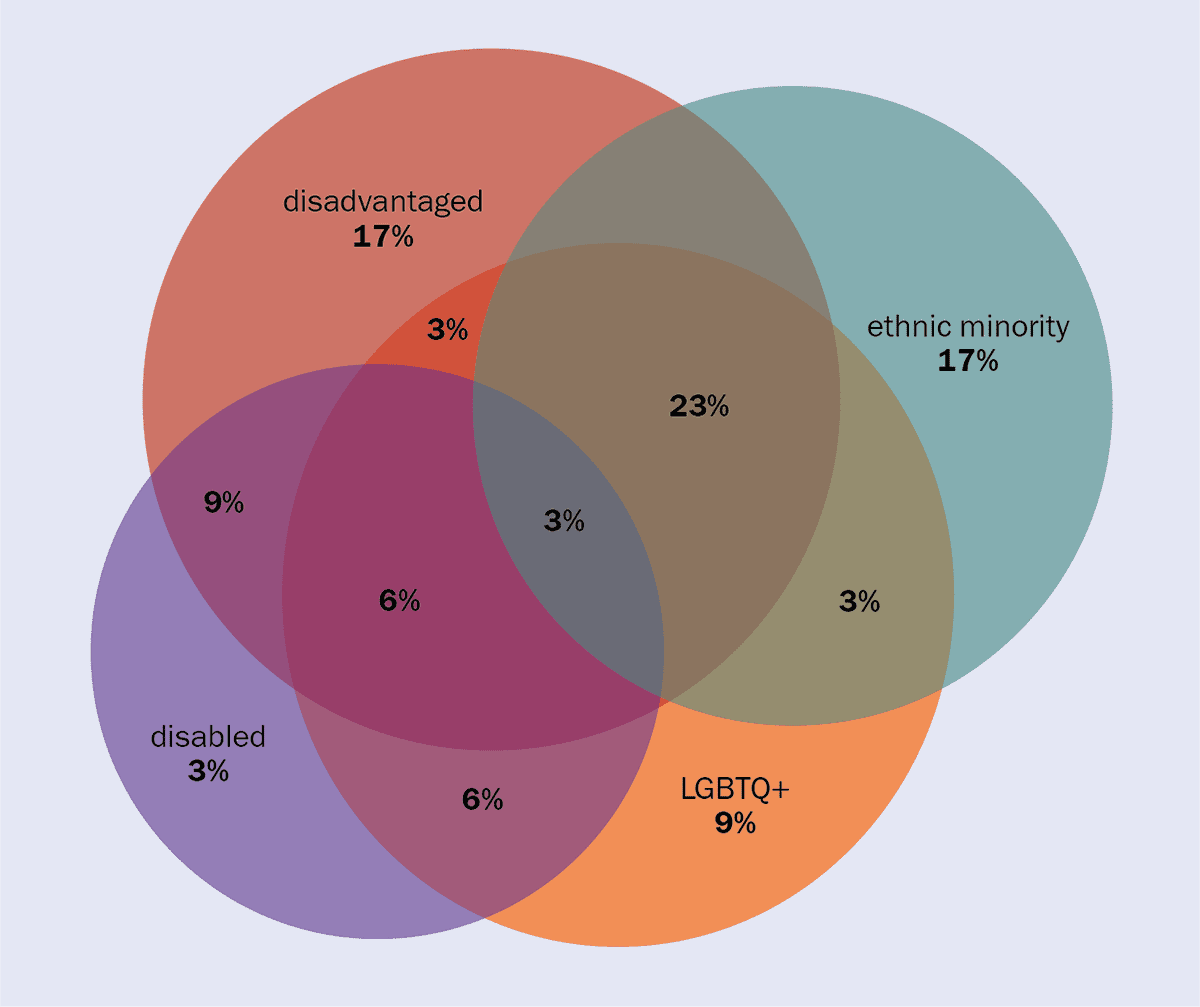
Some stark findings emerge when we analyse the different under-represented groups from which those applying for – and winning – BBGSF awards come. Perhaps the most striking thing after seeing the sheer number of highly qualified and motivated students who need our funding is the huge extent to which intersectionality comes into play. Of all the applicants in 2022 and 2023, 80% were women, 56% had disabilities, 56% came from disadvantaged backgrounds, 26% were LGBTQ+ and 46% came from ethnic minority groups. This is representative of the distribution we’ve seen in all applications so far, and is reflected in the population of our awardees (figure 1).

Venn diagram showing the proportion of BBGSF scholars who meet its various criteria

As a white woman who began my degree in 1980, I find it hard to imagine how much harder my career progression would have been if I’d suffered the double (or triple) whammy of multiple bias, discrimination or marginalization. However, this is the reality for many of our very capable undergraduates today.

For example, one of the BBGSF scholars told me (and I paraphrase), “The fact I’m a woman in physics has never been an issue – the problem has been that I’m ‘poor’. I had to hold down a job while doing my degree and my marks suffered because of that. Once, I was refused an extension to a deadline because the academic believed it was ‘my choice’ to have a job and that I should choose between being committed to my physics degree and getting more ‘pocket money’.” Many, if not most, academic physicists in the UK come from middle-class backgrounds and, by definition, few have experienced such hardship. This can lead to unconscious bias that is much broader and every bit as damaging as the gender bias we’re now relatively familiar with.

Criteria such as research experience, which is often used in awarding PhD scholarships, put a PhD beyond the hope of otherwise excellent candidates. This is because students who have responsibilities such as being a carer, or who need to work throughout the holiday periods in an academic year, often cannot take up internships. Such students will therefore not have that “all-important” research experience, or have had the chance to write a paper – both of which often carry significant weight when PhD applications are being considered. Indeed, awarding PhD funding simply on the basis of academic achievement, such as exam grades, research experience or papers published, makes us miss excellent candidates and restricts the diversity of the physics community.

Beyond good intentions

I strongly believe that our community is mostly a caring one, where people aspire to be the best they can be. However, even in the applications to the BBGSF some academics miss the point, well-intentioned though they may seem. For example, we’ve heard comments like “My commitment as a PhD supervisor to supporting minorities is clear because I’ve just employed a non-white, female postdoctoral research assistant – she will be ideal in supervising this student.” Or “We considered all eligible students and chose the one with the top marks.” Token gestures such as these can sometimes do more harm than good, and will not, in the long run, drive the change that we want: to truly champion students from all walks of life in physics. 

More worryingly, some bad behaviour is pervasive. I’ve had to reassure some of our scholars that it is not okay to be shouted at, no matter what the situation, and have given them advice on how to manage such behaviour. Unfortunately, quite a few PhD students and early-career researchers face this kind of problem, irrespective of whether they are from an under-represented group – but that doesn’t make it okay. And it’s definitely not okay to have other senior figures then excuse such behaviour by saying “Don’t worry about it – it’s just how professor X is – they shout at everyone.” We should be moving away from such conduct altogether.

PhD students in a lecture theatre

I’ve also had to intervene with institutions that require PhD students to buy their own laptop or computer, which can cost almost a month’s worth of their stipend. If a department really cannot afford to equip its PhD students with computing hardware, the BBGSF contributes to the students’ research expenses with funds that can be used for such purchases. Ironically, though, it’s often the richest universities that have this expectation that students should pay for their own laptops.

Despite these issues, we are hugely grateful for the support that physics departments and institutes across the UK and Ireland have given the scheme, by being willing to co-fund scholars. Some have even gone beyond the co-funding requested. One particular physics department committed to fully funding the applicants it put forward – irrespective of the outcome of their application to the BBGSF – because it could see the value of increasing diversity and supporting students with great promise. Another worked with us to find the majority of the funding for a student as we had hit the top of our budget. We also provide fully funded top-up awards that allow PhD students to balance their research duties with any caring responsibilities, or give them money to complete their PhD when all other sources fail.

Personal and professional impact

Being chair of the BBGSF has been both a privilege and a life lesson. The very existence of the BBGSF has given students a reason to approach someone with questions about funding, as well as the confidence to do so. After one particular talk I gave about our scheme, I ended up in a long discussion with a disabled student. They were self-funding a PhD because they needed to study part-time and had been told that it wasn’t possible to hold a UKRI scholarship part-time. It was also unclear to them whether the BBGSF fund supports part-time applications – which we do. When I looked into this, I found conflicting advice about part-time UKRI funding for PhDs, but I was able to clarify that it is possible to hold UKRI studentships part-time. This crucial information has now been made clearer on the UKRI website and hopefully the option of part-time PhDs will be advertised more widely across institutions in the future.

Three women lead an onstage panel

The fund is making a real difference. Our 10-year plan is to have a cohort of 100 BBGSF scholars, and we’re well on the way to that. The IOP has been vigorously fundraising, and we are incredibly grateful for all the donations that have made it possible for us to increase the number of awards made, from four in 2020 to nine in 2022.

With her generosity, Jocelyn Bell Burnell started something special. She not only understands the value of diversity to our community, but has done amazing things to foster it

Because we immediately and unilaterally matched the increase to PhD stipends announced by the UKRI in October 2022, it does unfortunately mean there might be a fall in the number of awards we can make this year. But we always hope for more donors to the fund – big or small.

With her own incredible generosity, Bell Burnell has started something truly special. She not only understands the value of diversity to our community, but has done amazing things to foster it. The clapping and stamping when she enters a lecture theatre these days is, thankfully, for a very different reason – one of immense gratitude and support.

  • The Bell Burnell Graduate Scholarship Fund can be contacted at bellburnellfund@iop.org. The next round of the Bell Burnell Graduate Scholarship Fund will open for applications in autumn 2023. For information on how to apply and to read interviews with previous awardees, see our website

Photoacoustic mapping of tumour oxygenation predicts radiotherapy efficacy

Advances in radiation therapy have revolutionized the treatment of cancer, but the efficacy of treatment can vary significantly among patients. Recent developments in imaging techniques have enabled clinicians to monitor changes in tumour structure to assess response to radiation therapy.

While structural changes can take weeks to develop, the tumour microenvironment can be a strong indicator of treatment efficacy. Tumours with low oxygenation – hypoxic tumours – are more resistant to radiation therapy. As such, monitoring tumour oxygenation levels in real time could enable personalized treatment delivery, thereby improving treatment efficacy. With this aim, a team at the University of Michigan is investigating the use of photoacoustic (PA) imaging to map tumour oxygen levels.

To obtain PA images, laser pulses are delivered to the tissue of interest. The light is partially absorbed, with the level of absorption dependent upon the laser wavelength and the absorption coefficient of the targeted materials at that wavelength. This absorption of light leads to thermoelastic expansion in the tissue and subsequent emission of ultrasound, which is detected with an ultrasound array transducer and analysed to construct a PA image.

By using multiple incident wavelengths, first author Janggun Jo, senior author Raoul Kopelman and their team have developed a PA functional imaging technology for chemical imaging of tumour microenvironment parameters, such as pH, and potassium or oxygen levels in tissue. They report their findings in ACS Nano.

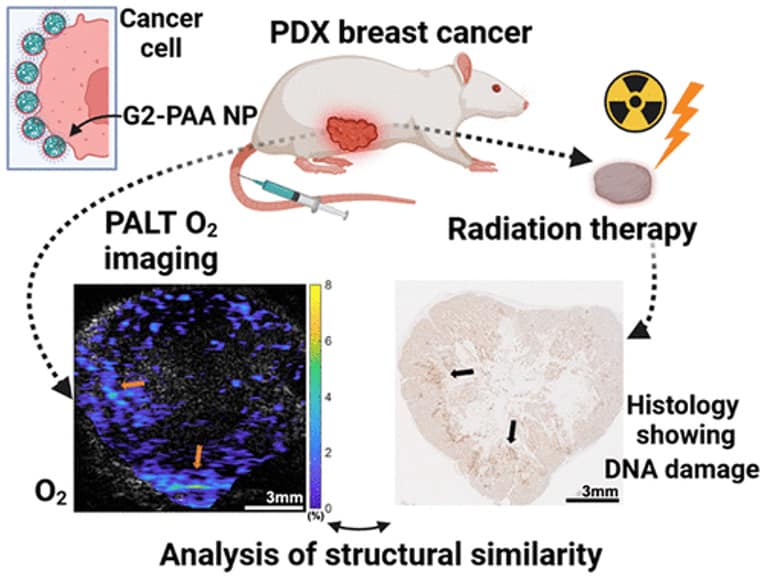
The researchers combined PA imaging with tumour-targeted chemical construct nanoelements (TTCCNE) that act as PA contrast to visualize the oxygen distribution within the tumour. They created the nanoelements by conjugating the phosphorescence indicator Oxyphor G2 to polyacrylamide (PAA) nanoparticles that have a long phosphorescence lifetime (254–281 µs). Utilizing two laser pulses – the pump and probe beams – the exponential decay of the phosphorescence can be measured. This decay rate strongly correlates to oxygenation levels in the tumour microenvironment.

Photoacoustic lifetime imaging of tumour oxygenation

The researchers developed their photoacoustic lifetime (PALT) imaging technique with the aim of predicting tumour response to radiation therapy.

Predicting radiotherapy response

To assess the technique in vivo, they implanted patient-derived xenografts of triple negative breast cancer, the most aggressive form of breast cancer, within the mammary fat pads of mice. Once the tumour had grown, they injected G2–PAA nanoparticles through the animal’s tail vein, which then accumulated in the tumour.

The team delivered a 630 nm pump beam to the tumour, acting as an excitation source, and used a 920 nm probe beam to monitor the excited state decay, enabling the creation of PALT images of tumour oxygenation. While blood oxygenation only provides an indirect assessment of tissue oxygenation, PALT-based oxygen imaging provides a direct assessment of oxygen levels in tissue.

PALT images predict tumour response

Next, the researchers treated the mice with radiation therapy, delivering a total dose of 6 Gy to the tumour at a dose-rate of 1.5 Gy/min. Upon completion of treatment, they harvested the tumours and performed histological staining to determine the distribution of DNA damage.

To investigate whether the method can predict tumour response, the researchers compared the DNA damage with the PALT images obtained prior to treatment delivery. They identified excellent spatial correlation between the pre-treatment tumour oxygen concentration determined using PALT and the radiation-induced DNA damage indicated via histological staining.

At an increased oxygen concentration, the radiosensitivity of cells increases rapidly compared with areas with reduced oxygenation. As spatially resolved PALT images of tumour oxygenation can identify a diverse distribution of hypoxic areas, Jo claims that “PA imaging of tumour oxygenation powered by TTCCNE is capable of predicting tumour responses to radiation therapy, thus enabling personalized treatment decisions”.

The team believes that PA imaging could be generalized further, to monitor the acidity and potassium levels of the tumour, for example. “Using the proper TTCCNE, PA chemical imaging could predict the efficacy of chemotherapy (or of specific drugs), as well as of immunotherapy treatment, for the given patient’s tumour, and thus guide the choice among those three therapies versus surgery,” says Jo.

Luminous protostar sheds light on the origins of Earth’s water

A study of a young star and its protoplanetary disc has provided important insights into the origins of the water on Earth. Researchers have determined the isotopic make-up of the water in the disc and found it to be similar to that of comets in the solar system. This suggests that much of the water on Earth has interstellar origins that predate the Sun.

Planetary scientists have long debated the origins of water on Earth. This is because it is generally accepted that the region of the Sun’s protoplanetary disc in which Earth formed was too warm for liquid water to condense along with other materials that make up the Earth. A leading explanation is that Earth’s arrived later on comets and other objects from the outer solar system  – after first forming in interstellar space.

Now, a study described in a paper in Nature presents new evidence about the origins of water on Earth based on the observation of a young star and its protoplanetary disc. This is a disc of dense gas and dust that forms around a new star and, under the right conditions, will evolve into a system of planets. The study backs up the idea that at least some of the water on Earth arrived from outer regions of the solar system.

Filling a gap

Using the Atacama Large Millimeter/submillimeter Array (ALMA) radio telescope, the authors discovered gaseous water in a planet-forming (protoplanetary) disc surrounding the distant protostar V883 Orionis. The observations fill an important gap in our understanding of the distribution of water during the formation of planetary systems and could mean that the water on Earth predates the formation of the Sun.

John Tobin, an astronomer at the National Radio Astronomy Observatory and lead author of the paper, told Physic World that the crux of this research was the observed ratio of semiheavy water to light water in the V883 Orionis. A light water molecule contains two hydrogen-1 nuclei, whereas semiheavy water contains one hydrogen-1 nucleus and one hydrogen-2 (deuterium) nucleus.

“A portion of the water in your shower is made with deuterium, roughly 1 out of every 3000 molecules,” says Tobin.  “This is a large amount because if the water did not form in the interstellar medium, prior to the formation of the Sun, then we’d only expect 1 out of every 50,000 water molecules to be made with deuterium. This tells us that a significant fraction of Earth’s water was formed in interstellar space.”

Important ratio

This isotopic ratio between semiheavy water and light water is the key to understanding how Earth’s water got here. Scientists have measured this ratio on Earth, in comets, in protostars and even in interstellar space. This observation of V883 Orionis, however, is the first time the ratio has been measured in a protoplanetary disc.

Tobin says that there are two ways that water could arrive on a planet like Earth. These are chemical inheritance and chemical reset. In the chemical inheritance model, water is formed in interstellar space before being delivered to a protoplanetary disc with its isotopic ratio unchanged. Under the chemical reset model, the heat generated within a protoplanetary disc breaks up water molecules. As the disc cools, water molecules reform with a distinct isotopic ratio – which is lower than the ratio expected for water inherited from interstellar space.

It turns out that the ratio of Earth’s water is somewhere between that predicted by these two models. As a result, Tobin and colleagues were keen to study the isotopic ratio of water in a protoplanetary disc, which would shed light on the link that carried water from interstellar space to Earth.

Liquid, not frozen

Using the ALMA radio telescope in northern Chile, Tobin and his colleagues observed the protoplanetary disc around V883 Orionis. This is a protostar – a very young star that is still accumulating materials from its surroundings – that is about 1300 light-years from Earth. This star is about 200 times brighter than the Sun. This extra energy output means that the water in the protoplanetary disc is in liquid form. This is important because it is much easier to measure the isotopic ratio of liquid water than the frozen water in previously observed protoplanetary discs.

In 2021 ALMA observed V883 Orionis for six hours, allowing the researchers to determine the isotopic ratio of its protoplanetary disc. They found the ratio to be very similar to that of comets and younger protostar systems.

Tobin explains that this fills in an important gap of our knowledge of the formation of water.

“The ratio of semiheavy to normal water [D/H] in systems like comets, protostars and Earth indicates that the water has a significant enhancement of its D/H ratio relative to the cosmic D/H ratio,” says Tobin. “Water can only form with a high D/H ratio on the surfaces of dust grains in the cold interstellar medium. Therefore, the fact that the water D/H ratio is enhanced and relatively constant throughout star and planet formation (and Earth) means that a significant fraction of our water must have formed in the cold interstellar medium and been transported to Earth relatively unaltered.”

The research is described in Nature.

UK unveils ‘plan B’ if negotiations to join Horizon Europe fail

The UK government has published its long-awaited “plan B” for British science if negotiations to join the EU’s €95bn flagship Horizon Europe research programme fail. The £14.6bn seven-year  initiative, named Pioneer, would take the money that has been earmarked for the UK’s Horizon Europe participation and invest it in UK science, research, technology and innovation.

Although the government says its “preference” is to rejoin Horizon Europe, it warns that association would have to be “a good deal for UK’s researchers, businesses and taxpayers”. Launched by Michelle Donelan, secretary of state for science, innovation and technology, Pioneer has four main elements. They involve attracting and training scientists and engineers; encouraging research and innovation; boosting international collaboration; and providing extra cash for research infrastructure.

If implemented, Pioneer would receive the £14.6bn that the UK would have paid to join Horizon Europe from 2021 to 2027. The UK government said this would include over £1bn that has now been awarded to UK researchers taking part in Horizon Europe projects, from the Horizon Europe guarantee scheme.

The UK’s participation in Horizon as an associate member had originally been agreed in 2020 as part of the post-Brexit trade deal with the EU. But its participation stalled and became a bargaining chip in disagreements over Northern Ireland. However, this block was removed in February with the signing of the Windsor Framework, which concerns the flow of trade through Northern Ireland.

In early April, Donelan met Mariya Gabriel, European Commissioner for Innovation, Research, Culture, Education and Youth, in Brussels to begin formal negotiations to join Horizon Europe. Donelan says that while the UK government prefers association with Horizon Europe, the agreement “must be on the right terms” and that there needs to be an “ambitious alternative ready to go should we need it”.

For the good of UK science and innovation, the government’s priority must be to secure association to Horizon Europe

Tony McBride

The main sticking point appears to be how much the UK should pay to join Horizon Europe, given that the country has missed out for the last two years and has already spent some of the money that had been earmarked for Horizon on UK researchers.

Tony McBride, director of policy and public affairs at the Institute of Physics, which publishes Physics World, is clear that negotiations must succeed. “For the good of UK science and innovation, the government’s priority must be to secure association to Horizon Europe,” he says. “Should it be needed, any alternative to Horizon must also make up for the loss of the established networks, partnerships and infrastructure the UK has benefited from over many, many years, as well as for the disruption and uncertainty caused by these years of delay.”

Sarah Main, executive director of the Campaign for Science and Engineering, echoes those views. While agreeing it is sensible for the UK government to prepare alternatives to Horizon Europe, she warns that it should not “get in the way of progress towards the goal of a full and cooperative research relationship between the UK and EU”.

Astronomers braced for a revolution in fast radio burst localizations

Radio astronomers across the world are bracing themselves for a transformation in their ability to localize fast radio bursts (FRBs). Before the end of the year, upgrades to a suite of FRB-hunting telescopes are expected to increase the localization rate of FRBs to their host galaxies by more than an order of magnitude – potentially revolutionizing our understanding of the universe.

First discovered in 2007, FRBs are intense bursts of radio waves lasting less than a few milliseconds. They come in two main types: either from sources that repeat or those that do not. But of the 1000 or so FRBs to have been detected, only around 3% have been shown to repeat.

As they last for such a short time, it is impossible to schedule follow-up observations, which makes it hard to work out where FRBs come from. All instruments need to stand ready to capture the location of an FRB, whenever it may arrive. Indeed, until recently, astronomers had localized barely two dozen FRBs.

While most FRBs have extragalactic origins, a galactic FRB was recently detected in the Milky Way in 2020 from a magnetar – a neutron star with a large magnetic field. FRBs turn out, however, to be useful for cosmology thanks to a factor called the “dispersion measure” (DM). Measuring the DM allows astronomers to calculate the number of free electrons along the line-of-sight of the FRB and thus directly determine the electron density in the universe.

“These electrons can be hard to observe, since most of them are in very diffuse gas,” says Steffen Hagstotz, a cosmologist the Ludwig Maximilian University of Munich. “In this sense, FRBs are really complementary to other probes such as weak lensing, which mostly tells us about the distribution of dark matter. By studying both, we can learn more about how ordinary matter traces dark matter on cosmological scales.”

There are also various conflicting measurements of the present-day expansion rate of the universe, called the Hubble constant. Reconciling this “Hubble tension” is considered one of the most pressing issues in modern cosmology. FRBs offer an alternative route to determining the Hubble constant by probing the redshift-dispersion measure relation. Hagstotz recently co-authored a study finding that a sample of only about 500 localized FRBs would be sufficient to competitively measure the Hubble constant.

A cracking idea

The present scarcity of localized FRBs has spurred teams of radio astronomers worldwide to squeeze the performance of their facilities. Vikram Ravi from the California Institute of Technology kicked off the FRB race at the American Astronomical Society meeting in January when he announced the localization of 30 new FRBs with the brand new Deep Synoptic Array (DSA) in California. During its commissioning in 2022, DSA detected more than one burst per week using just 63 of the 110 antennae that the DSA will eventually have.

If the DSA is the new kid on the block among radio telescopes, then the Square Kilometer Array Pathfinder (ASKAP) in Western Australia is already a familiar face. Its Commensal Real-Time ASKAP Fast Transients Survey (CRAFT) programme first started localizing FRBs with sub-arcsecond accuracy in 2017, making it possible to study FRB host galaxies. CRAFT piggybacks onto ASKAP by using an FRB-searching compute cluster, which concurrently scans its 30 square degree field of view for radio transients in parallel with other observations.

CRAFT has, until now, operated by incoherently summing the signals from its 36 parabolic dishes, but this is about to change with an upgrade dubbed CRACO. Incoherent summing improves sensitivity by the square root of the number of dishes, while the sensitivity of coherent summation improves sensitivity linearly with the number of dishes.

Coherent searching, however, requires 65,000 times more data processing power, a feat made possible by a A$1m upgrade to the instrument’s computer cluster. “CRACO will be 5 times more sensitive with the same field of view than the current FRB detection system we use on ASKAP,” says Keith Bannister, principal research engineer at Australia’s Commonwealth Scientific and Industrial Research Organisation, which operates ASKAP.

CRACO works by making a movie of the sky and looking for an FRB in this movie. “The image size is 2.5 million pixels – similar to full HD video,” adds Bannister. “1000 times per second, we try 1000 different DM trials, totalling 1 million images per second – about 25 trillion pixels per second.”

CRACO is currently undergoing a three-month commissioning period, with the expectation that once the full cluster is installed by the end of the year, ASKAP’s detection rate will increase by between 10- and 20-fold, finding several FRBs per week.

While ASKAP pushes the sensitivity frontier to detect more FRBs, the Canadian Hydrogen Intensity Mapping Experiment (CHIME) in British Columbia already has the luxury of detecting several FRBs per day thanks to its staggering field of view of 200 square degrees. However, CHIME’s low resolution means that it can reliably localize FRBs only from nearby galaxies. Engineers at CHIME have chosen to improve performance on the resolution frontier by constructing so-called “outriggers” – identical yet downsized versions of the CHIME telescope.

“The outriggers upgrade of the CHIME/FRB project consists of three mini-CHIMEs,” says Ziggy Pleunis from the University of Toronto. These outriggers, based in British Columbia, West Virginia and California are spread 100–3300 km from CHIME, providing CHIME with about 50 milliarcsecond resolution, enabling it to pin-point FRBs to within their host galaxies.

Work on the outriggers are proceeding rapidly according to Pleunis: “Two have already been constructed and instrumented, and the ground is now being levelled for the third site.”  The outrigger in British Columbia is already undergoing commissioning and even collecting data and Pleunis adds that the aim is to have all three telescopes working this year, after which the CHIME/FRB collaboration will optimize their instruments by practicing on known repeating sources before moving on to detecting new ones. “Then we can hopefully quickly start localising FRBs,” he adds.

Image-guided HIFU system shows potential for clinical treatments

Multi-spot HIFU ablation

High-intensity focused ultrasound (HIFU) is an early-stage, non-invasive thermal therapy used to treat a variety of medical conditions, including neurological disorders and some cancers. Now, researchers at the City University of Hong Kong have developed an array-based HIFU system that integrates real-time ultrasound (US) and photoacoustic (PA) imaging to improve treatment delivery. The system provides temperature and structural information with which to guide therapy, overcoming previous challenges of long treatment times and inaccurate or costly image guidance.

HIFU offers the advantages of deep penetration, controllable ablation spot size and low hardware cost. A major disadvantage, however, is the often long treatment times, due to focal spots smaller than the actual dimension of the treatment region and fixed focus depths. Lengthy mechanical scanning may cause misalignment between the designated treatment spot and the actual HIFU focus. To minimize damage to surrounding healthy tissues, precise and timely dose control is critical.

Combining ultrasound imaging with HIFU can provide real-time monitoring at low cost, but has been inappropriate for clinical use due to insufficient temperature sensitivity to accurately guide the HIFU treatment. The new system, developed by Yachao Zhang and Lidai Wang and described in Biomedical Optics Express, resolves many issues by connecting the PA/US imaging transducer and the HIFU transducer to a single data acquisition system and programming the PA/US imaging and HIFU transmission synchronously.

The array-based HIFU transducer has a wide dynamic steering range in both the axial (40 mm) and lateral (16 mm) directions. Treatment spots are moved electronically by adjusting the excitation phase map, making it feasible to treat multiple spots relatively fast, at 15 s/spot. Zhang and Wang advise that because the multi-element HIFU transducer can also be used to acquire ultrasound images and align with the imaging transducer in the axial direction, the tedious spatial calibration process between therapeutic and diagnostic transducers can be avoided. The HIFU applicator selects the ablation region automatically, based on feedback from the dual-mode images.

The novel HIFU/PA/US system consists of four major components. A HIFU/imaging probe integrates a 128-channel HIFU transducer and a linear phased-array imaging transducer. The data acquisition system has 256 channels, half used for HIFU therapy and the other half for PA/US imaging. The setup also includes an optical system, comprising a tunable optical parametric oscillator laser and a Q-switched Nd: YAG laser. Finally, the control unit includes a motion controller to translate the sample, and a sequence controller to synchronize the HIFU transmission, the PA and US imaging, and the PA-based temperature monitoring.

To demonstrate dynamic multi-spot ablation using the HIFU transducer, the researchers designed a circular ablation pattern with nine target spots and used it to ablate a polydimethylsiloxane (PDMS) phantom. Using the position information, the HIFU system automatically ablated each spot for 15 s. The ablation pattern on the PDMS sample matched well with the planned design.

The researchers also tested the system using fresh chicken breast tissue. They used sequential HIFU transmission, PA imaging, PA thermometry and US imaging to display dual-mode images and record temperature changes of the target spot, verifying that the system can monitor HIFU therapy progress in real time. The experiments validated the precise and dynamic steering capability of HIFU ablation, and demonstrated that structural and functional information generated by co-registered dual images can precisely position the HIFU therapy and maintain dose control.

“Because of the advantages of multi-modal imaging and non-invasive therapy, the tri-modal system still shows great prospects in clinical application,” Zhang and Wang conclude.

Watching gold flow through woodlice, why water droplets can seal leaky pipes

When I was a child I remember being fascinated by woodlice, some of which will roll-up into armoured, pea-sized balls when under threat. I grew up in Canada, and one thing that I noticed when I moved to the UK is that British woodlice take a lot more prodding before they roll-up than do their more sensitive Canadian cousins.

It turns out that woodlice are helping scientists develop a new way for monitoring the presence of metallic nanoparticles in the environment. Wolfgang Langbein and colleagues at the University of Cardiff have studied how woodlice absorb gold nanoparticles and how the metallic crystals move through their tiny bodies.

To do this the team used a newish technique called four-wave mixing microscopy. This works by firing light pulses at the woodlice – light that the gold nanoparticles absorb.

“By precisely pinpointing the fate of individual gold nanoparticles in the hepatopancreas of woodlice, we can gain a better understanding of how these organisms sequester and respond to metals ingested from the environment,” explains Langbein.

Environmental detection

In addition to boosting our understanding about how potentially toxic materials are taken up by living organisms, the research could lead to the development of new medical uses of nanoparticles and techniques for detecting nanoparticles in the environment. The research is described in Applied Physics Letters.

Water is a truly wonderous substance and it seems to be a never ending source of fascinating scientific discoveries. The latest involves water’s known ability to seal a hole in a leaky pipe.  Katharine Jensen at Williams College in Massachusetts and colleagues have looked at a curious and poorly understood effect – that a small hole in a vertical pipe can be sealed by the water that is dripping out of it. This occurs even when there is a pressure difference that would tend to push water out of the pipe.

Dribs and drabs

The team drilled a 0.8 mm hole in a water filled pipe and watched what happened using a high-speed camera. As the height of the column of water above the hole fell, so did the pressure at the hole. As a result, the escaping water made the transition from a continuous flow to a dripping of droplets.  After about 15 droplets exited the pipe, the next droplet stayed put – effectively plugging the hole.

The team modelled the effect in terms of the surface tension of the droplet, but that did not do a very good job of describing their observations. Then, inspired by the wobbling motions of trapped droplets, they team described the droplet as a mass and spring system. This model was much better at describing the team’s observations – and provides further insights into yet another amazing property of water.

Jensen’s team describes its findings in a preprint on arXiv and you can read more about the research in an article in Physics by Rachel Berkowitz.

Copyright © 2026 by IOP Publishing Ltd and individual contributors