The burgeoning field of nonlinear optics is explored in this episode of the Physics World Weekly podcast. It features Nathalie Vermeulen of Brussels Photonics at the Free University of Brussels and Eric Van Stryland of the College of Optics and Photonics at the University of Central Florida. They talk about the science of nonlinear optics and the wide range of applications – from astronomy to quantum computing – that have emerged.
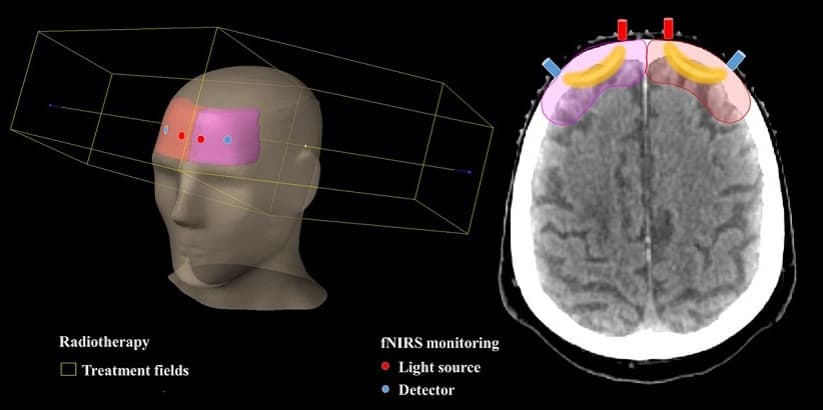
Tracking oxygenation A functional near-infrared spectroscopy device attached to the patient’s forehead measures changes in haemoglobin and tissue oxygenation levels as the patient receives a dose of radiation. (Courtesy: T Myllylä et al J. Biomed. Opt. 10.1117/1.JBO.28.1.015002)
Blood flow and oxygen supply to tumours change over the first few weeks of radiotherapy. Scientists currently believe that reoxygenation occurs due to tumour shrinkage, decreased oxygen consumption and increased perfusion. Clinicians hope that these and other possible changes might be exploited to improve a patient’s response to radiation therapy.
In a potential step toward personalized cancer treatments, researchers in Finland are using functional near-infrared spectroscopy (fNIRS) to measure real-time haemoglobin concentration, an indirect indicator of tissue oxygenation, during whole-brain radiotherapy.
Teemu Myllylä from the University of Oulu leads the fNIRS research in collaboration with Juha Nikkinen, chief physicist in the clinical medical physics division of radiotherapy at Oulu University Hospital. The goal of their research studies, Myllylä says, is to apply fNIRS to begin to close some of the gaps in our knowledge of tissue and tumour oxygenation and response during and after radiotherapy.
Functional near-infrared spectroscopy has been used for several decades to study real-time brain activity in response to different stimuli and cognitive tasks. The relatively inexpensive, portable and non-invasive approach can measure cerebral haemodynamics up to 2 cm deep in the adult human brain. The fNIRS device uses infrared light to measure real-time changes in regional concentrations of haemoglobin – a surrogate for changes in blood volume and, by extension, how well oxygen is getting to tissues – in the brain.
In their recent proof-of-concept study, reported in the Journal of Biomedical Optics, the researchers used fNIRS to measure haemoglobin concentration during palliative whole-brain radiotherapy. The team observed increased blood flow during treatments in 10 patients undergoing multiple whole-brain irradiations. No effect was observed before irradiation or after irradiation ended.
The team attached fibre optic tips for the multiwavelength fNIRS device perpendicular to the brain and confirmed that they did not interfere with the setup or delivery of radiation. Radiation dose was delivered using static field whole-brain radiotherapy, which comprised two opposing 6 MV fields. Forward-intensity-modulated radiation therapy, which adds smaller fields from the same direction as the main fields, was applied to provide homogeneous dose coverage of the entire brain.
Because a NIRS device only measures the relative concentration of haemoglobin throughout the brain, different patients have different fNIRS signal amplitudes. The researchers normalized the signal amplitudes by filtering the fNIRS signal in a very low-frequency band and then subtracting the signal at the beginning of the irradiation from whole corresponding signals. They used resting state data from hundreds of healthy individuals as control data.
The team is now collecting fNIRS data from participants with solid tumours to try to differentiate between haemoglobin concentrations in tumour and healthy tissue and to study tumour responses to irradiation. They are also investigating why they observed differences in tissue oxygenation between the first and second irradiation in their Journal of Biomedical Optics study. Possible explanations include a smaller absorbed dose in the second irradiation, multileaf collimator or other measurement setup effects, or physiological responses.
“The [fNIRS] technology is easy to perform in clinical settings and practically does not disturb or slow down the normal radiotherapy procedures performed on patients,” Myllylä says. “There is high potential to exploit fNIRS in clinical situations because it is a safe technique and can be used in combination practically with all currently-used clinical neuroimaging and therapy techniques.”
The UK-born physicist Nicola Foxhas become head of science at NASA, one of the highest profile positions at the US space agency. Fox takes over from Thomas Zurbuchen as NASA’s associate administrator for the science mission directorate after he stepped down at the end of 2022 following six years as the agency’s chief scientist.
Born in Hitchin, Hertfordshire in 1969, Fox graduated from Imperial College London with a BSc in physics in 1990. After an MSc in telematics and satellite communications from the University of Surrey, she returned to Imperial to do a PhD in space and atmospheric physics, which she completed in 1995.
Fox then moved to the US, doing a postdoc at the Goddard Space Flight Center before heading to the Applied Physics Laboratory (APL) at the Johns Hopkins University in 1998. As a research scientist at Johns Hopkins, she studied various aspects of the geospace impact of coronal mass ejection events from the Sun.
Fox later became chief scientist for heliophysics at APL as well as the project scientist for NASA’s Parker Solar Probe – NASA’s first mission to “touch” the Sun, which launched in August 2018. Fox joined NASA headquarters in 2018 as the director of the heliophysics division, where her portfolio also included NASA’s space weather research programme.
NASA’s science mission directorate has five separate divisions focusing on earth science, planetary science, heliophysics, astrophysics, and biological and physical sciences. In her new role, Fox is responsible for over 100 NASA missions as well as an annual budget of $7.8bn. She is also only the second women to hold the position after astronaut Mary Cleave who was associate administrator for science from 2005 to 2007.
“It’s the role of a lifetime, I could not be more excited,” Fox told BBC Radio 4. “You don’t really dream of working for NASA, it certainly doesn’t seem like it’s something that could be a reality.”
“As the director of our heliophysics division, Nicky was instrumental in expanding the impacts and awareness of NASA’s solar exploration missions and I look forward to working with her as she brings her talents, expertise, and passion to her new role,” noted NASA administrator Bill Nelson.
Opening with a brief summary on the history of colonization on Earth (and everything that fraught subject entails), Hollander moves quickly to take the reader through the basics, such as the fundamental architectural, transportation and zoning considerations of city planning. He then looks at how we might address the particular demands of settling on Mars, and what can be learnt from constructions in extreme environments on, and in the orbit of, Earth.
Finally, a whistle-stop tour of proposed Martian city concepts – both from speculative fiction and academia – leads to a proposal for the Red Planet’s first city, that he dubs “Aleph”, presumably after the first letter of the Hebrew alphabet. The book is rich and detailed, yet easy-to-read – and certain to engage any space enthusiast.
The book is rich and detailed, yet easy-to-read – and certain to engage any space enthusiast
For this reviewer, however, The First City on Mars has two main issues. One is that despite Hollander’s repeatedly stated ambition that he hopes this book will serve as a literal handbook for future Martian city planners, I couldn’t help but feel that a slightly more popular and less scholarly format could have been a better fit. Certainly, that is what I expected based on the lively cover blurb, which fostered something of a disconnect.
In rare but jarring places, excessive detail – when combined with the textbook format – gives the impression of reading a dissertation by an overzealous student. Case in point: a section on the merits of mass transit systems and the automobile careens off into a bizarre tangent about street racing, the “Fast & Furious” franchise and the “famed Batmobile”. As Burt Ward might have put it: “Wholly irrelevant, Batman!”
But the bigger disappointment comes from the fact that the actual conjuring up of a tangible plan for Aleph is presented rather as a reluctant afterthought.
In fact, Hollander himself readily admits that he is more interested in outlining his underlying “key principles for Mars city building”, after which he would have been “content (on some level) with ending the book”. What does follow is enticing but too brief, and is concluded with an all-too-twee piece of fiction about the life of a new arrival to Aleph city.
A final and unaddressed question arises from how exactly one defines a city and whether Aleph itself – containing just nine tri-layered habitat domes around 100 metres across – quite fits the bill, even with the potential to be replicated modularly across a region. Still, one must admit that “The First Village on Mars” is perhaps a less impressive title.
Light waves confined in an evaporating water droplet provide a useful model of the quantum behaviour of atoms, researchers in Sweden and Mexico have discovered. Through a simple experiment, a team led by Javier Marmolejo at the University of Gothenburg has shown how the resonance of light inside droplets of specific sizes can provide robust analogies to atomic energy levels and quantum tunnelling.
When light is scattered by a liquid droplet many times larger than its wavelength, some of the light may reflect around the droplet’s internal edge. If the droplet’s circumference is a perfect multiple of the light’s wavelength inside the liquid, the resulting resonance will cause the droplet to flash brightly. This is an optical example of a whispering gallery mode, whereby sound can reflect around a circular room.
This effect was first described mathematically by the German physicist Gustav Mie in 1908 – yet despite the simplicity of the scenario, the rich array of overlapping resonances it produces can create some incredibly complex patterns, some of which have yet to be studied in detail.
Optical tweezers
To explore the effect in more detail, Marmolejo and team devised an experiment where they confined water droplets using optical tweezers, then they evaporated the liquid by heating it with a fixed-frequency laser. As the droplets shrank, their circumferences were sometimes equal a multiple of the laser’s wavelength. At these “Mie resonances”, the droplets flashed brightly.
As they studied this effect, the researchers realized that the flashing droplets are analogous to the quantum behaviours of atoms. In these “optical atoms”, orbiting electrons are replaced with resonating photons. The electrostatic potential that binds electrons to the nucleus is replaced by the droplet’s refractive index, which tends to trap light in the droplet by internal reflection. The quantized energy levels of an atom are represented by the droplet sizes where Mie resonances occur.
Marmolejo’s team also spotted an analogy to quantum tunnelling in the optical response of the droplets. As light waves first encounter the confining potential of a droplet, some of the light is reflected. The rest of the light tunnels through the confining potential, resonates, and then leaks out. This created interference patterns which strongly resemble Fano resonances, which were first spotted when electrons were scattered from atoms.
Atomic analogue
Despite being over 100,000 times larger than real atoms, the researchers propose that their optical atom could provide a useful model for studying the inner workings of atoms. They also suggest that the droplets could boost our understanding of the scattering of light.
Beyond its interesting potential for research, the team also hopes the experiment could have useful practical applications in areas including medicine and environmental monitoring. Here, chemicals contained in confined, evaporating droplets would modify the refractive index of the liquid, which would change the sizes at which they flash. This could be used to monitor for pollutants.
By studying an artificial neural network, researchers in the US may have gained a better understanding of how and why our memories fade over time. Led by Ulises Pereira-Obilinovic at New York University, the team has found evidence that the stable, repeating neural patterns associated with newer memories transform into more chaotic patterns over time, and eventually fade to random noise. This could be a mechanism used by our brains to clear space for new memories.
In some models of the brain, memories are stored in repeating patterns of information exchange called “attractor networks”. These form within webs of interconnected nodes that are used to represent the neurons in our brains.
These nodes convey information by emitting signals at specific firing rates. Nodes that receive signals will then generate their own signals, thereby exchanging information with their neighbours. The strengths of these exchanges are weighted by the degree of synchronization between pairs of nodes.
Stable patterns
Attractor networks form as an external input is applied to a neural network, which assigns an initial firing rate to each of its nodes. These frequencies evolve as the weights between different pairs of nodes readjust themselves, and eventually settle into stable, repeating patterns.
To retrieve a memory, researchers can then apply an external cue that is similar to the original input, which kicks the neural network into the relevant attractor network. Multiple memories can be imprinted onto a single neural network, which naturally switches between stable attractor networks over time – until an external cue is provided.
These systems have their limits, however. If too many attractor networks are stored on the same neural network, it may suddenly become too noisy for any of them to be retrieved, and all its memories will be forgotten at once.
Losing memories
To prevent this from happening, Pereira-Obilinovic’s team suggest that our brains must have evolved a mechanism for losing memories over time. To test this theory, the trio, which also included Johnatan Aljadeff at the University of Chicago, and Nicolas Brunel at Duke University, simulated neural networks in which the weights between connected nodes in an attractor network will gradually diminish as new memories are imprinted.
They found that this caused older attractor networks to shift into more chaotic states over time. These networks featured faster fluctuating patterns. These patterns of firing signals never perfectly repeat, and can coexist far better with newer, stable attractor networks. Eventually, this increasing randomness causes older attractor networks to fade into random noise, and the memory they carry is forgotten.
Altogether, the researchers hope their theory could help to explain how our minds are able to constantly take in new information, at the price of losing older memories. Their insights could help neurologist to better understands how our brains store and retrieve memories, and why they ultimately fade over time.
The European Union has confirmed that the UK can start negotiations to become an associate member of the €95bn Horizon Europe research programme once the EU and UK’s agreement over the status of Northern Ireland has been ratified by the British parliament. But despite the optimistic noises from Brussels, there is disquiet in the UK scientific community due to what it sees as a shift in tone on Horizon membership from the UK government and seeming reluctance to start negotiations.
The UK government has long maintained that it wishes to join Horizon Europe, which began in 2021 and is the world’s largest research and innovation funding programme. Britain had been a full and highly successful member of previous EU research programmes for decades. Indeed, its ongoing participation, albeit as an associate member, had already been agreed at the end of 2020 as part of the post-Brexit trade deal between the UK and European Union.
However, membership stalled and became a bargaining chip in disagreements over Northern Ireland. If it were to become an associate member of the research programme, Britain would take part in projects alongside other non-EU nations, including Israel, New Zealand, Norway, Switzerland and Ukraine.
The Windsor Framework, which concerns the flow of trade through Northern Ireland, was agreed on 27 February and opened the door for the UK to join Horizon Europe. “The European Commission had always said that the lack of an agreement around the Northern Ireland Protocol was the thing that was stopping us moving forward with the association,” says Daniel Rathbone, assistant director of the Campaign for Science and Engineering (CasE). “It seems that the big political block on Horizon Europe Association is now lifting.”
Speaking at a press conference on 27 February, Ursula von der Leyen, president of the European Commission, said work on the UK’s association with the research programme could start “immediately” once the Northern Ireland deal is implemented. She added that this was “good news for scientists and researchers in the EU and in the UK”.
While Rathbone is pleased to see “the enthusiasm from Ursula von der Leyen” towards Horizon Europe association, he does not feel that the UK government is showing the same level of enthusiasm. It is a feeling shared by other organizations, with representatives from across the UK and EU research and development sector signing a joint statement urging rapid progress on UK association to EU programmes, including Horizon Europe, Copernicus and Euratom.
It is a view echoed by the Institute of Physics (IOP), which publishes Physics World. “The government must honour its commitment to UK science and innovation”, says Tom Grinyer, the IOP’s group chief executive officer. “Being frozen out of Horizon Europe has been costly to UK and European science and the physics innovations that can transform our society and economy,” he adds.
That view is backed by Tim Bradshaw, chief executive of the Russell Group, which also signed the joint statement. “Now is the time,” he says “for politicians on both sides to take decisive action to get association over the line, ending two years of damaging uncertainty and unlocking enormous benefits to scientists and researchers on both sides of the channel.”
Show me the money
A week before the Windsor Framework agreement was announced, CaSE revealed that the UK’s former Department of Business, Energy and Industrial Strategy (BEIS) had quietly returned £1.6bn to the Treasury, which had been allocated for Horizon Europe association, or other science and innovation spending. BEIS, which used to look after British science, was disbanded last month and replaced by a dedicated new Department for Science, Innovation and Technology.
The UK government had repeatedly stated the money would be spent on R&D, Rathbone says, but it has not explained why it had been returned, beyond accounting issues – a move that has worried scientists. “[There is] no guarantee that it comes back to R&D and no real explanation as to why it’s no longer available to science,” he adds. According to Linda Partridge, a vice president of the Royal Society, there are reports in Whitehall that “practically every department is announcing that they do science” so they can have a claim on the money.
It’s glaringly obvious that Sunak has said nothing about [Horizon Europe association], in fact he’s studiously avoided saying anything about it
Linda Partridge
Since the Northern Ireland deal was unveiled, Conservative prime minister Rishi Sunak has also not publicly discussed the EU research framework. When fellow Tory MP Philip Dunne asked Sunak in parliament on 3 March if negotiations to resume association with Horizon Europe had begun, Sunak merely said that the government “will continue to work with the EU in a range of areas — not just research collaboration, but strengthening our sanctions against Russia, energy security and, crucially, illegal migration”.
Sunak had also failed to mention Horizon Europe when asked similar questions by Scottish National Party MP Kirsty Blackman and Labour MP Paul Blomfield on 27 February. “It’s glaringly obvious that Sunak has said nothing about [Horizon Europe association], in fact he’s studiously avoided saying anything about it,” says Partridge. “It’s not at all clear what has changed or why, but it’s leading to widespread consternation.”
There have also been reports that Sunak is uncertain about the benefits of the European research programme. According to the Financial Times, “senior colleagues” said the prime minister was “sceptical” about the value of Horizon Europea and the cost of participation. British officials said Sunak had questioned whether the UK should route its science budget through Brussels and was considering an independent global science collaboration plan, known as “plan B”.
There are a lot of countries outside Europe that have associated or would like to associate [with Horizon Europe], because they recognize the value of the programme
Daniel Rathbone
Rathbone says that Horizon Europe is about much more than just finance, such as the research collaborations it enables. He adds that arguments about alternatives enabling collaborations with countries outside of Europe are irrelevant. “There are a lot of countries outside Europe that have associated or would like to associate [with Horizon Europe], because they recognize the value of the programme,” he says. “It helps to unlock and enable collaborations outside Europe as well as inside Europe.”
Speaking to BBC Radio 4 on 6 March, the UK science minister George Freeman noted that the government’s policy had always been to seek association with the research programme, and confirmed that the door was now open following the agreement of the Windsor Framework. Freeman added, however, that the UK’s financial contribution to the research programme needs to be negotiated.
“If you have been out of the club – not by your own volition – for two years, the monies that you would have paid in for full membership over the whole seven years clearly aren’t due, so we need to sit down and come up with a sensible package,” Freeman explained.
Partridge agrees that there are areas that will now need negotiation. “No-one’s denying that the programme has been running for a couple of years, so there will have to be financial adjustments – that’s true with any agreement, you have to hammer out the details,” she says. “What we would like to see is an announcement of goodwill towards the prospect and a serious roadmap for the negotiations.”
Rathbone, meanwhile, believes the financial issues are solvable in a relatively short period of time. “What we’d really like to see is those conversations and negotiations with the EU taking place in parallel with the final steps on the Windsor Framework, so that once that is signed off the association is ready to go,” he says.
But further confusion about the UK’s position emerged on 6 March when the UK government launched a 10-point strategy to make the UK a “science superpower” by 2030. Backed by an additional £370m in funding, it included plans to boost the economy and improve people’s lives through investment in science, technology and innovation. However, the strategy said nothing about Horizon Europe apart from confirming that the UK would continue to finance, until the end of June, existing successful Horizon grant applicants if the UK fails to associate.
Rathbone says that while the strategy is important, the idea of the UK becoming a science superpower is “dead before it’s even got going” without Horizon Europe association. “The situation is clear, everybody from industry to scientists wants this association [with Horizon Europe],” adds Partridge. “This foot dragging by the government is really baffling”.
With electrification of transportation becoming critical for meeting the decarbonization goal, lithium-ion batteries need multifold upscaling. This increase in scale demands next-level understanding in the depth of phenomena occurring in the batteries. This is critical to enhance the safety, improve the performance, and reduce the total cost of ownership.
Being electrochemical in nature, the resultant performance of lithium-ion batteries culminates from a series of interrelated complex phenomena that are dynamic in nature. The phases that get formed during these dynamic phenomena are metastable in nature and thus difficult to access. Hence it becomes imperative to characterize these transitory phases as they happen. To enable this, several new techniques have been developed that help us to understand the changes in the bulk material, electrode/electrolyte interface, and gas-evolution aspects. These techniques span the use of varying radiations including X-ray, electron, neutron, optical and scanning probes.
This webinar focuses on an overview of each of the major techniques and what we can learn from each technique.
An interactive Q&A session follows the presentation.
Chockkalingam (Chock) Karuppaiah has more than 25 years of electrochemical experience in the energy and technology sectors. Prior to founding Vetri Labs, Chock was the vice-president of Stack Engineering at Bloom Energy, professor at Case Western Reserve University, and fundamentals team manager at Plug Power. While at Bloom, he led the product design, process development, and manufacturing scale-up of seven product generations. His technical work includes the development of solid-state batteries, polymer electrolyte fuel cells, solid-oxide fuel cells, and flow batteries. Recently, he joined Ohmium as chief technology officer where he will help scale their electrolyzer technology for the generation of green hydrogen. He has authored 25 patents in the area of electrochemical technology and devices.
When you think of space launches, you probably imagine a NASA or SpaceX mission control, with rows of staff huddled over monitors, huge wall-sized screens, and loud celebrations when some tremendous rocket defies gravity to slice through the atmosphere and reach space.
You likely don’t think of a jumbo jet taking off from an unassuming regional airport in the seaside town of Newquay, tucked away in the south-west of England. But this was how, on Monday 9 January 2023, the UK attempted to join the growing number of countries launching rockets into space from their own soil. Run by Spaceport Cornwall – a consortium of Cornwall Council, Goonhilly Earth Station, the UK Space Agency and the launch operator Virgin Orbit – the “Start Me Up” mission aimed to put nine small satellites into low orbit, making it the first satellite launch from UK soil.
Rather than a rocket blasting off from a stationary, vertical position on the ground, Start Me Up used Virgin Orbit’s LauncherOne – a 31-tonne rocket that launches from under the left wing of a modified Boeing 747-400, called Cosmic Girl, while in flight. The event was bidding to be the fifth successful flight of the air-launched rocket.
With the mission’s eponymous Rolling Stones song playing to the gathered crowds, Cosmic Girl’s take-off from Cornwall was uneventful. The jumbo jet then flew to a “drop zone” roughly 10,500 m above the Atlantic, off the south-western tip of Ireland, where it released LauncherOne. Seconds later, the rocket’s first-stage NewtonThree engine fired, propelling it up to nearly 13,000 km/h. About three minutes later, the second-stage NewtonFour engine ignited, all seemingly going according to plan.
However, nearly two hours after take-off – just as Cosmic Girl was returning to land safely at Newquay – Virgin Orbit’s Christopher Relf announced on a live stream of the event: “It appears that LauncherOne has suffered an anomaly which will prevent us from making orbit for this mission.” LauncherOne did successfully reach space, soaring to an altitude of 180 km, but failed to orbit. The rocket and its payload of nine small satellites fell back to Earth. Some of them burned up on re-entry into the Earth’s atmosphere, while the rest landed in a pre-approved section of the Atlantic Ocean.
Industry undeterred
The Start Me Up mission could be viewed as a cautionary tale for Virgin Orbit and other launch companies hoping to send rockets into space from UK spaceports. But if anything, it has galvanized those in the industry. Now that the crowds have dispersed, Melissa Thorpe, head of Spaceport Cornwall, has had time to rally for round two. “Of course, it was disappointing,” she says, “but at the same time we’re really excited that we kind of proved that capability and we’re moving forward, looking towards the next launch later this year.”
Time to rally Melissa Thorpe, head of Spaceport Cornwall, is still excited about the facility’s future despite the failure of its first rocket launch from UK soil. (Courtesy: Spaceport Cornwall)
Also aiming for launches this year – conventional vertical ones in these cases – are two Scottish facilities: the SaxaVord spaceport on the island of Unst in Shetland, and Space Hub Sutherland at the A’Mhoine peninsula in Sutherland. Along with four more spaceports in the works, the UK’s space launch capability is certainly set to soar. For Ian Annett, deputy chief executive of the UK Space Agency, this is now a watershed moment for the UK space industry, which is already worth £16.5 billion a year to the country’s economy and employs nearly 50,000 people.
He argues that the UK is good at designing and building satellites, has attractive conditions for setting up operations centres, and has world-leading capabilities in exploiting space-based data. “The one thing that’s missing is launch capability,” he says. “If you can provide that end-to-end spectrum, it serves the broader endeavour so that we can do everything.”
Up to now, UK satellites have launched primarily from the US, French Guiana or Kazakhstan. But shipping satellites abroad is expensive for UK space businessesand it’s always risky transporting fragile cargo to distant sites. Domestic launch capacity offers a cheaper and safer alternative.
More broadly, the official line from the government is that space launch facilities will be a boon to the UK economy, swelling UK industry capitalization from £17 billion now to £40 billion by 2030. In turn, this growth will attract investment, provide new high-skilled job opportunities and encourage young people to study science, technology, engineering and mathematics (STEM) subjects in preparation for careers in the space industry. But are these ambitions realistic?
One hurdle is competition. There are around 168 launch companies around the world, at different stages of development, vying for satellite developers’ business. “Probably about 50% of them only exist on PowerPoint,” says Annett. “I would predict that a large number will either consolidate or they won’t get off paper – so don’t believe everything you read about the number of launch operators.” Nevertheless, even if many fall by the wayside the launch market will inevitably become crowded, making it a challenge for UK spaceports to compete.
High hopes The SaxaVord spaceport is on the island of Unst in Shetland, the most northerly part of the UK. (Courtesy: SaxaVord)
But Annett sees other advantages. “If you look at successful spaceports, they have generated other space-related activities around them,” he explains, pointing to Rocket Lab’s Launch Complex 1 in New Zealand where commercial deployments of smallsats have seeded an entire successful space industry in the country. Then there’s Houston Spaceport in the US, which has managed to attract a multitude of aerospace companies without ever hosting a launch or landing. “While many will conduct their business plans on how many launches they get a year and who their customers are,” Annett adds, “the real success factors will be defined by creating a centre of gravity for space-related activity.”
Spaceport Cornwall is already focused on this, looking beyond launch to ensure it survives and thrives. “For us, it’s about that wider cluster,” says Thorpe. “We want a sustainable business model that’s based on lots of different businesses using the site – being attracted here because of launch, of course – and then we just grow it organically.”
Space skills gap
Another challenge for the UK launch industry mirrors that of the country’s wider space sector: a yawning skills gap. Already 51% of UK space businesses worry about filling vacancies, with most of these roles focused on science, engineering or technical tasks. For example, the shortage of propulsion engineers in the UK has become so chronic that Annett says that the UK Space Agency is planning to sponsor PhD students to do propulsion subjects.
Joseph Dudley, director and founder of the thinktank Space Skills Alliance, sees a range of factors contributing to this shortage. “The space sector is growing very fast so obviously there’s more and more demand for people with the kinds of skills that space companies need,” he says. “But that’s in the wider context of there being quite a lot of competition with other STEM sectors that are also growing quite fast.”
These other sectors include finance and technology, where the major players are household names with deep pockets, attracting STEM talent from a young age through fun coding camps. They also have generous graduate schemes, recruit across all STEM disciplines, and offer attractive alternative education pathways for those who don’t attend university.
In contrast, the UK space sector is less flush with cash and follows more traditional recruitment practices, with 75% of workers holding at least one degree, usually in a physics or engineering discipline. “If I say ‘you’re going to need to do a four-year aerospace engineering degree’, that’s a hell of a commitment, it’s very expensive, and it means the sector is always drawing from a small pool of talent,” adds Dudley. Coupled with the UK space industry being dominated by start-ups with little capacity to train up recent graduates, it means there are simply not enough experienced people to go around.
For Dudley, plugging the skills gap calls for a multi-pronged approach. He believes the UK needs to explore some of the recruitment innovation seen in the tech sector to attract talent, and provide more training opportunities for young people. A bigger focus on recruiting and retaining women and people from other under represented groups is important too, along with making job adverts more attractive to job seekers in general.But for any of these aims to be met, people need to know that UK space careers exist and could be a viable and successful option for them, and this is where spaceports can play a key role.
Spaceport Cornwall is trying to inspire the next generation of space professionals by engaging with every single school in Cornwall through online and in-person programmes. It has also worked with Truro and Penwith College to co-develop the world’s first undergraduate-level Higher National Certificates and Diplomas (HNC/Ds) in space technologies. And the team has collaborated with the University of Exeter and Falmouth University on various educational projects. “Launch is almost a nice cherry on top,” says Thorpe. “As long as we’re out engaging with young people and inspiring them, that’s success to us.”
Is space still cool?
For many invested in the UK space industry, the logic goes that if young people see launches and space activity happening at UK spaceports, have interactions with members of the industry and can see viable career paths, then the sector can latch on to the “cool factor” that space has always enjoyed. However, this may not be such a powerful draw in today’s more environmentally conscious world.
Since they were first mooted, UK spaceports have experienced resistance from environmental organizations concerned with both the greenhouse-gas emissions regular space launches will produce, and the impact on human health, flora and fauna.
Rockets release pollutants up to about 80 km into the sky, which is so far above the clouds that they are not dispersed by rain. They therefore remain in the atmosphere for two and a half years compared to just a few weeks for pollution closer to the ground
The space industry currently consumes about 1% of fossil fuels burned by conventional aviation. But this figure will rise with the tenfold increase in rocket launches and emissions that is expected in the next 10–20 years. What’s worse, the emissions from launches are more harmful than those from aviation. Rockets release pollutants up to about 80 km into the sky, which is so far above the clouds that they are not dispersed by rain. They therefore remain in the atmosphere for two and a half years compared to just a few weeks for pollution closer to the ground.
1 Relative effects Using a 3D model, Eloise Marais and colleagues calculated the effect of emissions from rockets at different heights. (Redrawn from original published in Earth’s Future10 e2021EF002612)
“Soot particles are very, very efficient at absorbing the Sun’s rays and warming the atmosphere,” Marais explains. “And all rockets are going to produce nitrogen oxides that can deplete ozone in the ozone layer, and also water vapour, which is not great if we’re releasing it into layers of the atmosphere where it is fairly foreign.”
Compounding the issue are spent stages and decommissioned satellites adding to the growing amount of space junk re-entering Earth’s atmosphere. When space junk burns through the mesosphere it produces yet more nitrogen oxides, as well as a host of different particles that could contribute to ozone depletion.
Marais is quick to point out that the effect on the ozone layer is relatively small, but this may change if the rate of satellite launches continues at its current pace: “We don’t have to have the same amount of emissions coming from rocket launches to have the same climate effect as Earth-bound sources.”
Environmental agenda
There is a strong argument that the benefits of increased satellite launches outweigh the environmental costs. For example, more satellites mean better monitoring of half of the UN’s 54 essential climate variables; democratizing connectivity and Internet access; and allowing for more precise navigation and weather forecasting. But environmental sustainability is still high on the agenda for each of the UK spaceports hoping to launch in 2023.
Spaceport Cornwall’s environmental impact has been a key consideration from the outset. As it operates from an existing airport, it avoids the extra carbon footprint and disturbance to local flora and fauna that comes with building a site from scratch. It is also exclusively a horizontal launch facility, meaning the rockets taking off from there are smaller and produce considerably fewer combustion byproducts than comparable vertical launch rockets. Yet there is still a way to go before the consortium can reach its aim of becoming the world’s first carbon-neutral spaceport by 2030. “We did a whole lifecycle analysis around launch, looking at the good, the bad and the ugly, even before Start Me Up,” says Thorpe. “Now, we’re looking at not just offset or mitigation, but how do we bring that impact down and do it in a more efficient and sustainable way.”
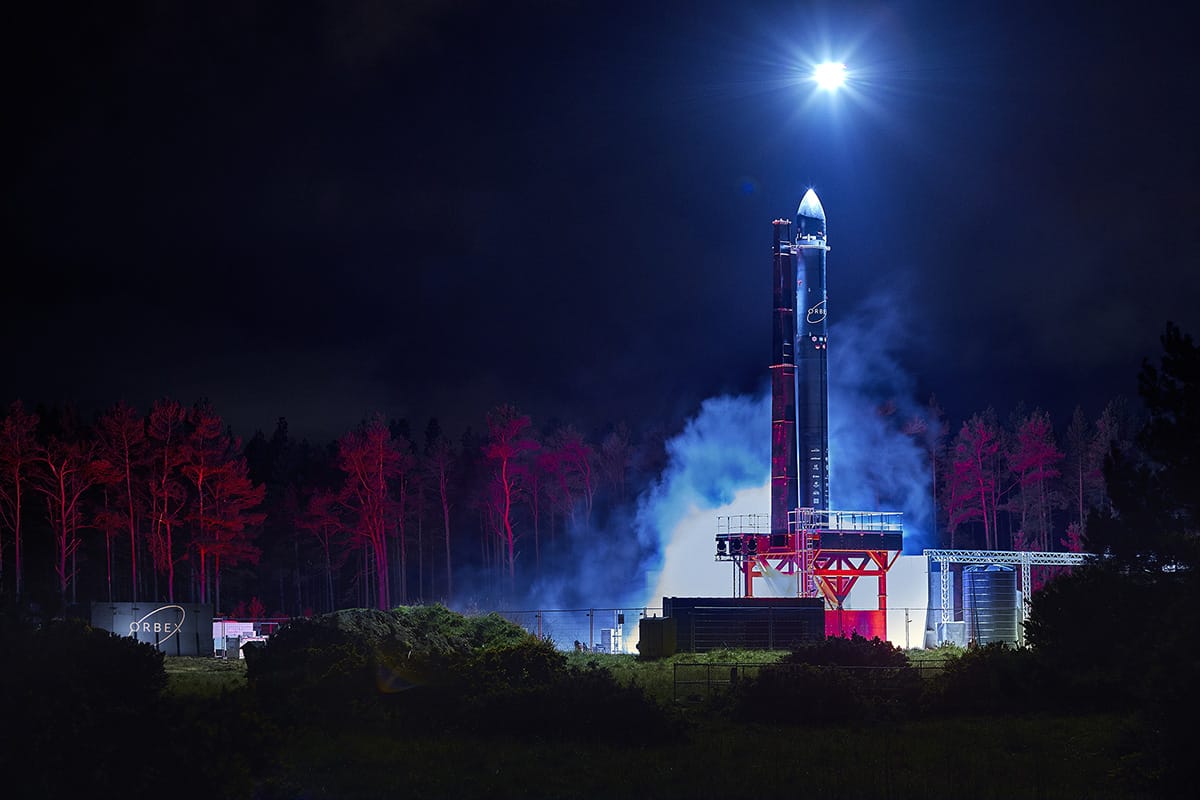
Prime example The Orbex Prime is a reusable rocket that uses a renewable ultralow-carbon fuel called BioLPG. It will have a much lower carbon footprint than fossil-fuel-powered rockets, but will still release some of the same pollutants into the upper atmosphere. (Courtesy: Orbex)
An obvious route to improving sustainability is being explored for launches at SaxaVord and Sutherland, where rocket companies are attempting to replace existing rocket fuels (primarily solid rocket fuel, hydrazine, kerosene and cryogenic/hydrogen fuel) with more environmentally friendly alternatives.
The private rocket company Skyrora – which has agreed a multi-launch deal with the SaxaVord spaceport – uses Ecosene, a premium kerosene derived from unrecyclable plastic waste. The low-temperature catalytic pyrolysis process developed to make Ecosene produces 70% lower CO2 emissions compared to classic methods of fuel production.
Similarly, another launch company Orbex – which plans to launch its Orbex Prime rocket from Space Hub Sutherland – uses the renewable ultralow-carbon fuel BioLPG. This is produced as a byproduct of the waste and residual material from renewable diesel production. A study by the University of Exeter modelled emissions from Orbex Prime, calculating that launches will have a carbon footprint up to 96% lower than those running on fossil-fuel alternatives.
For Marais, though, these fuels miss the mark. They may have a lower carbon impact in their production, but they are still going to release the same pollutants into the higher layers of the atmosphere as traditional fuels. “As well as carbon neutrality, we should also be considering pollution neutrality,” she says. “There should be funding for environmental scientists to look at this further; funding that is independent of the companies that are considering these fuels.”
Impacting the space environment
With so many questions about the impact of spaceports on the environment, it can be easy to forget the impact increased satellite launches are having on their final destination: space. There are currently 10,513 satellites orbiting Earth, a number that has more than doubled since 2019 according to the UN Office for Outer Space Affairs.
Messy business A computer generated image showing the concentrations of objects in low Earth orbit and in the geosynchronous region as seen from a vantage point above the North Pole on 1 January 2019. About 95% of the objects are orbital debris rather than functional satellites, and the dots represent their position but are not scaled to Earth. (Courtesy: NASA ODPO)
Her chief concern is the impact on astronomy of the large satellite constellations being developed by SpaceX, OneWeb and others. Already, these table-sized satellites (too large to be launched from UK spaceports) are damaging ground-based observations of the night sky. Satellite downlink transmissions can mess up radio observations of, for example, the cosmic microwave background and star formation. And satellites passing through an observatory’s line of sight appear as streaks, which make it challenging to observe transient events, such as gamma ray bursts, or monitor hazardous asteroids for planetary defence.
Recently, the NSF and SpaceX signed an agreement to mitigate the effects of satellites on ground-based astronomy. The agreement involves making SpaceX’s next generation of satellites less bright; reducing radio interference over radio quiet zones by briefly turning off downlink transmissions; and SpaceX opting out of a prior agreement that requires certain observatories to shut off their laser guide stars as satellites pass over. Walker hopes that every satellite developer and operator will follow suit, even start-ups and academic groups building smallsats intended for launch from UK spaceports. “The smallsats are not quite as much of a problem,” she says. “But if we get hundreds and thousands up there, regardless of whether they’re cubesats or something a little bit bigger, it’s going to make a difference – we all have to act as good stewards”.
Annett too is concerned about the space environment becoming cluttered, but for a different reason. Kessler syndrome refers to the hypothetical scenario where space junk collides with satellites or spacecraft, in turn creating more debris resulting in a chain reaction that would make the near-Earth environment unusable for decades.
Currently, over 130 million pieces of space debris – including 36,500 objects larger than 10 cm, from entire satellites to tools dropped by astronauts – are estimated to be orbiting Earth. This figure will only grow with more launches. “We all know about the danger of Kessler syndrome,” Annett says. “But the UK is a leader in the UN’s long-term sustainability goals for space, and we’re investing in UK companies that can help us look after that environment, such as ClearSpace and Astroscale, which are designing missions to remove space debris.”
A cleaner future? Several companies are developing plans to clear space junk, such as Astroscale, with its ELSA-d (pictured, top) and ADRAS retrieval missions, and ClearSpace, which recently won a contract for space debris clearance from the UK Space Agency (pictured, bottom). (Courtesy: Astroscale; ClearSpace)
There is one piece of space debris, circling in low Earth orbit every 90 minutes, that would be particularly satisfying to capture in a UK mission launched from home soil. Prospero is a long-decommissioned scientific test satellite that stands as a memento to the UK’s first and only successful launch of a vehicle into space. It flew aboard the British rocket Black Arrow from the Woomera rocket range in South Australia in 1971. But the feat was never repeated as the UK government at the time deemed the launch business too expensive.
Over 50 years later, a host of different factors – economic benefits, jobs and skills generation, and Earth and space environmental impacts – will go into deciding whether the launch business has become worth pursuing again. And if it has, wouldn’t removing Prospero be a fitting way to celebrate finally creating a successful, sustainable launch industry?
On 4 April 2023, Virgin Orbit filed for Chapter 11 bankruptcy protection in the US after failing to secure new investment. The filing means that the business can continue operating and address its financial issues, but is protected against creditors. On 16 March 2023, Virgin Orbit had paused operations and furloughed staff while the company sought a new investment plan.
Cervical cancer is the fourth most common cancer among women globally. According to the World Health Organization, there were an estimated 604 000 new cases and 342 000 deaths in 2020. While surgery and chemotherapy can be used to treat early-stage disease, locally advanced cervical cancer is typically managed with a combination of chemoradiation and brachytherapy.
Brachytherapy is a type of radiation therapy in which radioactive sources are placed inside or next to the tumour to deliver a high dose of radiation while minimizing exposure to surrounding healthy tissues. Previous research has demonstrated that for locally advanced cervical cancer, brachytherapy is a key factor for maximizing tumour local control and, hence, overall survival.
Brachytherapy, however, has not undergone the same technological advances as other radiation treatments, with the recommended dosage a one-size-fits-all method. There is a need for customized radiation dose that considers the anatomy of each patient as well as the degree of local tumour dissemination.
One technique that has helped in the targeted administration of radiation is magnetic resonance image-guided adaptive brachytherapy (MR-IGABT). With the assistance of MR images, as well as interstitial needles, MR-IGABT can selectively treat high-risk clinical target volumes (CTVHR). Initial findings from the multicentre EMBRACE-I study established that using MR-IGABT to individualize radiation dose can enhance patients’ overall survival rate, as well as improve local tumour control.
A research group headed up at the Comprehensive Cancer Center of MedUni Vienna and Vienna General Hospital has now carried out a new study using data from the EMBRACE-I study, which included 1318 patients (with a median follow-up of 52 months) from 24 centres across Europe, North America and Asia.
In this latest study, reported in the Journal of Clinical Oncology, the authors aimed to identify the risk factors for local failure (defined as local recurrence or persistence of disease within the treated area) following chemoradiation and MR-IGABT in patients with locally advanced cervical cancer. The researchers analysed various patient-, tumour- and treatment-related factors to identify the predictors of local failure.
The study demonstrated that the use of MR-IGABT was associated with a lower risk of local failure, suggesting that this treatment modality may improve outcomes in patients with locally advanced cervical cancer. Risk factor analysis revealed that tumour histology was one of the most relevant prognostic factors: patients with squamous cell carcinoma had a lower failure risk than those with adeno- or adenosquamous carcinoma. Other parameters with significant impact on local tumour control included maximum tumour dimension, the presence of tumour necrosis, minimal dose to 90% of the CTVHR and a CTVHR volume of larger than 45 cm3.
The study provides valuable insight into the risk factors for local failure following chemoradiation and MRI-guided brachytherapy. This ability to identify high-risk patient and tumour characteristics could help clinicians tailor treatment strategies for individual parameters (such as histology or tumour size) and improve patient outcome. Importantly, the research also highlights the potential benefits of MR-IGABT, which may offer improved precision in the delivery of radiation therapy and better local control of disease.
One surprising outcome of this investigation was its advocating for a watch-and-wait policy in patients with residual disease, a somewhat counterintuitive approach. Although patients with local failure are often recommended more therapy, the research revealed that 74% of those with local failure achieved remission at a later time without additional treatment. Thus, the use of MR-IGABT may offer improved outcomes in these patients. The researchers say that further research is needed to confirm these findings and to optimize treatment strategies for this patient population.