A super-slippery material that can efficiently generate surface charges when illuminated could pave the way for next-generation interfacial materials and microfluidics. The new material is a combination of a copolymer, tiny liquid metal particles and lubricant-trapping microstructures, and its developers say it could find applications in lab-on-a-chip devices, biological diagnostics and chemical analysis.
Slippery lubricant-infused porous surfaces (SLIPS) show much promise for devices that are self-cleaning, anti-icing and able to resist “fouling” by microorganisms that might otherwise accumulate on structures such as boat hulls or microfluidic chips. Such lubricants do have their downside, however. For one, they act as a physical screen for the material beneath them, thereby masking any desirable properties (such as surface charge) it might have. Such screening is not good for applications in which droplets and liquids need to be manipulated and transported across the slippery surface in a controlled way.
Robust charge regeneration capability
Researchers led by Xuemin Du of the Shenzhen Institutes of Advanced Technology, Chinese Academy of Sciences, have now developed a slippery material that does not suffer from these screening effects. The new light-induced charged slippery surface (LICS), as it is called, consists of three core components: micro-sized Ga-In liquid metal particles for efficiently converting absorbed light into local heat; poly(vinylidene fluoride-co-trifluoroethylene) copolymer for its excellent ferroelectric behaviour; and microstructures coated with a layer of hydrophobized SiO2nanoparticles for trapping the lubricant.
In a series of experiments detailed in Science Advances, the team used light to control the movement of droplets placed on the new LICS, moving them at speeds as high as around 18.8 mm/s and over distances as long as around 100 mm. These droplets, which can be either microscopic or macroscopic (their volumes ranged from 10-3 to 1.5 x 10³µL) can also climb up flat or curved surfaces thanks to the charge on the LCIS – something that is not possible for current SLIPS.
“The LICS can rapidly reach as high as 1280 pico-Coulombs per square mm in 0.5 s when exposed to light illumination,” Du explains. “Its robust charge regeneration capability shows no apparent decay even after being exposed to 10 000 cycles of impulse near-infrared irradiation, or even immersed in silicone oil for six months.”
According to the team, the LICS could be used to create steerable droplet-based robots and for performing chemical reactions. It could also be integrated into a pump-free microfluidic chip, allowing for reliable biological diagnosis and analysis in a closed design.
The researchers now plan to further optimize their control of the droplets. “We will also be expanding the biochemical applications of these intelligent polymers and LICS microfluidic chips,” Du tells Physics World.
Artist impression of the coloured nanotubes. (Courtesy: R Zhang)
“Structurally colouring” carbon nanotubes with an amorphous layer of titanium dioxide not only makes them easier on the eye, it also makes them flame-resistant. This is the finding of researchers from Tsinghua University in Beijing, China, who say that these new properties should make it easier to employ nanotubes in wearable devices, smart textiles and functional coatings.
Carbon nanotubes (CNTs) are rolled-up sheets of carbon one atom thick. Thanks to their excellent electrical and mechanical properties, they show promise for many applications, including ultra-strong fibres and conductive wires. They do, however, have two inherent shortcomings: they are jet black in colour, which makes them aesthetically unattractive for some applications; and they are flammable, which means they cannot be employed in high-temperature environments where oxygen is present.
Colour control
Researchers led by Rufan Zhang of Tsinghua University’s Department of Chemical Engineering have now coated CNTs with amorphous TiO2 layers using a technique called atomic layer deposition (ALD). They report that this technique worked for both CNT fibres and CNT membranes and that they could control the colour by tuning the thickness of the coatings.
The team found that as well as increasing the structural and functional diversity of the CNTS, the coating process also makes them resistant to flames. Indeed, the materials can withstand eight hours of burning – unlike ordinary CNTs, which burn easily.
Chemically stable
Compared with conventional dyes and pigments, which are chemically unstable and cannot be used for colouring CNTs, the TiO2 coating-based structural colours can endure 2000 cycles of laundering, Zhang says, and more than 10 months of exposure to high-intensity ultraviolet irradiation.
The technique is convenient, simple, easily repeatable and easy to scale up, he adds. It produces brilliant, controllable colours, such as indigo, yellow-brown, blue, purple and green. Importantly, it does not affect the intrinsic electrical and mechanical properties of the CNTs.
The TiO2-coated CNTs might be used in numerous cutting-edge applications, Zhang tells Physics World. “These include ultra-strong fibres, wearable devices, smart textiles and devices that operate in high-temperature environments (such as aircraft, missiles and rockets), optical displays, colorimetric sensors, anti-counterfeiting devices, information encryption, multicolour passive photonic displays, optical fibres and lasers, to name just a few.”
The researchers now aim to further expand the colour range of their CNTs. “We will also further investigate the excellent performance of the coloured CNTs and look into interdisciplinary applications,” Zhang says.
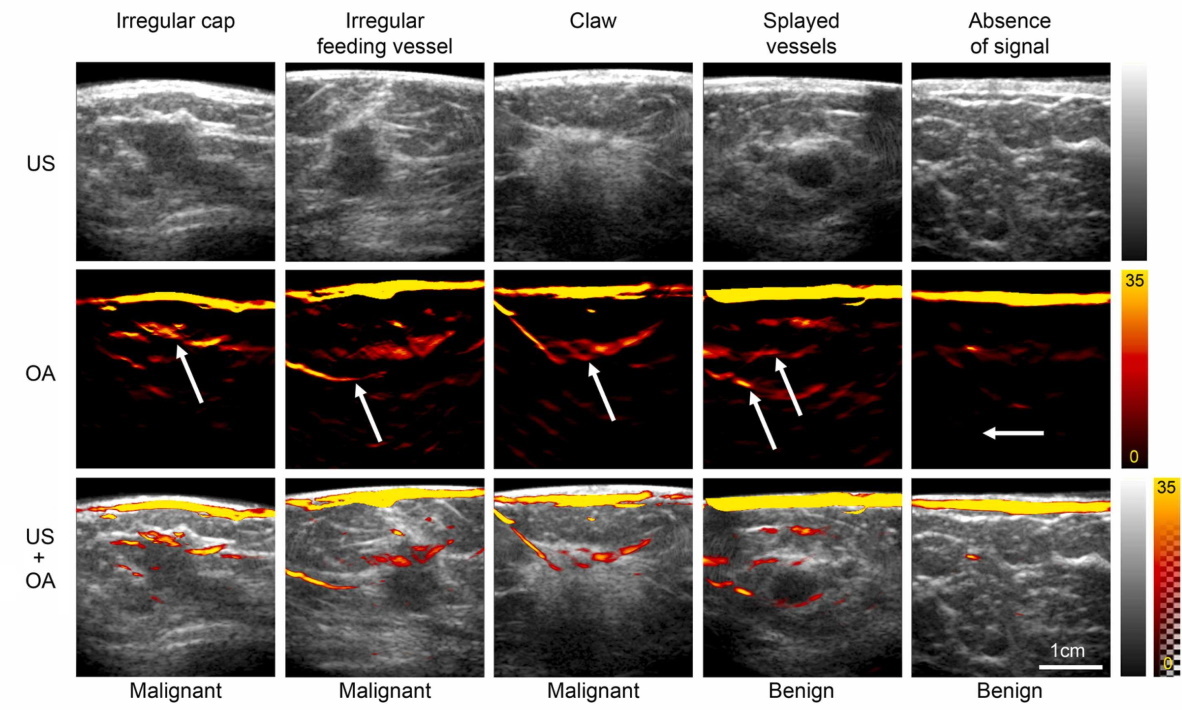
Key features: OA-US images illustrating the patterns used to define the feature set for benign and malignant lesions. Arrows indicate the OA feature (specified above the panels); the lesion histopathology is shown below. (Courtesy: CC BY 4.0/Photoacoustics 10.1016/j.pacs.2022.100383)
Adding optoacoustic (OA) imaging to ultrasound (US) could improve the diagnosis of breast cancer, according to findings from a multidisciplinary research team in Cambridge, UK. The combination enables visualization of functional blood vasculature overlaid with structural features of the breast.
To help accelerate the clinical application of this combined technique, the team developed a simple feature set using single-wavelength OA data from an integrated OA-US imaging system that can identify malignant breast lesions based on their vascular patterns. The researchers describe their findings in Photoacoustics.
A low-cost OA-US device using this feature set could increase the number of early breast cancer diagnoses, especially in women living in low-income countries, where breast cancer survival rates are less than 40% (compared with 80% in high-income countries). The proposed device could also expand breast cancer screening in populations with limited access to mammography.
Ultrasound imaging alone tends to have low sensitivity for breast cancer detection, and cannot always differentiate between benign and malignant lesions. OA imaging – a potentially low-cost technique based on optical excitation and acoustic detection – is being evaluated in clinical studies for breast cancer diagnosis, but the current analysis process is quite complex.
Principal investigator: Sarah Bohndiek from the University of Cambridge. (Courtesy: Sarah Bohndiek)
Principal investigator Sarah Bohndiek, of the University of Cambridge’s Cancer Research UK Cambridge Institute and department of physics, explains that the researchers’ objective was to simplify acquisition of OA-US data and create a simple imaging feature set that was easy to learn and clinically feasible to implement.
The team generated the feature set using images from 96 breast lesions in 94 patients with benign, indeterminate or suspicious breast abnormalities at Cambridge University Hospitals NHS Foundation Trust. The first 38 lesions (including 14 malignant and eight benign) were used to develop the feature set; the others were used for validation.
All patients in the study underwent mammography, breast ultrasound and OA imaging – performed using an OA device that also incorporated low-frequency tomographic ultrasound. The researchers used an excitation wavelength of 800 nm, which minimizes absorption by water and lipids, to create images showing the morphology of blood vessels surrounding a solid breast lesion. The use of a single wavelength simplified OA image processing and visualization, offering the possibility of future system simplification and cost reduction.
The researchers analysed the OA and US images separately and in combination, looking for patterns of blood vessels representative of healthy breast tissue, benign disease and malignancy. Benign lesions demonstrated no vascularity or vessels that were draped over the lesion without penetrating it. Malignant lesions had irregular feeding vessels that penetrated into the lesion and/or a disorganized irregular pattern around them. The internal appearance of the lesions did not differentiate benign and malignant lesions and was not used.
The researchers selected three features of malignancy that would upgrade any solid lesion to a BI-RADS 5 classification (highly suggestive of malignancy): irregular cap, irregular feeding vessel and claw sign. The presence of benign features – no vessels or vessels splayed over the lesion vessel – would downgrade a lesion to BI-RADS 2 (benign).
Two breast radiologists validated the feature set by independently interpreting the OA-US validation images (31 malignant and 13 benign solid lesions). It took only 20 min of training for them to become proficient in using the feature set. They were asked to use the features to classify lesions by BI-RADS category, as well as to classify the patients’ diagnostic ultrasound exams and mammography images.
The breast radiologists interpreted the OA-US images with a sensitivity of 96.8% and a specificity of 84.6%, with one false negative and two false positives for each reader. In comparison, mammography yielded three false negatives and two false positives for each reader, and ultrasound generated one false negative and six and seven false positives. Importantly, all of the mammography and ultrasound false negatives were correctly identified as positive by OA.
Bohndiek points out that OA-US requires practical experience to optimize the standard operating procedure and obtain high-quality image data, and for this reason, future multicentre validation studies should consider operator dependence and independent calibration.
“We have been undertaking validation studies of the OA-US device in the context of developing stable test objects (phantoms) that can be used by medical physicists for QA/QC once the devices are used routinely in the clinic,” she tells Physics World. “We are also planning to apply the system in the future to monitoring of response to radiotherapy treatment in breast cancer.”
Usually, when materials heat up, they become more disordered. Now, researchers at Radboud University in the Netherlands have found evidence for the opposite happening in the element neodymium, which develops long-range order as its temperature increases. The presence of this phase transition could shed light on the behaviour of materials known as spin glasses and could also aid the development of devices for information storage or neuromorphic computing.
Spin glasses such as neodymium (Nd) are a special class of magnetic materials in which particle spins form random, helix-like patterns below a certain critical temperature (termed the spin glass temperature). They are often considered to be disordered magnets and are different from other such “frustrated” magnets such as spin ices and spin liquids.
Recently, researchers led by Alexander Khajetoorians at Radboud discovered that Nd is a self-induced spin glass – meaning that the spin glass state comes about thanks to competing spin-exchange interactions that arise from the material’s own lattice structure. These interactions mean that Nd can exist in multiple low-energy states defined by its reciprocal lattice vector (or magnetic wavevector) Q.
Spins “freeze” into a solid
In the latest study, Khajetoorians and his colleagues observed the spins “freeze” into a solid as they heated the element from -268 °C to -265 °C. When they cooled it down again, the random spin whirling patterns reappeared.
Khajetoorians notes that the appearance of this disorder-order transition in Nd defies the common perception that increasing temperature induces disorder. Such a transition does not normally occur in magnetic materials, he adds, and it is also uncommon in other materials. One exception is Rochelle salt, which contains charges that are randomly distributed at lower temperatures, but build up and form an ordered pattern as the temperature increases.
In Nd, the behaviour is linked to a phenomenon in which many different states have the same energy, causing the system to become frustrated, the researchers say. An increase in temperature lifts the frustration with one ordering tendency surviving, allowing the spins to settle into an ordered pattern over a long range. “Specifically, the new state is a so-called multi-Q one,” Khajetoorians tells Physics World. “There is a high-energy phase at low temperature and vice versa.”
Applications in information storage and neuromorphic computing
The Radboud team used spin-polarized scanning tunnelling microscopy (STM) to probe the magnetic texture on the surface of Nd. They developed two analysis tools that allowed them to extract the spin glass transition temperature directly from their measured data at different temperatures. They observed many different and smoothly varying patterns in the element at 5 K (-268 °C) and fewer patterns at higher temperatures that were clearly separated by magnetic domain walls.
The researchers also compared their observations with atomistic spin dynamics simulations to help them trace the origins of the unexpected high-temperature order.
Khajetoorians says that he and his team will now be studying what happens when Nd is made thinner since this might induce some further unexpected effects. They would also like to test other magnetic materials to see if they exhibit the same spin-glass behaviour, which they say could be harnessed for new types of information storage or to develop neuromorphic computers.
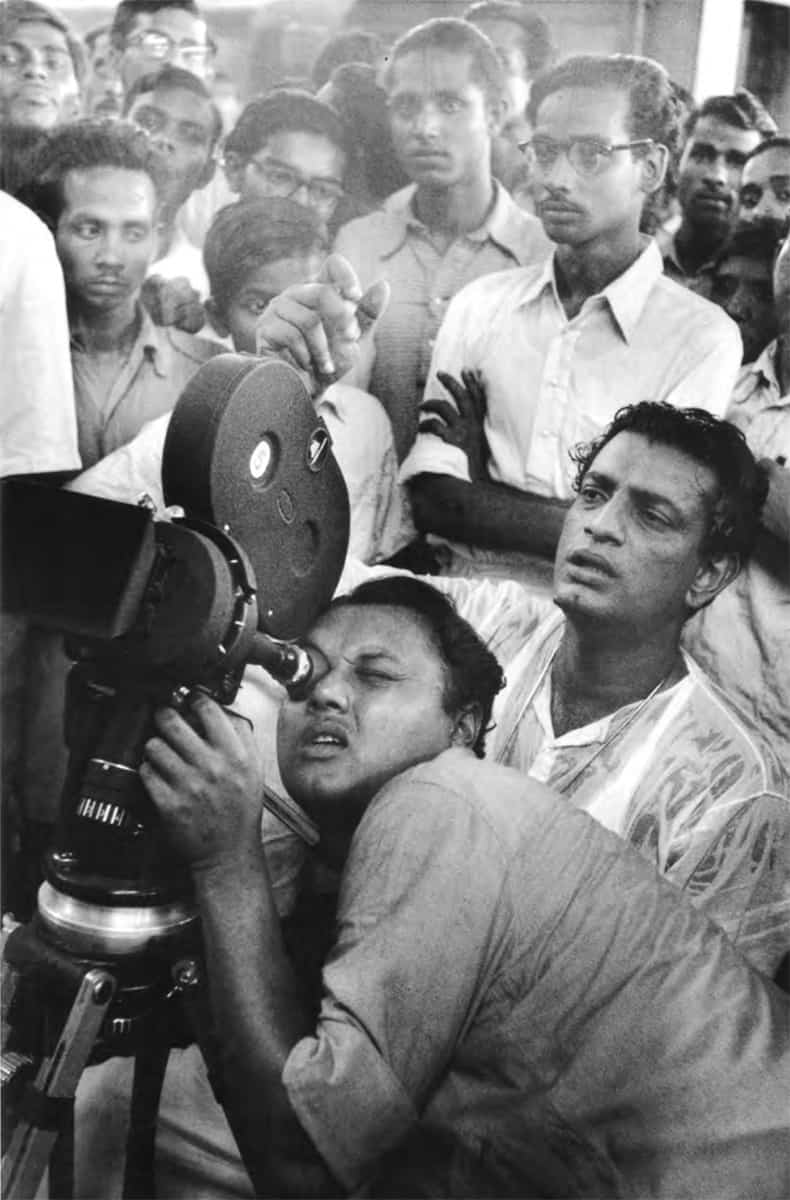
Bright light Satyajit Ray, sitting behind the camera operator, shooting Aparajito in 1956. (Courtesy: Marc Riboud)
Picture a scenic pond nestled within the confines of a small village in Bengal, its calm surface dotted with lotus flowers. Then imagine, one moonlit night, a spaceship splashing down and sinking into its depths, until the only thing visible is a golden spire sticking out of the water. The local villagers think it is a temple risen from the Earth below. Most of them decide to worship it. Little do they realize that the object contains a small humanoid creature that will invisibly play havoc in their lives.
If you think this sounds like an entertaining idea for a science-fiction film, you would be right. And if perhaps, you were to think it somewhat similar to the famous 1982 film E.T. the Extra-Terrestrial, directed by Steven Spielberg, you might not be far off either. But this other alien, the one that crash-landed in India and not America, never quite made it to movie screens across the globe, despite being dreamed up in the 1960s by one of the most significant film directors of the 20th century – Satyajit Ray.
Universal appeal
Born in Calcutta (Kolkata) in 1921, the Bengali polymath was not only a film director but also an established author, essayist, magazine editor, illustrator, calligrapher and music composer. Although all of his films are set in India, the finest of them hold worldwide appeal. Between 1955 and 1991, Ray directed almost 30 features, as well as short films and documentaries. Many won leading prizes at international film festivals. In 1991 he was awarded an Oscar for lifetime achievement – the only such Oscar to be bestowed on an Indian director. Ray also received an honorary doctorate from the University of Oxford: the second film director to be awarded this honour after his hero Charles Chaplin.
Not to have seen the cinema of Ray means existing in the world without seeing the Sun or the Moon
Akira Kurosawa
“Not to have seen the cinema of Ray means existing in the world without seeing the Sun or the Moon”, said Japan’s iconic film director, Akira Kurosawa, in 1975. On Ray’s 70th birthday in 1991, British film director Richard Attenborough, who had acted superbly on screen for Ray, called him a “rare genius”. And in 2021, on the centenary of Ray’s birth, American film director Martin Scorsese proclaimed that his films “are truly treasures of cinema, and everyone with an interest in film needs to see them”.
Coming of age (left) The village boy Apu in Pather Panchali (1955), the first film by Satyajit Ray, and (right) a more grown-up version of him in The World of Apu (1959), both seen in Ray’s celebrated Apu Trilogy. (Courtesy: Satyajit Ray Productions/Alamy Stock Photo)
Ray’s many admirers include a number of luminaries from science, as well as the arts. Chief among them was science writer and novelist Arthur C Clarke, who described Ray’s debut film Pather Panchali (1955) – the first of his classic Apu Trilogy – as “one of the most heartbreakingly beautiful films ever made”. A founder of econophysics, Eugene Stanley, wrote of the “Bengali genius” Ray in a 1992 issue of the statistical mechanics journal Physica A (186 1) – remarking that the director’s recent death had “left the world immeasurably poorer”. And today, a leading Indian theoretical physicist, Dipankar Home, says that he is “amazed by the profundity and steadfastness of Ray’s commitment to a scientific outlook, permeating his varied creations”.
Prolific polymath
Focusing on Bengal but also depicting other parts of India, Ray’s films cover everything from village poverty to urban wealth; they stretch from the 19th-century British Raj to the present-day; and they include comedies, detective stories, musicals, romances and tragedies. Uniquely among great film directors (apart from Chaplin), Ray wrote the script, cast the actors, designed the costumes and sets, operated the camera, edited the film and composed its score, drawing on his passion for Indian and western music. But unlike Chaplin, Ray was not keen to act himself, despite interest from leading Hollywood producers, such as David Selznick. As Ray once explained to the admiring but slightly offended actor Marlon Brando, “No it’s better behind the camera… It would be too tedious, you see”!
In addition to film-making, Ray was a sought-after graphic designer and illustrator, and a bestselling writer of short stories and novels, aimed at both children and adults. His first job, from 1943 to 1956, was with a British advertising agency in Kolkata, and he continued writing fiction until his death. His books, which were later extensively translated from Bengali into English, include both detective stories and science fiction, partly inspired by his early reading of Arthur Conan Doyle, Jules Verne and H G Wells. The Bengali detective he created in his 1965 short story Feludar Goendagiri (English title Danger in Darjeeling) was influenced by his childhood love of Sherlock Holmes. Nicknamed Feluda, the character was also dramatized on screen by Ray as well as being the star of over 30 of his stories and novels. Indeed Feluda has become Ray’s most familiar creation in today’s India, especially with younger audiences.
Fascinated by science
Ray’s grandfather Upendrakisore and father Sukumar were notable writers and illustrators themselves, and both were trained in science (unlike Satyajit). Their stories, comic verse and drawings remain much loved in Bengal today, and their influence on Ray is clear from his many films that reveal the director’s lifelong fascination with science – covering everything from physics and astronomy to medicine and psychology. Perhaps the most famous scene in Pather Panchali shows the curiosity and awe induced in the uneducated village boy Apu by the sound of humming telegraph wires, immediately followed by the boy’s first sight of a passing steam train scattering black smoke across a field of white pampas grass. And in Ray’s last feature film, The Stranger (1991), an avuncular anthropologist enchants his schoolboy great-nephew in Kolkata with a puzzling question: why are the apparent sizes of the Sun and the Moon in the sky similar, and the Earth just the right size for total solar and lunar eclipses? When the boy has no answer, his great-uncle tells him: “I say it’s one of the greatest mysteries of the universe. The Sun and the Moon. The King of the Day, the Queen of the Night, and the shadow of Earth on the Moon … all exactly the same size. Magic!”
Solitary insight Satyajit Ray at work in the drawing room of his apartment in Kolkata, West Bengal, in 1963. (Courtesy: Dinodia Photos/Alamy Stock Photo)
In 1983, in an Indian magazine interview, Ray explained his fascination with science, saying that “this universe, and its incessant music, may not be entirely accidental. Maybe there is a cosmic design somewhere which we don’t know”. Talking about the wonders of nature, he continued, “Watch the protective colourations of birds and insects. The grasshopper acquires the exact shade of green that helps it merge in its surroundings. The marine life and the shore birds put on the exact camouflage. Could it all be coincidence? I wonder. I don’t mystify it either. I think someday the human mind will explore all the mysteries of life and creation the way the mysteries of the atom have been explored.”
Visitor from other worlds
This attitude triggered Ray’s highly original science-fiction film project The Alien, which was taken up by Hollywood in 1967. It emerged in 1964 from a letter written by Ray to Clarke at his home in Sri Lanka, requesting his good wishes for a Kolkata science-fiction cine-club. Clarke replied expressing admiration for Ray’s films and a correspondence developed, which led to their talking in London after watching Clarke’s collaborator Stanley Kubrick – who revered Ray – directing 2001: A Space Odyssey. Ray outlined his idea for the project, and Clarke found it compelling enough to discuss it with another friend Mike Wilson – a flamboyant film-maker and professional skin-diver. Wilson, who was a keen sci-fi fan, volunteered to sell the project internationally.
As already mentioned, The Alien stars a small humanoid creature whose spaceship splashes down in a Bengali village pond where most (but not all) villagers take it to be a submerged temple and begin to worship it. The exceptions include Haba, a poor boy who survives off stolen fruit and begging and who forms a rapport with the alien creature after it has entered his dreams at night and played with him. Another doubter is Mohan, a sceptical journalist from Kolkata, who questions the existence of godly beings. There is also Joe Devlin, a “can-do” US engineer, who distrusts anything he has not personally experienced.
Devlin is in this backwoods area to drill tube-wells on behalf of a dubious Indian industrialist called Bajoria. On seeing the spire, Bajoria instantly perceives its possibilities as “the holiest place in India”. He offers Devlin money to pump out the pond, so its floor can be covered with marble and a marble structure built with a little plaque saying: “Salvaged and restored by Gaganlal Laxmikant Bajoria”!
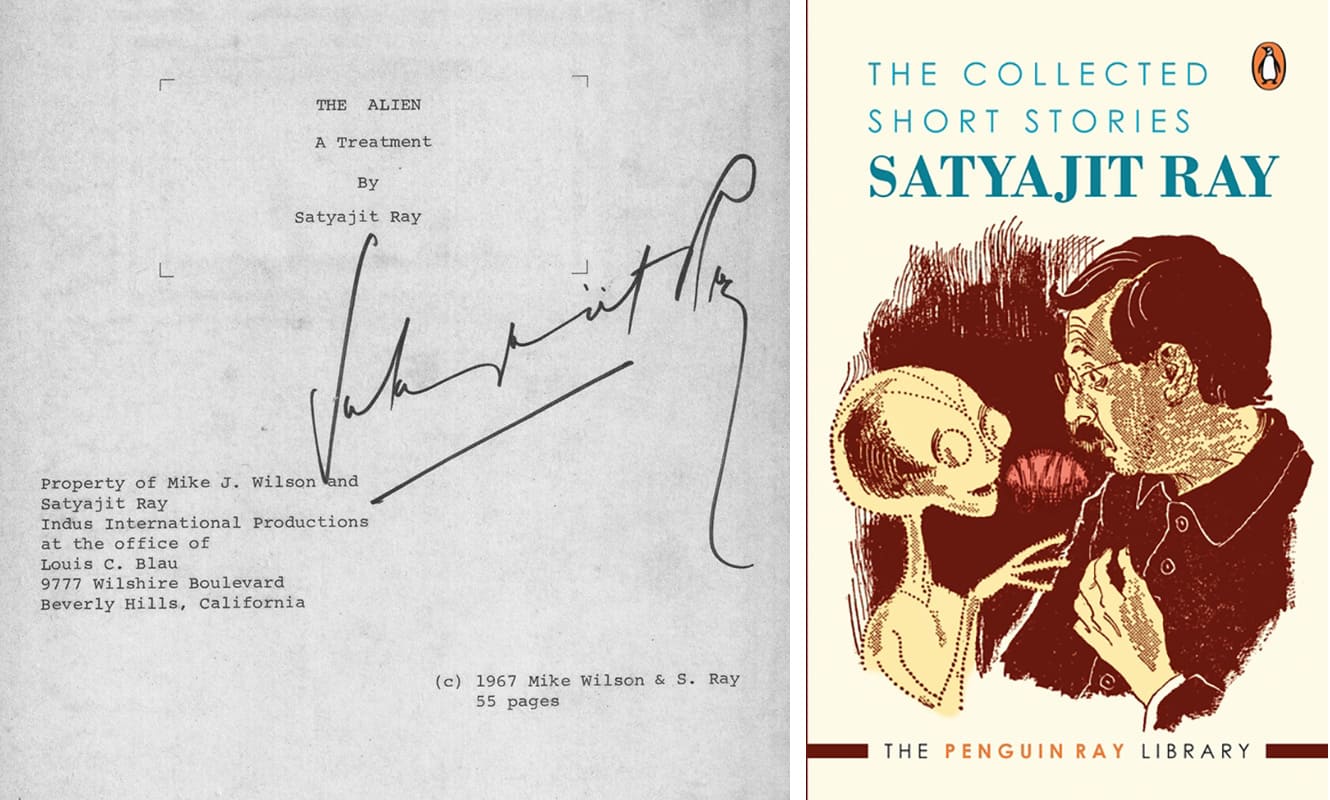
Extra-terrestrial visitor (left) Title page of the “Hollywood” script of The Alien, 1967. (right) A sketch of the alien as envisioned by Ray, and drawn by him to illustrate his 1962 short story “Bankubabur Bandhu” (“Mr Banku’s Friend”), on which he later based the script. (Book cover published with permission from Penguin Random House India)
The extra-terrestrial creature has other ideas though. Consumed with playful curiosity about the world in which it has just landed, it invisibly gets up to all sorts of very visible mischief: ripening a villager’s corn overnight; making a mango tree belonging to the meanest man in the village fruit at the wrong time of year; causing an old man’s corpse lying on its funeral pyre to open its eyes in front of his grandson; and other inexplicable pranks.
Ray drafted The Alien’s screenplay in Kolkata during early 1967, watched by Wilson, who made some useful suggestions, including the golden colour of the spaceship. Ray then proposed that British comedian Peter Sellers should fill the role of Bajoria well. He had admired Sellers in Kubrick’s Dr Strangelove and knew that Sellers had already played an Indian in The Millionairess. Soon, Ray and Sellers met in Paris over lunch arranged by Wilson, and Sellers apparently accepted the role enthusiastically.
The next stop on Ray’s Alien tour was Los Angeles, after he received a sensational cable from Wilson that Columbia Pictures wanted to back the film. There Ray was taken aback to discover mimeographed copies of his screenplay bearing the legend “copyright 1967 Mike Wilson & S Ray” circulating in Hollywood. He also met Sellers again, then filming another Indian role in The Party, but sensed the actor had developed doubts. After being whisked off by Wilson to a series of glamorous parties with film stars, Ray left Hollywood for Kolkata convinced that his innovative Indian project was “doomed”.
To its credit, Columbia remained committed, subject to Wilson’s withdrawal. Ray felt that Clarke was the only person who might bring this about. Clarke responded with a letter saying that Wilson had shaved his head and gone off to meditate in the jungles of south India as a monk. A brief letter from Wilson to Ray finally followed, relinquishing any rights to the Alien screenplay.
Striking similarities
For more than a decade Ray was encouraged by Columbia to revive the project and continued to treat it as possible. Not until he saw Spielberg’s E.T. did he give up hope. E.T., which began life in 1981 as a Columbia project, had much in common with Ray’s concept of The Alien. First, there is the benign nature of the creature. Then, as Ray told me in the mid-1980s while I was researching his biography, there is the fact that it is “small and acceptable to children, and possessed of certain superhuman powers – not physical strength but other kinds of powers, particular types of vision, and that it takes an interest in earthly things”.
Ray felt, though, that the appearance of his alien was much more interesting. “Mine didn’t have any eyes,” he continued. “It had sockets so the human resemblance was already destroyed to some extent. And mine was almost weightless and the gait was different. Not a heavy-footed gait but more like a hopping gait. And it had a sense of humour, a sense of fun, a mischievous quality. I think mine was a whimsy.” Ray could understand the audience appeal of Spielberg’s alien, though he found E.T. “a bit corny at times”. But he did not care for the extent to which the alien had been humanized. “It ought to be more subtle than that,” he said. “But the children are marvellous. Spielberg has talent in handling children; I’m not sure about otherwise.”
The first outsider to spot the similarities was Clarke, who described them as “striking parallels”. Telephoning Kolkata from Sri Lanka in 1983, he suggested Ray write politely to Spielberg about the resemblances. “Don’t take it lying down,” advised Clarke, according to Ray. But despite the fact that Ray remained firmly of the view that E.T. “would not have been possible without my script of The Alien being available throughout America in mimeographed copies”, he did not want to pursue the matter further. Ray agreed with Clarke that “artists have better things to do with their time”; and he knew that Spielberg’s view, according to a letter Clarke wrote to the Times newspaper in 1984, was that he was too young to have been influenced by Ray’s screenplay.
“Tell Satyajit I was a kid in high school when his script was circulating in Hollywood,” Spielberg told his friend Clarke on a visit to Sri Lanka “rather indignantly” – which hardly resolves the doubts, especially as Spielberg in the late 1960s was already an adult getting started in movies. According to Clarke, Ray and Spielberg were “two of the greatest geniuses the movies have ever produced”. However, as Scorsese publicly remarked in 2010, “I have no qualms in admitting that Spielberg’s E.T. was influenced by Ray’s Alien. Even Sir Richard Attenborough pointed this out to me.”
Naturally, Ray regretted that his film never got made. His only consolation was that the screenplay’s delicate effects might well have been crushed by crass Hollywood production values, especially since the story was located in India. One can easily imagine the fate of Ray’s Bengali “whimsy” in Hollywood hands. Perhaps it was for the best that Ray’s project evanesced like the alien spaceship’s lift-off from the pond in the finale of the screenplay – before the Bajorias of Beverly Hills could pump out the water and get a commercial grip on it.
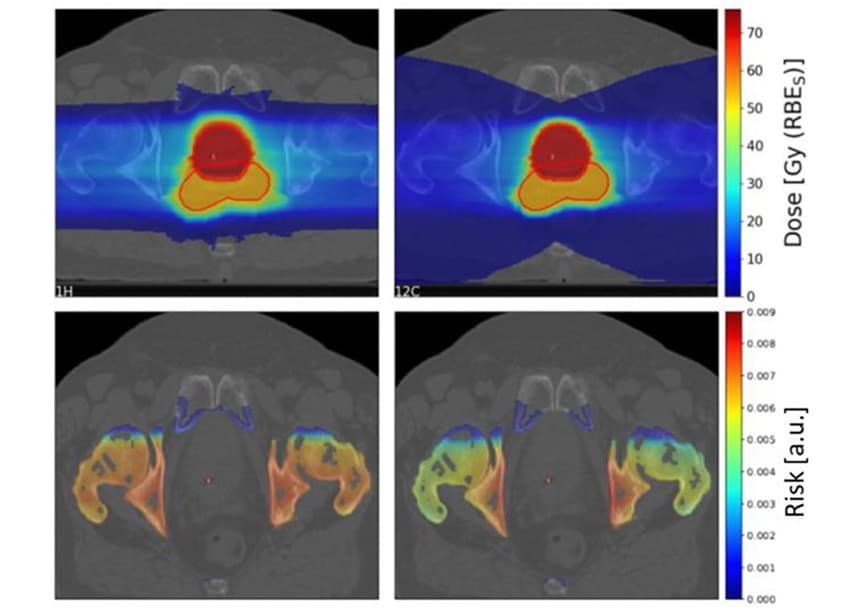
Assessing the risk: RBE-weighted dose distributions (upper panel) and corresponding bone cancer risk distributions (lower panel) in the prostate (upper red contour) and seminal vesicles (lower red contour) for a prostate cancer patient after proton (left) and carbon-ion (right) therapy. (Courtesy: CC BY 4.0/Med. Phys. 10.1002/mp.15805)
Particle therapy – cancer treatment using beams of protons or heavier ions – provides highly conformal dose delivery and greater sparing of normal tissues than conventional photon-based radiotherapy. But for long-term cancer survivors, the risk of radiation-induced secondary cancer (SC) is important, and should be considered when selecting their treatment modality.
With epidemiological data scarce for newer treatments such as proton and carbon-ion therapy, a team headed up at the GSI Helmholtz Centre for Heavy Ion Research is developing a model to compare the SC risks between particle therapy modalities. The model, described by Antonia Hufnagl and colleagues in Medical Physics, could ultimately be incorporated into treatment planning systems to include SC risk as an additional optimization criterion.
Lethal versus carcinogenic events
SC risk models typically work by considering the balance between cell kill (leading to cancer suppression) and cell transformation (induction of mutations that eventually lead to cancer). The probability that an irradiated volume will develop cancer is defined using the linear–quadratic (LQ) model, which provides a simple relationship between cell survival and delivered photon dose.
In this study, the researchers used the local effect model (LEM) to predict the relative biological effectiveness (RBE) of SC induction after particle therapy. To account for the increased RBE of particle radiation, they replaced the photon LQ parameters in the risk model with the ion-beam LQ parameters predicted by the LEM. A key feature of their approach is the use of the LEM in both the cell killing and cancer induction terms.
Research team: First author Antonia Hufnagl (left) and senior author Michael Scholz. (Courtesy: Michael Scholz)
“The double use of the LEM reflects the competition between the two major processes determining SC development, namely cell transformation and cell kill,” explains senior author Michael Scholz. “With increasing dose and/or effectiveness, cell kill can supress the viability of transformed cells. This leads to a complex interplay, which cannot be simply reflected otherwise in a one-step procedure.”
To investigate which factors impact SC risk, the researchers used the TPS TRiP98 planning system to generate biologically optimized carbon-ion and proton treatment plans based on an idealized geometry. The plans irradiated a 4x4x4 cm target with a single particle beam or two opposing beams, with a 4x4x1 cm organ-at-risk (OAR) in front of the target. Due to uncertainties in the photon LQ parameters used as input for the LEM, they estimated proton-to-carbon ion risk ratios, rather than individual risk values.
For these idealized set-ups, the model did not show a clear preference for either protons or carbon ions, but revealed a complex dependence on various parameters. The reduced lateral scattering of carbon ions leads to a lower SC risk than protons in the entrance channel. However, carbon ions deposit a higher dose behind the target due to the fragmentation tail, increasing the SC risk for OARs behind the tumour after carbon-ion irradiation.
For single-beam plans, the total SC risk was roughly 1.5 times higher for carbon ions than for protons. With two opposing beams, the total SC risk was 1.16 times higher for protons, although this varied strongly depending on the spatial location of the assumed sensitive volume with respect to the target volume.
Tissue radiosensitivity (to photons) had a major impact on the SC risk ratio, with radioresistant OARs benefiting from carbon-ion treatment and sensitive OARs from proton beams. In contrast, the fractionation scheme had little impact on expected risk values.
Patient geometry
To investigate clinical scenarios, Scholz and colleagues estimated the SC risks for 10 prostate cancer patients previously treated with photon radiotherapy at Karolinska University Hospital. They generated treatment plans for the patients using two laterally opposed scanned proton and carbon-ion fields.
As seen previously, the fragmentation tail of carbon ions resulted in a large low-dose area behind the target. However, the high-dose target region was more conformal for the carbon-ion than the proton plans.
The team calculated the proton-to-carbon ion SC risk ratios for four OARs (bladder, rectum, bones and skin) for the 10 patients. For bone and skin, proton plans yielded a slightly higher SC risk than carbon-ion plans, with median risk ratios of 1.19 and 1.06 for bone and skin, respectively. For bladder and rectum, however, proton plans resulted in significantly lower SC risks, with risk ratios of 0.68 and 0.49 for bladder and rectum, respectively.
The researchers conclude that the insights gained by this model could help optimize future treatments. Currently, relative risk modelling is mainly suitable as a tool for comparing different treatment scenarios for different patient cohorts. But Scholz notes that incorporating such models into treatment planning for individual patients would be straightforward.
“It just requires running the planning for a given dose distribution with two different biological parameter sets representing the cell kill and the cell transformation process, respectively,” he explains. “Then, only some postprocessing of the resulting 3D effect distributions with standard mathematical tools is needed to derive the corresponding risk ratio distributions.”
The next step, he says, is to validate the model via comparison to clinical data. “Since at present these data are scarce, extension of the approach to also include photon treatments and determining the corresponding risk ratios of protons versus photons and carbon ions versus photons would be an important next step,” Scholz tells Physics World.
Researchers at Massachusetts Institute of Technology (MIT) have developed a new 3D printing technique that could make it far easier to build detectors for measuring cold, dense plasma in Earth’s upper atmosphere. Javier Izquierdo-Reyes and colleagues hope that their simple, low-cost approach could open up this region of space to a far wider range of research groups.
As the most abundant state of ordinary matter in the universe, plasma is central to a wide array of cutting-edge technical applications: from fusion reactors to advanced material synthesis. One of the best places to measure its unique characteristics is in Earth’s upper atmosphere – where orbiting electrons have been stripped away from their atoms by powerful solar radiation.
Since the 1950s, researchers have used sensors known as “retarding potential analysers” (RPAs) to study this plasma. These detectors contain a stack of negatively-charged electrode meshes, with holes just a few times larger than the electron’s electrostatic influence. By filtering electrons out of the plasma, while allowing larger positive ions to pass through, RPAs allow researchers to directly measure the energy distribution of ions within atmospheric plasma – providing useful insights into its physical properties.
So far, however, RPAs have faced a key limitation. Since the electron’s electrostatic influence increases with temperature, and decreases with density, it becomes far smaller within cold, dense plasma, as is widely found in the upper atmosphere. To filter out these electrons, RPA meshes must contain the smallest possible holes, while maintaining a precise alignment between each mesh.
The detectors attain this alignment through an insulating housing structure for the electrode meshes, which separates them from the RPA’s metal casing. To withstand drastic and unpredictable temperature swings in the upper atmosphere, this housing is typically made from advanced semiconductor materials. However, as RPA meshes become finer, these costly materials must be machined both to a higher precision, and in more intricate shapes – driving up the time, cost and complexity of the manufacturing process.
To overcome this challenge, Izquierdo-Reyes’ team turned to a 3D printing technique named vat polymerization. The approach first involves lowering a platform into a vat of vitrolite resin: a durable glass ceramic that can withstand very high temperatures with good vacuum compatibility. Once the platform is submerged in a layer just 100 µm thick, the team use UV light to cure the resin.
By repeating the process, the researchers could build up RPA housing structures layer by layer. This resulted in a low-cost material that was stronger, smoother and less porous than would be possible with existing ceramic manufacturing processes. In turn, the ceramic was far better suited to withstanding extreme temperature swings.
Having demonstrated the low cost and relative simplicity of their approach, the researchers now envisage a new generation of miniaturized RPAs – which are both better suited than their predecessors to studying cold plasma, and can operate using far less power. If achieved, the sensors could be easily packed onto CubeSats: miniature satellites measuring just 10 cm across, which can be stowed as secondary payloads aboard launch vehicles for other missions. In turn, smaller research groups around the world could soon gain unprecedented opportunity to study plasma in its natural habitat.
New research has uncovered 34 new binary-star systems in which low-mass stars partner up with a so-called “failed star” or brown dwarf. The discoveries almost double the number of known systems and could help astronomers better understand where the dividing line between planets and stars is.
A key player in the research was citizen scientist Frank Kiwy, who is part of the public project Backyard Worlds: Planet 9. He searched through the 4 billion celestial objects in NOIRLab’s Source Catalog DR2 to find binary systems featuring brown dwarfs.
“Our new discoveries fill out a unique part of the brown dwarf companion population,” NOIRLab astronomer and co-founder of Backyard Worlds, Aaron Meisner told Physics World. “This will help scientists understand whether these mysterious celestial objects are more akin to Jupiter-like oversized planets or rather undersized stars.”
Meisner praised the contribution of the citizen scientist at the heart of the study, which is described in a paper in the The Astronomical Journal. “An extremely talented citizen scientist named Frank Kiwy single-handedly performed all of the data mining, then led a team of professional astronomers to publish the discoveries.”
Hard to spot “failed stars”
In terms of their masses, brown dwarfs fall between planets and stars. NASA currently defines the mass range of brown dwarfs as being 15–75 times the mass of Jupiter, which itself is about 0.1% the mass of the Sun. As a result, brown dwarfs lack the mass to kick start the nuclear fusion of hydrogen in their cores, so they resemble cooling embers rather than dazzling stars. This lack of significant radiation output, coupled with their small size, makes brown dwarfs difficult to observe.
“Brown dwarfs are small, intrinsically dim, and emit largely in infrared light,” Meisner explains. “All of these factors combine to make them both difficult to detect and easy to miss”. However, he points out that, “The large sky area and excellent sensitivity at red wavelengths provided by the NOIRLab Source Catalog were key in enabling these new discoveries”.
Since the first discovery of a brown dwarf , called Teide 1, in 1995, astronomers have discovered thousands of brown dwarfs by using highly sensitive telescopes. But only a small percentage of these have been in binary systems.
“We don’t yet know with much accuracy how common brown dwarf companions to stars are,” Meisner says. “Brown dwarf atmospheres are known to harbour molecules such as water and are essential laboratories that provide unique insights into planetary atmospheres, so it’s critical to find more examples of these intriguing systems.”
Citizen science superusers
In order to hunt brown dwarfs, Backyard Worlds: Planet 9 employs a network of over 100,000 citizen volunteers to scan telescope images. These people use their eyes to search data for features that machine learning and supercomputers may miss.
The volunteers include hundreds of “superusers”, who work on ambitious and self-directed projects and Kiwy is one of these superusers.
“I love the Backyard Worlds: Planet 9 project! Once you master the regular workflow you can dive much deeper into the subject,” Kiwy said in a statement from NOIRLab. “If you’re a person who is curious and not afraid to learn something new, this might be the right thing for you.”
Kiwy was able to spot 2500 potential ultracool brown dwarfs and discovered that 34 of these were paired with either low-mass stars or white dwarfs. The latter being stellar remnants that are left behind when stars like the Sun run out of hydrogen for nuclear fusion.
Powerful archives
“It’s remarkable that modern data archives are so powerful that they can enable professional astronomers – and even enthusiastic amateurs – to make major discoveries, without ever needing to go to a telescope,” Meisner added.
From these new discoveries and further research Meisner is hoping to better categorize brown dwarfs. The goal is to establish whether they are more like oversized planets, or if they are closer in nature to undersized stars. Citizen scientists look set to continue to play a role in this investigation.
“We’ll be using some of Earth’s premier telescopes to collect more detailed information about these newly discovered binaries,” Meisner said. “We also suspect that there are more of these discoveries still waiting to be uncovered in existing astronomical data archives – we may even launch a new citizen science project dedicated to finding them!”
The chances are that shortly before you started reading this article you checked the time. Whether you are staring bleary-eyed at an alarm clock, glancing at your wristwatch to see if you are late, or booking appointments into your phone’s calendar app, most of us consult clocks many times a day. It is this familiar and omnipresent tracking of time that forms the starting point for Chad Orzel’s A Brief History of Timekeeping: the Science of Marking Time, from Stonehenge to Atomic Clocks.
In this book, the US physics professor covers the centuries of scientific discoveries, political machinations and societal changes that have led us to current timekeeping methods. Orzel begins in the passage tombs of Neolithic Britain – in which the Sun only shines into the burial chamber at specific times of the year, marking a solstice or equinox – before discussing how the evolution of our modern-day calendar was shaped by religion and politics. As he later remarks, “for everyday purposes, time is not a universal absolute but a social convention”.
The book cleverly weaves centuries of scientific and technological tales together, taking us from a world of tick-tock to one enabling TikTok. We learn how precision marine chronometers developed in the 18th century led to a boon in reliable long-distance shipping thanks to their ability to correctly track longitude; why 19th-century railway companies were a catalyst for the adoption of global time zones; and how signals distributed via satellites or over the Internet are integral to disseminating today’s international reference time scale. Along the way, we are led through discussions of physics discoveries and phenomena fundamental to the story of timekeeping. These include electromagnetism, simple harmonic motion, celestial mechanics, and special and general relativity, as well as the atomic physics and quantum mechanics behind the atomic clocks that provide national time standards.
Orzel gives numerous insights into how sophisticated many historic scientific practices were, for their time. Some of the astronomy and mathematics of the Maya civilization sound almost like science fiction. It is incredible, for instance, that Mayan astronomical tables for tracking Venus successfully predicted when the planet will appear and disappear in the sky for several centuries. But we must not get carried away. From 1987 through to the first decade of the 21st century, an extrapolation from the Mayan calendar systems was used to develop mistaken predictions that the world would end on 21 December 2012. Orzel makes a good job of rubbishing the pseudoscience that gave rise to these prophecies of doom. Similarly he skilfully puts scientific results and claims into perspective in later chapters.
Equally fascinating are the sections highlighted by grey bars down the side of the page, which cover scientific concepts in more detail. Their broad spectrum ranges from describing how fluid mechanics governs the behaviour of water clocks, and delving into thought-experiments to help understand relativity, to explaining how the piezoelectric properties of quartz enable accurate and affordable timepieces, and highlighting why caesium was chosen for the first generation of atomic clocks.
As well as the science, Orzel includes historical stories, some of which are as amusing as they are engrossing. It made me laugh to learn that outflow water clocks were used to limit the time advocates could speak in Ancient Greek courts, and contemporary records indicate speakers commenting when their time was almost up. Picturing the arrays of several overlapping sand glasses used on board ships when tracking time for navigation was similarly entertaining: this arrangement provided a buffer against lapses in concentration by those delegated to turn over the just-emptied glasses.
Throughout the book Orzel also highlights how in the past, scientists’ roles could be different to those today. The 16th-century astronomer Tycho Brahe, for instance, cast horoscopes as one of his main duties as court astronomer in Denmark. Orzel also notes how much valuable scientific record can be lost due to invasion, looting and the passage of time; a fact that sadly still resonates today.
The inclusion of tales of rivalries between scientists, and historic struggles for funding or education, perfectly highlight Orzel’s research process. He also deftly describes how some scientists, like the 17th-century physicist Robert Hooke, had a prodigious talent for self-promotion. Others, though, who were just as important to the development of modern-day timekeeping quietly pressed on with their work – such as 18th century astronomer Tobias Mayer whose meticulous lunar tables later formed the basis for the Royal Observatory’s Nautical Almanac for determining longitude at sea.
Orzel concludes by looking towards a future in which today’s experimental optical-lattice clocks may eventually enable time measurements so precise that we could track earthquakes via fine-scale monitoring of the Earth’s shape, or possibly even detect particles of dark matter if they interact with the clocks’ atomic tick.
Throughout A Brief History of Timekeeping, Orzel leads us into some of the topics via events in his own life. This not only helps bring home how much we take the marking of time for granted, but along with his engaging writing style also prevents the physics content from feeling unrelated to our everyday experiences.
While I mostly feel very positive about this book, it is not without a few flaws. Although the diagrams mainly aid understanding, I found that some would have benefitted from annotations. Equally, Orzel partly based the book on a university course he teaches, and there are sections – such as those on the Michelson interferometer – which seem a bit too obviously derived from that, with some of his explanations requiring a reasonably high level of prior physics understanding. Also, the main text occasionally does not make complete sense if, as Orzel suggests you can opt to do, you have only skimmed over the highlighted sections. Furthermore the book’s title seems a bit of a misnomer in terms of suggesting a quick read. As Orzel himself comments, our personal experiences of time can be subjective, and I don’t consider just over 270 pages “brief”.
But predominantly A Brief History of Timekeeping is accessible to lay readers, and these are minor quibbles about what is overall an absorbing page-turner.It never drags, and I’m glad to have invested several hours to learning more about the fascinating history and physics of timekeeping in the hands of this accomplished author.
All-in-one vaccine: Infographic illustrating the new vaccine, composed of fragments from eight different viruses. The table shows the broad spectrum of SARS-CoV-2 variants and related coronaviruses that the vaccine induces protection against. (Courtesy: Wellcome Leap, Caltech, Merkin Institute)
As the virus that causes COVID-19 evolves and spreads, scientists and clinicians continue developing innovative ways to combat SARS-CoV-2 by designing vaccines and therapeutics. In a recent study published in Science, researchers present a vaccine that, in animals, protects against a variety of betacoronaviruses – a family of viruses that includes those causing the SARS, MERS and COVID-19 pandemics.
The study was led by a California Institute of Technology research team directed by Pamela Bjorkman. Bjorkman says that designing a vaccine with broad protection against several viruses is important, considering that several SARS-like viruses have emerged in the past two decades.
“We can’t predict which virus or viruses among the vast numbers in animals will evolve in the future to infect humans to cause another epidemic or pandemic,” Bjorkman says in a Caltech press release. “What we’re trying to do is make an all-in-one vaccine protective against SARS-like betacoronaviruses regardless of which animal viruses might evolve to allow human infection and spread. This sort of vaccine would also protect against current and future SARS-CoV-2 variants without the need for updating.”
Mosaic vaccine provides broad protection
Bjorkman’s team designed a nanoparticle vaccine consisting of spike protein fragments from eight SARS-like betacoronaviruses, using vaccine technology initially developed by collaborators at the University of Oxford. In theory, when an immune system is exposed to spike protein fragments attached to this so-called “mosaic” nanoparticle vaccine, it will produce a broad spectrum of antibodies that respond to all viruses represented in the vaccine.
The researchers conducted experiments in mice genetically engineered to express the human ACE2 receptor, which is used by SARS-CoV-2 and related viruses to enter cells upon infection. They found that animals inoculated with the mosaic nanoparticle vaccine produced antibodies to all viruses with fragments in the vaccine.
Mice that received a vaccine containing a nanoparticle without spike protein fragments did not survive infection by SARS-CoV-2 or SARS-CoV (which caused the original SARS pandemic in the early 2000s). Those inoculated with a nanoparticle coated only in SARS-CoV-2 spike protein fragments only survived exposure to SARS-CoV-2. Mice vaccinated with the mosaic nanoparticle, however, not only survived exposure to SARS-CoV-2, but were also protected from SARS-CoV, which was not one of the eight betacoronaviruses incorporated into the vaccine.
The researchers conducted similar experiments in non-human primates using the mosaic nanoparticle vaccine. Again, the animals survived exposure to SARS-CoV-2 or SARS-CoV, and they showed little to no detectable infection.
Working with collaborators at the Fred Hutchinson Cancer Research Center, Bjorkman’s team found that the antibodies developed by non-human primates when vaccinated were in response to the most common elements of receptor-binding domains, such as spike proteins. This result, the researchers say, suggests that the mosaic vaccine could be effective against new variants of SARS-CoV-2 or animal SARS-like betacoronaviruses.
“Animals vaccinated with the [mosaic] nanoparticles elicited antibodies that recognized virtually every SARS-like betacoronavirus strain we evaluated,” says first author Alexander Cohen in a press statement. “Some of these viruses could be related to the strain that causes the next SARS-like betacoronavirus outbreak, so what we really want would be something that targets this entire group of viruses. We believe we have that.”
Next up: clinical trials
With the efficacy of the mosaic nanoparticle vaccine borne out in both laboratory and animal studies, Bjorkman and her collaborators are now preparing a Phase 1 clinical trial to evaluate the vaccine in humans. The trial will enrol people who have been vaccinated and/or previously infected with SARS-CoV-2. Animal model experiments will run in parallel with human studies to compare immune responses in animals previously vaccinated with a current COVID-19 vaccine to responses in animals that haven’t been exposed to the virus or received a vaccine.