Manganese joins a new family of superconductors

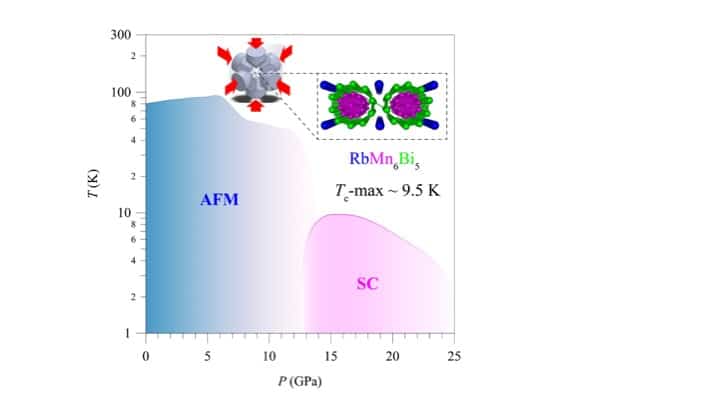
T-P phase of RbMn6Bi5

Researchers from the Institute of Physics, Chinese Academy of Sciences, Beijing, have spotted the tell-tale signs of superconductivity in a quasi-one-dimensional manganese-based material, RbMn6Bi5. The material, which has a superconducting transition temperature (Tc) of 9.5 K at a pressure of around 15 GPa, is the latest in a relatively new family of superconductors, the first of which was discovered in 2015 by the same group.

The classical theory of superconductivity (known as BCS theory after the initials of its discoverers) states that below a specific critical temperature, the fermionic electrons in a metal can pair up to create bosons called Cooper pairs. These bosons form a phase-coherent condensate that can flow through a material without scattering – with superconductivity as a consequence.

Mn-based superconductors

In 2015, researchers led by Jin-Guang Cheng discovered the first manganese-based superconductor, MnP. This material has a very low Tof just 1 K, and its properties are difficult to control because it is a three-dimensional binary molecule. Nevertheless, the fact that it superconducts at all was something of a surprise since conventional wisdom held that manganese-based materials cannot do so. Since then, the group has been screening other Mn-based magnetic materials under high pressures in the hopes of unearthing further examples of superconductivity.

In the new work, the team found what they were looking for in a group of one-dimensional ternary or complex Mn-based compounds. “This study and another related one published in Physical Review Letters establish AMn6Bi(where A=K or Rb) as a new class of ternary Mn-based superconductors with relatively high Tc,” Cheng explains. “The optimal Tc reaches almost 10 K, which is an order of magnitude higher than that of MnP, implying that the Tc of Mn-based superconductors has the potential to go higher.”

Cheng adds that the quasi-one-dimensional crystal structures and chemical composition of materials in the AMn6Bifamily make it easier to tune their physical properties through chemical substitutions and/or other structural/electronic regulations. This means that such materials could be used as the basis for designing other Mn-based superconductors.

“Quantum criticality”

In addition to the material’s relatively high Tc, Cheng and colleagues found that the upper critical field for the superconducting state (that is, the field at which superconductivity disappears) is also high, exceeding the Pauli paramagnetic limit Hp=1.84 Tc. According to Cheng, this implies the presence of strong electron-phonon coupling or exotic pairing mechanisms.

The researchers now plan to investigate the nature of the material’s superconductivity using microscopic probes such as nuclear magnetic resonance measurements. “We also hope to tune the physical properties of K/RbMn6Bi5 at ambient pressure through techniques such as chemical substitutions and gate-voltage regulations,” Cheng tells Physics World. “Ultimately, our goal is to find a Mn-based superconductor at ambient pressure with a Tc of over 10 K.”

They detail their work in Chinese Physics Letters.

Neutrino detectors could monitor treaty compliance by nuclear submarines

Two neutrino physicists in the US have proposed a novel way to detect the presence of weapons-grade uranium in nuclear-powered submarines without entering their reactor compartments. The procedure, which could be conducted in port while a submarine’s reactor is turned off, could help to safeguard against the diversion of highly-enriched uranium into weapons programmes.

The Treaty on the Non-Proliferation of Nuclear Weapons prohibits the transfer of nuclear material from civilian power plants – where it is monitored by the International Atomic Energy Association – to nuclear weapons. It does, however, permit its transfer to non-explosive military uses like nuclear-powered submarines and aircraft carriers. However, once nuclear material is transferred from the civilian realm to the military one, it becomes much harder to track.

Countries are unwilling to divulge the exact movements of their submarines, which makes monitoring them while they are in use impossible, and some are more secretive still. “If you forget about neutrinos, the next best proposal involves using neutron monitors – passive targets that soak up neutrons and become radioactive as a result.” explains Patrick Huber of Virginia Tech; “You place them in the reactor compartment and retrieve them while the vessel is in port. “This requires entry of an inspector into the reactor compartment, and as far as we know no foreigner ever entered the reactor compartment of a US ship.”

Pressing need

This concern has become more pressing as the US and UK have recently agreed to sell nuclear submarines to Australia – which is a non-nuclear state. Australia is unlikely to attempt to build a nuclear bomb, but the transfer of weapons-grade uranium to non-nuclear states underlines the need for a method of verifying that it is not diverted to make weapons.

Submarines can be fuelled with either highly enriched, weapons-grade uranium, which is around 90% uranium-235, or low-enriched uranium, which is mostly uranium-238. States might hypothetically therefore either simply remove highly enriched uranium from submarines or switch it out for low-enriched uranium, allowing nuclear submarines to keep operating while surreptitiously pursuing nuclear weapons programmes. “The foremost goal would be to verify that there is indeed a reactor on board the submarine and the second goal would be to check that it has been fuelled with what it says,” Huber explains.

Huber and Virginia Tech colleague Bernadette Cogswell propose using the fact that an operational nuclear reactor generates radioactive isotopes that decay with various half-lives. Almost all the neutrinos from these decays would pass straight out through the reactor compartment, and could be monitored by a detector underneath the submarine. Moreover, different types of fuel would produce different radioactive isotopes, and these might be identifiable from different neutrino signals.

Specifically, they worked out that, whereas uranium-235 is directly fissile, uranium-238 undergoes beta decay to plutonium-239 before splitting. Therefore, fission products of plutonium-239 decay would suggest that low-enriched uranium had been used in the reactor. Many radioactive isotopes are produced by the nuclear fission of both uranium-235 and plutonium-239, but two stood out for the researchers – cerium-144 and ruthenium-106, which both undergo decays that involve the emission of neutrinos.

Unique combination of decay properties

Cerium-144, which undergoes inverse beta decay with a half-life of 411 days, is produced in slightly larger quantities by uranium-235 fission than by plutonium-239 fission, whereas ruthenium-106, which undergoes inverse beta decay with a half-life of 536 days, is produced in large quantities by plutonium-239 fission but barely produced at all by uranium-235 fission. Both isotopes, if present, would be decaying continuously while a vessel was docked with the reactor switched off, producing neutrinos with different energies: “It’s not like there are 50 isotopes we could use instead,” says Huber; “It’s a fairly unique combination of properties these isotopes have.”

Huber points out that some countries have moved to eliminate the use of highly enriched uranium from naval reactors completely, and French nuclear submarines no longer use it. One day, therefore, their test might be used to verify the absence of weapons grade uranium from a reactor compartment rather than its presence.

Neutrino physicist Jason Detwiler of the University of Washington in Seattle is impressed with the duo’s work. “Most of the non-proliferation studies using neutrinos that I’m aware of have been focused on detecting the prompt neutrinos that come out of a reactor while it’s operating”. He describes as “really interesting” the fact that the researchers have identified a pair of isotopes and a relatively novel type of neutrino detector that should be able to detect them for a year or more with relative ease, and shown that they give a signal that corresponds to the central concern for non-proliferation. “They assuaged all the difficulties that a scientist could foresee,” he says.

The research is described in Physical Review Letters.

Low-friction state makes moving micro-objects easier

If you’ve ever struggled to shift a heavy piece of furniture, you have probably noticed that rotating the furniture while pushing it makes things easier. Researchers in Germany and Italy have now investigated this same phenomenon on the microscale and, in the process, identified the conditions that should allow microscopic objects to spin across a crystalline surface with a bare minimum of torque. This theoretical finding, which the team backed up with experiments on tiny magnetic spheres, could aid the development of micro- and nano-machines for applications in areas such as robotics and drug delivery.

To move an object – be it big or small – one must apply a force to overcome its static translational friction with the underlying surface. This is a basic principle of mechanics, yet the relationship between translational and rotational friction is complex, and it becomes even more so on tiny length scales where the contacting surfaces can involve as little as a few hundred atoms. In nanosized devices, translational friction is a particular problem because their high surface area-to-volume ratios means that their surfaces quickly wear out and may even spontaneously stick together as they come into contact.

Mimicking the contact area between two atomically flat surfaces

To study the relationship between static translational and rotational friction, members of a team led by Clemens Bechinger of the University of Konstanz, Germany began by making crystalline clusters of micron-sized magnetic spheres. They then brought these spheres into contact with a structured surface containing periodically-spaced wells like an egg carton. This set-up mimics the type of contact that occurs between two atomically flat surfaces, explains Xin Cao, a lead author of a paper on the research published in Physical Review X.

The researchers then rotated the clusters using a rotating magnetic field, keeping around 10 to 1000 spherical particles from each cluster in contact with the surface. The minimum torque required to make the cluster rotate corresponds to the static rotational friction, which the researchers explain is similar to the static translational friction that characterizes the minimum force required to push the cluster.

Once the rotation exceeds a certain threshold, the researchers found that static friction decreases dramatically, producing a state of ultralow static friction for very large clusters. “Such a low-friction state allows microscopic objects to be set in rotation by applying a minimal amount of torque and can be highly relevant for the fabrication and functioning of small mechanical devices – from the atomic to the micro-scale – bringing us closer to realizing smaller and more efficient machines,” Bechinger says.

A superposition of translation and rotation

“Under any realistic circumstances, the motion of objects are a superposition of translation and rotation,” he tells Physics World. “For many applications it is important to know the frictional resistance, which is accompanied with such motion because friction consumes energy and may even lead to the failure of devices. Unlike translational friction, little is known about rotational friction, but we have now addressed the latter in our study.”

So far, the researchers have focused on perfectly periodic surfaces. “In our future work, we will introduce defects, which are also present under many circumstances,” Bechinger says.

How some snakes can fly, visualizing aerosols from musical instruments, song celebrates new space telescope images

Did you know that some snakes can fly – or at least glide down from a tree under control? I had a vague idea that this was possible but I had no idea how the snakes did it, so I really enjoyed the video below from Mashable. Jake Socha at Virginia Tech explains how these normal looking snakes transform their body shapes when they launch themselves from trees, allowing the snakes to glide elegantly to the ground.

Staying on the topic of things flowing through the air, researchers at the University of Pennsylvania have used fluid mechanics to study the movement of aerosols generated by professional brass and wind musicians. In 2020, Paulo Arratia and Douglas Jerolmack were asked by the Philadelphia Orchestra to help them find a stage configuration that would minimize the spread of COVID-19 among musicians and the audience.

The dilemma was that the sound and co-ordination of the orchestra suffers if the musicians are separated by large distances, but if they are brought closer together and separated by clear barriers the musicians struggle to hear each other.

The researchers worked with musicians who played flutes, tubas, clarinets, trumpets, oboes, bassoons, and other wind and brass instruments.

Misty music

To see and track the aerosols flowing out of the instruments, the researchers placed a humidifier at the bell of the instruments to create a mist. They were then able to tract the particulates by shining light on the mist and observing it with a high-speed camera.

They found that the instruments produced similar-sized particles as those exhaled during normal breathing and speech. They also discovered that the particle flows out of most instruments dissipated into the ambient air flows after travelling about 2 m – which is on par with spacing recommendations during the COVID-19 pandemic.

You can read more about the study in Physics of Fluids.

Famous for his flowing locks and searing solos, the Queen guitarist Brian May also holds a PhD in astrophysics and is keen on promoting astronomy to the public. Now, he has teamed up with fellow rocker Graham Gouldman of 10CC fame to release a new song called “Floating in Heaven” that celebrates the first images acquired by the James Webb Space Telescope. You can watch the video above.

Friction plays crucial role in how dominoes topple in waves

Inspired by a video on YouTube, two researchers have uncovered new insights into the physics of toppling dominoes. Through an extensive set of simulations, David Cantor at Canada’s Polytechnique Montréal, together with Kajetan Wojtacki at the Polish Academy of Sciences, showed that the speed of a wave of falling dominoes is affected by two types of friction, as well as the spacing between the dominoes.

In 2017, Destin Sandlin, host of the YouTube channel SmarterEveryDay, posted a video called “Dominoes – HARDCORE Mode” – where he used a high-speed camera to film a chain of toppling dominoes. He noticed that the speed of the resulting wavefront – which propagates as each domino falls and strikes its neighbour – was affected by the friction between the dominoes and the surface they were placed on.

On smooth, low-friction hardwood, each domino appeared to backslide as it fell – in contrast to high-friction felt, where the bottom of each domino largely stayed in place. On low-friction hardwood, a domino struck its neighbour further down, slightly lowering the speed of the wavefront. Yet under the limitations of his experiment, Sandlin soon realized that the problem was far more complex than he had anticipated – leading him to admit: “this has broken me. I do not understand dominoes”.

Toppling simulations

In a new study, Cantor and Wojtacki delved further into the problem by simulating the toppling of 200 evenly spaced dominoes. Across 1210 simulations, they examined a wide range of spacings between dominoes, while also varying surface friction, and the friction between neighbouring dominoes.

The duo discovered that when dominoes are spaced apart by half their thickness, increasing the friction between them causes the wave to slow down, since the dominoes absorb more of its energy. In contrast, increasing domino-surface friction increased the wave speed in some cases, for the same reasons that Sandlin highlighted in his video.

Yet for spacings between 1.5–5 times the dominoes’ thickness, the simulations showed that domino-surface friction had little effect on the wave speed. This suggested that each domino gains more kinetic energy as it falls, making its neighbour less likely to backslide, regardless of surface friction.

Backsliding to a halt

For spacings larger than three times the dominoes’ thickness, Cantor and Wojtacki showed that the wave could become unstable when both domino–domino friction is high, and domino–surface friction is low. This combination would cause the dominoes to backslide too far to reach their neighbours, bringing the wave to a stop.

One other interesting result is that once the coefficient of domino–domino friction reaches 0.4, any further increase in friction does not seem to affect the wave’s propagation speed. This could be because the motion was no longer significantly affected by the dominoes sliding against each other. This same saturation effect is commonly found in related systems such as the friction between grains in a pile of sand – where friction places an upper limit on the steepness of the pile.

Based on these results, Cantor and Wojtacki constructed a law to predict wave propagation speeds. This incorporates domino spacing, as well as both types of friction. This law is in close agreement with past experiments – but more work is needed to fully uncover the physical mechanisms responsible.

The research is reported Physical Review Applied.

Undulations could replace twists in 2D materials

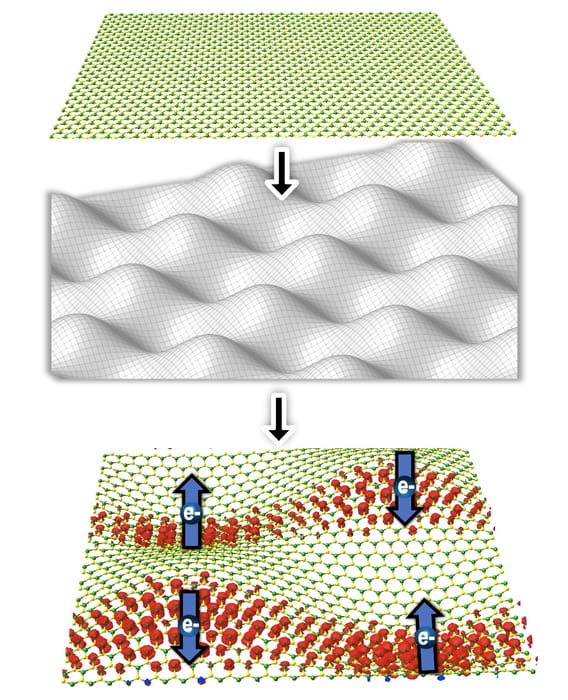
Stamping layers of 2D materials

Researchers at Rice University in the US have proposed a new way of controlling the magnetic and electronic properties of single-layer two-dimensional materials that involves growing or stamping them on a carefully designed undulating surface. The approach could be a simpler alternative to the complex “twisting” technique, which involves rotating two stacked layers with respect to each other.

In recent years, physicists have been experimenting with techniques that use the weak coupling between layers of 2D materials to change the material’s behaviour. One dramatic example is twistronics, in which experimenters modify a 2D material’s electronic properties by varying the angle between the layers. For instance, graphene (a 2D sheet of carbon atoms) does not normally have an electronic band gap, but it develops one when placed in contact with another 2D material, hexagonal boron nitride (hBN).

This unusual effect comes about because graphene and hBN have a similar lattice constant, such that stacking them together forms a pattern known as a Moiré superlattice. If the layers are then twisted out of alignment, the band gap disappears. Hence, graphene can be tuned from a metallic state to a semiconducting one simply by varying the angle of the layers. Indeed, in 2018, researchers at the Massachusetts Institute of Technology (MIT) discovered that placing two layers of graphene together with a relative rotation of 1.1°– the so-called “magic angle” – transforms the normally metallic material into a superconductor.

Naturally straining the material’s lattice

In the new work, a team led by Boris Yakobson showed that simply stamping or growing a 2D material on hBN onto a bumpy surface naturally strains the material’s lattice, creating pseudo-electric and magnetic fields that can then be used to control its magnetic and electric properties without a need for twisting. The researchers found that the strain creates “flat” band states that cause the normally insulating hBN to become a semiconductor. These states are 1D in nature, which is radically different from those obtained in twisted materials and could be exploited to study the exciting physics of 1D quantum systems, they say.

The advantage of the technique, which the researchers describe in Nature Communications, is that the deformation can be precisely controlled by using standard processes such as electron beam lithography to create patterns on the surface. “Indeed, it would be much easier to create bumpy surfaces using this process than it currently is to twist 2D bilayers of graphene or other heterostructures like hBN to less than a single degree of accuracy,” says Sunny Gupta, a postdoctoral researcher at Rice and a co-author of the study.

The researchers developed a computational model of deformation that they compare to wrapping a sheet of paper around a ball. “It is impossible to do this without crumpling the paper,” Yakobson explains, “because of their different topography (curvature patterns). To make it adhere to the ball, the sheet of paper should, in principle, be significantly deformed (if tearing is not allowed). Similarly, a flat 2D material when grown or stamped on a substrate with different topography will be strained and its electronic properties modulated.”

Creating different strain patterns

Using this model, the team found that substrates with different topographies could be used to create different strain patterns, giving rise to new quantum states and functionalities that are inherently absent in a flat 2D system, Yakobson adds. “By combining topography and deformation (which is like a adding a new ‘dimension’ in a 2D material) as we show in our work, we can create new quantum phases, such as flat electronic bands and strongly correlated 1D electronic sates,” he tells Physics World.

Such states, which are coveted by physicists, typically show unique properties such as magnetism and superconductivity. Creating them artificially is a highly active research field, but it is hard to do so via twisting because twisted systems require two layers of material and careful control of the twist angle between them. In contrast, the new technique can be employed even in single-layer materials. “Our proposed way of combining topographical modulations and 2D materials will overcome several limitations of current Moiré systems and allow us to explore physics in 1D systems, which is largely inaccessible by twisting 2D materials,” Yakobson concludes.

Using topography to alter the property of 2D materials is a new research direction, and in Yakobson’s view its broad scope means it could eventually garner similar attention as 2D twisted bilayer systems. “In the next stages of our work, we would like to explore how topographical undulations affect properties of a variety of 2D materials with inherent functional properties such as magnetism and electronic topological behaviour,” he reveals. “Importantly, we would also like to experimentally realize the material physics system we have offered the ‘recipe’ for in this study.”

Projectile fusion offers new path to clean energy, quantum communications for alien civilizations

Nuclear fusion powers the Sun, and if we could harness it here on Earth we would benefit from a clean and abundant source of energy. However, creating a fusion power plant remains a formidable technical challenge.

This episode of the Physics World Weekly podcast features an interview with Nick Hawker, who is co-founder and CEO of First Light Fusion. Recently, the UK-based company has achieved fusion in the lab using a new technique that involves firing a projectile at a deuterium target. Hawker talks about projectile fusion and how the company plans to develop the technology so that it could be used in a power plant.

Also this week, Physics World’s Margaret Harris explains how alien civilizations could be using quantum signals to communicate with us on Earth.

Photonic fractals open a new area of topological physics

Topological insulators for light have been created using fractal patterns instead of conventional lattice structures. The fractal photonic topological insulators (PTIs) were made by an international team of researchers, who have shown that light moves faster along the edges of these structures than it does on conventional PTIs. The discovery also defies conventional wisdom because the fractal PTIs lack bulk optical bands, which are normally seen as being essential for PTIs.

Topology was initially a mathematical field but has grown massively in physics since the discovery of topological insulators, materials that are electrical insulators in the bulk but conduct at their edges. PTIs are the optical analogues of topological insulators and support the unidirectional propagation of light on their edges. In a PTI, light is “forced” to propagate in only one direction because it cannot scatter backwards even in the presence of minor defects. Possible applications of PTIs include topological lasers, which could revolutionize optical computing and integrated photonics.

Fractals make it faster

PTIs are usually made of structures known as photonic crystals, which have the undesirable side effect of slowing the speed of light. As a direct consequence, the energy and information carried by the light is tardy.  To solve this problem, Tobias Biesenthal and colleagues at the University of Rostock in Germany, Zhejiang University in China and Israel’s Technion-Israel Institute of Technology, have used fractals to create PTIs. Fractals are self-similar structures in which identical patterns reproduce themselves on smaller and smaller length scales. They can be used to describe complex entities such as snowflakes and to calculate the length of a country’s coastline.

An essential property of fractals is the absence of an interior, they are instead full of edges. This absence of a bulk material means that a fractal will not slow down light as much as conventional materials. Indeed, Biesenthal and colleagues have created PTIs with Sierpinski patterns (see figure) and shown that light moves around them 11% faster than in ordinary PTIs.

New chapter for topological physics

However, speedier light is not the most important result of this work. The properties of topological insulators are usually defined by the properties of their interior – the “bulk-boundary correspondence”. This makes the interior crucial for obtaining topological effects. In this latest research, Biesenthal and colleagues showed that, contrary to popular belief, a PTI can be a structure that does not have a true bulk. Hence these new fractal PTIs are a new class of materials that could open door to a better understanding of topological physics and its future applications.

More details can be found in a paper published in Science.

Dissolvable implant cools nerves to provide drug-free pain relief

Pain management is a significant and ongoing health problem. Patients are often treated using opioids, which are effective but also highly addictive. The prevalence of opioid-use disorder and deaths due to overdose has motivated the development of non-opioid alternatives. Of these, nerve cooling could provide an effective and reversible strategy to alleviate pain.

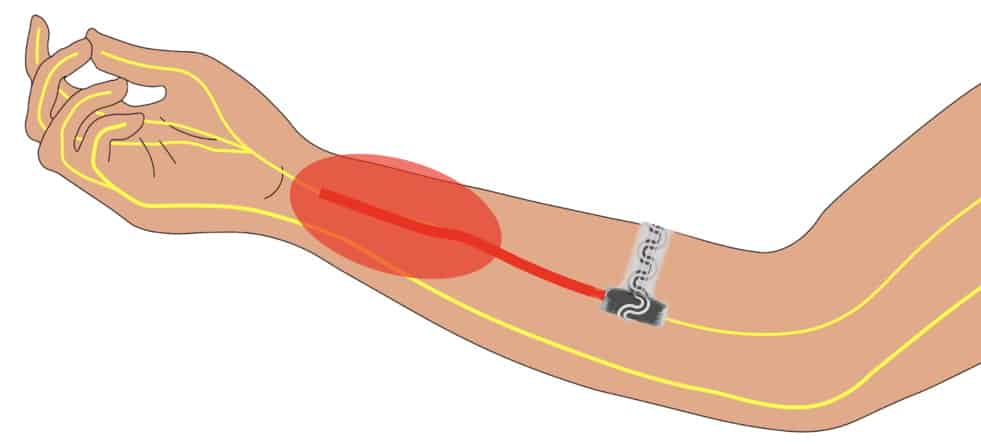
Cooling a nerve causes the pain signals that travel through it to slow down and eventually stop completely. But existing nerve-cooling devices, which use precooled liquids, are bulky, provide non-specific cooling and require high power, making them unsuitable for clinical use. As an alternative, a research team headed up at Northwestern University has developed a soft, flexible implant to cool nerves and provide targeted, on-demand pain relief without the use of drugs, reporting their findings in Science.

The paper-thin device, which is just 5 mm at its widest point, is constructed from elastomeric materials with tissue-like mechanical properties. As such, it can easily wrap around a single nerve like a cuff electrode to provide effective heat transfer. Another important innovation is that the materials are all bioresorbable and naturally absorb into the body over the course of days or weeks, eliminating the need for surgical extraction and its associated risks.

To create the cooling effect, the implant uses evaporative microfluidic cooling. It incorporates a microfluidic system with one channel containing perfluoropentane, a bioinert liquid coolant that’s clinically approved as an ultrasound contrast and for pressurized inhalers, and a second channel containing dry nitrogen. When the liquid and gas flow into a shared serpentine chamber, the perfluoropentane evaporates and generates localized cooling.

Previous research has shown that reducing the temperature of a nerve to 15°C can block the transmission of compound action potentials, while a complete conduction block is achieved at 5°C. If the temperature is too low, however, there’s a risk of nerve damage. To avoid this, the researchers incorporated a temperature sensor in an electronic layer alongside the microfluidic system to provide real-time feedback and control.

Implantable device inside an arm

“Excessive cooling can damage the nerve and the fragile tissues around it,” explains John Rogers, who led the device’s development. “The duration and temperature of the cooling must therefore be controlled precisely. By monitoring the temperature at the nerve, the flow rates can be adjusted automatically to set a point that blocks pain in a reversible, safe manner. Ongoing work seeks to define the full set of time and temperature thresholds below which the process remains fully reversible.”

In vivo assessment

The implant is designed for use on peripheral nerves, which connect the brain and spinal cord to the rest of the body and communicate sensory stimuli, including pain. To demonstrate the device’s cooling ability, the team tested it in rat models of neuropathic pain.

The soft, curled structure interfaced to the rat sciatic nerve without requiring sutures and without causing any damage. The device produced highly localized cooling, which caused effective and reversible conduction blocks of the nerves, as observed by electromyography, compound nerve action potential and muscle-force measurements.

The researchers also performed experiments in free-moving rats with neuropathic pain over several weeks. When mounted on the animal’s sciatic nerve, the device delivered a significant cooling-induced analgesic effect. They conclude that the cooling device can provide on-demand analgesia to manage neuropathic pain in freely moving animals.

Looking ahead, the team believes that the device could prove most valuable for managing post-operative pain following amputations, nerve grafts or spinal decompression surgeries. In such cases, the relevant nerves are already isolated and identified, making the application of the cuff straightforward to integrate into the clinical workflow.

Writing in a related perspective article, Shan Jiang and Guosong Hong from Stanford University note: “An implantable cooling device with on-demand local analgesia will be a game changer for long-term pain management.”

Quantum theory of consciousness put in doubt by underground experiment

A controversial theory put forward by physicist Roger Penrose and anaesthesiologist Stuart Hameroff that posits consciousness to be a fundamentally quantum-mechanical phenomenon has been challenged by research looking at the role of gravity in the collapse of quantum wavefunctions. Based on results from an experiment done under Gran Sasso mountain in Italy, the new work concludes that Penrose’s and Hameroff’s Orchestrated Objective Reduction theory (Orch OR) is “highly implausible” when based on the simplest type of gravity-related wavefunction collapse – although they point out that more complex collapse models leave some wiggle room.

Many scientists regard consciousness as a global manifestation of individual calculations by the brain’s billions of neurons. Penrose and Hameroff instead argue that consciousness is based on the non-computational collapse of coherent quantum superpositions between cellular structures within neurons known as microtubules. They reckon that while the superpositions guide classical neuronal processes, it is the continual gravity-related collapse of the quantum states that gives rise to our sense of self-awareness.

In the latest work, Catalina Curceanu of the Frascati National Laboratory near Rome and colleagues assess the plausibility of Orch OR in the light of results from an experiment they set up to probe gravity’s possible role in wavefunction collapse. Standard quantum theory leaves open the question of what causes a state’s wavefunction to collapse, simply providing the probabilities of the system collapsing into one classical state or another and implying that the process is random. But several physicists over the years have attempted to identify a physical mechanism behind the process – among them Penrose and Lajos Diósi, who have developed the Diósi–Penrose model. Diósi is at Hungary’s Eötvös Loránd University and Wigner Research Centre for Physics and has worked with Curceanu on this latest research.

Different curved space–times

The Diósi–Penrose model involves combining quantum mechanics with classical gravity such that a spatial superposition of quantum states generates a superposition of different curved space–times. The idea is that the latter superposition is unstable and causes the system’s wavefunction to collapse when the gravitational energy resulting from the difference in space–time formations – and therefore system mass – exceeds some threshold. This process is independent of wavefunction decoherence by environmental noise, but its realization requires that the latter is kept at bay.

While both Penrose and Diósi arrived at the same simple formula for the timescale over which this type of collapse would occur, their individual models differ. Penrose did not specify the dynamics of wavefunction collapse, whereas Diósi provided a full dynamical description. In doing so Diósi predicted that collapse should be accompanied by the emission of electromagnetic radiation – generated by charged particles within the system as they undergo a continuous Brownian motion related to the collapse mechanism.

Now, Diósi has teamed up with Curceanu and other physicists in Italy and Germany to establish whether his predicted radiation really is given off in nature. The group did so by monitoring the emissions from a cylinder of germanium about the size of a small tin of beans shielded from external radiation by lead and copper shields as well as the 1400 m of rock above the lab – the Gran Sasso National Laboratory near L’Aquila. They were able to test the Diósi–Penrose model by working out how much gravity-related collapse radiation should have been produced by the charged particles within the germanium and comparing their calculations against the measurements.

Carrying out their experiment over the course of two months in the summers of 2014 and 2015, they measured no radiation beyond that expected from residual emissions in the experimental apparatus. This allowed them to impose a lower limit on a parameter, R0, that they describe as the effective size of the particle’s mass density.

That result already ruled out one specific and natural formulation of the Diósi-Penrose model – which stipulated that the scale of the superposition is comparable to the size of the nuclei themselves – the measured lower limit of R0 being 0.54×10­–10 m while the size of the nuclear wavefunction of germanium cooled to liquid-nitrogen temperatures (as was the case in their experiment) would be an order of magnitude lower (0.05×10⁻¹⁰ m).

Molecular scale

Now, Curceanu, Diósi and colleagues have analysed what that value of R0 means specifically for the Orch OR theory, assuming two distinct scales of superposition – the nuclear one favoured by Penrose (about 10–15 m) and one similar to the size of whole tubulin proteins within a strand of microtubule (about 3 nm). In each case their aim was to work out how much brain matter would be needed to collapse the wavefunction on a timescale comparable to that of conscious experiences (typically about 0.5 s, but potentially as brief as 0.025 s).

With a nuclear-sized superposition, the collapsing effect of individual carbon nuclei within tubulin proteins is minuscule and therefore calls for huge numbers of nuclei to act in concert. In fact, the researchers work out that to collapse the wavefunction in around 0.025 s, a whopping 1023 tubulins would need to make up the coherent state. But as they point out, there are reckoned to be only 1020 tubulins in the whole brain (about 109 in each neuron). “These considerations seem to rule out tubulin separation at the level of the atomic nuclei,” they say.

In the second scenario, the larger superposition scale implies that fewer tubulins would need to remain coherent. Indeed, Curceanu and colleagues work out that a mere 1012 would do the job. Still, they say, the overall requirements seem daunting – the brain needing to maintain a mass of 10−16 kg in a coherent state for 25 ms over a length scale of about 10 nm. “This vastly exceeds any of the coherent superposition states achieved with state-of-the-art optomechanics or macromolecular interference experiments,” they note.

The researchers add that not all is lost for Orch OR. While they reckon that the theory seems implausible if based on the simplest wavefunction collapse model, it may become more plausible if a more sophisticated model can be developed – one, for example, that conserves energy (something not true of Diósi’s current model). “In future work,” they say, “we intend to develop such variants of the Diósi-Penrose collapse dynamics and then reexamine the tubulin superposition scenarios discussed above.”

The research is described in Physics of Life Reviews.

Copyright © 2026 by IOP Publishing Ltd and individual contributors