A new tool can rapidly and reliably detect the presence of Ebola virus in blood samples at lower concentrations than existing tests, researchers from the US report. The device has the potential to help control future outbreaks of the deadly infection.
Ebola virus disease is a viral haemorrhagic fever that is estimated to kill up to 89% of those who contract it. It is spread through contact with the blood, bodily fluids or organs of an infected person or animal. First discovered following two simultaneous outbreaks in Nzara, in South Sudan, and Yambuku, in the Democratic Republic of the Congo, it has since led to dozens of outbreaks in the tropical regions of sub-Saharan Africa. The worst outbreak to date occurred in West Africa between late 2013 and early 2016, and is estimated to have caused 11,323 deaths.
In recent years, a selection of vaccines and effective therapies for Ebola have been developed. Unfortunately, however, they are not widely available. Accordingly, health officials typically combat the disease by attempting to contain outbreaks, an approach that relies on being able to quickly identify infections and inhibit further transmission. This is a challenge though, as Ebola symptoms – body aches, bleeding, diarrhoea and fever – are highly nonspecific, meaning that it can be easily mistaken for other viral infections or malaria.
Existing tests for the disease, meanwhile – which include PCR-based techniques, lateral flow assays and enzyme-linked immunosorbent assays (ELISAs) – are limited by lengthy assay times, and the need for additional electronics for sample processing, trained technicians and even cold chain custody. In addition, they tend not to be very sensitive until the virus has had days to multiply to high levels in the body.
In this latest study, clinical pathologist Abraham Qavi of Washington University in St Louis and his colleagues propose an alternative based on optical microring resonators, a type of whispering gallery mode device that can be used for highly sensitive molecular detection.
Such tools take their name from the effect originally discovered for sound waves in the Whispering Gallery in London’s St Paul’s Cathedral. Words whispered against the wall of the dome can be heard clearly more than 30 m away, thanks to the way in which sound waves travel around the concave surface. This is an example of the principle of acoustic resonance – a phenomenon that can also be seen with light waves at a much smaller scale.
Explaining how their whispering gallery mode device can detect the presence of tiny amounts of Ebola-related molecules in blood samples, Qavi says: “We trap light in the resonators and use resonance to enhance and boost our signal. By monitoring where this resonance wavelength occurs, we can tell how much of the molecule we have.”
The molecule in question is a sensitive antibody developed to react to a soluble glycoprotein released by the Ebola virus. This protein is also key to current diagnostic tests for Ebola — but the new antibody is capable of detecting it at lower levels. In tests on blood from infected animals, the microring resonator devices could detect the diagnostic glycoprotein as early as, or earlier than, the current leading tests. The test, which only took 40 min, also provided information on the viral glycoprotein concentration. This information could potentially be used to tailor treatment plans for individual patients.
“Any time you can diagnose an infection earlier, you can allocate healthcare resources more efficiently and promote better outcomes for the individual and the community,” Qavi says. “Using a biomarker of Ebola infection, we’ve shown that we can detect Ebola in the crucial early days after infection. A few days makes a big difference in terms of getting people the medical care they need and breaking the cycle of transmission.”
“Rapid, biosensor-based assays are needed to deal with a myriad of global health concerns, among them the detection of virus infections with the potential to spread across the globe,” says Frank Vollmer, a physicist from the University of Exeter, UK, who was not involved in the new study. Whispering gallery mode sensors, he explained, have emerged as one of the most sensitive and multiplexed biosensor technologies that can address this need.
He added: “[The researchers] impressively combine the high sensitivity and multiplexed readout of the whispering gallery mode sensor with the specific detection of the Ebola virus glycoprotein in patient samples – providing the real-world whispering gallery mode biosensor application that can save lives.”
With their initial study complete, the researchers are now looking to miniaturize the device and test their diagnostic approach on infected individuals.
The US National Institute of Standards and Technology (NIST) has selected four algorithms that will be developed as post-quantum encryption standards to protect data from a future quantum computer attack. The announcement follows a six-year competition, with NIST now calling on institutions to investigate how to best apply the standards.
Once fully developed, quantum computers are considered ideal candidates for calculating complex processes. On the other hand, they could also be used for malicious activities, such as hacking currently encrypted information. This could put data – such as governmental documents or company secrets – at risk.
For this reason, in 2016 NIST launched an open competition in post-quantum cryptography where researchers from all over the world could submit their algorithms to be considered as a future standard. Several rounds shortlisted the candidates and allowed for further tweaking of the proposed protocols.
More to come
Now NIST has announced four winners. Post-quantum cryptography is designed for two main tasks. The first is general encryption that protects information exchanged across a public network. Here NIST selected the CRYSTALS-Kyber algorithm that uses comparatively small encryption keys that two parties can exchange easily and has a high speed of operation.
The second task concerns digital signatures and is used for identity authentication. Three algorithms were selected: CRYSTALS-Dilithium, FALCON and SPHINCS+. The first two are preferred due to their efficiency, while SPHINCS+ uses a different mathematical approach from the other three winners.
NIST says that institutes should now begin to upgrade to post-quantum cryptography, stressing a “collect-now decrypt-later” approach, which means implementing post-quantum cryptography before the creation of large-scale quantum computers. NIST also announced four other algorithms that are still under consideration as standards. The winners of that round will be announced at a later date.
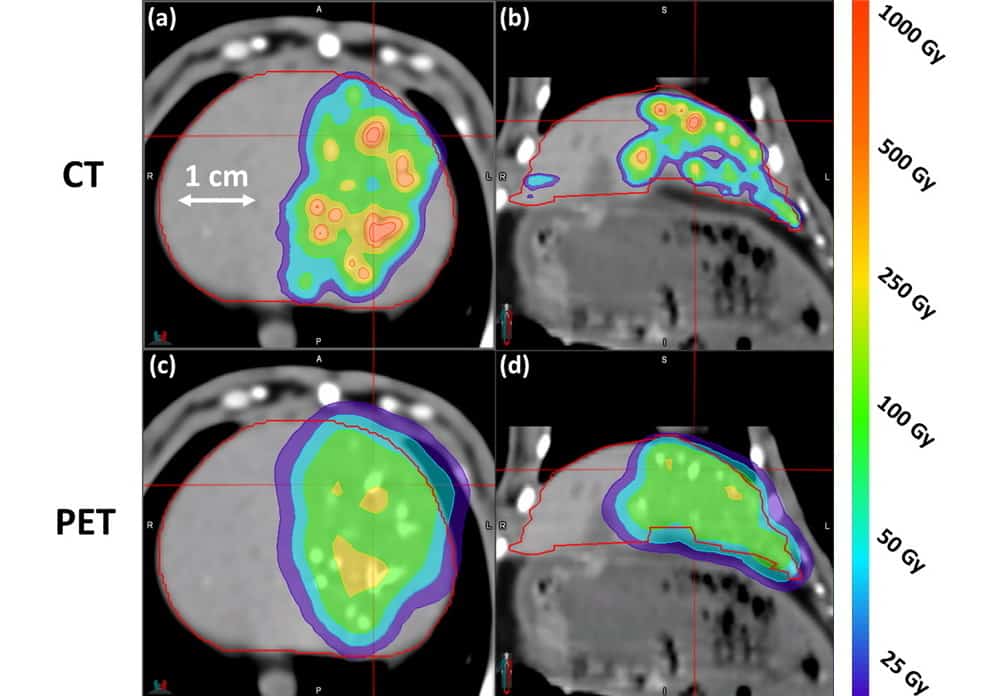
Accurate dose visualization: Axial and coronal views of the CT-based dose distribution (a, b) and the PET-based dose distribution (c, d). The CT-based image accurately displays the true dose heterogeneities. (Courtesy: E Courtney Henry)
Radioembolization is a minimally invasive treatment for non-resectable liver tumours, in which yttrium-90 (90Y)-labelled microspheres are delivered into the liver’s arterial blood supply. These radioactive microspheres travel to a tumour’s distal arterial capillaries, where they deposit in the microvasculature and deliver localized radiation dose to destroy the tumour.
Dosimetry in 90Y radioembolization is currently performed after microsphere administration, using PET and SPECT to visualize the radiation emission from 90Y and determine the absorbed dose to the tumour and surrounding healthy tissue. But these imaging modalities have limited spatial resolution, which limits the dosimetry accuracy.
Best-in-Physics: E Courtney Henry presented at the AAPM Annual Meeting. (Courtesy: E Courtney Henry)
As an alternative, E Courtney Henry from the MD Anderson Cancer Centre and colleagues at Dalhousie University are developing a dosimetry framework based on CT imaging, which has inherently better spatial resolution than PET or SPECT.
While commercial glass- and resin-based 90Y microspheres cannot be effectively imaged using X-rays, Henry is investigating radiopaque glass microspheres, which incorporate high-Z compounds, developed by ABK Biomedical.
“Our purpose is to perform precision dosimetry in 90Y radioembolization through CT imaging of these radiopaque microspheres, and also to compare dose estimates to the liver calculated from CT to conventional PET-based dosimetry,” he explained.
The dosimetry workflow starts by converting Hounsfield units in a CT image into microsphere concentration (in mg/ml) using a calibration curve acquired from a calibration phantom with known microsphere concentrations.
Next, the microsphere distribution is scaled by the voxel volume and 90Y activity/mg to give the activity distribution (in Bq). Finally, the absorbed dose (in Gy) is calculated by multiplying the activity distribution by the mean 90Y lifetime then convolving it with a Monte Carlo-derived dose-voxel kernel.
To test this approach, the researchers administered eight rabbits with a bolus of radiopaque microspheres containing 150 MBq of 90Y activity, and then performed CT and PET imaging. Henry shared images of axial and coronal slices of CT- and PET-based dose distributions in a rabbit liver.
The CT-based dose distribution appeared highly correlated with the embolized vasculature, accurately displaying the true dose heterogeneities. In addition, the dose was largely contained within the liver contour, due to the fast scanning time eliminating motion artefacts. The PET-based dose distribution, on the other hand, appeared far more homogeneous. The maximum dose to the liver calculated from PET-based dosimetry was 337 Gy, compared with 1376 Gy from CT-based dosimetry.
“CT-based dosimetry in 90Y radioembolization produces a larger, more accurate estimate of mean absorbed dose relative to PET,” Henry concluded. “It reduced partial volume effects, can potentially eliminate respiratory motion effects and gave improved depiction of dose heterogeneity. This allows us to refine the understanding of the dose-response relationship and permit an individualized approach to treatment planning to improve future patient outcomes.”
The atmosphere on Mars may have formed in a way that contradicts current theories, say researchers at the University of California, Davis, US. The team formed this conclusion thanks to a new analysis of the Chassigny meteorite, which fell to Earth in north-eastern France in 1815 and is believed to represent the Martian interior.
Current theories of planet formation suggest that rocky planets like the Earth and Mars acquired volatile chemical elements such as hydrogen, carbon, oxygen, nitrogen and noble gases such as krypton from the nebula surrounding their parent star during the early stages of their formation.
Initially, these elements dissolved (technically, they “ingassed”) in the planets’ mantle, which at that point existed as an ocean of molten rock, or magma, on the surface. Later, when the magma ocean crystallized, the ocean “degassed” these solar nebula-derived volatiles back into the atmosphere, where they gradually dissipated into space. Finally, at an even later stage, meteorites called chondrites delivered additional volatile materials by crashing into the young planets.
“It is therefore expected that the interior of the planets would mainly be composed of solar volatiles, or a mixture of solar and chondrite volatiles. The volatiles in the atmosphere, on the other hand, would come mainly from meteorites,” explains study team leader Sandrine Péron.
Martian interior contains chondrite krypton
That prediction, however, is not consistent with the team’s findings, which are based on measurements of krypton isotopes in samples of the Chassigny meteorite. Because the ratio of krypton isotopes in solar nebula-origin krypton and chondrite-origin krypton are different, analysing the isotope ratios allowed researchers to determine how Chassigny – and, by extension, the interior of Mars – got its krypton.
“Our study shows that the Martian interior contains chondrite krypton, which contrasts with the [solar-krypton-like] atmospheric composition,” Péron tells PhysicsWorld. “The current scenario therefore does not hold anymore.”
Precise measurements of isotopes
Before they could perform their measurements, the researchers first had to eliminate a third source of krypton. Chassigny spent 11 million years travelling through space before it fell to Earth – quite long, Péron says. During this time, it was exposed to cosmic radiation, which can generate krypton and other noble gases from other elements via spallation reactions.
To remove this so-called “cosmogenic” krypton from their sample, the researchers heated the meteorite in stages from around 200 to 1500 °C. This step-heating technique works because cosmogenic and Martian krypton are released at different temperatures.
Another important part of the analytical procedure was to separate krypton from the other noble gases present in the meteorite. The researchers did this by analysing the noble gases one after the other using mass spectrometry. “As we want to avoid interference issues, we need a nearly pure krypton phase (without argon and xenon) in the mass spectrometer,” Péron explains. “To achieve a clean separation of krypton from argon and xenon, we developed a new separation protocol at UC Davis involving a new cryogenic trap.”
This protocol, combined with the step-heating, enabled the team to obtain precise krypton isotopic measurements of the Chassigny meteorite, Péron says.
Meteorites delivered volatile elements much earlier
The fact that the krypton isotopes in Chassigny correspond to those found in chondrite meteorites, rather than in the solar nebula, implies that chondrites were delivering volatile elements to the infant Mars much earlier than previously thought, while the solar nebula was still present. “Solar volatiles in the atmosphere cannot originate from mantle degassing as previously assumed, but were likely captured from the solar nebula before the nebula dissipated (in around 10 Myr after the solar system was born), and after most of Mars had accreted,” Péron says. “This overturns current thinking.
“A challenging aspect is how to retain these solar volatiles in the atmosphere, since they should have been lost due to radiation emanating from the early Sun,” she continues. “A possible scenario is that Mars was cold after accretion and part of the solar gases got trapped underground or in the polar ice caps.”
The researchers hope their work will motivate further studies on how planetary atmospheres, and in particular the Martian atmosphere, form. For their part, they plan to better characterize the composition of the Martian mantle to determine whether it is heterogenous. “Another aspect is to better understand where the Martian atmosphere originated and how it evolved, taking into account the constraints from our study,” Péron says. “This will involve determining the conditions that allow solar krypton and xenon to be retained at the surface of the planet.”
“The moment I put my hand in my school blazer pocket and found it full of frog entrails, I already knew science was not for me.” So writes the comedian Robin Ince in the first line of The Importance of Being Interested – which indeed is an interesting book. Ince was not attracted to science as a teenager, despite having loved it as a young child. At secondary school his interest faded, as he felt that science was “detached from the real world”. He singles out, in particular, “the mind-numbing effect of an afternoon double-physics class”, and the division between those he saw as “science boffins” and others such as himself.
So how come he had the brilliant idea of blending science and comedy, raising the profile of the discipline through an innovative radio show and road show The Infinite Monkey Cagewith Brian Cox and others? His answer is disturbingly simple. “Sometime in my mid-20s,” he writes, “I bought a book about quantum physics. I didn’t really understand it, but I realized that what I wasn’t understanding was very exciting.” Ince then started to bring some science into his comedy routines – and the rest, one might say, is history.
But is developing a passion for science really that simple? Given the title of the book, Ince might argue that all that is required is interest – and if you have it, all you need is a popular-science book to get started. But what if you don’t have an interest in science? Can it be cultivated or even started from scratch – and if so, how? What were Ince’s science teachers doing wrong that resulted in his infant curiosity being smothered rather than nurtured?
The author, unfortunately, doesn’t elaborate on the circumstances of his inconsistent relationship with science; his role here is as a listener and rapporteur, so we see very little of Ince himself after the opening pages, apart from the ever-present humour. The book consists mainly of conversations he had with 100 scientists, philosophers, astronauts, religious people, pseudoscientists and sceptics during the first COVID lockdown, when all these people were “kicking their heels at home, so bored that they talked to me”.
In these chats we get a glimpse of what each of his interviewees does, and what inspires them. That is the point – this is not a science textbook, but rather a study of what it is about science (and scientists), that captivates people. I think what Ince is trying to do in this book is to pass on some of that inspiration to the reader, so that they might overcome the kind of negative responses to science that he himself experienced.
Each of the 12 chapters is based broadly around a specific scientific discipline and the people who work in it, but the themes are not well defined. Space and aliens crop up in at least three chapters, while religion features in another two, including what I feel to be the most interesting part of the book – a very thoughtfully and sensitively crafted discussion of death, starting with human mortality and then seamlessly opening out into the death of the cosmos. There are also chapters on neuroscience, evolution and time.
Throughout, Ince includes the conversations he had with some of the 100 interviewees. However, at the end he acknowledges that not all 100 made it into the book because, as he puts it, “my publishers quite rightly didn’t want a book that was as long as one of those great big biographies of Stalin that give you sciatica”. The people who do make the cut are mostly talking to Ince about their work – something that comes easily to those of us who have already caught the bug. The hope, as Cox writes in the introduction, is that Ince’s “unquenchable thirst for knowledge” will rub off on the reader.
The hope is that Ince’s unquenchable thirst for knowledge will rub off on the reader
Some of Ince’s interviewees also reveal how they came to science. Like Ince, the theoretical physicist Carlo Rovelli, a founder of loop quantum gravity theory, felt that school exercises in mechanics were “stupid” but managed to maintain his curiosity about “the nature of reality” sufficiently to build a career in physics. Aoife McLysaght was luckier. She told Ince that her path to genetics “came from an inspirational biology teacher who loved teaching and went way beyond the requirements of the curriculum”.
So, who will read this book, and what will they get from it? There are, of course, plenty of popular-science books – though probably few that use humour to communicate their message as effectively as Ince does here. But is popular-science writing just entertainment, or something more? I would like to think it exists to combat the kind of anti-science sentiments we have all witnessed during the two years of COVID, and during decades of climate change.
Understanding the science needed to tackle these threats is important; and since public money is spent on science, surely science ought to be accountable to the public in a meaningful way, which requires a greater engagement in it than now. Ince has certainly done his bit to stimulate interest, through his radio shows and live performances, and now this book. But I worry that the science discussed here is quite a small subset of the whole, and consists chiefly of what I call the “usual suspects”: quantum physics, relativity and cosmology. These subjects fascinate the casual reader because they are so weird, and so far detached from what we think of as reality. But will a fascination with such esoteric topics help people to understand – or even be interested in – the reality of climate change, or how to deal with a pandemic?
Towards the end of the book, Ince quotes Andrea Wulf, a successful science writer who describes science as like “a beautiful palace, with many, many doors”, where the doors have the names of scientific disciplines written on them. But do they really lead to something called “science”, or only to the subjects written on them – with the more useful, but less appealing, sciences shut off behind further doors down a dark corridor?
My one criticism of this eminently readable book is that it occasionally loses cohesion and reads a bit like a string of quotes. It might have been better had the author singled out just one “expert” and one topic per chapter, which might also have enabled him to cover more sciences. And he could have chosen the best evangelizer for each, making the book truly inspiring.
Overall, I’d describe this as “another popular-science book, with added jokes”. I wish it well, but with reservations about the narrow focus.
Lasers that should be scalable to arbitrarily high powers while retaining their frequency purity have been produced by researchers in the US. Their invention, which relies on an analogue to the physics of electrons in a Dirac semiconductor such as graphene, solves a problem dating back to the invention of the laser. The researchers believe their work could also inspire fundamental theoretical discoveries in quantum mechanics at macroscopic scales.
Any laser fundamentally comprises two essential components: a cavity and a gain medium – usually a semiconductor, explains Boubacar Kanté of University of California, Berkeley – the senior author of a paper that will appear in Nature describing the lasers. “The semiconductor emits a broad range of frequencies, and the cavity selects what frequency will be amplified to reach the lasing threshold.”
The problem is that any cavity will support not just a ground state “fundamental” frequency of a laser, but also several higher-frequency excited states. Pumping the cavity harder to boost the power of the laser inevitably tends to excite these higher-frequency states towards the lasing threshold. Higher-power lasers need larger cavities, but these support a denser spectrum of frequencies.
Nobody knew what to do about it
“If the gain only overlaps with the fundamental, then only the fundamental will lase, and people make nanolasers all the time with no problem,” says Kanté. “But if the higher-order mode comes close, you cannot distinguish between the two and they will both lase. This is a six decade-old problem: everybody knows it, and nobody knows what to do about it.”
Until now, that is. If the fundamental cavity mode were able to absorb all the energy from the gain medium, the researchers reasoned, all the higher order modes would be suppressed. The problem in a conventional laser cavity is that the ground state wavefunction is at its maximum in the centre of the cavity and falls to zero towards the edges. “In any surface emitting laser, or any cavity that we know to date…there is no lasing [at the fundamental frequency] from the edge,” explains Kanté; “If there is no lasing from the edge, you have a lot of gain available there. And because of that the second-order mode lives at the edge, and very soon the laser becomes multimode.”
To get around this problem, Kanté and colleagues utilized photonic crystals. These are periodic structures, which, like electronic semiconductors, have “band gaps” – frequencies at which they are opaque. Like graphene in electronics, photonic crystals generally contain Dirac cones in their band structures. At the vertex of such a cone is the Dirac point, where the band gap closes.
Hexagonal photonic crystal
The researchers designed a laser cavity containing a hexagonal photonic crystal lattice that was open at the edges, allowing photons to leak into the space around the crystal, meaning that the wavefunction was not confined to be zero at its edge. The photonic crystal had a Dirac point at zero momentum. As momentum is proportional to wave vector, the in-plane wave vector was therefore zero. This means that the cavity did indeed support a mode that was single valued all over the lattice. Provided the cavity was pumped at the energy of this mode, no energy ever went into any other mode, no matter how large the cavity. “The photon has no in-plane momentum, so the only thing left is for it to escape vertically,” explains Kanté.
The researchers fabricated cavities comprising 19, 35 and 51 holes: “When you are not pumping at the Dirac frequency singularity you see lasing at multiple peaks,” says Kanté. “At the Dirac singularity, it never becomes multimode. The flat mode removes gain for the higher order modes.” Theoretical modelling suggests that the design should work even for cavities containing millions of holes.
In future, Kanté believes that the concepts developed by his team could have implications in electronics itself, and to the scalability of quantum mechanics to the macroscopic world more generally. “All the challenge in quantum science is scaling,” he says. “People are working on superconducting qubits, trapped atoms, defects in crystals…the only thing they want to do is scale. My claim is that it’s to do with the fundamental nature of the Schrödinger equation: when the system is closed, it doesn’t scale; if you want the system to scale, the system needs to have loss,” he says.
Liang Feng of the University of Pennsylvania adds, “The single-mode broad-area laser is one of the holy grails actively pursued by the semiconductor laser community, and scalability is the most critical merit”. “[Kanté’s work] demonstrates just what people are looking for, and it demonstrates exceptional scalability backed by excellent experimental results. Obviously more work needs to be done to transform this strategy, demonstrated in optically pumped lasers, into viable electrically injected diode lasers, but we can expect that this work will inspire a new generation of high-performance lasers that can benefit multiple game-changing industries like virtual and augmented reality systems, LiDARs, defence and so many others where lasers play critical roles.”
The team has dubbed its device the Berkeley Surface Emitting Laser (BerkSEL) and describe it in an unedited preview version of their paper that is currently available on the Nature website.
Respiratory motion can impact the efficacy and safety of radiation therapy in the thorax and abdomen. For treatments using an MRI-guided linac, free-breathing 4D-MRI is a promising alternative to 4D-CT for motion management, providing excellent soft-tissue contrast with no ionizing radiation. High-quality MR images free from motion artefacts are needed to delineate lesions from normal tissue. Currently, however, MR-based approaches require multiple scans with substantial scan times.
To meet these needs, Sihao Chen, Hongyu An and colleagues at Washington University in St. Louis are developing a way to use a single MRI scan for motion detection, motion-resolved 4D-MRI and motion-integrated 3D-MRI reconstruction. Speaking at last week’s AAPM Annual Meeting, Chen showed that this is possible with an acquisition time of less than a minute, using a self-navigated MR method with deep learning-based image reconstruction.
The three-stage technique begins with a self-navigated respiratory motion detection sequence called CAPTURE, which is a variant of the stack-of-stars MRI sequence. The researchers implemented CAPTURE on the 0.35 T ViewRay MRI-guided linac and evaluated their proposed technique by imaging a respiratory motion phantom and 12 healthy volunteers. They performed regular MRI scans using 2000 radial spokes, with an acquisition time of 5–7 min. They evaluated the full scan (2000 radial spokes), as well as the first 10% of the data, which took just 30–40 s.
Chen shared some example CAPTURE-detected respiratory curves, which demonstrated CAPTURE’s ability to detect respiratory motion despite different respiratory patterns between subjects and during individual scans. The corresponding frequency spectra clearly identified the individual frequency components.
Next, the team used the measured respiratory signals to create 4D-MRIs via three reconstruction techniques: multi-coil non-uniform inverse fast Fourier transform (MCNUFFT); compressed sensing; and deep learning-based Phase2Phase (P2P) reconstruction.
In a motion phantom study, the team reconstructed 4D-MR images using either 5 min or 30 s of data. The CAPTURE motion detection improved the visibility of embedded spheres in the phantom to the level seen in ground truth images. In the short MRI scan, P2P reconstruction restored image sharpness and reduced undersampling artefacts compared with the non-corrected baseline.
For the patient scans, the researchers used the first 200 spokes for short-scan (30 s) reconstruction, observing that P2P clearly outperformed the other two methods for 4D-MRI reconstruction. They then used 4D-MRIs created from both the 30 s and 5 min scans to derive motion vector fields. Chen noted that the difference between the two was “moderate compared with the overall motion range”.
In the final step, these motion vector fields are employed to reconstruct 3D-MRIs using a motion integrated reconstruction (MOTIF) model. 3D-MR images of the phantom demonstrated that MOTIF reduced motion artefacts and improved image quality. In the patient study, short-scan images (200 spokes) reconstructed by MOTIF had better signal-to-noise ratio and fewer motion artefacts than the non-corrected baseline, and demonstrated “modest image quality” compared with regular-scan images (2000 spokes) reconstructed by MOTIF.
The team also performed a blinded radiological review of the 12 subjects. Images reconstructed by MOTIF using the entire data set scored over 8/10 points when rated for sharpness, contrast and lack of artefacts. “For short scans, MOTIF with P2P received a relatively satisfactory review score of 5/10, whereas no motion correction scored less than 3/10,” said Chen.
Chen concluded that a rapid single MRI scan, used with CAPTURE, P2P and MOTIF, can generate high-quality 4D-MR images for lesion motion range determination and 3D-MR images for lesion delineation on a low-field MRI-guided linac.
A new algorithm that compensates for deficiencies in X-ray lenses could make images from X-ray microscopes much sharper and higher in quality than ever before, say researchers at the University of Göttingen, Germany. Preliminary tests carried out at the German Electron Synchrotron (DESY) in Hamburg showed that the algorithm makes it possible to achieve sub-10-nm resolution and quantitative phase contrast even with highly imperfect optics.
Standard X-ray microscopes are non-destructive imaging tools capable of resolving details down to the 10 nm level at ultrafast speeds. There are three main techniques. The first is transmission X-ray microscopy (TXM), which was developed in the 1970s and which uses Fresnel zone plates (FZPs) as objective lenses to directly image and magnify the structure of a sample. The second is coherent diffractive imaging, which was developed to sidestep the problems associated with imperfect FZP lenses by replacing lens-based image formation with an iterative phase retrieval algorithm. The third technique, full-field X-ray microscopy, is based on inline holography and has both high resolution and an adjustable field of view, making it very good for imaging biological samples with weak contrast.
Combining three techniques
In the new work, researchers led by Jakob Soltau, Markus Osterhoff and Tim Salditt from Göttingen’s Institute for X-ray Physics showed that by combining aspects of all three techniques, it is possible to achieve much higher image quality and sharpness. To do this, they used a multilayer zone plate (MZP) as an objective lens to achieve high image resolution, coupled with a quantitative iterative phase retrieval scheme to reconstruct how X-rays transmit through the sample.
The MZP lens is made of finely structured layers a few atomic layers thick deposited from concentric rings on a nanowire. The researchers placed it at an adjustable distance between the sample being imaged and an X-ray camera in the extremely bright and focused X-ray beam at DESY. The signals that hit the camera provided information about the structure of the sample – even if it absorbed little or no X-ray radiation. “All that remained was to find a suitable algorithm to decode the information and reconstruct it into a sharp image,” Soltau and colleagues explain. “For this solution to work, it was crucial to precisely measure the lens itself, which was far from perfect, and to completely dispense with the assumption that it could be ideal.”
“It was only through the combination of lenses and numerical image reconstruction that we could achieve the high image quality,” Soltau continues. “To this end, we used the so-called MZP transfer function, which allows us to do away with perfectly aligned, aberration- and distortion-free optics, among other constraints.”
The researchers have dubbed their technique “reporter-based imaging” because, unlike conventional approaches that make use of an objective lens to acquire a sharper image of the sample, they use the MZP to “report” the light field behind the sample, rather than trying to obtain a sharp image in the plane of the detector.
Lia Merminga has just taken up a major mantle in the scientific world. In April, the renowned accelerator physicist took over as director of the Fermi National Accelerator Laboratory (Fermilab) – one of the most iconic particle-physics research centres in the world. Reaching that top job is a monumental achievement, and Merminga reflects on the path that led her to becoming the head of the institute where her journey in accelerator physics first began.
Growing up in her home country of Greece, where she was born in 1960, Merminga had a childhood resolve to pursue science. Indeed, one of her earliest inspirations was hearing her family tell stories about her uncle, George Dousmanis, who had a PhD in physics from Columbia University. “He was legendary in my family,” she recalls. “I have a fascinating photo of him as a graduate student with [Nobel-prize-winning physicists] Leon Lederman and Tsung-Dao Lee in the background.” Merminga’s interest in science was further galvanized by a biography of Marie Curie, which she read at the age of 13, and an excellent female physics teacher she had in secondary school. “I felt that this was a life worth living,” she says, “devoting oneself to science with such a singular purpose, advancing knowledge and having a huge impact on society”.
Inspiration Lia Merminga’s uncle George C Dousmanis, photographed with Nobel-prize-winning physicists Leon Lederman (right) and Tsung-Dao Lee (left) at Columbia University in the 1950s. (Courtesy: Lia Merminga)
After finishing school, Merminga went on to study physics at the University of Athens. In her third year, her thesis supervisor was a professor of theoretical particle physics, and Merminga decided that this was the branch of science she wanted to go into. “It doesn’t get more profound than that,” she explains, “just understanding the most fundamental constituents and interactions of matter.”
She set her sights on postgraduate studies at the University of Michigan Ann Arbor, US, with the intention to study theoretical particle physics. Merminga’s application was successful, and in 1983 she moved across the world to follow her academic dreams.
Merminga took courses and did some research projects in her chosen discipline. But she ultimately found that theoretical particle physics wasn’t as gratifying as she had imagined, due to the long timescales between developing a theory and being able to test it experimentally. After learning about a graduate student programme in accelerator science at Fermilab, she visited the research institute for the first time. This turned out to be a pivotal moment in her career.
Accelerating science
Particle accelerators propel beams of charged particles – from protons and electrons to ions – at very high speeds, close to that of light. Accelerator science focuses on designing, operating and optimizing these huge machines to enable particle physics and many other scientific fields. Researchers constantly work on improving our ability to control and direct beams, rather than simply looking at the outcome of collisions.
“The timescales for these experiments are much shorter than in particle physics,” Merminga explains. “That appealed to me. I could develop theories and test them and get more immediate results.” So she joined the PhD programme at Fermilab, working on the Tevatron – the world’s highest-energy collider at the time.
To optimize collisions, it’s important to be able to predict and control the beam of particles in the collider tunnel, especially in the presence of not-well-studied nonlinear effects. For her PhD project, Merminga used theoretical formalisms and experimental data from the Tevatron to study how the beam dynamics reacted to the magnetic system used to steer and focus it, especially where nonlinearity became a key limiting factor to performance. Her work informed the design of the Superconducting Super Collider, which was being planned at the time.
After completing her PhD – becoming only the second student to graduate from that specific programme at the time – Merminga went to work at the Stanford Linear Accelerator Center (SLAC). Since then, she has spent a career becoming an expert in multiple areas of accelerator science. Indeed, she has held several leadership roles, including chief of the accelerator division at TRIUMF, Canada’s particle accelerator centre.
Project priorities
While Merminga was progressing in her career, Fermilab was also changing. In 2011, after almost 30 years of colliding protons and antiprotons, the Tevatron was shut down. This marked a significant shift in the lab’s focus away from high-energy experiments. Part of the rationale behind this change came from the international nature of particle physics – since no single country has the capacity to do all the experiments, it makes sense for the large research facilities to investigate different areas.
By 2011, CERN’s Large Hadron Collider was up and running at higher energies than the Tevatron; so Fermilab saw the opportunity to take the lead in high-intensity experiments instead. The latter are particularly important for studying neutrinos; these tiny particles have extremely low rates of interaction, so to observe any such events it is essential to generate huge quantities of them.
Exciting times This new complex of buildings (centre left in this artist rendering) will host Fermilab’s Proton Improvement Plan-II complex, which will deliver the most intense beam of neutrinos in the world, allowing scientists to study neutrino and antineutrino oscillations and provide new insights into some of the biggest unknowns in physics. (Courtesy: Fermilab)
In 2015, to support new experiments, Fermilab started building the Proton Improvement Plan-II (PIP-II), and Merminga returned to her alma mater to lead the project. PIP-II is a 215 m-long linear accelerator that will serve as the heart of Fermilab’s new accelerator complex and contribute to multiple new experiments. One of PIP-II’s main goals is to create the most intense beam of neutrinos in the world, by launching its intense proton beam into a graphite target. These neutrinos will be sent through the two Deep Underground Neutrino Experiment (DUNE) detectors, which are currently under construction – one at Fermilab and the other 1300 km away in South Dakota.
The reason for being located so far away is that neutrinos come in three “flavours” – electron, muon and tau – and they exhibit the strange behaviour of “oscillating” between these types as they travel. The large distance between the two detectors increases their sensitivity to these oscillations, with this behaviour potentially having profound implications for the whole universe. Physicists think there might be a difference in the way that neutrinos and antineutrinos oscillate between their flavours, which would indicate a violation of matter–antimatter symmetry (C–P violation) and physics beyond the Standard Model. Such a difference might even be the key to why there is more matter than antimatter in the universe – a crucial condition for our own existence.
I’d love to see DUNE reach the definitive answer to neutrino oscillations and C–P violation as fast as possible because it’s related to matter–antimatter asymmetry, and why we are even here at all
Lia Merminga
So Merminga hopes that the neutrino studies powered by PIP-II will shed light on this big question. “I’d love to see DUNE reach the definitive answer to neutrino oscillations and C–P violation as fast as possible,” she says, “because it’s related to matter–antimatter asymmetry, and why we are even here at all.”
Merminga is also excited by the associated technology, such as superconducting radio-frequency (SRF) technology – in which Fermilab is a world leader – and she is keen to see how far the institute can push the limits there. SRF improves accelerator performance by avoiding the energy loss that normally occurs through resistance to currents in the accelerator walls. PIP-II’s structures will be made of superconducting niobium and cooled to 2 K to take advantage of this property.
Now that she is director of Fermilab as a whole, rather than of PIP-II specifically, Merminga won’t be quite as closely involved in it as she was before, but she intends to keep up with its progress and remains passionate about the project. “When it’s finished it’s going to be used for another 50 years by generations that come after me,” she says. “It’s powerful to contribute to something of lasting value.”
Trailblazer
While scientific knowledge has been progressing, so too has the world around it. Perhaps the fact that Fermilab is being led by a woman for the first time is a testament to those changes. Personally, Merminga does not feel her gender has been an obstacle in her career, and she emphasizes the power of technical proficiency.
“When I’m the only woman in a room,” she explains, “if I give the right answers or have the right insights, they’re going to stop thinking of me as a woman and focus on what I contribute. That’s how I’ve dealt with this in my career. Be very good at what you do and they’ll have to listen to you sooner or later.” Nevertheless, she believes that the under-representation of women in physics needs to change, adding that teams are much more impactful and effective when they have more diverse perspectives to draw on.
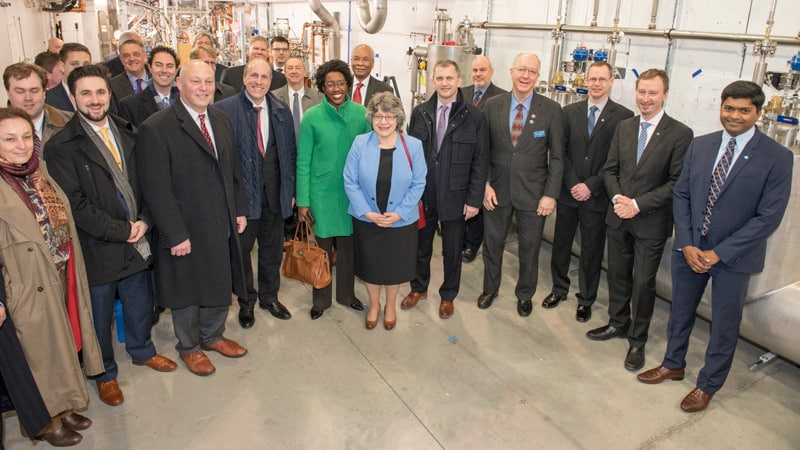
At the helm The PIP-II project groundbreaking ceremony took place in March 15, 2019, where Merminga (centre) was joined by members of the US Congress and invited guests to celebrate Fermilab’s position as a world-leading destination for neutrino research. (Courtesy: Reidar Hahn, Fermilab)
Merminga attributes much of her confidence to having attended an all-girls school, noting that boys can sometimes be more assertive. “Until I was 18, I was in an environment that was a little bit protected,” she says. “That helped me build confidence in myself. When I went to university, only 10% of students were women, but by then I had built enough confidence that it didn’t matter.”
Merminga therefore believes that girls-only physics programmes could help girls to feel more empowered to study the subject. But she says we need a multi-pronged solution that also addresses the practical issues people face throughout their careers. Fermilab, for example, has on-site day-care that enables parents to focus on their jobs more easily.
Another major factor is of course increasing the visibility of women in the subject. Merminga notes that this was helpful for her, having been inspired by her female physics teacher when she was in school, and then later by Helen Edwards, the lead physicist in the construction of the Tevatron. “To see someone in action is very powerful,” she says.
Fortunately, this has improved further in recent years. Since 2016, the experimental particle physicist Fabiola Gianotti has been director-general of CERN, also the first woman to hold that position. With Merminga taking the helm at Fermilab, two of the highest-profile jobs in physics are now occupied by women. So although there is still work to be done, this feels like a significant milestone.
Formulating the future
Although Merminga has led major projects and programmes before, directing such a large institute as Fermilab is a new challenge for her, as the bigger scale means added complexity. But she believes that the fundamental principles of leadership and managing a large scientific entity remain the same.
“It’s important to have a clear vision,” she says, “and to be able to articulate it to every employee; to have a plan to realize that vision; and to hold myself and everyone else accountable to deliver on it.”
So what is Merminga’s vision for Fermilab? This is something that she is still formulating, having only just taken over, and she is keen to consider lots of perspectives. One of the first actions she took in April was to embark on a “listening tour”, to hear from lab employees and Fermilab’s user community. While the specifics are still in the works, she describes the broad strokes of her ambition for Fermilab is for it to “lead the world in particle physics and accelerator science, technology and innovation, underpinned by a diverse and world-class workforce; by excellent and robust operations and business systems; by a sustainable campus strategy integrated with our mission; and by enduring and enabling partnerships, regional, national and international.”
Reflecting on her career, she says she has many feelings about becoming director of the institute where she first started out in accelerator science. “I’ll sum it up in two words: profound gratitude,” she says. “I was very privileged to be here as a grad student, doing experiments with some of the world’s best physicists and with the most advanced collider that existed at the time. How lucky can one get? The poem ‘Ithaca’ by Greek poet Constantine Cavafy comes to mind. He writes ‘Ithaca gave you the marvellous journey.’” Perhaps this inspires a more personal side of her mission as director, as she emphasizes that she now wants to give other young scientists similar opportunities. And as well as paying it forward, she wants to honour the legacy of previous generations of physicists and the former directors of Fermilab.
I feel responsibility and gratitude, and a lot of optimism that we can continue this trajectory
Lia Merminga
Looking back, it seems serendipitous that one of those former directors, Leon Lederman, is in the background of the photo picturing Merminga’s uncle. “We stand on the shoulders of giants,” she says. “I feel this big responsibility to continue the tradition of Fermilab being this great institution recognized around the world for innovation and breakthrough discoveries. I feel responsibility and gratitude, and a lot of optimism that we can continue this trajectory.”
Heating up: 323P/SOHO as observed by the Subaru Telescope in December 2020 (left) and the Canada France Hawaii Telescope in February 2021. (Courtesy: Subaru Telescope/CFHT/Man-To Hui/David Tholen)
For the first time, astronomers have clearly observed the partial disintegration of a comet at its closest point to the Sun. Led by Man-to Hui at Macau University of Science and Technology, the international team made the observation using a combination of ground- and space-based telescopes. Describing the event as the “lingering death” of the object, the team says that its study reveals some highly unusual features in the comet’s colour and rotation.
The innermost reaches of the solar system are home to numerous comets and asteroids that reach their perihelia – their point of closest approach to the Sun – inside the orbit of Mercury. Astronomers widely predict that these objects originated from the asteroid belt – or were short-period comets such as Halley’s Comet – before being directed towards the Sun by the gravitational effects of the major planets.
Since the new orbits of these objects frequently cross paths with those of the terrestrial planets, they aren’t expected to last for more than 10 million years before colliding with a planet, or crashing into the Sun. However, the number of these objects that are currently known to astronomers is still far smaller than current models predict.
This scarcity partly stems from the difficulties involved in observing these comets, which only become bright enough to study as they approach their perihelia. As they approach the Sun, the objects are expected to disintegrate under the extreme thermal stress they experience in the Sun’s immediate proximity. So far, however, high-quality observations of this fragmentation have yet to be made.
Pioneering observations
To shed new light on the process, Hui’s team studied the comet 323P/SOHO, which has a perihelion of just around 8.4 solar radii. This comet had never been observed from the ground before, placing a large uncertainty on the exact whereabouts of its perihelion. To address this challenge, the astronomers used Japan’s Subaru telescope, located in Hawaii, whose gigantic field of view allowed them to cover a wide region of the sky in their search.
Once they had identified 323P/SOHO in Subaru’s images, the team could then study it with a combination of higher-resolution ground- and space-based telescopes, including the Hubble Space Telescope. Following its closest approach to the Sun, these observations revealed that 323P/SOHO developed a long, narrow tail of dust – expected for a disintegrating comet.
Hui’s team predicts that this fracturing was partly triggered by the large thermal stress experienced by 323P/SOHO. However, they also noticed an unusually rapid rotation in the comet’s nucleus. With a rotational period of just over 30 min, 323P/SOHO spins faster than any other known comet in the solar system. This rapid rotation likely accelerated its disintegration, says the team.
In total, the researchers calculated that 323P/SOHO shed between 0.1% and 10% of its total mass as it passed its perihelion. In addition, they noticed some highly unusual colours in the comet’s nucleus and tail. The colours that changed over time in ways that astronomers have never seen before. Based on their calculations of the object’s orbit and gravitational influences, Hui and colleagues now predict that it has a 99.7% chance of colliding with the Sun within the next 2000 years.
The team now hopes that the same approach will allow them to view further near-Sun comets in future studies. If the same unusual features appear in these objects, they could shed new light on the disintegration process; potentially providing new clues as to why the innermost parts of the solar system are so sparsely populated.