Unfortunately, my enthusiasm was quickly dampened. Just a couple of chapters in, it began to feel as if the title refers to the structure of the book itself, which seemed harder to locate than the elementary particle in question. But while initially disjointed, I suggest you don’t let this put you off the book – it does get better.
I first had alarm-bells ringing as I read the preface, where Close remarks that the Higgs boson was dubbed the God Particle “in media headlines”. However, it was physicist and Nobel laureate Leon Lederman who came up with the epithet for the title of his 1993 book – a fact that Close himself references later in the book. The fact that the media ran with the phrase is neither here nor there, but putting the blame, as it were, on the media seems slightly uncharitable. In the preface Close also only mentions the 2013 Nobel Prize for Physics going to Higgs, ignoring until later on in the book that it was jointly rewarded to François Englert, which feels misleading and unfair on Englert. Even the title makes it seem as if Higgs was the only person involved in the scientific endeavour the book goes on to describe.
But I set this aside and continued. As a friend of Higgs, Close is uniquely placed to tell us the theorist’s story, with all the partiality one might expect from such a relationship. Close draws upon their private and public conversations, as well as referring to other books, scientific papers and primary sources. He begins by introducing us to Higgs’ family, including his grandparents. We are told of Higgs’ early education and how he attended Cotham Secondary School in Bristol, the same school that Paul Dirac once attended. It is not immediately clear, however, what relevance some of these snippets have. For example, Close describes Higgs’ conversion to socialism while coming from a traditionally conservative family, but the paragraph, inserted abruptly, does not seem to lead anywhere.
This unexpected dead-end is unfortunately not an exception. Close varies the attention that he gives different areas of physics in a way that can frustrate. Some ideas are introduced and then dropped almost immediately, while other statements are presented as fact without further discussion. Some terms are defined well after they are first introduced, and others have pages and pages of explanation devoted to them, with occasional (and needless) repetition of ideas and phrases – a proclivity raised in a Physics World review of Close’s previous book Trinity. We are told, for example, that Higgs’ father viewed Oxford and Cambridge as places that “were for the sons of the idle rich to waste their time and also that of their tutors”, and are then reminded of this exact sentiment with near-identical phrasing mere pages later.
Having said that, Close’s scientific narrative presents a more historically accurate description of the meandering path that led to Higgs’ ideas compared with other popular explanations of the significance of the BEH mechanism. Commonly, the tales begin with how the mechanism solves the problem of the W and Z boson masses under the unification of the electromagnetic and weak forces. Close chooses instead to introduce the reader to the crucial work of Jeffrey Goldstone and the problems arising from his ideas that Higgs and fellow theorists were trying to solve, as well as the importance of Philip Anderson’s 1962 paper that first introduced a mass-giving mechanism. Close also explains in welcome detail the link between the 1964 papers proposing the BEH mechanism to superconductivity, providing a rich history of 21st-century particle physics and its relationship with other domains of physics. Higgs is the protagonist of the story Close tells us but Elusive also explores the crucial roles played by many other principal actors on the particle-physics stage. Despite glossing over them in the preface, Close goes into detail about the work of Brout and Englert, and includes that of Gerald Guralnik, Carl Hagen and Tom Kibble.
Close’s writing is peppered with colourful metaphors but unfortunately, some left me scratching my head
Close’s writing is peppered with colourful metaphors but unfortunately, some left me scratching my head. For example, when referring to theorists proposing the existence of new particles, he alludes to trails and peaks before then switching metaphors to cookery and gourmet banquets in the same paragraph. Elsewhere, we are told that the W and Z bosons are bears in a cave, a concept first introduced in pages 44–48 and then dropped in without ceremony some 80 pages later. Bizarrely (or perhaps intentionally?), he later refers to Carlo Rubbia, one of the driving forces behind the discovery of the W and Z bosons, as “a bear of a man”.
None of this is to say, of course, that Close is not a compelling storyteller. There are parts of the book that lead you on with delight: “This particle carried zero charge, so he [Sheldon Glashow] named it Z, and like his native city New York, New York – so good they named it twice – he appended the traditional superscript 0 as well, making it Z0.” But I feel as though the book as a whole could have done with some more forceful editing. Some threads come together to form a unified tapestry, but the images they represent appear disjointed and occasionally without relation to anything else mentioned.
Indeed, on the editorial side of things, the most frustrating aspect of reading Elusive is to constantly gamble as to whether a note at the end of the book is worth looking at: sometimes they are references to papers, while others include a paragraph of contextualizing or expanding information. These notes would have served a better purpose as footnotes on the same pages they are referenced on.
The story of the Higgs boson is longer than the 48 years between the papers that predicted its existence and the announcement that it had finally been found – and it is a vastly more complex journey than is evident at first glance. Elusive is a timely and in-depth narrative, and although Close, as he might put it, has a mountain to climb, at least he is equipped with all of the ingredients needed for a scrumptious meal once at the top.
A novel type of molecule that is longer than some kinds of bacteria has been detected by physicists at the University of Stuttgart in Germany. Using a specially designed microscope, the team observed a binding mechanism between a charged ion and a neutral Rydberg atom – that is, an atom with a single, highly excited valence electron. The extent of the bond length in the new molecule is as wide as a few micrometres, which is at least 1000 times larger than in usual molecules.
When two particles combine to make a molecule, they usually do so in one of two ways: by electrostatic attraction between two oppositely charged ions (ionic bond) or by sharing electrons between two neutral atoms (covalent bond). In contrast, the bond observed by the Stuttgart team forms when the electric field of an ion deforms a Rydberg atom, inducing a dipole in which one side of the atom is more negatively charged and the other more positive. Depending on the orientation of the electric dipole, the interaction between the induced dipole of the Rydberg atom and the charge of the ion can be attractive or repulsive.
What’s unusual about this molecule is that the ion’s electric field distorts the atom in such a way that it causes the dipole’s orientation to flip at a particular distance. At shorter distances, the atom and the ion repel, while at larger distances, they attract. The distance at which this dipole flip occurs determines the bond length of the molecule.
A very cold recipe
To make this molecule, the researchers prepared a cloud of rubidium-87 atoms at a temperature of just 20µK, since higher temperatures would risk the thermal energy of the atoms and ions overcoming the weak strength of the bond. The team then used laser pulses to prepare the molecule’s constituents: firstly ionizing single atoms, then exciting a nearby rubidium atom in the ultracold cloud to the Rydberg state. The Rydberg atom is 1000 times larger than the ion since the more excited the electron is, the farther away from the nucleus it extends. When the Rydberg atom and the ion are separated by a distance comparable to the bond length, a molecule forms.
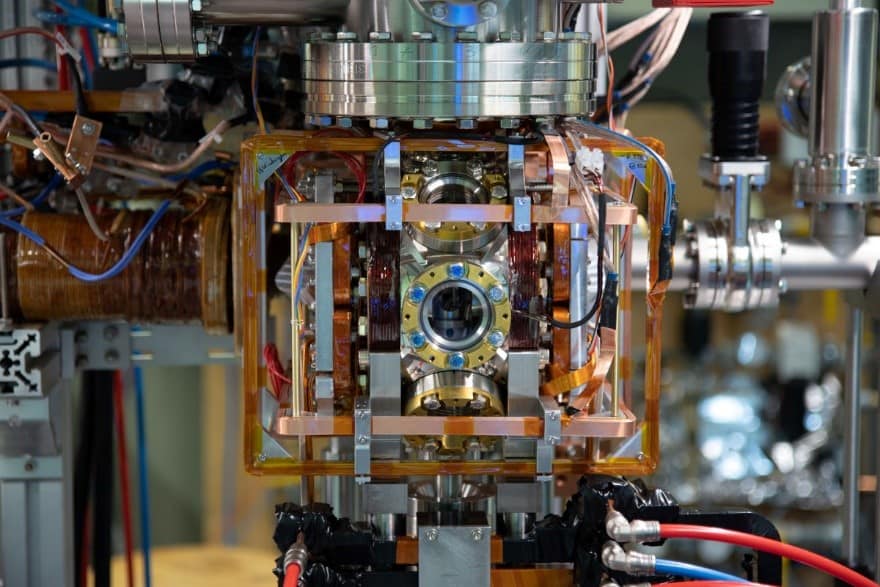
Ions inside: The experimental chamber. The ion microscope extends to the top of the image frame and beyond. (Courtesy: PI 5, Nicolas Zuber)
To verify the molecule’s formation, the researchers devised a special ion microscope. Unlike an optical microscope, which uses light to image an object, in this microscope an electric field separates the molecule and ionizes the Rydberg atom. The now separated ion and Rydberg core are then guided along the microscope and onto a detector. Due to their different charge-mass ratios, the Rydberg core and the ion will arrive at this detector at different times, allowing each of them to be detected individually.
Owing to the molecule’s large size, the microscope should be able to measure the motion of the binding partners in the molecule. “The vibrations in this molecule are relatively slow compared to typical molecules and our ion microscope offers enough time resolution to resolve such processes” explains Nicolas Zuber, lead author of a paper in Natureoutlining the results. Zuber adds that in the longer term, the ion microscope could also be used to study the dynamics of Bose-Einstein condensates (BECs), which are gases of cooled atoms all occupying the same quantum ground state. Atoms in a BEC behave like a single macroscopic matter wave that extends across the ensemble, and the spatial resolution of the ion microscope is high enough to probe phenomena on a scale similar to the length at which the matter wave changes. It could therefore make it possible to perform spatially-resolved experiments on these quantum gases, for example studies of ionic impurities and ion-atom scattering in the quantum regime.
An axial Higgs mode has been spotted within the collective quantum excitations of a solid material. Kenneth Burch at Boston College and colleagues in the US and China, discovered the quasiparticle cousin of the Higgs boson in a relatively simple tabletop experiment carried out at room temperature.
In 2012, the discovery of the Higgs boson at CERN’s Large Hadron Collider confirmed a prediction made nearly 50 years earlier about the mechanism by which some fundamental particles acquire mass. The Higgs mechanism is triggered by spontaneous symmetry breaking and was originally devised to explain how photons acquire mass in superconductors. As a result, analogues of the Higgs boson – collective excitations (or quasiparticles) called Higgs modes – can be found in superconductors.
Theory predicts that further symmetry breaking could lead to the emergence of a new type of excitation called the “axial Higgs mode”, which unlike the Higgs mode, has intrinsic angular momentum.
Now Burch and colleagues have observed an axial Higgs mode in rare-earth tritellurides. These are layered materials that harbour charge density waves (CDWs) in which chains of electrons form standing waves. These electrons behave in a highly correlated manner and a CDW is described as a quantum fluid – a category of materials that also includes superconductors.
Raman spectroscopy
Burch and colleagues probed their rare-earth tritelluride samples using Raman spectroscopy, whereby changes in the wavelength and polarization of scattered laser light provide information about how atoms vibrate in a sample. The team identified a peak in the material’s Raman spectrum that corresponds to a Higgs mode. They used a technique called quantum pathway interference to further characterize the Higgs mode. Quantum pathways are the different ways that the laser light can interact with the Higgs mode and the interference occurs because of the quantum nature of the system.
The two pathways of interest to the team were the excitation of a Higgs mode with no intrinsic angular momentum and the excitation of an axial Higgs mode. By varying the polarization of the incoming laser light and the polarization of the detected light, the team was able to observe this interference and confirm the existence of the axial Higgs mode in the material. What is more, the observations were made a room temperature, whereas most other quantum phenomena can only be seen at very low temperatures.
The team now hopes that their relatively simple experimental approach could be used to identify axial Higgs modes in other materials including superconductors, magnets and ferroelectrics. This could prove useful for future technologies because materials containing axial Higgs modes could be used as quantum sensors. And because the mathematics of the axial Higgs mode is analogous to that used in particle physics, studying the quasiparticles could provide clues for what lies beyond the Standard Model of particle physics.
Everyone knew something big was coming. Students had camped outside CERN’s designated seminar hall overnight in the hope of grabbing one of the few unreserved seats. Finally, on the morning of 4 July 2012, the suspense was ended. Spokespeople for the large hadron collider’s two general purpose experiments, ATLAS and CMS, confirmed the rumours: both experimental teams had detected a “Higgs-like particle” and the masses were very similar.
In the July episode of the Physics World Stories podcast, Andrew Glester revisits that historic day in 2012. He’s joined by two guests who were there at the particle physics lab in Geneva to live through that memorable day. Achintya Rao was a communications officer at the CMS experiment and Cristina Botta was a research scientist.
Discover much more about the past, present and future of particle physics in the July issue of Physics World, a special issue to mark the 10-year anniversary of the Higgs boson discovery.
Officials at the CERN particle-physics lab gathered today to celebrate a decade since the announcement of the discovery of the Higgs boson at the Large Hadron Collider (LHC). Held in CERN’s main auditorium, the anniversary symposium featured talks about the discovery as well as the latest Higgs research and what to expect in the coming decades of particle-physics research.
The event took place in the very same venue in which the ATLAS and CMS collaborations at the LHC announced on 4 July 2012 the discovery of a new particle with features consistent with that of the Higgs boson. ATLAS and CMS measured the Higgs boson’s mass to be 125 GeV.
A year later François Englert and Peter Higgs bagged the Nobel Prize for Physics for the part they played in the prediction of a new fundamental field, known as the Higgs field, which manifests itself as the Higgs boson and gives mass to the elementary particles.
“The discovery of the Higgs boson was a monumental milestone in particle physics. It marked both the end of a decades-long journey of exploration and the beginning of a new era of studies of this very special particle,” says CERN director general Fabiola Gianotti, who in 2012 was spokesperson for the ATLAS experiment.
“I remember with emotion the day of the announcement, a day of immense joy for the worldwide particle physics community and for all the people who worked tirelessly over decades to make this discovery possible.”
Today’s symposium at CERN also featured video messages from Higgs and Englert as well as former CERN director general Rolf-Dieter Heuer, who was leading the lab when the anouncement was made. “I think it’s splendid that you are having a celebration after 10 years,” noted Higgs, who is now 93.
Englert, meanwhile, said he “vividly” remembered the events on the 4 July 2012 and paid tribute to the contribution of the US-Belgian physicist Robert Brout, who died in 2011 and who may well have shared the Nobel prize with Higgs and Englert had he lived for longer. “Today, we celebrate the memory of this great physicist and wonderful man,” noted Englert.
Other talks at the symposium were given by Lyn Evans, who helped to build the LHC, as well as senior officials at the ATLAS and CMS detectors and leading theorists. Wrapping up the morning session, Gianotti noted that the discovery of the Higgs boson opened up a new “era of exploration” that has “wide-ranging implications” for particle physics and beyond.
She also highlighted the “superb” performance of the LHC in the decade since the discovery – noting nine million Higgs bosons have been produced at both ATLAS and CMS to date — as well as improvements in analysis methods and collaboration with theory.
‘Bright future’
Meanwhile, the next science run at the LHC – what is known as “run 3” – will begin tomorrow on 5 July. The was shut down four years ago to allow engineers to carry out maintenance, consolidation and upgrade work to CERN’s accelerator complex. The first beams were injected on 20 April with the two proton beams accelerated to a record energy of 6.8 TeV per beam before the luminosity and the stability of the beams were improved. ATLAS and CMS are now both expected to receive more collisions during this run than in the two previous physics runs combined.
Crying eyes Peter Higgs on 4 July 2012. (Courtesy: CERN)
Nobody who has seen the images will forget Peter Higgs’ watery eyes. Captured at CERN’s main auditorium on 4 July 2012, the video shows the British theoretical physicist holding a tissue as lab bosses announce that the Higgs boson has been discovered. Higgs, who was then 83, has welled up and removes his glasses to daub his face. But do those tears reveal the emotion of a particularly sensitive man? Or do they indicate emotional currents intrinsic to life as a physicist?
According to a view long enshrined in textbooks and ratified by traditional philosophers of science, physicists are investigators trained to apply physical and conceptual tools to unravel the puzzles of nature. Whatever moods strike them as that work unfolds reflect only the subjective responses of individuals; the moods on show are irrelevant to the practice of physics. Higgs must be simply a man prone to tears, so this view goes.
Do Peter Higgs’ tears reveal the emotion of a particularly sensitive man? Or do they indicate emotional currents intrinsic to life as a physicist?
But according to a more all-inclusive approach to science, which treats it as consisting not just of products but of practitioners too, those tears are different. Physicists belong to of a way of life that values solving nature’s puzzles – and moods are as intrinsic to that way of life as they are to ordinary life. Living in a world in which nature appears manipulable and measurable – and full of puzzles to be solved – physicists experience everything from awe, boredom, confusion and disappointment to discouragement, obsession, pressure, shock, scepticism and more.
Sure, those feelings aren’t necessarily different from what we experience in everyday life, but they are intrinsic to physics life, and therefore to physics itself. In fact, the puzzle-solving world that physicists inhabit is rather like sport, where athletes bring their all to the ebb and flow of a game. If you spot an emotionless athlete in an exciting match, you assume they’re either good at hiding their moods or are simply disengaged. Similarly, if you encounter a physicist who is blasé about their work or about their setbacks and successes, you can’t help but wonder how talented they really are.
Even the notoriously impassive theorist Paul Dirac was privately moody, as revealed by his recollection of the time he realized the likely relevance of “Poisson brackets” to quantum mechanics. Not knowing enough about this mathematical operation and being unable to find it discussed adequately in his textbooks, Dirac was in despair to find that the library was closed on that particular Sunday. He was forced to wait “impatiently through the night and then the next morning” until the library reopened.
Now and again there is some dramatic and sensational event that provokes a particularly intense and powerful emotion.
The conventional view of science, however, omits these moods, labelling them subjective and dismissing them as something in the domain of psychologists. But there is a “physics world” that practitioners are caught up in. Usually, it’s everyday stuff like conversing with colleagues and learning what others are up to; of hearing about new ideas, reading journals and ordering supplies; of planning and carrying out new projects. Now and again, though, there is some dramatic and sensational event that provokes a particularly intense and powerful emotion.
The mass thing
The announcement of the discovery of the Higgs boson was one such event. What a decisive piece of what an extraordinary puzzle! Hundreds of theoretical pieces had to come together to create the architecture of the Standard Model of particle physics, and decades of development in accelerator and detector technology were required. The Standard Model also had to incorporate all those strange particles discovered first in cosmic rays and then even more produced in accelerators.
That model required theorists to develop countless schemes to organize these particles into families, with experimentalists having to identify all the family members and their properties. All those forces in and between particles had to be consolidated into one. Gauge symmetry and broken symmetry had to be invented. Every now and then some deep flaw would appear in the evolving architecture – parity violation, charge–parity violation – that had to be resolved.
But a piece missing from the beginning was how mass figures in this architecture. The invention of the necessary idea itself took years and required many seemingly unrelated steps from seemingly unrelated fields.
Julian Schwinger discovered that attempts to link the weak and electromagnetic fields were stymied by the fact that electrically charged bosons are not massless. Yoichiro Nambu found the idea of hidden symmetry was key to superconductivity. Jeffrey Goldstone saw that the breaking the symmetry creates massless bosons. Philip Anderson used ideas from plasma physics to show that it’s possible to have massive gauge bosons, while several other theorists showed that bosons can become that way by absorbing the Goldstone boson.
Peter Higgs’ work not only described such a boson but also proposed ways that it might be identified experimentally. All these things, and many other contributions, had to go into fitting that piece into the blueprint of the Standard Model, showing that its blueprint was sound. And then came the enormous technical and experimental challenge of hunting for the boson – a job that was completed in 2012 – almost half a century after the boson’s first description.
The critical point
Peter Higgs was not alone in experiencing feelings that day at CERN during the announcement of that particle. There wasn’t a single mood in the room, of course. Some were celebrating the discovery after contributing to it, or were proud of the discovery despite working in another area in or outside CERN. Others may have been dismayed at having sought – but failed – to contribute, or at having had their contributions unacknowledged. These moods were all present and inseparable from the way of life of a physicist.
It is just that Higgs’ was more visible – and an alert camera operator caught it on film.
Philanthropic funding of science in the US is now on a par with federal research funding. That is according to an analysis of tax returns from non-profit organizations, which finds that philanthropic institutions now spend at least $30bn in total on science each year.
While there has been a lot of work exploring the patterns of government science funding, not much focus has been given to philanthropy even though it is known to contribute significant sums of money for research. Part of the issue has been a lack of data, but recent changes by the US Internal Revenue Service (IRS) has made tax data from non-profit organizations available for research. As well as financial and organizational details, these tax forms also list grants that the organization has awarded.
Louis Shekhtman from Northeastern University in Boston and colleagues analysed more than 3.5 million tax forms filed by US non-profit organizations between 2010-2019. They identified almost 70,000 organizations that are involved in funding scientific research and higher education.
Their analysis shows that over the study period, these organizations gave more than 900,000 grants totalling $208bn. In 2018 and 2019 the total awarded was about $30bn per year, which is comparable to grant funding distributed by the National Institutes of Health and around three times that awarded by the National Science Foundation.
Doling it out
Philanthropic bodies that support science and higher education gave cash to other causes such as the arts, religion and education. Yet about 44% of funders gave more to science than any other area with 16% exclusively funding science. Those funders that focused primarily on science accounted for 93% of all scientific philanthropy.
Unlike government science funding, which relies on a few large organizations, the data shows that philanthropic funding involves a few large foundations and many small funders. The top 200 were responsible for 66% of the cash given to science but made up just 0.3% of grant-giving organizations. The smaller organizations still contributed significant amounts of money, with more than 7000 non-profits giving at least $1m over the study period.
[This is] the first step of at least tracking where the money is going
Louis Shekhtman
Philanthropic funders tend to give more grants and money locally. Approximately 35% of grants went to recipients in the donor’s state and 49% of funds remained in the same state. The researchers found that about half of funders awarded their largest grant to someone within the same state as them.
The study also discovered that once a grant was awarded, 69% of those relationships repeated a year later and 60% two years later. Funding then became more entrenched over time. Donations over two consecutive years had a more than 80% chance of continuing the next year and funding relationships of seven years had an almost 90% likelihood to continuing.
Given that the IRS data does not include money given by private individuals and only accounts for the 80% of non-profits that file their taxes electronically, the researchers say that their figures of the amount of money given to science via philanthropy is likely to be an underestimate.
“[This is] the first step of at least tracking where the money is going,” Shekhtman says. “The next step has to be what are the publication outputs, what new centres are being developed and what researchers are being hired as a result of this funding.”
Yet Shekhtman says that it will be difficult to determine what all of the money is spent on. Universities in the US bring in billions of dollars in donations and while some of that money has strings attached, a lot goes to general operating costs, infrastructure and buildings – things scientists don’t tend to think about or list in their funding acknowledgements. “Who donated the building you work in? Without them your research couldn’t get done,” Shekhtman adds.
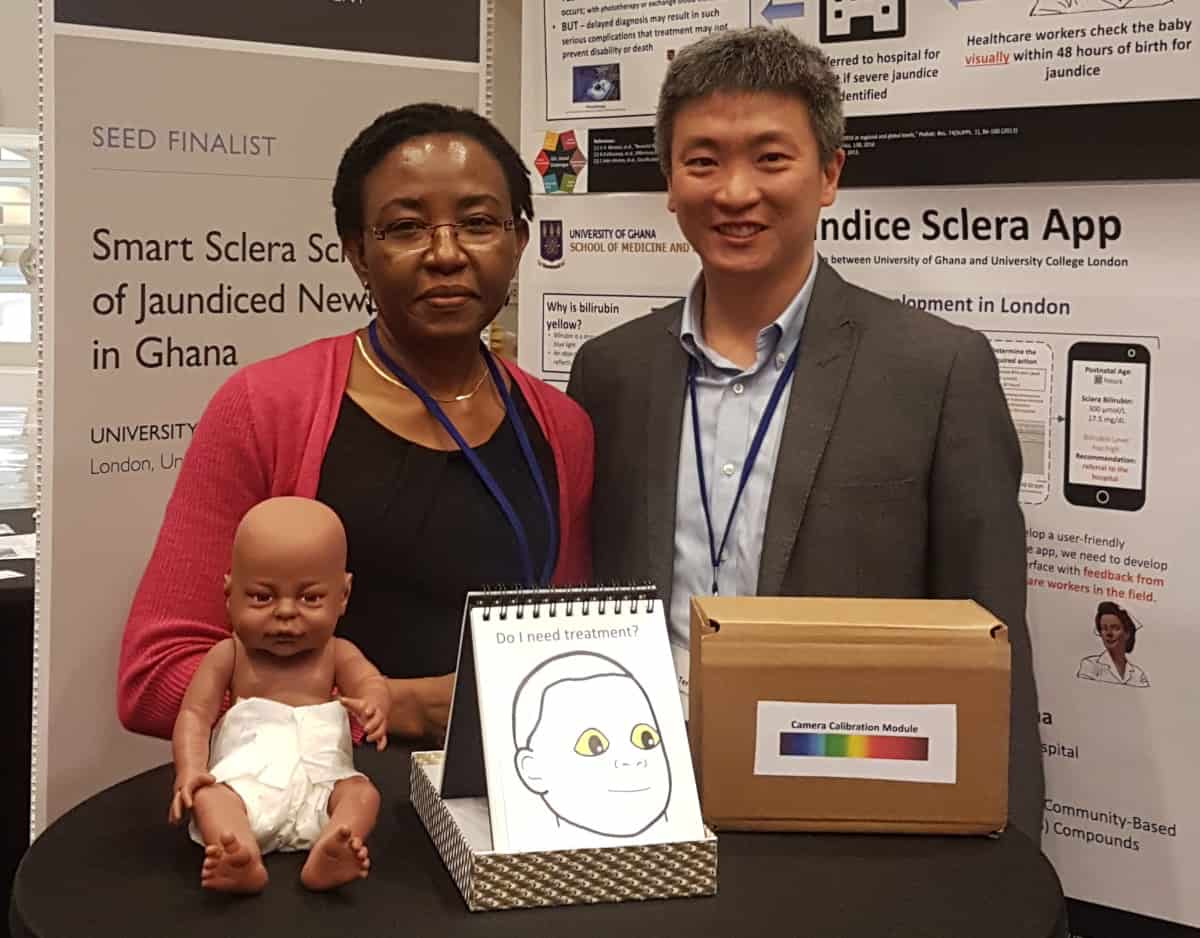
Smartphone screening: The neoSCB app is used to screen a Ghanian newborn for neonatal jaundice. The colour card seen in the photo is not required for the app, but was used to investigate ambient lighting. (Courtesy: Christabel Enweronu-Laryea/Terence Leung)
A smartphone app developed at University College London (UCL) identifies severe jaundice in newborn infants by scanning their eyes. The tool could prove invaluable in areas of the world that lack access to expensive screening devices.
A collaborative clinical study by researchers at UCL and the University of Ghana has now confirmed that the diagnostic performance of the neoSCB (neonatal scleral-conjuctival bilirubin) app is comparable to that of a conventional jaundice screening device.
Neonatal jaundice is caused by high levels of the pigment bilirubin in the blood, which build up when a newborn’s immature liver cannot remove bilirubin rapidly enough. Because bilirubin is toxic to the brain, if it crosses the blood–brain barrier it can cause brain damage. Without rapid treatment, an infant may suffer from permanent neurological dysfunction, developmental delays, hearing loss or even death.
The concentration of bilirubin in an infant’s blood can be assessed using a laboratory blood test or a transcutaneous bilirubinometer (TcB), a point-of-care device that takes a contact-based optical measurement of the skin. However, neither may be available to infants in low-resource countries and remote areas. Inability to test is a serious problem, because neonatal jaundice affects more than half of infants in their first week of life, a significant proportion of whom will need treatment.
Terence Leung, the developer of the technology behind the neoSCB app, explains that the smartphone camera technique works by quantifying the colour of the sclera (the white of the eye), as the degree of sclera yellowing is indicative of the systemic concentration of bilirubin. Leung and colleagues have been investigating the use of digital photography to measure sclera colour, and using this to quantify the scleral-conjunctival bilirubin (SCB), since 2014.
The app also incorporates ambient light subtraction, using the smartphone screen (front camera imaging) or the LED flash (rear camera imaging) to illuminate the subject. “This design explicitly addresses the confounding factors in colour measurement of jaundice – ambient light, camera characteristics and skin tone – while avoiding the need for add-ons or in-shot colour calibration cards,” Leung explains.
Clinical assessment
Following an initial pilot study on 37 newborns at University College Hospital London, the team performed a year-long study on 724 newborn babies in Ghana, publishing the findings in Pediatrics. The study was conducted at the Greater Accra Regional Hospital and at the Holy Family Hospital Nkawkaw, a district hospital in the Eastern Region.
Principal investigators: Christabel Enweronu-Laryea and Terence Leung at the Savings Lives at Birth Grant Challenge in Washington, DC, where they were awarded a grant to perform this study. (Courtesy: Christabel Enweronu-Laryea/Terence Leung)
The researchers used a Samsung Galaxy SB smartphone to record two images of each infant’s eye, with the LED flash on and off, enabling the use of ambient subtraction to minimize the effects of ambient light. To validate the diagnostic performance of the SCB level measured by the app, they also performed a TcB measurement using a Dräger JM-105 jaundice meter, plus a laboratory blood test, the gold standard to verify total serum bilirubin (TSB) levels.
Early in the study, the researchers optimized the neoSCB app by establishing an appropriate subtracted signal-to-noise ratio (SSNR) for quality control. The real-time SSNR is displayed on the app, making it easier to operate. They also added an option to zoom in on the captured image and manually choose an area-of-interest on the sclera to obtain a real-time calculated SCB value.
Principal investigators Christabel Enweronu-Laryea, of the University of Ghana Medical School, and Leung report that of the 336 infants who had not been previously treated for jaundice, the neoSCB app identified 74 out of 79 severely jaundiced newborns. By comparison, the TcB identified 76. The app exhibited reasonably high sensitivity and specificity, with a similar diagnostic accuracy to the JM-105 jaundice meter.
The TcB correlation with TSB was higher than SCB/TSB correlation, which had higher variance particularly when TSB was greater than the screening threshold of 14.62 mg/dl. The neoSCB app underestimated bilirubin at higher values of TSB, while the JM-105 gave no numerical values in similar conditions. The authors note that these findings are not clinically relevant for the smartphone app, which is designed to detect TSB levels that require additional clinical assessment and blood tests. However, they caution that the app should not be used in infants with a gestational age of less than 37 weeks, because it underestimates the scleral yellowness in preterm infants.
In addition to the hospital validation, 11 community healthcare workers in three rural communities in the Eastern region assessed the neoSCB app. They mastered its use with about 30 min of training and believe that it will be a highly effective and easy-to-use screening tool, especially since images and data can be electronically transmitted to hospitals when infants need additional testing.
“The neoSCB method was acceptable to mothers in urban and rural communities where the study was conducted. Mothers easily devised ways to keep the baby’s eye open, most often by initiating breastfeeding,” says Enweronu-Laryea. The researchers find the feedback from both the mothers and community healthcare workers encouraging, because many infants in sub-Saharan Africa have increased risk of severe jaundice due to the high prevalence of a genetic disorder associated with an increased risk of haemolysis (the destruction of red blood cells) and hyperbilirubinemia.
Now that the diagnostic algorithm in the neoSCB app has been validated, its user interface will be improved further to make it more user-friendly for healthcare workers. The researchers hope that the app can either be used independently, or integrated into established maternal–child healthcare apps as an additional functionality. The team is seeking international partners for the next steps of regulatory approval (FDA, CE mark and MHRA, for example) from countries where the neoSCB app would be used.
It’s rare in physics to be able to say “I was there” when a great discovery is announced. But several hundred people certainly enjoyed that privilege 10 years ago on 4 July 2012 as they crammed into CERN’s main auditorium. There they heard Joe Incandela and then Fabiola Gianotti – spokespeople for the CMS and ATLAS collaborations respectively – reveal the latest data from the Large Hadron Collider (LHC). The Higgs boson (or at least “a Higgs boson”) had been discovered. “I think we have it,” as CERN boss Rolf Dieter Heuer declared.
But what was astounding for such a technical discussion was that hundreds of thousands of people had tuned in from around the world to witness the event online. Hardcore particle physics had never been so popular, with non-physicists able to listen to discussions of the Standard Model, decay channels and standard deviations.
The announcement was a high-water mark for CERN. Over the previous few years, news about the LHC had been dominated by its early malfunction and scare stories the collider might make tiny – but potentially Earth-destroying – black holes.
Another celebration for high-energy physics that matches the discovery of the Higgs may be a long time coming.
The announcement of the Higgs boson was brilliantly choreographed by CERN, which let CMS and ATLAS take joint credit. In that way, the lab avoided a repeat of the messiness surrounding the discovery of the W and Z bosons 30 years earlier when one collaboration (UA1) hogged the limelight over the other (UA2). There was more good news in 2013 when Peter Higgs and François Englert shared that year’s Nobel Prize for Physics.
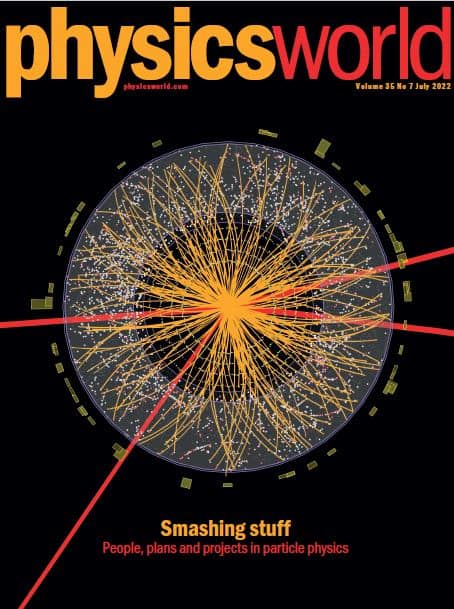
Smashing stuff: People, plans and projects in particle physics
Sadly, that early momentum was not sustained. Particle physicists hoped that signs of supersymmetry would be forthcoming but nature has not played ball.
Headlines over the last decade have instead been dominated by astronomy and astrophysics, with the discovery of gravitational waves and the imaging of black holes. A lot rests on the LHC’s Run 3, which is now under way, and on the subsequent conversion of the LHC into the High-Luminosity LHC. That upgrade will boost the machine’s luminosity 10-fold when it comes online in the 2030s.
In the US, Fermilab’s new director Lia Merminga is concentrating on “high-intensity” experiments, after the shutdown of the Tevatron collider, as she explains in an interview with Laura Hiscott.
Another celebration for high-energy physics that matches the discovery of the Higgs may be a long time coming.
• Satellite explains Betelgeuse dimming – Chance observations by a Japanese weather satellite has shed light on the process that led to Betelgeuse’s ‘Great Dimming’ in 2019. Keith Cooper reports
• ITER seeks new boss after Bigot dies – ITER Council searches for a long-term successor to Bernard Bigot as ITER deputy director Eisuke Tada takes over as interim head of the France-based fusion project. Michael Banks reports
• Gaia releases new Milky Way maps – The third data release from the European Space Agency’s Gaia mission is one of the richest sets of published astronomical information, as Michael Banks finds out
• IUPAP: uniting physicists for the last 100 years – Michel Spiro, president of the International Union of Pure and Applied Physics (IUPAP), talks to Laura Hiscott about the organization’s biggest achievements, its centenary celebrations, and its future
• Tracks of my tears – Physics is often viewed as a dispassionate and purely
objective activity. So how, wonders Robert P Crease, do we explain the reaction of Peter Higgs when the boson that bears his name was discovered?
• Green-sky thinking – The airline industry is emerging from COVID-19 with progress on de-carbonizing air travel, as James McKenzie discovers
• How to become a better supervisor – Rikke Plougmann argues that PhD students can only thrive if their wellbeing – and not just their scientific development – is properly supported
• A day in physics like no other – Achintya Rao recollects the momentous day 10 years ago when CERN announced it had discovered the Higgs boson
• Directing the future of Fermilab – Lia Merminga has just become the seventh director of the Fermi National Accelerator Laboratory in the US. She talks to Laura Hiscott about accelerator science, the future of particle physics and being the first woman to lead this iconic and influential research centre
• Helen Edwards: pioneer of the Tevatron – Helen Edwards was a formidable force in the field of accelerator science, whose impact can still be felt around the world today. Anita Chandran finds out more about her contributions to particle physics
• Making science centre stage – Jim Grozier reviews The Importance of Being Interested: Adventures in Scientific Curiosity by Robin Ince
• The man behind the machine – Achintya Rao reviews Elusive: How Peter Higgs Solved the Mystery of Mass by Frank Close
• On the particle pathway – Experimental physicist Freya Blekman talks to
Tushna Commissariat about the joy of working on big science collaborations
• Keep on keeping on – Exactly a decade after the announcement that the Higgs boson had been found, particle physicist Daniel Whiteson and artist Jorge Cham wonder how we can sustain the excitement of 4 July 2012 and what new particles – if any – might be awaiting discovery
It was around a quarter past midnight on 4 July 2012, and I was sprinting to catch the last tram of the night home from CERN, the particle-physics laboratory in Geneva, Switzerland. I had just spent the last few hours helping to put the finishing touches on an important article (one that was ultimately translated into 20 languages) that would soon appear on the website of the Compact Muon Solenoid (CMS) experiment, one of the two general-purpose particle detectors at the Large Hadron Collider (LHC).
As I rushed to the tram stop, I noticed the queue that had begun to form outside CERN’s main auditorium. A few enterprising students were asleep by the entrance, keen to get one of the handful of available seats for the seminar that was to begin at 9.00 a.m. that day. Outside, the night was clear and quiet, but in just a few hours the laboratory would be abuzz with crowds and excitement. Because today was the day that the CMS and ATLAS collaborations would announce the discovery of the Higgs boson.
An early Christmas present?
Anticipation had been building for months and wasn’t limited to scientific circles. On 13 December 2011, at a special end-of-year seminar at CERN, ATLAS spokesperson Fabiola Gianotti, together with Guido Tonelli, her CMS counterpart, had presented the latest results from each collaboration’s search for the Higgs boson. For years, CERN’s seminars had been publicly broadcast, as a way to serve the wider community of high-energy physicists, both experimentalists and theorists. Despite this being a highly technical seminar, it attracted an extremely wide audience of tens of thousands of viewers – including many journalists – from around the world. Indeed, the CERN IT team was forced to allocate additional resources to its streaming service, both for that seminar and to prepare for the attention that any potential discovery announcement might attract one day.
By late 2011, the LHC had delivered sufficient collisions to ATLAS and CMS at an energy of 7 TeV to allow the collaborations to start hunting through the range of masses where the particle had been predicted to be found. As she spoke, Gianotti could barely hide her excitement when she showed the slide with the regions that ATLAS had excluded in the search for the Higgs boson. The regions that had not been ruled out, however, continued to intrigue.
A slight excess was present at around 125 GeV, with a significance of 2.8σ – significantly less than the 5σ required to claim discovery, but enough to give everyone watching hope that the last piece of the Standard Model of particle physics was within our grasp. When he followed, Tonelli showed a similar excess in the CMS data. Although both collaborations cautioned that more data were needed to determine if the excess was indeed associated with the signal from a real particle, rather than the result of mere background fluctuations, it seemed as though Christmas had come early.
More data, however, were not immediately forthcoming. The LHC is a fantastically complex piece of machinery and requires regular maintenance. The behemoth was on its annual hibernation slumber at the time of the December seminar, and would only awaken in the spring. In February 2012 CERN announced that the accelerator would collide protons at an energy of 8 TeV that year, an increase of 0.5 TeV per beam; it would also deliver more collisions per second. ATLAS and CMS both began receiving collisions on 5 April, as the LHC broke its own record for the highest-energy particle collisions by an accelerator. But what these new data were to reveal would remain hidden for a little while longer.
Double-blind data, under wraps
Looking for a new particle at a particle accelerator involves some detective work. When two protons collide in the LHC, they may produce any of a number of heavy particles, including previously unseen entities such as the Higgs boson. But since these particles are unstable, they transform – or “decay” – almost instantaneously into lighter and more stable particles such as leptons (electrons or muons) and hadrons (e.g. neutrons). These decay products propagate through particle detectors such as ATLAS and CMS, leaving traces and energy deposits in the various layers that make up these instruments.
By aggregating the final states of the tracks and energies of the particles that billions upon billions of collision event leave in the detectors, physicists can work backwards to determine what the original particle produced in the collisions was. The data are typically examined using histograms of the masses of the decay products, with significant bumps in the data corresponding to the presence of a specific particle.
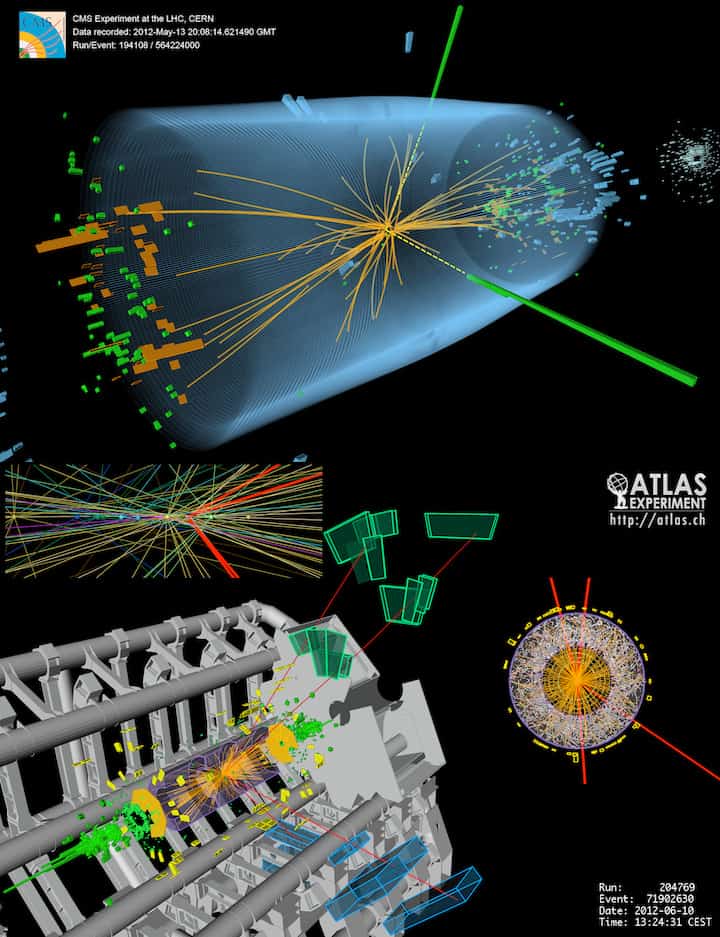
Key event Collision data from CMS (above) and ATLAS (below) showing signatures associated with the production of a Higgs boson. (Courtesy: CERN)
In the case of the search for the Higgs boson, the mass histograms for pairs of photons and for four leptons were critical. That is, the searches focused on cases in which a Higgs boson, after being produced, would transform into two photons; or cases in which it would transform into two Z bosons, with both transforming into pairs of leptons to give four leptons in the final state. Both ATLAS and CMS had reported a slight excess in these two datasets at the December 2011 seminar, and so took certain precautions when analysing the data being recorded in 2012.
To prevent subconscious biases from optimizing the analyses to augment the signals that had been seen in 2011, the collaborations did a “blind” analysis. Data in the mass regions that had been ruled out previously were used to optimize the analyses of the overall data, while the regions that had not been ruled out remained behind metaphorical blinds. Because the Higgs boson’s presence had been excluded in large mass ranges, there was no risk in using these data to minimize noise, and fine-tune the data processing. The mass regions of interest would not be analysed until the scientists were satisfied with their analysis methods. The analysis would then be extended to the entire dataset as part of the “unblinding” process.
Things moved swiftly on the accelerator’s part and in a few weeks the LHC had delivered more data than it had in all of 2011. On 15 June, just over two months after the 8 TeV data first started to arrive, experimental physicist Mingming Yang stood in front of her CMS colleagues, ready to present the results of the unblinding of the “two-photon” data. “With this, my heart is beating even faster,” she said, as she asked those of us gathered to brace ourselves for the next 15 minutes.
This was the first time those outside of the “Higgs to two photons” working group would see the results. Yang showed that the excess in the two-photon channel, from the combination of data from 2011 and 2012, had breached 4σ. Less than two weeks later, on 28 June, André David, who is today a section leader in CMS, presented the results for the same Higgs-to-two-photons channel, but which included the addition of new data collected in the interim.
As he stood in CERN’s main auditorium at an internal talk for CMS, David noted that with the additional data, the excess at 125 GeV seen by CMS now had a significance of 4.1σ. His talk to the packed auditorium took place only 16 hours after the full unblinding had been performed. Although those of us on CMS remained in the dark about what exactly it was that ATLAS had detected, we would soon find out what their data showed.
The room where it happened
On that historic day of 4 July 2012, at 6.15 a.m. after far too few hours of sleep, I took the tram back to CERN. As I made my way down the corridors to the main auditorium, I was amazed to see a serpentine queue outside the entrance, with those enterprising students I’d spotted the night before still at the helm. The queue wound from the auditorium entrance onto the landing and down a flight of stairs; it made its way past the post office, the bank and the kiosk into CERN’s Restaurant 1; it continued all the way to the coffee machines in the wing pointing towards the Alps, and on it went, out of the restaurant.
With the prime seats at the front of the auditorium already reserved for senior researchers and dignitaries, there were enough people in the queues to fill the available spaces several times over. Despite knowing they would not find a way in, those queuing had bright smiles on their faces. Eventually, only a small number were able to make their way into the auditorium and the gathered crowds had to be dispersed to the several conference rooms dotting the laboratory, where the proceedings from the main auditorium were to be screened live.
Over the years, CERN’s main auditorium has been the site of many famous talks and scientific pronouncements. But it was about to witness something never seen in the history of particle physics: hundreds of thousands of people tuning in from all over the world to watch a technical scientific seminar. The original intention had been for updates from ATLAS and CMS to be delivered at the biennial International Conference on High Energy Physics (ICHEP), which was taking place in Melbourne, Australia, that year. But CERN wanted the discovery to be announced “at home”, which led to a particle-physics conference being inaugurated from a different continent for the first time ever. Although taking place in Geneva, Switzerland, the seminar was nominally part of ICHEP itself, with participants connected between the two venues.
CERN director-general Rolf-Dieter Heuer welcomed the attendees at both sites, as well as those watching the webcast. Reversing the order from the December 2011 seminar, CMS would go first this time, with Joe Incandela, who had taken over as CMS spokesperson in the meantime, representing the collaboration. The presentation grew to a crescendo and as Incandela moved to the slide showing the mass and significance of the excess, the audience broke into applause even before he had finished speaking. At least one of the collaborations had seen a new particle.
This was the cue for us in CMS to make our article public. Sitting in the Council Chamber next to the main auditorium to help with the press conference that was to follow, my colleagues and I flipped the switch on the CMS website backend and began to share the article on social media. On the big screen in front of us, Gianotti soon began to speak and we turned our focus to the ATLAS results. Our hearts began to thump and we started to cheer when she showed us the mass and significance of the ATLAS observation. André David recalls being at the front of the auditorium as one of the young experts from CMS: “Seeing the results from the other team for the first time was like riding several rollercoasters all at once. I was connecting the dots, comparing the ATLAS results with our own and realizing that, well, this was more than a statistical fluke.”
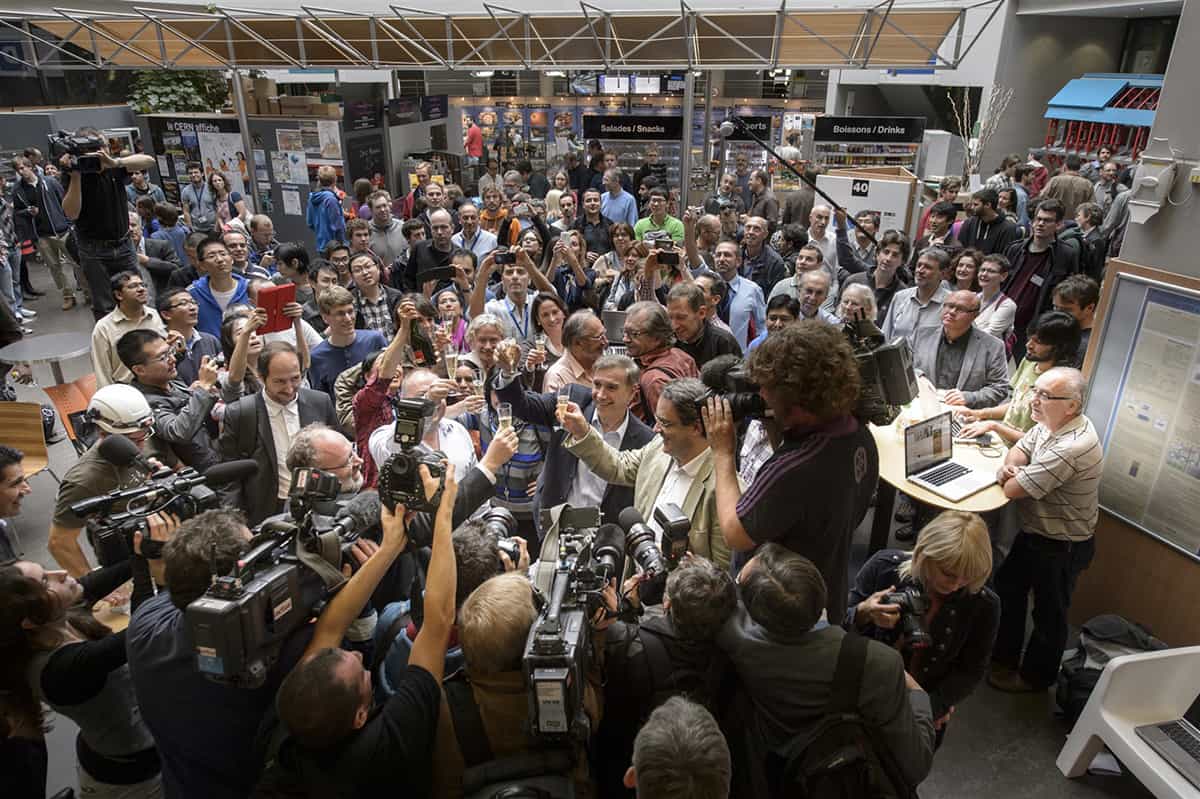
Jubilation CERN staff gathered to watch the announcement of the Nobel Prize for Physics in October 2013. (Courtesy: CERN)
Jubilation in the post-Higgs era
What followed remains something of a blur to me. The press conference was held in Council Chamber, and we could barely contain our excitement. It was nearly lunchtime when the seminar and press conference were finished, and although many of us gathered in the restaurant, most were too excited to eat. The afternoon was spent eagerly chatting with colleagues and friends, and we were not keen to go back to work. Given the long hours everyone involved had put in over the previous weeks, no-one begrudged the desire to soak in the celebration. Some of us looked at the buzz on both traditional and social media with a feeling of contentment. The world had changed for ever and we were now in the post-Higgs era.
Despite the data, both ATLAS and CMS were wary of officially dubbing it “the” Higgs boson on that day – the new particle was cryptically described as having properties consistent with those of the Higgs boson. Over the coming months, both collaborations measured various properties of the particle, allowing them to cement the claim that the observed entity was indeed the Higgs boson predicted by the Standard Model of particle physics.
And…relax Achintya Rao celebrates with colleagues at CERN after the announcement in October 2013 that the Nobel Prize for Physics would be awarded to the science behind the Higgs boson. (Courtesy: CERN)
In October 2013, some 15 months after the big announcement of 2012, a different kind of anticipation began to swell at CERN. Rumours had begun to circulate regarding that year’s Nobel Prize for Physics. Without any guarantee for whom it would be awarded to that year, we nonetheless prepared for celebration. A few of us decided to broadcast the announcement, made by the Royal Swedish Academy of Sciences, live onto the screens in the CMS half of CERN’s Building 40, which normally showed the status of the LHC and the CMS detector.
Crowds from both CMS and ATLAS began to gather next to the cafeteria in front of the screens, and a huge cheer reverberated through the building when it was announced that François Englert and Peter Higgs would be the latest Nobel laureates. Glasses of champagne were raised to celebrate the role that the experimental collaborations had played in 2012 to confirm the theoretical work done in 1964.
It is a pity that CERN has had no other celebrations of similar significance in the years since. The oceans at the energy frontier have revealed no new particle islands. But that does not mean that hope has been lost. At the time of writing, the LHC is about to embark on another data-collection run, this time pushing even closer to the maximum collision energy of 14 TeV the accelerator was designed for. After all, well over 95% of the potential data volume of the LHC’s lifetime still remains to be delivered. The Higgs boson has become a vital part of our toolkit to explore the vast unknown and, as David puts it, “We’ve barely scratched the surface.”