Monday 4 July 2022 marks the 10-year anniversary of that famous seminar at CERN when the discovery of a Higgs-like boson was confirmed. It was a shining example of the power of international collaboration and curiosity-driven research, and many hoped it would usher in a new era of discoveries beyond the Standard Model of particle physics.
In truth, the subsequent decade has been underwhelming for particle physics with few significant breakthroughs. But today the community is feeling energised once again as the Large Hadron Collider (LHC) has fired up after a three-year maintenance period. The upcoming third run of collisions will be at 13.6 trillion electron volts – close to the machine’s full capability.
This short film looks back at that historic moment in particle physics in 2012, and looks forward to the future of particle physics. Right now, LHC successor projects are looking precarious amid the turmoil of the pandemic and Russia’s invasion of Ukraine.
To find out more about the past, present and future of particle physics, take a look at July’s Physics World, a special issue devoted to the 10th anniversary of the Higgs boson discovery.
Synchrotrons and many board games have at least one thing are common – objects are accelerated in a circle but going round and round is not the main point of either. In board games, the object is fun and in “Diamond: The Game” there is also an educational element.
Developed by Mark Basham and Claire Murray at the UK’s Diamond Light Source synchrotron and Matthew Dunstan at the University of Cambridge, the game puts players in the role of a researcher at Diamond. By visiting different beamlines while progressing round the board, participants learn about the diversity of science that is done at the facility – including physics, chemistry, cultural heritage, and more.
Research covered in the game include a study of Rembrandt’s painting of Homer, COVID-19 drug screening, and work on the degradation of the Tudor warship Mary Rose.
STEM careers
The game is for two to five players and takes between 20-30 minutes to play. Diamond is suitable for ages 10 and up, and its inventors hope that it provides a realistic picture of what it is like to be a scientist – ultimately encouraging more young people to pursue careers in science, technology, engineering and medicine.
The game was play-tested by over 200 students and released online as a free-to-print game in 2020. The trio says that since then, Diamond has been played by more than 14,000 players in more than 30 countries worldwide. A boxed version of the game is now being delivered 100 schools in underserved areas of the UK.
In the true spirit of science, the researchers have published a paper about the game.
Burger flipping
It’s well into summer in the northern hemisphere so what better time than to get the barbecue out and fill the air with the smell of seared food. But what is the most effective way to grill a burger or a steak– flip the meat once or many times?
One school of thought is that you should flip only once as multiple times will mean less browning and therefore less flavour. Others, however, claim that regular flipping results in a more even cook and is also about 30% faster given that each surface of the meat is exposed to heat relatively evenly and with less time to cool down.
Mathematician Jean-Luc Thiffeault from the University of Wisconsin in the US has now created a “simple” model to demonstrate this speedy cooking time for flipped meat. Under the assumption that the burger is an infinite thin slab and has symmetric thermal properties – i.e. the same at the top and the bottom – he used a 1D heat equation to find that flipping the patty once results in a final cooking time of about 80 s. This reduces, however, for every subsequent flip so that some 20 flips results in a 20% drop in the cooking time.
Taking Thiffeault’s model to its mathematical extreme, the quickest cooking time finally reaches 63 s – or some 29% quicker than a one-flip. The only problem being that you have to flip the burger infinite times, which would challenge even the most experienced griller.
Physicists have created a light wave that is effectively unipolar, meaning it behaves as though it is solely a positive field pulse rather than the usual positive–negative oscillation found in electromagnetic waves. The positive pulse has a sharp peak and high amplitude and is powerful enough to switch or move electronic states, meaning that it could be used to manipulate quantum information and perhaps accelerate conventional computing as well.
Electromagnetic waves, and in particular light pulses, can be used to switch, characterize, and control electronic quantum states with incredible accuracy, explain team leaders Mackillo Kira and Rupert Huber of the University of Michigan in the US and the University of Regensburg in Germany. However, the shape of such pulses is fundamentally restricted to a combination of positive and negative oscillations that sum to zero. As a result, the positive cycle may move charge carriers (electrons or holes), but then the negative cycle pulls them back to square one.
Positive peak is strong enough to switch or move electronic states
An ideal quantum-electronic switch pulse would be so highly asymmetrical as to be completely unidirectional – in other words, it would contain only a positive (or negative) half-cycle of field oscillation. Under these conditions, such a pulse could flip a quantum state, such as a quantum bit, in minimum time (a half cycle) and with maximum efficiency (no back-and-forth oscillations).
This is fundamentally impossible for freely-propagating waves, but Kira, Huber and colleagues found a way to create the “next best thing” in the form of a quasi-unipolar wave consisting of a very short, high-amplitude positive peak sandwiched between two long, low-amplitude negative peaks. “The positive peak is strong enough to switch or move electronic states,” Kira and Huber explain, “while the negative peaks are too small to have much of an effect.”
In their work, the researchers started with a newly developed stack of nanofilms made of different semiconductor materials, such as indium gallium arsenide (InGaAs) that was grown epitaxially on gallium arsenide antimonide (GaAsSb). Each of the nanofilms is only a few atoms thick, and at the interface between them, ultrashort laser pulses can excite electrons mainly in the InGaAs film. The holes left behind by the excited electrons remain in the GaAsSb film, creating a charge separation.
Effective half-cycle light pulses
“We then made use of our quantum-theoretical breakthrough in exploiting the electrostatic attraction between the oppositely charged electrons and holes to pull them back together in a precisely controlled way,” Kira tells Physics World. “The fast charging and slower charge oscillations combined emitted the unipolar wave that we tailored as effective half-cycle light pulses in the far-infrared and terahertz part of the electromagnetic spectrum.”
Huber describes the resulting terahertz emission as “stunningly unipolar”, with the single positive half-cycle peaking about four times higher than the two negative peaks. While researchers have been working for a long time on producing light pulses with fewer and fewer oscillation cycles, the possibility of generating terahertz pulses so short that they effectively comprise less than a single half-oscillation cycle was, he adds, “beyond our bold dreams”.
Kira and Huber say that these unipolar terahertz fields could be a powerful tool for controlling novel quantum materials on time scales that are comparable to microscopic electronic motion. The researchers suggest that the fields could also serve as superior, well-defined “clockworks” for next-generation ultrafast electronics. Finally, the new emitters are, they claim, “perfectly adapted” to operate in combination with industry-grade high-power solid-state lasers and could thus form “an extremely scalable platform for applications in both fundamental science and industry”.
The researchers, who report their work in Light: Science & Applications, say they have begun to use these pulses to explore new platforms for quantum information processing. “Other applications include coupling these pulses into a scanning tunnelling microscope, which allows us to speed up atomic-resolution microscopy to few-femtosecond time scales (1 fs = 10-15 s), and thus capture the real-space and -time motion of electrons in actual ultraslow-motion microscopic videos,” they explain.
In this episode of the Physics World Weekly podcast we explore how climate change is affecting human and natural systems with Noah Diffenbaugh, who leads the Climate and Earth System Dynamics Group at Stanford University in California.
Diffenbaugh is editor-in-chief of the new journal Environmental Research: Climate, which is published by IOP Publishing (which also produces Physics World). He talks about the aims of the journal and how will it help us better understand climate change and its effects.
Also in this episode, Physics World’s Tami Freeman quizzes me on artificial intelligence and how it is being used in medical physics. Try the questions yourself and see if you can beat my score.
If ancient shorelines exist on Mars, they would be largely scoured from view by billions of years of asteroid impacts. That is according to a new study by researchers in the US, who used computer modelling to simulate eons of cratering on the Martian surface.
Since the 1990s, some planetary scientists have argued that certain landforms and surface features on Mars are the relic edges of dried-up oceans that covered huge swathes of the Red Planet. Their existence has been one of the central planks in the argument that vast bodies of water once sat on the planet’s northern plains, but there is still debate over whether they are genuine shorelines.
Among the most prominent features that have been proposed as shorelines are the so-called Deuteronilus and Arabia Levels, the latter of which is thought to date to roughly four billion years ago.
“The Arabia Levelis older and has a higher elevation of the two, so if it is really a shoreline, it would represent a larger ocean,” explains Mark Baum, a planetary scientist at Harvard University in the US. “[While] the Deuteronilus Level may represent a considerably smaller ancient ocean.”
According to Baum, the two potential shorelines roughly follow the boundary between the two parts of what is known as the “hemispheric dichotomy” on the Martian surface – the “dichotomy” being a noticeable difference between the smooth northern regions of Mars’s globe and its cratered southern uplands.
Our study shows that it would be very difficult to observe continuous ancient shorelines [today]
Mark Baum
Baum and colleagues have now used supercomputer simulations to examine what would happen to ancient shorelines, like Arabia and Deuteronilus, under the onslaught of billions of years of asteroid and comet impacts (arXiv:2206.09816). “We assume that if some part of a proposed shoreline is intersected by an impact, it would no longer be observable as a shoreline,” says Baum. “It would be obliterated by the violence of impact.”
The simulations show that some 70% of a four-billion-year-old shoreline would be erased after eons of impacts while 10–50% of a younger one – similar in age to the Deuteronilus Level – would be destroyed.
Geological signs
Elena Favaro, a planetary scientist based at the Open University in the UK, who was not involved with the new research, thinks the study “adds compelling evidence” to the body of research that questions the existence of shorelines on Mars. “There is a fair amount of scepticism within the community for relic shorelines, and the veracity of using this evidence for a global ocean,” she says.
Favaro adds, however, that there is other geological evidence for large bodies of water having existed on the planet, which includes “extensive channel and valley networks terminating at topographically low points”. These, she says, “shouldn’t be dismissed”.
Baum says it “remains possible” that the features are indeed shorelines. “We still can’t say with certainty. At this point though, we should be very cautious with claims that they’re real,” he argues. “Our study shows that it would be very difficult to observe continuous ancient shorelines [today], especially ones that are four billion years old, which would be difficult to observe at all.”
If the Arabia and Deuteronilus Levels aren’t shorelines, it might be that they are a mix of deposits left by volcanoes, floods and Martian glaciers says Baum. “Or perhaps [they’re] simply the result of degrading lithological units along the dichotomy,” he adds. “We should send geologists there to find out.”
The number of aerosol particles exhaled by people who are exercising increases 132-fold on average during periods of peak physical activity. This finding, from researchers at the Universität der Bundeswehr München in Germany, may help explain reports of high transmission of the SARS-CoV-2 virus in poorly ventilated indoor spaces such as gyms, and might also aid in the development of measures to reduce such transmission.
A graded exercise test
In the new work, scientists led by fluid-dynamics expert Benedikt Mutsch developed a way to measure the concentration of aerosol particles in expired (that is, breathed-out) air as people exercise more intensely – “from rest to exhaustion”, as they describe it. Using this method, they tested a group of 16 healthy volunteers – eight men and eight women – aged between 21 and 40. Seven of these volunteers were considered fitter than the others based on their measured VO2max, which is the maximum volume of oxygen (in millilitres) that can be metabolized under load.
The volunteers undertook a graded exercise test on a piece of equipment called a cycle ergometer that was located in a tent containing a reduced concentration of aerosol particles in the ambient air. During this test, volunteers in this “clean air tent” inhaled filtered air with very low aerosol particle concentration. Starting from rest, the researchers measured the subjects’ ventilation and aerosol particle concentration directly in the air they exhaled.
Big increases in aerosol concentration
Mutsch and colleagues found that the concentration of aerosol particles in the air expired by the volunteers increased significantly with exercise, rising from 56 +/– 53 particles/litre when they weren’t exercising to 633 +/– 422 particles when they were. Aerosol particle emission per subject also increased by a factor of 132 on average, rocketing from 580 +/– 489 particles/minute at rest to a “superemission” of 76,200 +/– 48,000 particle/min during times of peak exertion. The results were roughly the same for men and women, but there was a twist: the fitter volunteers exhaled many more aerosol particle particles during maximal exercise than did the other participants.
These results imply that aerosol particle emission increases exponentially above moderate exercise intensity, resulting in superemission during maximal exercise intensity, say the researchers. The new data might also partly explain so-called superspreader events, when large numbers of people are infected simultaneously by a small number of infectious individuals. Several such events have been reported during high-intensity group exercise in indoor spaces like gyms, they add, suggesting that measures need to be taken to prevent disease transmission between people who are exercising in these spaces.
“Mitigation measures might be adjusted to high-risk settings, for example,” Mutsch tells Physics World. “The aim should be to define criteria to make exercise safe.”
Steps for reducing risk
In situations of high risk of infection, the most important steps to take, according to Mutsch, are keeping a safe distance from others; ensuring that a good mechanical ventilation (HVAC) is in place; ventilating rooms by opening doors and windows; wearing face masks whenever physical distancing is not possible (for example, in changing areas); reducing the time spent in spaces where people are exercising with high intensity; and finally limiting the number of people in a given space.
The researchers, who report their work in PNAS, are now investigating a larger group of subjects – up to 80 – spanning different age groups and body-mass indices (BMIs), since there is some evidence that age and BMI may influence the amount of aerosol particle emission. “We also want to study what happens during resistance exercise, since the way people inhale and exhale might be different here,” says Mutsch.
A new bendable organic light-emitting diode (OLED) that produces warm, candle-like light with hardly any emissions at blue wavelengths might find a place in flexible lighting and smart displays that can be used at night without disrupting the body’s biological clock. The device, which is an improved version of one developed recently by a team of researchers from National Tsing Hua University in Taiwan, is made from a light-emitting layer on a mica substrate that is completely free of plastic.
Jwo-Huei Jou and Ying-Hao Chu of the National Tsing Hua University’s Department of Materials Science and Engineering and colleagues recently patented OLEDS that produce warm, white light. However, these earlier devices still emit some unwanted blue light, which decreases the production of the “sleep hormone” melatonin and can therefore disrupt sleeping patterns. A further issue is that these OLEDs were made of solid materials and were therefore not flexible.
Mica, a natural layered mineral
One way to make OLEDs flexible is to paste them onto a plastic backing, but most plastics cannot be bent repeatedly – a prerequisite for real-world flexible applications. Jou, Chu and colleagues therefore decided to investigate backings made from mica, a natural layered mineral that can be cleaved into bendable, transparent sheets.
The researchers began by depositing a clear indium tin oxide (ITO) film onto a mica sheet as the LED’s anode. They then mixed a luminescent material, N,N’-dicarbazole-1,1’-biphenyl, with red and yellow phosphorescent dyes to fabricate the device’s light-emitting layer. Next, they sandwiched this layer between electrically conductive solutions with the anode on one side and an aluminium layer in the other to create a flexible OLED.
Tests showed that when coated with a transparent conductor, the mica substrate is robust to bending curvatures of 1/5 mm-1 – a record high – and 50 000 bending cycles at a 7.5 mm bending radius. The OLED is also highly resistant to moisture and oxygen and has a lifetime that is 83% of similar devices on glass.
“Romantic” light
The new device emits bright, warm light upon the application of a constant current. This light contains even less blue-wavelength light than natural candlelight, Jou and Chu report, meaning that the exposure limit for humans is 47 000 seconds compared to just 320 s for a cold-white counterpart, according to the team’s calculations. This means that a person exposed to the OLED for 1.5 hours would see their melatonin production suppressed by about 1.6%, compared to 29% for a cold-white compact fluorescent lamp over the same period.
“We have fabricated an OLED emitting a psychologically-warm but physically-cool, scorching-free romantic candle-like light on a bendable mica substrate using our patented candlelight OLED technology,” Jou tells Physics World. “This technology could provide designers and artists with more freedom in designing variable lighting systems that fit into different spaces, thanks to their flexibility.”
The researchers now hope to make their OLEDs completely transparent. “When lit, these candlelight OLEDs could then be seen from both sides,” Chu says.
Precision radiation medicine specialist Elekta has shifted through the gears this year, accelerating the commercial and clinical exploitation of ProKnow, a dedicated suite of cloud-based software tools that enables regional and national networks of radiation oncology clinics to aggregate, structure and interrogate their diverse, and previously fragmented, data stores.
A lighthouse customer in this regard is National Health Service England (NHS England), the publicly funded healthcare system in England, which at the end of March confirmed an order for ProKnow licences covering 50 NHS Trust hospitals over three years (including education and training of clinical staff). The long-term vision is compelling, with ProKnow very much front-and-centre as NHS England cancer centres seek to reimagine best practice in the planning, delivery and management of their radiation therapy services while personalizing treatment to meet the clinical needs of individual patients.
Collaboration reimagined
Operationally, NHS England’s £1.4 million investment in ProKnow represents a long-term bet on collaboration and peer review, both of which are hard-wired into the software’s value proposition. After all, this is a cloud-based platform designed to harness the collective domain knowledge and expertise scattered across multiple clinical departments and multiple treatment centres. That always-on connectivity is likely to be particularly beneficial for staff at smaller radiotherapy clinics – for example, in the rural south-west of England – by facilitating informal and formal knowledge-share with radiation oncology teams in the big metropolitan hospitals.
In this way, clinicians, physicists, dosimetrists and other experts will be able to evaluate critical anatomy contouring, treatment design and plan quality as team activities – sharing the load, distributing tasks and mentoring colleagues as needed. Underpinning it all is an ever-growing knowledge repository of patient data that oncology teams can mine for clinical insights – trends, relationships, outliers, significance – to support innovation and continuous improvement in patient care.
“All of England’s radiotherapy centres have now installed their own licensed version of ProKnow – a significant logistical milestone in terms of the clinical roll-out,” explains Chris Walker, head of radiotherapy physics at the Northern Centre for Cancer Care at Freeman Hospital, Newcastle upon Tyne. “The next big step will see radiotherapy teams across England inputting their treatment planning data systematically into ProKnow – a development that will ultimately drive standardization and best practice across collaborating cancer centres.”
The medical physics team at Freeman Hospital was among the early-adopters of ProKnow, one of a network of 20 participating departments across England tasked with exhaustive road-testing of the software ahead of the bulk NHS purchase and clinical deployment. Walker, for his part, was also one of the main-movers behind the scenes, sitting on the multidisciplinary Radiotherapy Clinical Reference Group which advises NHS England on the development priorities for its radiotherapy service. “A core task for the reference group was to figure out what an optimum IT infrastructure might look like to facilitate peer review across the national radiation oncology programme,” he notes.
After an evaluation period spanning nearly three years, ProKnow emerged as the winning solution, not least because of its ability to function as a “universal translator” while networking England’s radiotherapy ecosystem. In short, ProKnow provides a vendor-agnostic software platform that can be accessed by radiotherapy departments anywhere via a simple web-based user interface – and regardless of their linac manufacturer, treatment planning system or oncology information solution.
Given ProKnow’s cloud-based architecture, robust cybersecurity is also mandatory, with all patient data encrypted in transit and at rest (while the fully HIPAA-compliant environment ensures the privacy and integrity of sensitive information). In terms of user access, ProKnow supports multifactor authentication, as well as single sign-on for institutions that have established their own federated user authentication. “Sharing of patient data between separate radiotherapy facilities complies with data protection requirements by being automatically anonymous outside the patient’s treatment centre,” adds Walker.
It’s all about execution
Functionality aside, the training and support provided by Elekta – as well as among the user community itself – will be pivotal to NHS England’s successful implementation of ProKnow over the next three years. With this in mind, the UK Institute of Physics and Engineering in Medicine (IPEM) has established a ProKnow Technical Oversight Group to focus on software commissioning and structured learning and development for radiation oncology teams. “We need to bring discipline and rigour to the technical commissioning,” explains Walker, “while also ensuring a commonality of approach for the initial applications of ProKnow across all our participating centres.”
In the near term, ProKnow will be used to create a national framework for treatment planning, driving standardization and continuous improvement across NHS England’s radiotherapy service. The aim is to enable clinical staff to take a single patient plan, or groups of plans, and benchmark against a collection of previous similar cases using so-called “treatment plan scorecards” – basically a range of predefined metrics that show dose coverage and sparing of sensitive organs to determine if they meet local protocols or nationally set guidelines.
Chris Walker: prioritizing a commonality of approach for initial ProKnow applications. (Courtesy: Freeman Hospital)
Walker and his colleagues at Freeman Hospital have already used ProKnow to design, and validate with other clinics, a set of 20 guideline scorecards for lung stereotactic body radiotherapy (SBRT). These scorecards are shared across SBRT treatment centres, allowing individual providers to perform internal audit against the guidelines for any number of patients in all categories of the dose regimens – in effect, a standardized baseline from which to develop individualized treatment plans on a patient-by-patient basis.
Meanwhile, with the input of various IPEM “task and finish” subgroups, similar efforts are already under way for other disease indications, with scorecards for breast, conventional (non-stereotactic) lung treatments, paediatric and head-and-neck radiotherapy all due for completion and roll-out this summer. “There’s a well-defined roadmap in place for how ProKnow can be put to use centrally by NHS England, aggregating and mining big data sets comprising hundreds or thousands of treatment plans,” notes John Byrne, deputy head of radiotherapy physics at the Northern Centre for Cancer Care. “The possibilities are endless once radiotherapy professionals start using ProKnow to mine their own data and collaborate with colleagues across the country.”
Make it easy
It’s clear that ProKnow’s consolidated data warehousing – at terabyte scale and beyond – will be fundamental to delivering against the NHS England roadmap, creating a powerful centralized asset that clinical teams can learn from. Furthermore, ProKnow can be bundled into the existing MOSAIQ Plaza software-as-a-service (SaaS) offerings, while there are plans to integrate with other Elekta cloud-based products such as Kaiku Health, a platform to guide treatment decisions based on the collection and management of patient-reported symptoms.
“The game-changer with ProKnow,” concludes Byrne, “is that it takes what used to be a really hard job and turns it into a really easy job. So it’s now straightforward for us to mine ProKnow’s central data store to figure out what we’re good at and what we can improve upon. Those big data insights will, in turn, drive enhanced patient outcomes and sustainable workflow efficiencies.”
I have a soft spot for accidental discoveries that inadvertently have a profound impact on our lives. Think of the glue that didn’t stick, which was developed by researchers at 3M and led to the ubiquitous Post-it Note. There was Wilhelm Röntgen’s discovery of X-rays, which revolutionized diagnostic medicine. And there was Percy Lebaron Spencer, a physicist at Raytheon in the US, who invented a new type of oven after noticing that microwaves from his radar set melted a chocolate bar in his pocket.
Serendipitous discoveries like these show just why “targeted” product research and development is not always a great idea. The beauty of experiments that are speculative or go wrong is that they can lead to findings you could never predict. Just think about the American chemist Stephanie Kwolek who, in 1964 while working for DuPont, invented Kevlar when her group was searching for a new lightweight yet strong fibre to use for tyres.
But the accidental discovery I want to focus on occurred at Corning Glass Works in upstate New York. Back in the early 1940s, researchers at the company were intrigued by the fact that glass, which is a supposedly transparent material, can darken and change colour if exposed to the heat and light of the Sun for long enough. Keen to investigate this effect, Robert Dalton, a Corning chemist, exposed samples of crystal-clear ruby glass to ultraviolet light and then baked them in an oven. The result: glass with several different shades of colour.
Donald Stookey, another Corning research chemist who had joined the business in 1940, was instructed to explore possible photographic applications of this wonderful new photosensitive glass. His work led to the development of a transparent, aluminosilicate-based glass that became photosensitive if it included trace amounts of gold, silver or copper. Stookey found he could even etch 3D designs into the glass, which was sold as “FotoForm” and later used as a material in electronics packaging and for aperture masks on colour television sets.
The great moment of serendipity occurred one day in 1953 when Stookey wanted to carry out an experiment that involved heating a piece of FotoForm glass to a temperature of 600 °C. The furnace, however, had developed a fault and Stookey mistakenly ended up heating the glass to 900 °C. When he tried to remove the sample from the hot oven, it slipped from his tongs and crashed to the floor. But instead of shattering, the glass – to Stookey’s amazement – bounced.
He had just created the first “glass-ceramic” – a new class of glassy material containing fine crystals of different shapes and sizes dispersed throughout. Subsequent work led Corning to develop this material into the hugely successful CorningWare range of saucepans and cooking pots. Resistant to thermal shock, they don’t break if moved directly from, say, a freezer and into a hot oven. CorningWare became just one of Stookey’s multimillion-dollar inventions.
Donald Stookey: thank him for your iPhone
(Courtesy: Corning Incorporated)
The Gorilla Glass that protects billions of smartphones and tablets – including all Apple products – would possibly never have existed had it not been for a moment of serendipity by the chemist Stanley Donald Stookey (1915–2014). Working at Corning Glass Works in 1953, his accidental discovery of “glass ceramic” (see main text) led to the development of CorningWare cookery pots, chemically strengthened glass and – eventually – Gorilla Glass itself.
During his 47 years at Corning, Stookey also developed photosensitive glass and Photochromic Ophthalmic glass eyewear, ending up with over 60 patents to his name. In 1986 he was awarded the US National Medal of Technology by President Ronald Reagan. When Stookey retired in 1987 as Corning’s director of fundamental chemical research, his legacy included the Stookey award, which is given each year to a Corning scientist for “outstanding exploratory research accomplishments”.
A unique mix
Trademarked as Pyroceram, the glass Stookey stumbled across had a unique combination of properties, being not just heat resistant, but extremely hard, super strong and transparent to radio waves too. The material also found its way into military applications, being used, for example, in the nose cones of supersonic radar domes in guided missiles. Later, in the 1960s, Corning developed a new kind of Pyroceram material that was not opaque but transparent to visible light.
The company initially chose not to commercialize this newer product, fearing it would cannibalize sales from Corning’s existing and hugely successful Pyrex range of borosilicate glassware, which had been going strong since 1915. But by the 1970s, researchers at Corning France had developed an amber-coloured version of Pyroceram, which they patented and turned into a new range of cookware, going under the Visions brand name.
Meanwhile, as part of an initiative that the company dubbed Project Muscle, Corning had been exploring new ways to make glass stronger. Most glass is strengthened by heating it to a high temperature and then cooling it rapidly so that the outside cools much faster than the inside – a process known as tempering. The temperature gradient puts the inside of the glass in tension and compresses the outer surface, making the glass stronger and less likely to have microscopic cracks and flaws.
Drop test Corning developers check their screens by dropping them up to 2 m onto hard, rough surfaces. (Courtesy: Corning Incorporated)
As glass gets thinner, however, it becomes ever harder to set up a substantial difference in cooling rate between the core and the surface. In the 1960s researchers at Corning discovered a way of chemically strengthening glass by allowing smaller ions in the glass to be replaced with larger ions from a chemical bath. Thanks to this process of “ion exchange”, the surface of the glass becomes highly compressed, and therefore less prone to the introduction of damage and the application of stresses that could make it break.
Corning sold this glass under the brand name Chemcor and it was used until the early 1990s in various commercial and industrial applications, including car windscreens, planes, drug vials, prison windows, safety glasses and phone booths. Chemcor had varying degrees of commercial success but all that was to change in January 2007 when Steve Jobs, then the chief executive of Apple, took the stage at that year’s MacWorld convention in San Francisco.
Enter Steve Jobs
In front of a whooping audience at the Moscone Center, Jobs introduced a revolutionary new device – the very first Apple iPhone. Until that point, smartphones had been clunky, ugly objects with fiddly keyboards. The new 3.5-inch iPhone promised to transform the market, offering customers a slick, touchscreen device with in-built camera and web-browsing capabilities for the first time.
But the day after revealing the device to an enthusiastic world, Jobs complained that the screen of his own iPhone, which he had been carrying around in his pocket, had ended up covered in tiny nicks. That’s because the prototype iPhone that Jobs had demonstrated was built with a plastic screen, which was mechanically strong but very easy to scratch. A few years earlier Corning had shown Jobs the company’s glass technology and he now insisted that, when the iPhone went on the market just five months later in June 2007, it had to have a glass screen.
Jeff Williams, Apple’s chief operating officer, recalls telling Jobs that his demand was impossible, insisting it would take three or four years to develop glass that was durable enough to meet Jobs’s requirements. “I said, ‘We’ve tested all the current glass and when you drop it, it breaks 100% of the time.’ And he said ‘I don’t know how we’re going to do it, but when it ships in June, it’s gonna be glass’.”
Two days later, Williams got a phone call from Wendell Weeks, Corning’s chief executive. Weeks suggested that Corning’s Chemcor glass, which the company had just started studying again for smartphone use under the name “Gorilla Glass”, could be the solution to Apple’s problem. There followed several months of what Williams calls “sheer terror” as teams at the two companies worked flat out to turn Chemcor into something that would be ready in time for the iPhone’s launch.
The work paid off. “When we launched in June [2007], customers had an iPhone that had the beautiful feel of glass – Corning glass – and was scratch resistant,” Williams recalls. “It helped set the tone for iPhone.” The scratch-resistant glass that shipped on the first-generation iPhone has been a key part of the iPhone success.
Market dominance
In the early smartphones, Corning’s Gorilla Glass was about 1 mm thick – any thicker and the capacitive liquid-crystal displays used at the time wouldn’t have worked well. But despite its thickness, the glass was hard, surprisingly flexible and incredibly scratch resistant, just as Jobs demanded. These days, Corning is on its seventh generation of Gorilla Glass, which is just 0.3–0.5 mm thick. Of course, there are now many competitors who also produce smartphone-glass, including Dragontrail from Japan’s AGC Inc and Xensation from the German firm Schott.
But Gorilla Glass dominates the market. By 2017 it had been adopted by 40 major manufacturers around the world, being used not only on all Apple iPhones and iPads, but in more than 1800 products from many different firms. According to Expert Market Research, the global smartphone-cover glass market was worth some $1.63bn in 2020, with Gorilla Glass being incorporated into nearly six billion devices. Corning, however, supplies all the glass for Apple smartphones, with the company having used it more and more with each generation of device.
Of course, phones do get dropped and even though Gorilla Glass is incredibly tough, smartphone screens can get damaged. That’s why there is also a healthy market for screen-protection films, which are often made of similar glassy materials. According to a report from MarketWatch this year, the screen-protector market is expected to grow from $2.3bn in 2020 to $5.4bn by 2026. After all, no-one wants to scratch a top-of-the-range nearly un-scratchable smartphone for which they might have paid more than £1000!
Still, can you imagine how the market would have reacted to an Apple iPhone that got scratched every time you put it in your pocket? If Jobs had launched the iPhone with a plastic screen as was originally the plan, I think that could well have killed off the device – however cool the idea was. Jobs was right: it needed to be glass. And to think it can all be traced back to a botched experiment and a faulty oven at Corning Glass Works in 1953. Without that serendipity, we might never be where we are today.
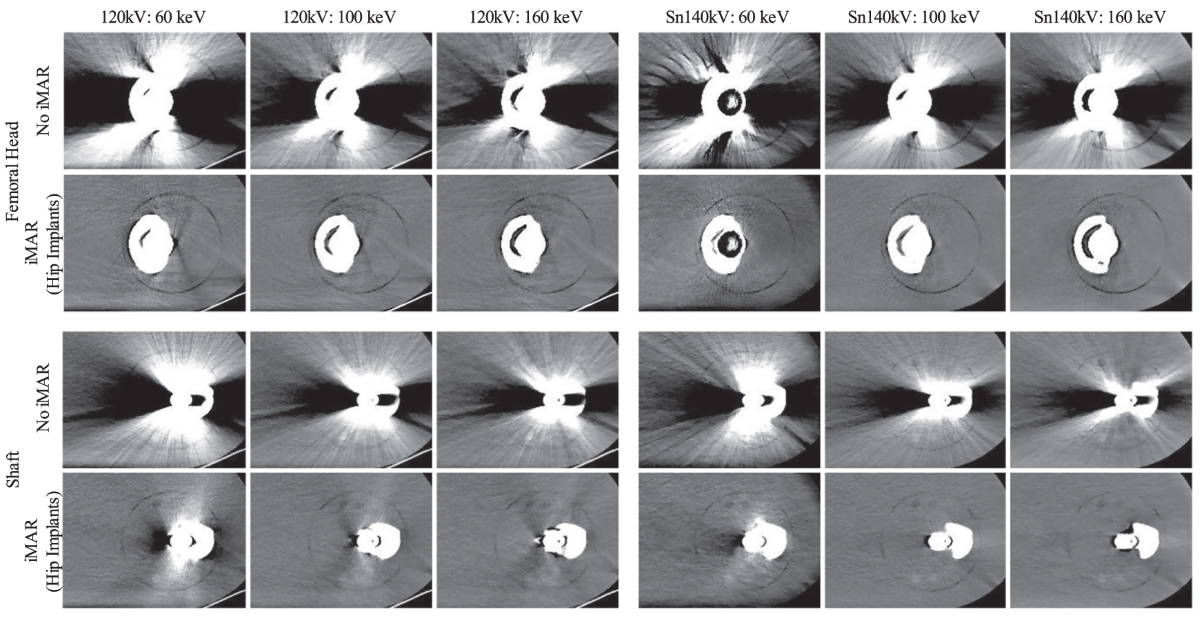
Hip phantom images: In CT slices of a hip phantom, no optimal keV setting could be found to effectively reduce metal artefacts. Adding iterative metal artefact reduction (iMAR) strongly reduced the base artefact level for all energies. (Courtesy: J A Anhaus et al Phys. Med. Biol. 10.1088/1361-6560/ac71f0)
Metal implants in the body, such as hip replacements or dental fillings, are a major source of artefacts in CT images. Clinically available methods reduce these metal artefacts – up to a point.
Iterative metal artefact reduction (iMAR) decreases the influence of metal during image reconstruction by interpolating between boundaries of metal in a tissue-normalized sinogram. However, iMAR doesn’t incorporate spectral information, so some anatomic information is lost. A second technique, virtual monoenergetic imaging (VMI), combines multiple spectra from a dual-energy CT acquisition.
New photon-counting CT systems inherently provide spectral information without requiring a dual-energy acquisition and offer better spatial resolution, improved contrast-to-noise ratio and lower radiation dose than conventional energy-integrating detectors. The first photon-counting CT system, the NAEOTOM Alpha from Siemens Healthineers, received CE certification and 510(k) FDA clearance in 2021.
Julian Anhaus, a third-year PhD student in the CT Physics department at Siemens Healthineers in Germany, is investigating different approaches for metal artefact reduction on these systems. He and his PhD research advisors, Christian Hofmann, a global CT technology manager at Siemens Healthineers, and Andreas Mahnken, a professor at Philipps-Universität Marburg, recently studied some of the possibilities for metal artefact reduction on the NAEOTOM Alpha, publishing their findings in Physics in Medicine & Biology.
“Of course, clinicians must make their own experiences with different protocols and consequentially spectra and other scan parameters, patients and implant types, but this work can be used as an orientation and guideline for clinicians on how to tune their clinical protocols on the NAEOTOM Alpha when performing scans on patients with metal to provide best possible images for the patient’s diagnosis or care,” Anhaus says.
VMI plus iMAR reduces artefacts from high-Z metals
Anhaus tested iMAR and VMI on the NAEOTOM Alpha using anthropomorphic phantoms for different body regions and a tissue characterization phantom. He reconstructed images with and without iMAR and computed VMIs in 10 keV steps from 40 to 190 keV.
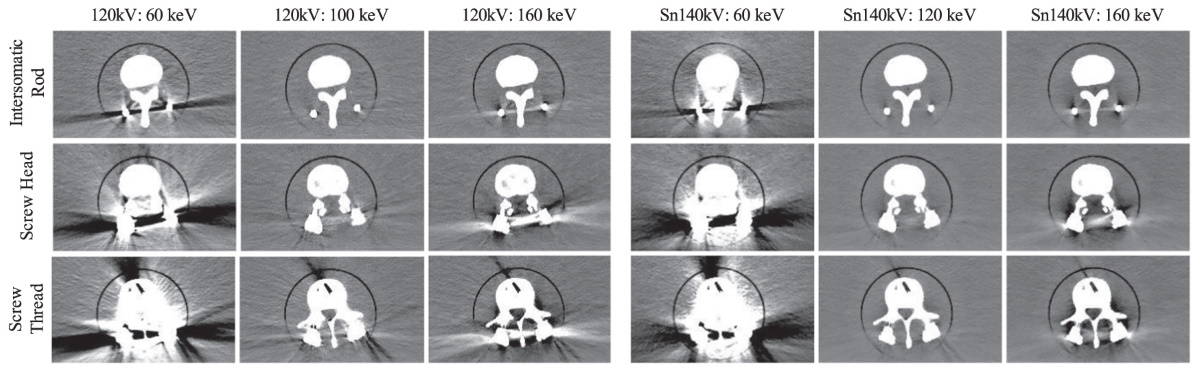
Virtual monoenergetic imaging: For spine implants, a clear optimal energy setting was observed at which metal artefacts were minimized. (Courtesy: J A Anhaus et al Phys. Med. Biol. 10.1088/1361-6560/ac71f0)
Results were mixed – Anhaus found that VMI could reduce metal artefacts in metals with low atomic numbers and low penetration lengths, such as those used in spinal implants. But for cases with large metal implants and materials with high atomic numbers, such as those used in dental fillings or in the hip head, he could only reduce artefacts by applying iMAR after VMI.
“The inherent spectral information, which is one of the main benefits of recent [photon-counting detector CT] systems, can be utilized to reduce metal artefacts without iMAR. Unfortunately, this only applies to certain metal and implant types,” Anhaus summarizes. “In most implant types, the utilization of spectral information reduces the base artefact level, but iMAR is still required to provide metal artefact-free CT images.”
Anhaus says that this study only scratches the surface of metal artefact reduction options for the NAEOTOM Alpha and other photon-counting CT systems.
“There are many thrilling methods which can be enabled through the photon-counting detector system and carried over to [metal artefact reduction] applications,” he says.
He and Hofmann emphasize that this study is not intended to compare image quality and artefact reduction potential between photon-counting CT and conventional energy-integrating detector CT systems that require dual-energy CT acquisition for VMI. A comprehensive comparison is part of their future work.