“Look up…get your head out of your ass
Listen to the goddamn qualified scientists”
Those aren’t lyrics you’d expect to hear from the normally saccharine pop star Ariana Grande, who sings them in the recent hit movie Don’t Look Up (which we reviewed in January). A comet roughly 9 km in size is heading straight towards Earth and the words come in response to the strangely uninterested reaction of politicians, media and many members of the public to the imminent planet-ending event.
The comet was discovered by astronomy PhD student Kate Dibiasky (played by Jennifer Lawrence) and her supervisor Randall Mindy (Leonardo DiCaprio). But most people – including the US president Janie Orlean (Meryl Streep) – don’t accept the two scientists’ knowledge. Despite the duo’s best efforts, reactions range from attempts to turn a profit to outright denial. Those in power are so misled that humans take no effective action. The collision occurs and (spoiler alert) disasters ensue.
Things are different in the much older movie Deep Impact (1998). After scientists say that an 11 km comet is heading our way, the US president listens, relays the news to citizens, and they trust him and the scientists. (As I said, the movie was made a long time ago.) Partially successful measures are taken, including a crew of astronauts sacrificing themselves to blow up the bulk of the comet. While the collision happens, much of humanity survives.
Asteroid and comet movies have some common threads. The bad news appears first as numbers; the scientists interpret the data, and their message passes intact to the public.
There’s a different twist in Seeking a Friend For the End of the World (2012), another comet-collision disaster movie. This time the comet is 112 km wide and nobody questions its truth. But some people riot, others turn criminal, while a few kill themselves. The protagonists, played by Steve Carell and Keira Knightley, are reflective about their fate, with no illusions there’s a future.
Their honest and genuine reactions reminded me of Nietzsche’s beautiful image of what happens just before the departure of an emigrant ship. The passengers and those they are leaving behind, he wrote, “have more than ever to say to one another, the hour presses, the ocean with its lonely silence waits impatiently behind all the noise”. If looming death can’t make humans candid and heartfelt, nothing can.
Processing disaster
These three films are just a small selection of the dozens of planetary disaster movies that can be streamed online. You can take your pick from countless others, where existential threats stretch from comets, asteroids, aliens and other space-based dangers to home-grown hazards too, including pandemics, zombies and nuclear weapons.
Asteroid and comet movies have some common threads. The bad news generally appears first as simply numbers: co-ordinates, orbits, trajectory predictions. The scientists then interpret the data, informing people in authority, who tell the public. What’s interesting, though, is that the scientists’ message – that there’s a likely impending catastrophe – passes intact all the way down the line to the public. That happens even though it’s progressively transformed for the consumption of each audience along the way.
My favourite way of describing this process is with the physics phrase “impedance matching”. It describes what you need to do to send a signal from a low-impedance region to one with high impedance. If you want to lose as little of the signal as possible, you have to step it gradually down. It’s what happens when you blow into a trumpet. Pressure pulses from your mouth (low impedance) can be heard in the open air (high impedance) only because the instrument’s horn gradually modifies those pulses as they travel outwards.
Don’t Look Up is all about what you could call “impedance mismatching”.
Don’t Look Up is different – and more interesting. Conspicuously and entertainingly revised for the current reception of existential threats like climate change and pandemics, it’s all about what you could call “impedance mismatching”. It starts conventionally enough. After DiCaprio and Lawrence have plotted their comet’s co-ordinates and concluded it’ll collide with Earth in six months with a 99.87% probability, they tell a NASA official, who tells the US president.
But the twist is that she appears more worried about the impending mid-term elections than about the Earth being destroyed, deciding she is going to “sit tight and assess”. The president digs in even more strongly when a charismatic businessman promises to alter the collision to deliver $32 trillion worth of rare minerals.
Trying to bypass the president, the two scientists decide to spread the news on a TV talk show, but find that its motto is “We keep the bad news light”. DiCaprio is told to “Keep it simple. No math.” To which he replies, “It’s all math.” Lawrence is ignored on camera when she’s calm, and ridiculed when she’s passionate. The TV host calls her “the yelling lady” and says she needs “media training”.
Political realities, media practices and vested interests create the substantial load that produces an impedance mismatch. In that media-saturated and politically permeated world, science is only one voice – and not one that can be easily understood. The signal is all but lost, leaving a grisly truth. If the world were somehow saved, it would only be because Ariana Grande’s celebrity, not scientific authority, was strong enough to make people “look up”.
The critical point
The morning after I saw Don’t Look Up, the front page of the New York Times carried two science-related stories. One was about the launch of the James Webb Space Telescope, the largest and most expensive space-based observatory ever, which appeared to be widely welcomed. The other was about a protest against the wearing face of masks by people opposed to scientifically recommended mandates.
It seems we need little impedance matching when the science poses no danger and the public is enthusiastic, as with the JWST. But the impedance can be strong when there are serious lifestyle or existential costs at play. It might sound like an exaggeration but impedance mismatch is a much greater threat to our planet than comets and asteroids could ever be.
Physicists in Japan and Taiwan have developed a compact, highly efficient method of generating high-energy ion beams by firing a laser pulse at a target made from two layers of graphene. Led by Yasuhiro Kuramitsu at Osaka University, the team showed for the first time that this ultrathin target can yield high-energy beams of protons and carbon ions despite the presence of noise in the laser pulse that tends to destroy thin targets made from conventional materials. The technique could make it possible to produce relativistic beams of ions using less intense lasers, widening the availability of ion-beam technology.
Laser-driven ion acceleration has many applications in medicine, plasma diagnostics and engineering as well as basic science. To bring these capabilities to facilities without the super-intense lasers needed to generate ion beams from robust, micron-thick targets, researchers are exploring ways to make the targets thinner. The problem is that at thicknesses below 100 nm, the targets are much less durable, meaning that they can be destroyed by noisy “pre-pulses” that arrive at the target before the main peak of laser intensity.
So far, the main solution has been to make use of a so-called “plasma mirror” that forms at the leading edge of the laser pulse when the target ionizes. Once ionization occurs, the material rapidly forms a surface that is highly reflective of the laser’s high-intensity peak, while remaining transparent to the noisy pre-pulse. Practically, however, it can be costly to ensure that target surfaces made from conventional 3D materials are thin and flat enough for plasma mirrors to form.
Graphene on target
To avoid this problem, Kuramitsu’s team exploited the unique properties of graphene, which is a two-dimensional sheet of carbon just one atom thick. As the thinnest, lightest, strongest and most transparent of all materials with a comparable thickness, graphene is an ideal candidate for laser ion acceleration. It is also straightforward to produce in the quantities needed for targets.
In their study, which is published in Scientific Reports, Kuramitsu and colleagues developed a large-area suspended graphene (LSG) target featuring a double layer of graphene 2 nm thick. Simulations showed that although the graphene would melt before the main laser peak arrived, the resulting plasma would remain intact until it interacted with the relativistic part of the pulse, generating MeV beams of protons and carbon ions without forming a plasma mirror.
The researchers went on to demonstrate the durability of their LSG target using the J-KAREN laser at the Kansai Photon Science Institute in Japan. They now hope their breakthrough will extend the advantages of laser-driven ion acceleration into new areas such as targeted cancer therapies, laser-driven nuclear fusion and laboratory-based simulations of astrophysics phenomena.
Scientists in Western Australia have carried out the first recovery of an observed meteorite fall with the help of drones and machine-learning techniques. The finding could pave the way for more falls to be located and studied, helping scientists explore the make-up of the asteroid belt between Mars and Jupiter (arXiv:2203.01466).
The discovery was made after a bright meteor fireball was spotted in April last year by cameras belonging to the Australian Desert Fireball Network. Following examination of the fireball, researchers determined that meteorites could have been scattered in an area near to Kybo Station in Western Australia. A team was then deployed to the predicted “strewn field” to begin searching the area using two drones.
The fireball analysis indicated that the mass of the fall was “quite small”, according to Ellie Sansom from the Space Science and Technology Centre at Curtin University, who is project manager for the Desert Fireball Network. “This was an excellent candidate to test our new drone detection techniques as we would have been unlikely to ever send a human team to this fall site,” she adds.
One drone photographed swathes of the landscape with a high-resolution camera. Its images were then loaded onto a computer running a machine learning algorithm that had been trained to look for unusual objects lying on the ground. The team also placed known meteorite specimens in view of the drone, so that the system could see what these looked like against the actual landscape being scoured for the new fall.
The meteorite fragment. (Courtesy: Seamus Anderson/Curtin University)
Candidate meteorites were identified before another, smaller, drone was sent for a closer look, flying low over the potential space rocks to allow the researchers to examine them more carefully. Eventually the list was whittled down to just four objects, which the team inspected on foot.
Among them was the 70 g meteorite. “There were about 10 seconds where I didn’t believe it and needed to take a hard look to confirm, followed promptly by about two minutes of screaming,” says Seamus Anderson, who led the Curtin University study.
Early analysis suggests the meteorite may be a chondrite-type meteorite whose past orbit took it far beyond Mars towards the orbit of Jupiter. The team is now planning to examine the space rock’s composition with a range of equipment including a scanning electron microscope.
A ‘game-changer’
Locating a newly landed meteorite marks an important moment for a cutting-edge technology that several teams around the world have been trialling in recent years. Last year a US-led group revealed how they had been testing a similar drone-and-machine-learning system to hunt for meteorites that they had placed on a dried-out lakebed in Nevada.
The leader of that study, Robert Citron at the University of California Davis, says the Curtin University team have made a “huge leap” through the discovery of a freshly fallen meteorite fragment. “As technology becomes cheaper and more readily available, it can be more accessible to other individuals or groups wishing to perform such studies, increasing the overall recovery of meteorites worldwide,” he says.
That is echoed by Martin Suttle, a meteorite expert at the UK’s Open University. He describes the technology as a game-changer. “Researchers rely on the recovery of new meteorites,” he says. “To be able to increasingly automate this process, reducing the number of researchers needed in big fieldwork expeditions, will bring the costs of searching down.” That, Suttle argues, will allow planetary scientists to not only look for more meteorite falls but also dedicate more time to the scientific analysis of those that are retrieved.
And more recovered space rocks — whose orbits, and therefore origins, can be determined because their falls have been detected by multiple cameras — means more data too. Suttle explains that the context provided by such information is vital. “Over time, this means we are able to build up a picture of which asteroid families are sending rocks to Earth and ultimately the composition and structure of the asteroid belt itself,” he says.
The human brain is remarkably good at storing and processing information. While our knowledge of how the brain works is by no means complete, scientists and engineers are developing computing technologies that mimic how neurons operate in the brain. This is not just about building faster computers; the brain is also very energy efficient and early indications are that neuromorphic systems could deliver improved energy efficiency. This is an important consideration because energy consumption and waste heat are limiting factors for conventional electronics.
A big question for those working in the field is how far we should we go in mimicking the brain. Should future systems be neuromorphic – trying to create systems that are as close to the brain as possible – or should they be inspired by the brain, rather than mimic it?
A good way to think about this is the relationship between birds and aeroplanes. Human flight was inspired by birds and an aeroplane mimics several aspects of avian flight – the most obvious being two wings. But an aeroplane is by no means a copy of a bird – jet engines are very different from wing-flapping muscles, for example.
Four experts
This week, four experts took part in a debate about the future role of neuromorphic systems in computing. The event was chaired by Regina Dittmann, who is an expert on electronic materials at the Forschungszentrum Jülich in Germany.
Arguing the case for neuromorphic computing were Kwabena Boahen – the founder and director of Stanford University’s Brains in Silicon lab in California – and Ralph Etienne-Cummings, who directs the Computational Sensory-Motor Systems Laboratory at Johns Hopkins University in Maryland.
Advocating caution were Yann LeCun – who is chief AI scientist at Meta (Facebook) and member of the Computational Intelligence, Learning, Vision, and Robotics Lab at New York University – and Bill Dally is a chief scientist at NVIDIA and a member of Bio-X at Stanford University.
Integration in 3D
Boahen kicked off the debate by saying that the success of neuromorphic computing hinges on our ability to integrate and scale-up components as demonstrated by the semiconductor industry, which achieved exponential growth in the number of transistors on a chip for many years. To illustrate the importance of the time constant in this neuromorphic Moore’s law, he used an amusing unit of neuromorphic computing power – the capybara’s brain – which he compared to a fly’s brain.
Moving from 2D to 3D architectures would help to drive integration, Boahen believes, but there are many challenges.
Etienne-Cummings pointed out that neuromorphic computing is very different to conventional computing. Unlike electronic pulses in a computer, voltage spikes in a neural system do not carry information, rather it is intervals between spikes that are important. In a sense, neuromorphic systems reach into the fourth dimension.
Medical applications
He emphasized that spike-based neuromorphic systems will play important roles in integrating biological systems with conventional computers. This would lead to better medical technologies such as prosthetics, for example.
Speaking about the limitations of neuromorphic computing, Dally pointed out that spikes are an inefficient way of representing numbers. This means that they are not particularly useful for doing many tasks that are currently done by conventional computers. Indeed, he said that we need to think more about what neural network models are appropriate for what tasks – using the example of the bird and the aeroplane. Neuromorphic systems would be useful for simulating biology, he said.
LeCun concurred about the need to be smart about what we copy from the brain in computing systems. He pointed out that the analogue electronics needed for neuromorphic computing are very difficult to build and integrate at the moment, and asked if a revolution in technology is coming.
Neuromorphic accelerators
He said that neuromorphic systems could act as accelerators that carry out specific tasks for conventional computing systems. He suggested the example of an accelerator for augmented-reality eyeglasses.
So, was the audience convinced by the neuromorphic advocates or by the sceptics? A poll at the beginning of the debate carried out by Dittman suggested that 46% of the audience agreed that neuromorphic systems are the future of high-performance computing. After the debate, this rose to 56%: so the ayes have it.
Mildred Dresselhaus, materials-science pioneer and nanotechnology trailblazer, should be a household name. Her contributions to science were immense: unravelling the electronic structure of carbon and paving the way for the discovery of fullerenes, carbon nanotubes and graphene. She was the first woman to be appointed Institute Professor at the Massachusetts Institute of Technology (MIT), which is the highest title that is awarded there. She was also the first woman to win a National Medal of Science in the category of engineering (awarded by the US president) and the first individual winner of the Kavli Prize in Nanoscience.
In an effort to identify the origins of Dresselhaus’ brilliance, Weinstock wonderfully weaves together anecdotes shared by the scientist throughout her life. The author herself first came across Dresselhaus 20 years ago, when she was researching an article on important women scientists for Discover magazine. When Weinstock joined the MIT News Office in 2014 she was in awe of the scientist, who had truly achieved legendary status at the university. In her mid-80s she hadn’t remotely slowed down, and her science continued to be ground-breaking.
Millie, as Dresselhaus was known to her students and colleagues, was born to Polish–Jewish immigrants in 1930, and grew up in a rough area of the Bronx, New York City, during the Great Depression. Weinstock affectionately refers to her as Millie throughout, which, combined with her in-depth descriptions of her personal life and sensational research career – and learning that Dresselhaus became known for her Scandinavian sweaters – portray her as the relatable hero science so desperately needs. Alongside her remarkable scientific discoveries, Dresselhaus made highly influential contributions to education and policy, valued mentoring, and was entirely committed to training the next generation of nanoscience researchers.
To support her family, Dresselhaus worked several jobs – as a tutor in an elementary school and as a labourer in a zipper factory. But she was inspired by reading Madame Curie, an award-winning biography of Marie Curie written by her daughter Eve, and spent her childhood allowance on copies of National Geographic magazine. In 1948 Dresselhaus enrolled in Hunter College in New York, where Rosalyn Yalow, her physics professor – and a future Nobel laureate – encouraged her to pursue science.
After graduating in 1951, Dresselhaus spent a year as a Fulbright scholar at the Cavendish Laboratory in Cambridge, UK, where she finally gained the confidence that she could succeed as a scientist. She worked on a PhD at the University of Chicago, where she studied how magnetic fields impact superconductors, under the supervision of Enrico Fermi. Dresselhaus credited Fermi with training her to “think like a physicist”. During her time at Chicago, she would walk with him into the lab, speaking freely about research directions and new opportunities. Fermi’s wife, Laura, would cook Italian food for his research group once a month, and Dresselhaus said that it was “the ambience and the friendliness in that household that made us really enjoy physics”.
While she only knew Fermi for one year, his approach to teaching, student supervision and public service “left an enduring impression” on Dresselhaus. Weinstock explains that she would become an extraordinary educator, described by former student Aviva Brecher as “the best, clearest and most caring teacher” they ever had at MIT. Her courses on solid-state physics are still taught today.
Dresselhaus’ resilience and determination meant that she succeeded in a world that was not welcoming to her
Dresselhaus’ resilience and determination meant that she succeeded in a world that was not welcoming to her. At the time, a lot of people still believed that “a woman’s place is in the home”. Her contributions to nanoscience were nothing short of incredible. She studied thermoelectric materials, as well as the magnetic, optical and electrical properties of semimetals, creating novel nanomaterials that provided the foundation for lithium-ion batteries, fullerenes and carbon nanotubes. Her attention to detail and creativity allowed her to formulate the design rules for nanomaterials, with a focus on sustainability.
Dresselhaus once remarked that “the take-home message here”, when it came to her materials research in general, “is that it’s not a bad idea to try to make the world a better place, when called upon to do so”. Weinstock emphasizes the impact of Dresselhaus’ research through the words of her collaborators and former students, who describe her perfect scientific intuition, inexhaustible energy and indelible legacy.
Like the subject of her book, Weinstock is a creative and committed advocate for women scientists. She led the successful 2016 “LEGO Ideas” campaign to create a “Women of NASA” LEGO set, honouring notable NASA pioneers (including Katherine Johnson and Margaret Hamilton). She recently celebrated six innovative women computer scientists in the “Women of Computer Science” LEGO set (featuring Grace Hopper and Gladys West). In fact, her first real-life interaction with Dresselhaus on arriving at MIT was to hand her a custom Weinstock/LEGO minifigure of Dresselhaus.
I have to admit, when I finished Carbon Queen I was left heartbroken that I had never met Dresselhaus, who died in 2017. I too study carbon-based nanomaterials, am fascinated by magneto-optic phenomena, and am passionate about training physicists of the future. So I flicked back to the beginning and started reading again. With Carbon Queen, Weinstock does more than tell the story of a brilliant scientist’s life; she transports you into a world of curiosity and wonder, driven by enthusiasm and persistence. It’s a world that I certainly want to be part of.
From Vivaldi’s “The Four Seasons” concertos to the Beatles’ “Blackbird” – musicians have always been inspired by nature. Many artists have even incorporated the sounds of nature into their songs. Now, researchers at the Massachusetts Institute of Technology (MIT) are taking a more fundamental approach, exploring the music of the building blocks of life and how they interact in harmonious ways.
In this episode of the Physics World Stories podcast, host Andrew Glester speaks with Markus Buehler, an MIT engineer who is translating living structures into sound – and vice versa. In one project he has created harmonies informed by the structure of spider webs, through research that could help uncover the secrets of spider silk. More recently his team translated the spike protein of the coronavirus SARS-CoV-2 into sound to visualize its vibrational properties.
Find out more in this feature article by Markus Buehler and Mario Milazzo, originally published in the January 2022 issue of Physics World.
Hydrogen, the simplest atom, is a basic building block of the universe. We know that it existed soon after the universe was born and that it still appears as a large part of the interstellar medium in which stars form. It is also the nuclear fuel that keeps stars radiating immense amounts of energy as they evolve over eons to create the chemical elements.
But how did we learn that hydrogen is a widespread and fundamental component of the universe? Not enough people know that the cosmic importance of hydrogen was first grasped by a young PhD student, Cecilia Payne (Payne-Gaposchkin after she married), who in 1925 discovered hydrogen in the stars. Indeed, she earned a PhD at a time when it was still extremely difficult for women to do so, and did breakthrough research for her thesis. For all the success of her science, her story also demonstrates the barriers and sexism that made it difficult for women to fulfil their scientific aspirations, and affected their careers throughout.
Young scientist
Cecilia Payne was born in Wendover, England, in 1900. Her father died when she was four, but her mother Emma saw that she had a gifted child who wanted to be a scientist. Emma enrolled her daughter in St Paul’s School for Girls in London, which was well equipped to teach science. The 17 year old thrived there and, as Payne-Gaposchkin later wrote in her autobiography The Dyer’s Hand (republished under the title Cecilia Payne-Gaposchkin: An Autobiography and Other Recollections), she would steal up to the science lab for “a little worship service of my own, adoring the chemical elements”.
Her advanced science education began in 1919 when she entered Newnham College at the University of Cambridge on a scholarship. There, she studied botany, her first love, as well as physics and chemistry – despite the fact that at the time, the university did not offer degrees to women. Nevertheless, it was an exciting time to study physical science as it absorbed the nascent areas of quantum mechanics and relativity.
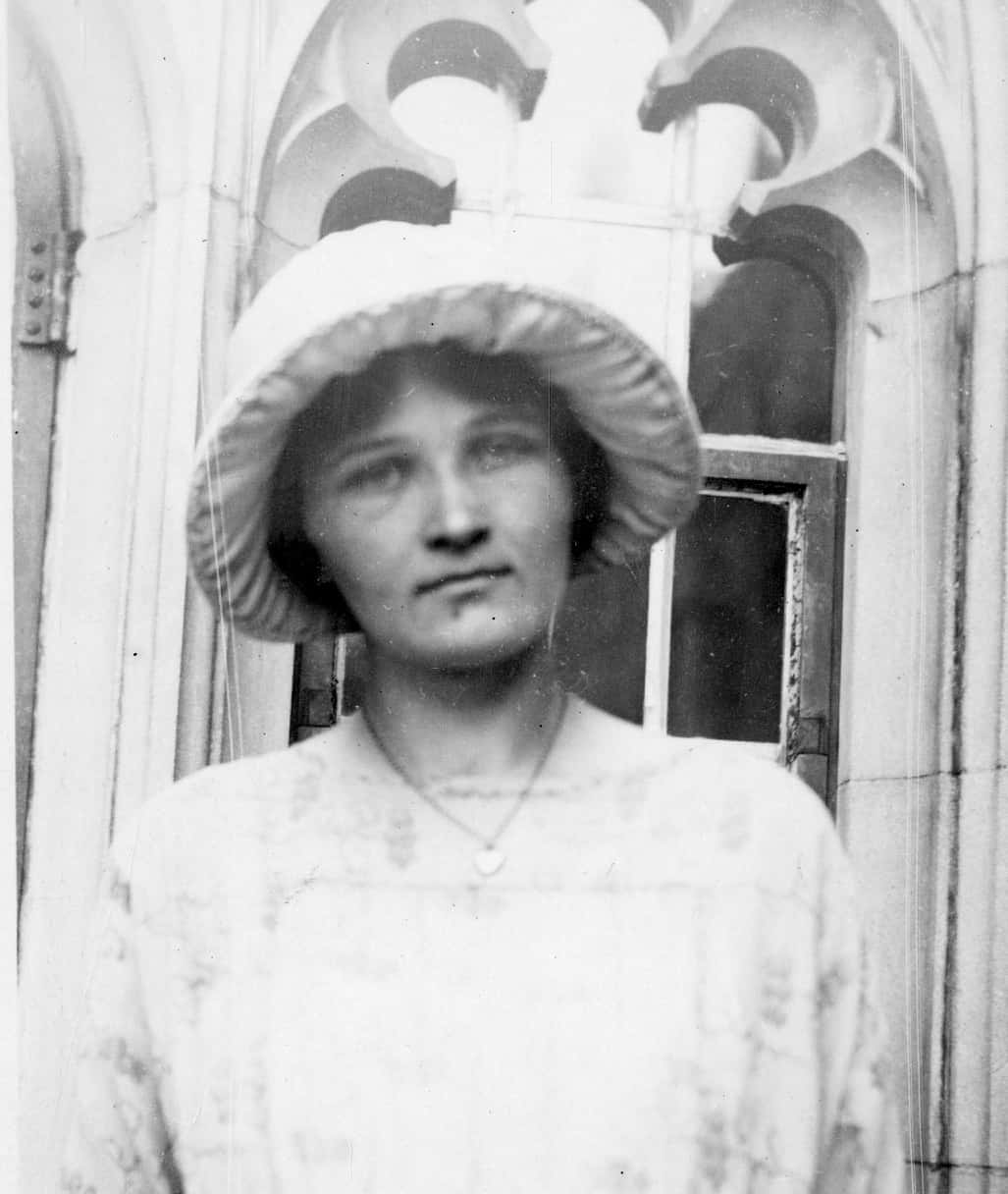
Stellar Cecilia Payne-Gaposchkin in the 1920s, location unknown. (Courtesy: Smithsonian Institution Archives)
At Cambridge the likes of Ernest Rutherford were exploring the atomic and subatomic worlds, and Arthur Eddington was studying the structure and development of stars. Indeed, Payne-Gaposchkin’s physics instructor was Rutherford himself, but as the only woman in his class, she found herself being humiliated. University regulations at the time required that she sit in the front row. As she relates in her autobiography, “At every lecture [Rutherford] would gaze at me pointedly…and would begin in his stentorian voice: ‘Ladies and gentlemen.’ All the boys regularly greeted this witticism with thunderous applause [and] stamping with their feet…at every lecture I wished I could sink into the earth. To this day I instinctively take my place as far back as possible in a lecture room.”
Instead, Payne-Gaposchkin found inspiration in Eddington. Almost by chance, she attended his lecture about his 1919 expedition to West Africa that confirmed Einstein’s theory of general relativity. This so impressed her that she decided to choose physics and astronomy over botany. When later she happened to meet Eddington, as she writes in her autobiography, “I blurted out that I should like to be an astronomer…he made the reply that was to sustain me through many rebuffs: ‘I can see no insuperable objection.’ ” He engaged her in his work on stellar structures, but he also cautioned her that after Cambridge, there would likely be no opportunities for a female astronomer in England.
New shores
Fortunately, a new possibility arose when Payne-Gaposchkin met Harlow Shapley, director of the Harvard College Observatory in Cambridge, Massachusetts, during his visit to the UK. He encouraged her efforts and she learned that he was instituting a graduate programme in astronomy. With a glowing recommendation from Eddington, Shapley offered her a modest stipend as a research fellow. In 1923 she sailed to the US to begin work on a PhD under Shapley’s direction.
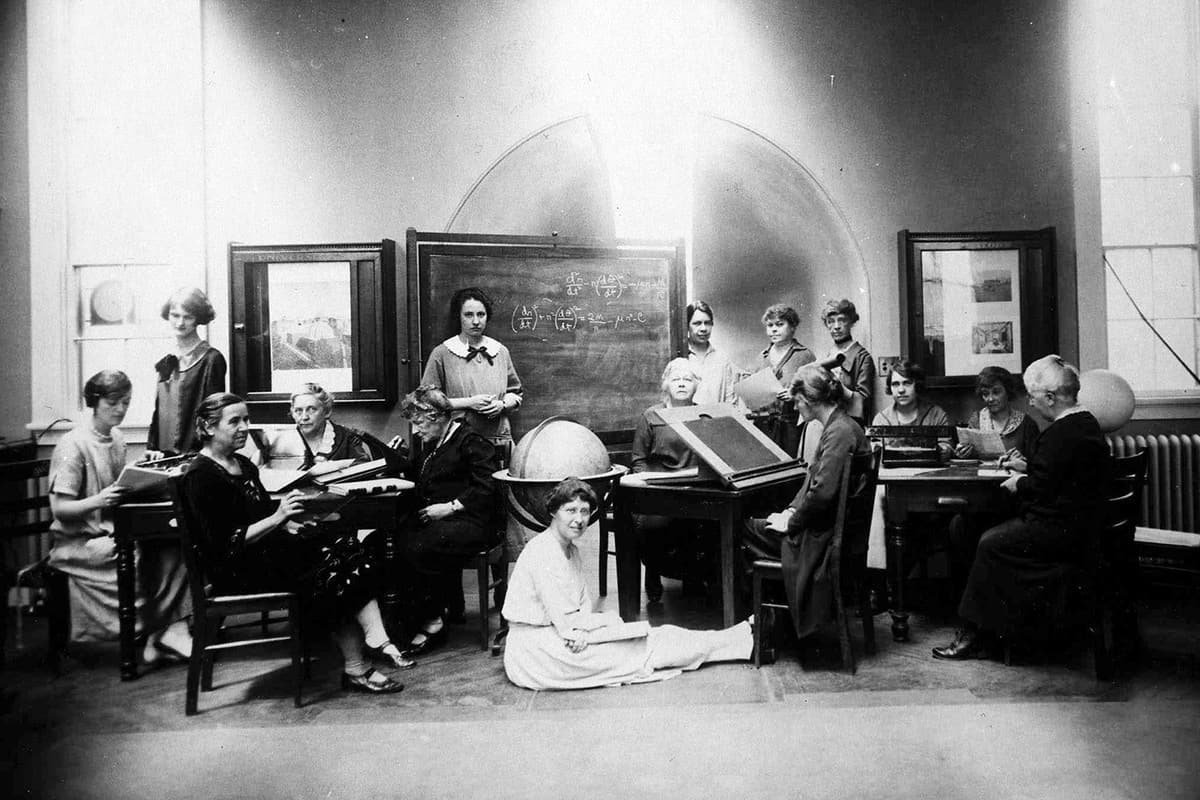
Cosmological computers A group of women working to process astronomical data at Harvard College Observatory in May 1925, including Annie Jump Cannon (fifth from left) and Cecilia Payne-Gaposchkin (fifth from right, seated at a draft board). (Courtesy: Harvard University Archives)
Women had long contributed to research at the Harvard Observatory. In the 1870s Shapley’s predecessor as director, Charles Pickering, had begun hiring women known as the “Harvard Computers” (in the original sense of a person who does calculations) to analyse the stores of data the observatory was collecting. Women were preferred because they were thought to be more patient than men for work involving fine detail, and they accepted lower wages than men. Some of the computers were hired without a background in science, but even those with college degrees were paid like unskilled workers at 25–50 cents per hour (see “The universe through a glass darkly”).
The Harvard Computers were not independent researchers, but assistants with assigned projects. Nevertheless, these women made some of the most significant contributions to early observational astronomy. They included Henrietta Swan Leavitt – famous for her discovery of the period-luminosity relationship of Cepheid variables – and Annie Jump Cannon, who was internationally recognized for organizing stellar spectra.
It had been known since the mid-19th century that each element produces a unique pattern of spectral lines, and that the spectra of different stars showed both similarities and differences. This suggested that stars could be classified into groups, but there was little agreement over how best to do so.
Bright light Annie Jump Cannon at her desk at Harvard College Observatory, date unknown. (Courtesy: Smithsonian Institution Archives)
In 1894 Cannon began the project of examining the stellar spectra collected at the observatory and putting them into a useful order. This daunting task occupied her for years. Spectra from different stars were recorded on glass photographic plates, with each image no more than an inch long. With a magnifying glass, Cannon read the details of hundreds of thousands of spectra and sorted most of them into six groups labelled B, A, F, G, K and M, with a minority placed in group O. The system was based on the strength of the Balmer absorption lines (which describe the spectral line emissions of the hydrogen atom) and reflected the spectral signatures of particular elements, such as metals in K stars.
Spectral studies
Cannon, however, did not probe the physical mechanisms that caused the spectra, nor did she extract quantitative information from them. In her PhD work, Payne-Gaposchkin drew on the physics she had learned at Cambridge to analyse this unique cache of data with the latest theories. The origin of spectral lines had been established only a decade earlier in 1913 by Niels Bohr’s early quantum theory of the hydrogen atom, later extended by others. These theories applied to neutral atoms. Payne-Gaposchkin’s great insight was to appreciate that spectra from excited or ionized atoms – such as would occur in the hot outer atmosphere of a star – differed from those of neutral atoms of the same species.
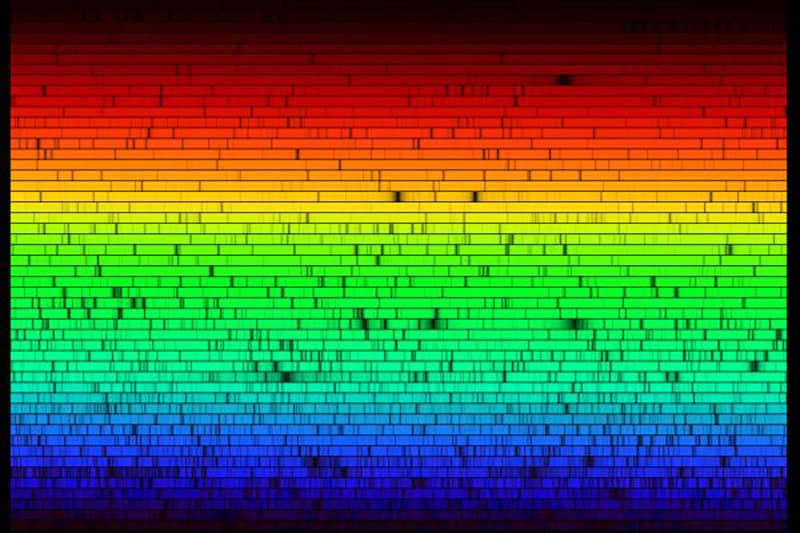
Sorting spectra Astronomers divide stars into different spectral categories, and early classification was based primarily on the strength of the hydrogen absorption lines in any spectra. Each line represents a particular chemical element or molecule, with the line strength indicating the abundance of that element, which varies mainly due to temperature. Today, most stars are classified under the Morgan–Keenan system, a sequence from the hottest (O type) to the coolest (M type). The original Harvard system was developed by Annie Jump Cannon, who re-ordered and simplified the prior alphabetical system. This image shows the visible spectrum of the Sun, and was created at the McMath-Pierce Solar Observatory. (Courtesy: Nigel Sharp (NSF), FTS, NSO, KPNO, AURA, NSF)
The relation among temperature, the quantum states of hot atoms and their spectral lines had been derived in 1921 by the Indian physicist Meghnad Saha. He could not fully test his ideas without knowing the quantum energy levels for each element, but these were being measured when Payne-Gaposchkin began her research. In a massive effort, she combined the new data with Saha’s theory to fully interpret Cannon’s stellar spectra including temperature effects. One significant outcome was the correlation of stellar temperatures with Cannon’s categories, with results still used today: for instance, B stars glow at 20,000 K whereas M stars glow at only 3000 K. This result, part of Payne-Gaposchkin’s remarkable 1925 thesis Stellar Atmospheres, was well received but another result in her thesis was not.
Compositional conundrums
Payne-Gaposchkin calculated the relative abundance of each element seen in the stellar spectra. For 15 of them, from lithium to barium, the results were similar for different stars and “displayed a striking parallel with the composition of the Earth”. This agreed with the belief among astronomers at that time, that the stars were made of the same stuff as the Earth.
But then came a big surprise: her analysis also showed that hydrogen was a million times more abundant than the other elements. Helium, meanwhile, was a thousand times more abundant. The conclusion that the Sun was made almost entirely of hydrogen immediately ran into trouble with a respected outside examiner of her dissertation. This was Henry Russell, director of the Princeton Observatory and a strong proponent of the idea that the Earth and the Sun had the same composition. Russell was impressed until he read her result for hydrogen. Then he wrote to Payne-Gaposchkin that there must be something wrong with the theory because “It is clearly impossible that hydrogen should be a million times more abundant than the metals.”
Without Russell’s blessing, the thesis would not be accepted and so Payne-Gaposchkin did what she felt she had to do. In the final version of her thesis, she disowned that part of her work by writing “The enormous abundance derived for [hydrogen and helium] is almost certainly not real.” But in 1929 Russell published his own derivation of the stellar abundance of the elements including hydrogen, using a different method. He cited Payne-Gaposchkin’s work and noted that his results for all the elements including the great abundance of hydrogen agreed remarkably well with hers. Without saying so directly, Russell’s paper confirmed that Payne-Gaposchkin’s entire analysis was correct, and that she was the first to discover that the Sun is mostly made of hydrogen. Despite that, he never stated that he had originally rejected that result in her thesis.
It may be that Russell offered his comment about hydrogen to warn a young scientist that presenting results contrary to accepted ideas could hurt her career. Probably only a senior researcher of Russell’s stature could have convinced the astronomical community of this new finding. Indeed, his later paper influenced astronomers toward accepting that stars are made of hydrogen to the point that he was credited with the discovery.
The power of Cecilia Payne-Gaposchkin’s thesis speaks for itself. Her lucid writing style, command of the subject and pioneering science shine through
Even without proper credit, the power of Payne-Gaposchkin’s thesis speaks for itself. Her lucid writing style, command of the subject and pioneering science shine through. Shapley had the work printed as a monograph and it sold 600 copies – virtually bestseller status for a dissertation. The highest praise came almost 40 years later, when the distinguished astronomer Otto Struve called Stellar Atmospheres “the most brilliant PhD thesis ever written in astronomy”.
If Payne-Gaposchkin had any ill-will toward Russell, she gave no outward sign of it and maintained a personal relationship with him. In a review of his work that she contributed to a 1977 symposium honouring him (he died in 1957), she called his 1929 paper “epoch-making” without referring to her own work. What she did strongly regret was that she had not stood behind her result. Her daughter Katherine Haramundanis wrote that “through her life, she lamented that decision”. In her autobiography Payne-Gaposchkin wrote “I was to blame for not having pressed my point. I had given in to Authority when I believed I was right…I note it here as a warning to the young. If you are sure of your facts, you should defend your position.”
Battling bias and prejudice
After completing her thesis, Payne-Gaposchkin stayed on at the observatory under Shapley, but in an anomalous situation. She wanted to continue astrophysical research, but because Shapley paid her a (small) salary as his “technical assistant” he felt he could direct her as if she were a Harvard Computer, and he put her to work measuring the brightness of stars – a routine project that did not much engage her. Shapley also had her teach graduate courses, but without the title of “instructor”, let alone “professor”, and without having her courses listed in the catalogue. In an attempt to remedy this, Shapley approached the dean and Harvard’s president Abbot Lawrence Lowell, but they adamantly refused. Lowell told Shapley that Miss Payne (as she was known then), “would never have a position in the University as long as he was alive”.
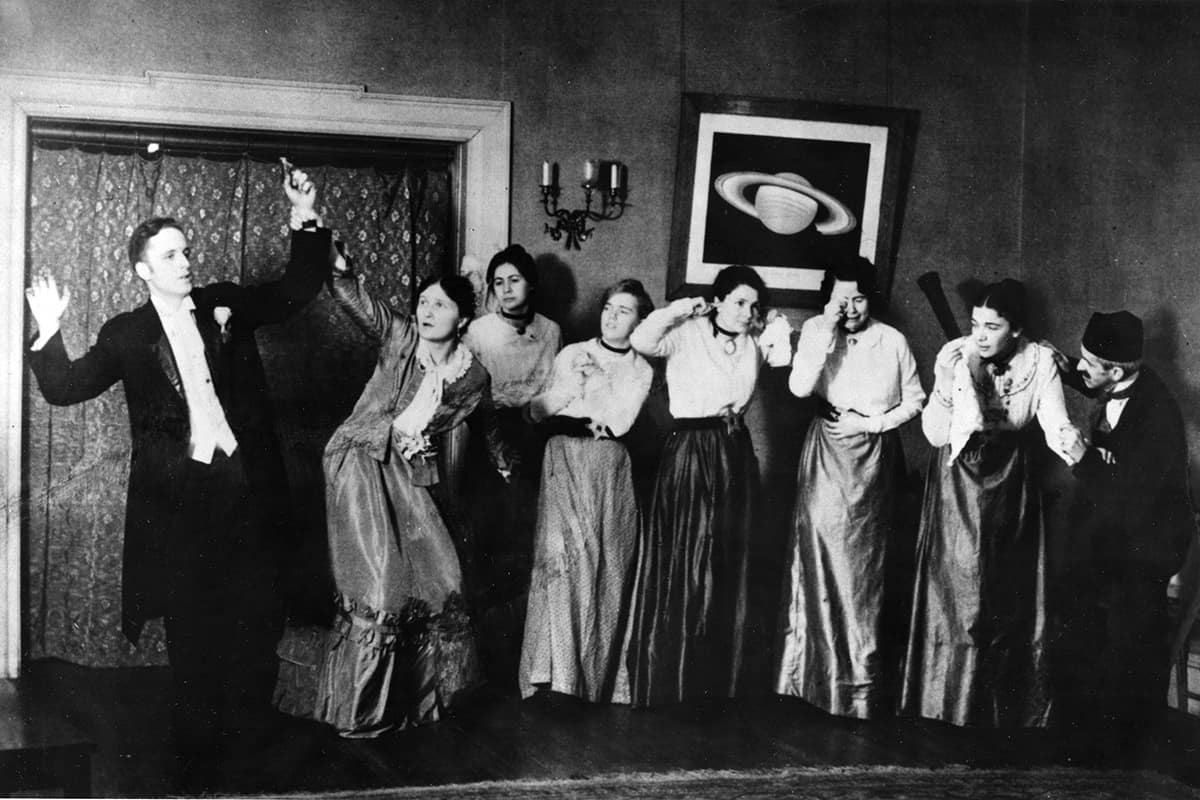
Curtain call On 31 December 1929 staff and graduate students at Harvard College Observatory put on a show dubbed Pinafore at the Observatory. The performers at the far left are Peter Millman and Cecilia Payne-Gaposchkin. (Courtesy: AIP Emilio Segrè Visual Archives, Shapley Collection)
Gender bias like this affected Payne-Gaposchkin at every stage of her career. Her PhD (the first in astronomy at Harvard) was not technically from Harvard. Shapley had asked the chair of Harvard’s physics department to sign off on the dissertation, but as Shapley relayed to Payne-Gaposchkin, the chair refused to accept a woman candidate. Instead, Shapley had to arrange for her PhD to be awarded by Radcliffe, the women’s college at Harvard. When later he began to build a true department of astronomy at Harvard, Shapley was convinced that Payne-Gaposchkin, his best researcher, was well qualified to serve as its first chair – but he realized that Lowell would never allow it, and so he brought in a male astronomer.
After decades of work at the observatory, publishing books and hundreds of research papers and becoming a sought-after instructor, Payne-Gaposchkin remained in a kind of career twilight – poorly paid and without a real academic position. This changed only in 1954, after Shapley retired and Donald Menzel, Russell’s prize student at Princeton, became director of the observatory. He discovered how little Payne-Gaposchkin was paid and doubled her salary, and then did something truly significant. With Lowell and his anti-woman bias long gone (he had retired in 1933), Menzel was able to get Payne-Gaposchkin appointed a full professor of astronomy. This was big news: the New York Times reported on 21 June 1956 that “[Payne-Gaposchkin] is the first women to attain full professorship at Harvard through regular faculty promotion.” A few months later, she became chair of the astronomy department, the first woman to head a department at Harvard.
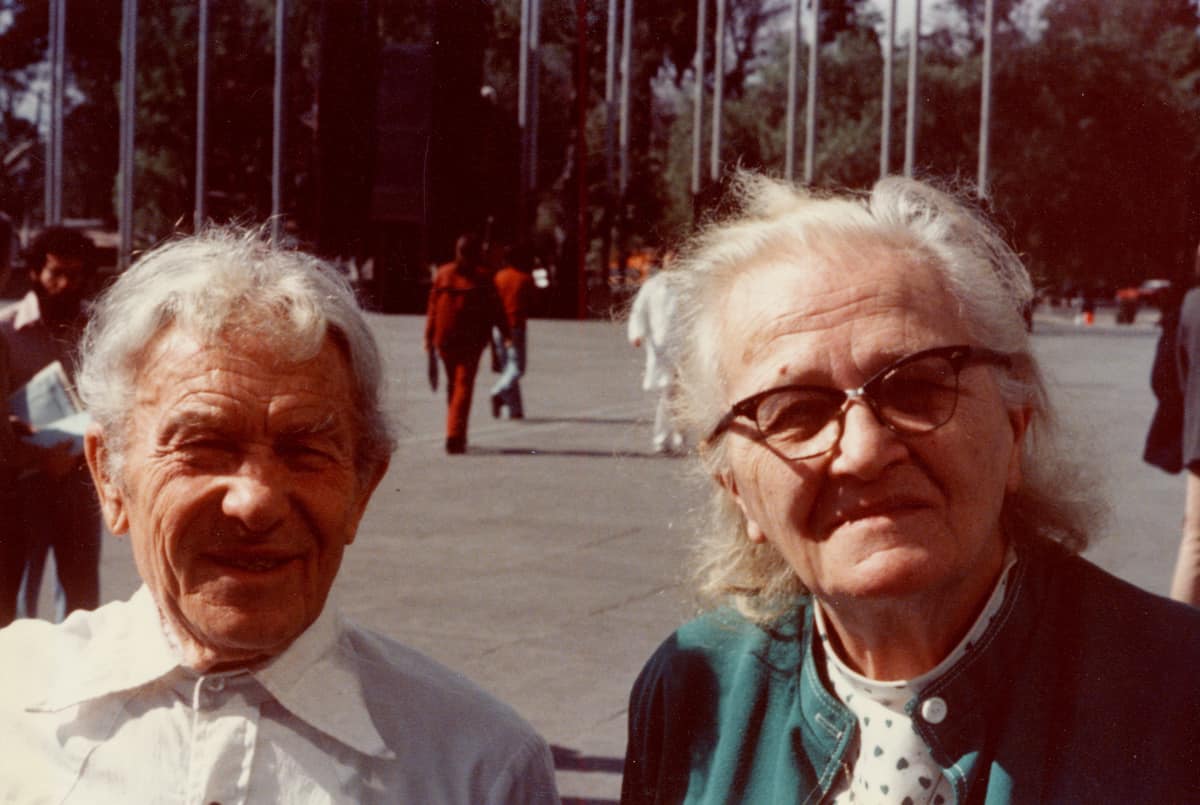
Battle to the top Cecilia Payne-Gaposchkin (right), with husband Sergei in Mexico City for the January 1979 meeting of the American Astronomical Society. (Courtesy: AIP Emilio Segrè Visual Archives)
In retrospect, Payne-Gaposchkin’s career was eminently successful with an outstanding dissertation, prolific research, excellent teaching and distinction for her “firsts” at Harvard and other honours. Along with all her academic work, she found room for her personal life. She wed the Russian émigré astronomer Sergei Gaposchkin in 1934 and with him raised three children while she continued astronomical research.
Exceptional drive
In some sense, one might say she “had it all” in combining science with family and children, but getting there was unnecessarily difficult and gruelling because of bias against women. She became a full professor only at age 56, much later than a man with similar achievements would have reached that status, and after being passed over for advancement, which must have taken a psychological toll. Only a person with exceptional drive and persistence, along with scientific ability, could have endured until final recognition.
Ultimately, Cecilia Payne-Gaposchkin, who died in 1979, was a pioneering scientist who did amazing work throughout her career, but was not treated professionally for most of it. Most of the Harvard Computers were employees, rather than researchers or graduate students. While Shapley gave Payne-Gaposchkin important opportunities and understood how good a scientist she was, he did also treat her merely as one more Harvard Computer, hired to support his own plans for the observatory. She advanced the position of women in astronomy beyond that of the computers, but she still encountered barriers that kept her from being the complete scientist she wanted to be, as women only began to achieve later in the 20th century. Her stellar work was often overlooked and her legacy forgotten, as she became one of the many “hidden” women in science who actually laid the foundation in their fields. It is only more recently that the significant contributions of the likes of Payne-Gaposchkin are being post-scripted into the history of science, and she should be remembered as a key transitional figure between older and newer possibilities for women in science.
German researchers have developed a device that could make possible the use of a technique called dark-field CT in clinical imaging of humans, according to a study published in Proceedings of the National Academy of Sciences.
The dark-field CT technique could provide more useful clinical data because it could measure X-ray properties that conventional CT can’t, wrote a team led by Manuel Viermetz of the Technical University of Munich in Germany.
“X-ray CT is one of the most commonly used diagnostic 3D imaging modalities today,” the group wrote. “Conventionally, this non-invasive technique generates contrast by measuring the X-ray attenuation properties of different tissues. Considering the wave nature of X-rays, complementary contrast can be achieved by further measuring their small-angle scattering (dark-field) properties.”
CT shows differences in how X-rays attenuate as they pass through tissues. Some wave properties of X-rays, such as refraction and small-angle scattering, offer useful diagnostic data. But the technology for gathering this data has not been developed to a usable level for medical imaging, the journal notes in a press statement.
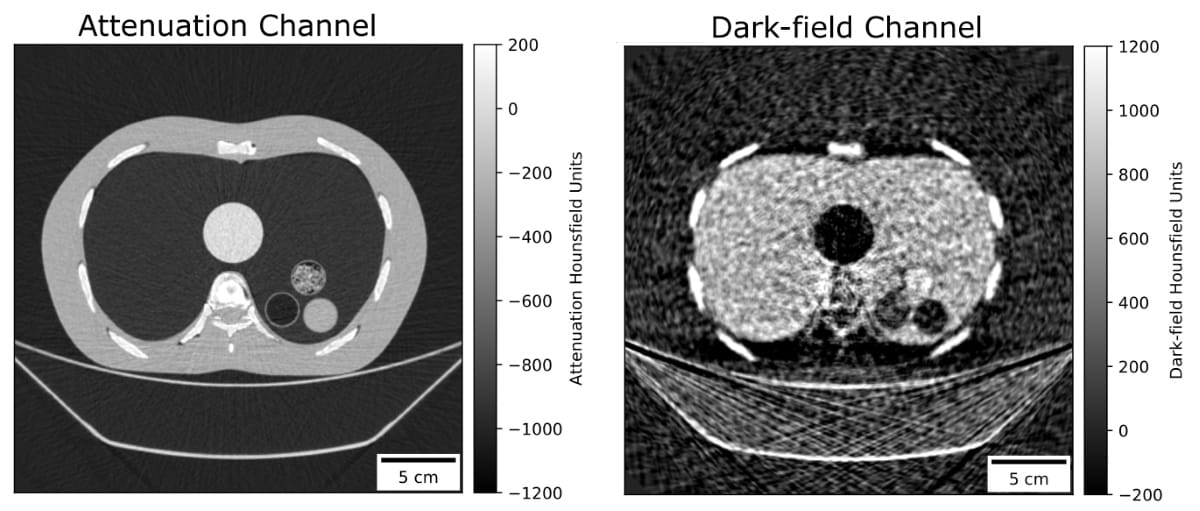
CT reconstruction: Besides conventional attenuation contrast, dark-field contrast is also retrieved, providing information on the porosity of tissue. Here, a chest phantom is filled with a foam insert that simulates lung tissue, and tubes containing different materials. While porous structures are too small and have low conventional attenuation CT, they are easily visible in the dark-field image. (Courtesy: Manuel Viermetz)
So Viermetz and colleagues integrated a Talbot-Lau interferometer into a clinical CT gantry to collect tissue microstructure information from small-angle X-ray scattering. The device included data-processing algorithms that mitigated any artefacts caused by the vibration of the CT gantry, and was tested on a phantom of a human thorax.
The group found that the device was effective in capturing dark-field data (i.e., small-angle scattering), which “provides additional valuable diagnostic information on otherwise unresolved tissue microstructure”.
“Dark-field computed tomography has been an active research field for more than a decade but was – until now – only realized in rather small laboratory set-ups or at synchrotrons,” Viermetz tells AuntMinnie.com. “In our work, the novelty is the realization of the dark-field technology with a clinical CT [device].”
The research lays the foundation for implementing dark-field CT for real-world medical applications, according to the authors. In fact, once dark-field CT systems are approved for clinical use, the group would expect that they would have “immediate impact” on lung imaging, as the technique has already shown promise in small animal studies on chronic obstructive pulmonary disease, emphysema, fibrosis and lung cancer.
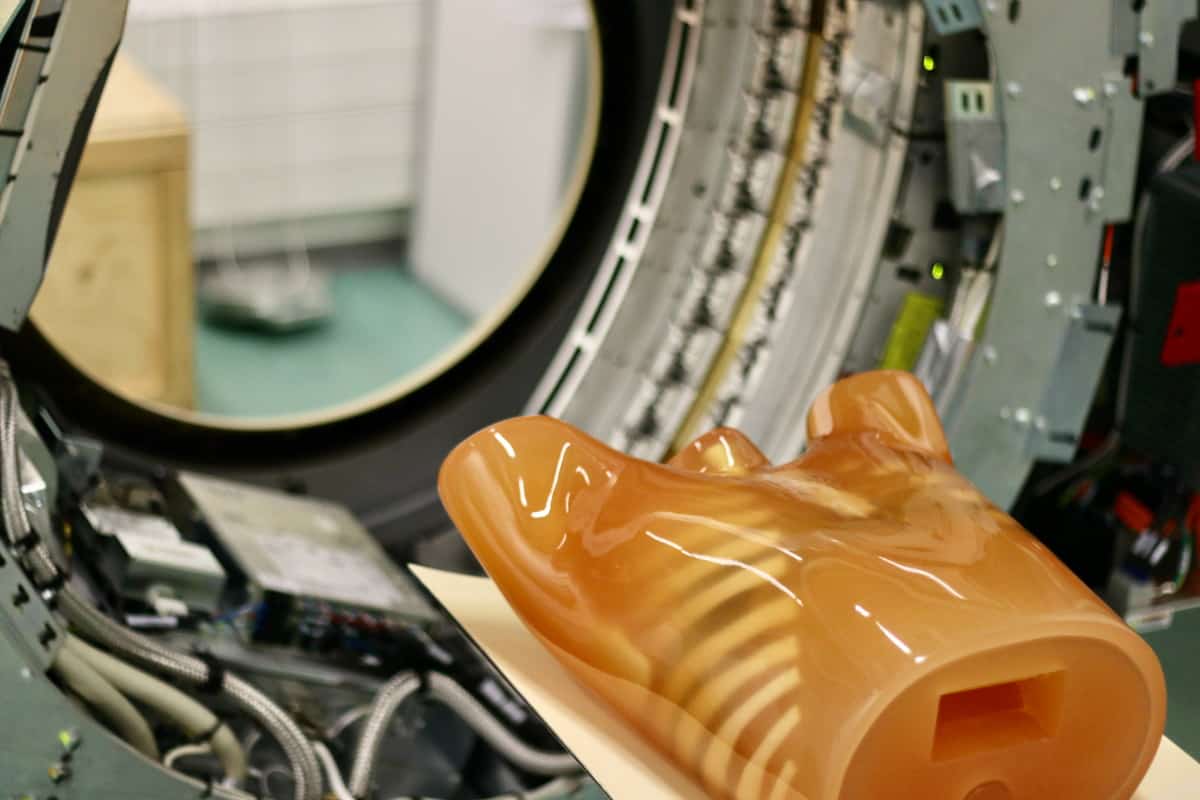
Adapting a clinical system: CT gantry equipped with a Talbot–Lau interferometer for dark-field imaging in clinical applications; a human chest phantom is positioned on the patient couch. (Courtesy: Manuel Viermetz)
“The fact that the demonstrated proof-of-concept requires only minor modifications to a prevalent device allows for rapid translation to clinical application and commercialization,” Viermetz and colleagues wrote. “The proposed dark-field CT is not only fully compatible [with existing CT systems] but actually, even advantageous in combination with other innovations (e.g., dual-energy and photon-counting detectors), which are currently introduced by manufacturers.”
Dynamically-controlled exciton transport has been demonstrated in a 2D transition metal dichalcogenide (TMD) using surface acoustic waves (SAWs). Researchers in the US and Japan used the SAWs to induce mechanical strain in a tungsten diselenide sample at room temperature, resulting in a maximum net exciton shift of nearly 1 micron. This work is a big step towards room temperature, practical excitonic devices including cooler and more efficient electronics.
Beat the heat
Excitons are quasiparticles that are found in semiconductors and comprise electron-hole pairs. The ability to control exciton transport is crucial for functioning excitonic devices – which have a range of potential applications including sensing, energy conversion and communications.
Excitons have zero electric charge, which means that they experience much less resistance than electrons when moving through a material. Currently, the speed of computers is limited by the heat produced – and energy lost – through electrical resistance. “If you think of the past almost two decades, the computers have always been at two to three gigahertz – they never increase in speed. And that’s the reason. It just gets too hot,” says Parag Deotare, who is at the University of Michigan and corresponding author on a paper describing the research. “If you just cut down your communication energy losses, then your processing speed automatically increases. Using excitons can theoretically cut those losses significantly.” Hence, the ability to control the movement of excitons is crucial in the development of cooler and more efficient electronics.
Getting wavy
The electric neutrality of excitons creates a new problem: unlike electrons, excitons cannot be transported by applying a voltage. The solution could lie in the fact that in 2D materials, the behaviour of excitons is very sensitive to their environment – this is because every atom in a 2D material is on the surface.
The exciton energy landscape is therefore easily affected by strain and electric fields, both of which can be applied by SAWs. These are acoustic waves that travel on the surface of elastic materials and create an oscillating mechanical strain. Exciton transport using SAWs has previously been achieved in quantum-well systems made of III-V compound semiconductors. However, this only occurred at cryogenic temperatures, below -150°C. TMDs such as tungsten diselenide offer a route to higher temperatures because their large exciton binding energies mean excitons still exist at room temperature and their band gaps are direct.
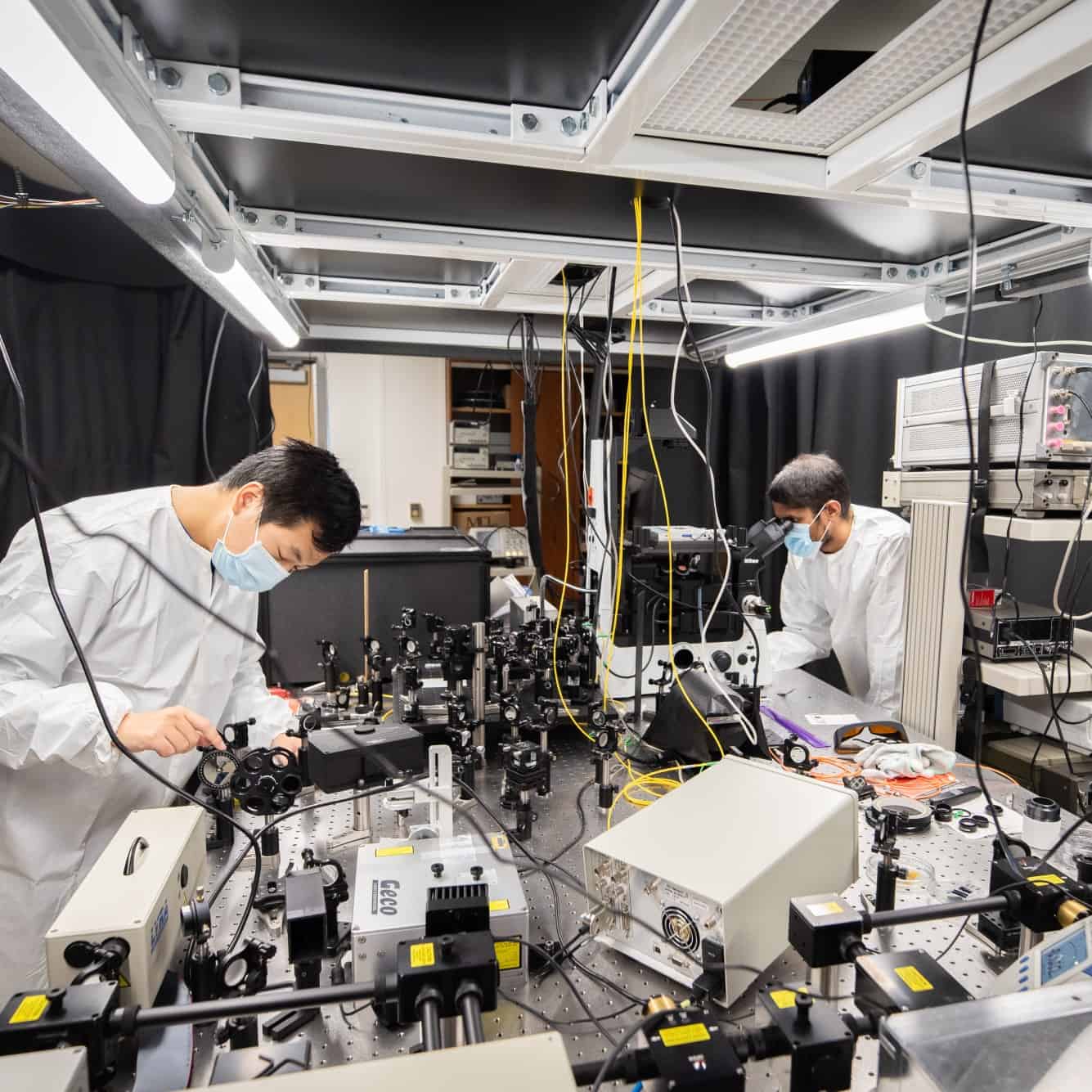
In the lab: PhD students, Zidong Li (left) and Kanak Datta (right), hard at work. (Courtesy: Silvia Cardarelli/University of Michigan.)
In this study, Kanak Datta, a PhD student at the University of Michigan, and colleagues used radio-frequency SAWs to induce a strain in a monolayer of tungsten diselenide – thereby modulating the energy landscape. The monolayer is encapsulated to increase the exciton binding energy, which reduces the chance of exciton dissociation (separation into the constituent electron and hole) and increases stability. The chance of dissociation can be further reduced by exciting the sample optically to produce charge carriers that screen the piezoelectric field required to generate the SAWs. In this way, the effect of the mechanical strain on the exciton flux can be studied.
Surf the wave!
The researchers used spatially-resolved photoluminescence measurements to track the excitons and found that they “surfed the wave” – that is, the SAWs produced a net drift of the exciton flux in the direction of propagation of the SAW. This drift was proportional to the input power to the SAW and reached a maximum distance of nearly 1 micron and a maximum average drift velocity of 600 m/s.
The drift, however, was not linear and was accompanied by oscillations with a period equal to that of the SAW, indicating weak coupling between the excitons and the SAW. In this regime, although the excitons adopt the frequency of the SAW, their drift velocity is nearly six times smaller. This is insufficient for them to keep pace with the wave and, therefore, they experience a smaller net shift The researchers found that this “acoustic steering” could be further controlled by altering the relative phase of the exciton flux and the SAW.
Although the exciton mobility of 900 cm2(eV s)-1 found in this study is nearly two orders of magnitude smaller than for III-V quantum well systems at cryogenic temperatures, the mobility could increase as fabrication techniques for TMDs improve and their defect density is reduced. In this way, it is hoped that the strong-coupling regime can be achieved and, therefore, long-range exciton transfer in TMDs will then soon be possible.
“What we’re doing right now will enable us to have a computer that can operate at a much higher speed, consume less energy, and be built at a very small scale,” says Zidong Li, a PhD student who worked on the study.
Two new methods for generating holographic plasma lenses capable of focusing ultrahigh-intensity lasers have been proposed by researchers in the US. Using computer simulations, a team led by Matthew Edwards at Lawrence Livermore National Laboratory (LLNL) worked out how the robust structures could be created by imprinting carefully generated interference patterns onto a plasma medium.
The latest advances in laser technology have allowed physicists to generate light pulses as powerful as 1015 W. However, these intense lasers are difficult to use in experiments because they cause irreparable damage to conventional solid-state optics.
A potential solution to this issue lies with plasma, an ionized state of matter that has a damage threshold several orders of magnitude higher than solid materials. Plasma has been used to generate optical components including amplifiers, gratings and mirrors – but so far, these structures have only been used to focus beams as powerful as around 1012 W.
Imprinting interference
As an alternative approach, Edwards’ team suggests the possibility of using holographic plasma lenses, which focus beams using diffraction. Typically, holograms work by imprinting the interference between a 3D light field and an initial reference beam, within a light-sensitive medium like a photographic plate. Afterwards, a second reference beam is diffracted by the imprinted pattern to reproduce the initial light field.
As well as interference patterns, holograms can also be imprinted as phase shifts, caused by the varying speed of light as it passes through media with varying densities. Drawing from this principle, Edwards and colleagues showed how a hologram could be used to modulate plasma density, producing a robust diffractive lens.
In their proposed set-up, two pump lasers are aimed along the same path, and positioned so that their foci overlap. This generates an interference pattern that spreads out from the point of overlap in a series of progressively larger rings, alternating between high and low light intensity.
Two techniques
Through computer simulations, the researchers showed how a lens could be generated through two possible techniques involving this set-up. In the first technique, the lasers are fired into a jet of gas. The resulting interference pattern ionizes the gas, creating a bull’s-eye pattern of alternating rings of plasma and unionized gas. In the second technique, the two lasers are instead aimed into and existing plasma. This time, the laser interference alters the distribution of plasma ions – again creating alternating rings of high and low density.
Both mechanisms created a holographic imprint of a 3D phase-shifting structure – which remained in place when the pump lasers were turned off. Through simulations, Edwards and team showed that the diffraction patterns generated by the first type of lens could be used to focus petawatt lasers, with intensities on the order of 1015 W/cm2. The second method proved even more effective, and was able to handle pulses as intense as 1018 W/cm2.
The team now hopes to carry out experiments to confirm the predictions. If achieved, this could open up new opportunities for experiments involving the ultra-intense lasers generated at LLNL, as well as a growing number of other facilities worldwide.