Why reforming scientific awards can help to tackle discrimination in physics

A scientific award reflects what the community values. It can raise the profile of a scientist’s work, create opportunities for career advancement and increase researcher morale. Awards can motivate scientists to perform high-risk, high-reward research – to make breakthroughs and change how we understand the world. Prizes can also strengthen community bonds and establish role models as well as transform interest, investment and participation in a particular discipline. 

But there is a problem. The application process for prize nominations is often broken, as is the way that they are awarded. The outcome is that women and gender-minority scientists, scientists of colour and those from smaller, less well-known institutions are less likely to receive the recognition they deserve. 

Awards are not only a chance to recognize the scientific breakthroughs that have brought us to where we are today, but opportunities to champion a vision for a more equitable future

The Nobel prizes are a perfect example of these discrepancies. Women make up only four out of the 219 Nobel laureates in physics, while no Black scientist has ever been recognized by a Nobel science committee. The Nobel prizes also overemphasize the contributions of individuals, which perpetuates an incorrect view that science advances via the “lone genius” rather than through collaboration and co-operation. By uplifting only one or a small number of people, the Nobels effectively erase the contributions of colleagues who are typically early-career scientists and arguably have more to gain from such recognition. 

The Nobels are not alone. Most awards require nomination packages and references, which can be onerous and intimidating to put together. Unless careful and conscientious advocates are willing to seek out awards and write statements to diversify the pool of nominees, then nominator and institutional bias determines who gets put forward.

The Matilda Effect is the (un)conscious bias that attributes the contributions of female scientists to their male counterparts. It shows how easy it is for award programmes to deny recognition to women scientists and scientists from historically marginalized groups, writing them out of history. And even if self-nomination is possible, it can favour over-confident scientists or those who have time to gather the required nomination materials. When women self-nominate, they are often derided for being self-promoting. 

Ultimately, however, it is the biases and interests of those on the awarding panel that determine who succeeds. Reviewers bring their own expertise, experiences and priorities to their role as jurors. If the panel isn’t diverse – and the names of the committee members not made public – their narrower experiences and perspectives have been shown to solicit less diverse nominations. Then there’s the Matthew Effect, which recognizes high-profile scientists while withholding recognition for those who have yet to make their mark. It explains why winners of early-career awards (typically given to scientists who had access to and chose the “right” supervisor, topic or institution) are more likely to receive more established prizes later on. 

A more equitable future 

There have, however, been some welcome reforms to counter these effects. The Institute of Physics (IOP), for example, now has a diversity and inclusion initiative as well as the opportunity to self-nominate for awards. Yet some of its awards still request the nominee’s h-index – a citation metric that is inherently biased against people in certain disciplines, women, people of colour, people from low-resourced countries and those who do not prioritize publishing. The IOP’s Bronze early-career medals, meanwhile, require two referees outside of the nominee’s department, which can prove challenging to less well-connected researchers at the start of their career. 

So, what more can be done? When the American Geophysical Union noticed women and minorities were under-represented in its fellowship, it established a task force to review selection criteria, created canvassing groups and trained selection committees in implicit bias. The Royal Society of Chemistry’s awards now place stronger emphasis on the science, not the individual scientists. It celebrates all members of scientific teams – from graduate students to technicians – and recognizes the work of educators in inspiring future chemists. Its prizes also come with a set of expectations and can be revoked if these are not met. 

While an independent review sends a strong signal that an awards programme is taking reform seriously, there are steps professional bodies, academic institutions and learned societies can take in the short term. Transparency brings equitability and accountability. We need to collect and share data on who is and isn’t being nominated, who wins, who is serving on selection committees and what the strategies are to correct any imbalances. We need to train selection committees on unconscious bias, have consistent evaluation processes with defined criteria and encourage membership to question their own stereotypes.

We also need to evaluate requirements for awards and make clear the rationale underlying those requirements. For example, is brilliance really best captured by a metric such as the h-index? Let’s re-think what awards are for: do they need to champion an individual, or could you recognize team work instead? And we should encourage people to nominate more diverse candidates. Once clear requirements are established and outreach efforts in place, let’s offer training programmes on how to put together nomination packages and how to write successful supporting statements. 

The responsibility is on the scientific community, too. Take the time to nominate that phenomenal colleague, that extraordinary group leader, that inspirational lecturer or a remarkable technician. Awards are not only a chance to recognize the scientific breakthroughs that have brought us to where we are today, but opportunities to champion a vision for a more equitable future. 

Jess Wade (click link below for full bio) is an Imperial College Research Fellow, e-mail jessica.wade@imperial.ac.uk, @jesswadeMaryam Zaringhalam is a biologist and senior producer of the non-profit Story Collider

‘Nearest black hole to Earth’ does not exist, Usain Bolt races a dinosaur, space telescope soap

Black holes can be difficult to spot for the obvious reason that they don’t emit any light of their own. In May 2020, astronomers using a telescope at the European Southern Observatory in La Silla, Chile, announced that they had spotted the nearest known black hole to Earth. Led by the ESO’s Thomas Rivinius, the team had observed what they thought was a triple system that comprised two stars and a black hole. The system is called HR 6819 and is a little over 1100 light–years from Earth. That is so close that its two stars can be seen in the southern sky. The team thought that the system contained a black hole because that would explain the unusual motions of the two stars. They proposed that one of the stars orbits the black hole every 40 days and the other star is orbiting at a distance.

The claim was contested by some astronomers and a team led by Julia Bodensteiner, then a PhD student at KU Leuven in Belgian, came up with an alternative proposal. Instead, the two stars orbited each other in 40 days and there is no black hole. For this to be true, one of the stars would have to have been “stripped”. This involves a large amount of material being transferred from one star to the other in a process that is also called “stellar vampirism”.

The two teams joined forces under KU Leuven’s Abigail Frost to work out which configuration best described HR 6819. The used the ESO’s Very Large Telescope (VLT) and Very Large Telescope Interferometer (VLTI) to observe the system in higher resolution. They did not see a star orbiting in a wide orbit, but instead saw two stars in a tight orbit and separated by one third the distance from the Earth to the Sun. So, no black hole is needed.  The research is described in Astronomy and Astrophysics.

Sprinting dinosaur

Would the Jamaican sprinter Usain Bolt be able to beat a 400 kg dinosaur in a 100 m race? It’s a question not many would have pondered, but Scott Lee, a physicist at the University of Toledo in Ohio, thought it would be a good problem for his students to solve. To make it a fair race, Lee chose the theropod dinosaur Dilophosaurus wetherilli, given it is thought to have a top running speed of about 10 m/s, which is about the same as Bolt’s average velocity when he set the 100 m sprint world record of 9.58 s at the 2009 World Championships in Berlin.

Using concepts from 1D kinematics and numerical techniques, the students discovered that Bolt’s lightning-fast (pun intended) acceleration at the start would leave the dilophosaurus in the dust as he wins the race with 2 s to spare. Given that the dilophosaurus had razor-sharp claws and the ability to spit venom at its prey (as DNA thief Dennis Nedry discovered in the hit-film Jurassic Park), if any race occurred then it would guarantee Bolt smashing his own record. The calculations are described in The Physics Teacher.

After delays and fears of cancellation, the James Webb Space Telescope (JWST) finally launched on Christmas Day 2021. The mission has taken its position in orbit around the Sun and NASA has released a very blurry first image taken by the telescope as its mirrors are aligned. If all goes well, the first proper images from the telescope should be available in June.

While you are waiting for the first (hopefully) dazzling images, you could check out the amazing array of JWST-inspired products that are available to buy. I came across this phenomenon via a tweet from Molly Peeples (@astronomolly). It included a photo of a bar of “James Webb Tele-soap”, which is emblazoned with the JWST’s now iconic mirror plus a few stars, galaxies and planets. It is made by the Canterbury Soap Works in the US, but sadly it has sold out on the e-commerce website etsy. However, if you do a search on etsy, you will find hundreds of JWST-themed items including mugs, t-shirts and (of course) mirrors.

Controlling cells with sound: scientists pioneer sonogenetics

A US-based research team has developed a new “sonogenetic” technique to activate and control mammalian cells with sound – potentially paving the way for innovative non-invasive versions of deep brain stimulators, pacemakers and insulin pumps. So, what exactly is sonogenetics? What are its potential clinical advantages? And what are the next steps for the research team?

Ultrasound stimulation

The novel approach combines ultrasound with gene therapy to deliver genes to specific cells in order to manipulate them with sound for therapeutic effect. The results of the research, reported in Nature Communications, show how the team used the method to activate human cells in a dish and to control neurons in the brain and spinal cord of mice.

Sreekanth Chalasani

“Sonogenetics uses ultrasound to control specific cells,” explains senior author Sreekanth Chalasani from The Salk Institute for Biological Studies. “Ultrasound is sound, which is mechanical in nature, and so it causes a small amount of mechanical deflection in the focal zone. We identified a channel protein that can sense this mechanical deflection. So, we can express this channel on a cell that we want to control.”

To test the technique, the researchers delivered the gene for a channel protein (TRPA1) to target cells. After expressing this channel, the cells became sensitive to ultrasound. In studies on mice, the team attached a transducer to the skin of the animals and could then control the target cells using ultrasound stimulation. “This channel is not found on the cell normally, so we are introducing a new functionality by adding this protein to the cell,” Chalasani adds.

Potential clinical applications

According to Chalasani, sonogenetics has a number of key advantages over more invasive existing therapeutic methods. To begin with, in basic terms, the new technique demonstrates how motor neurons in the cortex can move limbs – which was an expected result. He also points to a wide range of potential non-invasive clinical applications, including the replacement of deep brain stimulators, cardiac pacemakers and insulin pumps.

“Cardiac pacemakers are likely to be the first clinical application since there is a gene delivery system to deliver genes to the heart muscle in a human. We don’t have a way to deliver genes to targets in the human brain,” he says.

Current approaches for each of these methods involve surgery and include implanting a device in the body, which comes with an increased risk for infection and/or inflammation. “Our method doesn’t need an implant as the transducer is outside the body. All we have done is deliver a protein to the target cell,” Chalasani explains.

Chalasani says that he and his team are already engaged in taking the findings forward – and reveals that they are hoping to identify additional proteins that have increased sensitivity to ultrasound, that can respond to ultrasound at specific frequencies and that can inhibit neurons, not just excite them as they are currently doing.

“Also, we want to continue innovating with the ultrasound delivery devices so that we can deliver appropriate ultrasound stimuli to targets in the brain or body,” he tells Physics World. “We are currently working with mice, but want to extend this to large animals like pigs or primates before translating it to humans.”

Magnetic ‘stop sign’ helps songbirds return to breeding sites

Migrating birds use information extracted from the Earth’s magnetic field to target the same breeding grounds year after year, with the field’s inclination angle, in particular, acting as a “stop sign” telling them they have reached their destination. This conclusion, based on a new analysis of data obtained by attaching metal rings to the legs of birds and then tracking their movements, adds to a growing body of knowledge about field-based navigation in migratory animals.

Although there is considerable evidence that some species of birds use the Earth’s magnetic field to navigate, the precise mechanism is still not fully understood. Some theories invoke an inherited “clock and compass” vector system to explain how birds can return to their breeding grounds with extraordinary precision, but the question of how they know when and where to stop was unresolved.

In an attempt to answer it, Joseph Wynn and Tim Guilford of the University of Oxford in the UK and colleagues at the University of Oldenburg, Germany turned to a long-term experiment on Eurasian reed warblers (Acrocephalus scirpaceus). These migratory songbirds fly across the Sahara each year to spend the summer in Europe, and between the years 1940 and 2018 more than 17,000 of them were “ringed” to allow researchers to monitor their movements over many years and large geographical areas.

A single magnetic inclination angle

The team’s analyses suggest that the warblers register, or learn, a single magnetic inclination angle – effectively the degree of “dip” between the Earth’s magnetic field and its surface – before setting off on their journeys. Later, they use this angle as a unique coordinate telling them they have reached their breeding site. While different locations across the globe have the same inclination angle, the team say that the warblers solve this problem by stopping at the first place where they encounter the right inclination, according to their inherited vector system.

This explanation may not be all there is to it, however. Because the Earth’s magnetic field in a given location changes slightly from one year to the next, the magnetic parameter values that are characteristic of an individual bird’s breeding site will exist in a somewhat different location on its return trip. In a paper in Science describing the work, the researchers acknowledge that these magnetic variations need to be taken into account. “Nonetheless, we believe that our findings provide evidence for an unconventional mechanism of long-distance navigation, both within birds and migratory animals more generally,” they conclude.

Tracking space junk around the Moon, one teacher’s struggle to correct textbook errors

Space junk – debris left by humans in space – is a growing danger for satellites and space missions orbiting the Earth. It turns out that the Moon also has space junk and in this episode of the Physics World Weekly podcast, Roberto Furfaro and Vishnu Reddy of the University of Arizona talk about the challenges of tracking lunar space junk and identifying its origins.

Also this week, the teacher David Marshall talks about the sometimes byzantine process of correcting errors in physics textbooks, curricula and exams. He also shares some of the more bizarre mistakes he has found over the years – including one about bouncy light, which has yet to be corrected.

Horror and hope for Ukrainian scientists

I woke up in Germany at 5 a.m. CET on Thursday 24 February 2022, two hours after the first bombs had landed in my hometown Kyiv. The day before in a group meeting at the University of Bayreuth, my PhD supervisor asked my wife (also a PhD student) and me if we were scared about the situation in Ukraine. My wife said that she was worried about her parents and possible war. I was calm; I believed no-one could be so insane as to start a war in Europe in the 21st century.

Early Thursday morning my wife was sleeping and I decided not to wake her up, she deserved to have a few more hours of peace. I immediately messaged both our parents, but no-one answered.

We spent the entire morning writing invitation letters so our parents could come to Germany. I also wrote to my PhD supervisor to get some documents confirming our status to help our parents cross borders. He responded quickly and said that we should stay at home and do everything possible to help our families.

We scrolled through Telegram channels all day, monitoring the situation

The first day after the conflict began was spent in despair. We were scared of war and knew we could not do anything being so far from Ukraine right now. We scrolled through Telegram channels all day, monitoring the situation. In Ukraine as in the other post-Soviet countries, Telegram is the most popular messaging service and almost everyone uses it. No wonder it became the main source of information for us.

The Ukrainian government created official Telegram channels, where our president Volodymyr Zelensky reports every day about the current situation. In addition, every region of Ukraine has an official channel, where they try to report about the status of each region. People began to organize themselves through Telegram to attack Russian propaganda websites and send photos of Russian military columns moving through Ukraine to military officials to guide attacks.

Sleeping in a corridor

The next day I wrote to my former undergraduate adviser. He was in Ukraine with his family in the centre of Kyiv. I was happy to discover that he is now supervising a friend, who is doing a PhD with him. However, life is not normal: my adviser’s family is sleeping in the corridor of their building so that they as far from the windows as possible. Nevertheless, he was optimistic. I told him that the deadline for nominations for the Philipp Schwartz Initiative of the Alexander von Humboldt Foundation has been extended until 18 March for Ukrainian scientists. This is a programme for scientists who face considerable and ongoing personal danger in their home countries, inviting them to work in Germany. I also told him that I could help him with finding a host at my German university. He told me that he would do it only if Russia occupies Ukraine, otherwise he is going to stay.

On the third day after war began, our despair had been replaced by anger

On Sunday 27 February, the third day after war began, our despair had been replaced by anger. We were angry about war; angry about the fact that we cannot do anything except donate to the Ukrainian cause; angry about the bomb attacks; and angry about Russia’s president Putin.

Our university began to stir. On the Bayreuth campus, students started collecting warm clothes and medicine for people in Ukraine. My wife received an e-mail from a professor she met only once who said he would be happy to accept students from Ukraine for short research visits and asked for help to spread the news. In social networks, I started seeing more and more research groups worldwide encouraging Ukrainian students and scientists to apply for internships and visits.

Ukrainian science has been declining steadily following the collapse of the Soviet Union, funding is scarce and corruption has been eating into what little money is left. The equipment is old and researchers have to wait a long time to make measurements and do experiments. I remember how proud the scientists from a Ukrainian research institute were when they showed us an electron microscope that they received as a gift from Japan in the early 1980s.

I believe that Ukrainian science will rise in the future, as a part of the European scientific family

What is happening in Ukraine is a tragedy, but people all over the world are helping and the scientific community is no exception. Science should not have borders and it is wonderful that more and more science is being done in collaborations. I believe that Ukrainian science will rise in the future, as a part of the European scientific family and the bonds between scientists will grow stronger.

Plants accumulate nanoplastics mainly in roots, not shoots

A new study aimed at quantifying how plants take up plastic nanoparticles from the soil has revealed that the plastics accumulate mainly in the roots rather than the shoots. The technique used to trace the nanoparticles involves materials known as lanthanide chelates, and the researchers who developed it say it could be a versatile way to analyse the interactions between nanoplastics and plants.

Tiny fragments of plastic are everywhere – in the ocean, in our food, even on the summits of mountains. The smallest of these fragments, known as nanoplastics, are thought to be more hazardous to life because their small size enables them to penetrate cell membranes. Since the continued large-scale production of plastics means that concentrations of nanoplastics are unfortunately likely to increase, it is important to understand their impact on the environment and the potential risk to human health.

Because nanoplastics can interact with plants in many ways, scientists need to be able to follow how these particles accumulate and move through the plant’s structure. While many studies have investigated the way that plant protoplasts – that is, cells with their walls removed – take up nanoplastics, the mechanisms for uptake and translocation of nanoplastics through large-scale plant structures remain poorly understood. Quantitative information on the rate at which plants uptake nanoparticles and then transport them is particularly lacking.

Studies on lettuce and wheat

In the present work, researchers led by Yongming Luo of the Chinese Academy of Sciences studied how two crops, lettuce and wheat, took up 200-nm-diameter polystyrene particles doped with a europium chelate, Eu-β-diketonate. Polystyrene is the one of the most commonly produced polymers in the world and is widely employed both in food packaging and as a “soil conditioner” to stabilize soil surfaces and help them retain moisture. It has been detected in organic fertilizers, sewage sludge and wastewater.

To mimic different environmental conditions, Luo and colleagues grew their lettuce and wheat in hydroponic cultures and in sandy soil. They quantified the doped polystyrene particles in the plants using a technique known as inductively coupled plasma mass spectrometry. As europium is a very rare element and does not naturally occur in plants, every signal they detected represents a particle that the plant took up. They also visualized the particles using background-free time-resolved fluorescence imaging, and confirmed their presence using scanning electron microscopy.

The team’s analyses revealed that polystyrene-europium particles accumulated mainly in the roots of the plants, while transport to the shoots was less than 3% for 5000 μg of polystyrene particles per litre of exposure. Willie Peijnenburg, a researcher at Leiden University in the Netherlands who was also involved in the study, explains that finding more plastic in the root than the shoot means that only a small number of particles end up in the edible parts of the plants.

The researchers, who report their work in Nature Nanotechnology, say they now plan to apply this technique in microcosm or mesocosm experiments to enhance the sensitivity of their nanoplastic tracing and detection methods.“We need to carefully monitor potential lanthanide leaching from the particles in the systems we studied due to the complex environmental conditions, as well as due to the presence of a wide number of (micro)organisms,” team member Lianzhen Li tells Physics World.

Putting the physics into science fiction

Science fiction has always explored scientific possibilities, both current technology and the furthest reaches of what could still be described as science. The most interesting SF uses science as a means to explore society, psychology and other aspects of being human, which often means any physics involved isn’t explored in depth. Even “hard science fiction” – depicting science that is possible and central to its plot – rarely goes into great scientific detail. 

In that regard, The EXODUS Incident by Peter Schattschneider is an exception to the rule, not only including lengthy discussions of physics (and indeed other sciences) within its pages, but also featuring a bulky appendix with abundant background detail to the physics explored. It’s also a lively crime thriller set in the  future.

Schattschneider is a physicist based at TU Wien who has spent much of his career both writing science fiction and using classic SF in his lectures. So he is well placed to blend complex physics into storytelling.

The novel opens with an academic-paper-style abstract followed by social-media messages (Schattschneider wisely doesn’t specify what platform they’re being posted on), which tell us that the Earth is suffering from catastrophic climate change, a series of pandemics and of course war. In what might be the last chance to save humanity, Europe is sending a spaceship called Exodus to establish a colony in the Proxima Centauri system, on a planet identified as habitable by the Breakthrough Starshot project initiated by Yuri Milner and Stephen Hawking (the novel doesn’t mention the real-life project’s third partner Mark Zuckerberg).

After that set-up, I was a little confused to find the narrative is not initially set on a spaceship, but instead follows two police detectives in Austria investigating a serial murderer. They are living in a future where Vienna is unbearably hot, meat consumption has been outlawed by the EU and the population is declining fast, but otherwise their police work is familiar from any police procedural you might read or watch on TV. Until, that is, lead investigator Oliver Storm is given access to AI virtual-reality tools to help him explore crime scenes.

Schattschneider’s depiction of Europe in the future is scarily believable. As well as climate catastrophe, there are frequent military check points, border wars (including between the UK and Ireland – an interesting, albeit unnerving, detail) and resource scarcity. Everyone who can is moving further from the equator to temperate climes. One of the fundamentalist groups we encounter call themselves “Thunberg adepts”, who are still struggling to be heard in their call for real action to help the planet.

Schattschneider’s depiction of Europe in the future is scarily believable. As well as climate catastrophe, there are border wars and resource scarcity

The hero, Storm, is a smug, misogynistic character yearning for a past when he could own a car, travel freely and eat as much meat as he wanted to. In a nod to classic fictional detectives, he’s a loner with a shady past and manages to have sex with every woman he takes a shine to, despite being generally rude to them. He is also, importantly, curious about everything he encounters so that over the course of the novel various specialists can explain complex science and technology to him, as a cypher for us readers.

Sadly, Storm does reflect a certain old-fashioned patriarchal tone to the novel as a whole. The small number of women characters have no identifying characteristics beyond their appearance; there are no gay, trans or non-binary characters; men are known by their surname, women by forename; and men appear to be in charge of everything (though perhaps this is a deliberate part of the dystopia that Schattschneider has created). 

I decided after a few chapters that it’s best not to worry too much about the minimal character building, as this is not Schattschneider’s strong suit. When he tries to add character detail it’s clumsy and stands out from what is otherwise a strange but enjoyable murder mystery with a futuristic SF backdrop, which develops into fully embraced SF with the crime investigation as the backdrop. And while individual characters are lacking in depth, Schattschneider’s explorations of wider psychological themes are handled well, particularly isolation and conspiracy theories.

The plot goes to some (for me) unexpected places that explore a range of ideas social, political and psychological. Schattschneider’s influences are clear, from The Matrix to Arthur C Clarke, and many of these are acknowledged in fictional conversations between characters.

This novel is part of Springer’s Science And Fiction series, a collection of both hard science fiction and analysis of SF by scientists. It’s an interesting idea for an academic publisher to pursue, but I couldn’t help noticing that the series’ large roster of editors are all men, and of the 46 books published in the series since 2014, only three are written by women. SF has historically been a tough market to break into for authors who aren’t cis white men, but in recent years that has changed significantly and it’s a shame for a major publisher not to follow that trend.

Despite its flaws The EXODUS Incident is gripping and thought-provoking. The technical details of the Exodus spaceship are particularly thorough. It is propelled by a Bussard ramjet engine and last year Schattschneider co-authored a paper on the feasibility of such a system (Acta Astronautica 191 227) – concluding that the engine could be made to work but would achieve much lower speeds than previous studies suggested.

For physics fans, the appendix is the real treasure trove, as here Schattschneider produces a fictional mission report with all the technical details, from the ramjet engine to the type of vegetation that might survive on the exoplanet and its weather systems. But don’t skip ahead to the back of the book as it is full of spoilers.

  • 2021 Springer 182pp £22.99pb

Immunotherapy plus a burst of radiation treats brain tumours in mice

Glioblastomas are the most common and deadliest tumours of the central nervous system. Standard-of-care for these tumours typically involves some combination of surgery, radiation therapy and chemotherapy, but patients still often survive only a few months following treatment. Some newer immunotherapy drugs that show promise in other cancers have shown little to no benefit for patients with glioblastomas.

In part, this is because immunotherapies, which boost a person’s immune system so that it can fight cancer, do not cross the blood–brain barrier well. Another challenge is that the tumour microenvironments of glioblastomas suppress the immune system, making it challenging for the immune system to recognize and attack cancerous cells.

A recent study published in ACS Nano presents a novel combination therapy, investigated in mice, that may address both challenges. The therapy, when combined with a burst of radiation, halted glioblastoma growth and prolonged mouse survival.

“We overcame these hurdles by using extracellular vesicles,” says Bakhos Tannous from Harvard Medical School. Tannous, who is senior author on the ACS Nano paper, says that extracellular vesicles (EVs) are “known to facilitate intercellular communications governing diverse processes, such as immune response”.

Therapeutic EVs

EVs are naturally released from many cell types and carry different types of cargo, such as proteins, nucleic acids, lipids and metabolites, from a parent cell. At tens of nanometres to almost 10 µm in size, the smallest EVs can cross the blood–brain barrier and aren’t recognized as invaders.

“They [EVs] are naturally secreted by every cell in the body and therefore are not foreign molecules that induce immune rejection such as solid lipid nanoparticles, for instance,” says Tannous, who is also director of the Experimental Therapeutics Unit and the Viral Vector Core Facility at Massachusetts General Hospital.

Therapeutic uses for EVs arrived on the scene when researchers realized that EVs taken up in a target cell can alter its behaviour. Since this discovery, researchers have demonstrated that EVs can be used as a vehicle to deliver drugs throughout the body.

But EV-based therapies alone are not enough to treat glioblastoma, Tannous’ team notes.

An unwanted brake

Radiation therapy is perhaps the most important nonsurgical treatment for glioblastoma. While radiation sensitizes tumours that fail to generate T cell responses (which help kill cancerous cells), not all responses to radiation are beneficial. Sometimes, infiltrating immune cells are recruited into a tumour in response to radiation. These cells increase the amount of a critical protein called PD-L1.

PD-L1 is often described as a brake that keeps the body’s immune responses under control. Elevated expression of PD-L1 can trick the body’s immune system into thinking that a cancerous tumour isn’t a harmful, foreign substance. As a result, therapy can be less successful than it might be in the absence of elevated levels of PD-L1.

Tannous’ team has introduced a combination immunotherapy that inhibits PD-L1 and induces an immune response in the body to kill cancer cells. Tannous and his collaborators, also based at Nanjing Medical University, the University of Balamand and Brigham and Women’s Hospital, introduced small interfering ribonucleic acids (siRNAs) into EVs to reverse the anti-immunogenic effect that occurs when tumours are primed with radiation.

“By loading EVs with siRNAs against PD-L1 and injecting them in tumour-bearing mice primed with a burst of radiation, we can reverse this effect and induce T cell activation and anti-tumour immunity,” Tannous explains. “The burst of radiation was essential not only in recruiting immune cells, but also in increasing the uptake of these EVs by the tumour and its microenvironment.”

New combination therapy

The team produced the EVs using a human neural progenitor cell line and modified them with a peptide (cyclic RGDyK) that targets brain tumours and helps the EVs penetrate the blood–tumour barrier. The researchers then introduced siRNAs into the EVs’ membranes to help ensure that the body’s immune system responds to the tumour.

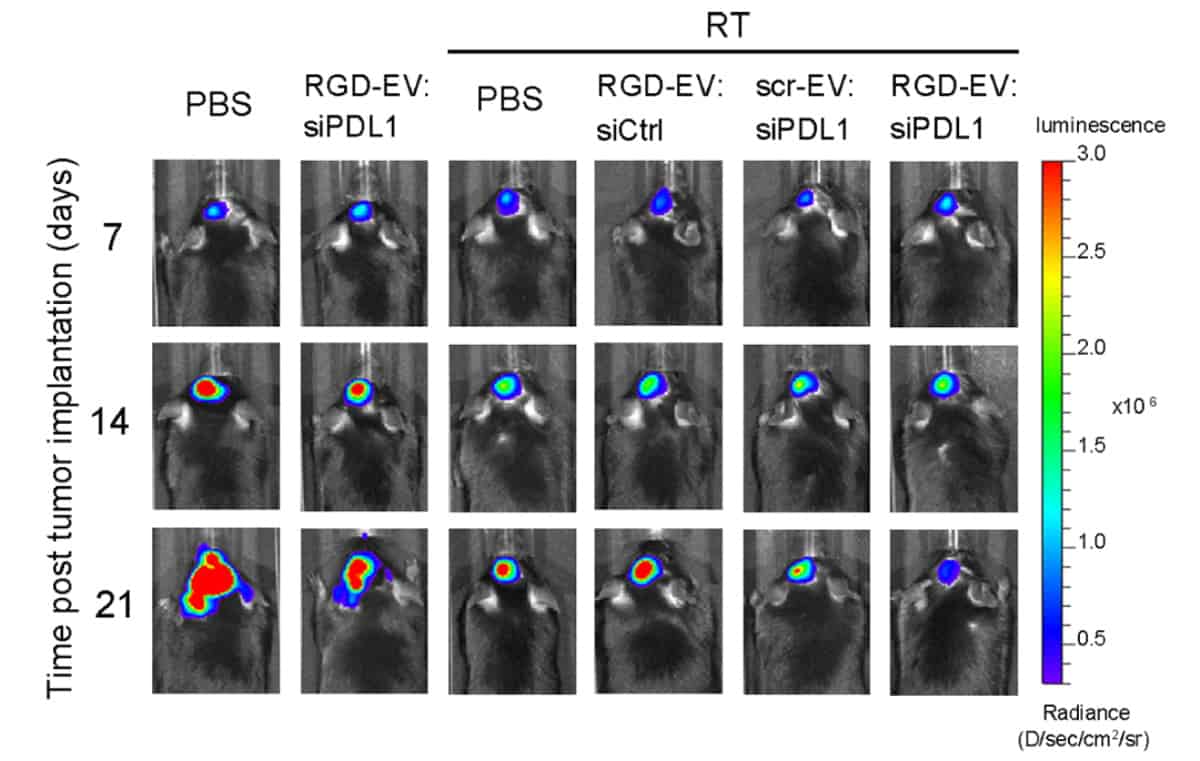
The researchers then put their combination therapy to the test. They injected mice with murine glioblastoma cell lines. Murine tumours were primed with a 5 Gy burst of radiation, analogous to stereotactic radiosurgery in a clinical setting, seven and 14 days following tumour cell injection. The mice received an injection of the combination therapy, unmodified EVs or saline (as a control) on days 10, 12, 17 and 19 following tumour cell injection.

Tracking tumour growth

The team found that priming the murine glioblastoma tumours with a burst of radiation enhanced the delivery of EVs to the tumours. The combination therapy also halted tumour growth and prolonged mouse survival. Results further suggest that using EVs allowed the immunotherapy to cross the blood–brain/tumour barrier, recruiting immune cells to the tumour site and inhibiting the expression of PD-L1. Fluorescence imaging studies showed that stronger fluorescence signals, and therefore more EVs, were observed in mice brains that had been irradiated relative to those that were not.

Large-scale production

The researchers say that their decision to isolate EVs from a human neural progenitor cell line, rather than stem cells or dendritic cells, was an important one. Using a human neural progenitor cell line allows them to produce EVs in larger quantities for larger studies and clinical trials.

Another important decision was to use copper-free click chemistry to modify EVs to include the brain-tumour-targeting peptide on the EV surface. Copper-free click chemistry, unlike some cell engineering methods, is suitable for in vivo applications, is fast and can be used for large-scale production of modified EVs. Previous work from the group found no obvious toxicity or tissue damage using these methods.

Now, Tannous’ team is scaling up EV production and labelling. The researchers are also working to further improve the EV delivery system and are testing how EVs can deliver nucleic acid therapies to brain tumours.

Whistler waves disappear close to the Sun

A close analysis of data from NASA’s Parker Solar Probe has revealed that electromagnetic “whistler waves” – so named because early radio operators mistook these eerie, descending sounds for a person whistling – are unexpectedly absent from certain regions of the Sun’s upper atmosphere. The discovery could lead to a better understanding of the physics of the solar wind, and thus to more accurate predictions of space weather and how it might affect us here on Earth.

The solar wind is a stream of energetic, charged particles – mostly electrons and protons – ejected from the Sun’s upper atmosphere, or corona, in all directions. Learning more about the dynamics of the solar wind is important because these charged particles perturb the Earth’s magnetic field when they collide with it. Such perturbations are known as space weather, and they can damage satellites, impact communications technologies and GPS signals, and even cause power outages on the ground at high latitudes.

Corona heating

The Parker Solar Probe was launched in 2018 with a mission to learn more about the solar corona and how heat moves through it. In the latest study, Cynthia Cattell and colleagues at the University of Minnesota Twin Cities in the US performed a statistical analysis of data from all of the probe’s solar “encounters” (as its orbits of the Sun are known) so far, focusing on observations made when the probe was especially close to the Sun.

Previous analyses had revealed that between about 35 solar radii (one solar radius is a little less than 696,000 km) and the Earth’s orbit at 215 solar radii, the solar wind contains “whistler waves”. These electromagnetic waves help regulate the way heat flows from the corona, and they also play an important role in the Van Allen radiation belts that surround the Earth.

Signatures of an ambipolar electric field

In regions closer to the Sun, however, the Minnesota researchers found no evidence of whistler waves. At less than about 30 solar radii, they instead spotted signatures of a different, electrostatic wave. The electrons in the solar wind in this region also showed evidence of being affected by an ambipolar electric field created partly by the Sun’s gravity. This effect is somewhat like the one that occurs near the Earth’s poles, where the solar wind is accelerated, Cattell explains.

The absence of whistlers implies that they cannot be responsible for controlling the heat flux in this region of the solar corona, she adds. “This heat flux is carried by what is called ‘strahl’ (the German word for beam or ray) electrons and the limiting of the heat flux is due to scattering of strahl by the whistlers so it is not a beam anymore,” she tells Physics World. “The whistler electric field rotates in a right-hand sense about the solar wind magnetic field at the same rate as the electrons do. So, electrons moving in a range of speeds see a constant electric field and are accelerated.”

Cattrell thinks the work should help scientists make better predictions of space weather. “If you don’t understand the details of energy flow close to the Sun, then you can’t predict how fast the solar wind will be moving or what its density will be when it reaches Earth,” she notes. “These are some of the properties that determine how solar activity affects us.”

Understanding the flow of heat is important also in many other astrophysical settings, including accretion discs, other stellar winds, and the interstellar medium, she adds.

The researchers, who report their work in Astrophysical Journal Letters, say they now hope to better understand why whistler waves are absent so close the Sun, how the electrons accelerated by the gravity-associated electric field might excite other waves and how that, in turn, impacts the solar wind. Meanwhile, Parker’s encounters are getting closer and closer to the Sun. In 2024 it will fly to within 6.08 million kilometres from our star – the closest any spacecraft has ever ventured.

Copyright © 2026 by IOP Publishing Ltd and individual contributors