Doing more with less Ilana Wisby, chief executive of Oxford Quantum Circuits. (Courtesy: Oxford Quantum Circuits)
It’s no surprise to anyone that quantum computing will have far-reaching impact in most areas of industry and communication. For physicist and “deep-tech” entrepreneur Ilana Wisby, the key to solving some of the 21st century’s most pressing challenges – from data security and drug discovery to climate science and artificial intelligence – lies in quantum computers. Wisby should know: she is the chief executive of the pioneering UK start-up Oxford Quantum Circuits (OQC).
Spun off from the University of Oxford in 2017 by fellow physicist Peter Leek, a year later the firm had built and launched the UK’s best superconducting quantum computer. In July this year, OQC followed in the footsteps of the likes of IBM and launched Europe’s first “quantum computing-as-a-service” (QCaaS) cloud-computing platform. “The launch of our QCaaS platform is not only a remarkable achievement in the history of OQC, but is a significant milestone in unlocking the potential of quantum computing both in Europe and globally,” says Wisby. Here, she talks to Physics World about the challenges of the quantum start-up sphere, the funding available in the UK, how to scale up quantum computers and more.
What’s it like being at a start-up and competing for funding in quantum technology right now? And where do you see the UK, when it comes to the global quantum technology race?
At OQC we are often compared to much larger companies, especially US-based ones. In the US, which has its own niche capital market that is risk-tolerant, these large companies often run huge fundraising campaigns to the tune of tens of millions. I am proud that we’ve achieved similar performances to much larger competitors with a lot fewer resources. That resource-efficient approach is recognized as one of OQC’s USPs within the investors community. We are demonstrating the type of return on investment they’re looking for.
I am proud that we have been able to achieve similar performances to much larger competitors, with a lot fewer resources
Part of being a start-up is that you are always trying to be innovative and therefore you can have an element of, “do what you can with what you have”. I think that hustle is something that the UK really has a drive for, and is within all of us. The UK has been key in pioneering the quantum programme, and there was government buy-in way ahead of much of the world. The likes of the EU, China and the US are of course bigger today, but we did share a lot of early work and research. This means that the UK has a diverse range of quantum technologies, and particularly when it comes to quantum sensing, the field is doing very well. We’ve also got a lot of momentum in quantum key distribution and cryptography.
So the UK is known for being a leader, particularly in academia. Where it historically has struggled is translating the academic innovation through to successful companies that remain in the UK. The government is very aware of this, and has opened a significant amount of investment focusing on research and development in quantum technologies. I firmly believe that the UK quantum scene is world-leading, particularly in the start-up sector. The way in which we collaborate with each other and encourage the sharing of ideas is, I think, important because we need to build a quantum ecosystem in order for it to be successful.
It’s not just about scaling up into big systems. Quality over quantity is what we have been focusing on, and with 10 orders of magnitude less money, we’ve got the same quality and the same power of devices, because we’re building smart. We’re building from the foundations, to get simple, scalable and flexible tech. It’s about investing in a design rather than just chasing scale.
At OQC, you focus on superconducting qubits, but there are a number of other types being exploited, such as cold ions and even silicon. Is there going to be one winner that comes out on top, or will we more likely see different qubits for different tasks?
This is not a race where there’s a one-horse winner. I come from a background of hybrid quantum systems, and I’ve worked with superconducting systems. But if we look at the computing market as a whole, and how that network is built, there are specific systems that are optimized for specific purposes.
I’m sure that there will be some technologies that are more widely adopted than others – if you want to do calculations quickly, and especially in the near term, superconducting circuits are the way to go. But if we’re starting to think about building an entire quantum network, I genuinely think there will be different elements that are more suited for different components of a future quantum computer. And right now, all of these technologies are room-sized, like we were in the 1960s with classical computation. We’ve got a long way to go before it’s an equivalent to what we have classically today – something that doesn’t need specialist engineers to make it work.
The other thing is, it’s really hard to get an objective take on which qubit is the best, as everybody’s biased to their own. At OQC, we are trying to understand the advantages, disadvantages and market for each of them. If you can find someone who can do that independently, I want to talk to them!
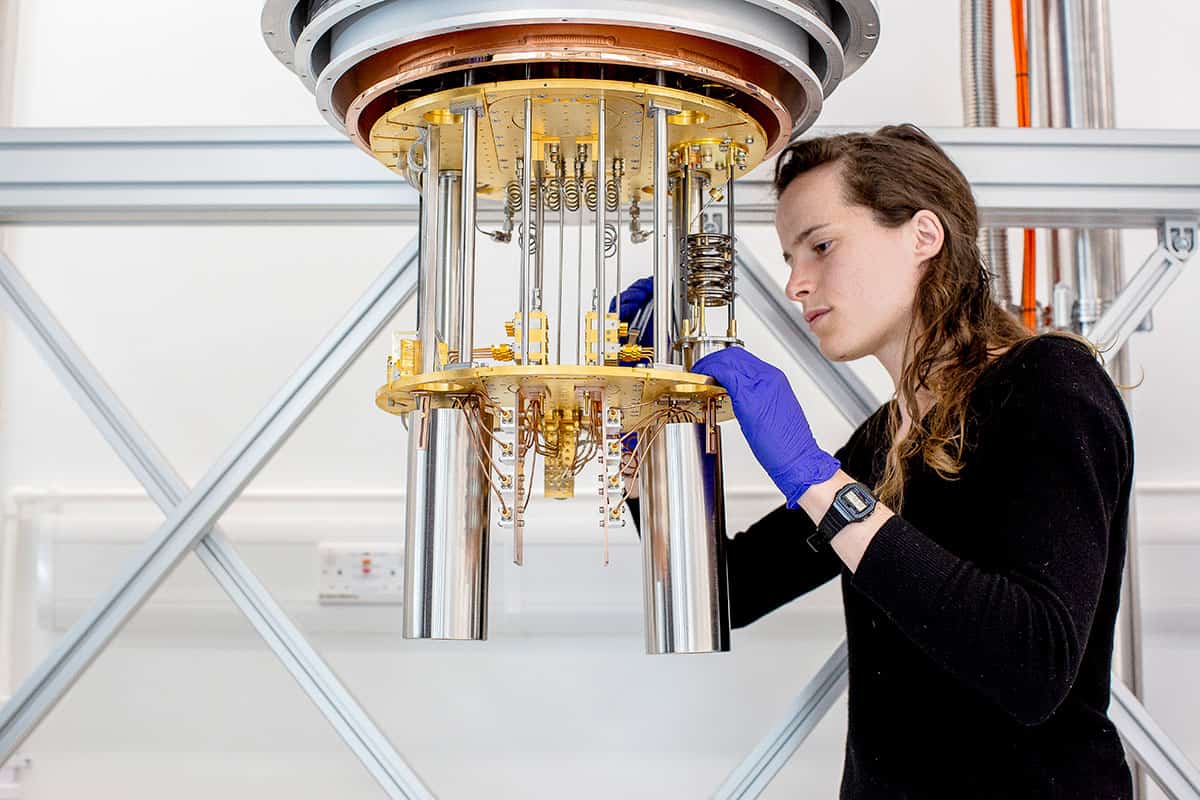
Cloud compatible An engineer inspects one of Oxford Quantum Circuits’ quantum computers. (Courtesy: Oxford Quantum Circuits)
As of now, we have four-qubit devices, which you can’t do true applications with, but we are soon scaling up to deliver larger-scale devices. Also, the number of qubits in any system is the worst measurement, as it’s a vanity metric. And this is where, while our four qubits may not stand up to those with 52 or 72 at first glance, all of those qubits are comparable to the best devices at this stage. Indeed, our qubits show high coherence and very low crosstalk. What we are trying to show now is that they are scalable, and as our company comes out of academia and into the R&D phase, we can look at things like scaling and engineering systems.
Going back to qubits, this is where benchmarking is so important, but currently there’s no independent approach. People are starting to talk about this, and the idea of “quantum volume” – which looks at number of qubits, connectivity and quality factors – is starting to head in the right direction.
Do you feel that there is a risk of hype in quantum computing, and the promises it makes, especially when it comes to people outside of the field?
Everyone talks about hype, but for me there’s a spectrum of thoughts when it comes to quantum technologies. You get some people who heavily lean towards an academic perspective, and don’t think anything should be said unless it’s been published and peer reviewed. And then others have already promised to solve the COVID-19 crisis using quantum computing. What I’m trying to do is to have an authentic voice that sits in the middle.
Even then, we’re having to justify saying that this field is going to be visionary. Quantum technologies are going to change the world, and I’m comfortable saying that the applications will be revolutionary and have a significant societal impact in a few years. But there are others who might find it uncomfortable saying even that much.
Quantum technologies are going to change the world, and I’m comfortable saying that the applications will be revolutionary and have a significant societal impact
For me, it’s about being able to help others understand that we do need to bring in the wider world. We need to engage with skills and people who don’t currently know that quantum exists. And the way to get their attention is for them to understand a concept or become interested in something that’s inspirational and conceptually cool – even if it’s not necessarily completely scientifically accurate. I’m okay with that.
Ultimately, as an industry, we need end users and we need that customer pull. We’re growing an industry and an ecosystem, and for that we need to be able to talk to a variety of people, whether they’re quantum specialists or software engineers or lab managers or marketing specialists. We need to be able to talk to everybody about what we’re doing, and that requires different strategies and a different language than purely scientific.
This episode of the Physics World Weekly podcast features a lively discussion about some of the best physics done this year as we talk about our Top 10 Breakthroughs of 2021. Our choices run the gamut from particle physics to neural engineering, with a good helping of quantum mechanics, fusion and astrophysics as well.
The Top 10 serves as the shortlist for the Physics World Breakthrough of the Year award, which will be announced on 14 December. Links to all the nominees, more about their research and the criteria for the award can be found here.
Physics World‘s Breakthrough of the Year coverage is supported by Bluefors, a leading supplier of cryogen-free dilution refrigerator measurement systems with a strong focus on the quantum computing and information community. Our aim is to deliver the most reliable and easy to operate systems on the market which are of the highest possible quality.
Researchers at ETH Zurich in Switzerland have developed a new way of controlling the strength of interactions between particles in two-dimensional semiconductors. Their technique, which relies on generating so-called “Feshbach molecules” and adjusting their interactions using an applied electric field, might well become a versatile “tuning knob” to study a broad range of 2D solid-state platforms in the laboratory.
Feshbach resonances allow researchers to tune the interaction strength between quantum entities by bringing them into resonance with a bound state. In the ETH team’s work, these states correspond to an exciton (an electron-hole pair) in one layer of a two-dimensional material bound to a hole in the adjacent layer. When the exciton (which is created by exciting the material with light) and hole overlap in space, the hole in one layer can then tunnel to the other layer and form an interlayer exciton-hole “molecule”, the researchers explain. It is this exciton-hole interaction strength that they tune by applying a varying electric field to the system.
Twisted bilayer system
In the work, the team, led by Atac Imamoglu, Ido Schwartz and Yuya Shimazaki of ETH Zurich’s Institute for Quantum Electronics, studied the 2D semiconductor molybdenum selenide (MoSe2), which belongs to the family of materials known as transition metal dichalcogenides (TMDs). In 2020, Imamoglu and colleagues showed that like its cousin, graphene (a 2D sheet of carbon just one atom thick), two single layers of MoSe2, separated by a single-layer barrier made of hexagonal boron nitride (hBN), can be arranged so that there is a small angle between the layers.
Such a “twisted bilayer” system, also known as a Moiré structure, can host a broad range of exotic and unexpected phenomena such as correlated insulator states and (in the case of graphene) even superconductivity thanks to strong correlations between the electrons in the layers. As well as these purely electronic states, TMDs also host light-matter states, which means they can be studied using optical spectroscopy – something that is not possible for graphene.
The researchers say that the electrically tuneable Feshbach resonances they exploited in the current work, which is detailed in Science, could be a generic feature of other bilayer systems that exhibit coherent tunnelling of electrons and holes. They add that being able to tune the binding energy of their Feshbach molecules using electrical fields is very different from the situation in cold-atom systems, where such resonances also exist, but must be controlled using magnetic fields, which are generally more difficult to produce. “The ‘tuning knob’ we have developed might become a versatile tool for a broad range of solid-state platforms based on 2D materials – opening up in turn intriguing perspectives for the wider experimental exploration of quantum many-body systems,” they explain.
I am a community builder in quantum technologies, start-up founder, mentor and PhD student, so I wear many hats that fit together nicely. Bringing people together in a field like quantum requires simplifying concepts to cater to all levels of education, as our community targets everyone interested in participating. My background in teaching physics has helped me a lot with this. As a start-up founder, I need to know how to structure my ideas to solve problems and attract the right partners.
In my research I characterize quantum materials to learn about current limitations at the fundamental level and to help develop better quantum hardware. To do this, I rely on my genuine curiosity, as well as persistence, as the process of scientific inquiry involves a lot of repetition and setbacks.
Another important role for scientists today is to stay objective and promote integrity in a hyperconnected world where fake news and exaggeration are constant challenges. Quantum computing, for example, currently resonates with many people’s interests and inevitably gets hyped. Some excitement is essential as it creates the impetus, enthusiasm and vision to drive big shifts. However, we should ensure that we paint the correct picture of current capabilities and the hard work that lies ahead until we have fully capable devices.
What do you like best and least about your job?
I feel fortunate to work on interesting things that are smoothly interconnected with one another. Every day I get to interact with talented people from diverse backgrounds. It is super fun to chat with entrepreneurs, policymakers, academics and enthusiasts about how to harness our distributed strengths. Inching towards a future where quantum computers can break new ground in drug discovery, optimization, machine learning and materials discovery will require the collective talent and contributions of many brilliant people. Further, I find it fulfilling to support and inspire others to reach their goals, and to make seemingly complicated subjects exciting.
On the downside, the field of quantum technologies is changing very fast, and it’s hard to keep up. It’s easy to get overwhelmed as there are so many exciting directions to pursue, and it’s hard to pick an area where one can have maximum impact. I have to sadly accept that I cannot get involved in everything.
What do you know today, that you wish you knew when you were starting out in your career?
From an early age, I had interests in many fields, and the advice I often received was that I needed to focus on one. I wish I had known that it’s okay not to want to be great at any one thing — you just need to be pretty good at an array of valuable skills that, when combined, make you truly one of a kind. It’s okay to specialize, but there is also room for those of us who want to be “jacks of some trades” instead.
Another important aspect I learned the hard way is that you have to work to learn, not just to earn. I wish I had volunteered often and said yes more than no. I also wish I had travelled more when I had few responsibilities: travelling to learn and discover; visiting places that would challenge my thinking; and meeting and networking with as many people as possible. Doing this can have a tremendous impact on your career and professional growth.
As space missions venture ever further afield, spacecraft will inevitably be exposed to greater amounts of cosmic radiation that can damage or even destroy their onboard electronics. Researchers at the Massachusetts Institute of Technology (MIT) and the US Air Force Research Laboratories have now shown that adding carbon nanotubes to transistors and circuits could render these devices resistant to higher amounts of radiation than is possible with standard silicon-based electronics.
Cosmic radiation is ionizing radiation made up of a mixture of heavy ions and cosmic rays (high-energy protons, electron and atomic nuclei). The Earth’s magnetic field protects us from 99.9% of this radiation, while the remaining 0.1% is significantly attenuated by our atmosphere.
Electronics designed for space applications have no such protection, however, and researchers are investigating ways of using emerging nanomaterials to mitigate the problem. Carbon nanotubes (CNTs), which are rolled-up sheets of carbon just one atom thick, are one promising possibility. These materials are beginning to be employed in electronics components such as transistors because they are more energy efficient than standard silicon-based devices. The radiation toleration of carbon-nanotube-containing field-effect transistors has not, however, been widely studied until now.
Electrical properties protected
In their work, a team led by Pritpal Kanhaiya and Max Shulaker deposited CNTs on a silicon wafer as the semiconducting layer in field-effect transistors (FETs). They then added radiation shields consisting of hafnium oxide, titanium and platinum to the semiconducting layer. They found that placing the shields both above and below the CNTs protected the electrical properties of the FETs against incoming X-ray radiation up to a dose of 10 Mrad (107rad). When a shield was placed only beneath the CNTs, they tolerated doses of up to 2 Mrad, which is similar to commercial silicon-based radiation-tolerant devices.
The researchers say their CNT-containing FETs, which they describe in ACS Nano, owe their high radiation tolerance to both extrinsic and intrinsic properties. The former include the fact that the devices can be fabricated at temperatures below 400°C. This makes it possible to engineer the device in geometries that are more tolerant to “total ionizing dose” effects – that is, to long-term ionizing damage. Intrinsic properties include material properties of the CNTs themselves, which provide radiation tolerance for so-called transient upsets that occur when ionizing radiation strikes the semiconducting channel in a device. The energy produced by the ionizing strike generates large amounts of electrons and holes within the semiconductor, creating charge disturbances and temporary current fluctuations.
NASA has launched a mission to measure the X-ray polarization from the most extreme and mysterious objects in the universe. The $188m Imaging X-ray Polarimetry Explorer (IXPE) was launched today from the Kennedy Space Center at 01:00 local time aboard a Falcon 9 rocket. During the probe’s two-year mission, it will study several astrophysical phenomena including black holes, active galactic nuclei, quasars, pulsars and supernova remnants.
Following a successful launch and separation, IXPE is now in orbit around the equator at an altitude of around 600 km above Earth. This particular orbit will minimize the X-ray instrument’s exposure to radiation in the South Atlantic Anomaly, the region where the inner Van Allen radiation belt comes closest to Earth’s surface.
The mission contains three identical telescopes, which are able to operate independently and that each have polarization-sensitive detectors. The craft will use these to provide simultaneous spectral, spatial and temporal measurements of cosmic sources, with scientists aiming to improve the polarization sensitivity by two orders of magnitude over the X-ray polarimeter aboard the Orbiting Solar Observatory OSO-8, which was launched in 1975.
Astronomers hope this will allow them to determine the geometry and the emission mechanism of active galactic nuclei and microquasars as well as find the magnetic field configuration in magnetars.
It is an indescribable feeling to see something you’ve worked on for decades become real and launch into space
Martin Weisskopf
“IXPE represents another extraordinary first,” says Thomas Zurbuchen, associate administrator for NASA’s science mission directorate. “IXPE is going to show us the violent universe around us – such as exploding stars and the black holes at the centre of galaxies – in ways we’ve never been able to see it. [It] will shape our understanding of the universe for years to come.”
Developed by NASA’s Small Explorer programme, IXPE is a collaboration between NASA and the Italian Space Agency and was selected in January 2017 with a launch date in May 2021. However, that was delayed due to the impact of the COVID-19 pandemic.
“It is an indescribable feeling to see something you’ve worked on for decades become real and launch into space,” says IXPE’s principal investigator Martin Weisskopf, who helped to conceive and build the spacecraft. “This is just the beginning for IXPE. We have much work ahead.”
A new wood-based material that conducts ions 10–100 times better than other polymers could find use in next-generation solid-state lithium-ion batteries. The material, which was fabricated by researchers at Brown University and the University of Maryland in the US, combines copper and cellulose nanofibrils and could be used as either a solid battery electrolyte or as an ion-conducting binder for the cathode of an all-solid-state battery.
Lithium-ion batteries are widely employed in applications ranging from mobile phones to electric vehicles. These devices have a high capacity and high energy density, which means they can store a lot of charge very quickly. During charging, lithium ions move from the cathode to the anode though an electrolyte, which is usually made from a lithium salt dissolved in a liquid organic solvent. While this type of electrolyte works well, at high currents, needle-like lithium-metal structures called dendrites form on the anode surface and flow into the electrolyte. These unwanted structures eventually pierce the barrier separating the anode and cathode, causing the battery to short or even, in some cases, to ignite.
Polymer ion conductor
To overcome this problem, researchers are looking to replace the liquid electrolyte in these devices with a solid-state one that is harder for the dendrites to grow through. Most solid electrolyte materials studied to date are based on ceramics, which make good ionic conductors but are also rigid and brittle. This makes it difficult to integrate them into electrodes, and they are also prone to cracking or breaking during repeated battery charging and discharging.
The new material made by Hu, Qi and colleagues is based on copper-containing cellulose nanofibrils, which are polymer tubes derived from wood. This combination allows the normally ion-insulating cellulose to rapidly transport lithium ions along the direction of the polymer chains thanks to the copper opening molecular channels in the polymer. According to the team’s modelling, these channels increase the spaces between the cellulose polymer chains, which normally exist in tightly packed bundles. The expanded spacing creates what amount to “ion superhighways” through which ions can zip by relatively unimpeded, they say.
As well as its high lithium-ion conductivity of 1.5 × 10⁻³ S/cm (a value comparable to that of ceramics), the new material is thin and flexible, and operates over a wide range of voltages of 0.2 to 4.5 V. The researchers say that their approach, which they detail in Nature, could be extended to other polymers and metal cations.
Digital flat-panel detectors are central to today’s clinical X-ray imaging systems. But flat detectors are ill-matched to the complex 3D shape of a human body. A better option could be to use curved detectors, which could minimize distortion around image edges and reduce vignetting compared with their planar counterparts. Efforts to produce flexible detectors, however, have so far been unsuccessful, due to the stiff and brittle nature of the underlying inorganic (mainly silicon-based) semiconductor technology.
A promising alternative for creating curved X-ray detectors is to use hybrid “inorganic-in-organic” semiconductors. One candidate architecture comprises X-ray attenuating bismuth oxide nanoparticles integrated into an organic bulk heterojunction (BHJ) consisting of the p-type polymer P3HT and the n-type PC70BM.
For such a material to function effectively as a curved detector, it must combine high bendability with optimized detection performance. To achieve this, a team headed up at the University of Surrey has examined the influence of P3HT molecular weight on the mechanical and electrical properties of these nanoparticle-incorporated BHJ (NP-BHJ) X-ray detectors.
Reporting their findings in Advanced Science, the researchers found that by tailoring the molecular weight of the organic semiconductor to lengthen the polymer chains, they could create robust, high-sensitivity curved X-ray detectors for medical applications.
“Our curved detector concept has shown exceptional mechanical robustness and enables bending radii as small as 1.3 mm,” says lead author Prabodhi Nanayakkara in a press statement. “The use of organic or ‘inorganic-in-organic’ semiconductors is also far more cost effective than conventional inorganic semiconductors made from silicon or germanium, which require expensive crystal growth methods.”
Performance parameters
To investigate the impact of P3HT molecular weight on detector performance, Nanayakkara and colleagues created rigid NP-BHJ detectors using four P3HT molecular weights – 25, 37, 46 and 55 kDa – as typically employed in P3HT-based optoelectronic devices. They fabricated the detectors on glass substrates and incorporated 55 µm-thick NP-BHJ films.
The team assessed a series of parameters, including dark current, photocurrent characteristics and charge transport characteristics. The detector dark current decreased with reducing polymer molecular weight. All devices, however, displayed low dark currents well within the industrial requirement of 10 pA/mm2 at an applied bias from −10 to −200 V. The device sensitivity was slightly higher for the lowest P3HT molecular weight, with a limit of detection (for a 70 kV X-ray source) of around 1.5 µGy/s – better than required for diagnostic imaging.
While performance parameters differed between the four devices, the researchers emphasize that all P3HT molecular weights evaluated provided excellent detector response characteristics, including ultralow dark current, high sensitivity and fast response time, highlighting the potential of NP-BHJ detectors for low-dose imaging and dosimetry.
Optimizing bendability
Next, the team assessed the mechanical properties of various detector constructions. X-ray detectors require a higher crystallinity to achieve satisfactory charge extraction. But with curved detectors, higher crystallinity can result in mechanical failure. To identify the most suitable P3HT molecular weight for a curved X-ray detector, the researchers performed grazing incidence wide angle X-ray scattering measurements on NP-BHJ films.
They found that crystallinity was lower for films fabricated from higher P3HT molecular weights, suggesting that such films have more amorphous regions that can bridge between the crystalline regions. These amorphous regions also increase intermolecular interactions and interchain entanglements, enabling greater deformation before mechanical failure.
The researchers also examined the impact of substrate thickness on the nanomechanical properties of various NP-BHJ films. They fabricated detectors on flexible polyimide substrates with thicknesses lower than (25 µm), equal to (50 µm) and higher than (75 µm) the 55 µm NP-BHJ layer. The mechanical behaviour was dependent on both P3HT molecular weight and substrate thickness. Lower molecular weight detectors were stiffer and extremely brittle, while those fabricated on thinner substrates curled excessively and delaminated easily from the substrates.
Based on the crystallinity and nano-mechanical analyses, the researchers predict that higher P3HT molecular weights and thicker flexible substrates are most suitable for fabricating curved X-ray detectors. With this in mind, they tested the responses of three detectors – 46 and 55 kDa P3HT on 75 µm substrates, and 55 kDa P3HT on a 50 µm substrate – to 40 kV X-ray irradiation under different bending radii.
All detectors displayed excellent resistance to bending, maintaining sensitivities of roughly 0.17 µC/Gy/cm2 and a dark current of less than 1 pA/mm2, even when curved to a radius as small as 1.3 mm. The team demonstrated the detectors’ mechanical robustness by performing cycles of dynamic bending down to a radius of 1.3 mm. After 100 cycles, the detectors exhibited less than 2.8% variation in sensitivity.
“The technology we’re demonstrating will help create a revolutionary new high sensitivity X-ray detector that is scalable, due to the design and materials adopted,” says senior author Ravi Silva. “This technology has huge potential in medical applications and other X-ray uses, so we’re working with a spinout company, SilverRay, and hope to turn this technology into the X-ray detector of choice for high-sensitivity, high-resolution, flexible large-area detectors.”
Much of quantum technology is linked to computing. It is easy to imagine how a better, more powerful computer, capable of solving complex problems, could be useful. But what is a computer, after all, if not a data-processing machine. Computers, quantum or otherwise, transform data into information, which is then used to steer scientific, medical, industrial processes. Their output is only as good as the data put in. And those data are collected by sensors.
New kinds of sensors and novel ways of obtaining information have, in fact, triggered many major technological and economic disruptions. “If we look back in history, Nobel prizes are aligned with sensors, such as Wilhelm Röntgen’s 1901 prize for X-rays,” says Kai Bongs, a quantum physicist at the University of Birmingham, UK. “No-one knew what these were, but nowadays every hospital, airport scanner, as well as a number of industrial quality-control machines have X-ray machines in them. They allow us to see something, to get data inside bodies that we hadn’t been able to get before.”
Indeed, the discovery of X-rays had a significant impact on medicine, security and industrial processes. In a similar vein, sensors and other devices that exploit quantum principles – especially the sensitivity of a quantum state as compared to its environment – may well be the first stage of a commercial quantum revolution.
Bongs is principal investigator of the UK Quantum Technology Hub Sensors and Timing. This hub, which is part of the National Quantum Technologies Programme, has more than 110 projects valued at around £120m. Its aim is to drive the innovation and commercialization of quantum clocks and sensors such as magnetic sensors for healthcare and gravity sensors. These technologies have applications across a diverse range of sectors, including climate, communications, energy, transport, healthcare and urban development.
“When we talk about quantum sensors we mean sensors that use some enhanced quantum effects, like superposition or possibly entanglement,” says Bongs. Superposition is the idea that quantum particles can be in two states at once or travelling along two trajectories at once. “The difference between those two trajectories can create essentially a quantum interference at the end when we bring them back together and that allows us to read out what ever caused the difference with very high precision,” he explains.
This quantum effect is being exploited by Bongs and his colleagues to create a quantum gravity meter, based on atom interferometry. In the device, atoms travel along two different trajectories at two different heights. This means that they are travelling through two slightly different gravitational fields and when they come back together the interference pattern can be used to reveal the gravity gradient.
Gauging gravity
Most gravity meters are based on a mass suspended on a spring, with changes in the position of the mass indicating change in the gravitational forces acting on it. Springs, however, stretch and bounce around if the ground vibrates. This means that these devices have to be recalibrated over time. They also have to be left in place for quite a long time to take a reading, to average out the background noise created by vibrations due to everything from passing trucks and trains to low-level seismic activity and more.
Spring-based gravity meters are already very sensitive, but the advantage of a quantum gravity meter is that when the ground vibrates for any reason, the whole unit moves as one, as there is no spring to bounce around. The container, the clouds of atoms, and the laser that measures how they fall, all shift together. “You overcome not necessarily the sensitivity barrier,” Bongs says, “but you overcome the barrier of ground vibrations, so that you can measure much faster due to suppression of noise.” You can then start to push the sensitivity, he adds.
In civil engineering, gravity sensors can be used to detect anything under the ground that creates a mass difference. They could help find buried infrastructure such as pipes, tunnels and old mine shafts. While there are other techniques for doing this, such as ground penetrating radar, most of them are active techniques. You have to put a signal into the ground, which places limits on how deep they can go. “The real advantage of gravity is that it is passive, so the ground doesn’t attenuate the signal because we are not putting a signal in, we are just passively measuring it on the surface,” explains Daniel Boddice, a civil engineer at Birmingham. As long as the object produces a big enough signal on the surface, it can be detected. In theory there is no fundamental limit on depth.
Bad vibrations
Despite their potential, Boddice says that gravity sensors are not used very often, even in geophysics. This is because they are currently too expensive due to the amount of time you have to leave them in position to gather enough information so that you can cancel out the vibrational noise. He adds that there is always vibrational noise, because the Earth is always shaking. Boddice’s colleague Nicole Metje, also a civil engineer at Birmingham, says that it is not just seismic vibrations that create the noisy signal. “When you are on a site even things like traffic, people moving, people drilling, that all causes vibration.” Boddice adds. “The real opportunity with a quantum sensor is going to be that we can use it in more places because we can take measurements quicker and more viably, and more accurately.”
Metje and Boddice have recently been using quantum gravity sensors to detect culverts – a pipe or structure that channels water – on railway tracks. They provide drainage but if they become blocked, the track bed becomes saturated with water and you get what are known as “wet beds”. This impacts the track’s stability and can create structural issues such as dips, which affect the speed at which trains can safely travel, causing delays.
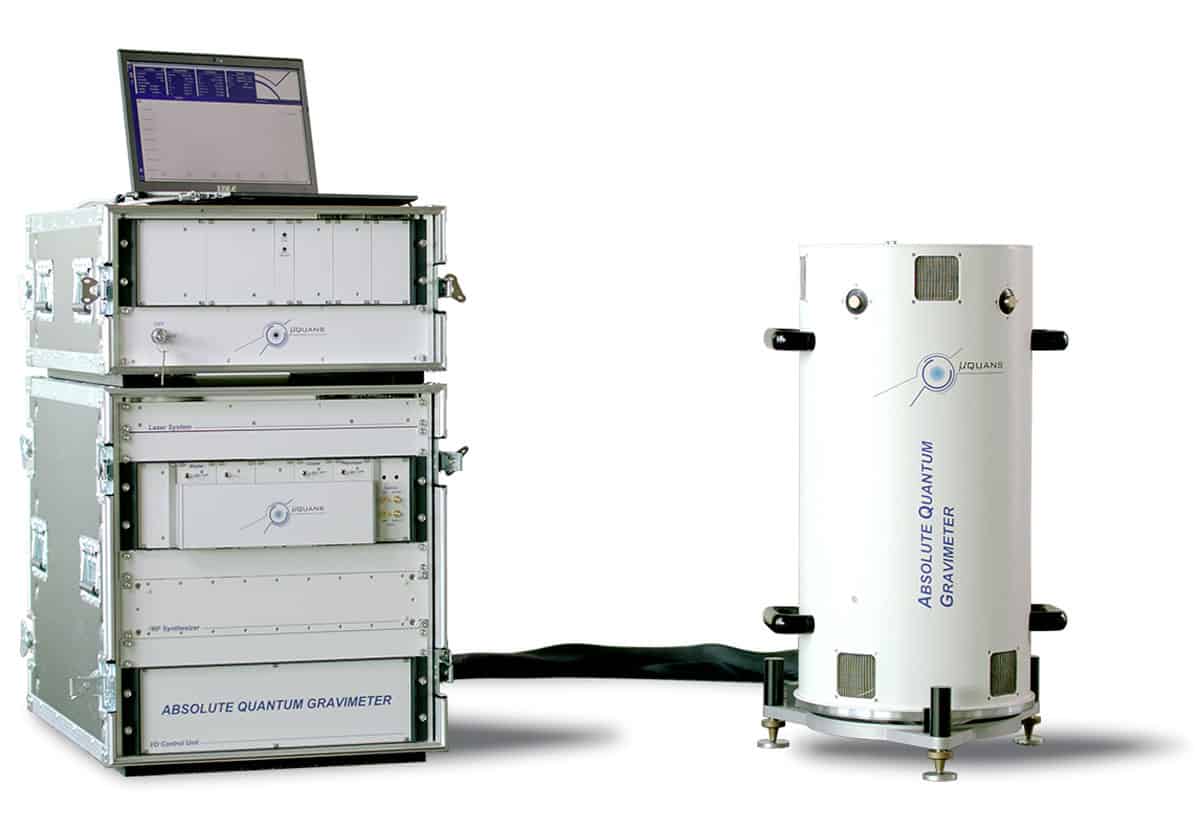
The Absolute Quantum Gravimeter from French company Muquans. (Courtesy: µQUANS)
These culverts can be buried deep under the track, which can make finding them and assessing their condition challenging. Ground penetrating radar often cannot infiltrate far enough. Measurements also have to be taken quickly as engineers usually only have a few hours on the track at night. Metje has shown that gravity sensors work better than any other technique for finding railway culverts.
Existing spring-based gravity sensors are, however, a last resort, Metje points out, because they are slow. But quantum gravity sensors could change this. Not only could they take measurements much faster due to the lack of noise from vibrations, they also don’t need to be stationary. Such quantum sensors could be placed on trains scanning the tracks as they go – indeed, the Birmingham team has been running trails on sections of train track in the UK. “We’ve done some investigations where we have looked at silted culverts, full culverts and empty culverts – so full with water, full with silt and empty,” Metje says. “You can’t detect [the differences] if you just do one measurement, but the idea is that we could have sensors on trains and if you get time lapse measurements you can then detect differences.”
Mitigating risk
George Tuckwell at the RSK Group – a UK-based environmental and engineering consultancy – has also been exploring how these quantum gravity sensors could be used for civil engineering applications. RSK helps its clients “de-risk” construction projects by accessing ground conditions at an early stage. They map the ground to identify variations in bedrock and groundwater, and other natural and artificial variations in the ground such as landfill and mine workings. This protects projects against unforeseen problems that can cost money and cause delays.
Tuckwell and his colleagues already perform gravity surveys, but these can be slow, time consuming, and therefore expensive. They also almost always require follow-up work, such as digging a hole or drilling a borehole, to identify the mass anomaly. Tuckwell hopes that quantum sensors could change this, as they should be more accurate, much faster and able to measure things that current devices cannot.
Together with the University of Birmingham and other industrial partners, Tuckwell has been working on combining quantum gravity sensors with artificial intelligence, past data and machine learning to create a system that can provide a model of the most probable ground conditions. The ultimate goal is to create a set-up that can scan a patch of land and provide an accurate map of the subsurface, with all the required information and no need for further investigations.
One of the advantages gravity has as a sensor is that it is impossible to shield a subsurface feature from its gravitational affect, so there is no way of hiding it. If there is something there that gravity could measure then gravity will measure it
George Tuckwell, RSK Group
“You can imagine an intermediate step where you would scan the ground, and the gravity sensor would say these are the three things that [the mass anomaly] is most likely to be and this is what you should do to confirm or otherwise to pin it down to one possibility – and lead you through what follow-up data to take,” Tuckwell says. “We have already developed an algorithm that as you are doing the survey it can suggest to you where you should measure the next point, to have the biggest impact on the certainty you’ll get of the model of the subsurface, and you can do that as you are going along.”
Although civil engineering is going to see the first commercial applications of gravity sensors, Tuckwell adds that there is also a lot of military interest. “For a defence and security application it might be a clandestine tunnel or some subsurface facility,” he explains. “And one of the advantages gravity has as a sensor is that it is impossible to shield a subsurface feature from its gravitational affect, so there is no way of hiding it. If there is something there that gravity could measure then gravity will measure it.”
From ships to volcanoes
Quantum gravity meters could also be used to create secure navigation systems. In recent years there has been increasing concern about GPS spoofing, particularly in marine navigation. This is when a ship’s navigation system is sent a false signal, so that it thinks it is in a different position to where it actually is. In the hands of rogue states or pirates this could potentially be used to hijack or wreck boats, or steer them into hostile territorial waters – a 21st-century version of the lanterns used by Cornish ship-wreckers.
If we could create accurate gravity maps, ships could have an onboard quantum gravity meter, and could then trace the gravity values and match them to the map, giving them their position. In theory, this gravity meter could be in an enclosed box entirely isolated from the outside world, making it unhackable. Even if somebody jammed the ship’s communications, satellite and radar navigation systems – all its links to the outside world – it would still be able to navigate. “The only way to interfere with [the gravity sensor] is to essentially change the gravitational signal, but that means moving masses on the order of mountains,” Bongs explains.
Unprecedented access The Absolute Quantum Gravimeter (see above) from French company Muquans has spent a year on Mount Etna collecting measurements. (Courtesy: iStock/marcocalandra89)
Measuring changes in gravity around a volcano is essential as it gives clues about changes in density of the underlying materials such as rock, gas and magma. An increase in gravity might suggest an influx of a denser material such as magma, while a drop in density (and so gravity) would point to a sinkhole. “The idea behind this instrument is really to exploit the gravity measurement at the surface of the volcano in order to obtain some information about the underground geophysical processes and get a better understanding of what is happening inside the volcano,” Desruelle explains. The main thing the device is measuring is changes in masses of magma inside the volcano, with the long-term goal of gathering enough data to predict volcanic eruptions. He adds that this is likely the first time that geophysicists have deployed a gravimeter so close to the top of a volcano, and that the researchers have already acquired some new information about the behaviour of Mount Etna, which will be published soon.
According to Desruelle, the way a quantum gravity meter works is both complicated and simple. Simple because it is basically a Newton experiment, where the test mass is dropped in a vacuum chamber and its vertical acceleration is measured, to give the value of gravitational acceleration, g, at any point on the Earth’s surface. Where is gets complicated is that instead of using an apple, this device uses a cloud of laser-cooled rubidium atoms. Every half a second, it captures a cloud of atoms, cools them to a temperature of a few kelvin and then lets them fall, using lasers to measure their acceleration (Sci. Rep.8 12300).
The quantum nature of the device comes from its reliance on wave–particle duality and using quantum interference to reveal differences in the gravitational field. The company did have to struggle with some challenges when it came to the mass, power consumption and size of the device. These factors were especially important for being able to successfully deploy the gravimeter in terrain such as that of Etna, making it robust enough to survive a year or more of changing temperatures.
As with many civil-engineering applications, the lack of noise from vibrations is a big advantage on a volcano. “As you may guess, the volcano is not a very friendly environment,” Desruelle says. “You have a very strong level of vibrations all the time and it is very challenging to acquire a very high resolution on the gravity measurement.” Another advantage is the lack of any springs in the quantum system, meaning that measurements can be taken for a very long time, with no need to recalibrate the system. Being able to collect data without any interruptions for months or years is very important for understanding complex geophysical systems – and is simply not possible with a mechanical gravity meter.
Beyond computing
Desruelle believes that while advances in building quantum computers are very interesting, “we are still talking about research activities and long-term perspectives”. Quantum gravity meters, however, are already operational and being used in the field. “I really believe that with quantum gravity meters, we have reached a very different level of technological maturity,” he says, pointing to concrete examples of their applications. Quantum gravity sensors can be used for any activity where “you really want to have an idea of the underground mass distribution”. This applies to hydrology and seismology, as well as civil engineering projects to detect voids, sink holes, tunnels and cavities. “Many people are interested in this instrument for geodesy,” he adds, “so they want to get a very good understanding of the geosphere and the gravity maps, so many institutes are assigned to provide gravity maps in many areas.”
A somewhat less practical, but equally interesting from a research point of view, application is that gravity meters can be used as dark-matter detectors. For civil engineering and geophysical applications, the two different paths the atom follows are just a few millimetres apart, but increasing the size of the device significantly increases its sensitivity, allowing it to be used to detect certain candidates for this mysterious invisible matter, which makes up almost 85% of matter in the universe.
As of January, UK Research and Innovation had already funded seven projects, with a £31m investment, that hope to show how quantum technologies could solve some of the greatest mysteries in fundamental physics. Three of the projects are looking at developing quantum-enhanced interferometry and sensors in the hunt for dark matter – to detect ultra-light candidates such as axions or to test our theories about the quantization of space–time. Often, a paradigm-shifting discovery in science comes on the back of melding together new technologies and established theories. We might still be at the very dawn of quantum sensors, but how remarkable it is that they can simultaneously help us build a better road and delve into the deepest mysteries of the universe.
A new, nanostructured version of a material known as a chalcogenide glass could find its way into a wide variety of optoelectronics applications thanks to its unusual transparency. Although chalcogenide glasses are already employed in detectors, lenses and optical fibres for near- and mid-infrared photonics applications, their use in the visible and ultraviolet parts of the electromagnetic spectrum has been limited because they strongly absorb light at these wavelengths. A team from Duke University in the US has now found a way to eliminate this undesirable effect, with possible future applications in underwater communications, environmental monitoring and biological imaging.
Chalcogenide glasses are amorphous materials that contain one or more chalcogens, which are chemical elements from the family that includes sulphur, selenium and tellurium. While they are ideal for use at infrared wavelengths, with applications ranging from optical switches and wavelength converters to molecular fingerprinting and astronomy, their lack of transparency in the ultraviolet is a drawback because many other applications, including underwater communications and biomedical imaging, require UV light sources.
Higher-order harmonic frequencies
Researchers led by Natalia Litchinitser recently predicted that nanostructured gallium arsenide (GaAs), a semiconductor widely employed in electronics, could react with high-intensity pulses of light in a way that differs from the behaviour seen in bulk or even thin-film versions of the material. This is because very thin wires of the GaAs lined up next to each other might vibrate at frequencies one or two octaves higher than the bulk or thin film material, creating higher-order harmonics with much shorter wavelengths.
The team set out to discover whether the same held true for chalcogenide glasses by depositing a 300 nm thick film of arsenic trisulphide (AsS3) onto a glass substrate. They then used electron beam lithography and reactive-ion etching to position the 430 nm wide AsS3 wires 625 nm apart from each other, creating a structure known as a metasurface.
Unexpected result
While bulk AsS3 completely absorbs light above frequencies of 600 THz (the blue-green or cyan colour range), Litchinitser and colleagues found that when they illuminated their metasurface with near-infrared (NIR) light, the nanowires transmitted faint signals at a wavelength of 846 nm, which is in the UV part of the spectrum. They attribute this faint signal to the material generating and transmitting both the NIR frequency and its third harmonic. This was very unexpected because the third harmonic falls into the range at which the material should be absorbing it, Litchinitser says.
The team attribute this result to the generation of nonlinear third harmonics and their phase locking with the original NIR frequency. “The initial pulse traps the third harmonic and sort of tricks the material into letting them both pass through without any absorption,” Litchinitser explains.
The researchers, who report their work in Nature Communications, now plan to engineer chalcogenide structures other than nanowires that can carry harmonic signals even better. One possibility would be pairs of long, thin, Lego-like blocks spaced at the right distance to produce stronger signals at the third and second harmonic frequencies. Stacking multiple layers of these metasurfaces atop each other might also enhance the effect, they predict.