

Laser-free trapping of heavy molecules opens an alternative route to new physics

The quest for physics outside the Standard Model often takes place at major accelerator facilities like CERN’s Large Hadron Collider or huge underground detectors for neutrinos, dark matter and other exotic particles. Researchers in the Netherlands have now opened an alternative front in this quest by developing a new laboratory-scale technique for trapping heavy neutral molecules. Such molecules are considered ideal candidates for detecting beyond-the-Standard-Model asymmetries in the electron’s electric dipole moment (eEDM), but previous methods were not capable of confining them. The technique therefore gives physicists a fresh set of tools for finding new physics.

Standard methods used in eEDM searches involve performing high-precision spectroscopy on atoms or molecules that are first slowed and then trapped with lasers or electric fields for the duration of the measurement. The problem is that finding new physics may require trapping molecules that are too heavy to be confined with lasers. Electric fields, for their part, can only trap heavy ions, rather than neutral atoms or molecules.

It’s a trap!

A new method can now be added to this list thanks to researchers at the University of Groningen, who developed it in collaboration with colleagues at Vrije Universiteit Amsterdam and Nikhef, the Dutch particle-physics institute. The researchers begin by creating molecules of strontium fluoride (SrF) via a chemical reaction that takes place inside a cryogenic gas at a temperature of around 20 K. These molecules have initial velocities of 190 m/s, compared to around 500 m/s at room temperature.

The molecules then enter a 4.5-metre-long device called a Stark decelerator in which alternating electric fields act to slow and then stop them. The SrF molecules remain trapped for 50 ms, after which the researchers analyse them using a separate laser-induced fluorescence detection system. Such measurements reveal fundamental properties of the electron, including the eEDM, that can then be checked for any asymmetry.

The heavier the better

These SrF molecules are around three times heavier than other molecules previously trapped using similar techniques, notes Steven Hoekstra, a physicist at Groningen and lead investigator on the research. “Our next step is to trap even heavier molecules, such as barium fluoride (BaF), which is one-and-a-half times heavier than SrF,” he says. “This type of molecule is even better for measurements on the electron dipole. Basically, the heavier [the molecule], the better these measurements will become.”
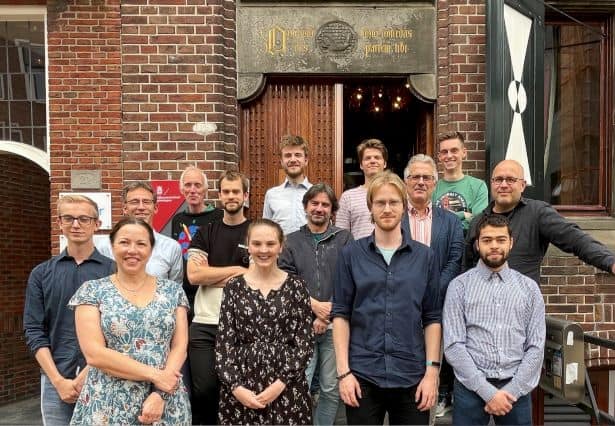
Photo of members of the NL-eEDM team standing on the stairs outside their laboratory

Trapping heavy molecules has other applications beyond eEDM measurements. One example might be to study collisions between molecules at low energies, under conditions similar to those found in space. Measurements on slowly moving molecules could also yield deeper insights into the quantum nature of their interactions. At high enough densities, the molecules’ so-called dipole–dipole interaction, which depends on their orientation relative to each other, makes a big difference in how they interact. These types of measurements offer opportunities that are not possible with stationary atoms, which do not interact in this way.

Complex and chiral

As a next step, Hoekstra says that he and his colleagues, who report their work in Physical Review Letters, plan to increase the sensitivity of their measurement setup by upping the intensity of their molecular beam. “We are also thinking of trapping more complex molecules, such as BaOH or BaOCH3,” he tells Physics World. “Additionally, we could use our technique to study asymmetries within chiral molecules: those that have a left and right-handed version.”

Ben Sauer, a physicist at Imperial College in the UK who was not involved in the current study, describes the result as the culmination of about 20 years of research on molecule deceleration. He predicts that it will have a big impact on precision measurements of the eEDM, where the resolution of the measurement is directly proportional to the time available to interrogate the molecules. As for wider applications, Sauer says: “I can see it being applied to some special cases. I think the limit is that there is a lot more interest in light molecules than heavy ones, since most of chemistry takes place at the top of the periodic table. But it is really good for physics investigations.”

Solar-powered harvesters could produce clean water for one billion people

One billion people could access safe drinking water using devices that use solar energy to condense water from the air. That is the conclusion of a team of researchers in the US led by Jackson Lord at X, The Moonshot Factory, who have developed a new tool for assessing the global potential for water harvesting. Their tool could soon help researchers to design completely off-grid water sources, suitable for use in local communities in many parts of the Global South.

The lack of access to safely managed drinking water now affects some 2.2 billion people worldwide. Addressing this serious problem using existing technologies is a key part of the United Nation’s sustainable development goals – with the organization declaring that everyone should have access to five litres of safe drinking water every day.

This could be achieved in some regions using atmospheric water harvesters (AWHs), which draw clean liquid water out of humid air. There are several different types of AWH, and Lord and colleagues focused on the solar-driven, continuous-mode AWH (SC-AWH). In such a device, heat from sunlight drives warm, humid air through a heat exchanger where it cools and releases water via condensation. Because a SC-AWH operates during the day when relative humidity tends to be low, it has a low efficiency and it had not been clear which locations worldwide are suited for its use.

Geospatial tool

Now, Lord’s team has created a geospatial tool called “AWH-Geo” for assessing the global potential for water harvesting. Based on a Google Earth Engine, the tool uses data from ERA5: a database containing a vast number of historical climate observations going back to 1979. To assess the varying outputs of atmospheric water harvesting in different regions, AWH-Geo considered a location’s sunlight irradiance, its relative humidity and its average air temperature. In addition, the tool accounted for annual variations in these parameters.

The team also looked at the global distribution of people without access to safe drinking water, using data from the World Health Organization and UNICEF. Combining this with AWH-Geo output, the researchers showed that atmospheric water harvesting could realistically provide five litres of  safe drinking water for some one billion people worldwide.

This is based on the use of a hypothetical SC-AWH with a harvesting area of 1 m2. The team calculates that such a device could yield 0.2–2.5 litres of water per kilowatt hour of primary solar energy when operating at a relative humidity range of 30% to 90% and average air temperature of 20 °C.

The researchers are now developing such a device, and with technological improvements they believe it could provide cost-effective, completely off-grid access to high-quality drinking water for many communities in the Global South. The researchers will now continue to use AWH-Geo to guide the development of new types of water-harvesting devices – with the ultimate aim to bring the UN’s goal for clean water a step closer.

The research is described in Nature.

Theory of teapot dribbling is complete at last, solar panels host astonishing microorganisms

Pouring from a teapot

Cast your mind back to 2009 and you might remember how physicists in France devised a way to end the trauma of tea dribbling down the underside of the spout of a teapot when you are pouring a brew. They found that the surface of the spout affects the flow of the liquid and that the best option to create dribble-free pouring is to give the spout a thin layer of a “super-hydrophobic” coating – a material that strongly repels water.

Now researchers in Austria and the UK say they have formulated a “complete theory” of the dribbling teapot effect – one that considers the inertia, viscous and capillary forces at play when a drop forms at the edge of the teapot spout that then wets the underside of it. By carrying out experiments – presumably involving lots of tea drinking – they confirmed their theoretical analysis, finding that the liquid trickles down the underside of the teapot spout when poured slowly but not when poured at a faster rate. The end of tea-stained tablecloths may be in sight. If you’re fast enough, that is.

In some locations, the build up of dust and biological materials can seriously degrade the efficiency of solar panels. Now, researchers at the São Paulo Research Foundation in Brazil have discovered that some microorganisms are well adapted to thrive in the harsh conditions found on the surface of solar panels. What is more, they say that these tough life forms could be used in a wide range of applications including sunscreen and pigments for textiles. Indeed, they believe that the resilient organisms could even be co-opted to help keep solar panels clean.

Astonishingly, the team found very similar microbiota on panels in locations as disparate as Brazil, California, Spain, the Arctic and Antarctic. About 90% of the organisms belong to two genera of bacteria. More recently they have identified a yeast that is present on panels in cooler climes. This organism has tensoactive properties – which means that it reduces the surface tension of water. This, say the researchers, could make the yeast useful for creating new detergents and antimicrobial agents.

Record-high thermal conductivity anisotropy comes with a twist

A simple twist has achieved a record-high anisotropy in thermal conductivity, reports an international group of researchers at the University of Chicago, University of Illinois at Urbana-Champaign, Cornell University and the Chalmers University of Technology. Their versatile approach could be used to cool nanoelectronic devices internally.

As described by Moore’s law, the number of transistors in integrated circuits is doubling every two years. But as computers become faster, the heat they produce also increases. To tackle this problem, one needs materials with high thermal conductivity, and even better materials with thermal properties that are anisotropic. Anisotropic materials have high thermal conductivity in some directions and low thermal conductivity in other directions. This means that they can simultaneously dissipate heat from a hotspot (local overheating) in directions with high thermal conductivity, while providing thermal insulation in other directions.

Layered materials

In this latest research, van der Waals crystals were used as starting materials. These are materials such as graphite and molybdenum disulphide, which comprise atomically thin layers that are stacked together. They combine strong in-plane bonding with the weak cross-plane bonding, which allows for the easy separation of the layers.

The team, lead by Jiwoong Park, David G Cahill and Paul Erhart, showed that by utilizing the anisotropy of van der Waals crystals and interlayer rotation, the thermal conductivity in the stacking direction can be suppressed to that of twice the thermal conductivity of air.

“Our nanomaterial film behaves as if it were 2D,” says Shi En Kim, who is a graduate student in molecular engineering at the University of Chicago. “Heat flows through the sheets as sluggishly as if through the air. That’s quite surprising, considering what we have here is a fully dense solid.”

High and ultralow thermal conductivity

Van der Waals materials combine strong in-plane bonding with weak bonding between planes. However, it is hard to change the conductivity of only one axis. It is known that twisting the two layers of graphene by a certain angle produces novel electronic properties. In the same line, researchers have incorporated twists in the single-layered molybdenum disulfide nanosheets by stacking monolayers of molybdenum disulfide randomly, leading to symmetry breaking in the cross-plane direction but preserving the perfect crystalline order in the in-plane direction.

They were thus able to preserve the high in-plane conductivity of a pristine bulk crystal, but the crystalline mismatch of the layers leads to increased phonon scattering, and ultra-low thermal conductivity, in the cross-plane direction. Currently, the ratio between the in-plane and cross-plane thermal conductivity of the material is a record high, reaching 900. This beats the previous record of 340 set by pyrolytic graphene.

The material was tested in a real-life application by being used as a heat-spreader for gold electrodes, which are a proxy for the nanowires that run through modern-day portable electronics. One gold electrode was covered with the molybdenum disulfide layers, while the other was not. When an electrical current was passed through the electrodes they warmed up due to Joule heating. The team found that the pristine electrode deteriorated quickly from overheating. The electrodes covered with molybdenum disulfide, however, were still functioning due to the cooling effect coming from the effective heat dissipation in the in-plane direction

The authors insist that this approach is not limited to molybdenum disulfide but could use many different 2D materials. Due to the infinite variability of possible combinations of 2D materials, this breakthrough opens a huge area of future research where the thermal conductivity of materials can be finely tuned.

The research is described in Nature.

Quantum material ‘learns’ like a living creature

Quantum materials known as Mott insulators can “learn” to respond to external stimuli in a way that mimics animal behaviour, say researchers at Rutgers University in the US. The discovery of behaviours such as habituation and sensitization in these non-living systems could lead to new algorithms for artificial intelligence (AI).

Neuromorphic, or brain-inspired, computers aim to mimic the neural systems of living species at the physical level of neurons (brain nerve cells) and synapses (the connections between neurons). Each of the 100 billion neurons in the human brain, for example, receives electrical inputs from some of its neighbours and then “fires” an electrical output to others when the sum of the inputs exceeds a certain threshold. This process, also known as “spiking”, can be reproduced in nanoscale devices such as spintronic oscillators. As well as being potentially much faster and energy efficient than conventional computers, devices based on these neuromorphic principles might be able to learn how to perform new tasks without being directly programmed to accomplish them.

Mimicking non-associative learning

In the new work, researchers led by Subhasish Mandal in the Department of Physics and Astronomy at Rutgers focused on nickel oxide, which is a typical example of a Mott insulating material. When they monitored how the material’s electrical conductivity changes as the concentration of its atomic defects is reversibly modulated using external stimuli such as oxygen, ozone and light, they found that it mimics non-associative learning. This type of learning is one of the most fundamental ways in which living organisms learn, and it helps animals adapt continuously to changing situations.

Another intriguing finding from the study is that when the researchers exposed the nickel oxide to rapidly changing oxygen concentrations or different light intensities, the material was unable to respond fully, and instead remained in an unstable state with its electrical conductivity fluctuating little. When they later introduced additional atomic defects into the sample using a harsher stimulus, ozone, the material’s electrical conductivity fluctuated faster, only to slow down again.

Universal learning characteristics

Mandal says that the team’s results demonstrate universal learning characteristics such as habituation and sensitization that are generally found in living species. He also suggests that the characteristics they unearthed could inspire new algorithms for unsupervised learning in neural networks and AI, much as the collective motion of birds or fish has done in the past. “The growing field of AI requires hardware that can host adaptive memory properties beyond what is used in today’s computers,” he says. “We find that nickel oxide insulators, which historically have been restricted to academic pursuits, might be interesting candidates to be tested in the future for brain-inspired computers and robotics.”

Beyond nickel oxide, the researchers say that similar effects could be found in other correlated materials that have defects susceptible to modulation using external stimuli. They now plan to further explore the learning behaviour of nickel oxide devices under electric fields in test chips.

The team reports its work in PNAS.

Quantum start-up targets single photons, perovskite pioneers bag Rank Prize

Our first guest in this episode of the Physics World Weekly podcast is the physicist Carmen Palacios-Berraquero, who is chief executive of Nu Quantum. The UK-based company spun-out from the from the University of Cambridge in 2018 and Palacios-Berraquero explains how the firm’s single-photon sources and detectors are used in quantum technologies.

Also in this episode are Akihiro Kojima and Mike Lee, who are two of seven winners of the 2022 Rank Prize for Optoelectronics – which has been given “For the discovery and development of all-solid-state perovskite semiconductor solar cells”. Kojima and Lee talk about the potential that perovskites have for creating high-performance solar cells and also chat about where their careers have taken them since they did their award-winning work.

Special relativity keeps digital identities secure

The laws of physics have been helping to keep sensitive information secret for well over a decade, with banks and other organizations using quantum cryptography to carry out very secure communications. But new research shows that special relativity can also be exploited to guarantee secrecy.

Scientists in Canada and Switzerland have shown that someone can prove their identity without having to provide a personal identification number (PIN) or other information that could potentially be stolen by hackers. They did so using two devices made from off-the-shelf electronics to carry out what is known as a zero-knowledge proof – finding that they could answer each of a series of questions designed to root out imposters in less time than it takes for light to travel between the two devices.

Anyone withdrawing money from a cash machine may think that their PIN ensures the transaction’s security. In reality, however, the PIN itself is vulnerable to fraudsters – who, either by planting a fake machine or tampering with an existing one, can capture the code and use it to remove money from a bank account.

Quantum threat

Zero-knowledge proofs remove this vulnerability by convincing authentication software that a problem can be solved without having to reveal the underlying secret proof. This is currently done by using what are known as one-way functions, such as factoring a huge number into two huge prime numbers, which are assumed to be trivial to evaluate but very hard to solve. While this works very well today, quantum computers could someday solve such problems, raising doubts about the future security of this technique.

The latest research avoids this approach by using multiple physically distant “provers” to independently persuade one or more “verifiers”. This is similar to the police interrogation technique of interviewing several individuals in separate rooms at the same time to make it difficult for the individuals to lie collectively.

First proposed by scientists in the mid-1980s, this approach revolves around graphs – collections of interconnected nodes lying on a plane. The provers’ task is to convince the verifiers without providing proof that a graph with a certain set of nodes and connecting lines is “three-colourable”. This means that when each node can have just one of three colours, no two nodes of the same colour will be connected.

Provers and verifiers

The process involves two pairs of provers and verifiers, with the provers providing the graph and then answering a series of questions simultaneously from their respective verifiers. They can convince the verifiers that the graph is three-colourable only if they always respond with different answers when asked for the colour of nodes at opposite ends of a given line, while always agreeing on the colour of a common node at the intersection of two different lines.

The crucial condition underpinning the protocol is that each question and answer be completed in less time than it would take the two provers to communicate with one another – making them unable, when asked enough questions, to generate the “right” answers in the absence of a three-colourable graph. This time limit is determined by special relativity, which stipulates that no signal can travel faster than the speed of light.

Previous protocols could not meet this requirement over any reasonable distance as they required too much information to be communicated between each prover and verifier. But Claude Crépeau and colleagues at McGill University in Montreal have devised a new, more efficient protocol, which Hugo Zbinden and co-workers at the University of Geneva have now put into practice.

As they report in Nature, the researchers demonstrated their scheme using provers and verifiers made from field-programmable gate-arrays and other commercially available components. They performed two tests, showing that within about a second they could complete the roughly half a million rounds of questions needed to ensure a correct verdict. One test used GPS signals to synchronize the prover-verifier pairs over a distance of 390 m, while the other reduced the separation to just 60 m by employing an optical-fibre link.

Still too far

The researchers acknowledge that 60 m is still too far for many practical applications, but reckon that improved communication and chip technology could reduce the distance to around a metre. At that point, they say, a user could insert a pair of cards into ports on either side of a bank machine, having first activated them via thumbprint recognition. Convinced that the cards – or perhaps ultimately mobile phones – contain data from a three-colourable graph, the machine would then complete the transaction.

Gilles Brassard of the University of Montreal, who was not involved in the research, points out in an accompanying “News and views” article in Nature that fraudsters might in future try and breach security by using quantum entanglement – exploiting instantaneous correlations between devices to avoid the three-colour problem. As such, he argues, more research is needed “before these ideas can find their way to your local bank”.

Adrian Kent of the University of Cambridge in the UK agrees that further work is required – both to increase device speed and to guard against powerful quantum computers. But he nevertheless sees the research as “a significant step towards a practical real world application of relativistic cryptography” – adding that plausible future applications of the technology include electronic payments and voting.

Life beyond the Nobel: laureates tend to be serial risk-takers

You don’t win a Nobel prize by playing it safe. Indeed, physicists who win Nobel prizes often go on to gain additional notoriety for work that is very different from their prize-winning research. This video introduces the colourful careers of two such academics: Luis Walter Alvarez and Brian Josephson.

To discover the stories of other physics laureates take a look at the article ‘Life beyond the Nobel’, the cover story from the November issue of Physics World.

NVIDIA highlights healthcare AI innovations

Today, around 30% of all the world’s data is healthcare data, with hospitals generating 50 petabytes of data each year. And by 2025, healthcare data is predicted to be growing at the highest rate of any industry. As such, it comes as no surprise that graphics processing unit (GPU) specialist NVIDIA is developing a host of artificial intelligence (AI) technologies and tools designed to transform healthcare AI.

At NVIDIA GTC, an online GPU technology conference held earlier this week, the company announced new products that aim to change the way that AI powers medical devices. One highlight is the launch of Clara Holoscan, an AI computing platform for the healthcare industry.

“Recent advances in AI, physics machine learning, ray tracing and computing will revolutionize medical instruments,” said NVIDIA founder and CEO Jensen Huang, in his keynote address.

Clara Holoscan allows developers to build applications that process multimodality sensor data, run physics-based models, accelerate AI-based analysis and render high-quality graphics in real time. The new platform provides the infrastructure for end-to-end processing of streaming data from medical devices, seamlessly connecting such devices with edge servers in hospitals.

Most medical devices, from diagnostic imaging systems to surgical assistance instruments, have a workflow that starts with a sensor, incorporates data processing steps and then requires image visualization for human decision-making.

Powered by a new superfast robotics chip, NVIDIA AGX Orin, Clara Holoscan is designed to accelerate each phase of this data processing pipeline. Steps include: transmitting sensor data directly to the GPU; physics-based calculations or AI processing to transform these data into the image domain; image processing, such as segmentation or classification; data processing; and 3D visualization of the device data and resulting predictions.

Importantly, the platform allows developers to run low-latency streaming applications on devices, while exploiting data centre resources for more complex tasks. “Holoscan applications can be deployed fully in-instrument, in the hospital’s data centre or a mixture of both,” explained Huang. “This allows companies to develop applications that require more computing than is in the device or to upgrade the installed base of devices years after deployment.”

Speeding drug discovery

Another area in which AI could make a massive impact is drug discovery, a notoriously time-consuming and data-intensive process.

“Researchers are creating AI models that learn physics and make predictions that obey the laws of physics,” said Huang. “The application of machine learning to improve physics simulation has been growing incredibly.” And this combination of deep learning and physics-based simulation could transform the way that drugs are discovered.

NVIDIA Clara Discovery

Virtual drug screening involves finding a chemical that will bind to and inhibit the function of a protein in the disease pathway, using molecular dynamic simulations of the atomic forces between the chemical and the protein. Until recently, the 3D structure of a human protein was determined using X-ray crystallography and cryo-electron microscopy. But only 17% of roughly 25,000 human proteins had been decoded, limiting computer-aided drug discovery.

Earlier this year, however, researchers taught AI to predict the 3D shape of proteins from just their amino acid sequences, using DeepMind to decode over 20,000 human proteins overnight. Alongside, AI models are now able to learn the characteristics of known effective chemicals and use these to generate other potentially effective novel drugs.

“More potentially effective chemicals meet hundreds of thousands more protein structures, opening up a gigantic unexplored space of new opportunities,” said Huang. “The opportunity space has increased a million-fold, but this has created a massive molecular simulation bottleneck.”

Enter San Diego-based start-up Entos, a member of the NVIDIA Inception programme, which aims to use machine learning to revolutionize and accelerate drug discovery. Entos has created OrbNet, a physics machine learning architecture that provides a thousand-fold performance increase in molecular simulations. The company is advancing its work using NVIDIA Clara Discovery, a collection of AI tools, models and applications that enable such in silico drug discovery.

Entos focuses on identifying drug molecules that could deactivate proteins linked to certain forms of cancer. Huang shared an example simulation of a chemical reaction between a protein and a candidate drug. “This simulation took three hours on one GPU. Without the OrbNet physics machine learning, it would have taken over three months,” he pointed out.

“The future of drug discovery is computational end to end, modelling the disease pathway, the genes involved, the drug–target interactions and the off-target interactions,” said Huang. “With the confluence of million times acceleration, machine learning for protein and chemical structure prediction, and physics machine learning simulation approaches, we are witnessing the dawn of the biology revolution.”

Science takes centre stage at COP26

The importance of scientific evidence to the negotiations at the COP26 climate conference in Glasgow was given extra prominence yesterday (9 November) in what was billed as Science and Innovation Day. It saw several new initiatives unveiled at the two-week United Nations’ summit, focused on decarbonization and ways to adapt to climate threats.

However, the optimism was dented when a report released yesterday from Climate Action Tracker, which monitors the impact of national climate policies, found that current commitments will lead to global warming of at least 2.4 °C above pre-industrial levels. That is well above the Paris agreement, designed to keep warming as far below 2 °C as possible.

There was more bad news with today’s release of the first draft of the COP26 final statement. It has been widely criticised for its lack of ambition and enforceable commitments — despite growing evidence that restricting average global temperature rise to 1.5 °C will lead to far less catastrophic outcomes than warming of 2 °C or more.

“The target of 1.5 °C isn’t plucked from the air, it is an important evidence-based number and it’s a real possibility albeit one that is going to require unprecedented change,” said Sir Patrick Valance, the UK’s chief scientific adviser in Glasgow.

Deep decarbonization

Science and Innovation Day saw four new projects unveiled under the Mission Innovation programme, increasing the total to seven. Some 22 governments and the European Commission have already signed up to the new missions, which cover urban transitions, cutting industrial emissions, carbon-dioxide removal, and developing greener fuels and materials. In total, governments, corporations and research institutes have already invested $18bn in the programme, a figure projected to rise to $250bn by the end of the decade.

Meanwhile, the UK, India, Germany, Canada and the UAE have agreed to disclose the embodied carbon in major public construction projects by 2025, as part of the Industrial Deep Decarbonisation Initiative. These five nations have also committed to net zero steel and concrete by 2050 for major projects. Elsewhere more than 40 states, including China and the US, have agreed to act on annual updates from the Breakthrough Agenda — a programme launched last week to stimulate green alternatives in carbon-intensive sectors such as transport, energy and heavy industry. Politicians and business leaders have talked up “green hydrogen” as a key solution in these sectors.

Green smokescreens?

Science and Innovation Day also had a strong focus on adapting to climate threats. The UK Space Agency announced an additional £7m funding for projects that will help to track climate change and identify hazards. The UK Foreign, Commonwealth and Development Office launched its Adaptation Research Alliance, which brings together almost 100 organisations from 30 nations to increase the resilience of vulnerable communities. The UK announced an additional £48m funding towards the programme, mostly for African projects, although this is dwarfed by recent cuts to the UK’s foreign-aid budget from 0.7% to 0.5% of its gross national income (roughly £4–5bn annually).

Pasang Dolma Sherpa, executive director of the Center for Indigenous Peoples’ Research and Development, said yesterday that indigenous voices are still not being sufficiently incorporated into climate-adaptation proposals. “Indigenous people represent 5% of people in the world but they are safeguarding 80% of biodiversity in ecosystems,” she said. Sherpa, who also works with the International Union for Conservation of Nature, called on decision makers to treat indigenous knowledge as an equal to modern science when devising solutions to climate change.

Copyright © 2026 by IOP Publishing Ltd and individual contributors