The market introduction of the MR-Linac technology improves the patient care via the real-time imaging of the targeted PTVs. Conventional Water Phantoms with ferromagnetic material become prohibited due to safety reasons. To overcome this situation, LAP introduced the MR-compatible Water Phantom THALES 3D MR SCANNER. Dr Thierry Gevaert, medical physicist and co-ordinator at the UZ Brussel institute, will share his experience with the THALES 3D MR SCANNER during the commissioning of the MRIdian Linac of Viewray. Furthermore, he will highlight which benefits played an important role for his clinical workflow.
During the webinar you will also learn more about the THALES technology for commissioning and quality-assurance processes of conventional Linacs.
Thierry Gevaert graduated as medical physicist at the Vrije Universiteit Brussel (VUB) and defended his PhD “Clinical implementation of frameless radiosurgery” in 2012. In 2016, he was nominated professor at the VUB and became chief of medical physics at the UZ Brussel (UZB). His appointment in the Department of Radiotherapy involves research, teaching and clinical practice. Thierry is board-certified in therapeutic physics and is engaged in mentoring medical physics for graduate students, residents and medical engineers. His research and clinical interests include stereotactic radiosurgery (SRS), stereotactic body radiotherapy (SBRT), motion management, the development of high-tech radiation techniques, image-guided radiotherapy (IGRT), all with an emphasis on clinical implementation of translational research. Thierry has made numerous international and national presentations, and published more than 50 peer-reviewed papers. Since 2015, he is also an auditor for the Novalis Certification program.
Thierry Mertens has a PhD in physics and nearly 15 years of experience in medical physics and radiotherapy. His main responsibility is to develop innovative quality assurance solutions to support the medical end-users with their clinical tasks. As business development manager for LAP since 2016, Thierry has been instrumental in the development of the THALES 3D MR SCANNER and had the opportunity to work closely together with pioneer users of the MRIdian system, therefore, within the LAP R&D team, he can advise on the customers’ needs, ensuring that the end-user needs are fulfilled.
Researchers in Japan have built the first nuclear magnetic resonance (NMR) magnet that incorporates high-temperature superconductors with truly superconducting joints between them. This breakthrough all-superconducting configuration enables the device to operate at relatively high magnetic fields in so-called persistent mode, making it suitable for applications such as maglev trains and magnetic resonance imaging (MRI). The new device might also serve as a stepping-stone towards persistent-mode magnets that work at even higher magnetic fields, without the need for liquid helium coolant.
Researchers made the first superconducting NMR magnets in the 1970s using coils of wire made from niobium-titanate (NbTi) and niobium-tin (Nb3Sn), both of which are low-temperature superconductors (LTS). Magnets of this type operate in persistent mode, meaning they provide a continuous current without being fed by an external DC power supply. A further useful property is that the magnetic fields they produce decay slowly, at just 0.01 ppm/h (10-8/h), thanks to superconducting joints between the NbTi and Nb3Sn conductors.
These first-generation superconducting NMR magnets could produce magnetic fields of more than 11.7 tesla. By the 1990s, this had increased to 18.8 T thanks to superfluid helium cooling and improvements to the materials. Further increases in the maximum magnetic field levelled off at around 23.5 T, however, because the engineering critical current density Je for LTS-based magnets dramatically decreases above this value.
Switching to high-temperature superconductors
In 2014, researchers overcame the 23.5 T upper limit for high-resolution NMR magnets by combining LTS outer coils with inner coils made from high-temperature superconductors (HTSs), which retain a high Je even at higher magnetic fields. The only snag was that this magnet had to operate in driven mode (that is, continuously fed by a DC power supply) because the absence of a good, practical superconducting joint between the conductors precluded persistent-mode operation.
A team led by Yoshinori Yanagisawa of the RIKEN Center for Biosystems Dynamics Research in Yokohama has now solved this problem by constructing a magnet with superconducting joints between wires made from REBCO, which is a HTS with the chemical formula ReBa2 Cu3 O7−x (the abbreviation Re denotes a rare earth metal such as yttrium). The new magnet is the first persistent-mode 9.39 T LTS/REBCO NMR magnet with a completely superconductive circuit, and it can operate in persistent mode continuously for two years. During this time, it loses only around 1 ppm of its magnetic field. The researchers also measured a magnetic field drift rate of just 0.03 × 10⁻³ ppm/h over the second year, which they say is more than three orders of magnitude smaller than is required for an NMR magnet.
The research, which is described in Supercond. Sci. Technol., is being done as part of a Japanese Science and Technology Agency project to develop technology for HTSs and applications involving NMR magnets and superconducting DC cables for railway systems. One of the project’s main goals is to make a high-resolution 30.5 T (1.3 GHz) LTS/HTS NMR magnet operating in persistent mode using superconducting joints between HTSs such as REBCO and low-resistance non-superconducting joints between a HTS and a LTS such as NbTi. One possible application for such a magnet would be to measure trace amounts of proteins such as amyloid β, which are known to be involved in Alzheimer’s disease, in the human brain.
For now, Yanagisawa and colleagues say that their next step will be to develop a liquid helium-free version of their NMR magnet. “Such a device could be used for magnetic resonance imaging and for maglev trains,” Yanagisawa tells Physics World.
As the COP26 climate summit gets underway in Glasgow, the stakes could not be higher. If we want to limit the average global temperature rise to 2 °C above pre-industrial levels, then ambitions need to be raised.
The promise from many nations is to reach net-zero greenhouse-gas emissions by 2050 (or earlier) and interim targets are essential. But the United Nations has just said that the latest commitments of the 192 parties of the 2015 Paris agreement will equate to a 16% rise in global greenhouse-gas emissions in 2030 compared to 2010. That trend may lead to a warming of about 2.7 °C by the end of the century.
Many negotiations in Glasgow will involve climate financing, although a carbon market in which greenhouse-gas emitters pay for the true cost of pollution still seems a distant dream. Wealthy nations have not even delivered a $100bn annual fund to help developing nations with climate mitigation and adaptation, which had been promised for 2020 onwards.
While most climate scientists are not directly involved in high-level negotiations, their work is essential to the process. Thousands of studies fed into the recent sixth assessment report of the Intergovernmental Panel on Climate Change – and their research provides the physical-science basis upon which climate projections and policies are made.
Ahead of COP26, I contacted eight climate researchers to find out their hopes for the event.
“As great as the COPs have been in terms of getting a big picture statement on the table, only two countries have been formally recognized as being on target. It’s actually two African countries, Morocco and the Gambia, that are making the progress needed for a decarbonized system. So we need to deliver on all of the wonderful words written down and deploy the technologies that we have. Then we absolutely have to end the massive subsidies for fossil fuels that are like a tonne weight sitting on the scale in favour of fossil fuels.”
Michelle Bell, environmental health researcher, Yale University, US
Courtesy: Michelle Bell
“We should focus on solutions that can provide co-benefits, such as policy measures that cut greenhouse-gas emissions while also improving air quality. I would also like to see a greater scientific understanding among the general public and policy makers about the true scientific consensus that exists. Just because we don’t know everything doesn’t mean we know nothing. I have had policy makers say to me ‘well, you didn’t prove it’. But their definition of proof is impossible.”
“I would like to see increased national and international action both in terms of mitigation and adaptation. Reaching net zero as fast as we can is essential to reducing heat-health risks. For the UK, for example, we see overheating in homes in summer because we are not adapted to the heat, even though we tend to get a period of relatively high temperatures almost every summer now. Limiting future warming and adapting to it are extremely important in protecting health.”
“There’s a lot of words, but they need to be backed up by policy actions. Here in Australia our government has begun paying lip service to climate change but they’re not really willing to back any actions that would solve the problem. What I would hope to see is evidence that the countries around the world will not only say we’re going to get to net zero by 2050 but are actually willing to talk about policy measures that are tried and true and that we know make a difference.”
Katrin Meissner, director of the USNW’s Climate Change Research Centre, Australia
Courtesy: Katrin Meissner
“I am optimistic given that the US is now showing strong leadership in addressing climate change. I think that this will create enough pressure on other countries to commit to meaningful emission reductions. The one realistic thing I hope national leaders will achieve at COP26 is a commitment to much more ambitious nationally determined contributions that, combined, will be in line with the Paris Agreement.”
“For infrastructure the one thing that will guarantee the future to be more sustainable is electrification. It’s an achievable goal because electricity generation is centralized, we only have a countable number of electric power plants. If we make them cleaner it will have an effect on everyone because it achieves other sustainability goals. A lot of people in the world do not have access to constant sources of energy, so electrification will give more people 24/7 access to energy, which is a very important for societal, economic and health goals.”
“What is needed is a proper commitment to genuinely get to net zero and that has to be through government legislation. One example for carbon capture and storage (CCS) would be to not allow the generation of electricity that is unabated use of fossil fuels, or to guarantee a price of electricity if it is carbon neutral.That would then allow wind farms, solar photovoltaics energy storage, CCS, all to compete on a level playing field.”
“I’d like to see concrete numbers and specific details on how we are going to do the decarbonization. We have the commitment, now we need the strategy of how we are actually going to do it. CCS is just one piece of the jigsaw. But I’d like to know exactly when things will happen because we have been chatting around this now for at least 20 years. In my view, in Spain we’ve had some initiatives here and there, but at the moment there’s no action.”
These eight researchers appear in a two-part climate special I am presenting for the Physics World Weekly podcast. Part one looks at the health risks of extreme heat plus the biggest challenges in climate modelling. Part two, due out on 4 November, examines climate solutions such as renewables, batteries and carbon capture and storage.
You can also learn about the latest climate science by signing up to Environmental Research 2021, a free to attend virtual event 15–19 November hosted by IOP Publishing. One of the first scientific conferences after COP26, it will cover climate science, energy, infrastructure and sustainability, environmental and global health, and ecology and biodiversity.
Neutrino physics has rarely been straightforward, and many surprises – and four Nobel prizes – have emerged in the 90 years since the particle was first proposed. Now, it looks like the first results from the MicroBooNE neutrino detector at Fermilab in the US are keeping the faith with this tradition.
A series of papers from the MicroBooNE collaboration suggest that mysterious signals seen in two other neutrino detectors are not the result of sterile neutrinos. The sterile neutrino is a hypothetical fourth type of neutrino and finding it would shake up our understanding of particle physics. Indeed, it would be the first particle outside of the Standard Model of particle physics to be discovered since the 1960s – and some physicists think sterile neutrinos could be a candidate for dark matter.
But don’t think that this is the end of the story. Those mysterious signals could instead be evidence for other exotic physics beyond the Standard Model – or even a different type of sterile neutrino.
Extremely difficult to detect
Neutrinos were first proposed in 1930 by Wolfgang Pauli to account for missing energy and spin in the beta decay of nuclei. Pauli famously apologised for proposing the neutrino because its weak interactions with matter would make it extremely difficult to detect. Indeed, it was not until 1956 that neutrinos were spotted in the lab. That was the electron neutrino, and now we know that two other types (or flavours) of neutrinos exist – the muon and the tau.
Discovering new particles is nice, but what is really exciting is the bizarre behaviour of neutrinos. This first came to light in the 1960s, when physicists began to build underground detectors to observe the copious amounts of electron neutrinos produced by the Sun. Researchers were faced with a glaring problem; far fewer electron neutrinos were being detected than predicted by the standard solar model.
This left physicists scratching their heads until the late 1990s when experiments in Japan and Canada began finding definitive evidence that a neutrino of one flavour can change into a neutrino of a different flavour – a process called neutrino oscillation. This oscillation occurs as electron neutrinos travel from the Sun, explaining why fewer than expected electron neutrinos are detected on Earth.
This solution to the solar neutrino problem changed the Standard Model of particle physics at the time. For oscillations to occur, neutrinos must have mass – and the Standard Model had assumed that neutrinos were massless.
Ideal hunting ground
This rich behaviour of neutrinos makes them an ideal hunting ground for even more physics beyond the Standard Model. For example, current and future neutrino experiments could shed light on one of the biggest mysteries facing physicists: why is there far more matter than antimatter in the universe? Studies that could help unlock the puzzle include searches for differences between neutrinos and their antimatter counterparts – antineutrinos.
So how do sterile neutrinos fit into all of this? Well, it is a bit like the solar neutrino problem all over again. Over the past two decades, two experiments that look at how neutrinos oscillate from one flavour to another have seen significant discrepancies between the number of neutrinos they detect, and the number predicted by our current understanding of neutrino oscillation.
One possible explanation is the existence of a fourth type of neutrino – the sterile neutrino – that can affect neutrino oscillation. The sterile neutrino would be even more difficult to detect because it would only interact with matter via gravity. This combined with the prediction that sterile neutrinos should have mass makes them a potential candidate for dark matter. So, any evidence for their existence is very exciting indeed.
Discovery level
This oscillation anomaly was first reported by the Liquid Scintillator Neutrino Detector (LSND) at the Los Alamos National Laboratory in New Mexico and then by the MiniBooNE experiment at Fermilab. For 15 years, MiniBooNE monitored how muon neutrinos created by an accelerator oscillate into electron neutrinos as they travel several hundred metres. In 2018, MiniBooNE physicists reported the detection of far more electron neutrinos than predicted by the Standard Model. When combined with previous measurements at LSND, the excess has a statistical significance of 6.1σ, which is well above the 5σ that is normally considered a discovery in particle physics.
However, other neutrino experiments have not seen the same excess and MiniBooNE was unable to say unambiguously that the signal came from electron neutrinos. The problem is that like all neutrino detectors, MiniBooNE does not detect neutrinos directly, but rather it detects particles that are created when neutrinos collide with atoms in the detector. In this case MiniBooNE was looking for electrons but could not distinguish them from photons that could arise from background effects.
In 2015, the new MicroBooNE experiment began taking data at Fermilab, in part to try to settle the question of the anomaly. Crucially, MicroBooNE can track the particles created by neutrino collisions and can therefore discriminate between electrons and photons.
Now the experiment has reported its first results, which rule out electrons as the sole source of the excess at a confidence greater than 99%. So, it looks like LSND and MiniBooNE did not see evidence for sterile neutrinos.
But don’t despair, there is still hope for new physics because the new data have also ruled out the most likely explanation for a photon background signal to 95% confidence, which means that the excess is still very much a mystery. According to Fermilab, future analyses of MicroBooNE data could reveal evidence for dark matter, axion-like particles, or the hypothetical Z-prime boson and beyond. And there is still the chance that the signal is from sterile neutrinos behaving in unexpected ways.
Problems and symptoms For Larry Gladney, being a physicist means “there’s literally a universe of mystery mocking your ambition to understand how reality works” but burnout is neither inevitable nor equally distributed. (Courtesy: Larry Gladney)
Three years ago I left the University of Pennsylvania, where I was dean of natural sciences, former chair of the department of physics and astronomy, and an endowed chair in that same department. I came to Yale University as a faculty member in physics to take on a very different leadership role: to promote diversity, equity, and inclusion across the arts and sciences. A big part of the impetus for my move was concluding that I was not doing enough to address a long-standing problem: less than 2% of physics faculty members at US institutions offering doctoral degrees are African-American, and about 3% are Hispanic, according to 2016 statistics from the American Institute of Physics. The numbers are similarly abysmal for quantitatively focused academic departments at universities across the nation.
In contemplating how I might help change things, I thought first about my own experiences and how I had “made it”. My memories are mostly happy ones – I have been privileged by higher education. However, I never felt comfortable as the only Black person in my undergraduate classes, nor as the only Black tenured faculty member in the sciences at Pennsylvania (a situation that changed a few years before I left). My realization was that, even after a long career in physics, there is no finish line – no point at which you feel, “I’ve made it.” The feeling that you constantly have to prove your capabilities never goes away when you so rarely come across people who look like you in physics.
In thinking back, I also recalled the stress of working in so many spaces that could easily have felt hostile with just a suspicious glance, an inappropriate question, or plain being ignored to the point of invisibility. I had to learn to adjust to the isolation that comes from thinking that no-one around you knows just how you feel. Early on, my recourse was always to work harder. This was the “burn-in” for my entry into physics. My path to survival was to prove I could outlast any attempt to see me fail. Never show stress, never complain, be indifferent to the lack of friends or family who could understand what you wanted to do or why you wanted to do it.
The burn-in for me was long: I decided to be a scientist at age 3, and I was set on physics by age 12. I never experienced self-doubt about either of those decisions, and a great many people encouraged me. But they also warned me that I would never be accepted in my chosen career. I was aiming for something so far removed from the Black experience that it would surely eventually lead to burnout, they said. So the support I received also stoked the fear that the physics community would never be my community.
Avoiding burnout
As I said earlier, there is no time when you know you have succeeded at physics. The field itself is humbling – there’s literally a universe of mystery mocking your ambition to understand how reality works even as it constantly beckons you. Even Albert Einstein expressed, at the end of his life, “I feel compelled to think of myself as an involuntary swindler.” At some point, we all have to acknowledge that just doing more work – more burn-in – does not make you a better physicist; it just makes you a poorer human being. Being able to separate what you do from who you are is an essential part of learning how to live with a career that can take everything you give and leave no satisfaction that you have made any real progress – if you let it.
While I was a PhD student, I had tonnes of revelations about how physicists get things done. None were more important than learning to trust my academic contributions without having to dedicate all my time to producing them. I learned to back away from constant work and to become friends with people who did not share my life experiences but helped encourage me to just talk about something other than physics. I found friends, learned to relax at the end of the week, and talked with my family even when I did not know how to share the pain of failing an exam or bombing on an experiment.
Burnout affects us all, but it does not do so equitably, nor is it inevitable for any of us.
No matter how naturally talking to others may come to some of us, the guilt that accompanies the thought that we could be doing more – working harder – is always there for all of us doing physics while Black. Burnout is the inevitable consequence of giving in to impostor syndrome, which drives you to think that more work can erase the racial stereotypes we know exist. Being Black and subject to the fears that come with stereotype threat makes it inevitable that we can feel inadequate to the tasks our ambition makes us take on. Learning to put physics aside and connecting with others is essential to coming back to physics refreshed, re-energized, and ready to advance. One option is to serve others by teaching and mentoring. My comfort with physics increased steadily the more I realized that I could help others understand it.
Paying it forward
Chronic workplace stress seems to be an unavoidable consequence of being in a tough field of endeavour. It is not. Burnout affects us all, but it does not do so equitably, nor is it inevitable for any of us. Everyone engaged in physics can change it for the better by being more honest with themselves about their self-doubts and by finding forums, like this essay, in which to communicate both the negative aspects of the field we share and the benefits of recognizing what we all have to contribute.
Part of that communication should be about the stresses that are not widely experienced. In an essay after George Floyd’s murder, I wrote: “Until you fear the same fate as I do on the few times I have been stopped in a car by the police, you cannot be in unity with me.” Although I stand by those words, it is vital to understand that unity in this context implies empathy, a true understanding of Black pain. Most members of the physics community (thankfully!) lack those life experiences that sap Black physicists’ strength and lead to the depressed feeling that things will never change. That feeling is compounded when those within and outside our field express the idea that things have already changed and that we would be living in a post-racial reality if we would only “let go” of victimization.
Adding all that to the stress of doing physics makes Black physicists so tired. Explaining why we are tired can make us more so. But the remedy is more communication, not turning off from our colleagues. Despite the energy it saps from us and the sometimes painful circumstances that arise, it is the responsibility of Black physicists to let everyone in our field know what we have been through and how those experiences have given us similarities and differences in how we get to burnout.
The key to avoiding burnout is common to the whole physics community: greater understanding of one another and the paths we have taken to do what we love. We owe it to ourselves and to physics to make it easier to share our joys and fears. Burnout is not a personal issue but rather a symptom of the humanity we lack in our hard science. Let’s change that and make burnout a thing of the past.
The past year has been tough because of the pandemic. What progress have you made at Sirius since it started operations?
We have made good progress despite COVID-19 restrictions. The first experiments at Sirius were done on our protein crystallography beamline, which reveals the 3D structures of biomolecules like proteins. It was a study of the maturation process of the main protease of the SARS-CoV-2 virus and is described in a paper published in June 2021 (Journal of Molecular Biology 433 167118).
Sirius is a greenfield machine, so everything is new including the synchrotron and beamlines. We currently have six beamlines in an advanced stage of installation and commissioning. At the moment about 50% of the time is spent on beamline commissioning while the other half is spent on commissioning the storage ring and its accelerators. In a year, we have increased the electron current in the storage ring from 10 mA to 70 mA. The aim is to get this up to 350 mA in the near future, but this will require the installation of a special device.
Can you tell us something about Sirius’ beamlines and the research that will be done on them?
Our beamlines are named after Brazilian flora and fauna. We like to divide the beamlines into scientific research themes, which are biological and soft matter; hard condensed matter; and what we call heterogeneous and hierarchical matter. However, I should emphasize that all our beamlines are multipurpose and can be used across a range of scientific disciplines.
In the biological and soft matter theme, Manacá is a structural biology beamline for protein crystallography, which is where the SARS-CoV-2 study was done. This is complemented by Sapucaia, which is a small-angle scattering beamline, and Cedro, which is a UV beamline dedicated to circular dichroism measurements. We also have the Imbuia beamline, which is devoted to infrared imaging and spectroscopy on nanometre and micron-length scales. Currently being commissioned, Cateretê is designed to do coherent diffraction imaging of cells and tissues, among other things.
Which beamlines focus on hard condensed matter?
We have four beamlines. Ema will be used to study material properties under extreme conditions of pressure, temperature and magnetic fields. The Sabiá beamline will allow us to study the magnetic properties of samples at the nanometre scale. Inelastic soft X-ray scattering will be done on the Ipê beamline, and this will allow scientists to study excitations in materials. Finally, Sapê will probe the band structure of materials using angle-resolved photoemission spectroscopy.
What do you mean by heterogeneous and hierarchical matter, and how will it be studied?
These are materials and systems with properties related to their intrinsic heterogeneous structures. This can include soils, catalysts, batteries and solar cells. To study these structures we have Mongo, which is a high-energy tomography beamline that provides a 3D overview of heterogeneities. We have Carnaúba, which is an X-ray nanoprobe beamline that will also provide 3D images of materials. Both beamlines create images that can zoom in an out between the nanometre and micron length scales.
Paineira is an X-ray powder diffraction beamline that is optimized for studying polycrystalline materials such as ceramics and pharmaceuticals. Jatobá will be used to study non-crystalline materials using a technique called pair distribution function or PDF. These two beamlines will provide structural information about samples on intermediate length scales.
Finally in this theme we have the time-resolved X-ray absorption spectroscopy beamline, Quati. This will provide high-resolution temporal and spatial information about heterogeneous materials.
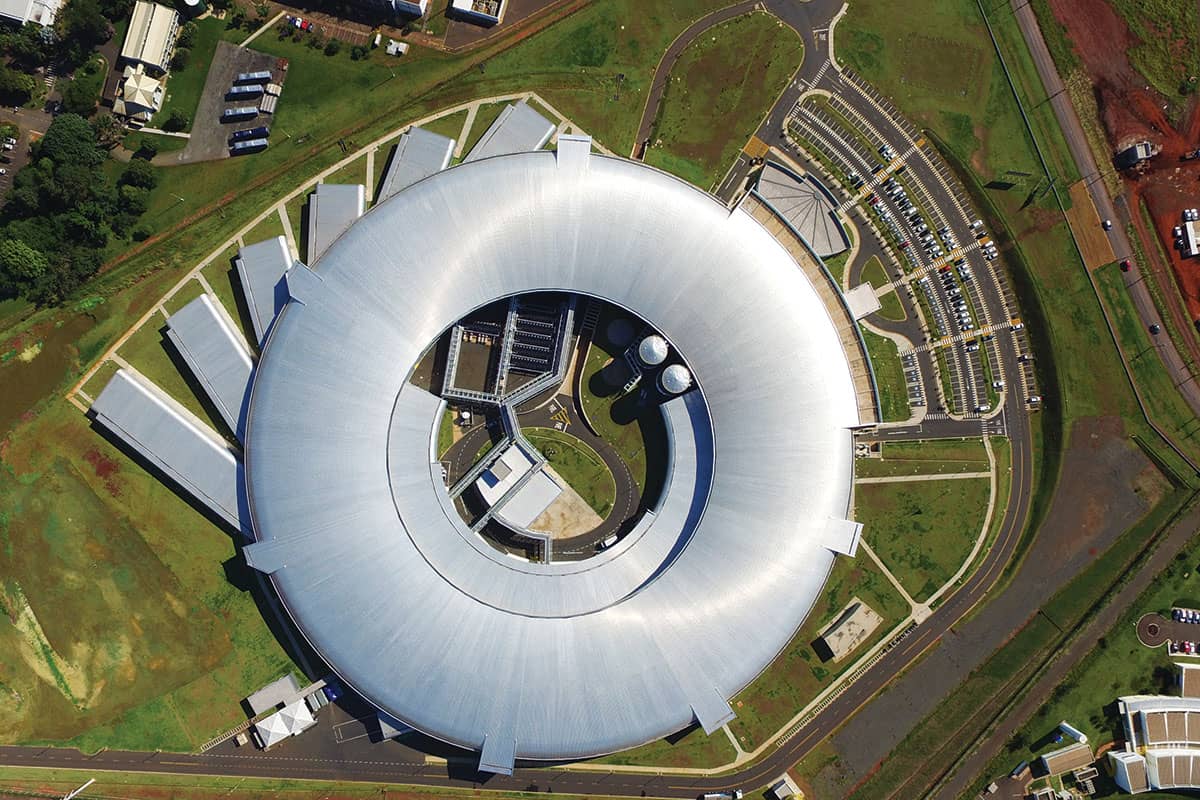
Fourth generation The Sirius storage ring is in Campinas, which is about 100 km north of São Paulo. (Courtesy: CNPEM)
How is the beamline installation and commissioning progressing?
Different beamlines are at different stages and good progress is being made with their installation and commissioning.
As well as our success with Manacá, we have had the first images from Cateretê. Scientists using Ema have done our first high pressure diffraction studies of materials that change their structure under extreme conditions. Carnaúba has also delivered its first scanning X-ray fluorescence image using a sub-micron beam. By early 2022 we expect to have about nine beamlines installed and in different stages of commissioning.
You and your colleagues got Sirius up and running in the middle of a global pandemic. Was that difficult?
Yes, the installation and commissioning of the storage ring and beamlines during the pandemic was a unique challenge. Much of the work was done remotely because we could only have a third of our staff on site. Indeed, most of our staff are still working remotely. The big challenge has been assembling and commissioning equipment because this typically requires different teams working together in the same space. This has delayed the process, as has problems in the supply chain. Even though most of our components were produced in Brazil, we still relied on international suppliers who were also affected by the pandemic.
A non-pandemic problem that we have faced recently is budgetary restrictions. Science is currently having a difficult time for funding in Brazil, which has also caused delays.
But despite these challenges, we have been able to install and commission Sirius and get our first users into the facility.
Sirius is one of the first fourth-generation storage rings in the world and is the only synchrotron currently operating in Latin America.
Is the facility primarily for Brazilian science, or do you see it as an international facility that will benefit science in the Americas and beyond?
Sirius is definitely an international facility, much like our first synchrotron UVX – which operated in 1997–2019. While about 80% of the scientists using UVX were Brazilian, the remaining 20% were mostly from other Latin American countries, especially Argentina. So, like UVX, I think Sirius will be a great opportunity for science in Latin America.
I think Sirius will be a great opportunity for science in Latin America
Another international dimension to our research is the collaborations we have with synchrotrons and user communities around the world. For example, we have very good interactions with the Canadian Light Source (CLS) in terms of a joint programme for agricultural and soil research. In the future we expect to be able train scientists in the use of both Sirius and CLS.
I believe that more agreements like this will come in a future. The reality is that there are few synchrotrons in the world, so they tend to be international facilities. That is what we hope for Sirius.
What is next for Sirius, and indeed the Brazilian Synchrotron Light Laboratory in general? Are there plans for any new facilities such as an X-ray free electron laser (XFEL)?
In the short term we plan to increase the number of beamlines at Sirius and also develop accelerator technologies such as insertion devices, which will allow us to perform more challenging experiments.
We also plan to create complex infrastructure at Sirius that will expand the type of experiments that we can do. One example is to create beamlines with high levels of biosafety – up to the highest level, four. This will allow us to do a broad range of biological sciences with colleagues at the Brazilian Biosciences National Laboratory, which is also on the CNPEM campus in Campinas.
In the midterm, there is still a great deal of room for upgrading the Sirius storage ring and improve its emittance. We have plans for evolving the current synchrotron and our accelerator tests facilities.
Looking further in the future, yes, we are considering an XFEL as a possibility. The technology is developing rapidly, and it is definitely something to be considered in the future of CNPEM.
With the UN climate summit COP26 kicking off in Glasgow this weekend, the Physics World Weekly podcast is focused on one thing: climate change. For the next two weeks, I will explore some of the ways that physical scientists are helping to tackle the climate crisis. In episode one I meet researchers who predict what will happen to the climate under different emissions scenarios.
Perhaps the most obvious climate hazard is extreme heat. The Earth’s average temperature is rising, but the heating is far from uniform and some communities are particularly vulnerable. To better understand the global health risks of extreme heat I catch up with Eunice Lo from the University of Bristol in the UK and Michelle Bell from Yale University in the US.
Later, I take a step back and look at the fundamental research that underpins climate models. Steven Sherwood, an atmospheric physicist at the University of New South Wales (UNSW) in Australia, explains why clouds are notoriously challenging for climate modellers. I also speak with UNSW’s Katrin Meissner who is interested in climate feedback mechanisms and what we can learn from tipping points in Earth’s past climates.
Next week’s episode is focused on technology solutions for climate change, including energy innovations, sustainable buildings and infrastructure, and carbon capture and storage. You can learn much more about the latest climate science at Environmental Research 2021, a free-to-attend virtual conference on 15–19 November hosted by IOP Publishing.
Researchers in China and Spain have succeeded in making a saser – the equivalent of a laser for sound waves – by adding a gain medium to artificial acoustic materials known as sonic crystals. The new saser could have applications in medical ultrasonics and non-destructive materials testing, among other areas.
Gain media (also known as active media) are commonplace in optics and are a crucial part of lasers. However, they have not really been employed for sound waves before, explains Johan Christensen, an expert in acoustic metamaterials at the Universidad Carlos III de Madrid. In a laser, the gain medium typically consists of a material such as a semiconductor, doped crystal or glass surrounded by a highly reflective optical cavity. By stimulating electrons within this medium to release energy due to collisions with photons in the cavity, it is possible to produce a coherent beam of photons all oscillating in unison, at the same frequency.
The new saser uses phonons – sound waves composed of sonic vibrations – rather than photons, and its gain medium consists of carbon nanotube (CNT) films. Here, bursts of heat get converted into sound when an alternating current is applied to the films. This acoustic amplification process generates sound even in the absence of a cavity, and without stimulated emission.
Whispering gallery modes
Together with Xiaojun Liu and Ying Cheng of Nanjing University, Christensen and colleagues constructed their saser out of sonic crystals made from thermoplastic rods arranged in a so-called kagome lattice – a pattern inspired by Japanese basket weaving. The rods, which are made from acrylonitrile butadiene styrene (ABS) enclosed by CNT films, allow the researchers to harness highly confined and amplified sound wave excitations that revolve around the structure’s edge. These topologically protected edge excitations are known as whispering gallery modes and are named after the now-famous phenomenon (first observed by Lord Rayleigh in 1878) of sound waves creeping around the curved gallery of St Paul’s Cathedral in London.
“This method allows for a rather flexible and tuneable approach to making a sonic gain medium that is based on the thermoacoustic effect in which (fluctuating Joule) heat is converted into sound when an alternating current is applied to the CNT film-coated ABS plastic rods,” Cheng explains. “Not only do the topological whispering gallery modes revolve around the enclosed sonic insulator through the complex edge states, they also out-couple and focus sound emission at audible frequencies.”
More concentrated and directed sound scanning
Such a saser could garner interest in medical ultrasonics where the main aim is to target and focus high-intensity sound waves – with little spread – on very small areas, he tells Physics World. Likewise, non-destructive tests for cracks in materials and fatigue could capitalize on the device’s narrow beam of sound, as it would enable far more concentrated and directed sound scanning.
The researchers, who report their work in Nature, now plan to modify their topological saser to make it emit at more useful ultrasonic frequencies and not just at low, audible, ones. “This will require shrinking the sonic crystal, but it might also be possible by changing the thermoacoustic gain medium,” Christensen says.
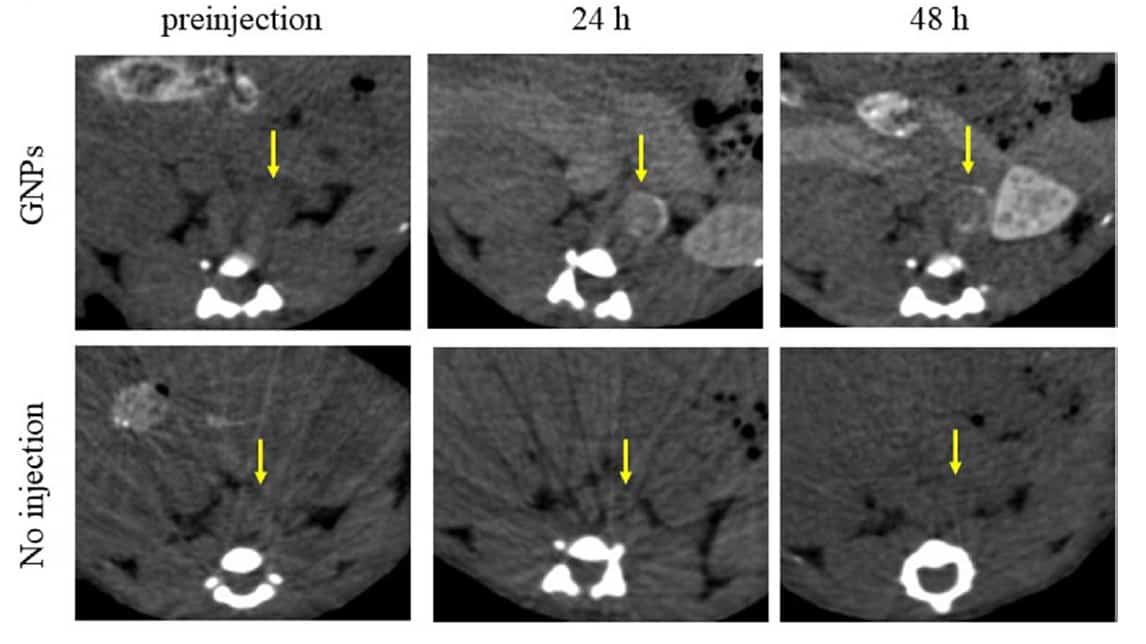
Contrast enhancement: In vivo CT images of abdominal aortic aneurysms in mice with and without GNPs. The images showed significantly higher CT attenuation values in the perivascular area (yellow arrows) in mice injected with GNPs. (Courtesy: CC BY 4.0/Mol. Imaging Biol. 10.1007/s11307-021-01654-5)
Gold nanoparticles (GNPs) show potential as CT contrast agents for imaging macrophages in areas of vascular inflammation, according to preclinical research from Japan. Such GNPs could also act as light absorbers in photothermal therapy, the research team report in Molecular Imaging and Biology. These findings could one day help in the diagnosis and treatment of vascular diseases such as atherosclerosis (plaque build-up in arteries) and abdominal aortic aneurysm (a swelling in the aorta).
Macrophages are specialized white blood cells involved in the detection and destruction of bacteria and other harmful organisms. They contribute to the progression of vascular inflammation, playing a key role in plaque formation, aneurysm progression and rupture. As such, macrophages could act as key imaging and therapeutic targets for vascular disease.
In an initial in vitro study, the researchers – from Tokyo Medical University, the University of Tsukuba and the AIST Nanomaterials Research Institute – incubated mouse macrophage cells with GNPs (50–200 µg/ml) for 24 hr and then scanned the cells with a micro-CT system. The CT attenuation values of macrophages incubated with GNPs were significantly higher than those without GNPs. The team note that GNP incubation did not decrease the viability of the macrophages.
Next, the researchers evaluated the use of intravenously injected GNPs for in vivo imaging of vascular inflammation in mice. They used ligation of the left common carotid artery to induce macrophage-rich atherosclerotic lesions in nine mice. The non-ligated right common carotid artery served as a control. Two weeks after the ligation, the team injected the mice with 10 or 20 mg of GNPs and scanned the animals with a micro-CT system, 24 and 48 hr after injection.
First author Hisanori Kosuge and colleagues report that the in vivo CT images exhibited contrast enhancement in both the diseased left and non-diseased right carotid arteries, at 24 and 48 h after GNP injection. Although the ratio of CT attenuation values in ligated versus non-ligated arteries was higher at 48 h than at 24 h, in both 10 and 20 mg groups, the difference was not statistically significant.
In a second in vivo study, the researchers induced abdominal aortic aneurysms in a group of male mice with deficient levels of apolipoprotein E, a protein involved in the metabolism of fats. They used ultrasound imaging to identify nine mice with aneurysms and injected five of them with 10 mg GNPs. After 24 and 48 hr, the researchers scanned all nine mice using micro-CT.
The CT images exhibited contrast enhancement in the perivascular area in mice injected with GNPs, while no enhancement was visible in non-injected mice. Ex vivo imaging of surgically exposed aortas confirmed that the CT attenuation values were significantly higher in mice injected with GNPs.
Therapeutic potential
The researchers also investigated the use of GNPs as light absorbers for photothermal therapy, by assessing the viability of GNP-incubated macrophages before and after exposure to pulsed near-infrared (NIR) laser light. They incubated macrophages with 0, 100 or 200 µg/ml of GNPs for 24 hr, and then exposed the cells to an 830 nm NIR laser. Low-intensity (178 or 196 mW) NIR laser light did not affect the viability of macrophages. However, high-intensity (400 or 437 mW) irradiation significantly reduced the viability of macrophages treated with GNPs (100 or 200 µg/ml) compared with those without GNPs.
While the experiment showed potential for vascular inflammation therapy using a NIR laser, the mechanism of reduced viability was unclear. The researchers note that it may be difficult to reduce cell viability in vivo using the same laser conditions as in vitro, because blood flow through vessels leads to insufficient target heating. They suggest that further studies are required to examine the effects of laser irradiation.
The researchers are optimistic about their study findings. “In vivo CT imaging with GNPs successfully depicted experimental carotid atherosclerosis and abdominal aortic aneurysms, and NIR laser irradiation reduced the viability of macrophages incubated with GNPs,” they conclude. “Thus, GNPs have a strong potential for non-invasive CT imaging and therapy for vascular inflammation.”
Most private fusion companies expect fusion power to be supplying electricity to the grid in the 2030s. That is according to the first-ever report on the state of the fusion industry, which has been published today by the Fusion Industry Association (FIA) and the UK Atomic Energy Authority (UKAEA). The report – The Global Fusion Industry in 2021 – also finds that private fusion endeavours have received over $1.8bn of funding since the 1990s.
The report states that there are at least 35 private fusion companies worldwide – most of which are concentrated in the US and Europe. Of the 35, a dozen declared themselves in the early stage of development or operating “in stealth mode” and so did not participate in the report. For the remaining 23 companies, 12 noted that they had only begun operating only in the past five years.
While not every company declared the amount of funding they had received, the 18 that did so had accrued almost $1.8bn to date plus an additional $85m in grants and other funding from governments. Four of the biggest players in private fusion – Commonwealth Fusion Systems, General Fusion, TAE Technologies and Tokamak Energy – accounted for 85% of that funding.
This report shows how, largely outside the headlines, the private fusion industry is accelerating towards commercial power
Melanie Windridge
Magnetic confinement, in which magnetic fields are used to contain a high-temperature plasma, is the most popular fusion technique being employed by the companies, according to the report. While electricity generation is a main target for private fusion companies, almost half of the firms see the technology also being applied to space propulsion with other markets including marine propulsion, hydrogen fuel and industrial heat.
Ambitious goals
Over the coming decade, the biggest experiment in fusion will be the ITER tokamak, which is currently being built in France and is expected to fire up in the late 2020s. It is a research reactor designed to show fusion gain, whereby more energy is generated by the fusion reaction than put in, and will not therefore supply electricity to the grid. That task is expected to be performed by fusion plants in the middle of the century. The UK, for example, is currently designing the STEP prototype plant, which is expected to be in operation in the 2040s.
Despite this timeline, the report found that most private companies think they can reach that aim sooner – albeit on a smaller scale. Over two-thirds of the companies surveyed for the report believe that electricity generated from fusion would enter the grid in the 2030s, while 20% thought it would more likely be the 2040s or 50s.
“This report shows how, largely outside the headlines, the private fusion industry is accelerating towards commercial power,” says FIA communications director Melanie Windridge. “The ambitious timescales highlighted in our first survey demonstrate the drive and commitment that exists within this growing industry.”
Indeed, Windridge told Physics World that if fusion is to have a meaningful impact on climate-change targets, then the first electricity production will be needed in the 2030s with commercial roll-out ramping up in the 2040s. Yet that will not only emerge from the activity of private firms.
“The companies recognise the importance of public-private collaboration, particularly on technologies such as tritium breeding and new materials,” adds Windridge. “We are calling for more support for public-private partnerships to help them realise their ambitions.”


 The market introduction of the MR-Linac technology improves the patient care via the real-time imaging of the targeted PTVs. Conventional Water Phantoms with ferromagnetic material become prohibited due to safety reasons. To overcome this situation, LAP introduced the MR-compatible Water Phantom THALES 3D MR SCANNER. Dr Thierry Gevaert, medical physicist and co-ordinator at the UZ Brussel institute, will share his experience with the THALES 3D MR SCANNER during the commissioning of the MRIdian Linac of Viewray. Furthermore, he will highlight which benefits played an important role for his clinical workflow.
 Thierry Gevaert graduated as medical physicist at the Vrije Universiteit Brussel (VUB) and defended his PhD “Clinical implementation of frameless radiosurgery” in 2012. In 2016, he was nominated professor at the VUB and became chief of medical physics at the UZ Brussel (UZB). His appointment in the Department of Radiotherapy involves research, teaching and clinical practice. Thierry is board-certified in therapeutic physics and is engaged in mentoring medical physics for graduate students, residents and medical engineers. His research and clinical interests include stereotactic radiosurgery (SRS), stereotactic body radiotherapy (SBRT), motion management, the development of high-tech radiation techniques, image-guided radiotherapy (IGRT), all with an emphasis on clinical implementation of translational research. Thierry has made numerous international and national presentations, and published more than 50 peer-reviewed papers. Since 2015, he is also an auditor for the Novalis Certification program.
 Thierry Mertens has a PhD in physics and nearly 15 years of experience in medical physics and radiotherapy. His main responsibility is to develop innovative quality assurance solutions to support the medical end-users with their clinical tasks. As business development manager for LAP since 2016, Thierry has been instrumental in the development of the THALES 3D MR SCANNER and had the opportunity to work closely together with pioneer users of the MRIdian system, therefore, within the LAP R&D team, he can advise on the customers’ needs, ensuring that the end-user needs are fulfilled.