Why Nobel laureates love to leave the herd: find out in the November 2021 issue of Physics World magazine

Cover of November 2021 issue of Physics World magazine

With politicians gathering for the United Nations COP26 climate summit in Glasgow this month, the 2021 Nobel Prize for Physics is a reminder of just why physicists do such important work on so many fronts.

One half of the prize went to Syukuro Manabe and Klaus Hasselmann for developing vital physical models that reliably predict global warming. The other half went to Giorgio Parisi, for studying other equally complex systems, notably condensed-matter spin systems.

What’s interesting, though, is that many physicists who win a Nobel prize find the freedom it brings lets them carve out new research paths. Unfettered by the need to “prove” themselves or continue on the treadmill of bringing in grants, equipment and students, Nobel laureates can branch out into new research directions.

But tackling novel topics is usually second nature for Nobel laureates. In fact, as the cover feature of the latest issue of Physics World magazine reveals, very often the shift in focus began long before their prize was conferred.

If you’re a member of the Institute of Physics, you can read the whole of Physics World magazine every month via our digital apps for iOSAndroid and Web browsers. Let us know what you think about the issue on TwitterFacebook or by e-mailing us at pwld@ioppublishing.org.

For the record, here’s a rundown of what else is in the issue.

• Complexity pioneers bag Nobel prize – Syukuro Manabe, Klaus Hasselmann and Giorgio Parisi win award for their work on the physics of complex systems, as  Michael Banks and Hamish Johnston report

• Learning from your mistakes – Caitlin Duffy says that physicists must recognize that failure is part and parcel of science

• Help me if you can – In his latest article on funding hi-tech firms, James McKenzie looks at the help on offer for businesses to innovate and grow

• Historical concerns – So you think the history of science is easy? Robert P Crease explains why it’s harder and more complicated than you might realize

• Life beyond the Nobel – Many physicists who win a Nobel prize find the freedom it brings lets them carve out new research paths. But often the shift in focus began long before their prize was conferred, as Physics World editors discover

• High-spec open-source microscopy for all – Open-science hardware offers unprecedented technological access to researchers and enthusiasts all over the globe. Richard Bowman and Julian Stirling of the Bath Open Instrumentation Group describe the lessons learnt in developing a low-cost, laboratory-grade microscope

• A valley of opportunities – After nearly two decades of graphene research, condensed-matter physicists Luis Foà Torres and Sergio O Valenzuela delve into the ongoing mystery of the material’s perplexing non-local response and the “valley Hall effect”

• Get stuck in – Jess Wade reviews Sticky: the Secret Science of Surfaces by Laurie Winkless

• Illuminating dark matter – Emma Chapman reviews Bright Galaxies, Dark Matter, and Beyond: the Life of Astronomer Vera Rubin by Ashley Jean Yeager

• Advice for post-COVID careers – COVID-19 has changed some aspects of the world of work forever, but others have stayed much the same. Andrew Hirst and Veronica Benson look at how physics students can prepare for careers in the post-pandemic world, and what universities and employers can do to help them

• Ask me anything – Careers advice from Ciara Muldoon, who helps run SearchScene, a search engine that helps tackle climate change and climate injustice

• The Geiger counter and the chair – Roberto Merlin on the meaning of a quantum-measurement system.

Researchers crack challenge of sending control signals to millions of qubits at once

Today’s best quantum computers have fewer than 100 quantum bits (qubits), but future applications of quantum computing may require millions or more. Finding space for that many qubits will be tricky regardless of whether the qubits are made from trapped ions, superconductors, quantum dots or some other technology. Furthermore, as the number of qubits grows, so will the amount of wiring needed to control and connect them. All these wires generate heat, making quantum computers more prone to error.

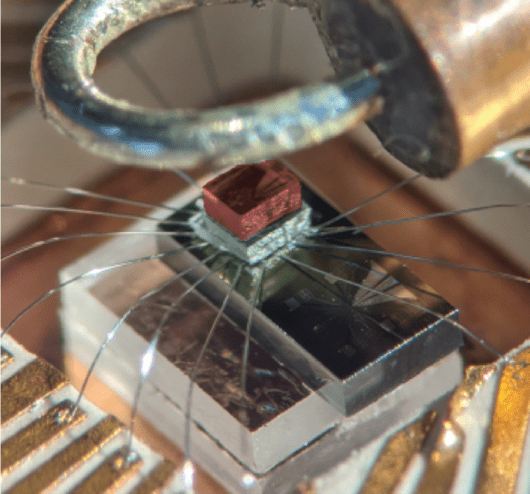
To address these challenges, Ensar Vahapoglu and colleagues at the University of New South Wales (UNSW), Australia, developed a prototype device that replaces wires with a dielectric resonator located directly above a chip containing silicon quantum dots. These nanometre-sized particles have an outer shell and inner core made of semiconducting material, and they possess properties such as the intrinsic spin of the electron and its associated magnetic moment that enable them to act as qubits.

The UNSW team’s design frees up valuable space while delivering a uniform magnetic field across the chip, making it possible to control the spin of electrons in all the quantum dots simultaneously in a way that requires less power and thus generates less heat.

Photo of the dielectric resonator crystal

The novelty of this design lies in the silicon chip technology because the quantum dots form on a structure that is very small and acts as a “nest” for electrons. This gives the researchers direct control over the electrons’ spin properties – so-called spin coherent control – via the uniform magnetic field, which maintains the spin states of the quantum dots.

By constructing this device, Vahapoglu and the team reduce by many orders of magnitude the space needed to both house and manipulate their qubit architecture.

A path toward improvement

To take full advantage of the new qubit design, Vahapoglu and colleagues identify several modifications. One is to use a different substrate for the integrated chip that contains the quantum dots to substantially reduce the power requirement for observing coherent control. Another is to improve the quality factor for the dielectric resonator.

Implementing these changes will enhance coherence times – that is, the time in which qubits remain in a superposition of all possible states – such that they can realize quantum gate operations using their global control scheme. Once they achieve this, Vahapoglu states, “we believe silicon spin qubits will be an even stronger challenger for the throne of the leading quantum processor platform.”

In search of new solutions for cheap and stable solar cells

What materials are you studying?

My research focuses generally on hybrid perovskite materials for optoelectronics, and more specifically on hybrid perovskite solar cells. Hybrid perovskites are semiconductors that are based on a lead halide framework that is filled with small organic cations; they are known as “hybrid” because they have organic and inorganic compounds put together. Like all perovskites, these materials have the chemical formula ABX3, but for the hybrid perovskites A is an organic cation, B is lead and X can be, for instance, iodine, bromide or another halide.

Because these materials are semiconductors, you might think they would have a rigid structure, in the sense of being crystalline. However, the beauty of the hybrid perovskites is that they are not rigid at all. In fact, we often describe them as “jelly-like” because they have a flexible nature induced by the presence of the organic cations. This flexibility has tremendous impact on the electronic properties of the materials: not only on electronic conductivity, but also on ionic conductivity, both of which influence the transport properties of a device and the structural flexibility of the materials themselves.

My group focuses on changing the organic cations to tune the perovskite’s structure. Standard hybrid perovskites are 3D networks, but tuning the organic cation allows you to tune the dimensionality of the network so that you end up with different-dimensional perovskites such as 2D or layered systems.

This is just one example of the versatility of this class of materials: the fact that perovskites can be tuned in this way means that they can be used to obtain a range of functionalities. Over the past decade, these materials have proved to be an extremely successful foundation for next-generation photovoltaic technologies. They are also interesting to me as someone with a background in engineering and physics who has now moved into chemistry. You can manipulate hybrid perovskites quite easily using just a simple chemical modification, and you end up with amazing optoelectronic properties. You can use them in solar cells – and it sometimes seems like the whole world is working on this, thanks to their incredible light-harvesting and charge transport properties – but you can also use them in LEDs and in other electronic applications. They have even started to appear in the fields of ferroelectrics and spintronics. They are extremely nice materials.

What are some of the benefits of chemically tuning these cations?

The purpose of tuning the chemical component is, first, to change the physical properties of the material. For instance, you can tune the exciton binding energy. You can tune the band gap of the material itself – the colour, in other words. You can tune the transport properties of the material. But you can also change the chemical properties of the film you make from the material, particularly in terms of its chemical stability. By changing the organic cation, for instance, you can create a material that is more hydrophobic.

This is important because stability is one of the big problems with perovskites in terms of real-world applications. The “golden triangle” is stability, efficiency and cost, and while hybrid perovskites are very good – better than established technologies – in terms of their low cost and high efficiency, creating stability remains a challenge for everyone. These materials degrade over time under certain conditions, and when you measure the operational stability of a device, you need to consider the conditions that the device is likely to experience – including humidity, UV light, thermal stress and oxygen in the air. All these conditions have different influences on the degradation of perovskites. When you put them together, they can drastically reduce the performance of a perovskite-based device.

How do you counteract that?

There is a vast and ongoing research effort aimed at finding new solutions, and this effort embraces two different approaches. One approach is to stabilize the active material itself. From a linear point of view we can try to make the material more stable, meaning it is less prone to degradation – that is, less prone to the infiltration of oxygen or water molecules. An example of this approach would be changing the cation to create a more hydrophobic material, as I mentioned earlier.

The other approach is to engineer the whole device to improve its stability. For example, by developing an extra layer of material that covers the solar cell and protects it, as has been done for other technologies. But of course, you should still consider the three pillars of the golden triangle. If you add extra layers to your solar panels – if you protect the perovskite with glass or expensive polymers, for example – you may increase the device’s stability, but you also increase its cost. So the research is taking place in parallel, exploring multiple approaches at the same time.

What are some other challenges of working with perovskites for solar photovoltaic applications?

The toxicity of these materials presents a big challenge. A few trials have explored replacing the lead in lead-halide perovskites with non-toxic or less toxic elements, but devices made from these alternative materials are still far from reaching the high efficiencies we obtain with standard lead-based hybrid perovskites. Something that is often overlooked is the relative abundance of these alternative materials. Non-toxic elements such as bismuth, for instance, are scarcer than lead, which makes them more expensive and so not suitable for large-scale production.

But also note that the amount of lead in a solar cell is really, really small. A solar cell may be a few hundred nanometres thick, and the lead component is a small percentage of the total. So this becomes more a question of regulation. It’s not really a scientific problem, because science cannot solve it. We need to ensure that the regulations we come up with are appropriate.

Another challenge is scaling up the technology. If you work on solar cells, engineering new photovoltaics, then going to market is the final goal. Research into the materials is crucial, but scaling up is an important milestone on the way. You need to harness what you have learned for small-scale solar cell production and use it for larger-area module production in terms of materials, processing, and stability. These are the challenges that researchers are trying to solve today.

What are the challenges in making perovskite solar cells more efficient? I think they’re running at about 26% efficiency.

Yes, that’s correct, and that means we are not too far from the theoretical limit for power conversion efficiency in this material, which has a band gap of around 1.5 eV. There has been a tremendous efficiency boost in the past 10 years, mainly dictated by two factors. First is the optimization of bulk perovskite crystals, which make up the core or active layer of a device. The second factor is optimization of the interfaces. A perovskite device is like a sandwich where the perovskite is the cheese, but you also have interfaces with other materials (the “bread” in the sandwich), and if you want to get high efficiency it’s crucial to optimize processes that take place at these interfaces. In other words, reducing the losses from non-radiative recombination, charge accumulation, and so on.

A perovskite device is like a sandwich where the perovskite is the cheese

The next question is, how do we go beyond our current efficiencies? Of course, optimizing the materials and the interfaces is still crucial, and research on interfaces, especially, is the aim of my group. But we also have the option of adding perovskite on top of established solar-cell technologies (such as silicon) to build what are called tandem photovoltaics. This is an extremely interesting way to boost the total efficiency of the final device. Silicon-only cells and perovskite-only cells can both reach a certain limit, but if you put them together you can push efficiency to a higher value. And higher efficiency might mean, for instance, that you need to cover a smaller area with your photovoltaic panel to get the same output – in other words, you have lower costs. The three parameters of cost, efficiency and stability are always interconnected.

What sort of developments do you hope or expect to see in the next few years?

A nice follow-up to all these research efforts would be to see these fantastic materials incorporated into commercial solar photovoltaic panels. Beyond that, it would be great to see them inspire new applications. When you think about solar photovoltaics, you think about modules that are installed on your rooftop, but there are many other applications that cannot be targeted with existing technologies. Flexible, transparent, coloured photovoltaic modules all have immense potential for applications in the so-called “smart cities” of the future.

My hope is that we go beyond existing expectations and imagine new applications. These materials have many advantages. They are simple to process using low-cost techniques, they are formed by solutions that you can deposit on a flexible substrate, and so on. But I also believe that fundamental research on this class of materials can inspire new knowledge in physics. If you think about excitonic physics or interface physics or charge transport phenomena, these are all subjects that can be investigated using this class of tuneable materials, and I believe that doing so will be essential to support new applications.


Large, defect-free quasicrystals could be made by ‘self-healing’

A new way to grow large, defect-free quasicrystals has been developed by researchers in the US. Through a combination of experiments and simulations, Ashwin Shahani and colleagues at the University of Michigan showed how clusters of growing quasicrystals can coalesce to create larger structures, provided they are mostly aligned with each other. The results could pave the way for a new wave of interest in the exotic materials.

A quasicrystal is an arrangement of atoms that has long range order but does not have the translational symmetry possessed by conventional crystals. A mathematical example is Penrose tiling, in which tiles with two different shapes can be arranged to form intricate patterns.

The first quasicrystal material was discovered in the 1980s and as more quasicrystals were found it became clear that the materials have a range of interesting mechanical, thermal and electrical properties that could potentially be used in a wide range of practical applications.

Insurmountable barrier

However, by the 2000s the development of quasicrystal technologies had stalled because of a seemingly insurmountable barrier: it seemed that making suitably large quasicrystals was extremely difficult. When conventional methods such as bulk crystal growth and thin-film deposition are used, large quasicrystal samples have defects, such as grain boundaries, in their atomic structures that invite corrosion. This limits the useful size of a quasicrystal to just a few centimetres.

In their study, Shahani’s team used 3D X-ray tomography to observe the real-time formation of quasicrystals within a molten mixture of aluminium, cobalt and nickel. Within a setup at Argonne National Laboratory, they initially observed the growth of multiple, defect-free quasicrystals in the mixture. As the mixture cooled, the researchers saw that these small quasicrystals collided with each other, then seamlessly coalesced to form a larger, defect free quasicrystals with tenfold rotational symmetry.

Molecular dynamics

Then the team did molecular dynamics simulations to try to understand how defects present when the quasicrystals initially joined together were able to “self heal”during coalescence. By varying the conditions in each run of their simulation, they identified the conditions required for smaller quasicrystals to coalesce, on the same time and length scales they observed in real life.

When the virtual quasicrystals were slightly misaligned with each other, they rotated into alignment under the influence of quasiparticles called “phasons” – which are associated with atomic rearrangements within quasicrystals. This behaviour did not occur when the quasicrystals were outside a certain range of alignment, and unwanted grain boundaries could form.

Shahani’s team hopes that its new insights into growing quasicrystals could provide valuable guidance in the development of industrial processes that are capable of producing large, high-quality quasicrystals. This may, in turn, lead to a resurgence of commercial interest in the exotic materials, potentially opening new avenues of research into their practical applications.

The research is described in Nature Communications.

The unconventional scientist who predicted that rising carbon dioxide levels would change the climate

With the United Nations Climate Change Conference (COP26) coming up next month, it is strange to think that less than 100 years ago global warming was not widely accepted, even among experts. In fact, in 1938 Sir George Simpson, a leading meteorologist, dismissed the link between rising carbon-dioxide (CO2) concentration and temperature as “rather a coincidence”. The correlation had been shown in a paper by an author outside the conventional scientific community, so, for good measure, Simpson added that a non-expert could not properly appreciate how atmospheric circulation affects the absorption of radiation. The non-expert in question was Guy Callendar, a British steam engineer doing his own atmospheric research at home.

But climate science has a long and multidisciplinary history, with contributions from scientists both within and outside academia. Many of the basics were set by eminent 19th-century figures, notably the French mathematical physicist Joseph Fourier, the Irish physicist John Tyndall, and the Swedish Nobel prize-winning physical chemist Svante Arrhenius. Other little-known researchers, however, made essential progress too.

One was Eunice Foote, a 19th-century American scientist. In 1856 her well-designed home experiment gave the first evidence that atmospheric CO2 is highly effective in absorbing heat from the Sun, leading her to predict that an increase in CO2 would warm the Earth. Three years later, Tyndall showed that the CO2 absorption occurs at infrared wavelengths. Then in 1896, preliminary calculations by Arrhenius hinted that humanity’s burning of fossil fuels could raise CO2 levels and warm our planet. This was finally validated in 1938, when Callendar first carried out effective climate modelling.

Callendar was born in 1898. His father, Hugh, was a talented experimental physicist who was dubbed a “universal genius” by Ernest Rutherford. Indeed, Callendar’s scientific development was greatly influenced by his father. Writing in the 2007 book The Callendar Effect, James Rodger Fleming explains how the young Callendar was raised in a household full of “books and a vast array of technical gadgets”. At age 17, he began working in his father’s lab at University College London, earned a certificate in mechanics and mathematics, then continued working with him. When his father died in 1930, Callendar became a successful steam engineer. He also pursued his interest in meteorology by using the varied physics he had learned during his apprenticeship to study whether human activities affect the Earth’s temperature.

Callendar analysed historical global measurements of temperature, of atmospheric CO2, and the use of fossil fuels

Callendar’s 1938 paper “The artificial production of carbon dioxide and its influence on temperature” (Q. J. Roy. Met. Soc. 64 223) analysed historical global measurements of temperature, of atmospheric CO2, and the use of fossil fuels. Over the previous 50 years, he found, global temperatures had increased by 0.05 °C per decade, and atmospheric CO2 had grown to a value of 289 parts per million due to the burning of fossil fuels, which had added 150,000 million tonnes of CO2 to the atmosphere. Only a quarter of this was absorbed in the natural carbon cycle, mostly by diffusion into the oceans. Callendar calculated the infrared absorption of the remaining excess CO2 within a layered vertical model of the atmosphere. This showed that anthropogenic CO2 accounted for two-thirds of the long-term warming, and that a doubling of CO2 would raise global temperatures by 2 °C.

These results were not initially well received. Simpson, who dismissed the apparent correlation as a coincidence, was just one of many critics in the scientific community. Peer reviewers questioned the validity of Callendar’s calculations and historical data. Perhaps they were influenced by the fact that he was not an establishment scientist but a working engineer doing his research alone and at home, and by his holistic analysis across scientific boundaries. But Callendar cogently responded to the scientific questions and produced three dozen more papers before his death in 1964.

Other researchers further explored climate change with new measurements of temperature, infrared absorption by CO2 (where Callendar’s own work contributed), and the carbon cycle. As scientists began recognizing the role of anthropogenic CO2, it became clear that Callendar’s 1938 paper had first established the connection. In 2013 climate scientists Ed Hawkins and Philip Jones called it a “landmark study” and Callendar’s achievements “remarkable” (Q. J. Roy. Met. Soc. 139 1961).

Of course, nobody is right about everything. Callendar’s speculations about the effects of warming missed the mark – he optimistically believed that rising temperatures would benefit humanity, by reducing glaciation and improving crop growth. Nevertheless, his contributions were key to accelerating the realization that warming was actually happening.

In 2016 another reconsideration (Endeavour 40 178) identified Arrhenius and Callendar as pioneers in the modern modelling of global warming. Callendar’s biographer characterizes him as a modest person, but I suspect he would be pleased that his unusual and excellent physics training finally led to his deserved recognition as a climate science innovator.

Synchrotron study could help preserve Tudor ship, calculating your lifetime experience of climate change

Hailed as the favourite warship of England’s King Henry VIII, the Mary Rose sank during the Battle of the Solent in 1545. The wreck was rediscovered in 1971 and was raised 11 years later. The wood was impregnated with a polymer to preserve it and then it was dried so that it could be displayed to the public.

Unfortunately, conservators have found that exposure to oxygen has created acidic chemical species in the oak hull, which could further degrade the Mary Rose. Now researchers have performed X-ray computed tomography on samples of wood from the hull at the European Synchrotron Radiation Facility in Grenoble, France. They found evidence for acidic nanoparticles based on iron and sulphur in the wood – and say the iron comes from metal fixtures in the hull and the sulphur comes from the action of bacteria.

“What our results have done is alert conservators to these previously unknown deposits and expand the study of degradation-inducing materials,” says team member and materials scientist Serena Cussen of the University of Sheffield. “Knowing the structure of these potentially harmful species also allows us to design targeted treatments for their future removal.”

The research is described in Matter.

How will climate change affect your part of the world in your lifetime? Researchers at the Free University of Brussels have created a new app that invites you to enter your age, the region where you live and a global warming scenario. It then estimates the increased likelihood of events such as wildfires, river floods and droughts for your region. It also can do a calculation for the entire planet.

The app was developed by Wim Thiery and colleagues, and it is called My Climate Future. Thiery says that the calculations are done “based on the best available scientific data and analysis”. He adds that the aim of the project was to “create a simple way of showing people, young and old, how climate change might affect them personally”.

Iridium Netwerk’s medical physics team redefines best practice in radiotherapy QA

A relentless focus on workflow efficiency, standardization and automation has helped medical physicists at Iridium Netwerk transform patient and machine QA best practice across the healthcare group’s multi-site radiation oncology programme in the Greater Antwerp region of Belgium. The catalyst for change was the clinical roll-out, through late 2017 and early 2018, of the SunCHECK Quality Management Platform from Sun Nuclear Corporation, the US-based manufacturer of independent QA solutions for radiotherapy facilities and diagnostic imaging providers.

Fast forward and it’s evident that SunCHECK – a single interface and database offering a unified view of patient and machine QA, independent from the treatment system – is now established as the QA “engine-room” for Iridium Netwerk’s distributed medical physics service. That service, staffed by 17 medical physicists and six physics assistants, spans four geographically distributed clinical sites and a unified suite of Varian treatment systems (seven TrueBeam and three Clinac iX machines) delivering leading-edge cancer care to around 6000 patients every year.

The clinical upsides are compelling. By consolidating four treatment sites into one network, the SunCHECK platform enables a portfolio of uniform QA processes that translate – and scale – across locations to support a mix of treatment systems and radiotherapy modalities. The standardized approach to QA also means patients will be treated using the same QA protocols regardless of location or the staff performing the checks. At the same time, SunCHECK’s in-built automation features and web interface – accessible across all of Iridium Netwerk’s sites – drive efficiencies through the radiotherapy workflow, superseding subjective manual processes that create QA inconsistencies and soak up valuable clinic time.

Continuous QA improvement

Underpinning Iridium Netwerk’s drive to automate and streamline its radiotherapy QA programme are two core software modules. SunCHECK Patient encompasses all aspects of patient QA, including secondary checks, phantomless pre-treatment QA and automated in vivo monitoring. Meanwhile, SunCHECK Machine addresses critical machine QA needs, including template-driven daily, monthly and annual QA; automated imaging, multileaf collimator (MLC) and volumetric modulated arc therapy (VMAT) checks; as well as long-term data trending and analysis.

For Evy Bossuyt and colleagues in the Iridium Netwerk medical physics team, the clinical introduction of SunCHECK Patient was driven, in large part, by the desire to implement automated in-vivo monitoring across the network’s four radiotherapy centres. Their goal: to increase patient safety by detecting errors over the course of radiation treatment while simultaneously addressing the increased complexity of advanced modalities such as VMAT and stereotactic body radiotherapy (SBRT). As such, it helps that SunCHECK Patient is fully automated, generating 3D results from EPID and/or log files. “Our department benefits from SunCHECK Patient’s ability to simplify and standardize pre-treatment QA of complex treatment plans, while also providing a major improvement over in-vivo diode detectors,” explains Bossuyt.

After an exhaustive planning phase – to specify clinical and operational workflows, dosimetric templates and QA tolerance levels – the Iridium Netwerk team began clinical deployment of SunCHECK Patient on two linacs, scaling up to all 10 of the treatment systems within five months of project initiation. Over the next year, SunCHECK Patient detected failures in 7% of the 56,542 fractions analysed (from September 2018 to August 2019), with failures detected in 8% of the 50,527 fractions analysed in year two (September 2019 to August 2020). Furthermore, for the treatment fractions evaluated using transit EPID dosimetry (43%), 16% and 13% of fractions failed in the first and second year, respectively. (Worth noting also that absolute verification was introduced at the start of year one to allow comparison of images to calculated data for enhanced error detection.)

SunCHECK Patient adds an extra dimension to patient QA.

Evy Bossuyt

“We’ve shown that large-scale clinical implementation of in-vivo transit dosimetry is feasible, even for complex techniques,” notes Bossuyt. Key to success is application of the AMARA (As Many As Reasonably Achievable) principle to the detection of errors – i.e. taking into account economic and social factors such as costs, throughput and patient comfort – as well as a granular understanding of the strengths and weaknesses of the EPID dosimetry system. “In this way,” adds Bossuyt, “SunCHECK Patient adds an extra dimension to patient QA, revealing a wide variety of deviations spanning errors in planning, machine problems, patient positioning, and changes in patient anatomy such as weight loss, tumour shrinkage or rectal/bladder filling.”

As well as one-off corrective actions to manage these and other “issues arising”, SunCHECK Patient has informed a raft of long-term operational and workflow iterations at Iridium Netwerk. Among those adjustments are updated breast treatment protocols based on extra imaging; follow-up protocols with dieticians for all rectum, stomach and oesophagus patients; and the discontinuing of in-vivo dosimetry with diodes (except for total-body irradiation treatments where EPID use is not possible).

“Alongside the enhanced error detection,” says Bossuyt, “the department has seen significant streamlining with regards to the aggregate workload and time allocated for essential patient QA checks. That’s down to SunCHECK Patient’s high degree of automation plus the in-built accessibility that comes from a web-based software platform.”

The machine perspective

On a parallel implementation track, Iridium Netwerk medical physicists have put SunCHECK Machine front-and-centre in an effort to create a unified, independent machine QA programme across the network’s four treatment centres. It’s a work-in-progress towards the goal of automating daily, monthly and annual QA tasks (versus the high levels of manual input required previously) at the sharp-end of treatment delivery.

Photo of Sarah De Vos

“We’ve already standardized a wide range of machine QA tasks within SunCHECK Machine,” explains Sarah De Vos, a colleague of Bossuyt’s in the Iridium Netwerk medical physics team. Those tasks include Starshot and Winston-Lutz tests; various MLC performance tests (e.g. picket fence); a field-size test that also checks flatness and symmetry; light versus irradiation field; various VMAT tasks (to check dose rates, gantry speed and leaf speeds); as well verification of mechanical read-outs.

“Beyond the specific QA tasks, SunCHECK Machine is user-independent,” adds De Vos “and guarantees objective measurements with data trending. The software also enables automation at scale within our machine QA programme, helping us to bank sustained and substantive time savings across the clinical care team.”

Beyond the specific QA tasks, SunCHECK Machine is user-independent and guarantees objective measurements with data trending.

Sarah De Vos

Equally significant, Iridium Netwerk’s large (and growing) central database for both machine and patient-specific QA creates the foundation for predictive intelligence tools based on machine learning. Over time, that opens the way to increased efficiency of preventative maintenance and QA of the treatment machines as well as continuous improvement in the quality of treatment planning.

As a SunCHECK reference site, Iridium Netwerk promotes radiotherapy QA best practice using the SunCHECK Quality Management Platform. The clinical team collaborates with Sun Nuclear on its product development roadmap while serving as a regional resource for the growing European base of SunCHECK users.

Further reading

E Bossuyt et al. 2020 Evaluation of automated pre-treatment and transit in-vivo dosimetry in radiotherapy using empirically determined parameters (phiRO 16 113-29)

Design and manufacture of solid-state batteries towards low cost

Want to learn more on this subject?

The next generation of energy storage devices may largely benefit from fast and solid Li+ ceramic electrolyte conductors to allow for safe and efficient batteries and fast data calculation. For those applications, the ability of Li-oxides to be processed as thin film structures and with high control over lithiation and phases at low temperature is essential to control conductivity.


Through this presentation, the field is reviewed from a new angle, not only focused on the classics such as Li-ionic transport and electrochemical stability window for Li- solid-state battery electrolytes, but focusing on opportunity and challenge routes in thermal and ceramic processing of the components and their assemblies with electrodes. Also reviewed and given perspective is the role of solid-state battery ceramic strategies for the electrolyte on the electrode interfaces and towards charge transfer and versus current densities. In other words, it will be a little ceramicist (own) love story on the good and evil that can be designed by smart ceramic design at the interfaces originating by the very first choices made in the electrolyte ceramic structure and material design.

In the second part of the talk, new opportunities are discussed on low-temperature processing of solid-state electrolyte ceramics that do not technically require “classic sintering” and avoid prior particle calcination – instead demonstrating opportunities to use liquid-based direct densification routes and vacuum techniques to design solid electrolytes, and grafting interfaces to new hybrid and solid-state battery prototypes targeted at processing below 700 °C for all parts. Collectively, the insights on solid-state energy storage provide evidence for the functionalities that those Li solid-state material designs can have for cost and mass-manufacturable solid-state and hybrid battery prototypes.

Want to learn more on this subject?

Professor Jennifer Rupp is the Thomas Lord Associate Professor of Electrochemical Materials in the Department of Materials Science and Engineering, and Associate Professor at the Department of Electrical Engineering and Computer Science at the Massachusetts Institute of Technology (MIT). She has joint appointments as Professor at the Technische Universität München (TUM), Germany, and as CTO, TUM International Energy. Rupp’s team current research focuses on processing ceramic and glass materials, solid-state material design, and tuning structure-property relations for novel energy and information devices and operation schemes. This ranges from alternative energy storage via solid-state batteries, solar-to-synthetic fuel conversion, or novel types of neuromorphic memories and computing logic entities for data storage and transfer beyond transistors, and new sensing functions to track chemicals in the environment.

Prof. Rupp completed her PhD at the Eidgenössische Technische Hochschule (ETH) Zürich where she held the position of Assistant Professor and received an SNSF ERC Starting Grant and Swiss National Science Foundation (SNF) professorship. Her postdoc at ETH Zürich was followed by a position as Researcher at the National Institute of Materials Science (NIMS) in Tsukuba, Japan (2011), and Visiting and Senior Scientist at MIT (2011–12). She has published more than 110 papers, holds 19 patents, and is a frequent speaker and panel member of the World Economic Forum. She engages with companies around the world through consulting and collaborations focused on material processing or electrochemical device and product engineering. Prof. Rupp is Associate Editor of the Journal of Materials Chemistry A and on the advisory board of Advanced Functional Materials and Advanced Materials Interfaces.

Her team’s research has garnered significant honours including the Merck KGaA 2018 Displaying Future Award; BASF and Volkswagen Science Award 2017; 2015 World Economic Forum “Top 40 international scientists under the age of 40”; 2014 ETH Zurich Spark Award; 2012 European Academy of Science Kepler Award;  and Solid State Ionic Society Young Scientist Award. She is a Fellow of the Royal Society of Chemistry (2021) and delivered keynote addresses at significant meetings such as the Royal Society (2018), Nature Conference on Materials for Energy (2016), and Gordon Research Conference (2014), as well as presenting on battery and energy technologies at the 2017 World Economic Forum.


Prioritization and a passion for science can get you through burnout

I write as a successful senior Black astrophysicist. It saddens me that there are very few of us; it is a reflection of the history of American academia in general and the culture of STEM fields in particular. My essay is not so much about a struggle with burnout, as it is a testament that a career in science can be great for those with the passion, despite the ever-present danger of burnout. Being Black in America is what it is, regardless. But I offer you hope while working through the obstacles – science can be a highly satisfying and rewarding way to spend one’s life. It is tragic that more talented Black people have not already experienced that, but it would be even more tragic if it continues much longer.

I had many fortunate circumstances that helped get me here, including the advent of affirmative action when I was ready for college and the fact that my father was a physics professor before me. These meant fewer barriers to pursuing a faculty career than for most aspiring Black physicists. Those I have mentored over the decades had to deal with more stresses than I did. I was always the only Black person in the room along the way, but that is sadly still often the case. It took me a long time to stop worrying about what people thought explained my success.

There are many ways to do research, including as a graduate student or postdoc, as a tenured professor or on the tenure track, in a college teaching position, in a government-funded research position or in industry. Additionally, a physicist can be a K-12 teacher, journalist, author, programmer, entrepreneur or a variety of other possibilities. Each comes with different levels of security, renumeration, level of control or power, demands on one’s time, respect from others and sense of accomplishment. Any position with some autonomy in what you work on and how you work on it entails concern about whether you are doing the right thing. All jobs come with the possibility of burnout when the factors listed above don’t reach a reasonable balance with each other. Furthermore, there is the all-important balance between work and family or outside life that must be healthy for you to be happy.

Advancing DEI

Since I was a tenured professor, I write from that perspective. They say if you have your hobby for a job, you’ll never work a day in your life. That isn’t entirely true, because no job comes without responsibilities you’d rather not have or don’t have enough time for. Professors at research institutions are incredibly busy because they have to teach, do and publish a high standard of original (and appreciated) research, mentor students and postdocs, and provide service to their department, university, and profession. In addition, Black professors both want and are expected to advance the diversity, equity and inclusion (DEI) agenda of their institution. They may not, however, receive the same implicit or explicit credit towards promotion for their DEI effort, compared to others who instead spend the time on their own research accrue.

To avoid burnout, you must look at all the demands on your time, prioritize them, then practise incessant time management to attempt to actually follow those priorities. This is essentially impossible since life rarely fully co-operates, unanticipated factors constantly arise, and anyway the prioritization can’t reach a satisfactory state because there simply isn’t enough time.

My own solution when things got out of hand (which they regularly did) was to remember that it was a temporary glitch arising in the context of an incredibly satisfying career. If the family needed more of me, something else simply had to give for a bit. The family had to recognize that later I might not be able to do something we’d like. Sometimes a paper had to wait on hold while I updated a course. Sometimes I couldn’t implement a better teaching idea for lack of time. Helpful through it all is the fact that science is now a very collaborative endeavour. There were always other members of projects to kick around frustrations with, socialize and share the good and the bad with.

Fulfilling and rewarding career

The good news for a tenured professor is that the consequences of imbalanced priorities or actions on your career really only occur on a timescale of two or three years, so adjustments on shorter timescales can be compensated for. I’m not saying that everyone can be happy under such pressured conditions, but for me the larger context of the growing body of my scientific accomplishments, my growing power to help my institution(s) make real progress in the DEI realm, my successful students and postdocs, and my nurturing family life all combined to make it a fulfilling and rewarding career.

I spent eight years as the founding vice chancellor for equity and inclusion at the University of California, Berkeley. I knew that my science would be reduced but not eliminated, and I could continue afterward. Working on diversifying science and academia had become a higher priority for me, partly because during the previous 20 years of working on it I had been the sole Black professor in the entire division of physical sciences (and that remained the case until I “retired”).

I bring this up partly because I want young folks to realize that they don’t have to give up their aspirations to improve the world in order to become physicists. However, becoming a physicist will likely put them in a better position down the line to make more meaningful changes in your profession, the educational system, or even society at large. One thing you are guaranteed – a lot of people will respect the fact that you earned a physics degree. Recently, it has also been rewarding to see old discoveries I helped with presented to students as just part of human knowledge. So yes, there will be some burnout along the way, but I believe it is very likely worth it.

Kagome geometry produces magnetism in a 2D organic material

Strong interactions between electrons can cause local magnetic moments to emerge in two-dimensional (2D) organic materials. This insight comes from a study by researchers at Monash University in Australia, who created a metal-organic nanomaterial with its molecules arranged in a so-called kagome geometry – a star-like shape consisting of corner-sharing equilateral triangles. The material and its unusual magnetic properties could find use in next-generation solid-state electronics.

2D materials with a kagome crystal structure contain electrons that behave in unusual ways. For example, the wavefunctions of the electrons can interfere destructively, resulting in highly localized electronic states in which the particles interact strongly with each other. These strong correlations can lead to a range of quantum phenomena, including magnetic ordering of unpaired electrons spins that can produce, for example, ferro- or antiferromagnetic phases, quantum spin liquids and abnormal topological phases. These phases are all useful for advanced nanoelectronics and spintronics technologies.

While physicists had previously observed strong electron–electron correlations in inorganic kagome crystals, they had not done so in organic systems. Such systems are attractive for materials scientists because they can be synthesized using versatile, tuneable, scalable and cost-effective approaches – via self-assembly and metal-ligand coordination processes, for example.

Magnetism stems from kagome geometry

In the new work, researchers led by Agustin Schiffrin studied a 2D metal-organic framework (MOF) with a structure comprising dicyanoanthracene (DCA) molecules linked in a kagome structure via copper atoms. The 2D MOF was placed on a silver surface. Using atomically precise scanning probe microscopy (SPM) measurements, the researchers found that the MOF hosts magnetic moments confined to specific locations. They backed up these results with theoretical calculations showing that the magnetism is a natural result of the structure’s kagome geometry.

Schiffrin explains that the presence of these local magnetic moments revealed itself experimentally through observations of the Kondo effect. This many-body phenomenon occurs when the magnetic moments are screened by a “sea” of conduction electrons – for example, from an underlying metal. The effect can be detected by SPM, notes team member Dhaneesh Kumar, and its presence implies that the material must be hosting magnetic moments.

Dhaneesh Kumar

The researchers stress that the magnetism is a direct consequence of strong electron-electron interactions that only appear when the normally non-magnetic components of the 2D MOF are arranged in a kagome geometry. These interactions effectively hinder electron pairing, and the spins of these unpaired electrons then produce the local magnetic moments observed.

Organic electronics

Schiffrin and colleagues say that their findings could aid the development of next-generation electronics based on organic materials. This is because the quantum correlations the team unearthed can be tuned to produce a host of magnetic phases, as well as electronic ones, all with different properties.

The researchers, who report their work in Advanced Functional Materials, say they now plan to turn their attention to technological applications. “We will do this by synthesizing such 2D organic and metal-organic materials on substrates other than metals (for example, insulators), incorporating them into devices and controlling electron–electron interactions and quantum phase transitions using external parameters, such as applied electric fields,” Schiffrin tells Physics World.

Copyright © 2026 by IOP Publishing Ltd and individual contributors