Flickering light reveals supermassive black hole masses

A correlation between the masses of supermassive black holes (SMBHs) and the timings of fluctuations in the brightness of their accretion discs has been found by astronomers in the US and the UK.  Colin Burke at the University of Illinois at Urbana-Champaign and colleagues believe that their discovery could help astronomers to better determine the masses of smaller supermassive black holes. Their research also hints at an emission mechanism that could be universal across many different types of accretion disc.

Accretion discs of gas, dust, and plasma surround SMBHs, which dominate the centres of many galaxies – including the Milky Way. As material from the disc falls into a SMBH, it is rapidly compressed and heated. This causes it to emit vast amounts of radiation at optical and ultraviolet wavelengths. These emitting discs are called active galactic nuclei (AGN) and can sometimes outshine all the stars in their galaxy. Optical emissions from these discs undergo seemingly random fluctuations in intensity, which can vary over a wide range of timescales. So far, the mechanisms underlying this flickering behaviour have remained a mystery.

To investigate the process in more detail, the team studied previous observations of 67 AGN, spanning the entire mass range of known SMBHs: from 10,000 to 10 billion solar masses. After measuring fluctuations in the optical emissions of each object, the researchers used a “damped random walk” model to determine the timescales over which these variations became noticeably smaller – or dampened. Across the entire range they studied, the astronomers spotted a correlation between the timescales of emission variability, and SMBH masses.

Mysterious mechanisms

Although the physical mechanisms driving these fluctuations remain a mystery, Burke’s team speculate that the damping timescales could closely trace fluctuation timescales in the heat emitted by the inner part of the accretion disc. Regardless of the cause, the researchers propose that the correlation they uncovered could be used to estimate the masses of SMBHs, simply by observing the variability of AGN associated with them.

This technique would be particularly useful when studying smaller SMBHs with AGN emissions that can be too weak for astronomers to make more robust measurements. In addition, it could help astronomers to place tighter constraints on the dynamic processes taking place within the inner regions of SMBH accretion discs.

Furthermore, Burke and colleagues noticed that similar correlations can be found between the masses and emission variability timescales of white dwarf accretion discs – which emit radiation through similar mechanisms as AGN. This suggests that a common process could be shared by all accretion discs – which can also be found surrounding objects including protostars, planets, and neutron stars. Through further analysis, the team now hope to explore this possibility in more detail.

The research is described in Science .
Steven Weinberg: probably the greatest theorist of his age

For reasons I can no longer quite remember, I was once invited to CERN to interview the Nobel-prize-winning theoretical physicist Steven Weinberg. I think Weinberg, who died last month, had travelled to Geneva to lecture on the development of the Standard Model of particle physics, in which he had played a key part, and there was time in his schedule for journalists like me to quiz the great man.

It’s usually the case that the simplest questions reveal the most illuminating answers, but that tactic, with Weinberg, was like asking someone who’d scaled Everest what they thought of the picnic tables at base camp. I was completely out of my depth.

If he was irritated or bored by my remarks, Weinberg was too polite to let it show.

If he was irritated or bored by my remarks, Weinberg was too polite to let it show and he responded with trademark lucidity and insight. He probably felt that anyone seeking a succinct explanation of his thinking should read one of his many books and essays, which set out his ideas precisely as he wanted.

The First Three Minutes remains one of the best popular books about cosmology, while his three-volume The Quantum Theory of Fields was vital for any serious theorist  thirsting to make progress on nature’s inner workings.

Despite some misgivings, I wrote up the interview and e-mailed it to Weinberg to check. He replied pointing out a few errors I’d made near the start – and flatly refused to read it further. I shouldn’t have been surprised, given that Weinberg was used to working  largely alone.

Most of his papers were single-authored, including “A model of leptons” (Phys. Rev. Lett. 19 1264), in which he described the unification of the electromagnetic and weak forces. Just three pages long, it led to his Nobel prize, which he shared with Abdus Salam and Sheldon Glashow, and remains one of the most highly cited papers of all time.

Weinberg’s approach was atypical in a world where thousands routinely collaborate – as they did, for example, to generate the first image of a black hole. But that’s not to say that Weinberg was a loner or curmudgeon. He enjoyed the arts and had a keen interest in the history of science, as I witnessed firsthand (see photo) at a session of the 2016 March meeting of the American Physical Society (APS), organized by Physics World columnist Robert Crease.

Speaking in the wake of his book To Explain the World, which outlined the development of the scientific method, Weinberg reminded delegates at the APS that he was unashamedly a “Whig historian”. The notion that we can only understand the past from the present enraged historians, but Weinberg’s position was at least clear and honest.

He defended his stance in a letter to Physics World a few months later, saying that René Descartes, for example, was flawed not because of his scientific errors but his “mistaken self-confidence” in his method for seeking truth. After all, as he wryly noted, “All scientists make scientific errors – even me.”

I just wish he’d corrected mine.

The physics of candyfloss – on Earth and in space

If you’ve ever read Roald Dahl’s Charlie and the Chocolate Factory, you must surely have dreamed of tearing back the silver foil from your favourite chocolate bar and winning a golden ticket. But on your tour of Willy Wonka’s factory, which of the physics-defying edible delights would you be most excited to witness? Would it be the everlasting gobstoppers that never get smaller no matter how long you suck them (surely a violation of energy conservation)? The toffee apples growing right off a toffee-apple tree? Or perhaps the rainbow drops that give you the power to spit in six different colours?

Now if Dahl had mentioned pastel-coloured clouds of sugar with the soft fluffy texture of cotton wool, you might well have thought it was another figment of his vivid imagination. Fortunately – remarkably – the marvel that is candyfloss exists in real life. It is more commonly called cotton candy in the US, and fairyfloss in Australia, but it serves the same purpose everywhere. We buy it in bags at fairs and at the seaside, stuffing it in our mouths for a few seconds of sensory magic. But what exactly is this strange substance and how do we make it? More importantly, why do we end up paying so much for what is, after all, just a spoonful of sugar?

According to Guinness World Records, confectioners were already spinning sugar in the 16th century, and recipes for the decadent treat have been found in multiple cookbooks published in the 18th century. A 1769 book called The Experienced English Housekeeper by author and entrepreneur Elizabeth Raffald offers two recipes for a “web” of spun sugar, one coloured silver and the other gold.

Since no candyfloss machine existed at the time, these recipes required hard manual labour: the sugar had to be melted and the liquid drawn out sharply by hand to form very thin strands. These filaments would instantly solidify on contact with the cold air, leaving a thread of sugar about 50 μm in diameter – roughly the same as a human hair. Do this enough times and you can create a delicate sugary web with which to decorate your ornamental desserts.

Of course, this manual method sounds difficult to master, and tedious even if you were to manage it. Fortunately for those of us with a sweet tooth that exceeds our culinary skills (guilty as charged), an American dentist called William Morrison teamed up with the confectioner John Wharton in 1897 to invent the first machine for spinning sugar. (Many have noted the irony in the fact that one of the machine’s inventors was a dentist. Perhaps it brought him more patients.)

In this device, the sugar, along with your food colouring of choice, is poured into a cylindrical component in the centre of a large bowl, where heating elements heat the sugar to above its melting point, around 190 °C. A motor sets the central component spinning very quickly, at up to a few thousand rotations per minute, generating a centrifugal force that pulls the liquid sugar towards the outside. On the outside rim of the spinning component, there are tiny holes through which the sugar shoots out into the cold air, solidifying into long threads that collect in the large bowl, ready to be wrapped around a stick and sold to the next customer.

This is actually a relatively simple set-up that you can put together at home quite cheaply (Phys. Educ. 44 420). The process of thinning the sugar out and filling it with air vastly reduces the density down to about 0.05 g/cm3 – about a thirtieth of the density of unspun sucrose (the type of sugar typically used). It is, however, still much higher than the density of our atmosphere (just over 0.001 g/cm3), so, despite their cloud-like appearance, these puffballs of sugar do not float away.

This is probably a good thing for any guardian of a child at a fairground. Kids tend to get pretty upset when they let go of their novelty helium balloons – can you imagine how upset they would be if the thing floating away were also edible and delicious? And as a parent, you might be even more distraught, given that a £2 bag of candyfloss has barely 100 g of sugar – an amount that would cost pennies in its unspun form.

But I wonder if, on a planet with a different atmosphere, candyfloss clouds might be possible. The first thing that springs to mind is the notably heavy gas sulphur hexafluoride. It is transparent and nontoxic, and the internet has videos aplenty of aluminium boats floating on it. Alas, sulphur hexafluoride is only about six times heavier than air, and still about 10 times lighter than candyfloss, so it would not float the sugar clouds unaided. Perhaps if the sugar were spun with helium instead of air it would reduce the density enough… but I’m getting carried away.

Hubble has actually spotted exoplanets that appear to have candyfloss density

If you humour me a little longer, we could go one step further and imagine a whole planet made of sweet fluff. To my surprise and delight, it turns out that the Hubble Space Telescope has actually spotted exoplanets that appear to have candyfloss density. Among these are three planets orbiting the star Kepler-51, which is about 2600 light-years from our own solar system.

The exact reasons for their extraordinarily low density are still a mystery, and their chemical composition is as yet uncertain. In December 2019 NASA announced that astronomers observing Kepler-51b and Kepler-51d with Hubble had “found the spectra of both planets not to have any telltale chemical signatures”. As unlikely as it is that they are actually made of sugar, one can still dream.

Forget the factory. Perhaps Willy Wonka has a whole solar system somewhere in the universe. Now that would be worth winning a golden ticket for.

Cosmic rays threaten Martian agriculture, rattlesnakes play a clever trick on your spatial perception

If humans ever do colonize Mars, producing food will be a difficult task. Besides the obvious challenges of providing water and nutrients for plants to grow, Martian farmers will also have to contend with damage by cosmic rays – according to researchers in the Netherlands.

Although Earth is also constantly bombarded by cosmic rays, ground-level radiation on Mars is about 17 times higher. Now, Nyncke Tack and colleagues at Wageningen University and the Research and the Reactor Institute Delft have studied how this radiation affects plants.

The team irradiated cress and rye plants with five specially-designed cobalt-60 radiation sources to simulate the radiation levels caused by cosmic rays on Mars. They observed multiple negative effects on the plants including brown leaves and dwarfed growth. In addition, after 28 days the harvest yield was smaller than in the non-radiated control group.

While the cobalt-60 sources only emitted gamma rays, plants on Mars would be subject to several different types of radiation, which could each affect the plants differently. Nevertheless, the team was able to conclude that crops would struggle with the effects of cosmic rays on Mars.

They describe their experiment in Frontiers in Astronomy and Space Science and there is lots more about growing food on Mars in this Physics World article, “Rocket for rocketeers”.

One thing you don’t have to worry about on Mars is rattlesnakes – although Rattlesnakes on Mars would be a great title for a B movie.

The venomous snakes are famous for their rattling tails, which are used to warn away potential attackers. If you hear a rattlesnake and then suddenly think it has come closer to you, then you may have fallen for an aural trick that has been discovered by Boris Chagnaud at Karl-Franzens-University Graz and colleagues.

In tests done in the lab they found that the snakes increased their rattling frequency from about 40 Hz to 60–100 Hz if a human form kept approaching them. To understand why, they created a virtual reality scenario in which a human subject perceives that they are walking through high grass towards a hidden rattling snake. When the subjects reached a virtual distance of 4 m from the snake, the rattling frequency was increased. When asked to say when they had reached 1 m away from the snake, all subjects underestimated the distance – and would therefore give the snake a wider berth in real life.

Chagnaud and colleagues describe their study in Current Biology.

Moon mission successfully retrieves lunar samples

China’s lunar mission Chang’e-5 has successfully retrieved rocks from the Moon – the first attempt to do so for nearly 45 years. Chang’e-5 was launched at 4.30 a.m. local time on 24 November 2020 by a Long March 5 rocket from Wenchang Satellite Launch Center. Once it landed on the Moon, it grabbed samples from the soil from an area not previously sampled to better understand the evolution history of our closest neighbour. The samples were returned to Earth in December 2020. 

Chang’e-5, weighing 8.2 tonnes, consists of four parts: an ascender, lander, returner and orbiter. Upon entering the Moon’s orbit, the ascender and lander separated and touched down in the Mons Rümker region – a volcanic mound in the north-western part of the Moon’s near side. The lander used a panoramic camera, spectrometer and ground-penetrating radar among other payloads to document the landing site before using a robotic arm to scoop up small rocks from the surface and drill up to 2 m into the ground.

The ascender then successfully lifted off from the top of the lander and docked with the returner-orbiter in orbit. The sample container was transferred to the returner, which headed back to Earth. “Chang’e-5 has achieved a number of ‘firsts’ in Chinese history, including sampling and taking off from another planet, and rendezvous and docking in the lunar orbit,” Pei Zhaoyu, mission spokesperson from the Chinese National Space Administration, told state media on 7 December.

Chang’e-5 also made more “firsts” on its way home. The probe was designed to adopt the so-called re-entry technology to slow down and avoid overheat by the Earth’s atmosphere. Much like skipping a stone on a lake, it dipped into the atmosphere, then jumped up, before finally making a gliding re-entry toward touchdown. China was confident about this method, having tested the technology with a rehearsal mission – dubbed Chang’e-5 Test 1. Indeed, Chang’e-5 was China’s most complex and ambitious lunar mission so far, so nothing was certain. Yet it successfully landed in Inner Mongolia, north China bringing with it about 1.7 kg of lunar material. Most of the returned samples will be stored at the National Astronomical Observatories of China, Chinese Academy of Sciences, in Beijing, with possible access by foreign scientists through collaboration with Chinese colleagues.

Rock collector

Brett Denevi from the Applied Physics Laboratory, Johns Hopkins University, who has analysed Apollo lunar samples, thinks that in Mons Rümker, China has picked “one of the best places to go” for a lunar sample-return mission. “That’s why this mission has attracted broad, international interest,” she says.

Indeed, scientists believe that part of Mons Rümker might have formed 1–2 billion years ago, being much younger than the sites visited by US and Soviet sample-return missions, which were more than 3 billion years old. Back in the 1960s and 1970s, six US Apollo crewed landings brought back 382 kg of rocks from the Moon while three Soviet Luna robotic missions returned 0.326 kg. The samples from the Chinese mission will help scientists improve their model to estimate the age of surfaces in the solar system, from rocky planets such as Mars and Mercury to asteroids. Surface ages are roughly defined by crater densities: more craters, older surfaces.

If the ages of Chang’e-5 samples are confirmed to be 1–2 billion years, it may challenge our current theory on the formation of the Moon, which should have cooled off by that time due to its small size and limited “heat budget”. Scientists would need to find out what had fuelled those volcanic eruptions. “[Chang’e-5] can lead to a whole new understanding of recent volcanisms on the Moon,” says Clive Neal from the University of Notre Dame in the US. “The new samples from Chang’e-5 will give us a way to quantify the younger end of the crater-counting curve.”

China is also working on multiple follow-up lunar missions, which will eventually lead to a human mission in the 2030s. These include Chang’e-6, which will return samples from the South Pole, while Chang’e-7 will perform a detailed survey of the south polar region. 

With renewed interest in lunar exploration and the advances in sampling and analytic capabilities, space-policy expert John Logsdon from George Washington University says that Chang’e-5 could “set a new standard” for robotic lunar exploration. “Chang’e-5 is an important step in the plan,” says Logsdon. “One that deserves close attention.”

MasSpec Pen detects cancer tissue in real time during surgery

Scientists in the US have conducted the first clinical tests of a new diagnostic device called MasSpec Pen. The “pen” is able to detect differences between healthy and cancerous tissue in a matter of seconds, to help surgeons decide which sections must be removed during pancreatic cancer surgery. The researchers, from The University of Texas at Austin and Baylor College of Medicine, describe their research in Proceedings of the National Academy of Sciences.

Cancer of the pancreatic duct is one of the most lethal types of cancer, with less than one in 10 patients surviving five years after diagnosis. To ensure that patients have the best chance of survival, doctors must surgically remove those sections of the pancreas affected by cancer. However, distinguishing healthy cells from cancerous tissue is a difficult task.

The current method for differentiating tissue types involves examining tiny frozen samples removed from the pancreas during surgery. But this frozen section analysis is time-consuming and can be inaccurate.

MasSpec Pen

In 2017, the team – led by Livia Eberlin at UT Austin and James Suliburk at Baylor College – developed the MasSpec Pen as a complementary tool to frozen section analysis. This technology provides surgeons with additional molecular information in vivo to guide decision-making, explains Mary King, first author of the present study.

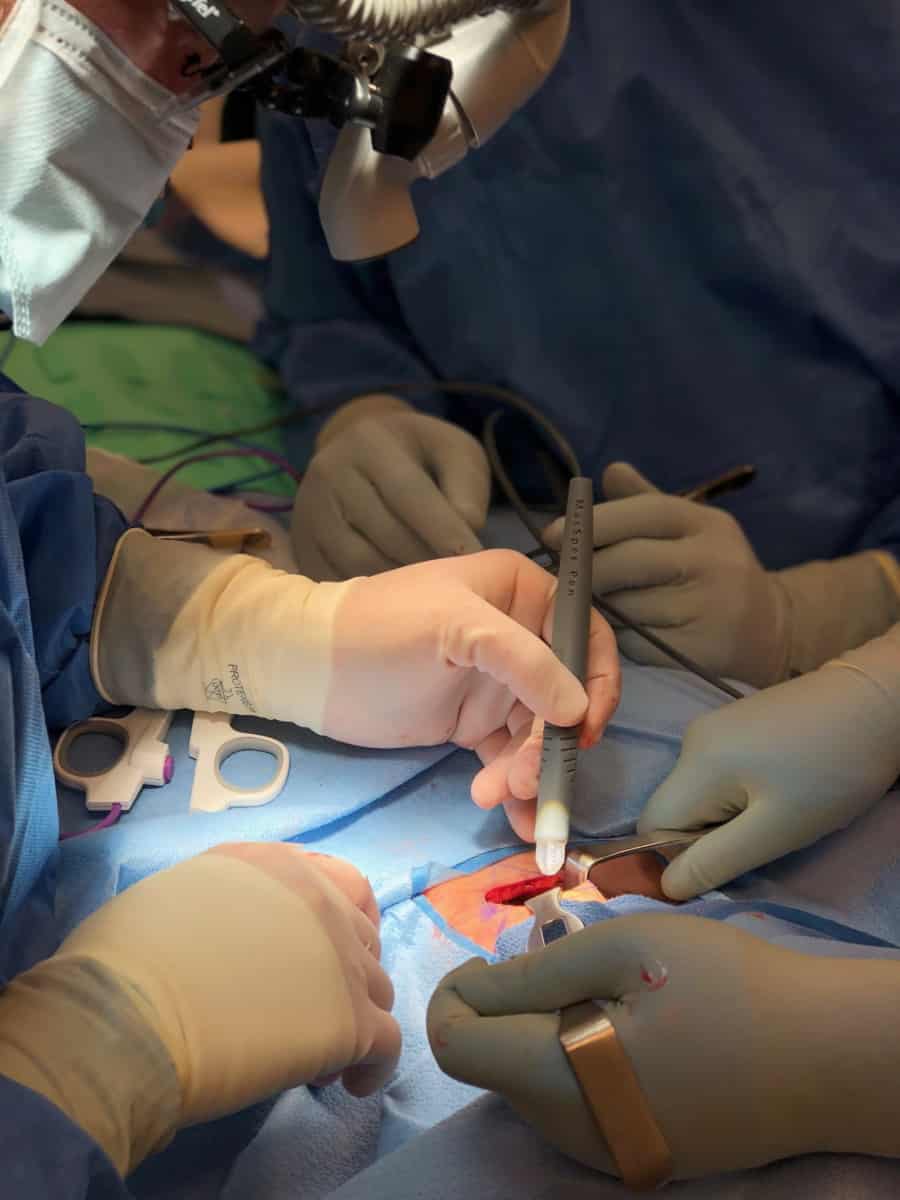
Surgeons can use the pen to extract biomolecules from the surface of pancreatic tissue. These molecules then feed into a connected mass spectrometer, which detects differences between cancerous and healthy cells from their molecular profiles. Tissue classification using the MasSpec Pen takes about 15 s – one hundred times faster than using frozen section analysis.

In their recent study, the researchers first used the MasSpec Pen in the laboratory to analyse 157 banked samples of human pancreatic tissue. Using the molecular profiles of these samples, they trained a statistical model to classify tissue as either cancerous or healthy.

They then transferred the setup to the operating room at Baylor St. Luke’s Medical Center in Houston. Here, the researchers analysed tissues in vivo and immediately after removal during 18 pancreatic cancer surgeries. They found that predictions from their statistical model were accurate in more than 93% of the samples analysed. They also observed that training their classification algorithm with both banked samples and samples collected from the operating room boosted the agreement between their predictions and post-surgery tissue analysis.

“These results show the technology works in the clinic for surgical guidance,” says Eberlin. “Surgeons can easily integrate the MasSpec Pen into their workflow, and the initial data really support the diagnostic accuracy we were expecting to achieve.”

The scientists are currently expanding their study with more patients and are also testing the MasSpec pen in breast cancer and ovarian cancer surgeries. King also emphasizes that they are working to improve the useability of their device in hospitals. “One of our future goals is adapting the MasSpec Pen setup with smaller and more mobile mass spectrometers to make it even more hospital and operating room-friendly,” she tells Physics World.

A personal mission: one scientist’s search for a theory of everything

Jesper Grimstrup is a Danish theoretical physicist who received his PhD in 2002. His life’s mission is to find a theory of everything. In Shell Beach: the Search for the Final Theory, Grimstrup explains how he had a brilliant idea on a trip to China two months after his PhD defence, and how he has since tried to convince other physicists of it. He calls his approach “Quantum Holonomy Theory”. I believe I’m not giving away too much when I say that other physicists have not been convinced.

Originally published in Danish in 2019, the English version of Shell Beach is a self-published book that Grimstrup released this year. He promised to write it for the supporters who financed him after he failed to obtain research grants to pursue his passion. It is not so much about the search for the final theory, but about his search in particular. The reader learns little about this pursuit in general, about its scientific history, or indeed what reason we have to believe that there should be such a theory to begin with. Grimstrup does away with the question of whether he is chasing ghosts in little more than a sentence, arguing that the laws of nature seem to have a minimal length scale and that settles the case.

It’s an untypical book for the non-fiction genre. Half of it is an attempt to convey the mathematics that Grimstrup believes matches his 2002 idea. It is a combination of loop quantum gravity and the theoretical physicist Alain Connesnon-commutative geometry. I think that most readers, even those with a PhD in physics, will find these parts difficult to follow. The other half of the book comprises diary entries from Grimstrup’s numerous kayaking, skiing, camping and hiking trips in different countries. The book has neither figures nor references.

Grimstrup does not tell his story chronologically. A childhood recollection from 1988 is followed by a trip to Germany in 2008, a 2011 conference in India, a memory from Iceland dated 2006, and then another visit to Germany in 2009. It is confusing and does not create a coherent narrative. The tales from Grimstrup’s outdoor adventures, while possibly entertaining for some readers, do little to advance the scientific explanations. They do, however, illustrate that Grimstrup sees himself as an adventurer, proud of taking risks – he once very nearly broke his neck jumping off a cliff – and his quest for a final theory is a challenge for him, just like, say, paddling down a waterfall.

Reports from research visits and conferences likewise add little to the reader’s comprehension of the science, but rather shed light on Grimstrup’s struggle to find a place in academia. According to him, the field is fractured into the tribes that are the large research programmes, and if one wants to survive, one needs to join a tribe. Those who are in the system don’t welcome dissenters. He believes he is onto a great revelation but – besides his long-term collaborator Johannes Aastrup – no-one is interested. He does not seriously consider, at least not in his book, that this lack of interest might have scientific reasons. When a well-known German professor (who is not named but is easy to identify) calls Grimstrup’s approach “obviously wrong”, Grimstrup neither comments nor explains the situation. Instead, the next paragraph skips to one of his travel adventures.

Along the way, Grimstrup chides physicists who, on encountering non-commutative geometry, ask “whether this formulation involves more or fewer free parameters than the ordinary formulation”. Grimstrup thinks this is “tedious nitpicking” because “there is beauty here, I assure you”. He complains about the lack of attention he gets because he believes “that the mere possibility of a link, the idea itself, is worthy of discussion since it is one of the only existing candidates for a final principle”. He doesn’t discuss other existing candidate theories of everything, aside from briefly mentioning string theory, and the two approaches that he himself works with.

This book does not clarify for me what problem Grimstrup believes he has solved

In the end he explains that he found his theory, but it is “empty” because gravity remains a non-quantum force. The name of the book Shell Beach refers to the place sought by the protagonist of the 1998 movie Dark City that, when he finds it, turns out to be empty. This book does not clarify for me what problem Grimstrup believes he has solved. He does not explain how, if gravity remains unquantized, his idea solves the problem that the measurement update in quantum mechanics is instantaneous and hence incompatible with relativity. Indeed, the measurement update isn’t even mentioned in the book. (Please note that I am reviewing his book, not his scientific papers.)

But many of the accusations that Grimstrup raises against the current academic system and its culture deserve to be taken seriously. The difficulties he has faced are familiar to me, and I am heartened by the support he received through crowdfunding. However, I also think Grimstrup is too quick to put all the blame on others.

I have met many physicists – some young, some not-so young – who believe their sense of mathematical beauty allows them to recognize whether an idea will describe nature well. Like Grimstrup, they don’t care that, historically, this approach to theory development has worked badly. Like Grimstrup, they’re on a personal search for meaning, an “intellectual search for something that lies outside of the intellectual”, as he puts it. And since the societal relevance of such a personal endeavour is highly questionable, I think research funding bodies are right in refusing to spend tax money on it.

Be that as it may, Grimstrup has managed to present a topic that’s been written about too much already – the search for a theory of everything – in a new and original way. Shell Beach goes a long way to illustrate what’s wrong with the foundations of physics. You’ll not learn much physics from it, but I’m sure it’ll become an important case study in the sociology of science.

  • 2021 Self-published £23.99pb 276pp

Surfing, sunscreen and the perfect pizza: the physics of holidays

In this episode of the Physics World Weekly podcast, we chat about the physics involved in some of the things we do while on holiday – from surfing to slapping on sunscreen. Holiday food and drink will also get the physicist’s treatment as we learn why wood-fired brick ovens make the best pizza and talk about an online calculator for chilling beverages to perfection.

We also chat about a new brain-machine interface that could someday help people suffering from paralysis, brain injuries or disorders such as locked-in syndrome. And, we learn how the vibrations of Saturn’s rings have revealed a big surprise about the interior of the giant planet.

Terahertz radiation is created using semiconductor surface states

A highly efficient way to convert optical photons into terahertz radiation has been developed by researchers in the US and Germany. The team, led by Mona Jarrahi at the University of California, Los Angeles, showed how the electric fields associated with semiconductor “surface states” can be used to create electrons that emit radiation in the  terahertz range.

Terahertz radiation falls between infrared light and microwaves in the electromagnetic spectrum and has a range of potential applications including security scanning and medical imaging. However, creating practical sources of terahertz radiation is challenging.

One option is to convert light into terahertz radiation using a wavelength conversion system that relies on nonlinear optical effects. The downside of this approach, however, is that it can require bulky and complex optical setups, severely limiting their potential applications.

Now, Jarrahi’s team has come up with a new conversion technique that avoids these problems by using semiconductor surface states.

Incomplete bonds

At the surface of a semiconductor there is break in the periodicity of the crystal lattice and a region of incomplete chemical bonds. The result is the existence of localized electronic surface states, with energies that can lie within the semiconductor’s bandgap – where no electron states can exist within the bulk material. As many semiconductor applications rely on the bandgap, surface states can diminish the semiconductor’s performance, and engineers have found ways to minimize their effects.

Jarrahi and colleagues’ technique uses the large electric field at the surface of a semiconductor that is created by the incomplete bonds. When light strikes the surface, electrons are excited to higher energy levels and can move around the surface, where they are accelerated by the large electric field. These electrons will radiate away their extra energy at the surface, creating terahertz radiation. To enhance this emission, the team placed an array of nanoantennas on the surface, which concentrates the incoming light into the surface region.

The wavelength of the emitted terahertz radiation is a beat frequency of the incident photons and the team produced terahertz radiation with wavelengths ranging from 0.1–1 mm. Using low-energy optical infrared pulses, the system produced terahertz radiation with an efficiency some four orders of magnitude greater than existing nonlinear optical methods.

The team also showed how the technology could be incorporated into an endoscopy probe – which involves coupling to thin, highly efficient optical fibres. Such an instrument could be used to carry out detailed imaging and spectroscopy in opaque environments where optical techniques do not work. The researchers also believe that their technique could be extended to extended work in other regions of the electromagnetic spectrum.

The research is described in Nature Communications.

Brain–machine interface turns thoughts into actions

Brain-machine interface

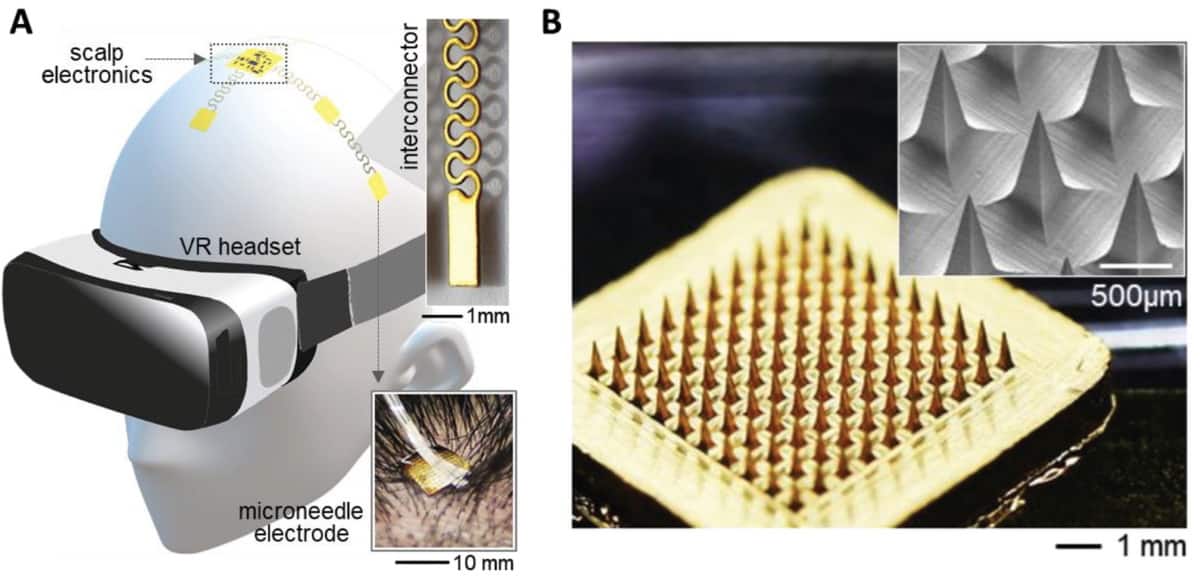
Although Marvel Comics’ portrayal of telekinesis may frighten some, long-range control of objects or machines may eventually be realizable through brain–machine interface technology. Such technologies involve connecting external devices with electrical outputs from the brain to facilitate communication between humans and computers. Recently, a team of researchers from South Korea, the UK and the US developed soft scalp electronics for real-time brain interfacing and motor image acquisition. Their study, published in Advanced Science, details the design and application of this device.

The leading technique for non-invasive acquisition of the brain’s electrical activity is electroencephalography (EEG), which measures brain activity via scalp-mounted electrodes. Unfortunately, these electrodes need to be attached by (an often bulky and uncomfortable) hair cap with extensive wiring. Moreover, EEG typically requires conductive gels or pastes to minimize the effects of motion artefacts and electromagnetic interference.

To address these shortfalls, the research team – headed up by Woon-Hong Yeo at Georgia Institute of Technology – has developed a portable EEG system that’s soft and comfortable to wear. The new device uses an array of flexible microneedles that acts as an electrode to detect brain signals. These signals feed through a stretchable connector into a wireless circuit, which filters and processes the inputs in real-time.

Woon-Hong Yeo's team

The gold-plated microneedle electrode provides biocompatibility and excellent contact with the scalp. Mechanical testing demonstrated the array’s impressive durability, yielding a low resistive change after a series of 100 bends. The microneedles themselves also showed mechanical robustness, with their shape and electrical coating remaining intact after 100 insertions of the needles into porcine skin.

To test the device’s efficacy in classifying brain signals, the team paired it with a virtual reality video game and a machine learning algorithm. In the video game, four volunteers responded to visual cues to perform motor imagery tasks every four seconds. By recording the brain’s activity, the convolutional neural network interpreted the input to determine the subject’s intended tasks. The system achieved high accuracy, correctly classifying 93% of inputs at a high information transfer rate of 23 bit/min, allowing real-time wireless control of the game.

The researchers conclude that this motor imagery technique offers significant potential to act as a general-purpose brain–machine interface. They note the need for further work in optimizing the placement of electrodes to maximize the number of functional imagery classes while maintaining high classification accuracy. The group believes that, in time, the technology may offer a solution for individuals suffering from paralysis, brain injuries or disorders such as locked-in syndrome.

Perhaps Stan Lee had a premonition of brain interface technology when he first depicted Wanda Maximoff’s telekinetic powers back in 1964…

Copyright © 2026 by IOP Publishing Ltd and individual contributors