The fundamental advantage of proton therapy lies in its ability to deliver a high radiation dose to a specific depth in the body, known as the Bragg peak, which lies at the maximal penetration depth of the proton beam. After this, the dose rapidly falls off, sparing healthy tissue behind the target.
Conventionally, proton therapy planning relies on estimates of this particle range in the patient, provided by Hounsfield look-up tables (HLUT) that convert CT numbers to stopping-power ratio (SPR). Any uncertainties in these range estimates, however, could result in the actual delivered dose not fully covering the target. To prevent this, proton therapy centres typically add a safety margin of 2.5–3.5% of the proton range plus 1–3 mm, but this can correspond to about 10 mm for deep-seated tumour sites such as the prostate. This safety margin could potentially be reduced using state-of-the-art CT-based methods for range prediction, such as DirectSPR, the direct determination of SPR from dual-energy CT (DECT).
PGI works by detecting the prompt gamma rays produced when the proton beam interacts with atomic nuclei within the patient. The PGI slit camera, developed by IBA, relies on the projection of the emission profile of prompt gamma radiation along the proton path onto a spatially resolved detector through a tungsten knife-edge slit collimator. The resulting one-dimensional prompt gamma distribution, which is obtained for each spot of a pencil-beam scanning treatment, contains information regarding the range of the protons in the patient. For this study, the PGI slit camera was upgraded by mounting it on a floor-based docking system to improve positioning accuracy.
Validation for prostate cancer treatments
The DirectSPR implementation in Dresden, based on a long-term collaboration with Siemens Healthineers, uses CT images at two X-ray energies for direct measurement of a patient’s tissue properties and performs a voxel-wise direct SPR calculation from those DECT scans. The researchers conducted PGI-based validation of proton range prediction using this DECT-based DirectSPR, as well as two other range prediction approaches: a standard HLUT method; and an adapted HLUT optimized by DECT-derived SPR calculation.
They analysed the accuracy of the three approaches using clinical PGI measurements during hypofractionated treatment of five prostate cancer patients (30 fractions in total), with in-room control DECT scans in the treatment position. For each pencil-beam-scanning spot, the team obtained the range shift by comparing the PGI measurement to a control-CT-based PGI simulation. The mean range prediction accuracies were: 0.0 ± 0.5% for DirectSPR; 0.3 ± 0.4% for the adapted HLUT; and 1.8 ± 0.4% for the standard HLUT approach.
“The highest accuracy was reached for the Direct SPR approach, yielding no range deviation for the monitored prostate-cancer treatments,” write the authors. “Our validation confirms the superiority of DECT-derived SPR prediction approaches over current state-of-the-art HULT approach based on single-energy CT.” They hope that this validation of range prediction in patients will support change in clinical treatment planning and foster the clinical implementation of DECT-based planning at other proton therapy centres.
The researchers note that they chose prostate-cancer treatments to evaluate because these contain a highly homogeneous target region, as well as requiring the highest penetration depth in particle therapy. They point out that the comprehensively determined uncertainty of the PGI-based validation was about 1 mm in prostate cancer patients. This is far smaller than the range prediction uncertainty of HLUT-based approaches and DirectSPR used at the Dresden proton therapy facility – an important prerequisite for this first-in-human range validation of the clinically applied technique.
Based on their research, the researchers will extend the application of PGI to other treatment sites, such as head-and-neck cancers. They also plan to use PGI and accompanying CT data acquired within their study to systematically investigate the sensitivity of PGI-based treatment verification to detect anatomical changes during the course of proton therapy.
It’s a hot summer day, and you’ve been queuing for the better part of two hours. The line inches along agonizingly slowly, and your anticipation ebbs and flows each time you creep ahead or hear the distant screams and whoops. Finally, it’s your turn – you pick your seat, strap in, take a deep breath and prepare to scream your head off. The rollercoaster train cranks to the top of a steep hill, then drops down. A mere one to two minutes later it’s all over, and you wobble off the track as the next bunch of giddy thrill seekers clamber on.
Every day (pandemics allowing), people all over the world flock to amusement parks, with the main attraction usually being a rollercoaster ride. The thrill of rollercoasters lies mostly in the fact that they allow us to go at fast speeds, experiencing sudden, hair-raising changes in acceleration and direction – all while putting into action some of the most basic principles of Newtonian mechanics.
Hill thrills
Rollercoaster trains have no engine or no power source of their own. Instead, they rely on a supply of potential energy that is converted to kinetic energy. Traditionally, a rollercoaster relies on gravitational potential energy – the energy it possesses due to its height. It is pulled to the top of a big hill, the highest point of the ride, and released.
The UK’s tallest rollercoaster, The Big One at Blackpool Pleasure Beach, starts with the train being cranked to the top of a massive 65 m hill. On rides like this, your anticipation builds with the clank-clank-clank of the chain, as it pulls you slowly up the hill. Gravity then takes over, pulling the cars down a 65° drop. As the train dives, the potential energy decreases and the kinetic energy increases as it accelerates to around 119 km/h (74 mph).
Thrills and spills Reaching a height of 65 m, The Big One at Blackpool Pleasure Beach used to be the tallest and steepest rollercoaster in the world. It is still the tallest in the UK and one of the fastest, with a top speed of 119 km/h. (Courtesy: iStock/onfilm)
Instead of a lift hill, many modern rollercoasters use a launch to give the train kinetic energy. Stealth, at Thorpe Park in Surrey, for example, uses a hydraulic system to catapult the train out of the station, propelling riders from 0 to 128 km/h (80 mph) in less than two seconds. This system uses a winch to rapidly pull a catch car along the track. The catch car “catches” the rollercoaster train, pulls it along and then releases it, flinging it down the track.
Other rides use electromagnetic propulsion systems, where electromagnets on the train and the track pull, and then propel, the train forwards. Like the catapult systems, these can create incredible amounts of acceleration, moving the trains to speeds of more than 95 km/h (60 mph) in a few seconds. Although you don’t have the nervous wait as you are pulled up the hill, these launches still provide a sense of anticipation as you sit in the station.
Energy conservation
Rollercoasters constantly shift between tapping into potential and kinetic energy. The kinetic energy gained when the train travels down the first hill – or fires out of the launch – gets it up the next, smaller hill. As it travels up the hill, it loses kinetic energy and gains potential energy, and the cycle starts again. Many newer rollercoasters also include further launches, which are often electromagnetic, that provide the train with additional kinetic energy part way through the ride.
Most people like to sit at the front or the back of the train, with many rides offering separate queues for these prime spots. In these positions riders feel a greater sense of weightlessness, explains Ann-Marie Pendrill, an expert in using rollercoasters in physics education at the University of Gothenburg and Lund University in Sweden. Pendrill adds that the middle of the train is where one experiences the highest G-forces, but not many people choose to sit there. “The force if you are sitting in the middle will really be more straight up to you, not sideways, not back to front. It will be more or less the way it should be theoretically.”
A unit that might make purists wince, the G-force is the difference between the acceleration, a, that you experience as a rider and the acceleration due to gravity, g, (9.8 m/s2) divided by g and expressed per unit mass: (a–g)/g. This force comes into play thanks to the movement you undergo on the ride– you experience a “positive” G-force when the train is at the bottom of a hill, and a corresponding “negative” force when it crests the top of a hill. When your downward acceleration is close to g, you feel weightless. This is why you feel so much lighter as you accelerate down the hill. But as the rollercoaster train pulls out of the dive, your body wants to continue travelling in the same direction. The sudden change in direction as the track flattens is why you squash into the seat and abruptly feel heavier: the ride pushes up, while your body tries to carry on travelling downwards.
You experience similar “lateral” G-forces on the corners, where your body tries to continue moving in the same direction, while the train turns. If the track isn’t banked, you slam into the side of the car (or another passenger). If the track is banked, the force acting against you from the seat is along the same axis, which helps to smooth out the ride.
My stomach is in my mouth
Pendrill has taken her smartphone on rollercoasters all over Scandinavia, to collect data using an accelerometer (figure 1). Her favourite rollercoaster, the Helix at Liseberg in Gothenburg, Sweden, begins differently to many others. It starts at a high point and just rolls out. Riders reach the station at the top of the hill via an escalator or stairs. Pendrill’s accelerometer measurements show that at the bottom of Helix’s first drop, the force exerted on the riders is 3.5g, known colloquially as 3.5G. This is similar to that experienced at the bottom of the first drop on The Big One.
1 A rollercoaster in numbers Using a smartphone, Ann-Marie Pendrill of Lund University collected vertical accelerometer data on the Valkyria rollercoaster at Liseberg in Sweden, from which she plotted the G-force on a rider as a function of time. Safety guidelines recommend that the maximum rate of acceleration in any part of a ride should be no more than 15 g/s (rising dashed lines). There are also limits to how long riders can be exposed to different forces for (coloured horizontal lines). After exposure, these forces must drop off fast, with the minimum “drop rate” of 0.8 g/s (falling dashed lines) limiting how long each exposure lasts in practice. (Courtesy: Phys. Educ.55 065012/CC BY 4.0 IOP Publishing)
What are referred to as negative G-forces on a rollercoaster are, in reality, often less than 1G, rather than actually negative, which means that you experience a feeling of nearly being lifted out of your seat. This is referred to as “airtime”, when riders experience moments of weightlessness, as the train travels over a peak at speed. “I like the airtime hills where you kind of float,” says Pendrill. “I really like the equivalence principle – the equivalence between gravitational and inertial mass – so that you float, you are weightless as you are in freefall over the hill. You can have that for a reasonable amount of time, if the hills are well built.”
On Helix’s two airtime hills you experience around 0G and –1G, according to Pendrill’s measurements. She explains that these features rely on projectile motion, much like a zero-G flight. As in the valleys and corners, Newton’s first law of motion comes into play: an object in motion tends to stay in motion, so your body wants to carry on travelling in the same direction. As the train drops away when it goes over the hill, your body tries to carry on moving upward and forwards, leaving you with a feeling of weightlessness. Your internal organs also try and follow the same path, which is why it can feel like they are floating inside your body, and your stomach is in your mouth.
These airtime hills are where you will experience the lowest G-force if you are sitting in the front or the back of the train. “Think about a train going over the hill,” Pendrill says. “As it comes up it will slow down until the middle, and then it will speed up again. So both the front and the back of the train move faster over the hill, which means that you lift more.”
What goes up Rides at Liseberg in Sweden include the Helix (green) and the Valkyria (yellow). (Courtesy: Liseberg)
Rollercoasters are designed so that you are constantly experiencing changes in forces. On the Helix ride in Sweden, a launch halfway round the ride fires the train up a steep hill into an inverted top hat. Pendrill’s data show that after this launch, riders experience around 4G as they fly up the hill, before it drops to around 0G as they travel upside down through the top hat; then rapidly increases to more than 4G as the train flies into the valley at the bottom. Coming out of the valley the train shoots over an airtime hill, with riders experiencing –1G, before diving into another valley where the force hits 4G again. This all happens in about 15 seconds.
Heightened senses
It is these rapid changes that make rollercoasters so exciting, explains Brendan Walker, a researcher at Middlesex University London and rollercoaster consultant, who describes himself as a thrill engineer. “If you look at people’s physiological response when they are on a rollercoaster, the arousal aspect of emotions is very much tied, almost inextricably tied, to changes in G-force,” Walker explains. “So we’ve got the jounce and the jerk, which are the differentials of acceleration – velocity, acceleration, jerk, jounce – every one of those has an impact on our levels of arousal, as they change.” Indeed, when you ride, you experience a heightened state of stimulation, as your heart is pumping fast and your blood pressure increases.
What happens next depends on the ride. Do the changes in force feel nice? Are there exciting or dramatic visuals? Can you see other people watching in awe, or terror, as you fly past? “All those other elements that are more aligned with the arts, theatre, dance, body movement; that is where the pleasure comes in,” Walker says. “If you manage to get that as you are delivering the hard levels of arousal through the physics, then you’ve got a thrilling moment on a ride.”
Round and round The Kumba at Busch Gardens in Tampa, Florida, had the world’s tallest vertical loop when it opened in 1993. It features seven inversions across a three-minute ride. (CC BY 2.0 Jeremy Thompson)
Pendrill adds that rides need to strike a balance between changes in force that are a bit more violent, and ones that creates a sense of excitement. “You want things to change, but not too rapidly or too smoothly,” she says. Frank Farley, a psychologist and expert in risk-taking and thrill-seeking at Temple University in Philadelphia, US, believes that most people go on rollercoasters for the simple thrill of it. “The excitement, a feeling of riskiness, the escape from the humdrum of everyday life, the contrast with everyday life, the challenge as to how you will handle it.”
Walker agrees. “People I’ve interviewed without fail say that it is the moment they feel truly alive when they are thrilled, yet we are starved of that in a safety-conscious western world, so people gravitate towards thrill rides.” He adds that it is no surprise to him that theme parks first started to appear in places like Coney Island, New York, and the peripheries of other cities like London as the world became more industrialized and more urban.
Upside down, you’re turning me
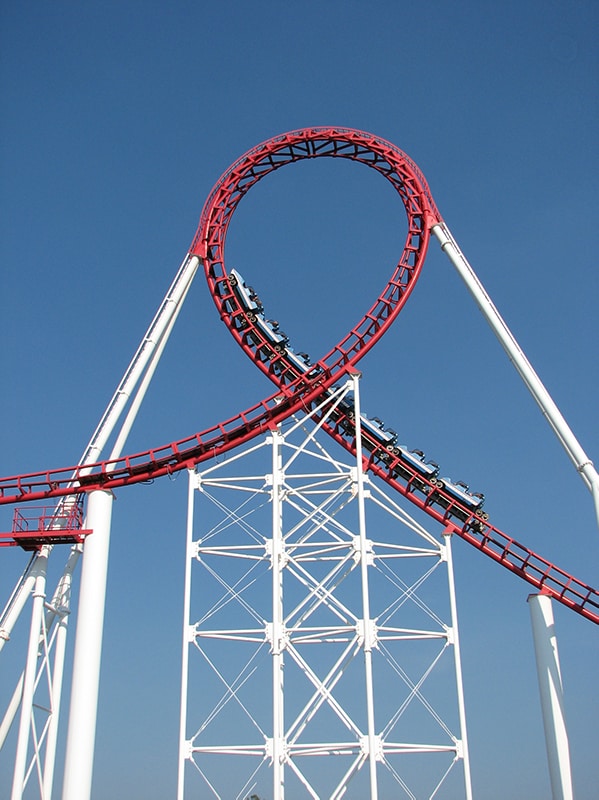
Of course, the biggest thrill on a rollercoaster is going upside down, on the loops. As you travel through a loop, inertia – the tendency of an object to resist change in its state of motion – pushes you outwards and keeps you in your seat. Gravity tries to pull you down, but the stronger acceleration force counters this, pushing you first sideways and then upwards.
Thrill ride The Great American Scream Machine (1989–2010) at Six Flags in the US included a teardrop-shaped loop. (CC BY 2.0 Jeremy Thompson)
Rollercoaster loops are most often not perfect circles – instead, they are teardrop-like in shape. This is because it takes a greater amount of acceleration to get the train around a perfectly circular loop. Pendrill says that for such a loop, the acceleration would change rapidly between about 6g and 1g as you travelled around the loop. It is this change, rather than the high G-force itself, that is dangerous: the jerk is not good for your body. “They built them like that in the early 20th century and people had whiplash,” Pendrill says.
With teardrop-shaped loops, the radius of curvature changes as you move through the loop. It is larger at the bottom and sides of the loop and smaller at the top. This reduces the acceleration required at the sides. Pendrill says that forces are typically around 4G as you enter and exit such loops.
There are now a huge number of different “inverting elements” or styles of loops that modern-day rollercoasters employ, with a confusing array of names, such as sea serpents, a bent Cuban eight, pretzel loops and knots, batwings and even the terrifying-sounding “demonic knot”. One popular inversion that is the final feature on many modern rollercoasters is the “heartline roll”. In this, the train performs a 360° roll, but it rotates around your centre of gravity, or your heartline.
“Since it is constant velocity, the force acting on you is compensating gravity and is pointing up, but if your head is down it feels different from when your head is up,” explains Pendrill. Walker adds that such rolls “create a very different sensation” and have a very different effect on the blood in your body, as compared to other aspects of the ride when your blood is usually rushing to your feet.
Virtual reality
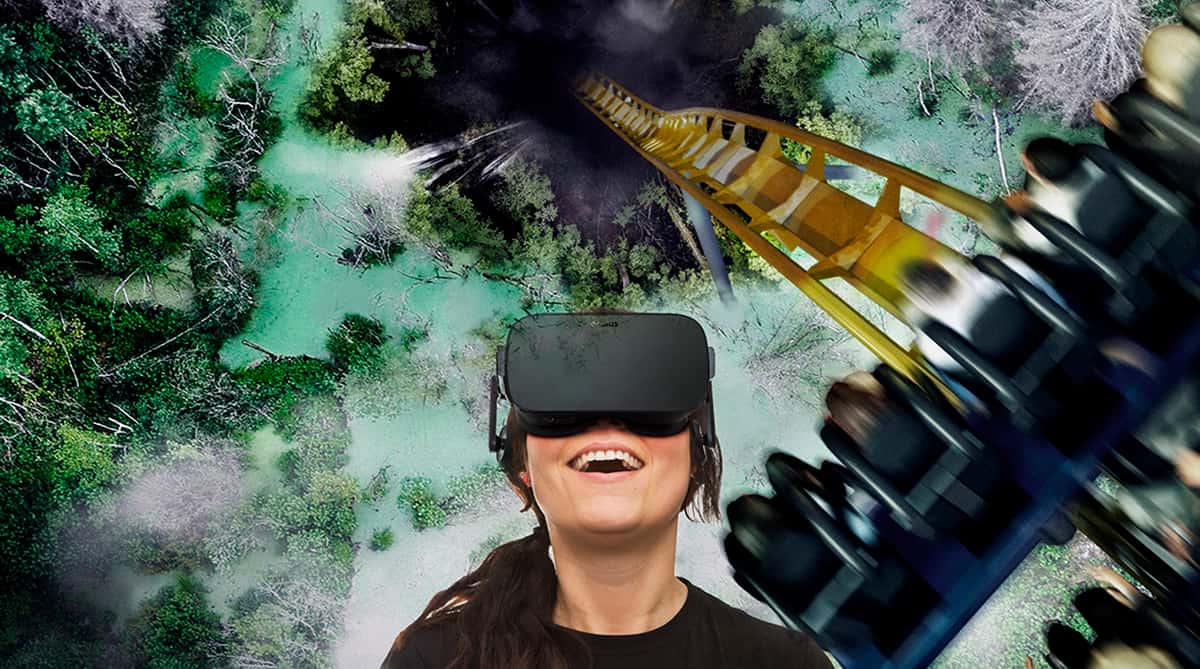
From a physics point-of-view there is a lot more we could do on rides, Walker says, but the human body is a limiting factor. One way some people are looking to push rollercoasters to the limit is with virtual reality (VR), where riders wear headsets and travel through a virtual world during the ride, adding extra levels of visual simulation and illusion.
According to Malcolm Burt, an expert in disruptive media, thrill rides and VR at Central Queensland University in Australia, VR has a number of advantages when it comes to amusement park rides. It can revitalize old rollercoasters, and it is easier and cheaper to update than a physical ride. This means you can change it quite quickly, offering different, perhaps even seasonal or topical, experiences.
Indeed, it is possible to create unique sensations by combining the G-forces of a rollercoaster with a virtual world. The human body isn’t particularly adept at sensing direction and speed, just that there have been changes. This means it is quite easy to trick people into thinking that a ride is much more aggressive than it actually is. You can make slopes appear much steeper or higher than they are in reality, for example. “Little movements can have big impacts on your brain when you have the right visual stimuli,” Burt says.
Virtual thrills Theme parks are starting to incorporate virtual reality into some rollercoaster rides to enhance the experience, including Valkyria at Liseberg in Sweden. (Courtesy: Stefan Karlberg/Liseberg)
It is important, however, to make sure that people are not receiving information that is contradictory to what is going on in the physical world, adds Walker. Burt agrees, stating that most VR rides give you clues as to what is coming so you can be ready, to prevent discomfort. For example, if there is a blast-off in the virtual world, it might coincide with a launch mechanism on the rollercoaster.
Burt recalls once having a “horrible experience” on a VR rollercoaster that was still in development, before the headset was working properly. “It was terrifying,” he says. “There was no sensory feedback whatsoever, it was literally like having a blindfold on, on this very aggressive rollercoaster. I was thinking, ‘just breathe, just breathe, you’ll be fine, you’ll be fine’.”
When Walker works on VR rides, the software he uses contains an advanced physics simulator. “We have methods to simulate the physical forces in real time and then build our virtual world around that,” he explains. “Our virtual representation of a fantasy world has a very close correlation to the physics of the real world.”
So the next time you’re queueing up at the amusement park – be it to ride the longest, tallest, scariest rollercoaster you can find, or even one that is in space, thanks to your VR headset – don’t forget to think about all the physics in action that you’re about to experience. Chances are, it will all go straight out of your head the minute the ride begins.
If you happen to come across the phrase “counterfeit consciousness” in a research paper, it just might be a fake – according to an amusing news article in Nature. In it, Holly Else explains why Guillaume Cabanac at France’s University of Toulouse and colleagues believe that fake papers are being created by running plagiarised text through translation software. This results in what the researchers describe as tortured phrases including “counterfeit consciousness” – which was apparently substituted for “artificial intelligence”.
Moving on to a legitimate form of creative writing, Femi Fadugba did a MSc in physics at the University of Oxford and went on to study at the University of Pennsylvania. But today, he is a rising star in the world of young adult fiction. His book The Upper Worldis published by Penguin and will soon be made into a film by the Oscar-winning actor Daniel Kaluuya. It is a work of science fiction and borrows heavily from the physics of space and time – indeed, it has an appendix of equations that are relevant to the plot.
The book is set in the London neighbourhood of Peckham, where Fadugba spent much of his youth. “There’s no reason why Peckham couldn’t be the theoretical physics capital of the world,” he tells Kadish Morris in this profile in The Guardian.
Moving from South London to the western edge of the city, and there is some good news for another Oxford physics graduate. Matthew Benham is owner of Brentford Football Club, which today will play its first match in the English Premier League. I’m not an expert on the history of the club, but I think this is the first time the team has played in England’s top flight since 1947.
So, congratulations to Benham, who must feel like he has won a Nobel Prize.
Researchers at the Paul Scherrer Institute (PSI) in Switzerland and the Brookhaven National Laboratory (BNL) in the US have employed an advanced X-ray spectroscopy technique to study the complex electronic properties of so-called correlated metals for the first time. Their findings could help us better understand quantum materials such as magnets, multiferroics and unconventional superconductors.
Correlated materials get their name from the behaviour of their electrons, which interact much more strongly with one another than is possible in conventional materials. This coupling between electrons makes the physics of correlated materials extremely rich and promising for a host of applications in data processing and quantum computing, but it also makes them challenging to study.
RIXS reveals electronic correlations
Researchers led by Thorsten Schmitt and Jonathan Pelliciari have been using the intense and extremely precise radiation from the Swiss Light Source (SLS) at the PSI to probe these materials with a technique called resonant inelastic x-ray scattering (RIXS). Here, soft X-rays are scattered off a sample while the incident X-ray beam is tuned so that its energy excites electrons from a lower electron orbital to a higher electron orbital. This process leaves behind a “hole” in the lower electron orbital, which disturbs the system and triggers various electrodynamic processes.
After a short time, the hole in the lower electron orbital is filled and X-ray light is remitted. The spectrum of this so-called inelastically-scattered radiation contains information about the induced electrodynamic processes, which in turn provides insights into the electronic structure of the material being studied.
Comparison to calculations required
While the RIXS technique works well for correlated insulators, it has previously run into trouble when probing correlated metals because so many different electrodynamic processes occur during scattering. This complexity makes it hard to interpret spectra from correlated metals without some other reference point, Schmitt says. As his colleague Keith Gilmore explains, they need to compare their experimental spectra with theoretical calculations before they can satisfactorily interpret the data generated by synchrotrons equipped with hundred-metre-long beamlines. “Thus far, this has limited rigorous testing of theories and our ability to predict the outcome of the experiments,” says Gilmore, who formerly worked at BNL and is now at Humboldt University in Berlin.
Gilmore goes on to explain that some of the most interesting quantum materials are produced by doping insulating compounds to make them metallic. However, the metallic versions of these materials have so many electrons and orbitals that simulating them is too costly in processing terms for typical computational methods. “The insulating case is simpler because we can use model calculations that can be solved exactly – something that is impossible for metals,” he says. Initial attempts to describe the RIXS process in metals and correlated metals were made as early as in the 1970s, Pelliciari adds, but the lack of experimental data slowed further theoretical development.
Combining state-of-the-art computational methods
More recently, the advent of new, more powerful computational tools, together with novel instrumentation, has made it possible to compare the theory of these complex systems with calculations for the first time. The technique developed by the PSI/BNL team does this in a unique way. The researchers start with an electronic structure that they obtain using density functional theory, a well-established theoretical framework. They then use a different method called many-body perturbation theory to calculate the excited states produced by the X-ray beam. “In this way, we produce a first approximation to the RIXS spectrum and then improve this initial calculation by evaluating more complex correlated responses to the X-ray excitation that we initially neglected in the perturbation theory calculation,” Gilmore tells Physics World, adding that the latter step involves a real-time dependent density functional theory calculation. By combining the contributions of one electron with the coordinated reaction of all the other electrons, he says, they can overcome their previous lack of predictive power.
The researchers successfully tested their technique on barium-iron-arsenide, which becomes an unconventional high-temperature superconductor when a certain number of potassium atoms are added to it. They used the X-ray beam to excite an inner electron in the iron atom in the material from the ground state to the higher energy valance band. As mentioned, this creates further secondary excitation and triggers complex decay process that show up in the spectral structure.
“Our work means that it is now possible to describe the RIXS process by providing a complete description of the material and of the electrodynamic processes occurring during the spectroscopic response to excitation with resonant X-rays,” Gilmore says. “This combined experimental and theoretical approach greatly enhances our ability to gain valuable new insights into the fascinating behaviour of correlated metals using RIXS.”
At his best, Alan Lightman is a wondrous writer: poetic, original, insightful, inspired. In his new book Probable Impossibilities: Musings on Beginnings and Endings, he ponders the infinitely small and the infinitely large, and the impossibility of understanding each, let alone grasping our place in a universe that pulls us in both directions. He illustrates this at one point with a simple story of taking his two-year-old daughter to the ocean for the first time.
After parking they begin to walk across the undulating dunes, towards the shore’s edge. “Eventually we climbed over a sandy hill. And there was the ocean, stretching on and on until it merged with the sky. It was my daughter’s first glimpse of infinity. For a moment, her face froze. Then she broke out in a big smile.”
This put a lump in my throat as I recalled my own encounters with such infinities, with sights that don’t at first seem real: Arizona’s Grand Canyon; Oregon’s Crater Lake; the emerald expanse at Forbes Field, a baseball park in Pittsburgh, when my dad and I first came out of the stadium tunnel when I was a small boy. I love that Lightman, ever the curious, observant writer, made a point of watching his daughter’s face at that crucial, unique moment.
Lightman is a noted physicist and author of several popular-science books, including his acclaimed first novel, the international bestseller Einstein’s Dreams, an imagination of fantastical concepts of time in the dreams of a fictional Albert Einstein. Now professor of the practice of the humanities at the Massachusetts Institute of Technology (MIT), he’s had a broad and unique career that’s garnered many awards, including six honorary doctorates in the humanities.
This book, he writes on his homepage, is “a collection of meditative essays on the possibilities, and impossibilities, of nothing and infinity – and how our place in the cosmos falls somewhere between”. That’s a rather broad range, to say the least, but Lightman has something interesting to say about nearly everything. In one chapter, “On nothingness”, he recounts a vivid, minute-long out-of-body experience he says he had as a nine-year-old child, floating in space far beyond the galaxy. And in a chapter titled “Is life special?” he estimates that the fraction of all matter in the universe in living form is one billionth of one billionth (10–18).
Some of the most interesting parts of the book are lengthy, rounded profiles of scientists working in different fields. I especially enjoyed one about the Nobel-prize-winning geneticist Jack Szostak trying to create a living cell from scratch – from a collection of non-living materials. Throughout more than a dozen pages on biology, Lightman includes thoughts from rabbis, Buddhist monks and bioethicists, as well as his own musings on the ideas of Richard Feynman (who spent much of his career at Caltech, where Lightman did his PhD) and the android character Commander Data from Star Trek: the Next Generation.
Just as interesting is a profile of the theoretical physicist Andrei Linde of Stanford University, who invented a revised version of cosmologist Alan Guth’s 1981 Big Bang inflation model. Linde’s theory, called “eternal chaotic inflation”, predicts that our universe is one of a vast number of universes, each of them constantly and randomly spawning off new universes in an everlasting chain of creation. Lightman says some of the predictions of the Guth–Linde theory have been confirmed by experiment, but a great deal of Linde’s ideas will forever remain pure speculation. Such is theoretical physics these days. Lightman goes on to talk with Linde about his ideas about infinity and his photography hobby (on his Flickr page you can see impressive photographs of buildings bathed in lights reflected off water).
As much as I enjoyed these and other anecdotes, I was, however, often distracted by trite statements that should never have left the editorial stage. Interviewing a physicist in Los Angeles by Skype from his guest room in Concord, Massachusetts, Lightman says they are “practically next door on the scale of the galaxy”. Groan.
At the end of a chapter on “Immortality” Lightman imagines that “a kind of immortality” might be attained by imprinting his social security number on each of the atoms comprising his body, so that someone could follow them for the next thousand years, as they became parts of soil, plants, people, lives and memories. Really? I found myself groaning again.
The very well-known fact that things weigh one-sixth as much on the Moon as they do on Earth – which for some reason Lightman labels a “little-known fact” – “does not” he writes, “appear in the diet books I’ve seen”.
And in the aforementioned chapter “Is life special?” – wherein Lightman mistakenly takes proton decay as a fact – he estimates that the “Era of Life” in the universe lasts from about one billion to 1000 billion years after the Big Bang. This seems reasonable, in a universe that he estimates meaningfully spans about 1082 years. But he describes these trillion years as a “relatively brief moment”, one that is “joyous” and “majestic”, but also “tragic”, “cruel” and “devastating”. A trillion years is cruel and devastating?
Perhaps on the infinite and infinitesimal, impossible as they are for us to comprehend, it is difficult for even the best of writers to perfectly span the void
Sometimes Lightman reaches too far. However, by no means did these instances – and I found surprisingly many – ruin the book for me. I just felt that the author often took the easy way out of a paragraph or chapter, and that isn’t the Lightman I’ve read before. But perhaps on the topics of the infinite and infinitesimal, impossible as they are for us to comprehend, it is difficult for even the best of writers to perfectly span the void.
The idea of seeing round corners without using a mirror may sound magical but, in the past ten years, non-light-of-sight (NLOS) imaging has become an increasingly active research field, with potential applications including surveillance, self-driving cars and fire and rescue. Now researchers in China have found a novel way to detect the arrival times of scattered photons with picosecond resolution, producing sharper images than possible with a standard camera without requiring expensive, specialist equipment.
The most common method for NLOS imaging measures the time-of-flight of scattered photons. Multiple laser pulses are emitted sequentially and focused at a surface within the line of sight. Some of these photons then scatter off the concealed object before reaching the detector. The detector records the time between emission and detection and uses it to infer the distance each photon has travelled. A computer algorithm then works out the shape of the concealed object from the path lengths of the scattered photons.
“The precision with which I can build a 3D image depends one-to-one on how good my temporal resolution is,” explains optical physicist Daniele Faccio of the University of Glasgow. “How precisely can I say how long it took for a photon to go round the corner, hit an object and come back again?”
Expensive and hard to use
In 2012, the first work on NLOS imaging achieved a temporal resolution of about 10 ps by using a streak camera similar to the type used in ultrafast optics, “You can buy streak cameras with 1 ps resolution,” says Faccio, “but they’re relatively hard to use and they cost between £100,000 and £200,000.”
Moreover, streak cameras do not offer single photon resolution, which is important as scattered signals can be very weak. Recent work, therefore, has focused on digital single photon detectors, which are much cheaper and more user-friendly. However, their time resolutions are limited to approximately 100 ps, which limits the image resolution to the centimetre scale.
Now, Jian-Wei Pan of the University of Science and Technology of China and colleagues have developed a technique that improves this time resolution dramatically. They send one “signal” pulse from an infrared laser to the visible wall, allowing the photons to scatter and return into a lithium niobate waveguide. A tiny fraction of a second later, they send a second “pump” laser pulse into the waveguide. If a scattered signal photon arrives at the same time as a pump photon, a visible photon is produced.
Non-linear optics
“When the pump and signal photons enter the waveguide, they undergo frequency upconversion through a nonlinear optics process,” explains team member Feihu Xu. “That produces [a photon at] another wavelength that can be detected by a single photon detector…The single photon detector only works in the visible wavelengths, so if the pump does not mix with the signal, there’s no detection.”
By varying the time spacing between the signal and pump pulses, the researchers can ascertain the times at which scattered photons arrive at each pixel in turn. They achieved a time resolution of about 1.4 ps, allowing them to obtain an order of magnitude improvement in image sharpness over anything achieved previously.
Long acquisition times
“It’s a very interesting accomplishment that, to the best of my knowledge, has improved upon the state-of-the-art in terms of spatial resolution in the non-line of sight volume over any previous technique based only on time-of-flight,” says electrical engineer Vivek Goyal of Boston University in the US. He notes, however, that “to make these measurements with very fine time resolution, you have to sweep the time between the signal and the pump. That multiplies your acquisition time.”
Faccio agrees: “If I’m driving and I want to see another car approaching from behind a corner, I don’t need 200 micron resolution – all I need to know is whether there is a car…and I certainly can’t wait an hour for the results,” he says. “What people are focusing on now is ‘how can I do this faster, with less laser light, and how can I make the volume that I can image bigger’. This is very neat, it’s very high precision, but it’s not obvious to me what the killer application is.”
Xu acknowledges that “right now a bottleneck is the imaging speed. It takes us maybe minutes, but there’s a lot of room to improve. For stationary monitoring by the police or the military, even slow imaging could have some applications, but for general applications we definitely need to solve the imaging speed problem.”
If you built a very expensive telescope, would you hitch it to a balloon and fly it 40 km above the surface of the Earth? That is what Mohamed Shaaban at the University of Toronto and an international team will do next year when they launch their SuperBIT telescope on NASA’s superpressure balloon. Shabaan explains why the team is putting their telescope on a balloon and how the instrument will be used it to study gravitational lensing, which could improve our understanding of how much dark matter there is in the universe.
John Enderby, who died last week aged 90, was a pioneer of neutron science and a staunch advocate of scholarly publishing. For many years he was our colleague at Institute of Physics Publishing and associate director Tim Smith joins the podcast to chat about Enderby’s contribution to publishing and science.
A metallic water solution has been observed in the laboratory for the first time thanks to a new method that bypasses the need for extremely high pressures. By reacting water with an alkali metal in a way that avoids the usual explosive outcome, an international team of researchers showed that they could produce a gold-coloured conducting layer on the surface of the resulting solution – a rare example of a modern scientific result visible to the naked eye.
In principle, any insulating material can be transformed into a metal by applying a high enough pressure to it. For pure water, the pressure required is 48 megabars – a value that is way beyond what is possible in laboratory experiments and may be literally astronomical, existing only inside the cores of large planets or stars.
At pressures obtainable in the laboratory, researchers recently showed that water could be made superionic, containing high-conductivity protons. A metallic state containing conductive electrons, however, was thought to be out of reach.
Suppressing explosions
Researchers led by Pavel Jungwirth have now turned this idea on its head by reacting water with a sodium-potassium (NaK) alloy to produce a metallic water solution. To do this, they first had to suppress the explosive reaction – a favourite of school science experiments – that normally occurs when water and an alkali metal come together.
“We know that dissolving alkali metals in water leads to explosions, so we did it the other way around,” Jungwirth says. “We blew a tiny amount of water at pressures as low as 10-4 mbar onto a NaK alloy drop squirted from a micronozzle at a dripping rate of about one drop every 10 s in vacuum.”
When there is no water vapour in the vacuum chamber, the NaK drops have a silver metallic sheen. This lack of visible colour occurs because alkali metals do not have d or f electrons that can be optically excited and produce colour via photoluminescence. When the researchers introduced water into the chamber, Jungwirth says they were “lucky enough” to find a water vapour pressure (~10-4 mbar) at which roughly 100-nm-thick layers of water begin to form on the alkali metal drop. At this pressure, the underlying alkali metal layer dissolves faster than the metal and water can react, forming a metallic water solution.
Surface layer turns golden
Once enough water adsorbs to the surface of the NaK drops, the researchers report that the surface layer turns gold almost immediately and remains in that condition for up to ~5 s. After this point, as water continues to adsorb, the drop’s colour changes to bronze for another 2−3 s. Eventually, the drop loses its metallic sheen, turning purple/blue and finally white as an alkali hydroxide layer forms as a product of the alkali metal-water reaction.
The whole process lasts for about 10 s, during which time the drop grows and reaches its final size of ~5 mm in diameter. It then falls off the end of the nozzle and a new drop starts to grow. This process can continue for a “train” of hundreds of drops, provided the water vapour pressure remains in a relatively narrow range around its optimal value. The trick, Jungwirth says, is to use only a tiny amount of water and go directly to the concentrated metallic regime. It also helps that the delocalized (metallic) electrons are less reactive than the localized solvated electrons.
Concentrated metallic regime
The researchers used optical and photoelectron spectroscopy techniques to characterize the metallic nature of the drop’s surface layer. They estimate that this layer contains around 5 × 10²¹ electrons per cubic centimetre. While the practical applications of creating a 100-nm-layer of metallic water that lasts for a few seconds are most likely zero, Jungwirth notes that the experiment is “really beautiful” and easy to follow. “My hope is that if a smart high school kid sees this, they may decide to study physics or chemistry,” he tells Physics World.
The researchers, who report their work in Nature, say they now plan to map in detail the metal-to-electrolyte transition upon diluting the metallic water layer with more water, as they did for metallic ammonia last year.
The COVID-19 pandemic may be having subtle but long-lasting impacts on scientific activities – especially on women researchers and those with young children. That is according to a new US analysis, which suggests that the number of non-COVID research projects being initiated may have fallen by almost a third since the start of the pandemic. Researchers’ working hours are, however, now returning to pre-pandemic levels.
In their study, management scientist Dashun Wang of Northwestern University in Illinois and colleagues compared the results of two online surveys examining the impact of COVID-19 on the working lives of scientists in Europe and the US. The first survey was undertaken in April 2020 and had 4535 respondents, while the other was conducted in January of this year and received 6982 replies.
The disproportionate impact the pandemic has had on women and parents of young children means that there is a risk academia will permanently lose talented researchers
Tatyana Deryugina, University of Illinois at Urbana-Champaign
COVID-19 has dramatically affected research output. Respondents who were not involved in COVID-related studies said they had published 9% fewer papers and reported a 14.8% drop in submissions – consistent with measurements of publication rates. Meanwhile, 27% of respondents said they had launched no new projects at all in 2020, whereas only 8.9% has started none in the previous year.
These figures, the authors say, mean that the full impact of the pandemic has not yet emerged. In particular, respondents not involved in COVID research reported an average decrease in new projects of 36.2% in 2020, the equivalent of losing one new project (of the usual three) per scientist. This decline in new projects appears to be the same across all scientific disciplines, but it has disproportionately affected women and people with young children.
Disproportionate impact
Wang and colleagues speculate that the decrease in new non-COVID projects may stem from fewer of the face-to-face and spontaneous interactions that trigger ideas – a notion supported by a fall in new collaborations seen in pre-print authorships in late 2020. The psychological toll of the pandemic may be to blame too, the authors say.
There are some brighter spots too. Respondents to the first survey reported that their weekly working time had dropped by an average of 7.1 hours in comparison with pre-COVID levels, but by the time of the second survey in January, the difference was only 2.2 hours on average. The situation is also brighter for scientists directly involved in COVID-related research, for whom the pandemic appears to have had little impact on working hours, publications and project initiation.
“Understanding how COVID is changing scientific productivity is crucial not just for predicting how academic output will be affected by this pandemic in the long run, but also for designing policies that mitigate [its] effects,” says Tatyana Deryugina, an economist at the University of Illinois at Urbana-Champaign, who was not involved in the study but has examined the effects of the pandemic on women academics. “The disproportionate impact on women and parents of young children means that there is a risk academia will permanently lose talented researchers because of this temporary shock unless countervailing policies are implemented.”
Rebecca Krukowski – a behavioural scientist at the University of Tennessee who was also not involved in the study – says that the ongoing impacts COVID on childcare and schools is having a huge impact. “It makes sense that women and parents of small children do not have the bandwidth to brainstorm new projects or forge new collaborations,” she adds. “They are, not surprisingly, barely keeping their heads above water, without much support.
A surgical catheter that can change its rigidity as needed during operations has been developed by researchers from Switzerland and Spain. The tool – the core of which is built from a tailored phase-change alloy – could improve the safety of minimally-invasive ophthalmic surgeries.
One procedure that could benefit from such a tool is epiretinal membrane peeling, a delicate surgery that only highly skilled surgeons can perform. Epiretinal membranes are thin, transparent layers of fibrous tissues that can form over the retina and, in severe cases, cause one’s vision to become blurred and distorted. They most commonly arise in those aged 50 and older, as a result of age-related detachment of the vitreous jelly from the retina. However, the condition can also manifest following ocular surgery, inflammation of the eye or as a consequence of diabetic retinopathy. It is estimated that some 2% of people aged 50 or older – and 20% of 75-year-olds – have such membranes in one or both eyes, although treatment is usually only necessary in around 15% of cases.
Epiretinal membranes are removed in a surgical procedure that sees the pathological cell layer – which is typically some 60 µm thick – gently peeled off by a tiny, rigid gripping tool inserted into the eye. To reduce the risk of harming the sensitive retina, the operation starts with the vitreous being removed from the patient’s eye and replaced with a saline solution that is less susceptible to transferring potentially damaging shear forces. Nevertheless, the procedure still relies on the finely controlled application of force to avoid retinal tearing.
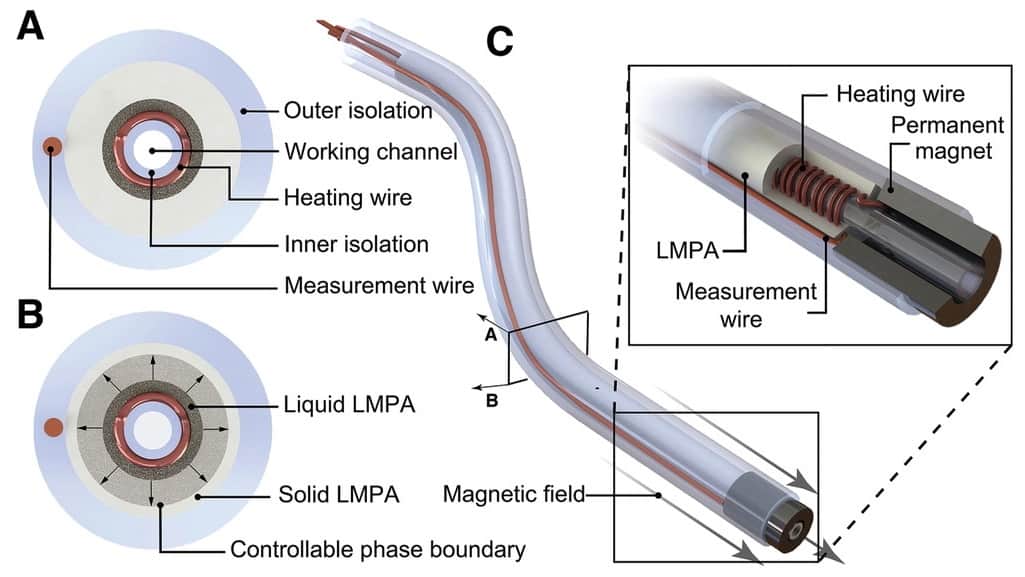
To minimize this risk further, medical roboticist Quentin Boehler of ETH Zurich and colleagues have developed a new type of catheter comprising a core made of a low melting point alloy (LMPA) that’s sandwiched, alongside a heating wire, between two insulating polymer layers. The device is just 1 mm thick in total.
(A) Cross-section of the variable-stiffness catheter. (B) Central heating causes the LMPA to melt from the inside out, shifting the phase boundary radially outward. (C) Overview and close-up of the proposed catheter. (Courtesy: CC BY 4.0/Adv. Science 10.1002/advs.202101290)
As its temperature rises, the alloy progressively melts from its core outwards, resulting in an increase in flexibility that can be reversed by allowing the catheter to cool back down. The alloy is tuned such that the phase transition occurs at 47°C – above the temperature of the human body (37°C), but not so high as to cause physiological damage.
A resistance-measuring wire contained in the catheter’s outer insulating layer allows operators to monitor the alloy temperature and, by extension, ensure the desired liquid-to-solid ratio and corresponding rigidity. In this way, the catheter – which has a magnetic tip – can be safely navigated, by an external magnetic field, to its desired target in its soft state before being allowed to stiffen in order to deliver the desired force to the pair of grippers at its end.
According to the team, the wire takes approximately 16 s to heat to a fully flexible state under surgical conditions and some 30 s to cool back down, and can deliver forces that range from 20 mN to 8 N. To demonstrate the potential of the concept, the researchers successfully performed a simulated membrane peeling operation on an eyeball phantom, onto which they had pressed a thin Parafilm layer to simulate the unwanted cell layer.
“We believe that our approach simply provides much more safety to the procedure,” says Boehler, noting that the catheter can also be adapted into a microcannula to inject drugs behind the retina. “More generally, we believe that variable-stiffness soft continuum robots can be part of the next generation of minimally invasive medical tools using robotic assistance, as they will benefit from increased safety and dexterity provided by this feature.”
“While shape morphing instruments have been available in laparoscopic surgery for a while, at the submillimetre level at which eye surgery is performed such capabilities were until now not possible,” comments Marc de Smet, an ophthalmic surgeon from the MIOS Centre in Lausanne who was not involved in the present study. However, he added, the current time constants are “relatively long in the hands of a surgeon poised to carry out a task that might involve 60 s in a given position”.
Furthermore, he continued, “while a 1 mm diameter is considerable achievement, current vitreoretinal surgery is carried out at diameters of 0.63 mm or less. At 1 mm, sutures are required at the end of surgery to close the wound, while at 0.63 mm or less, suture-less surgery associated with rapid healing is possible.”
With this initial study complete, the researchers are moving to demonstrate their catheter in animal models, with the goal of delivering a human intervention in the near future.