Not observing a theoretically predicted feature in an experiment can be frustrating, but it is also a crucial step for advancing science. This is what happened when a team of physicists in Austria, Denmark and Spain went looking for a feature that purportedly comes from Majorana bound states, which are exotic quasiparticles that might one day become the workhorses of quantum computing. While the physicists observed a signal with the expected characteristics, their investigations showed that it originates instead from a tiny piece of semiconducting material in the system they studied – suggesting that a different approach may be required to observe these elusive states.
In their work, Marco Valentini, Georgios Katsaros, and colleagues from the Nanoelectronics group at the Institute of Science and Technology (IST) Austria, Peter Krogstrup from Microsoft Quantum and the University of Copenhagen and Ramón Aguado and colleagues from the Institute of Materials Science Madrid ICMM at the National Spanish Research Council CSIC, studied a semiconductor-superconductor structure that is predicted to produce phenomena known as Majorana zero modes. These modes are signatures of Majorana bound states, and they should show up as peaks (technically termed zero bias conductance peaks) in the structure’s electron tunnelling spectrum. They are also the core ingredient of so-called topological quantum bits (qubits), which could provide a stable and error-resistant building block for quantum computing. To date, however, no such topological qubit has been made.
“Half-electrons”
Originally, Majorana zero modes were simply a mathematical construction that allowed an electron to be described theoretically as being composed of two halves. From a quantum computing perspective, they are attractive because if an electron can be “split” into two, the information it encodes as a qubit will be protected from local perturbations as long as the “half-electrons” can be stored far away from each other. “This concept is not so different from what Voldermort did in Harry Potter to protect his soul,” Katsaros explains. “He split into several horcruxes his Majorana zero modes.”
According to theory, these “half-electrons” should appear in a setup consisting of a semiconducting nanowire wrapped in a shell made from a superconducting material and placed in a magnetic field. The superconducting coating covers the nanowire completely, “pretty much like thin cannelloni (the superconductor) stuffed with a filling (the semiconductor),” Valentini says. The only part of the wire left “bare” in this so-called full-shell geometry is its tip, which forms the junction to a metal from which electrons are injected into the nanowire.
Since half-electrons are predicted to exist in this setup, Valentini and colleagues expected to observe the signal of Majorana zero modes in the nanowire. They didn’t. “First, we were confused, then frustrated,” Valentini admits. “Eventually, and in close collaboration with our theoretical colleagues in Madrid, we examined the setup, and found out what was wrong with it.”
Andreev bound states
The researchers performed tunnelling spectroscopy measurements on their setup to further investigate the role that the junction plays. They decided to vary the nanowire structure to see whether any structural effects were responsible for their results.
When they doubled the length of the uncoated junction from 100 nm to 200 nm, they found the source of the discrepancy: the exposed inner nanowire formed a quantum dot. This is a tiny piece of semiconducting material that can isolate individual quantum particles such as electrons thanks to its confined geometry. “The electrons in this quantum dot could then interact with electrons in the superconductor material coating the nanowire and thereby mimic the signal of the half-electrons (that is, the Majorana modes) we were looking for,” Valentini explains.
“Using the full-shell geometry, one can switch off and on superconductivity by means of an external magnetic flux (the so-called Little-Parks effect), which allows for a careful comparison with the theoretical results obtained by our team in Madrid,” Aguado says. “Eventually, we concluded that the zero-bias peaks measured at IST were in fact a product of quantum states known as Andreev bound states. These states result from the complex competition between electron-electron interactions in the quantum dot and superconductivity in the wire.”
“Mistaking this mimicking signal for a Majorana zero mode shows us how careful we have to be in our experiments and in our conclusions,” Valentini adds. “While this may seem like a step back in the search for Majorana zero modes, it actually is a crucial step forward in understanding nanowires and their experimental signals.”
The researchers, who report their work in Science, say they now hope to understand why they only see zero bias peaks when quantum dots form in the junction – a result that seems to suggest that they might never be able to achieve the right regime for obtaining Majorana zero modes in their experiments. “Was the material combination incorrect?” asks Katsaros. “Are the assumptions made in the theoretical models invalid in the experiments? Only future experiments will tell.”
Stroke – a life-threatening condition in which a blockage or bleed cuts off the brain’s blood supply – can cause serious long-term disabilities. Survivors often suffer from neurological impairments that result in diminished mobility and hemiparesis, weakness or paralysis on one side of the body.
One approach used to help stroke survivors regain walking ability is the lower-limb powered exoskeleton, a wearable machine that helps patients stand and walk during rehabilitation. A research team headed up at the University of Texas Health Science Center has now performed a detailed study of how such a powered exoskeleton affects patients’ neuromuscular coordination following a stroke. They describe their findings in the Journal of Neural Engineering.
“Traditional therapy usually involves two or three physical therapists manually guiding a patient’s impaired limb to follow and reinforce the desired trajectories, which can be very labour-intensive and even unsafe,” explains first author Fangshi Zhu. “The powerful motors from the exoskeleton can deliver accurately controlled assisting torques to the impaired joints during the mass practice of task-specific activities and liberate the therapists from the heavy manual labour.”
In the first part of the investigation, 11 able-bodied subjects and 10 stroke subjects underwent a walking assessment on a treadmill, during which the researchers captured motion data and monitored lower-limb muscle activities. By comparing parameters between the two groups, they characterized normal gait patterns and post-stroke motor deficits. Compared with the able-bodied controls, stroke subjects had significantly slower walking speed, shorter step length, lower foot clearance and increased gait asymmetry.
The researchers found that among able-bodied subjects, four distinct muscle synergies (or motor modules, groups of muscles that cooperate to accomplish a motor task) were needed to describe lower-limb muscle activities during steady walking. For the stroke subjects, three motor modules were sufficient in their paretic leg. The team note that this reduced inter-muscle coordination complexity leads to poorer locomotion performance.
Gait training
In the second part of the study, five of the stroke subjects underwent gait training using the Ekso 1.1, a lightweight lower-limb exoskeleton equipped with powered actuators at the hip and knee joints. The participants had between 10 and 15 sessions of gait training, during which they walked with the exoskeleton for up to 50 minutes, guided by a physical therapist as needed.
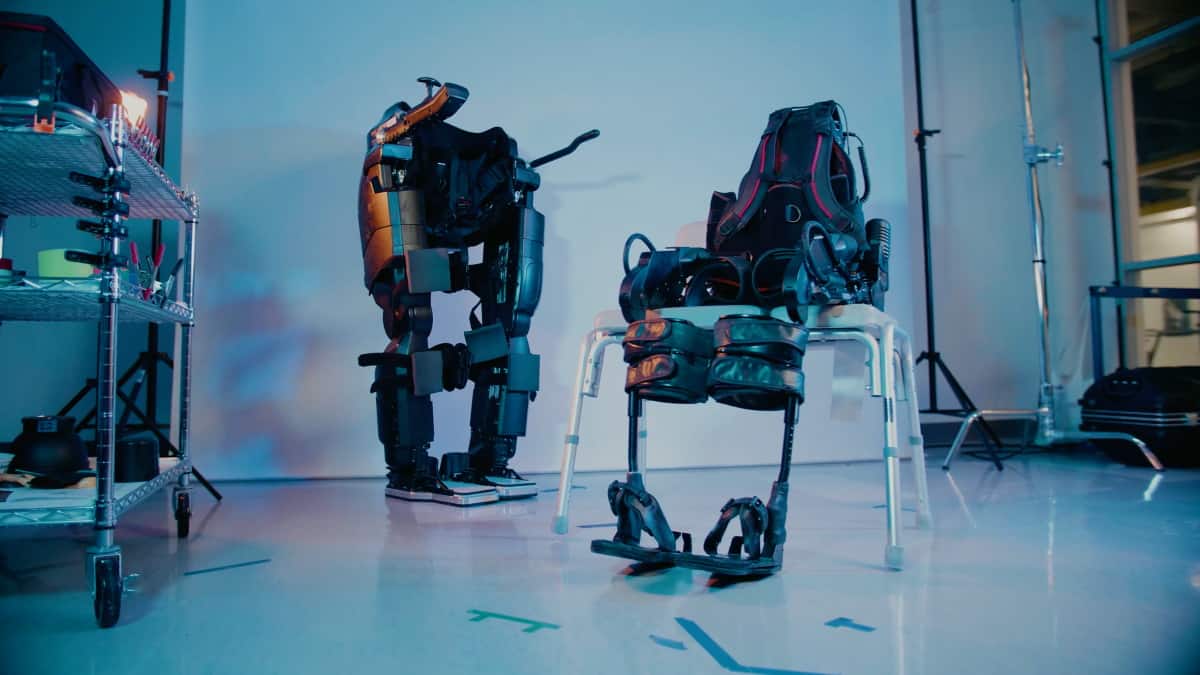
The team is studying how rehabilitation robots such as exoskeletons can help stroke survivors to walk better. (Courtesy: Fangshi Zhu)
Throughout each training session, the researchers used electromyography to monitor the activity of eight muscles and optical tracking to capture the motion of eight body segments and 18 bony landmarks. Before and after training, they assessed participants’ walking speed, step length, foot clearance height and stance-to-swing time ratio. Results showed that the gait training did not significantly improve stroke subjects’ locomotion performance or inter-muscular coordination (the number of motor modules needed to reconstruct walking).
The researchers surmise that this lack of improvement could be due to the subjects receiving too few training sessions and/or insufficient exercise intensity within each session. They also point out that the study participants were examined long after their neural injury (13 months post-stroke in one case; three years or more in the others). As recovery from stroke is fastest in the first few weeks, this delayed intervention could also lead to reduced effectiveness.
Walking assistance
While exoskeleton-assisted gait training had limited impact on stroke subjects’ locomotion performance, wearing the exoskeleton immediately altered their lower-limb muscle synergy pattern.
Active assistance from the hip and knee actuators and passive assistance from the footplate increased the paretic leg motor coordination complexity, resolved foot drop issues, and guided stroke subjects to shift abnormal motor module activation towards the normal pattern seen in the able-bodied group.
These changes were described by the researchers as “a prominent positive impact the Ekso had on the stroke subjects”. The exoskeleton did, however, also have negative influences on motor modules for the hamstrings and quadriceps, due to excessive assistance or restrictions that subjects tried to resist.
The researchers conclude that their findings reveal the potential of using a powered exoskeleton to augment impaired gait and help stroke survivors regain normal walking ability in a long-term rehabilitation programme. The study also demonstrates the use of muscle synergy analysis to evaluate the effect of exoskeleton training, which could help inform future protocols.
Zhu notes that while this study provides insight into how one particular exoskeleton affects a single patient group, other types of exoskeleton have been used in clinical centres to help a wider population regain compromised motor ability after neural injuries.
“Therefore, we are trying to expand this study to a broader scale,” Zhu tells Physics World. “In the Center for Wearable Exoskeletons, we have an ongoing clinical trial study investigating the effect of three different lower-limb powered exoskeletons on three post-neural injury populations (stroke, spinal cord injury and multiple sclerosis). The objective is to understand the impact of each robot’s assistance on each population so that in clinical application, we could select the best treatment device for the right population group to maximize the therapeutic benefits.”
A transparent, viscous coating that can be brushed or painted onto any type of surface could reduce disease transmission by capturing airborne droplets. The coating, which is based on a polymer commonly employed in cosmetics, could be applied to plexiglass barriers and face shields as well as windows, walls, ceilings or even curtains. Used in this way, it could remove virus-laden particles from the air and so slow down the spread of infectious respiratory diseases like COVID-19, according to the researchers at Northwestern University in the US who developed it.
The coronavirus responsible for the current COVID-19 pandemic is transmitted through respiratory droplets and aerosols emitted when people cough, sneeze, talk and breathe. Removing these droplets – especially in confined spaces – is therefore one way of combatting the disease.
Droplets are absorbed and then dry up
The new coating is designed such that when airborne droplets come into contact with a coated surface, they stick to it rather than bouncing off as they would normally. Team leader Jiaxing Huang says that a key challenge was to keep the coating from fogging up or becoming hazy in the process. While fogging comes from light scattering by droplets, and simply making the surface hydrophilic can prevent it, hazing is due to scattering by the residue left after droplets evaporate and is a lot harder to deal with.
“Our coating works like a sponge to absorb droplets and then distributes them in the film, so preventing the formation of large, dried particulate matter responsible for light scattering,” he explains. This property makes the coating suitable for transparent plexiglass divider screens and plastic face shields, he adds, pointing out that additives such as sanitizers and pigments could further extend its applications.
Crater-like “potholes”
To test their technology, the researchers began by studying the behaviour of a stream of aerosol droplets that they directed onto a clear hydrophobic polyethylene terephthalate (PET) microscope slide in an inverted optical microscope. The size of these droplets was about 10 microns, which is typical for respiratory aerosols. Most droplets bounced or glided off this uncoated microscope slide, and therefore became airborne again.
For their coating, the researchers chose a polymer called poly(acrylamide-co-diallyldimethylammonium chloride (PAAm-DDA) – a safe, water-soluble, transparent, film-forming polyelectrolyte often used in cosmetic products and antimicrobial coatings. PAAm-DDA is also very stable in a wide range of temperatures, from -20 °C to roughly 60 °C.
When the researchers coated their microscope slide with this polymer, the behaviour they observed was quite different: most colliding droplets were captured and subsequently absorbed by the coating. The trapped droplets partially dissolved the underlying polymer, leaving behind crater-like “potholes” once the slide had dried. Any solute or dispersant (for example, pathogens) remained in the potholes, meaning they couldn’t be released into the air again, say the researchers.
Promising result
By comparing the mass of the slides before and after the experiments, the researchers calculated that the coating captures droplets at a rate of around 105 mg/m2h. They say this is promising because the maximal droplet capture required in a room, based on the volume of respiratory droplets produced by a person speaking loudly, is estimated to be in the 10-5 to 10-2 mg/m2h range – 7 to 10 orders of magnitude below the capture capacity they demonstrated in their experiments.
The researchers also performed a qualitative experiment to evaluate whether their coating reduces the number of aerosol droplets bouncing off surfaces. In this experiment, they placed 2 x 2 cm silicon wafers coated with their polymer on the edge of a plexiglass screen to catch and visualize escaped droplets. They then directed a stream of aerosols at coated and uncoated versions of the screen from a distance of 5 cm for five minutes. Subsequent microscopy observations showed a drastic difference in the number of aerosol droplets escaping from the coated screen compared to the uncoated one.
Simulating more realistic situations
Huang and colleagues say that the main limit in this type of experiment is that people produce respiratory droplets in lower concentrations than is typical for lab-generated aerosols. Naturally-produced droplets also come in a much wider range of sizes and contain many large sub-millimetre sized droplets that splash and break up into smaller ones upon colliding with a surface.
To overcome this problem, the researchers repeated their experiments using droplets produced by an air-sprayer. This type of device has been used in previous studies to simulate different kinds of droplets and the high speed at which they are released by a person when they cough or sneeze.
They directed the droplets towards a coated and uncoated plexiglass screen for just 1 second. They repeated the experiment at least five times and found that the number of droplets escaping from the coated screen was reduced by about 80% compared to the uncoated one.
“The air-spray results demonstrate that the coating can reduce the escape of both fine low speed aerosols and large high-speed droplets,” the researchers say. “This should be useful for enhancing the function of transparent divider screens, which have become ubiquitous in this pandemic and are likely to continue to be used for some time yet.”
The researchers started this project during a period when the Northwestern campus was closed due to a “stay-home” order in the state of Illinois. “Luckily, however, we obtained ‘essential researcher’ status so that we could work in the lab and improvise using what we had in our labs and offices,” Huang tells Physics World. “In the future, we would really like to perform approved tests of the coating with human generated droplets and are currently in contact with potential collaborators worldwide to design such trials.”
Researchers in the UK and Germany have used quantum entanglement to securely distribute secret keys among multiple users in a network. By distributing entangled photons over optical fibres at telecommunications wavelengths, the team demonstrated that conventional telecoms infrastructure offers a viable path towards realizing a large-scale network of interconnected quantum devices – and perhaps even quantum-secure conference calls using Zoom or other platforms.
To send messages securely, two or more parties must first share, or exchange, a secret key, which is a string of genuinely random bits used to encrypt and decrypt messages. Quantum key distribution (QKD) protocols such as the widely-known BB84 protocol have previously been used to perform this key exchange between two users.
In the original BB84 protocol, a user wishing to securely send a bit to another would encode their secret bit onto a quantum state and transmit the quantum state via public, unsecure channels. A fundamental tenet of quantum mechanics, the no-cloning theorem, guarantees that a third party cannot silently eavesdrop on such a communication without revealing their presence. In subsequent versions of BB84, the two communicating parties share several entangled pairs of qubits and make random measurements on their respective qubit to derive a secret key.
Conference key agreement
In multi-user communications, it is often desirable for all parties to share a single secret key, such that each member can decrypt messages broadcast by any other member of the group. The process by which users of such a network share a key is called conference key agreement (CKA). According to Joseph Ho, one of the authors of the paper, this type of multi-user key distribution can provide strong encryption for tasks such as video conference calls.
In principle, it is possible to use two-party protocols like BB84 to share N-1 key pairs between N users and use classical methods to distil the conference key. In this technique, a designated leader in a network establishes N-1 secret keys with each other member and then transmits the conference key to each member, encrypting it with their respective secret key. However, this method is inefficient and will be impractical in future quantum networks that need to host many users.
Distributing entanglement across a distance
A more efficient alternative is to derive the key from multipartite entanglement. In this method, a multipartite entangled state is distributed to all members and each member performs measurements on their own qubits to generate the key.
In their experimental demonstration, Ho and Massimiliano Proietti, working in a group led by Alessandro Fedrizzi of the Institute of Photonics and Quantum Sciences at Heriot-Watt University in Edinburgh and together with colleagues from Heinrich-Heine-Universität Düsseldorf in Düsseldorf, used a multi-user QKD protocol to securely exchange data in a network consisting of four parties. At the core of their experiment are quantum states that contain four photons in an equal superposition of two states: one where they are all horizontally polarized, and another where they are all vertically polarized. Copies of these four-photon states, which are known as Greenberger-Horne-Zeilinger (GHZ) states, were distributed to four members in a network, separated by up to 50 kilometres of optical fibre. The researchers also use additional techniques to correct any errors in distribution of the key, followed by a round of privacy amplification to further enhance the scheme’s security.
During the experiment, which lasted 177 hours, the team generated a secure key containing over a million bits. The key was then used to securely share an image between four users in the network.
The fact that the experiment was conducted using conventional optical fibre at standard telecommunication wavelength indicates that existing communication infrastructure can be used for quantum-assisted key distribution. However, according to the researchers, much remains to be accomplished before CKA schemes such as the one implemented at Edinburgh can be reliably used for secure communication outside the laboratory. “One of our general goals is to demonstrate our CKA scheme in a field-test,” Ho tells Physics World.
For that to happen, researchers will first need to develop new capabilities for creating large entangled states at an appreciable rate and distributing them over long distances.
“No way” was my reaction in February 2020 when asked if I’d take the first round of vaccines for COVID-19. The vaccines were still being developed and, as a historian, I knew too much about the problems that accompanied early vaccination attempts. These include a notorious episode in 1955 when Cutter Laboratories released several lots of the newly developed polio vaccine that were faulty despite having passed government safety tests. The contaminated doses led to more than 40,000 children developing some form of the disease.
With stories like that in mind, I was not about to participate in a COVID vaccine beta test.
By February 2021, however, my view had shifted and I eagerly sought my first opportunity to get vaccinated. I was then fascinated by what led to my quick and comfortable COVID-19 about-face, especially because I was researching an episode in US history in which scientists failed to persuade the public about the safety of a nuclear reactor, amplifying rather than lessening fears by treating safety as a technical issue – as a matter of numbers. (I will not be talking about compulsory versus voluntary vaccination programmes, which involve other issues.)
The art of persuasion
All those carrot-and-stick strategies intended to encourage people to get vaccinations – lotteries, musical and sports events, videos of politicians and influencers – would not by themselves have worked on me. In my case it came to make sense to me that I should be vaccinated. I knew to look for help to the Greek philosopher Aristotle, who in his Rhetoric had spelled out three dimensions of how persuasion comes about, for which the Greek terms are ethos, logos, and pathos.
I knew to look for help to the Greek philosopher Aristotle.
Ethos refers to the character or credibility of the speaker or source, logos to the soundness of the argument and pathos to the impact on the hearer. A persuasive scientist speaking to the public, say, needs to establish credibility by citing scientific sources, clearly express what the evidence points to in terms that non-scientists can understand, and engage the audience. Scientists tend to do the first well, sometimes do the second, and can be extremely poor at the third.
Each of these factors played a role in my conversion. At the beginning of 2020 I knew few credible sources about COVID vaccine safety, but by year’s end I had read a growing number of studies about the vaccines by the US Centers for Disease Control and other authoritative institutions – agencies that, I knew, checked and cross-checked their findings.
Second, at the outset I had little idea of how the various COVID vaccines worked, only that they were somehow different from smallpox, measles and polio vaccines. This made me sceptical that a vaccine could be so quickly created. My scepticism was amplified by the knowledge that the US Food and Drug Administration had not “approved” but only “authorized” the COVID vaccines.
But friends of mine with medical training gave me clear and understandable (to me) descriptions of how mRNA vaccines for COVID-19 (the primary two vaccines in use in the US) worked, why they could be created so quickly, and the reasons justifying the unusual approval procedure. These friends explained that, thanks to all the research on SARS – a cousin of COVID – in the first decade of this century, medical researchers already knew much about the disease. It is now possible to produce mRNA segments in laboratories that, when injected into a person, hijack cells to produce the distinctive (but harmless by itself) spike protein and flood the body with it, which in turn sparks production of the antibodies.
The third element in my initial reluctance to get vaccinated was that I felt little urgency when cases in New York State were virtually zero. My feelings of vulnerability mounted quickly after April 2020 as I read more and more about brain fog, ravaged lungs and permanently intubated victims of COVID-19 – and I had friends who suffered and acquaintances who died. All it would take would be a single exposure on a subway, restaurant or close encounter – and that could be me or my family.
All three elements worked together: I had been persuaded by a feeling of vulnerability that was part and parcel of my having been exposed to data and receiving understandable explanations from credible sources. Aristotle had pretty much nailed it.
People’s resistance to vaccination is heightened when they are made to feel guilty or told that they are being irrational.
Except for one aspect. Aristotle was writing about persuading people who shared his background as a citizen of a Greek city-state. I, too, had the same educational background of those who were persuading me – my friends who were health workers, and their positive experiences with the medical establishment. I had been vaccinated as a youth for polio, tetanus, smallpox and other illnesses; I was given a yearly flu shot, by doctors whom I trusted; and I experienced vaccinations as a routine and benign part of my life. Yes I remember the Cutter incident and a number of other vaccine missteps, but integrating these episodes with the rest of what I knew about vaccines made me comfortable with the COVID one.
The critical point
But mine is a privileged experience. Many in my country and abroad rely on inadequate medical treatment from uncaring doctors in poorly equipped hospitals. Others remember trust-undermining unethical clinical trials and experiments on minority populations, or feel manipulated by big pharma or the medical or government establishment, or confront discrimination and structural racism. The resistance of people in these groups is heightened when they are made to feel guilty or told that they are being irrational.
Individuals with those experiences make a different kind of sense out of pushes for vaccines, and are less impressed than I am with more studies, better explanations and warnings of horrible consequences. Just as in the episode I am studying involving public alarm over a nuclear reactor, resistance to vaccination programmes cannot be treated as a purely scientific or technical issue. Persuasion requires more than numbers.
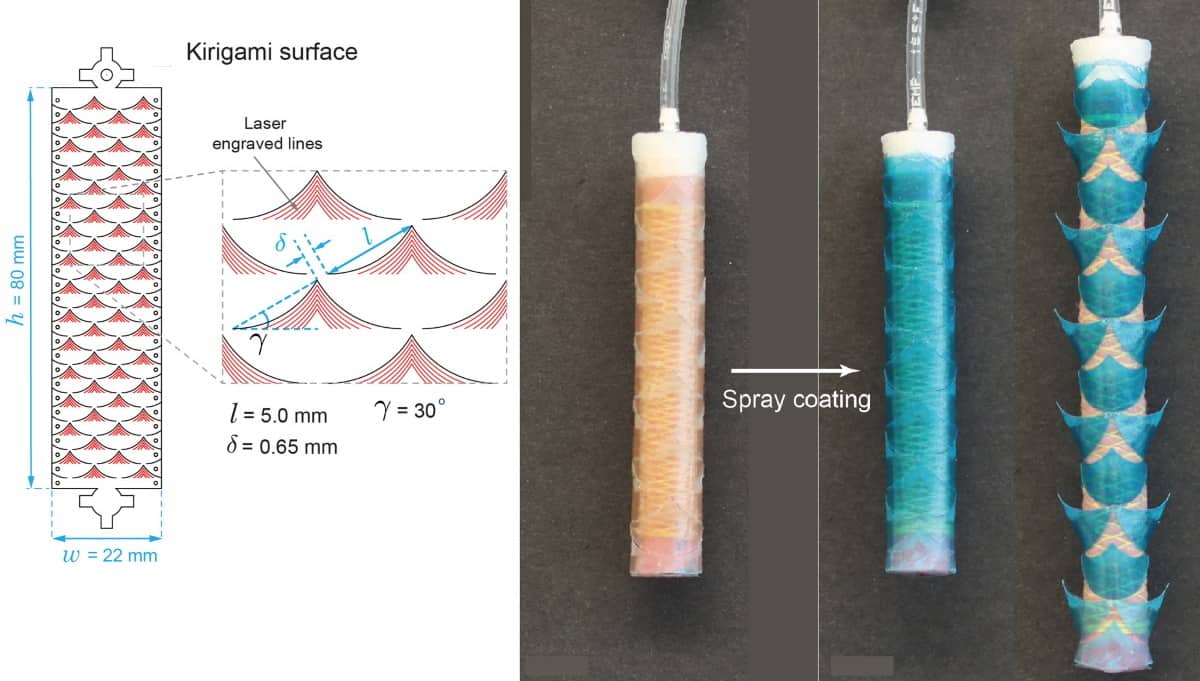
The kirigami-inspired stent has two key elements: a soft, stretchy tube made of silicone-based rubber and a plastic coating etched with needles that pop up when the tube is stretched. (Courtesy: MIT)
A new type of stent with “pop-up/fold-down” needles that deliver drugs to tubular organs such as the gastrointestinal tract, vasculature and airway has been designed by a team of US-based engineers and physicians. The stent’s flexible design was inspired by kirigami, the Japanese art of folding and cutting paper to create three dimensional structures, and by the scaly skin of snakes and sharks.
The kirigami-based injectable stents, described in Nature Materials, could serve as a new class of implantable drug-releasing systems, capable of deploying deposits of drugs in multiple locations. In particular, the stents are designed to improve localized drug delivery for diseases that affect tubular organs such as the oesophagus and bowel.
Tubular structures in the body, particularly vertically oriented or winding organs, are difficult to coat with therapeutics. Diseases in these areas are currently treated with a broad range of approaches including topical drugs and/or peripheral injections, although the drug may spread to other parts of the body causing side effects.
To address this shortfall, the multidisciplinary team – from Brigham and Women’s Hospital, Massachusetts General Hospital and Massachusetts Institute of Technology (MIT) – created a flexible, cylindrical stent comprising a stretchable kirigami shell integrated with a fluidically driven linear soft actuator.
The cylindrical skin consists of a periodic array of snake-denticle-shaped cuts embedded in thin plastic sheets. The cuts form barb-shaped “needles” that pop up when the tube is pressurized and expands. These needles penetrate tissue, injecting drug-containing degradable microparticles that release the drugs over a period of time.
The actuator, made of 1.5-mm-thick silicone-based rubber, delivers controlled air pressure to expand the stent to up to 60% of its original diameter and lodge it firmly in the organ structure. The air pressure forces the kirigami needles to buckle outward, changing their orientation from planar to perpendicular to the stent body surface. After the microparticles are injected, the air pressure is released and the needles return to their original flat configuration for easy and safe stent removal.
Cut and fold
Kirigami-inspired design is not new to medicine. It has been used to create bandages that stick more securely to joints and to create lightweight sensors that monitor joint motion. Senior author Giovanni Traverso, who is both a gastroenterologist and a biomedical engineer, says that his lab at MIT has previously designed and tested buckling-induced kirigami surfaces for the soles of shoes to increase friction forces and reduce slipping on slick surfaces.
“This technology of our stent could be applied in essentially any tubular organ,” Traverso explains. “Having the ability to deliver drugs locally, on an infrequent basis, really maximizes the likelihood of helping to resolve patients’ conditions and could be transformative in how we think about patient care by enabling local, prolonged drug delivery following a single treatment.”
The researchers created kirigami needles of several different sizes and shapes for their study. By varying those features, as well as the thickness of the outer plastic sheet, the researchers could control the depth to which the needles penetrate into tissue. They tested the stents by endoscopically inserting them into the oesophagus of three Yorkshire pigs weighing between 50 and 80 kg. Pigs have similar anatomical dimensions to adult humans and have been widely used to evaluate biomedical gastrointestinal devices.
Once in place, the researchers inflated the balloon inside the 8 cm long and 12.5 mm diameter stent, allowing the needles to pop up and penetrate about half a millimetre into the tissue. They deflated the balloon two minutes later, after the microparticles were deposited, flattening the needles to enable the stent to be endoscopically removed.
The microparticles contained budesonide, a steroid used to treat inflammatory bowel disease and eosinophilic esophagitis. The researchers measured its release at one, three and seven days following injection. They were able to detect the drug even seven days after delivery. “This indicates rapid absorption of the drug in the tissue, enabling sustained local delivery of budesonide and supporting the potential for this controlled drug-releasing system to deliver drug agents to tubular segments of the GI tract,” they write.
“As part of our ongoing work, we are aiming to develop systems that can deliver drugs for multiple months for a range of conditions, with a goal of providing the needed treatment after a single administration event,” Traverso tells Physics World. “We view these approaches as having the capacity to transform the patient experience by reducing the need to take medications and thereby significantly improving drug adherence.”
Astronomers have followed up their seminal 2019 observation of the supermassive black hole at the heart of the galaxy Messier 87 (M87) with stunning images of another black hole. This time they have used the Event Horizon Telescope to make high-resolution observations of a jet of plasma emerging from the supermassive black hole in the active galaxy Centaurus A, which lies 12 million light-years from Earth in the constellation of Centaurus.
The observations, documented in Nature Astronomy, build upon information astronomers gathered from the glowing ring that represented the matter around M87’s supermassive black hole, which was our first direct glimpse of such an area of space. The new findings reveal that matter around black holes seem to behave similarly over a range of masses.
“They all seem to follow simple symbiotic relationships between the matter that is flowing in via accretion and the matter that is flowing out as jets,” says Michael Janssen from the Max Planck Institute for Radio Astronomy in Bonn, Germany, who is lead author on the study. “These relationships hold for all ranges of black hole masses that we have studied so far.”
Black holes all seem to follow simple symbiotic relationships between the matter flowing in via accretion and matter flowing out as jets.
Michael Janssen, Max Planck Institute for Radio Astronomy
Centaurus A’s supermassive black hole has a mass of 55 million times that of the Sun, placing it between M87’s black hole (6.5 billion solar masses ) and our Milky Way’s black hole Sagittarius A* (2.6 million solar masses). The results show that the behaviour of matter observed around M87 is also present in smaller supermassive black holes, such as our galaxy’s own.
As the fifth brightest galaxy in the sky and the closest radio galaxy to Earth, Centaurus A has been widely studied, as have the jets that extend outwards from its central region. But astronomers did not have much high-resolution data about this source. “The EHT was able to see Centaurus A in a completely new light, at a 10 times higher observing frequency and 16 sharper resolution than that of previous studies.”
The ETH team examined the central region of this galaxy and its black hole using the same very-long-baseline interferometry (VLBI) techniques that were also used to capture the image of M87’s supermassive black hole. This improved resolution has let the team visualize the jets produced by the active galaxy as a hollow “bi-cone” with bright edges.
“The strong edge brightening of the jet was a surprise,” admits Janssen. “We have seen edge brightening before in other jets but never this extreme. We are still struggling to understand this with our theoretical jet models.”
The properties and overall geometry of the plasma jets at Centaurus A look very much like those found in the jets launched by M87 and its titanic black hole – as well as those emitted by much tinier stellar-mass black holes. Armed with details of these jets, astronomers can tell how a black hole does or does not gobble up surrounding matter.
“The matter swirling around black holes, feeding them by forming an accretion disc, is also fuelling jets,” explains Janssen. “Not all particles in the direct vicinity of a black hole are devoured. Some escape and are hurled into space, forming the jets that we see in sources like Centaurus A.”
Learning that black holes of such widely varying masses “eat” in similar ways could help researchers search the Universe for other, more elusive black holes, particularly those with intermediate masses. But his team’s next target is something much closer to home: Sgr A* at the centre of our galaxy. “Stay tuned for that,” Janssen says.
The mechanisms behind the energetic X-ray flares in Jupiter’s version of the Northern Lights are remarkably similar to those that produce Earth’s aurora, an international team of astronomers has discovered. Using simultaneous observations by two different satellites, researchers co-led by William Dunn at University College London and Zhonghua Yao at the Chinese Academy of Sciences determined that both processes are driven by vibrations in planetary magnetic fields – a phenomenon that could be universal even among planets that have very different magnetospheres.
As volcanic gases erupt from Jupiter’s innermost moon, Io, the heavy sulphur and oxygen ions they contain form a donut-shaped ring of plasma around the planet. From there, these particles gradually move along Jupiter’s magnetic field lines to fill its magnetosphere. Eventually, some of the ions strike Jupiter’s polar atmosphere. The large amount of energy they deposit produces spectacular, highly energetic X-ray bursts in Jupiter’s aurora every 27 minutes.
Since X-rays are typically only generated in far more extreme environments such as black holes or neutron stars, these bursts (and their clockwork-like regularity) have intrigued astronomers ever since they were discovered 40 years ago. Despite widespread interest, however, the exact mechanisms that drive such regular X-ray pulses have remained a mystery.
Simultaneous observations
In their study, Dunn, Yao and colleagues examined the pulses using simultaneous observations from two different spacecraft: NASA’s Juno satellite, which orbits Jupiter and takes in situ measurements of its magnetosphere; and ESA’s XMM-Newton observatory, which monitors the planet remotely from its orbit around the Sun. By analysing 26 hours of observations from each instrument, the astronomers determined that Jupiter’s X-rays are driven by periodic vibrations in the planet’s strong, rapidly-rotating magnetic field.
Although the source of these vibrations is still unknown, the team’s observations revealed that they transfer energy to the heavy ions emitted by Io – essentially allowing these charged particles to “surf” along Jupiter’s magnetic field lines. This generates regular waves of energetic plasma, which in turn produce energetic X-ray flares as they impact the planet’s atmosphere.
Remarkably, Dunn and Yao’s team discovered that although this specific process appears to be unique to Jupiter, it is strikingly similar to mechanisms that occur in Earth’s magnetic field, where far more subtle field-line vibrations generate less energetic plasma waves. This means that despite the several-orders-of-magnitude differences in the time, space, and energy scales of the two planetary systems’ flare mechanisms, they ultimately have a common source.
By extension, the astronomers suggest that this mechanism could be universal across many different planetary environments. They now hope to capture similar mechanisms playing out in the magnetospheres of Saturn, Uranus, and Neptune, and perhaps even giant exoplanets.
Researchers in Spain and Italy have observed “second sound” in a room-temperature semiconductor for the first time. This phenomenon, which occurs when distinct waves of temperature pass through a material, had previously only been observed in exotic superfluids at ultracold temperatures (and, more recently, in graphite). Its surprise appearance in a material widely used in electronic chips could make it possible to improve the performance of electric devices by managing waste heat better.
Second sound is not sound as we generally think of it. It gets its name because in mathematical terms, the thermal waves moving through a material resemble the pressure waves that create sound in air. In physics terms, these waves are fluctuations in the density of quasiparticle thermal excitations called rotons and phonons within the material.
Thanks to this quantum mechanical heat-transfer effect, materials that exhibit second sound have a very high thermal conductivity. Until now, however, the presence of these thermal waves was largely confined to exotic superfluids in which momentum is conserved during collisions between phonons. In most ordinary materials, a process known as Umklapp phonon-phonon scattering causes the phonons to exchange momentum with the material’s crystal lattice, meaning that phonon momentum is not conserved.
Thermal waves at room temperature in a semiconductor
In their experiments, which they report in Science Advances, the researchers studied how a germanium sample behaves when subjected to lasers that produce high-frequency megahertz-range oscillating heating waves on its surface. Contrary to predictions, the heat did not dissipate by diffusion, but partially propagated into the material via thermal waves.
This type of thermal transport, being wave-like, has many of the advantages offered by waves, including interference and diffraction, says ICMAB team member Sebastian Reparaz. “The technique we employed could allow us to observe such wave-like heat transport in other materials, by modulating the temperature field of the laser at sufficiently high frequencies,” he explains. This, in turn, could lead to new ways of controlling heat transport in electronics devices made from germanium and any other materials that exhibit second sound. Ultimately, Reparaz says, the discovery “could also allow us to design a new generation of thermal devices in the same way that those based on light were developed”.
Reparaz adds that the second sound thermal regime might also lead to a rethink on how scientists and engineers deal with waste heat in electronic devices. Many such devices, including solar cells, light-emitting diodes and phone batteries, generate significant amounts of heat. This can lead to localized overheating, which decreases the devices’ efficiency and lifespan.
Unifying current theoretical models
From a theory perspective, the new findings might make it possible to unify models for second sound. Until now, theorists treated materials exhibiting this effect as being somehow very different from the semiconductor materials used in everyday electronic chips, says F Xavier Alvarez of the UAB. “Now all these materials can be described using the same equations,” he explains. “This observation establishes a new theoretical framework that may allow in the not-too-distant future a significant improvement in the performance of our electronic devices.”
The researchers say they will now try to observe high frequency thermal waves in other materials at room temperature. “We also want to study how we can exploit thermal wave interference and diffraction to control heat propagation,” Reparaz tells Physics World.
In 2013 a gamer by the name “DOTA_Teabag” was playing Nintendo’s Super Mario 64 and suddenly encountered an “impossible” glitch – Mario was teleported into the air, saving crucial time and providing an advantage in the game. The incident – which was recorded on the livestreaming platform Twitch – caught the attention of another prominent gamer “pannenkoek12”, who was determined to explain what had happened, even offering a $1000 reward to anyone who could replicate the glitch. Users tried in vain to recreate the scenario, but no-one was able to emulate that particular cosmic leap. Eight years later, “pannenkoek12” concluded that the boost likely occurred due to a flip of one specific bit in the byte that defines the player’s height at a precise moment in the game – and the source of that flipping was most likely an ionizing particle from outer space.
The impact of cosmic radiation is not always as trivial as determining who wins a Super Mario game, or as positive in its outcome. On 7 October 2008 a Qantas flight en route from Singapore to Australia, travelling at 11,300 m, suddenly pitched down, with 12 passengers seriously injured as a result. Investigators determined that the problem was due to a “single-event upset” (SEU) causing incorrect data to reach the electronic flight instrument system. The culprit, again, was most likely cosmic radiation. An SEU bit flip was also held responsible for errors in an electronic voting machine in Belgium in 2003 that added 4096 extra votes to one candidate.
Cosmic rays can also alter data in supercomputers, which often causes them to crash. It’s a growing concern, especially as this year could see the first “exascale” computer – able to calculate more than 1018 operations per second. How such machines will hold up to the increased threat of data corruption from cosmic rays is far from clear. As transistors get smaller, the energy needed to flip a bit decreases; and as the overall surface area of the computer increases, the chance of data corruption also goes up.
As transistors get smaller, the energy needed to flip a bit decreases; and as the overall surface area of the computer increases, the chance of data corruption also goes up
Fortunately, those who work in the small but crucial field of computer resilience take these threats seriously. “We are like the canary in the coal mine, we’re out in front, studying what is happening,” says Nathan DeBardeleben, senior research scientist at Los Alamos National Laboratory in the US. At the lab’s Neutron Science Centre, he carries out “cosmic stress-tests” on electronic components, exposing them to a beam of neutrons to simulate the effect of cosmic rays.
While not all computer errors are caused by cosmic rays (temperature, age and manufacturing errors can all cause problems too), the role they play has been apparent since the first supercomputers in the 1970s. The Cray-1, designed by Seymour Roger Cray, was tested at Los Alamos (perhaps a mistake given that its high altitude, 2300 m above sea level, makes it even more vulnerable to cosmic rays).
Cray was initially reluctant to include error-detecting mechanisms, but eventually did so, adding what became known as parity memory – where an additional “parity” bit is added to a given set of bits. This records whether the sum of all the bits is odd or even. Any single bit corruption will therefore show up as a mismatch. Cray-1 recorded some 152 parity errors in its first six months (IEEETrans. Nucl. Sci. 10.1109/TNS.2010.2083687). As supercomputers developed, problems caused by cosmic rays did not disappear. Indeed, in 2002 when Los Alamos installed ASCI Q, then the second fastest supercomputer in the world, initially it couldn’t run for more than an hour without crashing due to errors. The problem only eased when staff added metal side panels to the servers, allowing it to run for six hours.
Cosmic chaos
Cosmic rays originate from the Sun or cataclysmic events such as supernovae in our galaxy or beyond. They are largely made up of high-energy protons and helium nuclei, which move through space at nearly the speed of light. When they strike the Earth’s atmosphere they create a secondary shower of particles, including neutrons, muons, pions and alpha particles. “The ones that survive down to ground level are the neutrons, and largely they are fast neutrons,” explains instrument scientist Christopher Frost, who runs the ChipIR beamline at the Rutherford Appleton Laboratory in the UK. It was set up in 2009 to specifically study the effects of irradiating microelectronics with atmospheric-like neutrons.
Millions of these neutrons strike us each second, but only occasionally do they flip a computer memory bit. When a neutron interacts with the semiconductor material, it deposits charge, which can change the binary state of the bit. “It doesn’t cause any physical damage, your hardware is not broken; it’s transient in nature, just like a blip,” explains DeBardeleben. When this happens, the results can be completely unobserved or can be catastrophic – the outcome is purely coincidental.
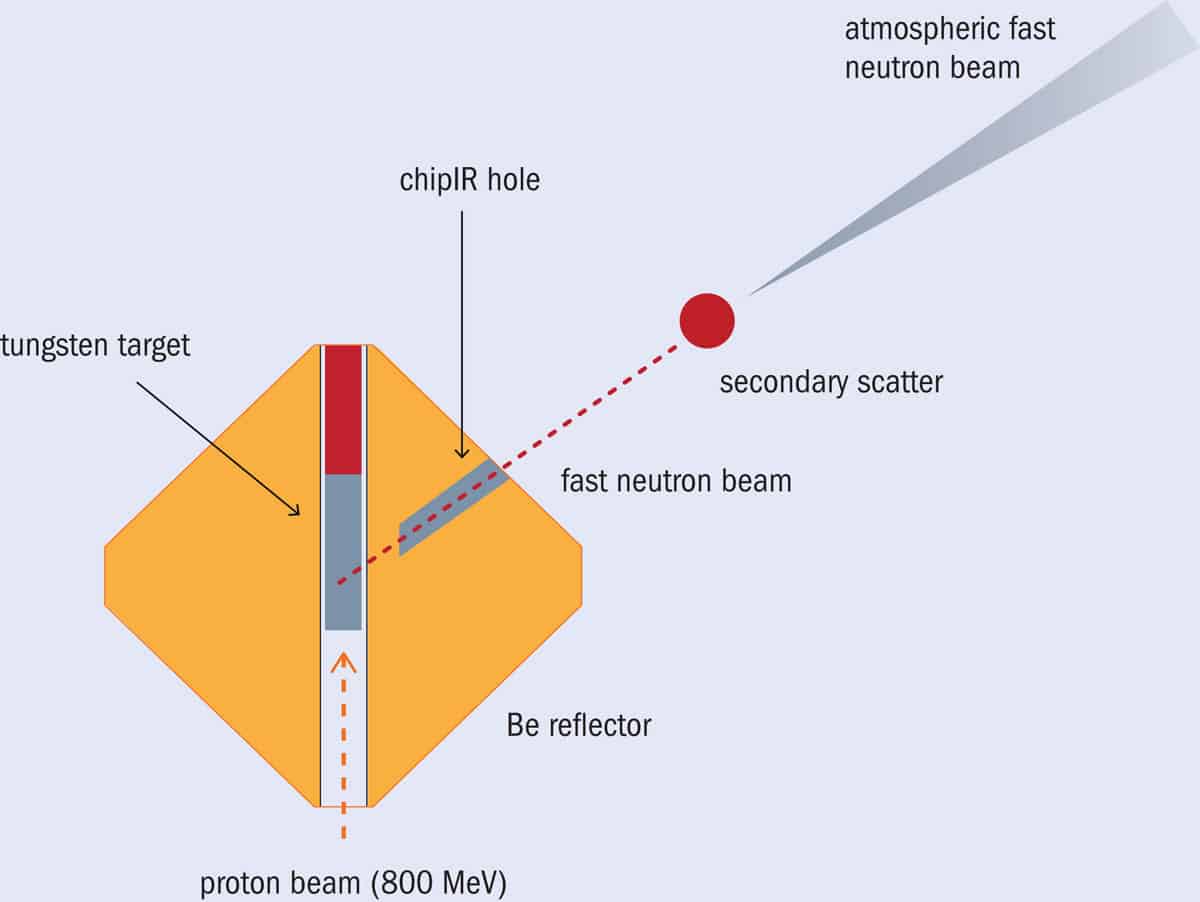
1 Rapid-testing single-event effects Schematic of the components needed to produce the ChipIr atmospheric neutron beam. It has been built at the ISIS spallation source at the Rutherford Appleton Laboratory, UK, in collaboration with the Italian Research Council (CNR) and is used to study the effects of irradiation on microelectronics, and to rapidly test the effects of “single event upsets” caused by high-energy neutrons. (Courtesy: STFC/CNR)
Computer scientist Leonardo Bautista-Gomez, from the Barcelona Supercomputing Center in Spain, compares these errors to the mutations radiation causes to human DNA. “Depending on where the mutation happens, these can create cancer or not, and it’s very similar in computer code.” Back at the Rutherford lab, Frost – working with computer scientist Paolo Rech from the Institute of Informatics of the Federal University of Rio Grande do Sol, Brazil – has also been studying an additional source of complications, in the form of lower energy neutrons. Known as thermal neutrons, these have nine orders of magnitude less energy than those coming directly from cosmic rays. Thermal neutrons can be particularly problematic when they collide with boron-10, which is found in many semiconductor chips. The boron-10 nucleus captures a neutron, decaying to lithium and emitting an alpha particle.
Frost and Rech tested six commercially available devices, run under normal operating conditions and found they were all impacted by thermal neutrons (J. Supercomput. 77 1612). “In principle, you can use extremely pure boron-11” to be rid of the problem, says Rech, but he adds that this increases the cost of production. Today, even supercomputers use commercial off-the-shelf components, which are likely to suffer from thermal neutron damage. Although cosmic rays are everywhere, thermal neutron formation is sensitive to the environment of the device. “Things containing hydrogen [like water], or things made from concrete, slow down fast neutrons to thermal ones,” explains Frost. The researchers even found the weather affected thermal neutron production, with levels doubling on rainy days.
Preventative measures
While the probability of errors is still relatively low, certain critical systems employ redundancy measures – essentially doubling or tripling each bit, so errors can be immediately detected. “You see this particularly in spacecraft and satellites, which are not allowed to fail,” says DeBardeleben. But these failsafes would be prohibitively expensive to replicate for supercomputers, which often run programmes lasting for months. The option of stopping the neutrons reaching these machines altogether is also impractical – it takes three metres of concrete to block cosmic rays – though DeBardeleben adds that “we have looked at putting data centres deep underground”.
Today’s supercomputers do run more sophisticated versions of parity memory, known as error-correcting code (ECC). “About 12% of the size of the data [being written] is used for error-correcting codes,” adds Bautista-Gomez. Another important innovation for supercomputers has been “checkpointing” – the process of regularly saving data mid-calculation, so that if errors cause a crash, the calculation can be picked up from the last checkpoint. The question is how often to do this? Checkpointing too frequently costs a lot in terms of time and energy; but not often enough and you risk losing months of work, when it comes to larger applications. “There is a sweet spot where you find the optimal frequency,” says Bautista-Gomez.
The fear of the system crashing and a loss of data is only half the problem. What has started to concern Bautista-Gomez and others is the risk of undetected or silent errors – ones that do not cause a crash, and so are not caught. The ECC can generally detect single or double bit flips, says Bautista-Gomez, but “beyond that, if you have a cosmic ray that changes three bits in the memory cell, then the codes that we use today will most likely be unable to detect it”.
Until recently, there was little direct evidence of such silent data-corruption in supercomputers, except what Bautista-Gomez describes as “weird things that we don’t know how to explain”. In 2016, together with computer scientist Simon McIntosh-Smith from the University of Bristol, UK, he decided to hunt for these errors using specially designed memory-scanning software to analyse a cluster of 1000 computer nodes (data points) without any ECC. Over a year they detected 55,000 memory errors. “We observed many single-bit errors, which was expected. We also observed multiple double-digit errors, as well as several multi-bit errors that, even if we had ECC, we wouldn’t have been seen,” recalls Bautista-Gomez (SC ‘16: Proceedings of the International Conference for High Performance Computing, Networking, Storage and Analysis 10.1109/SC.2016.54).
Accelerated testing
The increasing use of commercial graphics processing units (GPUs) in high-performance computing, is another problem that worries Rech. These specialized electronic circuits have been designed to rapidly process and create images. As recently as 10 years ago they were only used for gaming, and so weren’t considered for testing says Rech. But now these same low-power, high-efficiency devices are being used in supercomputers and in self-driving cars, so “you’re moving into areas where its failure actually becomes critical” adds Frost.
Rech, using Frost’s ChipIR beamline, devised a method to test the failure rate of GPUs produced by companies like Nvidia and AMD that are used in driverless cars. They have been doing this sort of testing for the last decade and have devised methods to expose devices to high levels of neutron irradiation while running an application with an expected outcome. In the case of driverless car systems, they would essentially show the device pre-recorded videos to see how well it responded to what they call “pedestrian incidents” – whether or not it could recognize a person.
Safety-critical The risk of cosmic rays triggering an error in self-driving cars seems niche now, but could become a major concern in the near future. (Courtesy: iStock/metamorworks)
Of course, in these experiments the neutron exposure is much higher than that produced by cosmic rays. In fact, it’s roughly 1.5 billion times what you would get at ground level, which is about 13 neutrons cm–2 hr–1. “So that enables us to do this accelerated testing, as if the device is in a real environment for hundreds of thousands of years,” explains Frost. Their experiments try to replicate 100 errors per hour and, from the known neutron flux, can calculate what error rate this would represent in the real world. Their conclusion: an average GPU would experience one error every 3.2 years.
This seems low, but as Frost points out, “If you deploy them in large numbers, for example in supercomputers, there may be several thousand or if you deploy them in a safety-critical system, then they’re effectively not good enough.” At this error rate a supercomputer with 1800 devices would experience an error every 15 hours. When it comes to cars, with roughly 268 million cars in the EU and about roughly 4% – or 10 million cars – on the road at any given time, there would be 380 errors per hour, which is a concern.
Large scale
The continued increase in the scale of supercomputers is likely to exacerbate the problem in the next decade. “It’s all an issue of scale,” says DeBardeleben, adding that while the first supercomputer Cray-1 “was as big as a couple of rooms…our server computers today are the size of a football field”. Rech, Bautista-Gomez and many others are working on additional error-checking methods that can be deployed as supercomputers grow. For self-driving cars, Rech has started to analyse where the critical faults arise within GPU chips that could cause accidents, with a view to error correcting only these elements.
Another method used to check the accuracy of supercomputer simulations is to use physics itself. “In most scientific applications you have some constants, for example, the total energy [of a system] should be constant,” explains Bautista-Gomez. So every now and then, we check the application to see whether the system is losing energy or gaining energy. “And if that happens, then there is a clear indication that something is going wrong.”
Both Rech and Bautista-Gomez are making use of artificial intelligence (AI), creating systems that can learn to detect errors. Rech has been working with hardware companies to redesign the software used in object detection in autonomous vehicles, so that it can compare consecutive images and do its own “sense check”. So far, this method has picked up 90% of errors (IEEE 25th International Symposium on On-Line Testing and Robust System Design 10.1109/IOLTS.2019.8854431). Bautista-Gomez is also developing machine-learning strategies to constantly analyse data outputs in real-time. “For example, if you’re doing a climate simulation, this machine-learning [system] could be analysing the pressure and temperature of the simulation all the time. By looking at this data it will learn the normal variations, and when you have a corruption of data that causes a big change, it can signal something is wrong.” Such systems are not yet commonly used, but Bautista-Gomez expects they will be needed in the future.
Quantum conundrum
Looking even further into the future, where computing is likely to be quantum, cosmic rays may pose an even bigger challenge. The basic unit of quantum information – the qubit – is able to exist in three states, 0, 1 and a mixed state that enables parallel computation and the ability to handle calculations too complex for even today’s supercomputers. It’s still early days in their development, but IBM announced it plans to launch the 127-qubit IBM Quantum Eagle processor sometime this year.
For quantum computers to function, the qubits must be coherent – that means they act together with other bits in a quantum state. Today the longest period of coherence for a quantum computer is around 200 microseconds. But, says neutrino physicist Joe Formaggio at the Massachusetts Institute of Technology (MIT), “No matter where you are in the world, or how you construct your qubit [and] how careful you are in your set up, everybody seems to be petering out in terms of how long they can last.” William Oliver, part of the Engineering Quantum Systems Group at MIT, believes that radiation from cosmic rays is one of the problems, and with Formaggio’s help he decided to test their impact.
Future obstacle Scientists have been looking at how cosmic rays can cause decoherence in qubits, a serious problem for quantum computing. (Courtesy: Christine Daniloff, MIT)
Formaggio and Oliver designed an experiment using radioactive copper foil, producing the isotope copper-64, which decays with a half-life of just over 12 hours. They placed it in the low-temperature 3He/4He dilution refrigerator with Oliver’s superconducting qubits. “At first he would turn on his apparatus and nothing worked,” describes Formaggio, “but then after a few days, they started to be able to lock in [to quantum coherence] because the radioactivity was going down. We did this for several weeks and we could watch the qubit slowly get back to baseline.” The researchers also demonstrated the effect by creating a massive two-tonne wall of lead bricks, which they raised and lowered to shield the qubits every 10 minutes, and saw the cycling of the qubits’ stability.
From these experiments they have predicted that without interventions, cosmic and other ambient radiation will limit qubit coherence to a maximum of 4 milliseconds (Nature584 551). As current coherence times are still lower than this limit, the issue is not yet a major problem. But Formaggio says as coherence times increase, radiation effects will become more significant. “We are maybe two years away from hitting this obstacle.”
Of course, as with supercomputers, the quantum-computing community is working to find a way around this problem. Google has suggested adding aluminium film islands to its 53-qubit Sycamore quantum processor. The qubits are made from granular aluminium, a superconducting material containing a mixture of nanoscale aluminium grains and amorphous aluminium oxide. They sit on a silicon substrate and when this is hit by radiation, photons exchange between the qubit and substrate, leading to decoherence. The hope is that aluminium islands would preferentially trap any photons produced (Appl. Phys. Lett. 115 212601).
Another solution Google has proposed is a specific quantum error-correction code called “surface code”. Google has developed a chessboard arrangement of qubits, with “white squares” representing data qubits that perform operations and “black squares” detecting errors in neighbouring qubits. The arrangement avoids decoherence by relying on the quantum entanglement of the squares.
In the next few years, the challenge is to further improve the resilience of our current supercomputer technologies. It’s possible that errors caused by cosmic rays could become an impediment to faster supercomputers, even if the size of components continues to drop. “If technologies don’t improve, there certainly are limits,” says DeBardeleben. But he thinks it’s likely new error-correcting methods will provide solutions: “I wouldn’t bet against the community finding ways out of this.” Frost agrees: “We’re not pessimistic at all; we can find solutions to these problems.”