Catherine Heymans appointed first female Astronomer Royal for Scotland

Astrophysicist Catherine Heymans has become the first woman to be appointed Astronomer Royal for Scotland since it was created almost 200 years ago. Heymans, who is based at University of Edinburgh, will become the eleventh person to hold the role after it became vacant in 2019 following the death of the incumbent John Campbell Brown, who held the position since 1995.

Heymans has a DPhil in astrophysics from the University of Oxford and, following postdoctoral positions in Germany and Canada, moved to the University of Edinburgh in 2008. Since 2019 she has held a joint position at Ruhr-University Bochum as director of its German Centre for Cosmological Lensing.

I hope to be able to demonstrate that science is for everyone

Catherine Heymans

Created in 1834, the position of Astronomer Royal for Scotland was originally held by the director of the Royal Observatory in Edinburgh. Since 1995, however, it has been awarded as an honorary title. Heymans was recommended to the Queen for the role by an international panel that was organized by the Royal Society of Edinburgh. She is expected to officially begin the position in the coming days following the signing of the official Royal Warrant.

Astronomy for all

Heymans told Physics World that it is an “honour” to have been appointed not only the first female Astronomer Royal for Scotland but also the first female for all the Astronomer Royal positions in the UK. Heymans adds that she wants to use the position to show girls that science is an “amazing, creative and innovative career, and absolutely for them”.

Heymans, who has given numerous popular talks about her research including in 2013 to celebrate the 25th anniversary of Physics World, says that John Campbell Brown especially used the role to engage with the public, something that she would like to carry on. “Science is such a thought-provoking subject, yet so many people are scared of it,” she says. “I hope to be able to demonstrate that science is for everyone, irrespective of gender, age, (dis)ability, race, religion or belief, or sexual orientation – it doesn’t matter who you are or where you come from – the universe is for everyone.”

Indeed, one of Heymans’ first initiatives will be to install telescopes at all of Scotland’s remote outdoor learning centres that are visited by school pupils. “My hope is that once that spark and connection with the universe is made, children will carry that excitement home with them and develop a life-long passion for astronomy or, even better, science as a whole,” she says.

UK Astronomer Royal Martin Rees says that Heymans’ appointment is “excellent news”. “She is a distinguished successor to her predecessors in this role and I wish her a long and successful tenure,” he adds.

Triboelectricity can boost the efficiency and lifetime of filter masks

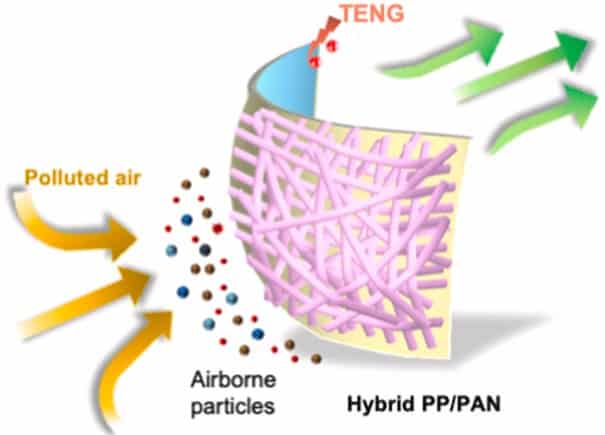
TENG powered mask

A new design for a self-powered air filter mask with enhanced removal efficiency for nano and microparticles and an extended lifetime of at least two days of continuous service has been unveiled by researchers in China.

Filter masks play an important role in our wellbeing as the presence of airborne particulate pollutants is widespread and has a negative impact on human health. Most recently, the COVID-19 pandemic has shown us the importance of using face masks as protective equipment, to prevent the respiration of hazardous particles in the environment. However, current disposable masks are unable to remove extremely small particles effectively. Another shortcoming is that they can only be used for a few hours, after which, the efficiency of filtration decreases.

In this latest research, Lingyun Wang and colleagues at City University of Hong Kong and the Chinese University of Hong Kong have discovered that the inclusion of polymeric fibres with a small diameter within the range of nanometres are the key to enhancing a mask’s ability to eliminate suspended particles. They have created a hybrid air filter using the fibres that has a porous structure, with varied pore sizes to increase the amount of filtered material.

Charge separation

However, the capture efficiency of these fibres alone is still relatively low. This is because filtration relies on the passive accumulation of particles due to the physical impact of the particles on the fibres and Brownian motion. To boost the efficiency, Wang and colleagues took advantage of the fact the polymers have a marked separation of positive and negative charges due to their large dipole moment, which can attract more particles through electrostatic interactions.

To boost the long-range attraction of the filters to negatively charged and dipolar particles in air, the team applied an external electrical field to the hybrid air filter using a triboelectric nanogenerator (TENG). Today’s N95 masks exploit a similar strategy, using charged polypropylene to attract airborne particles. However, N95 masks can only achieve this attraction for a few hours, after which their ability to attract particles decreases. By actively applying a voltage using triboelectricity, the team enhanced these electrostatic forces and increased lifespan of their filter masks to up to two days.

The researchers also harnessed the TENG to give the filter antiseptic properties by incorporating silver nanowires with the fibres. Silver has well-known antibacterial properties because it releases ions that damage bacterial proteins. This effect can be enhanced using an electric field and this allowed the team to achieve a 35% sterilization rate.

Low-cost and green energy

The TENG provides low-cost and green energy, which is harvested from the movement between two materials that generate opposite charges by contact friction. One of the materials gains electrons while the other loses them, generating an electrical current that is used to power the filter masks. Therefore, a mask can be self-powered by the wearer’s movement only, without the need for batteries or additional energy sources.

In the new device, the team connected the polymer fibres to the TENG via an electrically conductive substrate. The hybrid filtering material was tested using a custom-made set-up that produced a continuous air flow while monitoring the numbers of particles in air before and after the contact with the filtration masks.

The researchers found that the filters can operate for two days under a continuous airflow, while maintaining a high removal efficiency even for small particles. They now hope to incorporate their technology into practical lightweight facemasks that are charged using human motion.

The findings are reported in a paper in Nano Energy.

Chemistry gets put to a quantum test

Chemical reactions are complex. Even if only a few molecules are involved, the final configuration will depend on a huge number of parameters – including, in principle, all the possible locations each electron in each atom can occupy as the reaction takes place. Calculating these trajectories is beyond the power of today’s best computers, but researchers led by Kang-Kuen Ni of Harvard University in the US have now demonstrated an alternative. By cooling molecules of potassium and rubidium down to a fraction of a degree above absolute zero, they reduced the number of possible reaction outcomes to just 57. They then probed all these outcomes down to the level of individual quantum states, paving the way for a better understanding of chemistry.

When molecules are cooled close to 0 K, they enter their absolute quantum mechanical ground state, with the lowest possible levels of electronic, vibrational and rotational energy. Additionally, their kinetic energy, which governs their movement through space, becomes vanishingly small. Ultracold molecules are therefore an ideal test bed for validating quantum-dynamical models of reactions.

Ultracold KRb reactions

In their study, which is published in Nature, Ni and her colleagues focused on the reaction that occurs when ultracold potassium-rubidium (KRb) molecules exchange atoms to form K2 and Rb2. This reaction releases energy (it is exoergic), but the energy released is not sufficient to excite vibrational motion in the product molecules. This means that all the energy must instead go into rotational and translational motion (recoil energy).

Under these conditions, a quantum statistical model that includes conservation of energy conservation and angular momentum predicts that the number of possible joint quantum state pairs in the product molecules is relatively small, at 57. However, measuring these states is still no easy task and requires special techniques.

The researchers detect the rotational states of their K2 and Rb2 molecules by ionizing them with a laser pulse. The ionization process is selective, occurring only when the laser frequency matches the gap in the molecules’ energy levels, which is different for each rotational state. The ionized molecules then fly through a series of circular electrodes (all integrated into the reaction chamber), at which point electric fields propel them towards a position-sensitive detector. Once the researchers mapped how often a particular rotational state originated from the reaction, they changed the laser frequency to match the energy levels of the next rotational state and repeated the process until the survey was complete.

Ni and colleagues also needed to determine whether the molecules they detected were produced in the same reaction event. For this, they applied the principle of conservation of linear momentum. When two KRb molecules of similar momenta collide, the resulting K2 and Rb2 molecules fly away from each other with equal but opposite momenta. This means the product molecules arrive at the detector at different locations, but their arrival can be correlated. This correlation enabled the researchers to distinguish reaction products from molecules that originated in other processes.

Quantum-dynamical model

In a series of experiments (most of which were run remotely to comply with COVID restrictions), the Harvard team measured the scattering probabilities for all 57 allowed rotational state-pairs of the products. They found that while 50 of these probabilities matched theoretical predictions, the remaining seven did not. In one of these non-matching outcomes, the reaction took place close to the threshold of the exoergic energy, where most of the energy couples only to rotational motion. This leaves very little recoil energy for the reaction products to fly apart and get detected, meaning that the lack of theoretical agreement could be an artefact of the team’s measurement system. The other deviations, however, have no straightforward explanation, and contradict the prediction that all product states should have an equal probability of forming.

“For many physical chemists it’s been a long-term dream to be able to follow a chemical reaction from start to finish at the quantum state resolved level,” Ni says. “In this work, we achieved that.” Ni notes that the deviations they observed “may not be understood for another 10-20 years, until perhaps a quantum computer solves the quantum reaction dynamics calculations”. However, she concludes, “the data is there for future benchmarking of theory for when that becomes available”.

“A significant achievement”

Balakrishnan Naduvalath, a physical chemist at the University of Nevada in Las Vegas, US, who was not involved in the study, says that precisely mapping the quantum states of reaction products is “a significant achievement that no other research group has accomplished for a bimolecular chemical reaction in the ultracold regime”. The experiment, he adds, “provides much deeper insights into chemistry and at the same time challenges theory. The availability of experimental results surely would motivate theorists to develop new methodologies (and benchmark them) to study this class of four-atom reactions that might also benefit other areas of chemistry.”

As a next step, members of the Harvard team plan to put their system to work on molecule-to-atom reactions, which are less complex, and for which the available theoretical predictions are more accurate. They also hope to leverage such reactions to generate quantum entanglement resources.

Organic thin-film devices show promise as proton dosimeters

Researchers in Italy have developed organic detectors that can quantitatively and reliably measure proton radiation dose, both in real time and integration mode. The organic devices, based on semiconductor thin films, demonstrated direct detection of 5 MeV protons. The team suggest that this new class of material has the potential to create flexible, portable and tissue-equivalent proton detectors for use in applications such as proton therapy.

Organic semiconductors have been demonstrated previously to be reliable detectors of ionizing radiation; but the multi-institutional team, led by Beatrice Fraboni of the University of Bologna, believes that this is the first study to evaluate the detector’s responsivity to proton beams.

Organic detection devices have unique advantageous features for developing flexible, large-area, direct proton dosimeters, according to the researchers. Organic semiconductors can be deposited from solution using low-cost techniques that are easily scalable onto large areas. Low-temperature fabrication processes (below 180°C) allow for fabrication of flexible devices onto plastic substrates. The devices operate at very low bias (less than 1 V), are portable and wearable. Finally, their composition and density make them human-tissue equivalent in terms of proton absorption. Thus they can be employed as medical dosimeters without requiring complex calibration procedures.

The detectors fabricated by the team have a photoconductor structure in which the active semiconducting layer is an organic thin film of microcrystalline TIPGe-Pn. This 150 nm film is deposited from solution onto two interdigitated gold electrodes on a plastic substrate, which ensures the mechanical flexibility of the system.

The researchers tested the detector’s response to proton irradiation, both in real time and in integration mode, reporting their findings in Science Advances. They irradiated the detectors using a 5 MeV proton beam from the 3 MV Tandetron accelerator at the LABEC ion beam centre in Firenze.

The best sensitivity obtained by the detectors was 5.15±0.13 pC/Gy, with a calculated limit of detection of down to 30±6 cGy/s. The sensors demonstrated a stable and reproducible response to proton beams with fluences between 3.5 x10⁹ and 8.7×10¹¹ protons/cm2, and maintained a linear response up to a total dose of 28 kGy.

The researchers note that while the energy of therapeutic beams is commonly above 70 MeV, the proton energy tested in this work is similar to end-of-range values, in particular the energies of scattered protons reaching internal tissues surrounding the target. The detector could therefore be employed to monitor dose to healthy tissues during treatments, such as the dose delivered to the rectal wall during proton therapy of prostate cancer, for example. The organic sensors could fit into a rectal balloon to help ensure the safety of surrounding healthy tissues.

Another potential application is as a medical dosimeter to measure radiation absorbed by astronauts during long-duration space missions.

“Our work demonstrates the possibility to operate simultaneously the same sensor in real-time mode and in integration mode, exploiting the interface coupling of the organic semiconductor with the plastic substrate,” first author Ilaria Fratelli tells Physics World. “While the energy released by the proton beam in the organic semiconductor is registered by an instantaneous increase of current, the energy released in the plastic substrate generates an accumulation of trapped charges, which induces an increase of the device conductivity proportional to the total radiation dose absorbed by the system.”

The team is now planning further tests in proton therapy centres to investigate the effect of higher energy proton beams. “We are also continuing our research through two parallel pathways,” says Fratelli. “We are studying the fundamental mechanism of interaction between protons and the materials forming the device, to reach full control and optimization of the sensing system. And we are working on the geometry and architecture of the device, on the interface effects that rule the integrative response of the detector, and on the semiconducting material employed as the real-time active layer.”

Why we need to change the public’s perception of physics

Physics is more stimulating than ever and the world increasingly depends on it. Yet, sadly, many women still do not feel inclined to pursue the subject. My own motivation for studying physics at university was my inquisitive nature: I simply enjoy delving into mathematics to understand how the world works. However, studying a subject like physics, where men dominate, can be intimidating. Sometimes I feel overwhelmed and question whether I even belong.

I have experienced biases during my time in physics, such as being told that I am too “girly” to be a physics student. Gender bias can also have a big impact on women when it comes to looking for jobs. Women who want to pursue a research career in physics, for example, must publish more papers in top-tier journals than men just to be accepted for the same job position. The gender gap can leave aspiring female physicists feeling inadequate and isolated.

Yet this is a problem not exclusive to physics: women in other sciences go through similar issues. We as individuals feel as though we are carrying the hopes, aspirations and responsibilities for all women in our field. Hiding from the spotlight or “blending in” can only make matters worse. It just means that examples of female success, such as the African American female mathematicians and computer scientists who worked at NASA in the 1970s, end up being ignored or forgotten.

While studies have revealed no difference in the capabilities of girls at physics – they perform as well if not better in exams than boys – physics stands out as the second most popular A-level subject for boys in the UK but only the 18th most popular for girls. This means that science, technology, engineering and mathematics (STEM) subjects at university and occupations in these fields are dominated by men. Between 2017 and 2018, for example, women accounted for just 35% of STEM graduates from UK universities, while, according to the UK Higher Education Statistics Agency, the yearly increase in women studying core STEM subjects is only around 1000 students. Despite the many recent efforts to inspire women to pursue STEM subjects, it seems that no significant change has occurred. So, will there ever be an even division between males and females in science or is the divide firmly engraved in us from ancestral societal roles?

Changing perceptions

Stereotypes – whether of gender, race or culture – will always exist. They emerge from a fundamental human desire to use our cognitive skills to classify information. We might know nothing about a person, but we subconsciously make assumptions about them based on those stereotypes. Women, for example, are perceived as affectionate and caring towards others while men are considered to be assertive and wanting to dominate. The problem with these generalizations is that they result in two key variations between male and female roles in society. First, women are more likely to hold low-authority positions and men are more likely to hold high-level positions. Second, women are therefore more likely to be homemakers and men are more likely to be employed in a paid business.

When it comes to physics, we portray physicists as hard-working, clever, socially inept…and male. However, there is a point when such stereotypes morph into discrimination, such as gender bias. Many wrongly correlate girls’ loss of interest in mathematics and physics to a fear of being “unfeminine” or to them being unable to cope with the perceived difficulty of the subject. Those assumptions then underscore even more firmly traditional beliefs of men’s competitive instincts, durability and motivation to master hard topics. The net result is a subconscious barrier to physics in young girls’ minds.

I believe that changing the public’s perception of what a physicist is will be key to redefining the cultural barriers between physics and wider society. It will take time, but the focus needs to be on children, who are scientists by nature, in that they show a curiosity for how the world works. Indeed, it has been shown that girls only begin to develop negative opinions about science once they reach the age of 10, especially when they become aware of female societal roles. Children gather their perspective on gender “norms” from people around them and increasingly from the media and social media too – so the more they see diversity in the appearance of scientists the better. Sadly, some secondary-school physics textbooks do not include a single female physicist.

Women pursuing a career in any STEM field should be looked after. Finding other women who have been through similar challenges will help to remind us that we are not alone in doubting ourselves in STEM. For now, we need to see these thoughts as a compromise for the reward of an accomplished life. Only in time can we change the perception of what it is to be a physicist, but that change will come.

Reimagining patient-specific QA in proton and ion therapy facilities

A ground-breaking R&D collaboration between clinical physicists at MedAustron and their industry partner IBA Dosimetry, a German supplier of independent QA solutions and services to radiation oncology clinics, is rewriting the rulebook on patient-specific QA for proton therapy. A case study in clinical translation, the partnership is focused on practical implementation of myQA iON, IBA Dosimetry’s patient QA dose-verification software, yielding operational insights and technical innovations that will enable proton therapy clinics to increase their workflow efficiency while simultaneously enhancing patient safety and treatment outcomes.

From a commercial perspective, IBA Dosimetry is positioning myQA iON as a “game-changer” in patient QA – a software-as-a-service solution that supports the planning, delivery and management of proton therapy while ensuring interoperability with the proton treatment systems of all leading radiotherapy equipment manufacturers. As such, myQA iON gives physicists and dosimetrists the flexibility to combine Monte Carlo dose recalculation, QA based on irradiation log files, plus real-world detector measurements within a unified, automated and web-based software verification system that enables users to access their QA on-campus or remotely from any device that connects to the hospital network.

A division of labour

Over the past 18 months, MedAustron, a cancer treatment centre specializing in proton and carbon-ion therapy and related research, has emerged as one of IBA Dosimetry’s flagship customer sites supporting the clinical roll-out of myQA iON. Joint activities have spanned beta testing, customer training as well as acceptance and commissioning, while subsequent physics and clinical validation by the MedAustron team enabled efficient implementation of myQA iON into the patient QA workflow. “Having the chance to collaborate with a company like IBA Dosimetry provides us with a long-term QA solution, including service and maintenance,” explains Loïc Grevillot, beam delivery and Monte Carlo simulation group leader at MedAustron.

That division of labour on QA is also driven by operational necessity, given that the MedAustron clinic is still work-in-progress. The facility currently has two clinical treatment rooms with fixed proton beam lines plus one treatment room set aside for clinical and preclinical research studies. A fourth treatment room with a proton gantry will come online next year, extending patient treatment hours across the site to full capacity. As such, measurement-based patient-specific QA (with set-up and beam time) is in direct competition for beam-time needed to support the commissioning effort at MedAustron. Beyond the commissioning phase, of course, patient-specific QA will need to be streamlined further in order to maximize the beam-time allocated for patient treatment. “That’s why MedAustron wanted to be a pioneer in Monte Carlo-based independent dose calculation,” Grevillot adds. “We’re now using myQA iON second-check calculations for a preselected subset of plans embedded in an extensive machine-based QA programme.”

So how did the MedAustron team set about integrating myQA iON into routine clinical practice? According to Grevillot’s colleague Ralf Dreindl, the first step is to identify the relevant commissioning tasks – covering beam-model aspects, CT calibration and clinical testing. “Our strategy involved moving from simple geometries in water and air phantoms to complex clinical cases in patient geometry in order to get the precise overall picture,” he explains. Other considerations include the clinical simulation settings – in terms of the trade-off between dosimetric accuracy and simulation times – as well as benchmarking the implemented gamma index for 3D dose verification. “Our clinical workflow foresees post-processing tasks that start immediately after the clinical approval of a treatment plan,” explains Dreindl. “One of these tasks is the independent dose calculation of the approved plan or beam set.”

Operationally, however, the rework of established clinical routines is always a delicate and nuanced undertaking. The MedAustron team therefore defined a two-month transition period for clinical implementation, with plan complexity being the main driver of dosimetric approval via myQA iON’s independent Monte Carlo dose calculations or the usual patient-specific QA measurements. “Since the transition period ended,” Dreindl adds, “we are now using myQA iON for all normofractionated proton treatments in the horizontal beam lines.”

Benefits realization

In-house analysis indicates significant – and immediate – efficiency gains since the MedAustron team implemented myQA iON clinically on the centre’s two horizontal proton beam lines. During the first two months of operation (starting in February 2021), Dreindl and colleagues noted an average 24% reduction in patient-specific QA measurements for single-field optimized proton beams (in which the spot positions and weights of each proton field are optimized individually, yielding uniform dose distribution over the tumour target). Multiple-field optimized beams (with highly conformal dose distributions to the target volume) are also now part of the mix for independent dose check, yielding up to a 50% reduction in patient-specific QA measurements since the beginning of April. For the near term, says Dreindl, hypofractionated treatment schedules will always be measured manually in addition to the independent dose check provided by myQA iON.

myQA iON

More broadly, the reduction in patient-specific QA measurements is strongly dependent on the “patient mix”. For the moment, MedAustron can only simulate horizontal proton beam lines, but there are plans to start with the vertical proton beam line in spring 2022 after commissioning is complete on the new treatment room with proton gantry. Other joint lines of enquiry with IBA Dosimetry include the implementation of irradiation log-based QA at MedAustron – to provide fraction-by-fraction monitoring and evaluation of treatment delivery accuracy – as well as the integration of the GATE-RTion/IDEAL Monte Carlo dose calculation engine (developed by MedAustron) into myQA iON to support the clinical implementation of independent dose check for carbon-ion therapy. “We cannot fully replace the patient-specific QA measurements with independent dose check,” notes Dreindl, “though the integration of log-file-based QA may be an interesting route to further reduce QA measurements beyond the current 50% threshold.”

Better together

Just 18 months after they started working together, the collaboration between MedAustron and IBA Dosimetry is going from strength to strength. “As a clinical user, it’s essential for us to have a comprehensive tool like myQA iON which has undergone a certification process,” notes Markus Stock, head of the medical physics division at MedAustron. “Working as part of a collaboration, we always have a hot-line to the team at IBA Dosimetry for assistance on installation, commissioning and the testing of new functionality.”

One thing is certain: as cancer care providers seek continuous improvements in treatment efficacy, next-generation particle therapy systems will be pushed to the limits – of physics and engineering – when it comes to targeting accuracy, dose distribution accuracy and the sparing of healthy tissue. All of which translates into evolving and increasingly complex demands on patient, machine and workflow QA. “That’s why it’s essential for industry and clinical users to work hand-in-hand to deliver user-friendly, patient-centric QA technologies that support clinical decision-making and workflow efficiency,” concludes Stock.

First results from UK tokamak offers a STEP towards commercial fusion

The prospect of commercially viable, fusion-power plants based on the spherical tokamak has moved closer after a major experiment in the UK released its first results. Using a novel kind of exhaust, researchers at the Mega Amp Spherical Tokamak (MAST-U) at the Culham Centre for Fusion Energy in Oxfordshire were able to cut the waste heat load on the reactor walls ten-fold. If the results can be extrapolated to working fusion reactors, then exhaust material and other components would not need to be regularly changed – making such reactors more cost effective by allowing them to operational for longer.

Operated by the United Kingdom Atomic Energy Authority (UKAEA), the CCFE is already home to the Joint European Torus (JET) tokamak, which was built in 1983. MAST, however, is different to JET in that it features a spherical, cored-apple like plasma. JET, in contrast, has a doughnut-shaped device, as does the giant ITER experiment, which is currently being built in Cadarache, France.

This result shows so much promise for compact designs

Ian Chapman

Built in 1999, MAST has been used to confine highly pressurized plasmas with a lower magnetic field than those used in JET, which could help to build a more cost-effective fusion device. The plasma in MAST is created by letting in a small puff of deuterium gas, which is then heated by driving a current through it. This flow of charged particles around the tokamak’s wall starts off the plasma and gives it its initial heat. Magnetic fields then confine the hot plasma of deuterium and keep it away from the walls of the tokamak.

Following over a decade of research, in 2013 MAST underwent a major £55m overhaul – dubbed MAST-U – that involved the device being completely stripped and rebuilt.  The upgrade, funded by the Engineering and Physical Sciences Research Council, involved new power supplies, upgraded heating systems and diagnostic tools to help scientists not only study plasma conditions relevant to ITER, but also plan what kind of facility will be needed next to deliver the goal of providing fusion power to the grid.

Turning a corner

One of the biggest aspects of the upgrade involved installing a new kind of heat exhaust system known as a divertor.  The fact that spherical tokamaks are more efficient than their doughnut-shaped counterparts, with more power for a smaller volume, has its downsides. In particular, the waste heat from the plasma is more intense and it is through the divertor that this power must be funnelled.

In a spherical tokamak reactor, the exhaust carries a fifth of the energy of the fusion reaction. A standard divertor of the kind used at JET and ITER, which is like a bowl at the bottom of the reactor vessel, would not be good enough for a spherical tokamak scaled up to fusion-like conditions. Also, the heat load – running at tens of megawatts per square metre – would simply be too much to withstand and quickly degrade the material.

Researchers at Culham therefore built a new kind of divertor called “Super-X”. Tiled with graphite, Super-X is shaped like a funnel, with the idea being that the plasma load is spread over a larger area as it exits the tokamak. Simulations have shown that the Super-X divertor could decrease the heat flux and plasma temperature in the divertor  — taking a 50 MW/m2 heat load and reducing it to just 5 MW/m2.

MAST-U was completed in late 2019 and a year later achieved its first plasma of deuterium. Since then engineers and scientists have been conducting tests and have now confirmed what their simulations had shown – that the Super-X divertor can reduce the exhaust heat load ten-fold.

“This result shows so much promise for compact designs,” says Ian Chapman, UKAEA chief executive. “This means that materials in fusion plants will last a lot longer before needing to be replaced, which is crucial for a commercial reactor.” According to Andrew Kirk, MAST-U lead scientist, the result indicates that the divertor wall would only need to be replaced once during a power plant’s lifetime.

Research on MAST is informing the conceptual design of the UK’s prototype fusion power plant – Spherical Tokamak for Energy Production (STEP). Work on the £220m design is set to be complete by 2024 with the aim to build STEP by 2040. Chapman confirms that STEP will feature a Super-X divertor configuration and engineers will now spend the coming months on MAST-U studying how to minimize the heat around the divertor while trying to maximise the fusion performance of the plasma.

Infrared cloaking device could make objects invisible to thermal cameras

Cloaked Homer Simpson

A thermal cloaking technique that can hide warm objects from infrared cameras has been proposed by researchers in France, the US, and the UK. Fernando Guevara Vasquez at the University of Utah and colleagues have calculated that thermal cloaking can be achieved by surrounding objects with rings of tiny heat pumps that absorb and re-emit heat. Although further work is needed to demonstrate the technique in the lab, it could lead to better ways of protecting electrical circuits from heat damage.

Invisibility cloaking of objects has received much attention in recent years. It usually involves using advanced metamaterials to smoothly guide electromagnetic radiation around an opaque object so that the object does not appear to disturb the radiation – thereby rendering the object invisible to an observer.

Now, Guevara Vasquez and colleagues have considered an alternative approach for thermal cloaking that involves actively manipulating infrared radiation in the vicinity of the object to be cloaked. This involves absorbing infrared light using heat sinks and emitting it using thermal sources.

Tiny heat pumps

To do this, the researchers propose using tiny heat pumps based on the Peltier effect to create the sinks and sources. This effect involves passing electrical currents across metal-metal junctions, which can either emit or absorb heat depending on the configuration. In their simulations, they arranged cloaking elements in a ring surrounding the object to be cloaked, with heat sinks and sources paired together.

The sinks absorb the heat produced by an infrared source that illuminates the object from behind from an observer’s perspective. Using mathematical equations of heat flow, the team can calculate how this absorbed infrared radiation would appear on the opposite side of the ring, if the object was not in the way. This calculated radiation is re-emitted by the heat sources on the part of the ring facing the observer, which is a thermal camera.

In their simulations, this technique could make a uniform flow of heat to appear completely unaffected by objects with complex geometrical shapes – including a profile of the head of cartoon character Homer Simpson (see figure). The team also used the tuneability of Peltier elements to go beyond thermal cloaking. Using their mathematical model, they were able to make one object look like a completely different object to the thermal camera.

One drawback of the proposed cloaking system is that the temperature of the illuminating source must be known ahead of time, so further research is needed before a practical device can be built. Peltier elements are already widely available commercially, so the technology required is well within reach.

If thermal cloaking is realized, it could enable engineers to hide the heat-emitting parts of circuits such as power supplies, preventing them from interfering with heat-sensitive components such as thermal cameras. The technique could also be used in industrial processes to control the temperatures of materials.

The research is described in the Proceedings of the Royal Society A.

Combining physics and biology: lasers and machine learning for personalized medicine

Nabiha Saklayen is a physicist who has been fascinated with space and stars ever since childhood. “I was obsessed,” she says, adding that this feeling never went away as she got older. Saklayen would often immerse herself in astronomy books that her mum had bought her, dreaming of becoming an astronaut or an aerospace engineer. “They were my most prized possessions,” she recalls.

Growing up in various countries around the world, including Saudi Arabia, Germany and Sri Lanka, Saklayen excelled in science and in many other subjects, such as writing and music. However, she always felt drawn towards her quest to understand the universe, with her interest in physics being piqued while attending a science-focused international high school in Sri Lanka. It was simply the most challenging, appealing and rewarding subject for her. “It pushed me to think outside the box.”

Keen to continue with physics, Saklayen considered studying in the UK. However, she decided it was important to have a broader learning experience than was possible there. “I was committed to physics but I really wanted the option to explore other subjects,” she recalls. Saklayen decided to move to the US, attending Emory University in Atlanta, Georgia, where the interdisciplinary curriculum allowed her to take classes in linguistics, sociology and journalism, in addition to physics.

She graduated with highest distinction, in 2012, majoring in physics with a minor in mathematics. Saklayen points out that another advantage of Emory was the range of research opportunities for undergraduate students. “I started doing research on soft condensed matter, the summer of my freshman year of college in Eric Weeks’ lab, and later published my first paper. This helped me get into a top graduate school.”

Saklayen continued her studies at Harvard University in Cambridge, Massachusetts, and earned her PhD in physics, focusing on biophotonics, in 2017. “I merged physics and biology together. My specific training was in laser physics and I worked with mammalian cells, such as stem cells and blood cells,” she says, adding that she specifically chose biophysics because “it was the closest to real-world applications”.

During her PhD, Saklayen invented new and cheaper laser-based nanopatterned surfaces to engineer cells with precision. “These laser-based methods allow you to create transient pores in cells and deliver cargoes or genetic materials into cells while keeping them healthy and alive,” she explains. Saklayen’s research was carried out in collaboration with many eminent scientists at Harvard Medical School, including the stem cell biologist Derrick Rossi who founded Moderna, haematologist-oncologist David Scadden, and geneticist George Church. “They all were very excited about this laser-based technology and encouraged me to pursue entrepreneurship – and that’s what happened,” she explains. “It was not something I considered for myself.”

Building a multidisciplinary team

After her PhD, in 2017, Saklayen launched a start-up company with physicists Marinna Madrid and Matthias Wagner, initially setting out to treat blood diseases with the technology. She had met Madrid previously when working in the same research group. “We had a fantastic working relationship for many years, so it made sense,” says Saklayen, adding “if she wasn’t my teammate, I don’t know if I would have come this far or if I would have even started the company.”

Later the same year, they met their third co-founder and chief technology officer, Wagner, a serial entrepreneur in the optics field who had previously built and run three start-up companies. Wagner developed the platform technology for commercialization. “Actually, our first version of the platform was built in what I like to call Matthias’ garage,” says Saklayen.

Over the next year, Saklayen narrowed down the potential applications for their platform by researching what the life sciences industry needed. To the team’s surprise, it was more important to be able to remove low-quality cells in a cell culture with the laser than to deliver cargoes into the cell. So this is what they did. “I had not expected this because it’s much easier to remove unwanted cells,” says Saklayen. “That was a pivotal moment.”

For Saklayen, the key thing is that business decisions evolve over time and cannot be based simply on the interests or intellectual curiosity you might have had as a research scientist or a PhD student. “It’s about what is useful for the industry and what customers are willing to pay for,” she says. Soon after, the team met its first seed investors in the form of The Engine, a venture firm spun out of MIT that operates as an accelerator and provides co-working space to its companies. This led them to start working full time on Cellino Biotech in 2018.

We became a unified team across physics and biology, which was very special – not many companies have this type of team that is very balanced across disciplines

Nabiha Saklayen

With the business premises sorted, in Cambridge, Massachusetts, the team immediately hired biologists. “When we first brought our biologists onto the team, we became a unified team across physics and biology, which was very special – there’s not that many companies that have this type of team that is very balanced across different disciplines,” says Saklayen. Cellino Biotech grew again in 2019, when Wagner came up with the idea to form a machine learning team and automate some of the complex processes that are normally done manually by scientists.

“We now use machine learning to train image-based algorithms to decipher which cells are high versus low quality and then we use a laser system to remove any unwanted cells with precision based on those algorithmic decisions,” Saklayen explains. “There are no humans involved in any part of this process.”

The 14 team members working at Cellino Biotech now include four physicists, two biologists and two machine-learning engineers, and the start-up has 12 patents pending. Despite “speaking different scientific languages”, Saklayen stresses how important it has been to work with her multidisciplinary team at Cellino Biotech and make sure everyone communicates well. “It is one of our biggest strengths,” she says. Although she no longer does the science herself, she enjoys being around scientists, advising them and seeing their ideas materialized. “I feel plenty of ownership of our collective efforts,” says Saklayen.

Working hard

As Cellino Biotech’s chief executive, Saklayen’s job is varied and fast-paced: she leads the company’s vision; hires and trains employees; manages her team; organizes logistics and budgets; and fundraises. “Everything moves 100 times faster than anything we ever did in academia,” she says. “I love that energy because you can see that we’re taking massive jumps forward every year.”

However, being an entrepreneur is not easy. “I thought I worked hard on my PhD, but the start-up is even harder,” Saklayen says, noting that she has to constantly think in multiple dimensions. But she finds that being a physicist has really paid off. “It has given me a unique set of tools where I’m able to look at problems from a universal lens and come up with solutions,” she says.

During her PhD, Saklayen ran the biophotonics sub-group at Harvard with five or six undergraduate, graduate and postdoctoral students – just like a start-up. “It was unusual but my PhD adviser was completely hands-off,” she says. Saklayen also recalls her previous experience running Model United Nations as an undergraduate student and managing about 100 people. “Both of these experiences built a very strong leadership foundation for me to start from, so I came into this as an experienced leader,” she says. “My mom says I was preparing for this CEO role my whole life without knowing it and there’s some truth in that.”

Having ended up in a career that she hadn’t planned for, Saklayen believes today’s physics graduates have to keep an open mind and talk to scientists in other disciplines to widen their opportunities. “As physicists we’re often very elitist in how we view other disciplines, but don’t fall into that,” she says. As a woman of colour in physics, she also has a message for minority groups in the field. “Don’t let the world get to you; you’re smart, you’re brilliant and you have to keep going,” she says. “It’s an opportunity to educate the world that physicists can look different.”


A comprehensive compendium of bioimaging and microscopy technologies

bio ebook covers

Imaging technologies play a vital role in the advancement of life sciences. In recent years, novel imaging techniques and tools have emerged that allow characterization of molecular mechanisms and biophysical properties of tissue with unprecedented resolution. Alongside, we’ve seen a shift towards exploiting the correlation and combination of complementary imaging modalities. Until now, however, no single publication has provided information on all of the imaging modalities available for biological and preclinical research.

A new book aims to address this shortfall, by compiling a comprehensive collection of bioimaging modalities and microscopy techniques, and explaining how to fully exploit their potential. The book – Imaging Modalities for Biological and Preclinical Research: A Compendium – brings together a series of articles covering a vast range of imaging modalities. The book is divided into two volumes: volume 1 focuses on ex vivo biological imaging and microscopy, while volume 2 examines in vivo imaging, multimodality techniques and emerging technologies.

“Imaging is becoming an indispensable toolset for biomedical research, as it can illustrate all relevant processes of life and disease,” explains editor Andreas Walter. “An overview of available solutions to tackle research questions is essential. It is specifically important for us to bring together the fields of biological microscopy and in vivo preclinical imaging to create synergies and learn from established standards in the different communities. So far, each imaging community has worked in isolation on their advancements, but joint efforts would be beneficial to biomedical sciences.”

The idea for the book arose during a conference run by COMULIS (Correlated Multimodal Imaging in Life Sciences), a network of some 500 imaging scientists working in diverse fields. Walter, who is chair of COMULIS, worked with co-editors Julia Mannheim and Carmel Caruana to create a publication that encompasses all currently available imaging modalities. “It was really a joint effort between medical physicists, biologists and imaging scientists across various fields,” he notes, adding that most of the book’s authors were recruited from the COMULIS network.

Designed to act as a valuable reference work, the book provides overviews of each imaging modality – from fluorescence microscopy to electron microscopy, ultrasound to MRI, and many more. Every chapter guides the reader through the physical principles and biomedical applications of each modality, and includes a discussion on the technique’s strengths and limitations, as well as future developments. To highlight the importance and benefits of multimodality approaches, the editors included a dedicated section on correlative multimodality imaging and image data fusion.

The book is targeted at researchers, physicians, physicists and life scientists working in universities, industry and research labs who wish to deepen their knowledge of bioimaging and the wide range of associated applications. It is also suitable reading for students looking for insight into the complex topics of microscopy and bioimaging.

While most areas of biomedical research can now be addressed with bioimaging, many biomedical scientists are still unaware of the multitude of imaging techniques and their potential. Walter hopes that by introducing the capabilities and limits of bioimaging methods, and providing a basic understanding of contrast mechanisms and biomedical applicability, the book will help such biomedical scientists select the right imaging technique. “The knowledge about and inclusion of bioimaging might even allow them to tackle previously inaccessible research questions,” he says.

  • Individual copies of Imaging Modalities for Biological and Preclinical Research can be purchased at the IOP Publishing Bookstore.
Copyright © 2026 by IOP Publishing Ltd and individual contributors