

Nanospindles enhance ultrasound destruction of tumours

Vanadium-doped titanium dioxide nanospindles

Sonodynamic therapy (SDT) is a promising, non-invasive cancer treatment that uses ultrasound to activate sonosensitizers, which in turn generate reactive oxygen species (ROS) that attack and destroy tumour cells. Researchers from Soochow University in China have developed a new type of sonosensitizer that enhances the amount of damage than SDT can inflict upon tumours without harming normal tissue. Writing in Applied Physics Reviews, they describe how the new sonosensitizer can suppress the growth of human breast cancer tumour cells in mice.

The new sonosensitizer is based on vanadium-doped titanium dioxide (V-TiO2) nanospindles. While TiO2 has been used in the past as a sensitizer, it does not work well because it has a wide band gap in its electronic structure. This causes electrons stripped away by ultrasound to rapidly recombine with the nanoparticles, preventing the generation of ROS. The researchers determined that if they doped the TiO2 nanoparticles with vanadium to form nano-sized spindles, this would reduce the band gap, thus increasing the efficiency of ultrasound-triggered ROS production.

Lead author Xianwen Wang and colleagues also determined that vanadium doping causes the nanospindles to act like tiny enzymes that catalyse the generation of highly toxic hydroxyl radicals from hydrogen peroxide contained within the tumour. This provides an additional method of killing the cancer cells, via chemodynamic therapy. Additionally, they report that the nanospindles cause glutathione depletion, which further increases the oxidative stress generated by the chemodynamic–sonodynamic therapy.

The researchers created high-quality V-TiO2 nanospindles and then coated them with polyethylene glycol to create V-TiO2-PEG nanospindles with good water solubility. Following initial testing, they assessed the cytotoxicity of the nanospindles using both non-cancerous human umbilical endothelial vein cells and breast cancer cells. They confirmed that the V-TiO2-PEG nanospindles exhibited no obvious cytotoxicity to the non-cancerous cells but that the viability of the cancerous cells decreased with increasing nanospindle concentration.

The team next examined the therapeutic efficacy of the nanospindles in the cancer cells and in vivo in tumour-bearing mice. The mice were divided into five groups, which received: no treatment (control group); ultrasound irradiation; injection of V-TiO2-PEG nanospindles; injection of commercial TiO2 nanoparticles plus ultrasound; and injection of V-TiO2-PEG nanospindles plus ultrasound.

Tumours in the control group grew rapidly, while the nanospindle-only and the ultrasound-only groups experienced moderate tumour growth suppression. Tumour growth in mice receiving nanoparticles/nanospindles plus ultrasound was markedly suppressed, with the most severe tumour damage and necrosis seen in animals receiving V-TiO2-PEG nanospindles plus ultrasound. ROS staining revealed that tumour sections in this latter group exhibited the strongest fluorescence, indicating that V-TiO2-PEG nanospindles plus ultrasound irradiation generated more ROS in tumour tissues than nanospindles or ultrasound alone.

The researchers identified V-TiO2-PEG nanospindles in the spleen and liver of the mice and, later, in the animals’ faeces and urine. They did not detect any obvious signs of organ inflammation or damage. “It is worth noting that the V-TiO2 nanospindles are rapidly excreted from the body,” comments co-author Liang Cheng. “This helps prevent any possible long-term toxicity effects.”

“Our all-in-one nano-platform based on V-TiO2 nanospindles with tumour microenvironment modulating properties enhances sonodynamic therapy against cancer,” conclude the researchers.
Entangled photons can see through translucent materials

Entangled pairs of photons have been used by physicists in Germany and Austria to image structures beneath the surfaces of materials that scatter light. The research was led by Aron Vanselow and Sven Ramelow at Humboldt University of Berlin and achieved high-resolution images of the samples using “ultra-broadband” photon pairs with very different wavelengths. One photon probed the sample, while the other read out image information. Their compact, low-cost and non-destructive system could be put to work inspecting advanced ceramics and mixing in fluids.

Optical coherence tomography (OCT) is a powerful tool for imaging structures beneath the surfaces of translucent materials and has a number of applications including the 3D scanning of biological tissues. The technique uses interferometry to reject the majority of light that has scattered many times in an object, focussing instead on the rare instances when light only scatters once from a feature of interest. This usually involves probing the material with visible or near-infrared light, which can be easily produced and detected. Yet in some materials such as ceramics, paints, and micro-porous samples, visible and near-infrared light is strongly scattered – which limits the use of OCT. Mid-infrared light, however, can penetrate deeper into these samples without scattering – but this light is far more difficult to produce and detect.

Vanselow, Ramelow and colleagues circumvented this problem by using pairs of quantum-mechanically entangled photons in which one photon is mid-infrared and the other is either visible or near-infrared. The entangled pairs are generated by firing a “pump” laser beam at a specialized nonlinear crystal developed by the team. This creates entangled pairs of photons – one mid-infrared “idler” photon and one visible/near-infrared “signal” photon.

Idler photons

The nonlinear crystal sits in an interferometer and in one arm of the interferometer, the light is split so the idler photon strikes the object to be imaged whereas the signal photon is reflected by a mirror. The other arm of the interferometer has a detector that measures the signal photons. Because the two photons are entangled, information about the idler photon (and hence the object) can be gleaned from a measurement on the reference photon. This information is used to create an image of the object.

The team tested the performance of their imaging system using samples that included paint layers and alumina ceramic stacks etched with microchannels. They produced both 2D and 3D images of the samples, down to microscale resolutions. Altogether, this improved the signal-to-noise ratio of conventional mid-infrared OCT by a factor of one million. This agreed with the team’s theoretical prediction for their setup’s best possible performance – meaning it was only limited by intrinsic quantum noise.

According to the team, the technology could be used to see inside materials inaccessible to other non-destructive techniques. Applications could include studies of alumina-based ceramics, which are used for drug testing and DNA detection, owing to the well-defined sizes and high densities of their pores. Elsewhere, the updated form of OCT could be used to make real-time images of microscale mixing in liquids, precisely engineered 3D-printed ceramics, and quality control for pharmaceutical coatings.

The research is described in Optica.

Collective behaviour emerges particle by particle

An ensemble of just six atoms displays all the signatures of a phase transition expected for a many-particle system. This is the finding of a team led by researchers at the University of Heidelberg, Germany, who used a quantum simulator to investigate how collective behaviour emerges in a microscopic structure. The new work advances our understanding of many-body physics, which describes phenomena that cannot be understood simply by studying the behaviour of individual particles.

Theories of many-body physics ignore the microscopic details of particle behaviour and focus instead on macroscopically observable quantities such as pressure, temperature and density. A system such as a glass of water, for example, might be described in a way that neglects the position and velocity of individual water molecules – even though the system’s macroscopic properties are the result of interaction between such molecules – once the number of water molecules reaches a certain critical size.

But what is that critical size? In other words, how big does an ensemble of particles need to be before their exact number becomes irrelevant and the entire system can be described using many-body theories? The transition from “discrete” to “continuous” behaviour has important implications in atomic, nuclear and solid-state physics, but determining exactly when it occurs has proved difficult. What is more, while the microscopic behaviour of each individual particle might be easy to describe exactly, the macroscopic behaviour of the particles as they interact is not.

Quasi-two-dimensional quantum simulator

A team led by Selim Jochim of the University of Heidelberg’s Institute of Physics tackled this problem by trapping up to 12 ultracold lithium-6 (6Li) atoms, assembled in two internal hyperfine states, at the focus of a laser beam. The trap’s geometry is such that the atoms can move in just two spatial directions, meaning that the system is effectively two-dimensional. The researchers then applied a special cooling technique that brought the system very close to its motional ground state, at a temperature just above absolute zero. This set-up also allowed the researchers to continuously tune the strength of the interactions between the atoms via an applied magnetic field, using so-called Feshbach resonances.

In their experiments, Jochim and colleagues configured the applied magnetic field so that the atoms attracted one another. If the attraction was strong enough, the atom formed pairs that could subsequently undergo a phase transition to a superfluid (a state in which the particles flow without friction). The researchers then observed how the atoms formed pairs as a function of their interaction strength and their number by measuring the binding energy of the atom pairs. To their surprise, they found that the atoms behaved like a many-body system even with only six atoms present.

Precursors of a quantum phase transition

Study lead authors Luca Bayha and Marvin Holten note that the type of pairing they studied is the precursor of a quantum phase transition to a superfluid phase with an associated “Higgs mode”. This mode has previously been observed in cold-atom, superconducting and ferromagnetic systems, but Bayha and Holten say that their work casts fresh light on how it arises. “Our atomic simulator provides a way to study the emergence of collective phenomena, particle by particle,” they say.

Members of the team, which also includes collaborators at the universities of Lund, Sweden, and Aarhus, Denmark, say they are now planning to study superfluidity in such mesoscopic systems in much more detail. “We will also use a novel imaging method to resolve each atom in our sample separately,” Bayha and Holten tell Physics World. “This will allow us to reveal the atom pairs that form in the superfluid state directly.”

The present work is detailed in Nature.

Tandem solar cells break new record

Solar cells made from a combination of silicon and a complex perovskite have reached a new milestone for efficiency. The new tandem devices, made by Steve Albrecht and colleagues at the Helmholtz-Zentrum Berlin, Germany, have a photovoltaic conversion efficiency (PCE) of 29.15%, beating out the previous best reported value of 26.2%. They also retain 95% of their initial efficiency even after 300 hours of operation and have an open-circuit voltage as high as 1.92 V.

Solar cells containing two photoactive semiconducting materials with different but complementary electronic band gaps can reach much higher PCEs when used in a tandem configuration than either material on its own. Perovskites, which have the chemical formula ABX3 (where A is typically caesium, methylammonium or formamidinium; B is lead or tin; and X is iodine, bromine or chlorine), are one of the most promising thin-film solar-cell materials around because they are efficient at converting the visible part of the solar spectrum into electrical energy. Since silicon is an efficient absorber of infrared light, combining silicon with a perovskite helps to make the most of the Sun’s output.

“Perfect bed” for perovskite

Working with Vytautas Getautis and his team at the Kaunas Technical University in Lithuania, Albrecht and colleagues constructed their tandem solar cell by sandwiching a self-assembled monolayer (SAM) of a novel carbazole-based molecule between a complex perovskite with a 1.68 eV band gap and an indium tin oxide electrode connected to the silicon. Electrical charge carriers (electrons and holes) can diffuse through perovskites quickly and over long lengths, and adding the SAM layer facilitates the flow of electrons and holes even further. “We first prepared the perfect bed, so to speak, on which the perovskite lays on,” explains Amran Al-Ashouri, a member of Albrecht’s team.

To understand the various processes at play at the interface of the perovskite and the SAM, the researchers studied the interface using a combination of transient photoluminescence spectroscopy, computational modelling, electrical characterization and time-resolved terahertz photoconductivity measurements. The information gleaned from these and other techniques enabled them to optimize the device’s so-called fill factor – a key parameter for photovoltaic devices, and one where perovskite-based solar cells have long fallen short of better-established solar cell materials.

Accelerating hole transport

In Albrecht and colleagues’ experiments, the fill factor depends on how many charge carriers are “lost” on their way out of the SAM-perovskite interface. These losses occur due to a process known as nonradiative recombination, in which excited electrons and holes recombine without emitting light – an unwanted interaction that lowers the efficiency of power conversion.

In the new tandem device, the electrons flow in the direction of incoming sunlight through the SAM, while the holes move in the opposite direction through the SAM into the electrode. The researchers observed, however, that the speed at which holes are extracted is much lower than the corresponding speed for electrons – something that would normally limit the fill factor. According to Al-Ashouri, the new SAM solves this problem by considerably accelerating hole transport, which improves the fill factor and makes the perovskite cell more efficient.

Members of the team, which also includes researchers from the universities of Potsdam in Germany, Ljubljana in Slovenia and Sheffield in the UK as well as the Physikalisch-Technische Bundesanstalt (PTB), HTW Berlin and the Technische Universität Berlin, say that the maximum PCE possible for their design — 32.4% — is now “within reach”. “To this end, we plan to further reduce resistive losses in the tandem solar cell to explore the full PCE potential well above 30%,” team member Eike Köhnen tells Physics World.

The research is detailed in Science.

Elastic diamond could be used to make LEDs and lasers

Normally brittle diamond has been stretched by almost 10% by an international team of scientists in China. Modelling done by the team suggests that this stretching significantly alters the electronic properties of the material, which could lead to new applications for diamond such as LEDs and variable-colour lasers.

As well as shining brilliantly in jewellery, diamond has long fascinated scientists for its range of extraordinary properties. Diamond is the hardest material on Earth, has very high charge-carrier mobility and is almost totally transparent. It also has a high thermal conductivity and a very high dielectric breakdown strength – a combination that would be useful in high-power electronic devices.

Unfortunately, diamond has several properties that make it unsuitable for electronic applications. It has a very large indirect band gap of 5.47 eV, giving it very few free charge carriers. Moreover, indirect band gap semiconductors do not interact efficiently with light via electronic transitions, so diamond cannot be used as a light source or a solar cell.

Strain engineering

The electronic properties of semiconductors can be altered by adding impurity atoms (doping), but this is very difficult in diamond because of the rigidity of its carbon lattice. An alternative to doping is strain engineering, which involves changing the atomic spacing in a lattice. The processor in every modern PC, for example, contains strained silicon with electron or hole mobility that has been altered by strain engineering.

“In silicon – which we’re also working on – if you apply just a 1% strain you see a huge change in electrical mobility,” explains joint team leader Yang Lu of the City University of Hong Kong. In the new research, the team looked at whether strain engineering could help with diamond.

Theoretical calculations suggest that the diamond lattice should withstand strains up to about 12%. In practice however, when real diamonds are stressed, the strain becomes concentrated at defects in the lattice, causing the diamonds to break rather than stretch.

High elasticity

In 2018, Lu and colleagues etched nanoscale diamonds and, by bending them, demonstrated that diamonds could show high elasticity: “We discovered this, but the straining method can’t be well characterized,” explains Lu. “Since then, a lot of other groups have done follow up work – mostly computational – predicting band gap change, metallization and even superconductivity.” Testing these predictions, however, requires the precise characterization of the strain.

In their new research, Lu and colleagues used advanced fabrication processes to produce micron-scale, T-shaped samples of single-crystal diamond, which they stretched using a custom-made mechanical gripper (see figure). They measured different Young’s moduli along different crystallographic axes, achieving a maximum strain of 9.7% before the diamond fractured. At lower values, the lattice returned to its original configuration when the strain was removed.

“We managed to microfabricate diamond into the shape and geometry that we want,” says Lu. “This is just an illustration of the device concept. We can scale up.”

Direct band gap

Experimental limitations prevented the researchers from directly measuring the effects of stretching on the electronic band structure of their samples. However, calculations done using density functional theory and their experimental data suggest that along one crystalline axis, the band gap falls from above 5 eV to around 3 eV at around 9% strain. Along another axis, the band gap changes from indirect to direct.

Lu’s group is now looking at several possible applications for stretched diamond including making lasers of different colours. “Intrinsically, diamond has a wide band gap so would produce UV light,” he says. “Now imagine if we stretch the diamond, it goes from ultraviolet to violet, and if we stretch it further it goes from violet to red.”

Christoph Nebel, founding director of the German diamond and carbon technology consultancy Diacara, says that tuning the band structure of semiconductors using pressure and tensile stress “is a very old story going to the 1950s”. He adds, “What is surprising is that you can apply such a strong tensile stress without the diamond breaking.”

Mark Newton of the University of Warwick in the UK agrees that the crucial result is the elasticity: “They’ve opened up all of these possibilities by demonstrating this level of strain. The changes that this could have for all the electronic and optoelectronic properties are just a sentence at the end of their paper but that’s where the cool stuff will come.” He is particularly intrigued by the change to a direct band gap which he says, could potentially lead to a diamond-based LED.

The research is described in Science.


Sweat evaporator could power fitness trackers, supersonic slap cooks a chicken

If you have resolved to get more exercise in 2021, researchers in Singapore have just the fabric for you. They have invented a new material that allows skin to evaporate sweat six times faster than normal fabrics – and it also stores 15 times more moisture. What is more, the material can generate electrical energy from the sweat it has captured.

It was created by Tan Swee Ching, Ding Jun and colleagues at the National University of Singapore – perhaps not surprising given the city’s hot and humid climate. As well as reducing odours and infections associated with excess sweating, the material could power wearable electronic devices such as watches and fitness trackers.

Above is a finite element analysis simulation that purports to show that you can cook a chicken by slapping it at 3725.95 mph (about 6000 km/h). What puzzles me is that the chicken appears to be vapourized by the slap, whereas the hand only appears to break into several pieces. Surely a human hand is not significantly stronger than a chicken?

Join the next generation of quantum communicators

2020, despite all its multitudinous awfulness, was a good year for quantum science. Here at Physics World, we come across important papers nearly every week on topics from quantum algorithms and improved qubit architectures to better quantum sensors and imaginative new experiments on quantum fundamentals. In fact, there’s so much exciting research coming out in this area that we can’t write about it fast enough – at least, not without some help.

Back in 2017 Physics World set up student contributor networks in materials/nanoscience and medical physics/bioengineering. These contributor networks are made up of PhD students with a passion for science communication, and for the past three and a half years, members of the Physics World editorial team have provided them with training and mentorship to help them write about the most exciting new research in their fields. Some of our contributors are now pursuing careers in science communication, writing for us (and other media outlets) as paid freelancers after “graduating” from the network. Others have remained in academia or entered industry jobs, using their communication skills to write better grant applications, papers and reports. All have benefited from the chance to connect with other members of the network and publish their work on a site read by hundreds of thousands of professional scientists all over the world (they even get their own page on our site – here’s an example).

All of which makes me very pleased to say that we are now expanding this programme to include a new contributor network, this one focused on quantum science and technology. As with our existing networks, we’re looking for PhD students with a talent for writing and a passion for communicating the latest research to a broader scientific audience. We’ll provide initial training on how to craft compelling science news stories, and we’ll also ensure that you get regular feedback from other student contributors as well as our professional journalists, giving you ongoing support to hone your scientific writing skills.

We expect each contributor to write 1–2 articles (of about 500 words each) per quarter about a recent paper in their field, and to provide pre-publication feedback on a similar number of articles written by other contributors in the network. The goal is that after 1–2 years in the network, every contributor should have a body of well-written, published work that they can put on their CVs – either as evidence of strong communication skills when applying for jobs in academia or industry, or as a springboard to a career in science communication. More information is available here.

Get involved

If this sounds like it’s right up your street, and you’d like to apply to join the new network, please send the following information to pwld@ioppublishing.org by 31 January 2021:

  • A short (~300 words or less) explanation of why you’d like to join the network and what you think you’d bring to it. Previous experience in science communication is not required, but if you have some, please say so.
  • A short (~500 words or less) description of what your PhD is about, written so that a physicist in a completely different field (e.g. astronomy) can understand what you’re doing and appreciate why it’s interesting and important.

Materials/nanoscientists and medical physicists/bioengineers wanted too!

Finally, we’re also looking to recruit new students into our existing contributor networks in materials/nanoscience and medical physics/bioengineering. So if you’re a PhD student in one of these fields, and you’d like to be involved, we’d love to hear from you, too.

Biology-guided radiotherapy system spares critical organs

A new, biology-guided radiotherapy (BgRT) system could improve radiation therapy by delivering high dose to the target tumour while avoiding critical organs, according to a study by a radiation oncology research team at the City of Hope National Medical Center. The team simulated intensity-modulated radiotherapy (IMRT) treatments of patients with nasopharyngeal carcinoma (NPC), comparing these plans with those for other IMRT delivery techniques at the hospital.

The researchers created treatment plans for the BgRT system and compared these with helical tomotherapy (HT) and volumetric modulated arc therapy (VMAT) plans for 10 NPC patients who had received prior treatment at the hospital. They hypothesized that the unique delivery pattern of the BgRT system could enable superior beam modulation, which could improve the therapeutic ratio by lowering dose to critical organs. They note that even without utilizing the PET-guidance capabilities of the new system, this type of treatment for NPC patients may offer benefits comparable to those of proton therapy, which is not available to all due to the limited number of proton therapy centres.

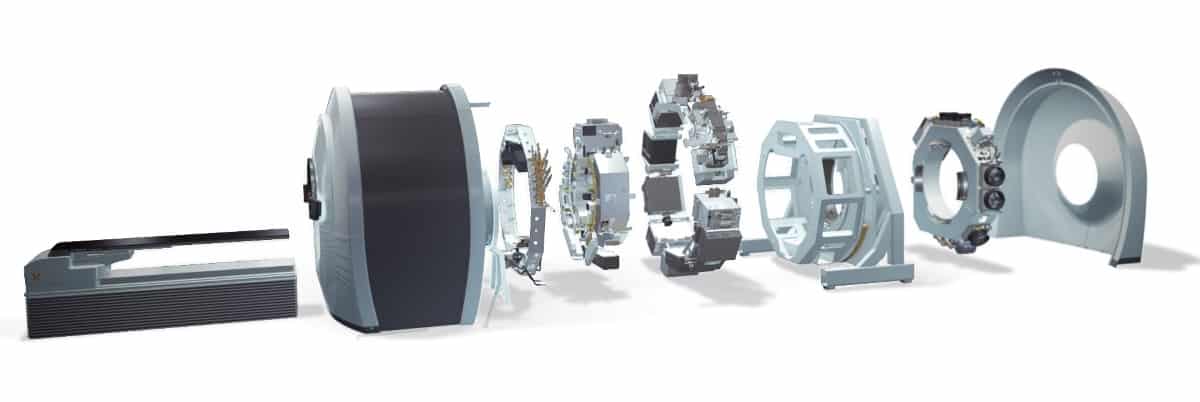
The prototype treatment system, developed by RefleXion Medical, combines a compact 6 MV linac and a 16-slice CT with a ring gantry and integrates a PET subsystem to provide real-time tumour tracking. With a continuous rotation speed of 60 rpm, the gantry has much faster rotation than a HT machine. Its 64-leaf multileaf collimator (MLC) transitions 100 times per second to enable synchronized alignment with the linac pulse frequency. The system’s couch remains in a fixed position during radiation delivery, with multiple gantry rotations performed at each couch position, and advances in 2.1 mm steps when the beam is off.

RefleXion biology-guided radiotherapy system

After reviewing the patients’ original HT treatment plans, the team created VMAT and IMRT plans. Principal investigator Chunhui Han generated all the prototype IMRT plans for the BgRT system, which were optimized multiple times to achieve optimal dose homogeneity to all planning target volumes (PTVs) while adequately sparing critical organs. The researchers then compared all treatment plans using dosimetric parameters to PTVs and organs-at-risk (OAR). They report their findings in Medical Dosimetry.

Han and colleagues report that plans for the three modalities had comparable dose coverage, mean dose and dose heterogeneity to the primary PTV. Six of the seven mean dose parameters examined for OARs were lower in the prototype IMRT plans than in the HT or VMAT plans. “The average left and right parotid mean doses in the prototype plans were 10.5 Gy (35.5%) and 10.4 Gy (34.9%) lower than those in the HT plans, respectively, and were 5.1 Gy (21.1%) and 5.2 Gy (21.1%) lower than those in the VMAT plans, respectively,” they write.

However, IMRT plans for the prototype BgRT system had higher dose heterogeneity to non-primary targets. Han tells Physics World that the clinical impact of this is subject to debate and may vary case by case. “Compared to dose increase in non-primary targets, reduction in dose to critical organs is typically more important and desirable,” he explains. “The increased dose to non-primary targets will be more of an issue if they overlap with some critical organs and the dose increase is affecting sparing of critical organs.”

Treatment times were longer on the BgRT system, taking an average of 11.4±1.2 min, compared with 8.3 min for HT and 3.4 min for VMAT. Han believes that this will have limited impact in routine clinical radiotherapy. “A patient typically receives a 3D imaging scan and image-guided positioning corrections prior to the start of treatment,” he points out. “Since this BgRT system has a dedicated kilovoltage CT system with a fast gantry rotation speed, the pre-treatment scan time is a factor of two to three shorter than the time for a MVCT scan of the same length on a helical tomotherapy unit.”

The researchers note that radiotherapy treatment planning for NPC presents unique challenges in plan optimization, because many critical organs are in proximity to target volumes. As such, NPC can serve as a benchmark to evaluate intensity-modulation capabilities of a delivery system. “Improvements in critical organ doses with the prototype plans could have significant clinical impact on patient quality-of-life, such as minimizing the risk of stimulated salivary production,” they write.

Han and colleagues have been investigating the prototype BgRT system for several years. They are currently conducting an ongoing pre-clinical study to explore its use in treating metastases at various sites. They are also performing a retrospective review of historical patient imaging data, including PET data, to evaluate the feasibility and clinical benefits of using the PET feature of the BgRT system.

Quantum cryptography network spans 4600 km in China

A network for quantum key distribution (QKD) spanning thousands of kilometres has been built in China. It links four quantum metropolitan area networks (QMANs) in cities in eastern China with a remote location in the far west of the country. The system comprises a 2000 km fibre optic link between the cities of Shanghai, Hefei, Jinan and Beijing and a satellite link spanning 2600 km between two observatories – one east of Beijing and the other just a few hundred kilometres from China’s border with Kazakhstan.

The network was built by Jian-Wei Pan at the University of Science and Technology of China in Hefei along with colleagues in academia and industry.

QKD uses the principles of quantum mechanics to allow two parties to share a secret cryptography key. A crucial feature of QKD is that the two parties can tell if an eavesdropper has intercepted the key while it is being shared. Once the secrecy of the key is established it can be used to exchange encrypted messages using a conventional telecoms network.

Quantum states of photons

In standard QKD implementations, information is encoded in the quantum states of photons – which are exchanged between the two parties. Photons are used because they can travel several hundred kilometres in optical fibres before their quantum information is lost. Photons can also carry quantum information between ground stations and satellites, allowing QKD to be performed between locations thousands of kilometres apart.

The Chinese network serves about 150 users and comprises more than 700 fibre links and two high-speed satellite-to-ground free-space links – all of which support QKD transmission. The fibre links are supported by 32 “trusted relay nodes” that are capable of forwarding quantum information. The individual QMANS contain trusted relay nodes as well as user nodes and optical switches. The Jinan QMAN is the largest, containing 50 user nodes supporting 95 users.

The satellite portion of the network makes use of the Micius quantum communications satellite, which was launched by China in 2016. Just one year later, Micius was used to make a QKD connection between Beijing and Vienna, which are separated by 7400 km.

To ensure that large numbers of users can access the network, its architecture involves five different layers. These are a quantum physical layer; quantum logical layer; classical physical layer; classical logic layer; and an application layer.

According to the University of Science and Technology of China, Pan and colleagues will further expand the network by working with partners in Austria, Italy, Russia and Canada. The team is also developing low-cost satellites and ground stations for QKD.

The network is described on Nature.

Processing natural language using quantum computers, listening to the oceans’ myriad sounds

Using computers to process natural human language is notoriously difficult, so perhaps its not surprising that researchers are turning to quantum computers. In this episode of the Physics World Weekly podcast, Bob Coecke of Cambridge Quantum Computing explains why natural language processing is “quantum native” – which makes it a perfect candidate for an early practical application of quantum computing.

Also in this episode, Ana Širovic – a marine biologist at Texas A&M University at Galveston – takes us on a sonic journey through the oceans, discussing the many sounds made by marine creatures. She also talks about the threats posed to nature by sounds related to human activity.

Coecke has recently published two preprints on quantum natural language processing on arXiv. They are “Foundations for near-term quantum natural language processing” and “Grammar-aware question-answering on quantum computers”.

Copyright © 2026 by IOP Publishing Ltd and individual contributors