Biology-guided radiotherapy system spares critical organs

A new, biology-guided radiotherapy (BgRT) system could improve radiation therapy by delivering high dose to the target tumour while avoiding critical organs, according to a study by a radiation oncology research team at the City of Hope National Medical Center. The team simulated intensity-modulated radiotherapy (IMRT) treatments of patients with nasopharyngeal carcinoma (NPC), comparing these plans with those for other IMRT delivery techniques at the hospital.

The researchers created treatment plans for the BgRT system and compared these with helical tomotherapy (HT) and volumetric modulated arc therapy (VMAT) plans for 10 NPC patients who had received prior treatment at the hospital. They hypothesized that the unique delivery pattern of the BgRT system could enable superior beam modulation, which could improve the therapeutic ratio by lowering dose to critical organs. They note that even without utilizing the PET-guidance capabilities of the new system, this type of treatment for NPC patients may offer benefits comparable to those of proton therapy, which is not available to all due to the limited number of proton therapy centres.

The prototype treatment system, developed by RefleXion Medical, combines a compact 6 MV linac and a 16-slice CT with a ring gantry and integrates a PET subsystem to provide real-time tumour tracking. With a continuous rotation speed of 60 rpm, the gantry has much faster rotation than a HT machine. Its 64-leaf multileaf collimator (MLC) transitions 100 times per second to enable synchronized alignment with the linac pulse frequency. The system’s couch remains in a fixed position during radiation delivery, with multiple gantry rotations performed at each couch position, and advances in 2.1 mm steps when the beam is off.
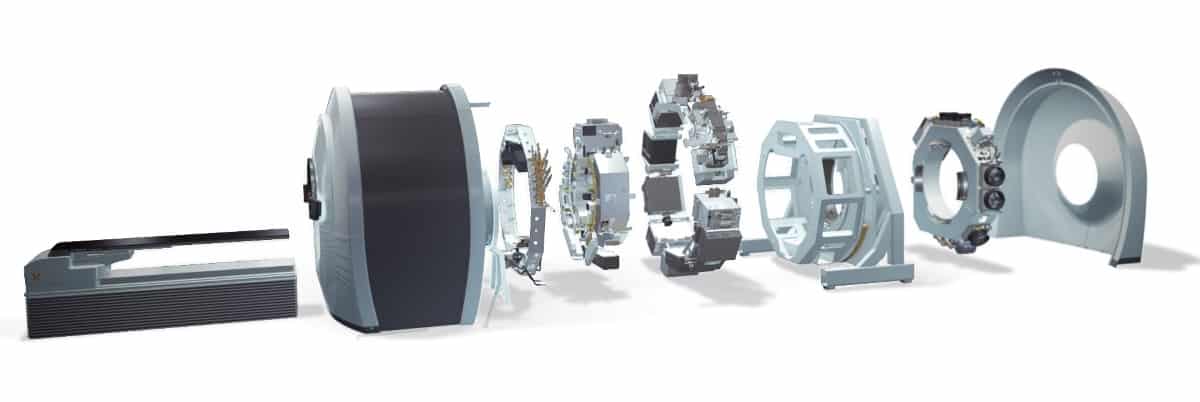
RefleXion biology-guided radiotherapy system

After reviewing the patients’ original HT treatment plans, the team created VMAT and IMRT plans. Principal investigator Chunhui Han generated all the prototype IMRT plans for the BgRT system, which were optimized multiple times to achieve optimal dose homogeneity to all planning target volumes (PTVs) while adequately sparing critical organs. The researchers then compared all treatment plans using dosimetric parameters to PTVs and organs-at-risk (OAR). They report their findings in Medical Dosimetry.

Han and colleagues report that plans for the three modalities had comparable dose coverage, mean dose and dose heterogeneity to the primary PTV. Six of the seven mean dose parameters examined for OARs were lower in the prototype IMRT plans than in the HT or VMAT plans. “The average left and right parotid mean doses in the prototype plans were 10.5 Gy (35.5%) and 10.4 Gy (34.9%) lower than those in the HT plans, respectively, and were 5.1 Gy (21.1%) and 5.2 Gy (21.1%) lower than those in the VMAT plans, respectively,” they write.

However, IMRT plans for the prototype BgRT system had higher dose heterogeneity to non-primary targets. Han tells Physics World that the clinical impact of this is subject to debate and may vary case by case. “Compared to dose increase in non-primary targets, reduction in dose to critical organs is typically more important and desirable,” he explains. “The increased dose to non-primary targets will be more of an issue if they overlap with some critical organs and the dose increase is affecting sparing of critical organs.”

Treatment times were longer on the BgRT system, taking an average of 11.4±1.2 min, compared with 8.3 min for HT and 3.4 min for VMAT. Han believes that this will have limited impact in routine clinical radiotherapy. “A patient typically receives a 3D imaging scan and image-guided positioning corrections prior to the start of treatment,” he points out. “Since this BgRT system has a dedicated kilovoltage CT system with a fast gantry rotation speed, the pre-treatment scan time is a factor of two to three shorter than the time for a MVCT scan of the same length on a helical tomotherapy unit.”

The researchers note that radiotherapy treatment planning for NPC presents unique challenges in plan optimization, because many critical organs are in proximity to target volumes. As such, NPC can serve as a benchmark to evaluate intensity-modulation capabilities of a delivery system. “Improvements in critical organ doses with the prototype plans could have significant clinical impact on patient quality-of-life, such as minimizing the risk of stimulated salivary production,” they write.

Han and colleagues have been investigating the prototype BgRT system for several years. They are currently conducting an ongoing pre-clinical study to explore its use in treating metastases at various sites. They are also performing a retrospective review of historical patient imaging data, including PET data, to evaluate the feasibility and clinical benefits of using the PET feature of the BgRT system.

Quantum cryptography network spans 4600 km in China

A network for quantum key distribution (QKD) spanning thousands of kilometres has been built in China. It links four quantum metropolitan area networks (QMANs) in cities in eastern China with a remote location in the far west of the country. The system comprises a 2000 km fibre optic link between the cities of Shanghai, Hefei, Jinan and Beijing and a satellite link spanning 2600 km between two observatories – one east of Beijing and the other just a few hundred kilometres from China’s border with Kazakhstan.

The network was built by Jian-Wei Pan at the University of Science and Technology of China in Hefei along with colleagues in academia and industry.

QKD uses the principles of quantum mechanics to allow two parties to share a secret cryptography key. A crucial feature of QKD is that the two parties can tell if an eavesdropper has intercepted the key while it is being shared. Once the secrecy of the key is established it can be used to exchange encrypted messages using a conventional telecoms network.

Quantum states of photons

In standard QKD implementations, information is encoded in the quantum states of photons – which are exchanged between the two parties. Photons are used because they can travel several hundred kilometres in optical fibres before their quantum information is lost. Photons can also carry quantum information between ground stations and satellites, allowing QKD to be performed between locations thousands of kilometres apart.

The Chinese network serves about 150 users and comprises more than 700 fibre links and two high-speed satellite-to-ground free-space links – all of which support QKD transmission. The fibre links are supported by 32 “trusted relay nodes” that are capable of forwarding quantum information. The individual QMANS contain trusted relay nodes as well as user nodes and optical switches. The Jinan QMAN is the largest, containing 50 user nodes supporting 95 users.

The satellite portion of the network makes use of the Micius quantum communications satellite, which was launched by China in 2016. Just one year later, Micius was used to make a QKD connection between Beijing and Vienna, which are separated by 7400 km.

To ensure that large numbers of users can access the network, its architecture involves five different layers. These are a quantum physical layer; quantum logical layer; classical physical layer; classical logic layer; and an application layer.

According to the University of Science and Technology of China, Pan and colleagues will further expand the network by working with partners in Austria, Italy, Russia and Canada. The team is also developing low-cost satellites and ground stations for QKD.

The network is described on Nature.

Processing natural language using quantum computers, listening to the oceans’ myriad sounds

Using computers to process natural human language is notoriously difficult, so perhaps its not surprising that researchers are turning to quantum computers. In this episode of the Physics World Weekly podcast, Bob Coecke of Cambridge Quantum Computing explains why natural language processing is “quantum native” – which makes it a perfect candidate for an early practical application of quantum computing.

Also in this episode, Ana Širovic – a marine biologist at Texas A&M University at Galveston – takes us on a sonic journey through the oceans, discussing the many sounds made by marine creatures. She also talks about the threats posed to nature by sounds related to human activity.

Coecke has recently published two preprints on quantum natural language processing on arXiv. They are “Foundations for near-term quantum natural language processing” and “Grammar-aware question-answering on quantum computers”.

Dutch physicist and Nobel laureate Martinus Veltman dies aged 89

The Dutch physicist Martinus Veltman, who won half of the 1999 Nobel Prize for Physics for his theoretical contributions to the Standard Model of particle physics, died on 4 January aged 89. In the 1960s and 1970s, Veltman’s work was instrumental in understanding the weak interaction in particle physics. Veltman shared half the prize with fellow Dutch physicist Gerardus ‘t Hooft, who had been Veltman’s PhD student.

Veltman was born on 27 June 1931 in Waalwijk, the Netherlands. He studied physics and mathematics at the Univeristy of Utrecht, in which he called the teaching “uninspiring” and began to do odd jobs including typing lecture notes as well as selling tools, which he later admitted he was a “complete failure” at. In 1955 Veltman joined the Van Der Waals laboratory at the University of Amsterdam becoming an assistant to Antonius Michels, which involved maintaining the library and preparing talks for Michels.

After two years of military service, Veltman began a PhD in 1959 at Utrecht under the guidance of Léon van Hove. During his doctorate, Veltman spent time at the CERN particle-physics lab near Geneva, which van Hove later served as director general in the late 1970s. Once Veltman’s completed his PhD in 1963, he spent a year at the SLAC National Accelerator Laboratory, which was then known as the Stanford Linear Accelerator Center before heading back to CERN. Veltman remained at CERN until 1966 before returning to Utrecht.

Tackling infinities

It was at Utrecht that Veltman carried out his Nobel-prize-winning work. In the 1960s, Sheldon Glashow, Adbus Salam and Steven Weinberg unified the weak and electromagnetic interaction and predicted the existence of the W and Z bosons, which carry the electroweak force. This theory, which later became known as the Salam-Weinberg theory, was, however, not taken seriously by many in the community because it seemed impossible to subject it to the usual “renomalisation” procedure. This meant it generated infinite and therefore meaningless expressions so it seemed impossible to perform accurate calculations with it.

In the early 1970s, Veltman and ‘t Hooft showed how to carry out this renormalisation and used their theory to make precise calculations of particle properties. These predictions were confirmed when the W and Z particles were detected for the first time in 1983 at the Large Electron-Positron Collider at CERN. This first led Glashow, Salam and Weinberg being awarded the 1979 Nobel Prize of Physics. When later precision calculations agreed with the experimental values of the W and Z boson, ‘t Hooft and Veltman bagged the 1999 Nobel prize “for elucidating the quantum structure of electroweak interactions in physics.”

In 1981 Veltman moved to the University of Michigan before retiring in 1996, when he moved back to the Netherlands.In 2003 Veltman published a popular-science book Facts and Mysteries in Particle Physics and regularly gave lectures on physics. He was also a regular guest at the annual Nobel Lindau Nobel Laureate meeting in Germany.

Relativistic quasiparticles tunnel through barrier with 100% transmission, verifying century-old prediction

A curious effect called “Klein tunnelling” has been observed for the first time in an experiment involving sound waves in a phononic crystal. As well as confirming the century-old prediction that relativistic particles (those travelling at speeds approaching the speed of light) can pass through an energy barrier with 100% transmission, the research done in China and the US could lead to better sonar and ultrasound imaging.

Quantum tunnelling refers to the ability of a particle to pass through a potential-energy barrier, despite having insufficient energy to cross if the system is described by classical physics. Tunnelling is a result of wave–particle duality in quantum mechanics, whereby the wave function of a particle extends into and beyond a barrier.

Normally, the probability that tunnelling will occur is less than 100% and decreases exponentially as the height and width of the barrier increase. However, in 1929 the Swedish physicist Oskar Klein calculated that an electron travelling at near the speed of light will tunnel through a barrier with 100% certainty – regardless of the height and width of the barrier.

Relativistic quasiparticles

Testing this remarkable prediction has proven difficult because of the challenges of accelerating electrons to the required velocity and creating an appropriate barrier for tunnelling. More recently, physicists have discovered that the collective behaviour of electrons in graphene creates massless quasiparticles moving at near to the speed of light. While some indirect features of Klein tunnelling have been seen in graphene, conclusive evidence for 100% transmission has remained elusive.

In this latest work, Xiang Zhang at the University of Hong Kong and colleagues have built an experimental system that uses sound waves to simulate the behaviour of relativistic quasiparticles in graphene. To do this the team created a barrier using two different 2D triangular lattices made from acrylic cylinders (see figure). Just as the 2D atomic lattice of graphene affects the behaviour of electrons in graphene, these phononic crystals affect the behaviour of sound waves – creating quasiparticle acoustic excitations that behave like relativistic electrons.

While the two phononic crystals had the same lattice constant (the separation between cylinders is 28 mm in both), they are each made of cylinders with different radii (12 mm and 7 mm). The tunnelling barrier was created by sandwiching a region of 7 mm lattice between two regions of 12::mm lattice. While the acoustic quasiparticles can move easily in the 12 mm regions, they encounter a potential barrier within the 7 mm region.

Near-perfect transmission

Quasiparticles were created by injecting sound waves into one side of the phononic crystal. Instead of only some of the quasiparticles tunnelling through the barrier, the team measured near 100% transmission. They then tested several systems with different barrier thicknesses and different potential barrier heights – the latter can be adjusted by changing the radii of the cylinders in the barrier lattice. As predicted by Klein, the near-perfect transmission was unaffected by changing these two parameters.

Klein tunnelling was observed for sound over a broad frequency range and the response of the system can be fine tuned by adjusting the size and spacing of the cylinders. As a result, Zhang and colleagues believe that their discovery could be used to boost the transmission of sound waves across interfaces. This could improve sonar systems used for exploring underwater regions and could also lead to the development of new medical ultrasound systems that are better able to see through obstacles within the body.

The research is described in Science.

Visualizing the treatment beam improves radiation therapy delivery

Cancer patients undergoing radiotherapy at Dartmouth-Hitchcock Medical Center are receiving added treatment scrutiny, via real-time monitoring of the radiation dose delivered during their treatments. This treatment verification is enabled by a Cherenkov imaging system, which provides real-time visualization of each radiation beam.

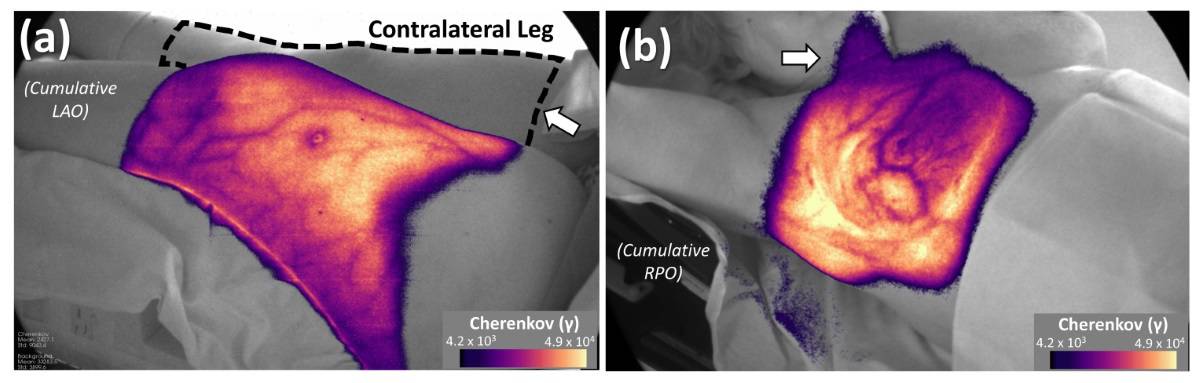
Cherenkov imaging is a novel technique that captures light emissions during radiotherapy. The Cherenkov effect occurs when photon or electron beams interact with tissue, generating light that shows the shape of the treatment beam on the skin’s surface. The intensity of this light is in proportion to the delivered dose. The BeamSite Cherenkov imaging system, developed by DoseOptics, uses time-gating technology to ensure that each linac pulse contributes to the image. Time-integrating software creates images that are overlaid in real time on the patient, providing surrogate maps of surface dose.

These dose maps can be used to visually verify treatment field delivery and patient positioning throughout each treatment fraction. This is not possible using standard quality assurance (QA) measures, according to the research team from the Geisel School of Medicine and Dartmouth Engineering, who developed, validated and commercialized the system.

The Dartmouth team, led by Lesley Jarvis, conducted a study examining the practical utility of Cherenkov imaging in clinical radiotherapy practice. The researchers evaluated the system in 64 patients who received radiotherapy at Dartmouth-Hitchcock’s Norris Cotton Cancer Center. Patients were treated for breast cancer (29), sarcoma/lymphomas (23) and other cancers, using techniques including 3D conformal radiotherapy, total skin electron therapy, arc therapy and total body irradiation. Jarvis and colleagues published their findings in the International Journal of Radiation Oncology, Biology, Physics.

Radiation therapists and radiation oncologists reviewed the Cherenkov images to determine information of clinical benefit and identify treatment incidents. They first noted that the images were useful to monitor the tumour target and adjacent anatomy to ensure appropriate treatment delivery.

To evaluate day-to-day patient positioning accuracy, the researchers evaluated 129 fractions of imaged treatments of 15 breast cancer patients, using the system’s automated image analysis software. The Cherenkov emissions qualitatively matched the expected surface dose distribution predicted by the treatment planning system. Analysing the delivery accuracy by calculating the mean distance to conformity (MDC) revealed that the inter-fraction MDC was within 7 mm compared with the first day of treatment.

To perform absolute dosimetry with Cherenkov imaging, the researchers applied scintillator discs to regions-of-interest (ROIs) on three patients. The system identified the scintillators in the image and converted the intensity to dose, based on known emission response of the scintillator.

Jarvis and colleagues identified six cases among the 64 patients in which Cherenkov images provided particularly beneficial information. This included identification of unintended dose to the contralateral breast, arm or chin in breast cancer treatments. In extremity sarcoma treatments, Cherenkov imaging confirmed that the contralateral leg did not inadvertently receive dose.

Cherenkov imaging

Cherenkov imaging also identified positioning issues, even though these patients had been set up using an optical positioning system that reported positioning within the set tolerance levels. The researchers explain that “typical ROIs for optical surface imaging systems are often focused on a small area and do not detect alignment issues outside of the ROI. This may have the consequence of giving the clinical team a false sense of security.”

In addition to real-time monitoring, Cherenkov images can also be used for post-treatment analysis of accuracy and/or dosimetry. This analysis can be automated for large-scale review of treatment repeatability. Such data can help identify a patient who may require different immobilization due to set-up difficulties.

“In this limited cohort, we found opportunities to improve treatment delivery for individual patients,” write the authors. “Of specific clinical importance, we show that Cherenkov imaging can detect stray radiation dose to tissues. Currently, there is no practical technique available to monitor contralateral breast dose or dose to other adjacent anatomy on a daily basis.”

Co-author Brian Pogue, co-founder and president of DoseOptics, tells Physics World that the research team is now planning a large, retrospective analysis of clinical data of patients receiving radiotherapy at Dartmouth-Hitchcock, to determine the incident rate detection and the value of Cherenkov imaging in daily monitoring of all treatments. He notes that Cherenkov imaging of all radiation oncology patients within the cancer centre began in the autumn of 2020. The BeamSite camera system received 510(k) clearance from the US Food and Drug Administration in December 2020.

“We will compare the value of incident detection at each of our two cancer centres. Only one uses surface guidance tools, so there may be interesting differences in daily patient alignment that Cherenkov imaging may better identify,” explains Pogue. “We are also investigating the ability to match lines between adjacent treatment fields, as well as quantifying absolute dose by using a calibration of the Cherenkov attenuation from a patient’s CT scan. We hope to implement this potentially for quantitative dose imaging.”

Why free will is beyond physics

Free will worries many physicists. It looks impossible to reconcile with a belief in deterministic physics, according to which events unfold as forces influence the trajectories of particles. In his new book Until the End of Time, the US theoretical physicist Brian Greene says that our choices only seem free because “we do not witness nature’s laws acting in their most fundamental guise; our senses do not reveal the operation of nature’s laws in the world of particles”. In his view, we might feel that we could have done otherwise in a particular situation, but, short of some unknown psychic force that can intervene in particle motions, physics says otherwise.

Greene, like many others who take this view, is upbeat about it: free will is a perfectly valid fiction when we’re telling the “higher-level story” of human behaviour. You can’t change anything that will happen, but you should merrily go on thinking and doing “as if” you can with all the attendant moral implications. Maybe this picture works for you; maybe it doesn’t. But in this view, you have no say about that either.

But is free will really undermined by the determinism of physical law? I think such arguments are not even wrong; they are simply misconceived. They don’t recognize how cause and effect work, and by attempting to claim too much jurisdiction for fundamental physics they are not really scientific but metaphysical.

Hubristic and absurd

In the late 4th century BCE, the Greek writer Epicurus tried to reconcile our apparent freedom to act with Democritus’s idea that the world is composed of atoms moving according to immutable laws. Epicurus supposed that predestiny is avoided because these particles sometimes execute a random change in motion – a “swerve”. If that doesn’t sound convincing now, modern arguments that try to save free will with physics are hardly any better. Classical chaos makes prediction of the future practically impossible, but it is still deterministic. And while quantum events are not deterministic – as far as we can currently tell – their apparently fundamental randomness can’t deliver willed action.

If the claim that we never truly make choices is correct, then psychology, sociology and all studies of human behaviour are verging on pseudoscience. Efforts to understand our conduct would be null and void because the real reasons lie in the Big Bang. Neuropsychology would be nothing more than the enumeration of correlations: this action tends to happen at the same time as this pattern of brain activity, but there is no causal relation. Game theory is meaningless as no player is choosing their action because of particular rules, preferences or circumstances of the game. These “sciences” would be no better than studies of the paranormal: wild-goose chases after illusory phenomena. History becomes merely a matter of inventing irrelevant stories about why certain events happened.

Perhaps that is the bitter truth. Why should we sacrifice physics just to save the face of other disciplines? But let’s consider the alternatives. Understanding decisions and behaviour through psychology allows us to form hypotheses and test them empirically. Some of these look as though they’re right: we can reliably predict what might make people change their behaviour, say. If, however, physics demolishes free will, this is just a peculiar coincidence. Forget all the “as if” gloss: reducing all behaviour to deterministic physics unfolding from the Big Bang offers us no genuine behavioural science at all, as it denies choice and puts nothing in its place that can help us understand and anticipate what we see in the world.

Surely, then, we have to choose one or the other? No, we can have both. It’s simply a matter of recognizing distinct domains of knowledge – of accepting that at certain levels of reductionism, some explanatory power vanishes while some is newly acquired. It is not because of the sheer overwhelming complexity of the calculations that we don’t attempt to use quantum chromodynamics to analyse the works of Dickens. It is because this would apply a theory beyond its applicable domain, so the attempt would fail. Greene presents the matter as a hierarchy of “nested stories”, each level supplying the underlying explanation of the next. But that’s the wrong image. To regard every form of human enquiry, from evolutionary theory to literary criticism, as a kind of renormalized physics is as hubristic as it is absurd.

“Chimpogenic” physics

The sceptical physicist might then ask: so where does this “free will” come from that enables events to turn out differently than they might have? In response, we should turn the question around: what exactly caused events to turn out as they did? The underlying problem here is that the reducibility of phenomena – which is surely valid and well supported – is taken to imply a reducibility of cause. But that doesn’t follow at all. What “caused” the existence of chimpanzees? If we truly believe causes are reducible, we must ultimately say: conditions in the Big Bang. But it’s not just that a “cause” worthy of the name would be hard to discern there; it is fundamentally absent.

To account for chimps, we need to consider the historical specifics of how the environment plus random genetic mutations steered the course of evolution. In a chimp, matter has been shaped by evolutionary principles – we might justifiably call them “forces” – that are causally autonomous, even though they arise from more fine-grained phenomena. To complain that such “forces” cannot magically direct the blind interactions between particles is to fundamentally misconstrue what causation means. The evolutionary explanation for chimps is not a higher-level explanation of an underlying “chimpogenic” physics – it is the proper explanation.

There is good reason to believe that causation can flow from the top down in complex systems – work by Erik Hoel of Tufts University in Massachusetts and others has shown as much. The condensed-matter physicist and Nobel laureate Philip Anderson anticipated such notions in his 1972 essay “More is different” (Science 177 393). “The ability to reduce everything to simple fundamental laws does not imply the ability to start from those laws and reconstruct the universe,” he wrote. “The behaviour of large and complex aggregates of elementary particles, it turns out, is not to be understood in terms of a simple extrapolation of the properties of a few particles. Instead, at each level of complexity entirely new properties appear, and the understanding of the new behaviours requires research which I think is as fundamental in its nature as any other.” Perhaps this is easier to accept for those working in condensed matter than in high-energy and “fundamental” physics.

Free will is not a putative physical phenomenon on which microphysics can pronounce

Free will, then, is not a putative physical phenomenon on which microphysics can pronounce – it is a psychological and neurological phenomenon. In truth, “free” is a deeply problematic term, and “will” is scarcely better – so neuroscientists and cognitive scientists often prefer to talk about volitional decision-making. Decisions are things that happen at the level of neural networks and they are made using the coarse-grained information available to sensory receptors and neurons. It makes no sense to regard them as interventions in particle interactions.

If we recognize, as we should, that the origins of volitional decision-making lie in evolutionary biology, we must accept that the entire mode of its operation – the way in which brains imbued with innate tendencies and learned information process low-resolution stimuli – doesn’t share an epistemic language with Newtonian and quantum mechanics. To talk about causation in science at all demands that we seek causes commensurate with the phenomena: that’s simply good science and good epistemology.

Long-standing disputes about free will and physical law, with their philosophical jargon of compatibilism and libertarianism, have not really advanced our understanding of the problem of determinism since Pierre-Simon Laplace supposed in the early 19th century that he could predict the entire future from total microscopic knowledge of the present. But this rather sterile debate can be and at last is being replaced with a “neuroscience of free will” that examines how brains, with their particular architectures and dispositions, arrive at decisions on the basis of past and present experience. That’s the way to pose worthwhile, testable questions about choice and behaviour.

Those who say that free will, and attendant moral responsibility, don’t exist but we should go on acting as if they do rather prove that their position is empty because it neither illuminates nor changes anything about how we do and should behave. The worry that free will must be salvaged somehow from physical determinism because otherwise responsibility for our actions will vanish is then revealed to be groundless. Moral responsibility is not a physical principle but a construct of human psychology and society. It expresses the view that we must strive to choose some behaviours and reject others. Some find that harder than others. Some can be encouraged to do so, perhaps by social sanctions. This is what we see in the world. To say that it only looks that way is to add nothing significant.

To claim that reality is not what you think it is, but that this can never be proved, is to speak metaphysically. Immanuel Kant was doing so when he postulated the Ding-an-sich – the “thing in itself” – that we can never access through our senses. It can be fun and stimulating to debate such things, but it is not science.

Radio telescopes could give us a new view of gravitational waves

The cosmic microwave background (CMB) is a rich source of information about the early universe, and now physicists in Switzerland and Germany reckon it could also serve as a detector of high-frequency gravitational waves, which are ripples in space–time. Indeed, the researchers have used pre-existing radio observations of the CMB to calculate new upper limits on the size of high-frequency primordial gravitational waves.

The best developed technique for detecting gravitational waves, and the one used to discover them in 2015, relies on interferometry. In LIGO and other observatories, laser beams are deflected between mirrors at the ends of long (several kilometres) evacuated pipes and then interfere with one another. When a gravitational wave travels through the Earth it causes tiny changes in the distance between the mirrors, which is observed as changes in how the light interferes.

The size of interferometers like LIGO makes them most sensitive to gravitational waves within a certain frequency band – from about 10 Hz to 10 kHz – meaning that much of the gravitational-wave spectrum remains unexplored. While the planned space-based LISA observatory will target lower frequencies in the millihertz range to detect waves from supermassive black holes, observations at megahertz, gigahertz or even higher frequencies could provide a window on exotic phenomena in the very young, hot universe. Detecting these high frequencies could also provide new insights into the fundamental constituents of nature, by allowing tests of the Standard Model of particle physics at energies beyond the most powerful particle colliders.

The Gertsenshtein effect

To observe these higher frequencies, physicists have investigated a range of alternative approaches. This latest effort relies on the Gertsenshtein effect, which involves gravitational waves converting into electromagnetic waves (or vice versa) in the presence of a magnetic field.

While other researchers have looked for this effect in the results of pre-existing terrestrial experiments, Valerie Domcke at the CERN laboratory in Geneva and Camilo Garcia Cely at DESY in Hamburg have come up with a way for detecting the effect at cosmic scales. The idea is to scrutinize the spectrum of the all-pervasive CMB, which was produced about 400,000 years after the Big Bang when electrons combined with protons to form neutral hydrogen. Whereas today’s leading cosmological model tells us that this spectrum should be that of a black body, significant cosmic conversion of gravitational to electromagnetic radiation at megahertz to gigahertz frequencies would instead raise the intensity of the CMB’s low frequency “tail”.

The researchers specifically looked for distortions in the CMB spectrum generated before the first stars formed and hydrogen started reionizing, some 150 million years or so after the universe came into being. During these “dark ages” there were few free electrons to scatter photons, so the probability of oscillations occurring between gravitational and electromagnetic waves was higher than it would otherwise have been.

EDGES and ARCADE2

To set new limits on the size of gravitational waves at high frequencies, Domcke and Garcia Cely analysed data from two radio telescopes designed to peer far back in time. One, EDGES, consists of two dipole antennas and a dish located in the desert of Western Australia. The other, ARCADE2, was a balloon experiment flown over Texas.

The researchers found they could indeed use the data to set new limits, although they did have to make an assumption about the strength of cosmic magnetic fields. With the fields set low, their results were less stringent than those from putative terrestrial oscillations – the maximum amplitudes at 78 MHz (EDGES) and 3-30 GHz (ARCADE2) coming in at one part in 1012 and 1014 respectively. But with the fields set high, those limits dropped to one part in 1021 and 1024 respectively, the latter being seven orders of magnitude lower than limits imposed by the most sensitive laboratory experiment.

Domcke and Garcia Cely argue that their new approach to gravitational-wave detection could improve substantially as radio telescopes become more sensitive – particularly as scientists develop new facilities to measure the 21 cm line in neutral hydrogen, which is central to studies of reionization. More sensitive telescopes would set tighter limits on primordial gravitational waves or could even reveal their existence.  They say that this radiation could in principle be produced by sources such as merging light black holes or from clouds of dark matter around spinning black holes.

They add that excess photons with frequencies below 10 GHz have been observed by both EDGES and ARCADE2. However, they point out that this excess would imply that gravitational waves have far more energy than that inferred from other cosmological observations. As a result, they say that astrophysical sources, “are a more likely explanation for the excess radiation observed”.

A paper describing the work has been accepted for publication in Physical Review Letters.

Cryomech makes its name as a problem-solver

The Gifford-McMahon Cryocooler may be synonymous with Cryomech, but the company’s legacy isn’t defined by product. It’s far more about problem-solving and the company’s consistent success doing so since it was founded in 1963

“We understand that in science and in emerging technologies, the customer’s approach to their research is unique and we have to always be prepared to come forward with a unique product or solution for that,” says Cryomech’s business-development manager Tabitha Sebastino.

“That’s something we’re immensely proud of: that we’re able to think so creatively, consistently and reliably when it comes to solving customer problems.”

We’re able to think so creatively, consistently and reliably when it comes to solving customer problems

Tabitha Sebastino

That consistent creativity drives the routine release of pioneering technology, from the legendary Pulse Tube Cryocooler to more recent solutions like laboratory-scale helium-recovery systems. This Cryomech quest for perfection spans all its products, from cryocoolers to cryostats.

“Today researchers are very much focused on their area of expertise and they’re expecting their scientific equipment to be more reliable and just a little bit more autonomous,” Sebastino adds. “The market demands confidence that a product works as promised out of the box, and for a very long time.”

New challenges

Cryomech hq lores

Cryomech evolves quickly, releasing new products almost annually. The company’s flexible nature also equipped it well for succeeding even amid a pandemic that brought production to a standstill at first.

“What Cryomech found was how to take the adaptive and quick-on-your-feet problem-solving mentality we use for product development, and shifted it to our business,” Sebastino says. “We adopted a multi-shift, seven-day-a-week operations model that not only allowed us to get our employees back to work faster in a safe and socially-distant environment, but it also allowed us to continue to fulfill customer orders. We were back shipping product again probably within two weeks of the shutdown.

“And then in September, we were able to take that manufacturing model and shift it into our new space,” she says.

That new Syracuse-based facility brings all Cryomech operations under one state-of-the-art roof. Because of unprecedented growth over the last decade or so, the old campus just a few blocks away ended up including multiple buildings. Some employees had never actually worked together.

“There’s been an interesting time of re-introduction to one another,” Sebastino says. “It leads to stronger collaboration. It also leads to stronger information and knowledge sharing which is at the foundation of what makes Cryomech great.”

That collaboration is essential at Cryomech, where they take an integrated approach to R&D.

“Our R&D process sits right next to our engineering and operations. It’s not something separate that develops in isolation that then presents products to the company, it’s a group that actually solves the company’s problems and the customer’s problems in real time,” Sebastino says. “If we can’t pull something off the shelf, that team springs into action to develop a solution for them.”

The sales and customer-service team asks a lot of questions of their cutting-edge customers. They have a deep bank of product options available and want to ensure the customer is provided the best solution for their application. If those established solutions don’t fit, R&D and engineering staff at Cryomech will look into providing a new configuration.

One example was when the company first commercialized the Pulse Tube Cryocooler in 1999, initially offering a heat lift – the amount of heat a cryocooler can remove at a certain temperature – of 0.5W@ 4.2K. It subsequently introduced a 0.75W, 1W, 1.5W and now a 2W version. Today, Cryomech offers the world’s largest selection of two-stage Pulse Tube Cryocoolers available anywhere.

Driving innovation

This air of creativity comes from all over the company. It’s by the design of the late Peter Gifford, the second-generation owner of the company who grew it from a niche operation to legitimate world leader over the course of 40 years.

“Peter took so much pride in taking people off the street right from here in Syracuse,” Sebastino says. “When you create the right environment, you can take just about anybody and really teach them the science and teach them what an important role they can play in the scientific community.

Peter Gifford

“We really live that model,” she says. “And the ability to collaborate and the ability to share information is at the foundation of it.”

Cryomech converted to an employee stock ownership plan (ESOP) before Gifford’s death in 2017.)

“Employee ownership really was Peter’s parting gift,” Sebastino says. “He knew he was leaving his company and leaving his technology in very good hands.

“So, in selling his company to the employees, he really passed the baton to us to take this company he created and move it forward into the future,” she says.

A seat at the table

With a healthy mix of direct-sale and original equipment manufacturers, Cryomech feels uniquely positioned heading into the future. As it continues to develop new products on a customer-by-customer basis, it also strives to serve its larger partners with higher volumes of equipment linked to emerging technologies like quantum computing, fusion and large-scale magnet systems.

“We always want Cryomech to be the name on people’s minds. When they have new technology that is being developed, we want to be at that table,” Sebastino says. “We want to be the people that are really enabling these pioneering technologies of the future.”

No matter where the future takes Cryomech, it will always enhance a legacy of problem-solving that’s been more than 55 years in the making. It’s this no-matter-what spirit that drives its workforce and ensures their seat at the proverbial table of emerging technology.

“Everybody gets a solution,” Sebastino says. “When we take on a challenge, we always deliver.”

Where many have gone before

As a consummate fan of televised science fiction, it was inevitable that the task of reviewing a book entitled Space 2069 would first bring to my mind the cult 1970s series of almost the same name (Space 1999). Having finished journalist David Whitehouse’s latest book – which bears the subtitle After Apollo – Back to The Moon, to Mars and Beyond – I found myself musing, however, on the opening narration of a quite different franchise. Space, as so many episodes of TV’s Star Trek have reminded us, is the final frontier; one in which we have unparalleled potential to go “where no-one has gone before”. In this reviewer’s opinion, the same, alas, can no longer be said of publishing on the subject. When it comes to writing about our past and future exploration of the solar system in particular, the pioneer days are over, the wagon trains have arrived en masse, and to stand out on the now crowded shelves, newcomers really need to show they have access to an untapped motherlode.

It is for this reason, I think, that I found myself – while not disappointed – generally unaffected by Whitehouse’s serviceable new offering, a sequel to his widely acclaimed bestseller, Apollo 11: the Inside Story. As the US renews its interest in picking up crewed lunar exploration where the Apollo programme left off, and China continues to build the steady momentum of its own space programme, Whitehouse knowledgeably (if predictably) imagines our next 50-ish years of humans travelling back to the Moon; on to the red planet; and beyond. The book alternates between imagining the voyages of future space missions, and an encyclopaedic account of the past missions that will eventually make such journeys possible.

The book includes a number of fun titbits. For example, I was relieved to hear that coffee and hops would grow well on Mars, and was intrigued by the notion that the Moon could be used to house a backup seed bank and master library, in the event the Earth is struck by a global cataclysm. I was also amused to learn that astronauts refer to the impact of low gravity as “puffy face, bird legs”.

But some other areas were missed possibilities for engaging tangents, and left me wanting more. For example, I was keen to hear details about the “mutiny” of the Apollo 7 crew – surely it did not just involve “talking back” to ground control, as suggested? And I wanted a real discussion of the experiments that have been conducted into the psychological impacts of a simulated Mars voyage. Whitehouse mentions the longest such test – Russia’s 520-day-long Mars500 – but neglects the more captivating Sphinx-99 mission, whose chaos peaked with a fist fight and one “astronaut” locking herself away from most of the rest of the crew out of sheer frustration.

Whitehouse certainly has a formidable command of the history of space exploration, but in parts Space 2069 lets its overarching narrative slip into obscurity, behind the intense recitation of historical particulars. The most prominent example comes early on in the work, in a chapter that opens with the observation that, unlike the Earth, the geography of the Moon is unfamiliar. “At the time of Apollo many offices and children’s bedrooms had a poster of the Moon. They are seldom seen now,” Whitehouse writes, adding that “the names of the major craters and ‘seas’ are a mystery to many”.

As if to prove this point, the following 11 pages take the reader on a journey across the lunar landscape, from one such unheard-of locale to the next. With, perhaps, the aid of a map and plenty of pictures, this gambit might have worked well to engage the reader with the Moon’s alien geographies. Instead, the frenetic array of lunar placenames – Langregous, Medii, Aristarchus, Riccioli, Morteus and so on  – is overwhelming and self-defeating without visuals to help. In a similar vein, a later chapter called “22 images” is curious in showing exactly none.

In contrast, the more futurist sections of the work suffer from almost the opposite problem. The voyages of such imagined craft as the James Caird II – the first crewed vessel to orbit Mars in 2039 – are engaging (to the extent that the book could easily have been hung on such pegs alone) but would have benefited from more explanation as to the research grounding such narratives.

Space 2069 is rich, topical and informative. But so are the three other books on the same topic on my bookshelves

I should confess that a small portion of my mild disaffection with Space 2069 began even before the book’s preface, and manifests from how Whitehouse chooses to present himself in the acknowledgement’s section: as someone with personal relationships with Arthur C Clarke, Carl Sagan and Patrick Moore. Perhaps this was meant to establish his credentials, but for me, this name-dropping was ostentatious and unrelatable. I should prefer to have been informed of his background in astrophysics (a fact that I do not recall being mentioned at any point in the work) or instead introduced to his personality and humour as a writer.

This returns me to my opening point. Space 2069 is a perfectly agreeable book. It is rich, topical and informative. But so are the three other books on the same topic on my bookshelves. Without that special something – whether it be a fresh perspective, an unexpected framing device, or a particularly compelling or accessible authorial voice – there is little to commend one over the others.

  • 2020 Icon Books £16.99hb 304pp
Copyright © 2026 by IOP Publishing Ltd and individual contributors