The COVID-19 pandemic has shed light on the global need for inexpensive, simple-to-use pathogen tests accessible to individuals on a daily basis to move beyond point-of-care diagnostics in favour of methods even more readily available to all people.
We have developed a low-cost disposable electronic sensor for use by individuals with minimal training and simple equipment for detection of multiple pathogens in easily accessible biological samples, such as saliva. The devices were fabricated using scalable processes with potential for economical mass production to utilize the sensitivity and surface chemistry of a two-dimensional MoS2 transducer for attachment of antibody fragments in a conformation favourable for antigen binding. Ultra-thin layers (3 nm) of amorphous MoS2 were directly sputtered over the entire sensor chip at room temperature and laser annealed to create an array of semiconducting 2H-MoS2 active sensor regions between metal contacts.
The semiconducting region was functionalized with monoclonal antibody Fab (fragment antigen binding) fragments derived from whole antibodies complementary to either SARS-CoV-2 S1 spike protein or Influenza A hemagglutinin. The high affinity of the antibody fragment base for the MoS2 transducer surface with some density of sulfur vacancies promoted antibody fragment chemisorption with antigen binding regions oriented for interaction with the sample. Electrical resistance measurements of sensors functionalized with antibody fragments and exposed to antigen concentrations ranging from 2–20,000 picograms per millilitre revealed selective responses in the presence of complementary antigens comparable to gold-standard diagnostics such as PCR analysis.
Christopher Muratore is the Ohio Research Scholars Endowed Chair Professor in the Chemical and Materials Engineering Department at the University of Dayton, Ohio. Prior to joining the university, Christopher spent nine years as a staff member at the Air Force Research Laboratory and still works closely with sensor development and flexible electronics groups there. Throughout his 20-year research career, Christopher’s work has focused on developing an understanding of how to control structure and properties of surfaces and interfaces in addition to their impact on device or component performance in diverse applications. He has four patents, has published more than 90 peer-reviewed articles and has served as guest editor for Surface and Coatings Technology and Thin Solid Films over the past five years.
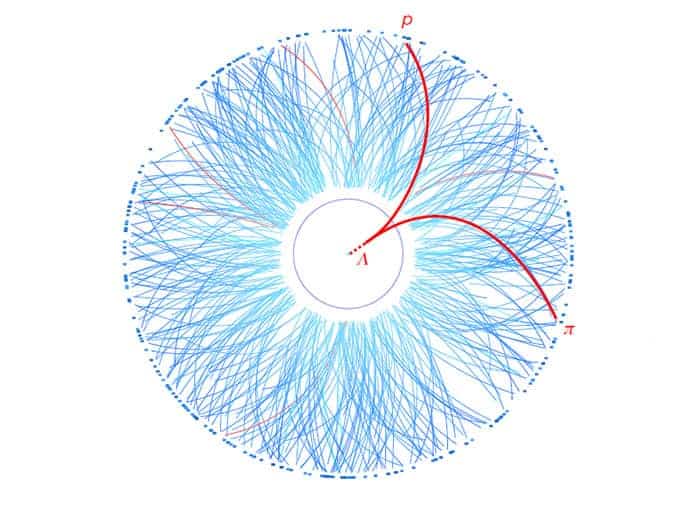
Collisions between high-energy protons at the Large Hadron Collider (LHC) at CERN have given physicists a first glimpse at interactions involving exotic particles called hyperons. Researchers working on the ALICE experiment on the LHC looked at how hyperons – which are baryons containing at least one strange quark – interact with protons via the strong force. Their results are an important step forward in our understanding of the strong force and could also provide insights into the incredibly dense matter within neutron stars.
Hadrons, including protons and neutrons, are particles comprising two or more quarks that are held together by the strong force. Interactions between hadrons are also moderated by the strong force – and most of our limited knowledge of how hadrons interact with each other comes from experimental studies involving protons and neutrons. Because of the nature of the strong force, these interactions are extremely difficult to predict theoretically – and gaining a better understanding of how hadrons interact is referred to as the “last frontier” of the Standard Model of particle physics.
Protons, neutrons and hyperons are all baryons that contain three quarks. While protons and neutrons comprise only up and down quarks, hyperons contain at least one strange quark. Therefore, studying how hyperons interact provides new insights into the strong force.
Hadron “sources”
In their study, the ALICE team looked at high-energy collisions between protons, which create “sources” of particles in the space surrounding the collision site. Here, quarks and gluons interact with each other to create new particles. Pairs of hyperons and protons are produced in sources before leaving and being detected by ALICE. By measuring correlations between the momenta of the proton and hyperon in a detected pair, physicists can glean important information about how they interacted when close together in the source.
In such high-energy conditions, these interactions can be predicted to a limited extent by modelling the behaviour of quarks and gluons on a discrete spacetime lattice. As the team hoped, these predictions almost perfectly matched up with their measurements.
As well as providing important insight into how hadrons interact, the study could also boost our understanding of neutron stars. That is because astrophysicists believe that hyperons could exist in the extremely dense cores of these objects. Further studies of hyperon interactions at ALICE – as well as future facilities in Russia, Japan and Germany, could lead to a better understanding of the physical processes underlying neutron stars and also neutron-star mergers.
The Centers for Medicare and Medicaid Services (CMS) is betting on revolution rather than evolution as it gears up to rewrite the reimbursement rulebook for radiation oncology providers in the US. Starting 1 July 2021, the Radiation Oncology Alternative Payment Model (RO-APM) will enable CMS to gather evidence – at scale – on an all-new “financial infrastructure” for radiation oncology services in the US – and crucially whether an alternative payment structure preserves or enhances the quality of care for cancer patients while reducing annual Medicare expenditures.
The RO-APM trial, which runs through to the end of 2025, is an ambitious and broad-scope undertaking, with participation mandatory for selected institutions. Under the model, CMS will reimburse participating facilities using an episode-based (i.e. bundled) payment scheme, with the trial cohort comprising approximately 950 US physician group practices (PGPs), hospital outpatient departments and free-standing radiation therapy centers from randomly chosen zip codes.
In this way, reimbursement is matched to a patient’s cancer diagnosis and covers radiotherapy services furnished in a 90-day “episode” for the 16 cancer types meeting the RO-APM criteria – a significant departure from the current fee-for-service model for radiation oncology in which the bulk of compensation is linked to treatment modality and the number of radiotherapy fractions.
No time to lose
If that’s the long-run regulatory and financial context, the operational implications for radiation oncology providers are already front-and-center – or at least they should be. “The clock is ticking down to the RO-APM, so burying your head in the sand is not a credible plan,” cautions Shawn Prince, senior director of patient access at US radiotherapy equipment vendor Accuray.
Shawn Prince: “Efficiency, efficiency, efficiency – that’s the name of the game in the RO-APM.” (Courtesy: Accuray)
In other words, it’s vital that radiation oncology clinics make the most of the next six months to prepare fully for the introduction of the RO-APM. “If the care providers don’t come to grips with the details of the new model – the nuances of the billing and coding requirements, for example – there’s a real risk they’ll leave significant amounts of money on the table,” Prince adds.
With this in mind, the patient access team at Accuray has put together a dedicated RO-APM project management tool with phased action plans for all members of the cross-disciplinary radiation oncology team, while also highlighting the pivotal role of oncology information systems and electronic health records in supporting the transition. That core reference document is backed up by sustained community engagement and education – for example, the recent Physics World webinar Medicare Radiation Oncology Alternative Payment Model: What You Need To Know.
“We have specialist resources and deep domain knowledge at Accuray that will help our customers better prepare for the RO-APM,” says Prince. What’s more, that knowledge-share extends to prospective customers. “Our radiotherapy solution is unique and aligns well with the RO-APM framework, where payment is based on diagnosis rather than the treatment modality,” Prince adds. “If you’re a clinic that is considering adding or replacing linear accelerators, we’re keen to talk further about how Accuray products can support your program within the RO-APM.”
The new rules of radiation oncology
At the clinical sharp-end, meanwhile, the day-to-day aspects of the RO-APM will, for the most part, be managed by a mix of clinicians, the nursing team, radiation therapists, as well as staff in billing and administration functions. More broadly, the all-inclusive payment that participating care providers will now receive (in place of fee-for-service) means that workflow efficiency will become a defining mantra – and the only way for clinics to succeed financially in the long term. “Under the RO-APM, the focus is going to shift decisively towards the total cost of delivering care,” says Prince. “The more efficient your radiotherapy program, the better the financial experience you will have.”
Expect greater emphasis, for sure, on the latest time-driven activity-based costing (TDABC) models. These tools enable radiation oncology providers to build a macro picture of capital expenditure (e.g. the cost of their linacs, imaging systems, software, QA tools and related medical supplies) and operational costs (e.g. staff salaries, service contracts and the like). From here, it’s a short step to drill down to a more granular view of per-patient cost-of-care and workflow efficiency for different treatment modalities – i.e. intensity-modulated radiation therapy (IMRT) versus volumetric modulated-arc therapy (VMAT) versus proton-beam therapy versus hypofractionated procedures such as stereotactic radiosurgery (SRS) and stereotactic body radiotherapy (SBRT).
Clinical outcomes being equivalent, the direction of travel within the RO-APM points towards radiotherapy modalities that deliver improved patient experience, increased patient throughput and reduced cost of care. All of which appears to sit well with Accuray’s emphasis on hypofractionated and ultrahypofractionated radiotherapy schemes – increasing the dose per fraction to enable significantly fewer overall treatments. A case in point is Accuray’s Radixact Treatment Delivery System, a helical radiotherapy platform that employs a continuously rotating gantry and unique dynamic collimation system to enable highly conformal dose delivery to diverse tumour sites throughout the body.
Radixact has recently been upgraded to incorporate motion-tracking and correction algorithms (collectively known as Synchrony) from Accuray’s flagship CyberKnife Treatment Delivery System, a robotic radiotherapy platform widely deployed in treating a range of disease indications using SRS and SBRT. This enhanced capability means that the Radixact System with Synchrony is now able to track and synchronize the delivery beam to the target position as the tumour moves. In effect, dose is delivered continuously to the moving tumour target – with the accuracy and precision required for hypofractionated radiotherapy (i.e. tight margins and steep dose gradients) as well as for standard radiotherapy procedures.
“Efficiency, efficiency, efficiency – that’s the name of the game in the RO-APM,” notes Prince. “That’s good news for radiotherapy systems like Radixact which enable clinics to rapidly scale their patient throughput on an annualized basis.”
Hypofractionate to accumulate
The RO-APM trial will run through to December 2025. If, after that time, significant cost savings accrue for CMS – as seems likely – it’s inevitable that other US healthcare payers will also migrate away from the current fee-for-service model in radiation oncology to a bundled payment scheme. “In my view,” says Prince, “the RO-APM will ultimately fast-track adoption of hyprofractionated and ultrahypofractionated radiotherapy, yielding enhanced efficiencies across the radiation oncology ecosystem – at the machine-level and right through to regional and nationwide healthcare systems.”
For now, though, Accuray remains focused on the near-term operational challenge of getting its customers up to speed for the launch of the RO-APM next summer. “Our specialist training and support on the RO-APM adds a lot of value,” Prince concludes. “The calculus is simple: if your radiation oncology program is successful, Accuray is successful.”
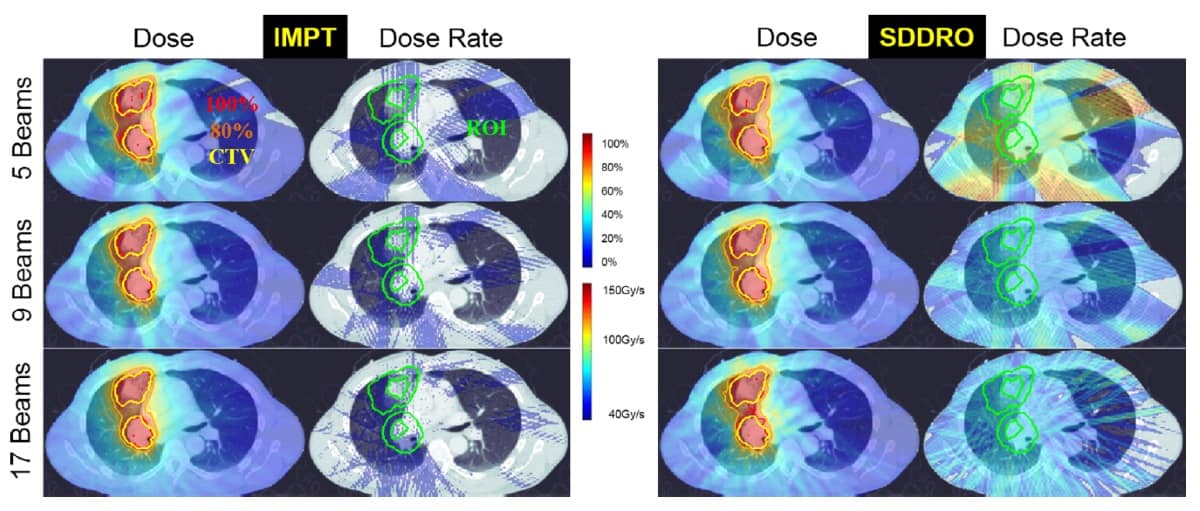
Dose and dose-rate distributions produced for multiple treatment beams using (left) intensity-modulated proton therapy and (right) simultaneous dose and dose-rate optimization (SSDRO) for a 10 Gy fraction. The plan quality was best for the SDDRO method using nine beams. (Courtesy: Med. Phys. 10.1002/mp.14531)
The primary goal of radiotherapy is to deliver a large radiation dose to cancer cells whilst sparing surrounding healthy tissue. Recent developments have shown that through delivery of ultrahigh dose rates to cancerous tissue, a technique known as FLASH radiotherapy, healthy tissue toxicity can be reduced, thereby improving the therapeutic ratio.
One approach for delivering the ultrahigh dose rates required for FLASH is to use proton therapy. As protons traverse through tissue, they deposit the majority of their energy at the end of their range. By ensuring maximum dose delivery within a confined volume, the combination of proton therapy and FLASH could improve the therapeutic ratio further.
Prior to treatment delivery, rigorous computational processes within the treatment planning system (TPS) help to determine the optimal plan. This optimization process also considers how to divide the total dose into multiple treatment fractions – known as hyperfractionation.
Currently TPS optimization algorithms only optimize the dose without consideration of the dose rate. However, the delivered dose rate has a significant impact on the efficacy of FLASH radiotherapy. To address this, Hao Gao and colleagues at Winship Cancer Institute of Emory University and Shandong University have developed a method for simultaneous dose and dose-rate optimization (SDDRO).
Dose-rate optimization
Gao and his team investigated the impact on plan quality when considering only dose optimization and when using SDDRO. They compared the dose and dose-rate distributions produced by SDDRO with traditional intensity-modulated proton therapy (IMPT) plans (with dose optimization only) for three lung cancer patients. They considered treatments delivered using one, three, five, nine and 17 beams, with fraction prescription doses of 2, 6 and 10 Gy.
The SDDRO method incorporates the usual dose constraints to the target volume and organs-at-risk (OAR). Additional dose-rate constraints are enforced, similarly to the dose constraints, in the region-of-interest (ROI). The ROI is selected as a ring-like expansion around the clinical target volume (CTV). The dose-rate constraints ensure that a large percentage of the ROI receives the desired FLASH dose rate (40 Gy/s or more).
Improved dose-rate coverage
In comparison to dose and dose-rate distributions produced by IMPT planning, SDDRO displayed significant improvements in the FLASH dose-rate coverage. The dose-rate constraint, where 98% of the ROI should receive the desired dose rate, was satisfied for all SDDRO plans in all cases. When multiple treatment beams were considered during optimization, the overall plan quality was improved, in terms of both dose and dose-rate distributions.
The best FLASH dose-rate coverage was obtained when planning treatments with nine beams and 10 Gy fractions. This suggests that the plan quality of SSDRO could be improved further by increasing the dose delivered per fraction – an approach known as hypofractionation.
The researchers also showed that the dose distributions produced with and without dose-rate optimization had comparable CTV coverage. Gao believes that “SDDRO can substantially improve the FLASH dose-rate coverage compared to IMPT for the purpose of normal tissue sparing while preserving the dose distribution”.
Future implementation of SDDRO
The ability of the proposed SDDRO method to handle dose-rate constraints is clear. For future implementation of this method, Gao suggests that “the dose rate–volume constraints should be prescribed in the similar fashion as the dose–volume constraints”.
While the authors acknowledge that implementation of the SDDRO method requires further development, they believe that this method may in the future become routine for FLASH treatment planning. “Unlike dose–volume constraints, for which various quantitative metrics have been established corresponding to clinical endpoints, the dose rate–volume constraints are new, for which the quantitative metrics are to be established,” says Gao.
When water vapour spontaneously condenses inside capillaries just 1 nm across, it behaves according to the 150-year-old Kelvin equation – defying predictions that this pre-quantum-era formula would inevitably break down at the atomic scale. This is the finding of researchers at the University of Manchester, who showed that the equation remains valid even for capillaries that can accommodate only a single layer of water molecules.
Condensation inside capillaries is ubiquitous in nature, and many physical processes – including friction, stiction, lubrication and corrosion – are affected by it. The Kelvin equation, which relates the surface tension of water to its temperature and the diameter of its meniscus (among other parameters), predicts that if the ambient humidity is between 30–50%, then flat capillaries less than 1.5 nm high will spontaneously fill with water vapour that condenses from the air.
In the real world, though, capillaries can be even smaller than this. At this scale, it becomes impossible to define the curvature of a liquid’s meniscus – meaning that the Kelvin equation should no longer hold. However, because such tight confinement is difficult to recreate in the laboratory, researchers have been unable to test this hypothesis until now.
Smallest capillary possible
The Manchester team led by Andre Geim and Qian Yang created their ultra-tiny capillaries by meticulously sandwiching strips of graphene (a two-dimensional sheet of carbon) between atomically flat crystals of mica or graphite using a process called van der Waals assembly. The graphene strips act as spacers and their thickness can be varied, allowing for capillaries of varying heights. Some are just one atom high, which Geim explains is the smallest capillary possible, allowing only a single layer of water molecules to pass through.
Using atomic force microscopy (AFM), Geim, Yang and colleagues imaged the capillaries as they filled with water. These data showed that capillary condensation follows the Kelvin equation even in these tiny structures. “The result came as big surprise,” Yang says. “We expected a complete breakdown of the equation since the properties of water change at this scale, with its structure becoming distinctly discrete and layered.”
Why no breakdown?
At the atomic scale, Yang explains that researchers rewrite the Kelvin equation in terms of how water molecules in both gas and liquid phases interact with solid surfaces (such as capillary walls). In this form, macroscopic quantities such as the contact angle of water with the capillary wall, the surface tension of water and its meniscus curvature all disappear from the equation, which then remains valid as long as the energy of the water-surface interactions does not notably change.
“In practice, however, the condition breaks at about four to five layers of confined water (which are less than 2 nm thick in total),” she tells Physics World. “Under stronger confinement still, the water structure strongly changes, and the interaction energies (primarily the liquid water-surface energy) inevitably change.” In this regime, the Kelvin equation should obviously fail — mainly because huge oscillations in the relative humidity at which condensation occurs are expected due to the aforementioned layered structure of water.
What the Manchester team found, though, is that these oscillations are strongly suppressed by the elasticity of the capillary walls. Although these walls adjust their position by less than 0.1 nm in response to the high pressures (of up to 1000 bars) present during capillary condensation under ambient humidity, Yang says that this miniscule adjustment is enough to snugly accommodate only an integer number of water-molecule layers. As a result, she concludes, “the Kelvin equation remains valid down to a monolayer of confined water”.
Full details of the research are described in Nature.
“Big data” has been a buzzword in scientific research for some time, but this week saw it applied to a longstanding puzzle in music history. The puzzle concerns metronomes, which are devices that make an audible click at regular intervals (traditionally set by the position of a weight on a pendulum) and are used by musicians to practice their timing.
The first such device was patented in 1815, and the great composer Ludwig van Beethoven (1770–1827) was quick to adopt it. The scores of many of his works use metronome markings to indicate how quickly he wanted the piece to be played, and he even attributed the success of his ninth symphony (with its famous “Ode to Joy” chorus in the final movement) to these new-fangled tempo instructions.
There’s just one problem: to most musicians, Beethoven’s metronome markings seem far too fast. And while tastes and tempi vary over time (not to mention between individual conductors), some of Beethoven’s instructions border on the unplayable. For example, the composer’s Op. 106 (the Hammerklavier sonata) starts out at 138 beats per minute for the half note – a value that physics student Almudena Martin-Castro and data scientist Iñaki Ukar describe as “decidedly unfeasible” in their recent paper on the subject.
Over the past 200 years, music scholars have put forward many potential explanations for this discrepancy. One of the most intriguing is that Beethoven’s metronome might have been badly made, incorrectly marked, or both – a distinct possibility given the vagaries of early 19th-century manufacturing.
To investigate this hypothesis, Martin-Castro and Ukar, who are both at the Universidad Carlos III de Madrid and UNED in Spain, began by using big data techniques to analyse 36 recordings of each movement of Beethoven’s symphonies, as interpreted by 36 different conductors. After analysing all 169 hours of music, they found that even conductors who profess a devotion to Beethoven’s original instructions consistently play the music slower than the composer’s marks indicate.
Next, Martin-Castro and Ukar developed a mathematical model of Beethoven’s metronome. This model was based on a double pendulum, and incorporated corrections for the amplitude of the pendulum’s oscillation, the friction of its mechanism, the impulse force, and the mass of its rod (an aspect that had not been considered in previous work). Using this model, they explored ways in which the metronome might have been faulty. Had part of the weight been broken off – perhaps by being hurled across the room by the famously irascible composer? Had the friction of the pendulum increased through poor lubrication? Or was the device tilted, leaning over the piano as Beethoven was composing his music?
While none of these hypotheses produced a homogeneous slowdown in tempi, the researchers eventually found one that did. It turns out that the deviation in written and played tempos exactly matched the diameter of the metronome’s weight, which suggests that Beethoven was mistakenly reading the wrong side of the scale. “We also found the annotation ‘108 or 120’ on the first page of the manuscript for his ninth symphony, which indicates that the composer doubted where he was reading at least once,” the researchers explain. “Suddenly, it all made sense: Beethoven was able to write down a lot of these marks by reading the tempo in the wrong place.”
Name that code
We love a good scientific acronym here at Physics World, and this week turned up a classic. While doing his PhD at the University of California Riverside in the US, astronomer Remington Sexton developed code to fit the spectra of active galactic nuclei (AGN) obtained via the Sloan Digital Sky Survey (SDSS). Because the code uses a method known as Bayesian decomposition analysis, it was entirely logical for Sexton to call it Bayesian AGN Decomposition Analysis for SDSS Spectra, or BADASS. Thoughtfully, Sexton has made his BADASS code free and open source, so anyone who wants to do some BADASS astronomy research with it can go and download it themselves. Now that’s a badass move.
Online success: Cebo Ngwetsheni, a PhD student from the University of the Western Cape, receives an award at the 10th anniversary “Tastes of nuclear physics” conference for a paper in Physics Letters B (Courtesy: David Jenkins)
We all remember the pictures of the famous Solvay conferences in the 1910s and 1920s, where the foundations of the “new physics” and quantum mechanics were discussed. A group of distinguished, wing-collared and moustachioed Edwardian gentlemen admits a single interloper in the form of Marie Curie. It was all a very different age.
But are our present-day conferences really more diverse? At first glance, they seem to be, as advisory committees challenge themselves to support diversity and gender inclusion.
However, we often choose to ignore the barriers to involvement of participants: those whose family situation does not allow them to travel, those who are uncomfortable to travel because of hostility to difference in the host country particularly attitudes to gender, race, homosexuality or disability.
A bigger issue still is the difficulty in including those who don’t have the resources to travel. Some conferences offer bursaries but nowhere near the levels needed to include large numbers of participants from developing countries.
If 2020 has taught us anything, it’s that our ability to communicate across the planet and talk “face-to-face” is limited only by our internet bandwidth.
We exacerbate this issue by holding conferences at which the main event is, in practice, a skiing holiday, or beach holiday, or safari excursion with conference talks pushed to the margins to facilitate freeing up the day for leisure. Many see their involvement in such conferences as “a perk of the job”.
If 2020 has taught us anything, it’s that our ability to communicate across the planet and talk “face-to-face” is limited only by our internet bandwidth. Recently, I was privileged to be part of an online conference that promises to change how we view such events forever.
Entitled “Tastes of nuclear physics”, it is one that I have supported for some years. It began 10 years ago at the University of Western Cape (UWC) – a historically-disadvantaged university in South Africa.
Its driving force is Nico Orce, who initially devised the “Tastes of nuclear physics” as a way of bringing foreign visitors to UWC to teach students on their MaNuS (Masters of nuclear science) programme about nuclear physics in a “summer school” format.
Since then, the event has grown and grown. Last year, it travelled 2000 km to the University of Zululand and hundreds of undergraduate students there also attended and heard speakers not only on the state-of-the-art but inspiring speakers who talked about their own careers and surmounting the challenges they had felt growing up in South Africa.
This year, we had to go online but we made it our mission to include any young people working in nuclear physics wherever they were in the world.
I feel it is no exaggeration to say that this year’s tenth anniversary “Tastes” on-line on Zoom was a historic event. The technology actually worked: the first speaker was in Australia, the chair was in the UK and the first question came from a scientist in India.
The sessions were punctuated with videos of the UWC choir singing that made you want to get up from the Zoom slump and jig about.
Students from all over the world joined including from Lebanon, India and, of course, South Africa. They asked questions and interacted with the speakers in virtual coffee breaks. We also recorded the lectures and rebroadcast them on YouTube for those with poor internet connections.
The diversity of the participants and speakers was impressive. We had talks from South African scientists on their own work in nuclear physics, the application of nuclear-physics technology to improving diamond mining, and again, saw role models speak about their careers.
The sessions were punctuated with videos of the UWC choir singing and renditions of “Gimme hope Jo’anna” and other music that made you want to get up from the Zoom slump and jig about.
Parts of the conference were moving and inspirational, particularly the “Women in science” session and the award of prizes from sponsors to some MaNuS students for publications they had lead.
We heard, for example, of one student, an orphan, whose sister had sat selling vegetables on the side of the road to pay for his university studies. I was left feeling at the end of the conference, as I have at many points in this turbulent year, that some things had significantly changed.
We all miss conferences where we can meet face-to-face but, as we hopefully return to something more like normality in 2021, let’s see how we can retain benefits for the many and not for the privileged few.
Two-qubit gates – the central building blocks of quantum computers – operate by exploiting tunnelling interactions between qubits. A team of researchers in Australia has now found a way to optimize these interactions in silicon by determining where the qubits should be positioned within the silicon crystal lattice. The work, which was carried out at the Centre of Excellence for Quantum Computation and Communication Technology (CQC2T) and Silicon Quantum Computing (SQC), is a step forward in the race to scale up silicon-based quantum processors.
Quantum tunnelling occurs when a particle passes through an energy barrier despite not having enough energy (according to classical physics) to overcome it. The phenomenon is at the heart of many modern technologies, including scanning tunnelling microscopy (STM), some types of CMOS electronics and quantum devices in which electrons are confined and manipulated.
Creating robust interactions between qubits
In 2018, the CQC2T/SQC team, led by Michelle Simmons of UNSW Sydney, used STM lithography to create qubits from phosphorus donor atoms in a silicon crystal. This technique makes it possible to position the atoms anywhere in a single atomic plane of the crystal. By placing phosphorus atoms a few nanometres from each other, the team created 2D donor arrays in which direct tunnelling interactions take precedence over dipolar (Coulomb) coupling. In this previous work, the researchers were able to map out the atoms’ wavefunction in 2D STM images and identify their exact spatial location.
In the new work, led this time by Sven Rogge, the researchers used STM to observe atomic-scale details of the interactions between coupled atom qubits. They also determined both the anisotropy in the wavefunction and the interference between the atoms directly in the plane. From this, the researchers learned that the positions of the qubits in the silicon lattice strongly affect the robustness of their interactions. In particular, they found that there is a special angle within the [110] plane of the silicon crystal in which these interactions are the most resilient. Such strong interactions are essential for making multi-qubit processors and, ultimately, a useful quantum computer.
Towards larger-scale processors
The advance in qubit positioning came about via a collaboration with researchers at the University of Melbourne. “Our colleagues at UNSW Sydney were able to obtain atomic-resolution images of coupled electron wave functions while we conducted advanced theoretical simulations to analyse these images and map the two-qubit interactions,” says CQC²T Deputy Director Lloyd Hollenberg, who led the Melbourne team. “We can use our previously-developed STM lithography technique to precisely place the phosphorus atoms at the special angle we discovered, so atom-based qubit devices could immediately benefit from the new result.”
The team is now working on building the first useful commercial quantum computer in silicon. “Since our results directly link to the STM lithography technique pioneered at UNSW, we hope to demonstrate enhanced device performance and reliability of multi-qubit devices fairly quickly,” study lead author Benoit Voisin tells Physics World. “We would also like to scale up our imaging technique to explore complex many-body regimes. For instance, strong tunnelling Coulomb couplings can be achieved at very short inter-dopant distances – a regime thought to be linked to high-temperature superconductivity.”
The Physics World 2020 Breakthrough of the Year has been awarded to an international team for creating a silicon-based material with a direct band gap that emits light at wavelengths used for optical telecommunications. This video provides a brief overview of the research and the applications it might enable in the coming years.
While 2020 started like any other year, it quickly became apparent that it was going to be a year like no other. In this episode of the Physics World Weekly podcast, we have a lively chat about how the extraordinary events of 2020 affected physics and physicists, and how scientists around the world have rallied to fight COVID-19.
Also in this episode is an interview with Erik Bakkers of the Eindhoven University of Technology in the Netherlands, whose team has won the Physics World 2020 Breakthrough of the Year.
This is the final Physics World Weekly podcast of 2020. Please join us again next year on 7 January for the next episode.



 Christopher Muratore is the Ohio Research Scholars Endowed Chair Professor in the Chemical and Materials Engineering Department at the University of Dayton, Ohio. Prior to joining the university, Christopher spent nine years as a staff member at the Air Force Research Laboratory and still works closely with sensor development and flexible electronics groups there. Throughout his 20-year research career, Christopher’s work has focused on developing an understanding of how to control structure and properties of surfaces and interfaces in addition to their impact on device or component performance in diverse applications. He has four patents, has published more than 90 peer-reviewed articles and has served as guest editor for Surface and Coatings Technology and Thin Solid Films over the past five years.



.jpg)