Hydrogen sensor is inspired by butterfly wings

Photonic nanostructures found on the wings of some butterflies have inspired researchers in Australia to create a new and highly accurate sensor for measuring hydrogen gas. The device operates at room temperature and was made by a team led by Yilas Sabri and Ahmad Kandjani at RMIT University in Melbourne. The sensor could play a role in the safe industrial storage of hydrogen fuel and the research could also lead to the development of new techniques for non-invasive medical diagnoses.

As a promising source of renewable energy, increasing amounts of hydrogen gas are now being stored at large facilities around the world. Because of the extreme flammability of this gas, there is a need for highly accurate sensors that can detect even the smallest traces of hydrogen that has leaked into the air. Today’s commercially available sensors measure changes in electrical resistance in metal-oxide layers as they interact with hydrogen. However, these devices require temperatures of over 150 °C to operate and are also sensitive to other types of gas – limiting their potential for industrial applications.

Sabri and Kandjani’s team took a more sophisticated approach in their study; where instead of heat, hydrogen detection in their sensors is assisted by light. Their design employs photonic crystals: optical nanostructures that can be manufactured, but also appear in nature. In this case, the team was inspired by the wings of some butterflies – which have orderly patterns of tiny bumps that make the wings extremely good at absorbing light. To mimic this structure, the researchers fabricated a lattice of hollow titanium dioxide nanospheres, which they deposited onto an electronic chip. They then coated the device with a titanium palladium composite to enhance its sensitivity.

Explosion alarm

When activated by light, the surface of this sensor reacts hydrogen gas with oxygen to create water. The presence of water changes the sensor’s electrical resistance, providing a precise measure of the amount of hydrogen in the air. Operating at room temperature, the sensor can measure concentrations in the 10-40,000 parts-per-million range. It can therefore sound the alarm when the concentration of the gas is high enough to be an explosion risk. The device can discriminate between hydrogen and other gases with a selectivity that exceeds 93%.

The sensor was made using established fabrication processes so the team is confident that production could easily be scaled up for widespread using – including in hydrogen fuel cells. Furthermore, the ability of the sensors to detect low levels of hydrogen make them suitable for medical applications. By detecting the gas produced by gastrointestinal disorders in a patients’ breath, clinicians could carry out non-invasive diagnoses and monitoring procedures far more easily.

The research is reported in ACS Sensors.

Midwinter looking bleak? Have some festive cheer with this physics quiz

1. It’s dark at the North Pole in winter. Fortunately, Santa’s reindeer have exceptional eyesight. Which wavelengths of light can they see? A Ultraviolet B Infrared C Microwave D All of the above

2. In 2019, researchers at the University of Manchester calculated that these same reindeer would burn 5.4 x 10¹³ J of energy per second while pulling Santa’s sleigh on its all-night supersonic Christmas flight. How many carrots would they need to consume to refuel? A 9.1 x 10¹² B 1.2 x 10¹⁵ C 7.5 x 10¹⁸ D 5.8 x 10²¹

3. Speaking of amazing animal feats, in July this year, a team of researchers calculated that the rectal pressure of a certain snow-dwelling creature can be as much as 28.2 kPa – enabling it to fire off its faeces at nearly 8 km/hr. What is it? A Polar bear B Penguin C Arctic fox D Partridge (in a pear tree)

4. The Jewish festival of Hanukkah (celebrated this year from 10–18 December) commemorates an occasion in the 2nd century BCE when a single jar (1 Greek amphora ~ 38.3 L) of sacred olive oil burned for eight days instead of one. What was the approximate carbon footprint of this miracle? A 117 kg CO2 B 306 kg COC 720 kg CO2 D 948 kg CO2

5. Which famous physicist was (according to the old Julian calendar) born on Christmas Day? A Galileo Galilei B Johannes Kepler C Isaac Newton D Gottfried Wilhelm Leibniz

6. Physicists love to quantify things – six quarks, four fundamental forces, three flavours of neutrino, etc. etc. But how many “hallelujahs” are there in Handel’s Hallelujah Chorus? A 18 B 23 C 54 D 72

7. If a holiday fruitcake were as dense as a white dwarf star, what would be its approximate mass? A 1 x 10⁴ kg B 1 x 10⁶ kg C 1 x 10⁸ kg D 1 x 10¹⁰kg

8. If you’re dreaming of a white Christmas, but the (dry bulb) temperature outside is hovering around 2 °C, how low must the humidity fall before snow can be made artificially? A 5% B 25% C 40% D 50%

9. Which scientist was the first person to manufacture an artificial snowflake? A Wilson “Snowflake” Bentley B Nathan Myhrvold C Ukichiro Nakaya D Frank Zamboni

10. And finally, what was the diameter of the largest natural snowflake ever recorded? A 6 cm B 17 cm C 24 cm D 38 cm

Stuck on the questions? We’ll provide the answers in the new year.


Update: As promised, here are the answers: 1 A 2 C 3 B 4 C 5 C 6 D 7 B 8 B 9 C 10 D

The best of physics in books, TV and film in 2020

In this episode, Andrew Glester is joined by Physics World journalists to discuss some of 2020’s best physics books, along with their favourite examples of physics featuring in television and film this year. For more information about all of the media discussed, you can revisit these reviews that have appeared in Physics World during 2020.

Magnetic coating gives life to millirobots

It is thrilling to live at a time when robots the size of small insects, known as millirobots, can open up new avenues of research. Such millirobots can be finely tuned to exhibit real-life locomotive behaviour, such as crawling and walking, and find use in biomedical applications.

The millirobots’ existence is thanks to a joint effort between two research groups in China. Their research, published in Science Robotics, took advantage of recent materials developments to employ magnetic fields as a driving mechanism. This approach enabled the team to design a variety of one-, two- and three-dimensional objects that, when coated with a magnetically drivable film, can simply be actuated by a magnetic field. More surprisingly, the novel millirobots can also be disintegrated upon command, using an oscillating magnetic field in an aqueous environment.

Millirobot composition

The two teams of researchers, led by Yajing Shen from the City University of Hong Kong and Xinyu Wu at the Shenzhen Institutes of Advanced Technology at the Chinese Academy of Sciences, created the millirobots by coating the surface of a target object with an adhesive agglutinate magnetic spray (M-spray). Considering the required degree of control over the robots and their scale, the researchers thought that this adhesion strategy could efficiently overcome the millirobots’ deformability constraints, irrespective of the size or shape of the targets.

The M-spray consists of polyvinyl alcohol (PVA), gluten and iron particles. The PVA and gluten provide the self-adhesive ability of the M-spray (referred to as M-skin). The iron particles, meanwhile, provide the magnetic component, responding to the direction and strength of an applied magnetic field that acts as the driving mechanism. The M-spray can create a film that’s thin enough (100 to 250 µm) to not interfere with the target’s original size, structure or morphology.

The researchers tested their devices under different magnetic field strengths (0 to 200 mT), demonstrating that their inanimate designs could be transformed into walking, rolling, crawling and flipping millirobots. What’s more, the researchers can reprogramme the millirobots’ navigation ability on demand. This reprogramming depends upon the direction and strength of the applied magnetic field, together with the distribution and alignment direction of the magnetic particles.

Potential for biomedical application

Since all the components of M-spray, namely PVA, gluten and iron particles, are biocompatible, the researchers sought to test the feasibility of their millirobots for biomedical applications, such as drug delivery. For this, the team performed in vivo experiments in anaesthetized rabbits, using radiology imaging to track the route of a drug encapsulated in an M-spray-coated capsule. When the capsule reached the target site, the researchers disintegrated the M-spray coating by applying an oscillating magnetic field. As its raw materials are biocompatible, the disintegrated coating can be absorbed and excreted by the body with little consequence.

To increase the stability of the M-spray-coated drug-delivery capsule in highly acidic environments, the researchers plan to replace the iron particles with nickel particles in the future. Preliminary findings have shown that this can prolong the stability of the capsule from eight to 30 minutes.

“Our experiment results indicated that different millirobots could be constructed with the M-spray adapting to various environments, surface conditions and obstacles. We hope this construction strategy contributes to the development and application of millirobots in different fields, such as active transportation, moveable sensor and devices, particularly for the tasks in limited space,” says Shen.

Following the first stars

With Christmas looming just around the corner, it will soon be time for one of my favourite festive traditions: considering the physics of Santa Claus. Not a year seems to go by without some enchanting new theory on how Saint Nick manages to pull a fast one on the laws of physics, delivering gifts to all good little children without running out of time or resorting to speeds that would vaporize poor Prancer and Vixen. Naturally, he has an ion shield, operates in 11 dimensions and owns a teleportation device. I confess, however, that I had given little thought to the physics of compiling the naughty list – but was relieved to learn that, as reindeers can see in the ultraviolet end of the spectrum, Santa is probably at least able to spot counterfeit notes and narcotics, which takes care of the most hardened end of child miscreants.

This amusing fact about reindeers’ UV vision crops up as one of many fun asides in physicist Emma Chapman’s effervescent new book First Light: Switching on Stars at the Dawn of Time. The subject of the work is the earliest type of star, rather confusingly dubbed by astronomers as “population III” stars. These giant bodies of helium and hydrogen, consisting of no heavier metals, were several times larger than the Sun and burnt thousands of times brighter. Chapman takes us on a tour of the pursuit of these elusive cosmic antiques, from the basics of star formation and evolution, to what makes population III stars special, all the way to how pioneering astrophysicists are working to locate them today.

Aside from a Magi-like interest in the stars, you may very well be asking: what does the winter holiday season have to do with our universe’s adolescence? You’d be surprised. First Light may be her first book, but Chapman is quite the master of the elaborate structural metaphor, with many of her chapters framed around an overarching anecdote or comparison. Exploring what she dubs the “cosmic dusk” – the ends of the lives of the population III stars – Chapman leads into a discussion of the James Webb Space Telescope by comparing the intricacy of the project to the juggling act of cooking Christmas dinner for one’s extended family (albeit with vastly more stress and more at stake than the Brussels sprouts). Adding to the picture, she deftly compares the James Webb craft’s large, folding mirror to both an origami swan napkin and a Transformers toy one might have found wrapped under a Christmas tree in the 1980s.

The flow is kept firmly tied to the motif by considering the densities of stellar remnants in terms of Christmas turkeys: “The density of a typical white dwarf is about 1000,000,000 kg/m3,” she notes, the equivalent of the unlucky bird “weighing the same as 3000 elephants”. The unexpected presence of supermassive black holes as early as 690 million years after the Big Bang, meanwhile, is like having teenage nieces and nephews turn up for Christmas looking like they have already reached middle age. Whereas the prospect of witnessing the first stellar deaths, or even the earliest stars themselves, would be “like all our Christmases have come at once”. The festive theme is a lovely through-line for the chapter and serves well not only as an explanatory function but also in forging a secondary narrative among what, in the hands of a less-talented writer, could easily have become a stodgy information dump.

An earlier chapter, meanwhile, pulls off the feat of exploring the impact of the first stars on the environment of the early universe by looking at them through the lens of an episode from the geological record: the so-called Great Oxidation Event. Explaining one esoteric scientific concept by first introducing another from a different field would seem like a practice that definitively belongs in the annals of communication no-nos – and yet Chapman makes it work with aplomb. As she explains, this episode, which took place some 2.4–2 billion years ago, saw a revolution in atmospheric make-up as blue-green algae caused the first significant accumulation of free oxygen in the atmosphere. This irreversibly changed the Earth’s environment, causing a mass extinction of existing life, and paving the way for the development of multicellular life. In a similar fashion, the earliest stars overhauled the early universe – adding heavy elements to a mix that had previously only featured hydrogen and helium. Unlike their cyanobacteria analogues, however, population III stars inadvertently brought about their own demise through the changes they wrought.

Emma Chapman’s authenticity and humour shine through

Throughout First Light, Chapman’s authenticity and humour shine through – whether it comes in the form of a darkly funny anecdote about shooting pigeons (which, no matter where they were released, seemed determined to come home to roost in a square horn antenna at New Jersey’s Bell Telephone Laboratory, leaving undesirable “dielectric deposits” on the equipment) or poking fun at elaborate acronyms like WIMPs (weakly interacting massive particles) and MACHOs (massive astrophysical compact halo objects). In fact, my only real criticism of the work is that, while it starts out very well paced, there are a few sections that are a little information-dense, especially in the second half. These seem to cover more material in less space, but even these parts of the work are far more engagingly presented than they might have been at the hands of a lesser writer.

In short, this is a charming book that was as fun to read as it was informative, making it as ideal for the casual reader as for those with an existing understanding of the field.

  • 2020 Bloomsbury Sigma 288pp £15.29hb

NASA scientists design a nanoscale complementary vacuum field emission transistor

What is a VFET?

A vacuum field emission transistor (VFET), also known as nanoscale vacuum channel transistor, is a device with no semiconductor channel. Instead, it has an empty gap between the source and drain terminals. Electrons tunnel through this empty space.

Vacuum diodes and triodes have long been known and used in numerous applications. Recently, researchers have combined the best of vacuum physics and modern integrated circuit manufacturing to produce VFETs on wafer scale with extremely small dimensions (for example, source-drain distance of less than 50 nm). This is smaller than the mean free path in air at atmospheric pressure. Thus, these small devices work under atmospheric pressure without the need for vacuum; nevertheless, for stable and reliable operation over time, moderate vacuum levels such as few hundred millitorr may be desirable. These VFETs work on small drive voltages such as 2 V, which is unheard of in vacuum electronics.

A wide variety of materials including silicon, silicon carbide, gallium nitride, graphene and carbon nanotubes have been considered as emission sources in constructing devices with either horizontal or vertical configurations.

What is a complementary device and why has it not been possible to create a complementary VFET?

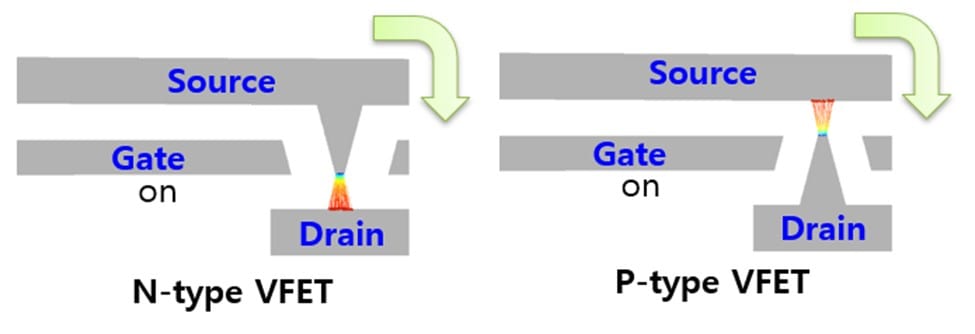
In conventional metal oxide semiconductor field effect transistors (MOSFETs), we have n-type and p-type devices –NMOS and PMOS respectively.  This is readily possible since semiconductors can be doped either way. The availability of these two types allows construction of a CMOS with the two devices working as a pair. When connected to a common input voltage, they work in opposite fashion: when one transistor is on, the other is off. This allows the CMOS to operate using less power.

Complementary operation of VFET has not been possible because there is no semiconductor material in the channel for doping and no possibility to create holes to make a p-type device.  VFET is unipolar since it is electron only.

How does your design overcome these challenges?

The primary (or the only) source of carriers in a vacuum device is electrons, resulting from the field emission in the source electrode. In the absence of holes, we need an external mechanism to invoke complementary operation (see figure below). That mechanism here is the nanoelectromechanical (NEM) actuation of the gate that modulates the vacuum channel length and resultantly the electron transport across the source-drain channel with the gate voltage. A shorter vacuum channel length is formed, and a positive input voltage turns on the n-type device and a negative input voltage turns on the p-type device.

The NEM-driven gate modulation is a successful technology employed in NEMS-relay switches and other low power electronics.

VFET

Are you currently fabricating devices based on this design, do you have any preliminary results?

Not yet. We have so far demonstrated the concept using simulations and studying potential circuits. This works well as in CMOS, providing complementary type transfer and output characteristics. Device fabrication is next.  We have provided a possible process flow to fabricate the devices, and the process steps are very similar to those currently in use in silicon integrated-circuit manufacturing. We expect that the device research community would come up with their own tweaks to both the design and process flow and their choice of material systems.

What are some possible practical applications for the device, if it can be successfully fabricated?

First, compared to electron-only conventional operation of VFET, this complementary operation will enable low static power consumption and high noise immunity, both of which are important in applications using logic circuits. Thus, low-power logic circuit application is one possibility.  Also, the VFET is ideal for radiation-immune electronics needed in space and military applications.

Why are VFETs immune to the effects of radiation?

Radiation strike on conventional solid-state devices creates all sorts of defects on the channel semiconductor and oxide materials. Depending on the type of defects and damage created, the effect can slowly accumulate and lead to malfunctions or can result in a catastrophic device failure. Absence of a semiconductor channel or dielectric material in the VFET makes it immune to radiation.

The design is described in ACS Applied Nano Materials.

Resolving the ‘squoon’, and other irregular satellites

Children’s author Julia Donaldson and illustrator Axel Scheffler are probably best known for their book The Gruffalo. But the duo recently put forth a new offering, whimsically titled The Smeds and the Smoos, featuring two types of aliens. The Smeds, who are red, never mix with the Smoos, who are blue. At the end of this tale of love, friendship and seeing past our differences, the now-amicable Smeds and Smoos celebrate “by the light of the silvery squoon”, an irregular, wonky natural satellite of their planet. But if a planet had a squoon, would beings on that world be able to see it, or would it be too small to view with the naked eye?

Well let’s think about the physics: for a satellite to be wonky, it must be small. This is because for a given object, above a fixed limiting radius, gravitational forces dominate cohesive forces, causing the object to be become regular and spherical. For typical astronomical objects, this radius (aka the potato limit) is approximately 200–300 km, providing an upper limit for the radius of our irregular squoon. So because the squoon has to be small, to resolve it with sufficient detail, it must be relatively close to the surface of its host planet. But getting close to a planet is perilous. Veer too near to a massive body, and a satellite can be torn asunder by the host planet’s tidal forces, limiting how close the squoon can approach the planet.

Our eyes have a minimum angular resolution of about 0.3 mrad, approximately equivalent to resolving a human hair’s width at arm’s length from the eye. If we assume that our aliens have an equivalent resolution, then to resolve a satellite with surface features would require an angular diameter of approximately 10 times this resolution. That’s about 3 mrad, not far off the 10 mrad angular diameter of our Moon.

To achieve this angular resolution, our squoon would have to be much closer to the planet than the 59 Earth radii that spans the distance from the surface of the Moon to our planet. However, the squoon can be no closer to its host planet than the Roche (instability) limit at which the difference in forces at either side of the satellite rip it apart. For a planet of radius R, with an orbiting satellite of radius r, at an orbital radius of a, with average densities ρp and ρs respectively, the closest distance from the surface of the planet to the orbiting body before destruction is

aR=R(2.44(ρpρs)131)

If we assume the Smeds and Smoos live on a rocky planet akin to our own, with a squoon of a similar density to our Moon, then a – R ≈ 1.9R. So, for a given density, the bigger the planet, the larger the Roche limit. This results in an angular diameter of our orbiting body, as viewed from the planetary surface, of

2raR2r1.9R

This inverse relationship to the radius of the planet implies that larger planets will have smaller angular diameter squoons at the Roche limit. If we impose our angular diameter of 3 mrad, and constrain the squoon radius to 200 km to ensure it can be sufficiently irregular and “squoony”, then, assuming densities of rocky planets, we find that the planet can be anywhere up to a radius of 60,000 km or about the size of Saturn before we are scuppered from resolving any irregular satellites by the Roche limit with the naked eye.

This suggests that all rocky planets observed so far could potentially harbour squoons that we could resolve, with the closest approach before destruction providing an upper limit for its angular diameter. Consider, for instance, Kepler 10c – a rocky Super Earth. If such a planet harboured an irregular satellite it could have a maximum angular diameter of 12 mrad. With an angular diameter similar to our Moon, that would feature prominently in its night sky. This display would come at a cost, though, not to mention the looming demise of the squoon as its radius drops below the Roche limit. Indeed, our aliens would have to withstand crushing gravitational field strengths of around 32 N kg–1. On the other hand, smaller planets could have much closer squoons without being destroyed by tidal forces. Earth could harbour a veritable super squoon at the closest possible orbit with an angular diameter of 33 mrad. Mercury could host an imposing 86 mrad, almost nine times that of our Moon.

So does our solar system already harbour squoons? Phobos, the irregular 11 km natural satellite of Mars, orbits at an approximate distance of 6 × 103 km from the Martian surface, with an orbital period of 7 hr 39 min. For a Martian, or a procrastinating Martian rover, this would provide an angular diameter of about 1.8 mrad and they would be able to resolve detail of its surface. Indeed, since 2012 the Mars Curiosity rover has managed to image Phobos from the surface of Mars. But it is teetering close to destruction with an ever-diminishing orbital radius so although Martian observers will observe a gradually larger satellite over time, it is predicted to be destroyed in 30–50 million years.

The squoon is not the focus of Donaldson and Scheffler’s new book but acts as a romantic backdrop for a story about embracing diversity. It is an excellent read for young children. Perhaps, somewhere in the universe, there are enlightened aliens gazing at their squoon pondering if there are beings other than themselves staring up at a silvery, spherical “moon”.

Spin in unpolarized light defies conventional picture

It’s been almost a century since Wolfgang Pauli mooted the idea of “hidden rotation”: a new quantum variable that would double the number of possible electron states. Today, this variable is known as spin angular momentum, and it’s widely accepted as an intrinsic property of fundamental particles. Yet despite the ubiquity of spin, there is still no real consensus about its physical meaning.

For photons, the usual explanation is that spin is related to circular polarization – a state of affairs in which the direction of the electromagnetic field in a beam of light rotates in a plane perpendicular to the direction of propagation, like hands round a clock face. This explanation has a straightforward consequence: no polarization, no spin. Now, however, an international collaboration of researchers has cast doubt on this principle by measuring non-zero transverse spin values in totally unpolarized light. In ruling out this supposedly fundamental requirement, the new observations expand our understanding of what spin angular momentum is not, while raising further questions about what it is.

The discovery of transverse spin

Physicists’ understanding of spin has evolved over the past 10 years thanks to the proposal (and later experimental corroboration) of transverse spin – that is, spin on an axis perpendicular to the direction of light propagation. In general, once you get far enough from a light source (or if you use a beam like a laser), light rays propagate essentially parallel to each other (paraxial rays), such that the light beam’s polarization is strictly confined to the plane perpendicular to the direction of propagation. For light that is circularly polarized in that plane, this picture implies that any resulting spin must align either longitudinally along the direction of propagation or directly against it. However, that did not always stack up with what researchers – including some at King’s College London in the UK – were observing. “We saw some interesting phenomena in electromagnetism that were hard to explain,” recalls Francisco Rodríguez-Fortuño, a researcher at King’s who was involved in the latest developments.

In 2013, when Rodríguez-Fortuño and his colleagues were working on circularly polarized dipoles (mimicked using an illuminated slit in gold film) next to waveguides. They took their “interesting phenomena” to Konstantin Bliokh, a researcher at RIKEN in Japan. Bliokh had been developing a theory that suggested that a light beam could acquire an out-of-plane polarization component if it underwent certain transformations, such as total internal reflection to produce a non-propagating “evanescent field” that fades exponentially from surfaces, or tight focussing. The conclusion of this theoretical work was that if these non-propagating forms of light had a longitudinal polarization component, they could have transverse spin. “Then everything made sense,” Rodriguez-Fortuño tells Physics World.

Beyond 2D polarization

By this point, observations of transverse spin were racking up for beams that initially had all kinds of polarizations and were then focused or reflected. These results implied that the polarization of the initial beam didn’t actually affect the transverse spin measurements. Meanwhile, further theoretical predictions remained untested – including one that suggested that transverse spin should appear even without any polarization in the initial beam.

The reasoning here is that, in effect, once the electric field’s longitudinal component is taken into consideration, the light field ceases to be a 2D phenomenon, and must instead be described in 3D. From that perspective, even a beam of light that is completely unpolarized in 2D has a non-zero level of polarization in 3D, simply because it has no longitudinal components. With that in mind, Bliokh posed a question for King’s researchers led by Anatoly Zayats: could they demonstrate this effect experimentally?

The answer, eventually, was “yes”. Although Diane Roth, a postdoctoral researcher at King’s, says the experiment was “not the hardest”, it did have some unexpected challenges. “One difficulty was to find a source of truly unpolarized light that also produced enough intensity for the effect to be measured,” says Roth, who worked on experiments measuring spin from an evanescent field. Since all laser light is polarized, the King’s researchers had to look elsewhere for their source. In the end, they found themselves working with a “humble incandescent light bulb” instead.

Meanwhile, collaborators at the Max Planck Institute for the Science of Light and University Erlangen-Nuremburg in Germany, and the University of Graz in Austria took a different tack. In their experiments on tightly focused light, they varied the polarization from a laser and then averaged measurements taken over long periods of time to get an effectively unpolarized light source. Despite their different source of unpolarized light, and differences in the transformations used to produce light fields with an out-of-plane electric field component, these groups also found that measurements from a scattering nanoparticle gave non-zero transverse spin quantities.

The researchers say that the biggest impact of their results will be a contribution to our understanding of what spin angular momentum is. However, that is not to say it will be without applications. Luke Nicholls, who was involved in the research at King’s, notes that it could have advantages for switching and routing light in photonic circuits. “In principle it could make this sort of routing cheaper and easier to do in the long run because you don’t necessarily have to have a fancy laser or things like that,” he says. “You can just do it with a bulb or an LED.”

The researchers describe their work in Nature Photonics.

Presentations from Luminate to make your start-up succeed

This time we are featuring three webinars from Luminate.

Luminate, a six-month intensive accelerator programme located in Rochester, New York, is looking for its next cohort. Qualified companies in the optics, photonics and imaging (OPI) sector can earn up to $100,000 in investment and join the programme, culminating in the chance to compete for $2m in funding. Applications are open until 7 January 2021.

If you want to know more, Luminate’s team of entrepreneurs recently hosted a series of three webinars to help start-up firms and entrepreneurs determine if their ideas are right for Luminate.

Tips from the top

Luminate can help optics, photonics or imaging start-ups strengthen their business and speed up their technology commercialization. In the first webinar entitled “Accelerate your startup at Luminate”, you can hear from Luminate managing director Sujatha Ramanujan, the director of operations Andy Simon and director of programme technology Damon Diehl, who will help you assess if Luminate is right for your start-up. The team discusses how Luminate has helped 30 start-ups from around the world advance their technology and businesses.

Founding figures

In the second webinar entitled “How getting into Luminate advanced my startup”, you can find out how Luminate’s first three cohorts worked with companies to grow their business and advance their technology. Featuring three founders of Luminate portfolio companies – Leslie Kimerling (CEO of Double Helix Optics), Yasaman Soudagar, PhD (CEO of Neurescence), and Michael Wilson, PhD (CEO of Simulated Inanimate Models) – this webinar details how Luminate continues to support and advance companies after they complete the six-month programme.

Application advice

If you need help applying, a third webinar is where to go. Entitled “Applying to Luminate”, the director of operations Andy Simon gives a brief overview of the accelerator programme and explains why to apply. Simon also provides a detailed description of the application process in the F6s platform and answers questions in a virtual office hours format.

What are the chances of life existing in the clouds of Venus?

Do researchers still think that phosphine – a supposed signature of life – is present in the clouds of Venus? Could such a harsh environment harbour life? And could microbes hang out in clouds indefinitely anyway?

These were among the questions discussed this week at the 2020 Fall Meeting of the American Geophysical Union (AGU).

The story began in September when a team led by Janes Greaves of Cardiff University, UK, announced it had observed phosphine’s spectral fingerprint in the clouds of Venus. Greaves’ group saw the signal in data from the James Clerk Maxwell Telescope (JCMT) in Hawaii and the Atacama Large Millimeter/submillimeter Array (ALMA) in Chile.

We know that on terrestrial planets such as Venus and Earth, the only known processes to generate phosphine are connected with metabolism by anaerobic microbial life. So does that mean there’s life on Venus? Not necessarily. In the original Nature Astronomy paper, Greaves’ team made it clear the phosphine could originate from unknown photochemistry or other processes.

But the implications still triggered strong reactions in the astronomy community.

First, the organizing committee of the International Astronomical Union (IAU) Commission F3 on Astrobiology criticized Greaves’ team for stoking the media hype – a statement that was swiftly retracted by the IAU executive. Then, a group led by Geronimo Villanueva of NASA’s Goddard Space Flight Center argued that the spectral signal is generated by sulphur dioxide in Venus’ atmosphere – though their suggestion that Greaves’ reprint should be retracted was also withdrawn.

‘Fake lines’?

Other researchers – including a group led by Ignas Snellen of Leiden University – also  questioned the way Greaves and colleagues calibrated their data. The original study had identified an absorption line at 1.1 mm, associated with phosphine absorbing radiation from warmer clouds deeper in Venus’ atmosphere. But that line appears against a complex background of thermal emission and Snellen’s group said the way it was removed (fitting the data with a 12th-order polynomial) may have introduced artefacts.

It was against this backdrop of uncertainty that Greaves and Villanueva joined others at AGU Fall on 11 December. Session co-chair Sushil Atreya from the University of Michigan opened by reminding everyone that “we should treat our colleagues with respect” and, in the thankfully courteous discussion that followed, Greaves highlighted a new paper her group had released on 10 December, addressing questions about the spectral baselines.

We’re not looking at confirmation bias here, we’re looking at solid results

Jane Greaves

It concludes there is a probability of less than 1% that “fake lines” (their words) had appeared in the original analysis. “We’re not looking at confirmation bias here, we’re looking at solid results,” said Greaves, who pointed out that much of the analyses were done by people unconnected with the science project.

Villanueva, however, stood by his view that the signal can be explained by sulphur dioxide. In his preprint Villanueva had argued that the part of Venus’ atmosphere in question could feasibly contain up to 100 ppbv. At AGU Fall, he said that if even half of that silicon dioxide abundance would place an upper limit on the phosphine detection of 3 sigma – not high enough to rule out chance.

Researchers have also been looking back at data from NASA’s 1978 Pioneer Venus mission. Rakesh Mogul from California State Polytechnic University-Pomona has analysed mass spectrometry data collected by a mission probe dropped through the Venusian atmosphere. Mogul said he has so far found no conclusive signal for phosphine but he has found lots of other “gems in the data” with implications for habitability. That includes all the compounds in the nitrogen cycle and chemicals associated with anoxygenic photosynthesis.

Life at the top

In a separate AGU session, researchers considered the feasibility of life existing in Venus’ clouds.

David  Smith from NASA’s Ames Research Center spoke about recent aerobiology on Earth. He said that micro-organisms have been discovered up to altitudes of 12,000 m using scientific aircraft and balloons. “We humans really are bottom dwellers underneath an ocean of atmosphere above out heads and we really don’t know where Earth’s biosphere boundary stops at extreme altitudes,” he said.

Smith did point out, however, that all life in Earth’s atmosphere has been swept up from the surface and eventually returns to the surface under gravity. Moreover, as you move up through the stratosphere, the only things that can survive desiccation and high radiation doses are inactive single-celled micro-organisms, such as endospores with tough coatings.

Conditions on Venus are another level of extreme. The planet’s dense atmosphere is almost entirely made of carbon dioxide, laced with clouds of sulphuric acid. While Venus’ surface swelters at an average temperature of 460 °C, and is crushed under an atmospheric pressure of 93 bar. The mechanism by which life could persist in the clouds conditions is far from clear.

Surviving in a liquid droplet

One possibility was outlined by astrophysicist Sara Seagar from Massachusetts Institute of Technology. She described a hypothetical lifecycle where metabolically active microbes survive in liquid droplets in the Venusian atmosphere. When they eventually succumb to gravity, the desiccated spores drop into a haze layer below before returning to the droplet zone thanks to vertical mixing induced by gravity waves.

A broader, philosophical, view of Venus’ habitability was offered by Noam Izenberg, a planetary scientist at John Hopkins University. He has co-developed a “Venus life equation” – loosely based on the famous Drake equation – which considers three key factors: how life might have originated on Venus; whether it was robust enough to survive; and whether there could have been continuity to the present day.

Indeed, recent studies conclude that water oceans may have existed on Venus for significant parts of its early history. Izenberg says it is not inconceivable that life on Venus was seeded from Earth following a large impact. “Something that might have been an extinction-level event on Earth, might also have been a seeding event for other places in the solar system,” he said.

Perhaps even at the interplanetary scale “life, uh, finds a way”.

Copyright © 2026 by IOP Publishing Ltd and individual contributors