Compton imaging opens up new avenues for diagnostic imaging

Compton imaging, originally developed by astronomers for detecting gamma ray sources, is now also under investigation for clinical imaging. In particular, a high-performance Compton camera could prove invaluable for applications within nuclear medicine and molecular imaging.

Unlike the established medical imaging technique of PET, which can only visualize positron emitters, Compton imaging has the potential to visualize a variety of gamma ray sources. To date, however, Compton image quality has not matched up to that of typical PET scans. To investigate its potential further, researchers at the National Institute of Radiological Sciences (NIRS) in Japan have created a combined whole gamma imaging (WGI) platform to directly compare the two modalities.

“Compton imaging has potential to provide better images than conventional SPECT and PET, in particular for radionuclides emitting high-energy gamma rays,” explains first author Hideaki Tashima. “We expect to explore new radionuclides that have never been used for nuclear medicine.”

A Compton camera incorporates two detectors that work in synchrony. For an individual gamma emission, Compton scattering occurs in the first detector (the scatterer) and photoelectric absorption in the second (the absorber). Both detectors record the interaction positions and corresponding deposited energies, enabling reconstruction of a Compton cone that indicates the emission point.

To create a WGI system that can perform both PET and Compton imaging, the researchers inserted a scatterer ring inside a whole-body depth-of-interaction PET scanner (the absorber ring). To enable small-animal imaging experiments, they remodelled a previous WGI prototype by halving the diameter of the scatterer ring. As the spatial resolution of Compton imaging reduces in proportion to the source–detector distance, this modification should also improve the resulting images.
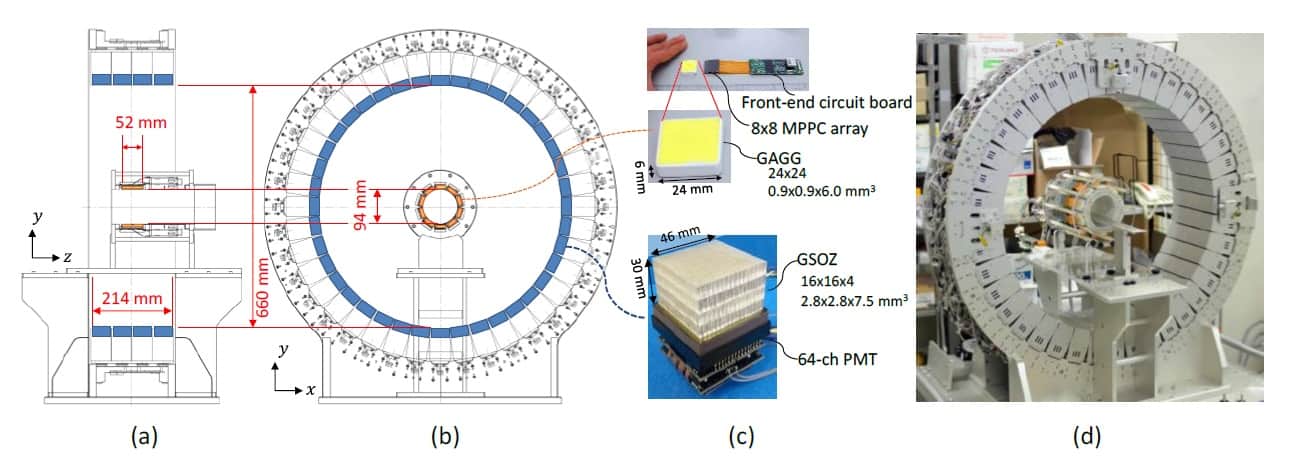
WGI prototype

System evaluation

Tashima and colleagues tested the WGI platform using 89Zr as the imaging source, as it decays via emission of a positron and a 909 keV gamma ray, enabling direct comparison of PET and Compton imaging. Alongside, they developed a 3D image reconstruction method incorporating detector response function (DRF) modelling, random correction and normalization. They report their findings in Physics in Medicine & Biology.

The researchers first evaluated the uniformity of the WGI prototype, by imaging a cylindrical phantom filled with 89Zr solution. When reconstructed without normalization, PET images exhibited ring artefacts and stripe patterns, while Compton images had higher coefficients of variation (COV) in the central region. The normalized PET and Compton images were of comparable quality, showing uniform radioactivity intensity throughout the phantom, and with COVs of 3.7% and 4.8% for PET and Compton images, respectively.

To assess the spatial resolution of the modalities, the researchers imaged a small rod phantom with clusters of cylindrical holes filled with 89Zr solution. The PET image clearly resolved the 2.2-mm diameter holes. The Compton image resolved the 3.0-mm holes in the peripheral region, with lower spatial resolution in the central region.

Finally, the team injected a mouse with 9.8 MBq 89Zr-oxalate and, one day later, used the WGI prototype to image the animal for 1 hr. The absorber ring (containing the PET detectors) had an axial length of 214 mm – enough to cover the whole animal. The PET image thus showed the entire mouse, revealing that 89Zr localized in its bones.
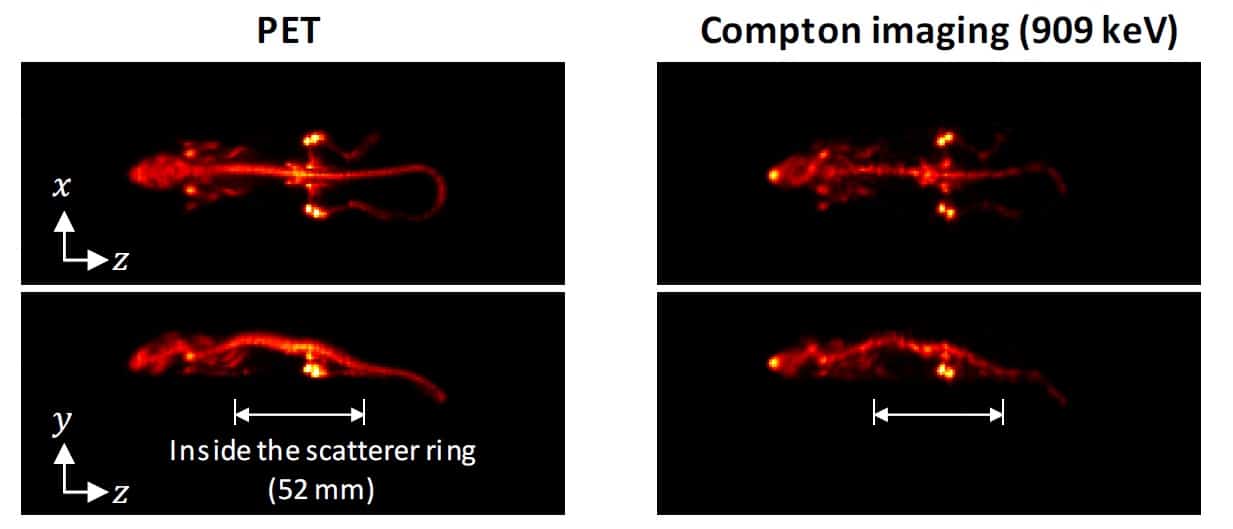
PET and Compton images

The scatterer ring was only 52 mm long, so the researchers positioned the animal’s torso inside the ring and its head and tail outside. Nevertheless, in Compton imaging mode, the WGI system could reconstruct the distribution outside the ring and create an image of almost the entire body. The Compton images agreed well with the PET images, clearly showing 89Zr in the mouse bones, although the image quality was better for regions inside the scatterer ring than those outside.

The researchers conclude that the WGI prototype could achieve Compton imaging with a quality approaching that of PET. They attribute this success to four key factors: the high energy of the gamma ray emitted from 89Zr, which improves the spatial resolution of Compton imaging; the DRF model used for image reconstruction, which further improved spatial resolution; the normalization step, essential for image uniformity; and the full-ring geometry of the WGI system.

Future work will focus on improving Compton imaging such that it outperforms PET. But the team’s ultimate goal is to unite the two techniques and implement a combined image reconstruction method. “Simultaneous measurement of different tracers with PET and Compton imaging can improve the efficiency of diagnosis,” explains Tashima. “In addition, reconstruction of a single tracer image by combining two types of signals can improve image quality through high sensitivity.”

“We are now exploring detector technologies for better energy resolution,” adds project leader Taiga Yamaya. “We are looking ahead to the realization of a clinical WGI system.”

D-Wave launches 5000 qubit system, solar-powered nanobeads could clean-up oil sands waste

D-Wave Advantage

The Canadian quantum computer maker D-Wave Systems has unveiled its latest platform, which contains a whopping 5000 qubits. Called Advantage, the system can be accessed via the company’s Leap 2 cloud service, which was launched earlier this year. The system is designed for use by businesses and D-Wave already counts several companies as customers, including the carmaker Volkswagen.

Your can read more about D-Wave system in “D-Wave’s 5,000-qubit quantum computing platform handles 1 million variables”.

Staying in Canada, petroleum production from Alberta’s oil sands produces effluent that is stored in tailings ponds – which are notoriously toxic. Now, researchers have used glass bubbles coated in titanium dioxide nanocrystals to deal with naphthenic acids, which are a particularly nasty group of chemicals found in the ponds.

The bubbles were developed at the University of Waterloo and their efficacy has been tested by a team led by Diane Orihel at Queens University in Kingston, Ontario. The team found that as the bubbles float on a pond, these use energy form the Sun to create radicals that destroy naphthenic acids. The coated bubbles are nontoxic and because they float, they can be gathered up and used again.

The research is described in the journal Facets and you can listen to Orihel explain the results to the CBC’s Bob McDonald on the science programme Quirks and Quarks.

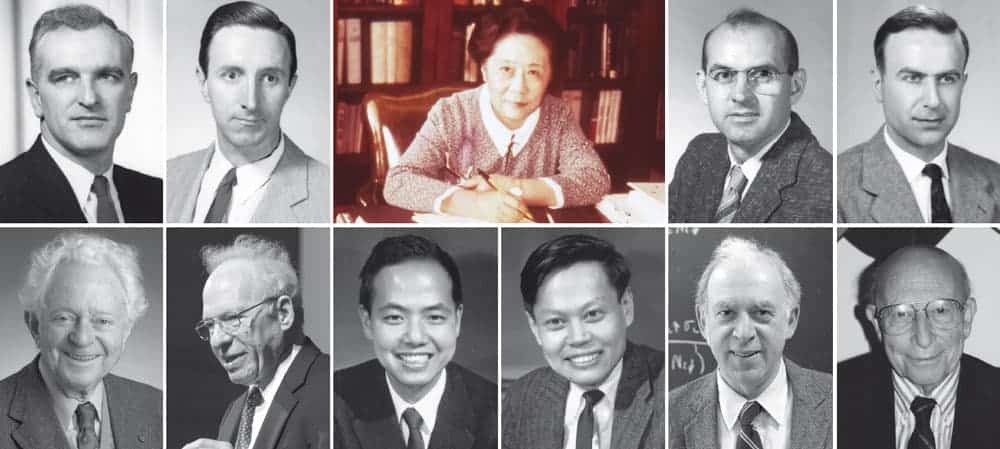
Overlooked for the Nobel: Chien-Shiung Wu

The 1957 Nobel Prize for Physics was shared by Chen Ning Yang and Tsung-Dao Lee “for their penetrating investigation of the so-called parity laws which has led to important discoveries regarding the elementary particles”. However, some physicists argue that the Chinese-American physicist Chien-Shiung Wu should have shared the prize for providing the experimental evidence for Lee and Yang’s theoretical prediction of parity violation. Furthermore, some believe that Wu was denied the prize because she was a woman.

Based at Columbia University in the late 1950s, Wu designed an experiment that tested parity laws by observing beta decay at ultracold temperatures. While Wu was an expert in measuring beta decay, she collaborated with scientists at the National Bureau of Standards (NBS) in Washington DC (now NIST) to meet the cryogenic requirements of what is now known as the “Wu experiment”.

In an 2012 article for Physics World (“Credit where credit’s due?”) the Hungarian chemist and historian of science Magdolna Hargittai dug deep into the claims and counter claims of who, if anybody, should have shared the 1957 prize with Lee and Yang.

Three competing groups

In a nutshell, it is complicated. According to Hargittai’s article, Wu and colleagues saw the first hints of parity violation on 27 December 1956. Shortly after news of this preliminary result got out, an independent group working at the Columbia cyclotron did a quick measurement in early January and observed parity violation in muons – at about the same time as Wu and colleagues were making their definitive measurements. What is more, a third group at the University of Chicago had been looking for parity violation since the summer of 1956 and had also found preliminary evidence by December.

The Wu–NBS and Columbia cyclotron teams published their results in the February 1957 issue of the Physical Review  and the Chicago paper was published in the March issue of the same journal.

And therein lies a major barrier to Wu sharing the 1957 prize. According to the Nobel rules, the 1957 prize cannot be awarded for work published in 1957. Indeed, the Nobel Prize Nomination Archive shows that neither Wu, nor anyone else who had measured parity violation in 1956-57, had been nominated for the 1957 prize.

So what is Hargittai’s conclusion on whether Wu was overlooked for a Nobel?

“My view is that Wu made an outstanding contribution to bringing down the axiom of parity conservation in weak interactions,” writes Hargittai.  “But to say it was an injustice that she did not win a Nobel prize is an oversimplification of a complex story.”

Eminent supporters

It is worth pointing out that some of the most eminent physicists of the day did champion Wu’s case for a prize – including the Nobel laureates Willis Lamb, Polykarp Kusch and Emilio Segrè. Starting in 1958, she was nominated for the Nobel prize at least seven times until her death in 1997 (only nominations made before 1966 are currently available online to the public, which means there could, in fact, have been more).

So regardless of whether it was the rules or sexism that denied Wu a Nobel prize, there is no doubt in my mind that she deserved one – if not in 1957, then certainly thereafter. Indeed, writing in Physics World after Hargittai’s article was published, Yang said that Wu’s contribution went well beyond her considerable experimental prowess and included her deep perception of why parity must be tested. In that same issue, Herwig Schopper, who was one of those to have nominated Wu for a Nobel prize, expressed the view that Wu and indeed others who made the experimental measurements were denied a prize because of the rule that only three winners can be named.

Boron neutron capture therapy is back on the agenda

Boron neutron capture therapy (BNCT), a technique that deposits highly targeted radiation into tumour cells, was first investigated as a cancer treatment back in the 1950s. But the field remains small, with only 1700 to 1800 patients treated to date worldwide. This may be about to change.

“The field of BNCT seems to be progressing rapidly at the moment,” said Stuart Green, director of medical physics at University Hospital Birmingham. “The big difference compared with five or ten years ago is that the commercial interest from a variety of companies is strong now and this is driving the field.”

BNCT is a two-stage treatment. First, a 10B-containing drug (most commonly boronophenylalanine) is infused into the patient’s bloodstream. After a couple of hours, the drug accumulates preferentially in tumour cells and starts to wash out of healthy tissues. At this point, the tumour target is irradiated with low-energy neutrons, which split the 10B atoms into alpha particles and 7Li ions – highly ionizing particles that are delivered directly into the cancer cells.

“BNCT is high-LET [linear energy transfer] radiotherapy targeted at the cellular level,” Green explained. As neither the neutron beam nor the drug are toxic by themselves, damage to healthy tissue is minimized. “BNCT is relatively safe compared with administering radioactive drugs or chemotherapy, where toxicity may be experienced all around the body.”

Speaking at the Medical Physics & Engineering Conference (MPEC), Green updated on the status of BNCT programmes worldwide, noting that clinical experience is continually increasing. The US Food and Drug Administration has now approved two boron drugs for clinical use. But by far the majority of treatments, over 1150 to date, have taken place in Japan, initially using the Kyoto University Reactor in the early 2000s, and more recently using three Sumitomo accelerator systems in Kyoto, Fukushima and Osaka.

“Very importantly, earlier this year we had the first ever medical device approval for BNCT, for treatment in Japan of recurrent head-and-neck cancer,” said Green. “This is a significant marker for the entire field.”

The Sumitomo BNCT system

Several BNCT clinical trials are now underway in Japan using these accelerator-based facilities. A work-in-progress study examining one-year survival in patients with recurrent malignant glioma is showing promising initial results. Another trial, which formed the basis of the approval by the Japanese Medical Agency, examined three-month response rates of patients with unresectable local recurrent head-and-neck cancer. This approval should enable the team to start treating patients on a routine basis.

In Finland, meanwhile, around 250 patients have been treated using neutrons from a research reactor. This reactor closed in 2012, but Helsinki University Hospital is currently working with Neutron Therapeutics (which originated from MIT) to commission an accelerator-based BNCT facility. Clinical trials at this facility were planned to begin late in 2020 (now delayed due to the pandemic), initially examining recurrent head-and-neck cancer followed by glioblastoma and other indications.

The previous treatments in Finland included many patients with locally recurrent head-and-neck squamous cell carcinoma – a difficult-to-treat cancer that recurs in almost half of cases. Green described a recent US-based study looking at conventional retreatments of this disease. Patients retreated with intensity-modulated radiotherapy had an overall survival of 13.3 months, with 1.8% experiencing grade 5 toxicity (death); those receiving stereotactic body radiation therapy had 7.8 months overall survival with 0.5% grade 5 toxicity. In contrast, the (so far unpublished) Helsinki data showed that BNCT of similar cases conferred an overall survival of 25 months, with zero occurrences of grade 5 toxicity.

Elsewhere, Chinese company Neuboron is constructing a BNCT Centre at the Xiamen Humanity Hospital in China, with plans for other facilities in the future. These facilities will be based around a relatively compact accelerator-based neutron source designed by US firm TAE Life Sciences.

Green also described recent developments in the UK, where the University of Birmingham has received a £9m award from the EPSRC funding agency to develop a high-power neutron source. The source is slated mainly for testing and research into nuclear materials, but will also act as a user facility for other communities needing high-intensity neutron irradiation.

The source, which will be situated next to the university’s medical physics building, could be used to test new boron compounds in cells, for example, as well as to perform dosimetry, beam characterization and imaging studies. Green notes that builders arrived on site in the last few weeks, with accelerator delivery planned for August 2021 and full operation scheduled for February 2022.

The other big news in the BNCT field, said Green, is the collaboration between oncology software specialist RaySearch and various BNCT companies, including Neutron Therapeutics, Sumitomo and TAE Life Sciences. “RaySearch has taken on BNCT and is producing treatment planning tools to help us bring it into our clinical work,” he said.

“For the first time, there’s a substantial and sustained effort in the commercial sector to drive this field forward,” Green concluded. “We should keep an eye on BNCT over the next few years, there’s a lot happening, and hopefully our community can play a key role.”

Conjuring solitons in optical moiré lattices

Moiré lattices — wherever they form – are full of surprises. Superimpose two or more 2D periodic patterns on top of each other with a slight twist, and exotic properties will emerge.

A single sheet of graphene is a decent electrical conductor, but when two graphene sheets are stacked into a moiré lattice, the bilayer morphs into a superconductor, a Mott insulator, or a magnet; depending on the twist angle. Analogously, when two light beams “patterned” by masks interact, the resulting moiré lattice can transform the signal beam into a diffuse smear or a single localized spot. Recently, a group of researchers led by Fangwei Ye at Shanghai Jiao Tong University, China discovered that optical moiré lattices can also produce solitons – self-trapped solitary waves – at extremely low power levels.

Solitons in the spotlight

Light tends to disperse as it propagates. For example, a ray of light from a torch gradually spreads out. Earlier this year, Ye’s team discovered a way to stop the spreading and localize a laser into a tight spot using moiré lattices. Now, the same group has taken their findings a step further by exciting the light in moiré lattices into self-sustaining pulses known as solitons. Solitons retain their shape as they propagate over long distances, so they are important in telecommunications as steadfast information carriers.

The enemy of light localization is diffraction. Ye’s optical solitons fend off diffraction by relying on the nonlinear effect, a self-reinforcing phenomenon whereby the medium through which light shines modifies the light’s behavior . Ye’s medium is a photorefractive strontium barium niobite crystal with nonlinear holographic properties. The researchers imprinted a moiré pattern onto the crystal by shining a light beam stenciled by two twisted lattice masks. Then, the researchers shone a second light beam and observed how the beam profile evolved while they changed the masks’ twist angle and the laser powers.

The researchers discovered that their moiré lattices can produce solitons above a certain laser power threshold, depending on the twist angles in the patterning masks. Nonlinearity is a weak phenomenon that usually only manifests at high laser powers. But Ye and his team found that their power threshold is whoppingly low: only nanowatts of power is required – a million times weaker than a laser pointer.

“First observation”

“Our work is the first observation of solitons in moiré lattices,” says Ye. “It turns out, it’s quite easy to create solitons this way.”

The key to the low power requirement is the flat energy band in the moiré lattice. The photons in optical moiré lattices are squeezed into a narrow range of energies at certain twist angles. This energy range only supports certain self-trapped modes of light. The light diffraction is inherently much weaker in such flat energy bands, so only a small nonlinear effect is necessary to generate solitons.

“Thanks to the almost flat bands in moiré lattices,” says Ye, “this experiment brings the power threshold down to an extremely low level, representing a big step in soliton research”.

Moiré surprises?

Optical moiré lattices present a rich playground to look for other elusive nonlinear phenomena, such as four-wave mixing and second harmonic generation. According to Ye, solitons may be just the beginning.

Electrocaloric devices show potential for greener air conditioning

Ever-growing in their use, air conditioning systems use refrigerants that are powerful greenhouse gases. But independent teams in Europe and the US reckon they may have found a more environmentally friendly way to keep cool by using electricity to soak up heat by controlling the entropy of ceramic “electrocaloric” materials. They have shown how to increase the cooling power of the technique and say it could become competitive with conventional vapour-compression cooling systems.

Air conditioning currently consumes about 10% of the world’s electricity and could use far more in the future – with cooling units projected to grow from 1.2 billion in 2018 to about 4.5 billion in 2050, according to the Rocky Mountain Institute. The hydrofluorocarbons often employed as the refrigerant in these systems are efficient and nonflammable, but they are also very potent greenhouse gases – trapping far more heat when released to the atmosphere than carbon dioxide.

Caloric materials can in principle do a similar job as these refrigerants while emitting no pollution. The idea is to pump heat from a cool room to the hot outdoors, not by alternately compressing and expanding a fluid but instead by raising and lowering the entropy of a material by controlling its elastic, magnetic or electrical properties. In the latter case, this means using electric fields to control the polarization of dipole moments within a dielectric material.

Promising start

Research on the electrocaloric effect in ceramics got off to a roaring start in the early 1990s when scientists at the Moscow Power Engineering Institute in Russia claimed they could support a temperature difference as high as 12.7 °C between heat source and heat bath. Not relying on large compressors, pumps or magnets, the work held the promise of efficient, cheap and environmentally friendly air conditioners. But transforming those results into practical devices has proved hard going, with material properties quite different in bulk components compared to the thin films used in labs.

New research from David Schwartz, Yunda Wang, and colleagues at PARC, part of Xerox in California, does not break any temperature records but does, they say, show how lab-scale devices could be scaled up. They have used a large-volume fabrication technique often employed in the electronics industry to produce a solid-state device from multi-layer ceramic capacitors. The capacitors, each just a few millimetres across and made from lead scandium tantalite, were supplied by Japanese company Murata Manufacturing.

The heart of the PARC device has two layers of multi-layer capacitors lined up between copper rails and separated by insulators. The upper layer contains five capacitors, while the lower one has four although it is capped by an aluminium heat sink at each end. An actuator moves the top layer left and right so that four of its capacitors are always aligned with those below, while the extra one at either end comes into and out of thermal contact with the heat sink below it.

The Brayton cycle

Schwartz and colleagues used their device to carry out many rounds of a thermodynamic Brayton cycle, with one of the heat sinks being progressively cooled while the other served as the external heat bath. Cooling takes place in the first stage, with heat flowing from the four capacitors and the cold sink below to the five capacitors above. Then in the second stage the top layer is moved, and the electric field applied, which lines up the dipoles and thereby reduces their entropy. In compensation, however, the vibrational entropy of the material’s molecules goes up – resulting in an adiabatic temperature rise.

With the temperature of the upper layer now higher than that of the hot bath, the third stage sees the capacitor on the end dumping some of its heat into that sink. Finally, the electric field is turned off and the temperature of the upper layer drops below that of the lower, again adiabatically. The cycle then repeats.

Schwartz and co-workers found that when they applied an electric field of just over 10 MV/m, the capacitors underwent an adiabatic temperature rise (and fall) of 2.5 °C per cycle. With the cold sink slowly but steadily cooling over the course of about 100 cycles, they found that its temperature dropped by up 5.2 °C compared with the hot sink. They also measured a heat flux of 135 mWcm-2, which they say is more than four times higher than other electrocaloric cooling systems.

The researchers reckon that by adjusting the size and shape of their capacitors and making other tweaks to their system, they should be able to raise the heat pumping efficiency to over 50%. And that, they say, would make it “competitive with vapor compression cooling”.

Much higher temperature differential

In fact, Emmanuel Defay, Alvar Torelló and colleagues at the Luxembourg Institute of Science and Technology in Luxembourg have achieved a much higher temperature differential of up to 13 °C in a slightly different system. They also used multi-layer capacitors made from lead scandium tantalate supplied by Murata but achieved greater cooling by sending a dielectric fluid back and forth through the (porous) caloric solid.

Defay and colleagues argue that their temperature span “breaks a crucial barrier and confirms that electrocaloric materials are promising candidates for cooling applications”. They also reckon that by reducing the thickness of their capacitors (to 0.2 mm) and using water rather than a dielectric they might achieve a span as high as 47.5 °C. But their technology is still at a relatively early stage, and say that practical applications would require capacitors with higher breakdown fields as well as better electrical insulation.

The PARC results and the Luxembourg results are both reported in Science.

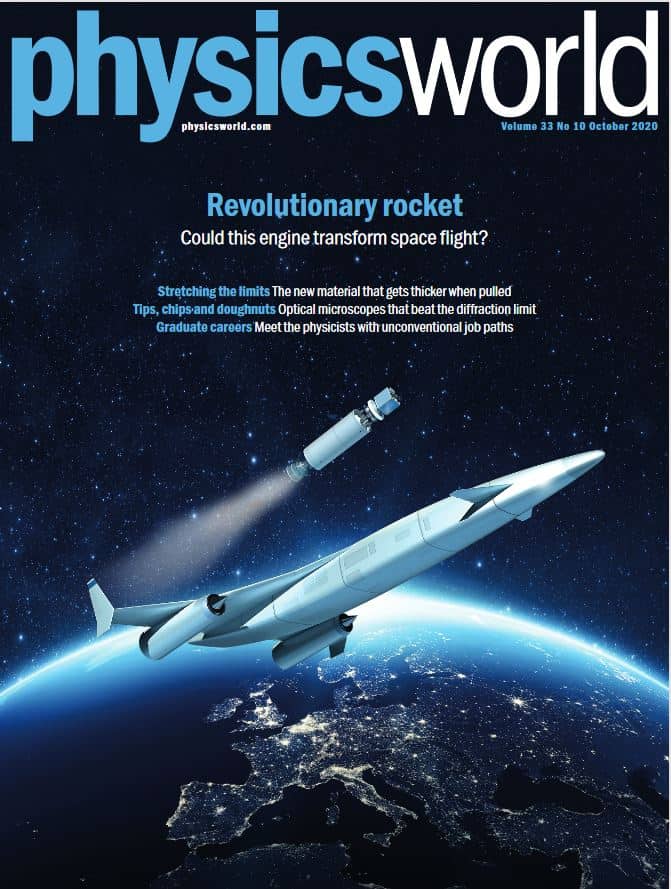
Online conferences, auxetic materials and a new kind of rocket engine: the October 2020 issue of Physics World is now out

Physics World October 2020 cover

When it comes to scientific conferences, we’ve all been affected by the restrictions from the COVID-19 pandemic. But even when the pandemic is over, as it surely will be one day, I don’t think we’ll ever entirely go back to massive scientific conferences as we knew them.

Sending thousands of people halfway round the world at great expense to mix in stuffy rooms increasingly seems a thing of the past, not least on the grounds of cost and pollution. What’s more, we can do so much more online.

Sure, it’ll take time to figure out what works best, but there are some intriguing developments already under way. In the new issue of Physics World, for example, you can read about a recent online conference in attophysics that deliberately set out to create scientific “battles”. More importantly, online conferences can make physics meetings more accessible and open.

If you’re a member of the Institute of Physics, you can read the whole of Physics World magazine every month via our digital apps for iOSAndroid and Web browsers. Let us know what you think about the issue on TwitterFacebook or by e-mailing us at pwld@ioppublishing.org.

For the record, here’s a rundown of what else is in the issue.

• US election focuses on science – from dealing with the COVID-19 pandemic to stimulating industries of the future, science policy will play a larger role than usual in next month’s US election, as Peter Gwynne reports

Redefining the scientific conferenceEleanor S Armstrong, Divya M Persaud and Christopher A-L Jackson argue that the COVID-19 pandemic offers an opportunity to start making scientific meetings more inclusive

Courting controversy onlineCarla Figueira de Morisson Faria and Andrew Brown say that academic debate can still be fostered in an online-only world

• Monumental mistake – Robert P Crease laments the disappearance of a landmark in US science history: the cooling tower at the Brookhaven National Laboratory

• Green strings attached – solving many of today’s environmental problems will require advanced technological solutions, says James McKenzie

• Eliminating the boundary between sky and space – reusable vehicles are vital to make access to space more affordable, but conventional rocket engines have their limits. Oliver Nailard describes how UK firm Reaction Engines hopes to revolutionize space access with a new class of propulsion system, the Synergetic Air Breathing Rocket Engine (SABRE)

• Stretching the limits – most materials get thinner when stretched, but “auxetics” do the opposite and get thicker. Helen Gleeson describes her group’s discovery of a material that is auxetic at the molecular level, which could be used in everything from body armour to laminated glass

• Optical microscopy – how small can it go? For centuries diffraction limited the resolution of optical microscopy. The past 50 years have, however, seen one limitation after another buckle under the ingenuity of a host of wide-ranging techniques, from lenses to tips, chips and doughnuts. Anna Demming reports

• Age of cosmic explosion – Tushna Commissariat reviews Look Up: Our Story with the Stars by Sarah Cruddas

• Intrepid interstellar adventurers – Ian Randall reviews Spacefarers: How Humans Will Settle the Moon, Mars, and Beyond by Christopher Wan

• Path of least resistance – graduate student Rosemary Teague and undergraduate Amber Yallop share their non-traditional degree pathways, some difficult choices they made along the way, and what a future in physics looks like for them now

• Is anybody there? – Chris Holt on the physics of ghosts

Why Google builds quantum computers, the LGBT+ experience in physics, CERN’s carbon footprint

In this episode of the Physics World Weekly podcast Google’s Sergio Boixo explains why the tech giant is building its own quantum computers. Boixo will be a plenary speaker at the upcoming Quantum 2020 virtual conference, and we will be interviewing other plenary speakers in future episodes of the podcast.

Next up is Ramon Barthelemy – a physicist at the University of Utah who has surveyed more than 300 LGBT+ physicists about their careers. Barthelemy chats with Physics World’s Matin Durrani about the survey and the issues faced by the LGBT+ physics community, which are also described in a paper in the European Journal of Physics.

CERN is home to the world’s largest particle collider and several experiments that are the size of small office blocks. So, it is not unexpected that the Geneva-based lab has a large carbon footprint. What is surprising, however, is the main source of CERN’s greenhouse gas emissions – as the science writer Kate Ravilious explains in the final segment of the podcast.

Overlooked for the Nobel: Nicola Cabibbo

In 2008 three physicists bagged that year’s Nobel Prize for Physics for developing predictions and concepts on symmetry breaking that became the cornerstones of the Standard Model of Particle Physics.

Makoto Kobayashi of the KEK lab and Toshihide Maskawa from the University of Kyoto, both in Japan, shared one half of prize for their work in 1972 on the mechanism of broken symmetry, which led to the prediction of a new family of quarks. Yoichiro Nambu of the University of Chicago in the US, who died in 2015, bagged the other half of the prize for realizing in 1960 how to apply spontaneous symmetry breaking to particle physics. Nambu’s work described how the vacuum is not the most symmetrical state, work that underpinned the mechanism for the Higgs field.

Symmetry breaking seeks to explain the subtle differences in physics that enables matter to tip the balance with antimatter in the universe. Charge (C) symmetry involves particles behaving like their oppositely charged antiparticles, while “parity” (P) symmetry means events should be the same when the three spatial co-ordinates x, y and z are flipped. In the 1950s, physicists discovered that charge symmetry breaks in the weak interaction, which governs radioactive beta decay. This was followed a few years later by observations of parity breaking in the weak interaction. A decade later and CP violation was shown to break during the decay of kaons.

It is the theory explaining CP violation that handed the 2008 Nobel prize to Kobayashi and Maskawa. In 1972, while at Nagoya University, the duo formulated a 3 × 3 matrix that describes how the strange quark and down quark inside a kaon can switch to and fro into their antiparticles and, in doing so, occasionally break CP symmetry. Moreover, the mixing in the matrix implied the existence of new quarks – the charm, bottom and top – all of which were discovered over the following decades.

Missing link

Kobayashi and Maskawa’s groundbreaking matrix was later named the CKM matrix after the initials of the physicists involved. But the first initial, C, reveals the contribution of someone else: Nicola Cabibbo. He was an Italian theorist from the CERN particle-physics lab near Geneva who in 1963 developed a smaller 2 x 2 quark-mixing matrix that ultimately laid the groundwork for Kobayashi and Maskawa almost a decade later.

Unfortunately for Cabibbo, the statutes of the Nobel Foundation, set down in 1900 some three years after the reading of Alfred Nobel’s will, state that the prize can go to no more than three people every year. While some mainained that Cabibbo could be honoured in another year, he died in 2010 at the age of 75 and another Nobel rule stipulates that awards cannot be given posthumously.

Some suggested that the committee could have given the prize in 2008 to Cabibbo, Kobayashi and Maskawa, leaving Nambu to be honoured in the future. Indeed, Roberto Petronzio, president of Italy’s National Institute for Nuclear Physics, said at the time that he was “filled with bitterness” at Cabibbo missing out.

So, in an alternative universe, Cabibbo, Kobayashi and Maskawa would have shared the 2008 Nobel, leaving Nambu to be awarded the prize following the discovery of the Higgs boson in 2012. But hindsight is a wonderful thing.

Redefining the scientific conference to be more inclusive

The ongoing COVID-19 pandemic has led to the cancellation or postponement of many in-person scientific meetings that have historically been a key forum for scientists to present and share their ideas as well as to foster academic collaborations. In response, scientists have moved their meetings online, which has been met with a mixed response, despite offering the possibility to dodge bad coffee, rubbish Wi-Fi and awkward poster sessions where you’re ignored in favour of warm beer. 

Based on our experiences of organizing and participating in many conferences both before and during the pandemic, we see many advantages that the “new normal” could bring, particularly for those from under-represented groups. Online conferences present an opportunity to challenge the problematic norms of existing conferences, which lead to the exclusion of already marginalized groups. They can also eliminate the environment that facilitates sexual or other forms of harassment and, when appropriate care is taken, also improve access to disabled people. 

Many academics travel extensively for scientific meetings – to develop and sustain collaborative projects as well as undertake fieldwork. Although sometimes exhilarating, travel presents barriers. The opportunity to travel is not equally distributed and can be prohibitively expensive. Most large conferences take place in the Global North and entering these countries from the Global South may require costly visas. Potential delegates may be subject to countrywide travel bans and upon entry researchers of colour may experience racial aggressions. Alongside the physical demands and inaccessibility of travel, unfamiliar locations may present challenges to disabled researchers and their carers. Conferences held in countries with discriminatory laws and attitudes may be unsafe for people from marginalized groups such as LGBTQ+ researchers. Travel also contributes to the unnecessary release of CO2.

Virtual conferences have the benefit of eliminating many of these barriers, making conferences more accessible to delegates who otherwise would be unable to attend. For example, more early-career researchers from China, India and Latin America attended the 2020 Virtual Perovskite Conference than usual, and disabled academics took part in this year’s Space Science in Context meeting at a rate that reflected the 24% of disabled people in the US and UK.

Smile, you’re on camera

Video presentations – whether pre-recorded or live – provide an opportunity to showcase a more diverse range of speakers. As questions can be asked anonymously and in advance, video-based talks have been shown to encourage questions from historically marginalized members of our communities such as early-career researchers or researchers of colour. Online events also allow the value of different contributions to be reshaped. Poster presentations are disproportionately delivered by early-career researchers and those of minoritized genders and people of colour. Running them in the middle of the day rather than alongside other, typically alcohol-based “social” events, places a higher value on this research. 

Conferences have typically been hostile to disabled and neurodivergent people. Combining pre-recorded and live events can improve accessibility for those who are disabled, chronically ill, neurodivergent and those with caregiving needs, who can access the material in their own time. Having a choice of format – for example, text or audio – also lets people choose how they engage with the conference based on their needs and preferences. Recorded meetings and having sessions repeat over the course of the conference can also overcome challenges related to time zones.

Disabled people must now be involved in conference organizing, especially as online conferences do not present a one-size-fits-all approach to accessibility. For example, lack of audio captioning, text that is not compatible with screen readers, video-based sessions without sign-language interpreters, and networking events conducted on inaccessible platforms will affect disabled researchers’ ability to connect. Evening events, meanwhile, may present barriers to attendees with caring or other responsibilities. These are important considerations for conference committees.

While online conferences lessen the burden for those in the most financially precarious positions, there will be additional costs linked to interpreters, captioning, Internet access and childcare. But this could be prioritized over travel, location and conference-funded socializing. 

Some have suggested that going online only could hinder how science is conducted in the long term and affect the “culture” of science. Unsurprisingly, these commentaries are typically generated by scientists for whom the traditional conference format is not exclusionary. Switching to an online conference can threaten meaningful networking, but tools and mechanisms do exist to support such engagement, including the use of randomly allocated breakout “coffee rooms”, using virtual worlds, and different forms of “virtual booths” for networking based on shared interests. Much like in-person events, ensuring a high-quality, rigorously enforced code of conduct is central to the success of online relationships. Relationships that develop online can be just as strong as those formed offline. 

In the face of COVID-19 we must be bold enough to redefine our norms. Rather than trying to maintain business as usual in an online format, we should ask ourselves who is not in the room where it happens. We should ensure that we share knowledge and opportunity in an accessible and inclusive way. Rather than representing an unmitigated disaster for the future of conferences and networking, COVID-19 is an opportunity to open up these spaces and make them welcoming to all.

Copyright © 2026 by IOP Publishing Ltd and individual contributors