Innovative brain–machine interface set to improve prosthetics and brain research

An international team led by researchers at Stanford University has developed a new device for connecting the brain directly to silicon-based technologies. The interface has the potential to improve human prosthetics and enable technology that could one day restore vision or speech in patients (Science Advances 10.1126/sciadv.aay2789).

The device, which contains hundreds of microwires, can be gently inserted into the brain and connected to an external silicon chip that records the electrical brain signals transmitted by each wire. The team – also from the Francis Crick Institute, University College London, ETH Zurich and Austin, TX-based technology company Paradromics – has already successfully tested the device on the retinal cells of rats and in the brains of living mice.

‘Electronic movies’

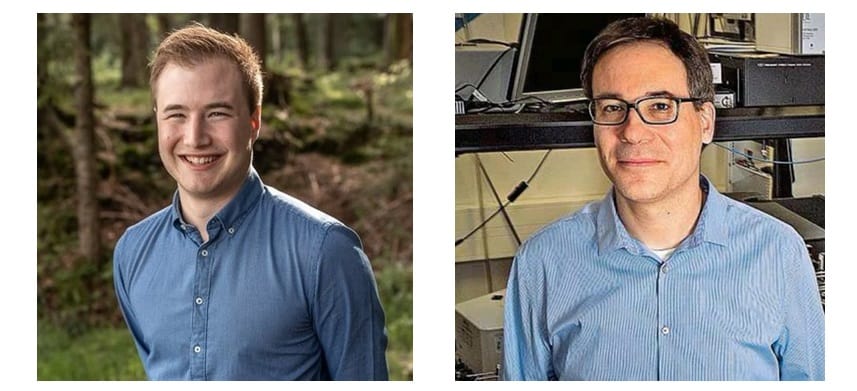
As first author Abdulmalik Obaid, a PhD Candidate at Stanford University, explains, the team’s main goal was to close the gap between the power of modern electronics and what is currently available in existing brain–machine interfaces.

“The difficulty with using modern electronics is there is a mismatch between the three-dimensional architecture of the brain and largely two-dimensional electronics. We sought to overcome these limitations by employing commercial silicon chips, such as the ones used in high-speed cameras and microdisplays, and combining them with arrays of microscopic wires,” Obaid says.

“As these chips are inherently flat, we combine them with easily tailored arrays of microscopic wires, which are precisely spaced to be minimally invasive,” he adds. “This approach lifts the scalable, but two-dimensional, silicon technology to the third dimension of the brain, allowing us to record ‘electronic movies’ of neural activity over large brain regions.

To scale-up and be able to record larger numbers of neurons, Obaid explains the research team had to create a brain–machine interface that was not only capable of recording from thousands of signals simultaneously, but also capable of integrating well with the brain and causing minimal damage. In doing so, he and his colleagues developed a way to create large-scale arrays of very thin microwires and figured out how to connect them to silicon-based devices, such as high-speed cameras and microdisplays, in order to take advantage of advances in those technologies.

Microwire array

“The combination of these two allows us to record more data from the brain, as well as being less invasive than previous approaches,” he says. “Another key benefit of this design is it allows us to simultaneously record different brain regions at different depths. This is important to study different neuroscience questions, or for brain–machine interfaces that need to reach different areas of the brain.”

Robotic limbs

Moving forward, Obaid says that the device has a broad range of potential applications in neuroscience research and brain–machine interfaces for clinical applications – particularly in view of its longevity and stability, which allows the team to study processes like learning in the brain.

“This is the neuroscience question we’re most interested in studying,” says Obaid. “In terms of clinical applications, while we are a way out, we’re particularly interested in applications for prosthetics, particularly speech assistance. The goal is that, through this device, the recording of more signals from the brain can improve the quality of prosthetics and enhance our understanding of the brain, both in healthy and diseased states.”

The team is currently testing the stability and longevity of the devices in the brain through long-term animal studies. Based on these studies, the researchers are also exploring what the neural activity recorded through the device can tell them about both short-term and long-term changes in the brain during learning.

“With the density and high resolution made possible by this technology, we hope that in the future it can be used to help improve human prosthetics, such as devices that can translate electric signals from the brain into robotic limbs, as well as devices that could restore vision or speech in a patient,” adds Obaid.
Physics on ice

When I watch films, TV shows or sports I often find myself thinking about the physics of the situation. Here in North America, we’re approaching the end of ice hockey season. The main aim of this sport is simply to get the puck into the net. But how far could a player actually hit a puck, if the net and edge of the rink weren’t there? Could you even make the puck loop all around the rink? These kinds of questions are ideal tools for teaching physics, as you can start with the most basic scenario and build upon it to reach the complex reality.

How far could a player actually hit a puck, if the net and edge of the rink weren’t there? Could you even make the puck loop all around the rink? Such questions are ideal tools for teaching physics

To answer how far you can hit a puck, there are three basic layers. You start with the ice, which is a very slippery surface – so it’s safe to assume that the friction between the puck and the ice is negligible. You also ignore air resistance, which only leaves the downward gravitational force and the normal force (the upward pushing force from the ice), which balance each other out. No net force means no movement, so you apply a pushing force, such as a hit from a hockey stick, which results in the puck travelling at a constant speed forever.

All of this is simple mechanics, but it’s not quite realistic. Although ice is very slippery, there will be a frictional force between it and the puck, which acts against the forward motion – meaning you must account for it. At a fundamental level, friction is a complicated interaction, but these complexities can be captured with a simple model of friction, which is found experimentally for different materials. Assuming the coefficient of friction is about 0.1 for our puck on ice, using some basic kinematics and Newton’s handy laws, that gives a stopping distance of just over 1000 m when the puck is hit with a starting speed of 160 km/hr.

While more realistic than never stopping, this scenario is still not believable, as air resistance also needs to be taken into account. Although the collisions between air molecules and objects can be complex, like with friction there is a model to describe the scenario. Unfortunately, when putting this into the equation for acceleration there’s a snag – the acceleration can be used to determine the change in velocity, but the magnitude of the acceleration now also depends on the velocity.

It’s possible to write the acceleration as the derivative of velocity with respect to time, turning this equation into a differential equation. But there is another route in the form of numerical calculations, which allow you to take a problem and break it down into many smaller and simpler problems. In this case, the motion of a sliding hockey puck can be modelled in small time steps, let’s say 0.1 seconds. During that tenth of a second, the hockey puck will indeed decrease in speed. However, the change in speed will be small – small enough that the acceleration can be calculated and assumed constant, allowing the motion during this short interval to be determined. With the help of a computer (because intervals of 0.1 s means a lot of data points), you get a plot of time versus puck position, which shows for a puck of mass 170 g, the stopping distance is 227 m. Turns out, air resistance plays a significant role.

So what about hitting the puck around an entire hockey rink (about 180 m, in the shape of a rounded rectangle) with one shot? In this scenario, the motion of the puck can be split into two parts. The simple part is the motion along the straight edges of the rink – the wall would create a different interaction with the air, and change the drag coefficient. For a first approximation we can assume the puck follows the same calculation as above. But when the puck travels around the rounded corners of the rink, which have a radius of curvature of 8.5 m, the boundary wall will add two new forces to the calculation. First, the normal force from the wall, which pushes the puck sideways in order to get it to turn. Second, the friction between the wall and the puck.

There are also two ways a puck could travel around this bend. It could “roll” along the wall, in which case there will still need to be some type of wall frictional force that causes the puck to increase its angular velocity. In order to be completely rolling, the angular velocity of the puck would have to be equal to the linear speed of the puck multiplied by the radius of the puck (which is true for any rolling without slipping object).

The other way the puck could travel around the corners is by completely sliding without rolling. In this version, the angular velocity of the puck would stay at zero and there would just be a kinetic frictional force. Of course, the coefficient of friction between the rubber puck and the wall would likely be much higher than for the ice–rubber interaction. But it gets even more complicated.

For this wall–puck friction, the magnitude of the frictional force depends on the normal force for the wall pushing on the puck to make it turn. This normal force depends on the radius of curvature of the wall and the speed of the puck. So, again, the wall–puck frictional force depends on the speed of the puck.

It’s possible that the puck could “bounce” when it transitions from the straight part of the wall to the curved part. This would not only cause it to lose kinetic energy (and slow down), but it would also mean that it loses contact with the wall. This is a pretty tough problem, and to solve it you probably need some more experimental data on the interaction between the puck and the wall. Consider this your homework the next time you’re watching a game!

Silicon-based light emitter is ‘Holy Grail’ of microelectronics, say researchers

A light-emitting silicon-based material with a direct band gap has been created in the lab, 50 years after its electronic properties were first predicted. This feat was achieved by an international team led by Erik Bakkers at Eindhoven University of Technology in the Netherlands. They describe the new nanowire material as the “Holy Grail” of microelectronics. With further work, light-emitting silicon-based devices could be used to create low-cost components for optical communications, computing, solar energy and spectroscopy.

Silicon is the wonder material of electronics. It is cheap and plentiful and can be fabricated into ever smaller transistors that can be packed onto chips at increasing densities. But silicon has a fatal flaw when it comes to being used as a light source or solar cell. The semiconductor has an “indirect” electronic band gap, which means that electronic transitions between the material’s valence and conduction bands involve vibrations in the crystal lattice. As a result, it is very unlikely that an excited electron in the conduction band of silicon will decay to the valence band by emitting light. Conversely, the absorption of light by silicon does not tend to excite valence electrons into the conduction band – a requirement of a solar cell.

In contrast, electronic transitions in direct band gap semiconductors do not involve lattice vibrations, so these materials emit copious amounts of light when electrons are excited – and are very good at converting light into electricity.

Incompatible with silicon processing

As a result, direct band gap materials such as gallium arsenide are used to create LEDs, lasers and solar cells. Unfortunately, these materials are hard to integrate into silicon processing, making it difficult and expensive to create devices that combine the electronic properties and scalability of silicon with the optical properties of direct band gap materials. Such devices could, in principle, lead to faster and more efficient telecoms and computing systems in which information is transmitted and processed using light alone.

50 years ago, researchers first calculated that a silicon-germanium alloy with a hexagonal crystal structure should have a direct band gap. The problem is that under ambient conditions both silicon and germanium have diamond-like crystal structures.

In 2015 Bakkers’ team developed a way of creating hexagonal germanium and silicon germanium nanowires. This involves first growing an extremely thin (about 35 nm diameter) gallium arsenide nanowire substrate. Germanium is then deposited on the nanowire, increasing its thickness by a factor of 10. The gallium arsenide nanowires have a hexagonal cross section and as a result, the surrounding germanium shell also has a hexagonal crystal structure. This is because the gallium arsenide provides a structural template for hexagonal growth; and the very high surface to volume ratio of the nanowire allows hexagonal growth to occur.

Once they created the hexagonal germanium shell, the researchers were able to deposit silicon-germanium or silicon to create hexagonal crystals of those materials. “We were able to do this such that the silicon atoms are built on the hexagonal template, and by this forced the silicon atoms to grow in the hexagonal structure,” explains Eindhoven’s Elham Fadaly.

Defects and impurities

In 2015, however, they were unable to make the nanowires emit light – a problem that the team said was related to the presence of defects and impurities in the crystal structure.

Now, the Eindhoven team has joined forces with researchers in Germany and Austria to create higher quality nanowires that emit light. They measured the emission by firing a laser at the nanowires in order to excite the electrons and then detected the infrared light that is emitted. “Our experiments showed that the material has the right structure, and that it is free of defects. It emits light very efficiently,” says Eindhoven’s Alain Dijkstra.

The researchers found that by reducing the silicon content of the hexagonal alloy from 35% to 0 they could change the wavelength of the light from 1.5 to 3.5 µm. This partially overlaps the wavelengths of infrared light that are currently used in optical telecoms.

Bakkers believes that the team will soon be able to create a laser using the nanowires: “By now we have realized optical properties that are almost comparable to indium phosphide and gallium arsenide, and the materials quality is steeply improving. If things run smoothly, we can create a silicon-based laser in 2020.”

As well as optical telecoms and optical computing, the new silicon-based material could be used to create low-cost chemical sensors that use infrared spectroscopy.

The research is described in Nature.

Physics in the pandemic: ‘I hope the rest of the world can see hope from my experience’

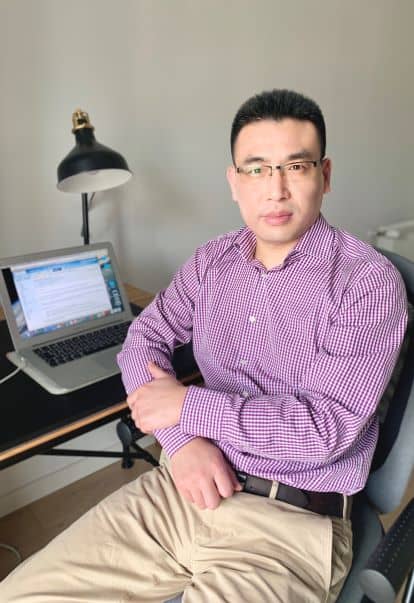
Tao Wang sitting at his laptop computer

I run a research group made up of more than 20 graduate students, and in a “normal” workday my job is to supervise and direct them on research activities related to optoelectronic devices such as solar cells and light-emitting diodes. I also teach an undergraduate course in polymer physics during our teaching season, with lectures two times a week. I would normally also go to conferences, although not every week.

The city of Wuhan and the residential compounds within it responded differently at different stages of the pandemic. At the beginning of the outbreak, normal life was not affected much as the number of infected people was low. On 23 January, Wuhan was locked down, with nobody able to leave the city; however, in the early days of the lockdown people could still walk freely outside their homes. This was soon changed so that nobody could leave their residential compound except those involved in essential work, as evidence showed that less strict measures were not preventing the spread of the coronavirus.

Life under lockdown

During the lockdown, a lot of medical and other resources were sent to Wuhan, and many volunteers helped deliver groceries to residential compounds, assist the vulnerable, and bring food to doctors and nurses on the front line. At first, patients with mild symptoms were asked to return home and self-isolate – partly due to the shortage of hospital beds and other resources, and partly due to a lack of experience in how to treat a virus that humans had not encountered before. Again, this was soon changed, as the virus continued to spread, clusters of infections appeared, and people with mild conditions developed more serious symptoms.

To deal exclusively with coronavirus patients, Wuhan constructed two new hospitals from scratch in 10 days. Another 16 makeshift hospitals were also built, some of them in one day. Other provinces in China also sent many thousands of doctors and nurses to hospitals in Hubei. This enabled health workers to collect and treat all patients in hospital and closely watch those who have been in close contacts with patients. The number of new cases reduced immediately with these actions, and this – along with a reduced number of patients in hospitals after their cure and discharge – helped to ease the crisis.

I have kept myself fairly busy while self-isolating at home during the lockdown time in Wuhan. Whilst we report our body temperatures every day to local health volunteers and try to keep our life free of chaos and panic, we also try to do some of the work we would expect to do in a normal time. My students and I have online meetings every two weeks, during which we discuss some of the latest literature related to their projects. We finished writing and revising a few manuscripts, and I also wrote two grant proposals (it is proposal writing time between January and March in China). At the beginning of the new semester in March, university students in Wuhan were asked not to return on campus due to the outbreak of COVID-19, and all face-to-face lectures have been turned to online virtual ones. This minimizes the disruption to their studies, while also ensuring their health and safety.

Emerging from the epidemic

For the past 20 days, very few new cases of coronavirus have been reported in Wuhan, and as of today the total number of coronavirus patients is less than 500. So, after 11 weeks of lockdown, people in Wuhan were allowed to leave the city from midnight on 8 April. Thanks to the great achievement of putting down a pandemic in about two months, people in “epidemic-free” residential compounds are now allowed to leave their homes, for example to do grocery shopping in supermarkets. A lot of commercial units have resumed functioning. The authorities are evaluating how to ensure public health and safety in these new circumstances, and when that is settled our students will be allowed to return to campus. I actually tidied up my office today, and I am waiting for our students to be back, which I am sure won’t take long.

With great efforts from people in every country, this extraordinary crisis will surely be overcome, and we will be back to “normal” life. But this new normality won’t be the same as the one that existed before. It is going to change our society in ways we haven’t fully anticipated. I hope the changes are positive rather than negative. We should live in more healthy ways so that we can share this planet with other beings, and that will require everyone to think things over after the disruption is finished. I do see positive things in all nations across the globe: responsibility, selflessness, self-discipline, unity and resolve. As for positive things in my professional life, the lockdown gave me time to look back and think over what I have done in my research activities over the past few years, and particularly to evaluate whether they are as methodologically robust as they could be. I have some thoughts on that and will start from those once I am able to return to my laboratory.

I hope the rest of the world can see hope from my experience in Wuhan. If we stick to social distancing, wash hands and wear masks, this pandemic is certainly controllable.

Half a life

The first woman Nobel laureate, the only person in history to win both the physics and chemistry Nobel prizes, the extraordinary scientist who first described radioactivity, the legend who discovered both radium and polonium, the pioneering activist who developed mobile radiology units – Marie Curie’s life is worthy of countless Hollywood biopics. But in trying to condense Curie’s entire legacy into 100 minutes on the big screen, director Marjane Satrapi takes on too much in her new film Radioactive. A Polish emigrant in an intolerant and unwelcoming Paris; a woman scientist breaking societal stereotypes; a world-changing discovery riddled with ethical dilemmas; a sexually liberated wife; a grieving widow; a humanitarian war hero – all this and more is featured in Radioactive. I passionately believe that the world should know the names and lives of more women scientists – but what Hidden Figures got so right (2017), this film gets so wrong.

Based on Lauren Redniss’s graphic novel – Marie & Pierre Curie, a Tale of Love and FalloutRadioactive is ultimately the story of the Curies’ relationship: how their discoveries of each other turned their worlds upside down, and how their discovery of radioactivity turned the world upside down. In an attempt to communicate the impact and risks associated with this discovery to a non-expert audience (without explicitly stating how dangerous it would be to conduct nuclear physics experiments in your bedroom), the film awkwardly hops around the 20th century: from 1900s Parisian chemistry labs to inside a reactor at Chernobyl; from the lecture theatres of the École Supérieure to the streets of Hiroshima in 1945; from the Curies swimming naked in a French river to an atomic bomb test in New Mexico. Perhaps a reflection on a badly written script more than the cast themselves, the characters are inconsistent and, at times, infuriatingly superficial.

Rosamund Pike as Marie Curie

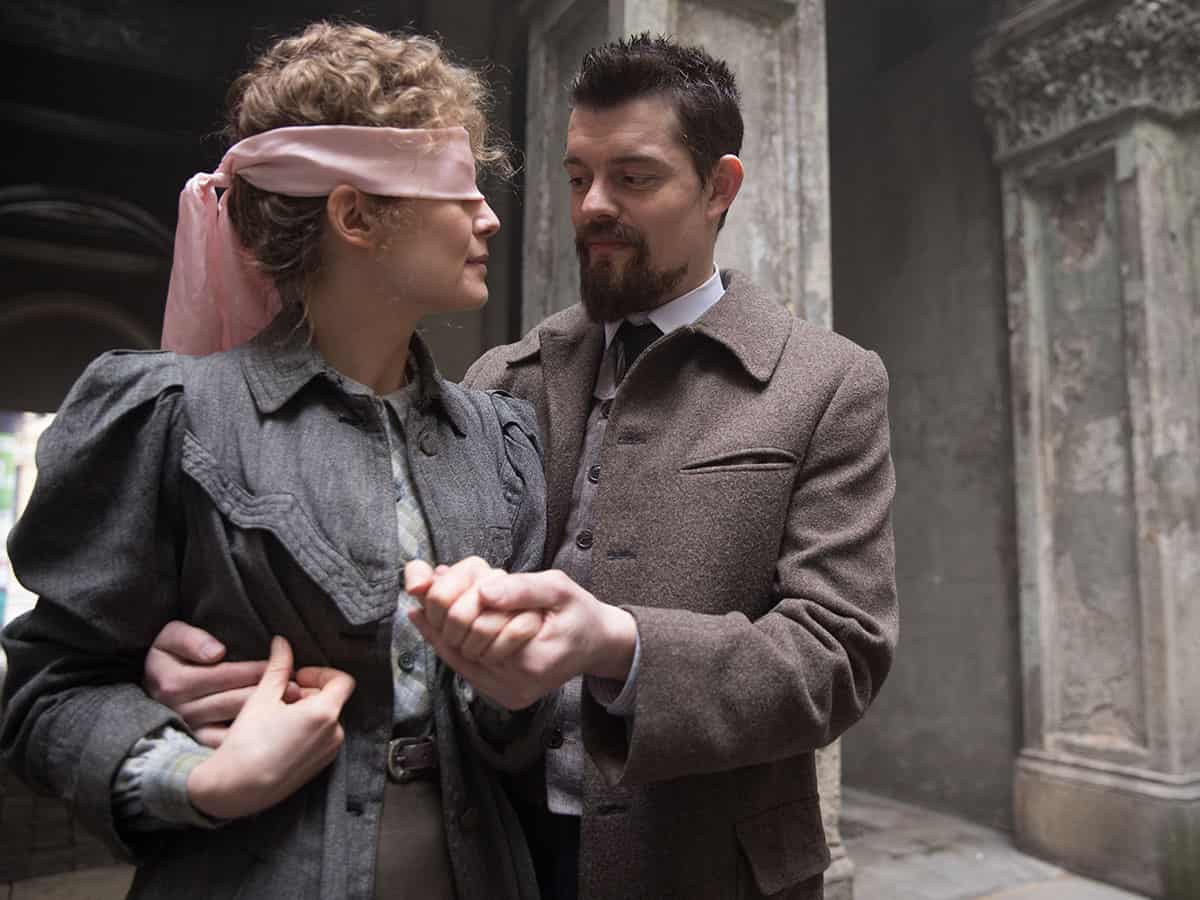
Marie Curie, played by Hollywood elite Rosamund Pike, oscillates between unbearably stiff and captivatingly compelling. She is evidently trying to play a controversial, unlikeable and unapologetic genius – but Jack Thorpe’s screenplay doesn’t rise to the challenge. Pike spends the first 23 minutes resolute that she will not, under any circumstances, get distracted, married or collaborate with another scientist. The following 80 minutes, though, show her working exclusively with the scientist she married after a romance limited to a handful of experiments and a lab move, ultimately becoming distracted when the love of her life (played by Sam Riley) gets trampled to death by a horse.

Neither Satrapi nor Thorne expect much from their audience, explicitly re-introducing each character by their full name every time they return to the screen – even when the Curies are alone with one another. The film also provides next to no detail about the scientific experiments. Perhaps fitting with her life’s work, Pike’s Curie spontaneously emits scientific platitudes like a radioactive nucleus. Certainly, dialogue in the Curie household – “This could change science forever!” – transcends into a Research Excellence Framework (REF) impact case study all too often.

Radioactive does not realize the excitement of the scientific process, the miracle of discovery

Radioactive serves as a reminder that while a lot about scientific research has changed since the beginning of the 20th century – including our appreciation of health and safety, and the overwhelming amount of time senior scientists are now required to spend on administrative tasks – a lot hasn’t. Curie’s battle for a permanent position and her own lab space, her being snubbed initially for the Nobel prize and her career being dependent on the opinion of senior male faculty members is painfully close to the present day. Despite this feeling of familiarity, the film does not realize the excitement of the scientific process: the thrill of unpredicted experimental results and the miracle of discovery, which must have been daily occurrences in the Curie laboratory. You are left with the distinct impression that neither Pike nor Riley spent much time with scientists before making the film.

The most frustrating thing about this film is that it could have been so much more. Marie Curie’s brilliance rocked the scientific establishment. From a ramshackle shed in the Latin Quarter of Paris, she transformed our understanding of matter: atoms were not (as was previously understood) indivisible; in fact, they were not even stable. Curie measured the atomic weight of her newly discovered elements with outstanding accuracy. She was the first woman in France to earn a doctoral degree in physics, and her examiners declared her PhD thesis the “greatest single contribution to science ever written”.

To date, she is routinely voted as one of history’s most significant scientists who defied societal expectations of women, and Radioactive was an opportunity to teach a new generation why. Instead, Curie is too contradictory to be conceivable. The raunchy evenings Curie spends with her husband and the later scandalous affair with fellow physicist Paul Langevin jars with the ambitious, independent woman processing tonnes of radioactive pitchblende. While I am immensely glad that women scientists are finally getting their time in the spotlight, I don’t anticipate Radioactive will achieve the half-life that Curie deserves.

  • 2020 Shoebox Films/Working Title Films/StudioCanal 110 minutes

Physics in the pandemic: ‘I miss my group’s vibrant office discussions that propelled my research’

As a graduate student who was on the verge of performing the last experiment for a paper, I lament the timing of COVID-19 – it could not have been more inconvenient.

My lab’s research at the University of Chicago centres on 2D semiconducting nanomaterials that are merely three atoms thick — or thin. We study their optical, electrical, and thermal properties and devise scalable processing techniques to integrate them with other materials. As our nanomaterials are fragile and easily contaminated, our experiments necessitate us donning full-body “bunny suits” (which are stuffy and constraining) and working in a cleanroom, a special facility where the very air is filtered to remove dust and air-borne particulates. Our research is labour intensive, to the extent that we sometimes jokingly call ourselves “blue-collar workers.”

Naturally, my research group was rather frustrated with the coronavirus, as lab shutdowns caused all our experiments to screech to a halt. We scrambled to recover a semblance of normalcy by working from home. But given the heavy experimental nature of our research, we would never be able to replicate the same productivity level as the pre-COVID era. But we would try our very best.

Ever since the lab closed, my group has conducted all interactions, including the weekly group meetings, through online platforms. In the group meetings before the coronavirus, each person would present a research update on their latest experiment. But after our exile from the lab, the old group meeting format no longer made sense.

Focus on the future

Now, we propose future experiments to be done once we return to the lab. Furthermore, our professor organizes online paper-writing clinics for students, especially for those who were more than halfway into their projects. Even if we don’t feel that our projects are near publication-ready, our professor encourages us to start writing a draft.

During the group’s inaugural online group meeting, we ran into a universal hiccup: a presenter was cut-off midsentence due to unstable Internet connection at home. An awkward silence ensued as the rest of the group waited for him to reappear online. During another presentation, I forgot to unmute myself, so I was talking to deaf speakers for several uncomfortable seconds.

Displaced from lab bench to laptop, my lab mates and I are still struggling to adapt to a sedentary lifestyle and working from home. I constantly remind myself of what my advisor has told us, “Consider this an opportunity”.

Combing through the latest research

My working days now consist of doing as much reading as I can. I allocate more time now to comb through the latest research. I take the time to learn new subjects, such as the basics of computer simulations and theoretical studies, a far cry from my experimental work. My lab mate and I have buddied up to check in on each other every day. We begin each day by listing our goals and hold each other accountable. I try to think deeper and more carefully about my project and its implications than ever before, planning future experiments so that I can hit the ground running once the lab reopens. I have no choice but to finally work on that draft of my paper despite the incomplete data (I may have to modify the story though).

Sealed away in my home, I appreciate the time to ruminate, to learn, to chart out the future. How incredibly fortunate I am: I still receive my monthly graduate school stipend, so I can afford my rent. My research is based on lifeless, inorganic materials, so I did not need to throw out any of our samples in preparation for the lab shutdowns, unlike many biology researchers. My experiments are relatively easy to pick up again once the lab doors reopen. I have two years left before I graduate—more than enough research time to make up for the coronavirus setback. Several universities have frozen their hiring of new faculty candidates; and many students graduating this year are struggling to find jobs amidst the economic downturn. In contrast, the impact of the coronavirus on my graduate career is temporary and salvageable—not detrimental, as far as I can tell.

Nevertheless, I miss my group’s vibrant office discussions that propelled my research. Online chatrooms are not able to replace the intimate, collaborative spirit in-person interactions engender. I miss being able to learn through experimentation, not just via reading.

I am also starting to miss my clean room bunny suit. Absence truly makes the heart grow fonder.

Online Demo: Reliable and accurate measurement with new WLI mode

View on demand

Join this webinar to explore easy to use and universal way to measure topography through WLI based optical profiler. This webinar introduces new way to measure surfaces through White Light interferometry profilers. This method combines sub-nanometer vertical resolution while retaining ease of use through self-adapting algorithm matching wide range of surfaces. Benefits will be illustrated via key applications such as academic or R&D multi-user environment, defect inspection on fine optics, orthopedic QA/QC and general texture/roughness measurement on machined parts. Accuracy will be discussed through wide range of roughness standards and calibrated spheres.

Who should attend:
– Researchers
– QA/QC engineer
– Metrology team
– Design engineer

Presenters:


Dr Samuel Lesko
Senior Application Development Manager


Dr Udo Volz
Application Scientist

Atomic Force Microscopy for Life Science Research

View on demand

Join this webinar to learn about fundamental AFM techniques for the investigation of a variety of samples in life science

This webinar covers the application of our multipurpose AFM platform allowing comprehensive characterization of biological samples, such as, live cells, tissues and biomaterials on the nanoscale. Various sample parameters like topography, stiffness and adhesive interaction will be investigated under controlled physiological conditions. True optical integration allows the simultaneous use of advanced inverted optical microscope techniques. You will also learn about single cell force spectroscopy (SCFS), cell-substrate or cell-cell/tissue interactions.

Presenters:

Dr Tanja Neumann
JPK BioAFM Application Scientist


Carmen Pettersson
Senior Manager Product Marketing Manager


Protective equipment against COVID-19 needs to go further, scientists say

Research on the fluid dynamics of respiratory emissions indicates that individuals infected with COVID-19 could spread viral particles up to 8 metres away when they cough or sneeze – a finding that appears to undermine statements by the World Health Organization (WHO) that “airborne transmission” of the novel coronavirus is not possible.

Current WHO guidelines for respiratory disease containment are based on a model of droplet spray transmission that dates from the 1930s. In this model, air resistance prevents single droplets released in respiratory emissions from travelling more than 2 metres from their source – a distance that has appeared prominently in public-health messages during the current pandemic. However, modern techniques have shown that clouds of turbulent gas in exhalations – that is, coughs and sneezes – can convey droplets much further than is possible for lone droplets in ballistic flight.

In a paper published in JAMA Insights on 26 March, Lydia Bourouiba, an applied mathematician and head of the Fluid Dynamics of Disease Transmission Laboratory at the Massachusetts Institute of Technology, US, outlines the implications of these newer techniques and her ongoing work on the fluid dynamics of respiratory emissions. “A turbulent gas cloud is critical to include in the picture,” she says. “Droplets trapped in the cloud can go further than isolated droplets, about 5 metres for coughs and 7-8 metres for sneezes.”

Based on her results, Bourouiba argues that in the current pandemic, “it is not possible to support that there is a safe distance of 1-2 metres in a healthcare setting full of symptomatic patients who emit such violent exhalations.” For this reason, she says, “protection of healthcare workers at the frontline has to be of higher respiratory grade.”

Enough evidence?

Bourouiba and her colleagues have been quantifying influenza respiratory emissions since 2016 using an imaging technique known as high-frequency frame capture illumination. These studies have shown that, because the swiftly-moving exhalation cloud tends to keep droplets together and trap them within a humid environment, evaporation can take minutes, rather than seconds.

The JAMA Insights paper includes several visualizations of the exhalation cloud’s spread, and Julian Tang, a virologist at the University of Leicester, UK, who has expertise in respiratory viruses and their transmission, says he finds them convincing. “You can see from the image and video that it [the exhalation cloud] does spread, which could be enough to convey and transport the infectious virus all the way along that pathway,” says Tang, who was not involved in Bourouiba’s study.

As for why the WHO guidelines do not take such possibilities into account, Tang offers two potential explanations. One is that there is no direct proof that coronavirus particles inhaled from such a gas cloud will cause infection. However, he notes that the huge number of variables and confounders at play – not to mention practical and ethical issues of doing experiments on such a new and deadly disease – make it nearly impossible to conduct a conclusive study quickly enough to affect the evolving pandemic situation.

“That level of proof [required by the WHO] is so ridiculously difficult that it precludes you doing any airborne precaution and infection control now,” he says. Even without such proof, he thinks the WHO should at least acknowledge the possibility of airborne transmission. “It’s the precautionary principle,” he says. “You try and prevent transmission if it’s potentially possible.”

The other possible explanation, Tang adds, has more to do with economics. “The WHO can’t endorse a mode of transmission which low- and middle-income countries can’t do anything about,” he says. While washing hands and cleaning surfaces to prevent droplet transmission is relatively cheap and easy, Tang explains that the possibility of airborne transmission means that healthcare workers on clinical wards might need expensive, full personal protective equipment (PPE) to prevent them from becoming infected.

As it stands, even well-off countries like the UK are struggling to provide adequate PPE for frontline healthcare workers. But that, he argues, is no excuse to ignore these results. “When you see all these studies showing the dissemination of airborne particles, it’s very hard to deny they could be a risk,” he says. “’Can’t afford it’ is one thing, but they shouldn’t say it just doesn’t happen.”

Policy shift

On 2nd April, BBC News reported some movement in the WHO’s position, with the chair of its advisory panel, David Heymann, announcing that the organization is “opening up its discussion again, looking at the new evidence to see whether or not there should be a change in the way it’s recommending masks should be used.”

For Bourouiba, whose research has also appeared in a TEDMED Talk, and who established a new conference to bring together policy makers and scientists, such movement is welcome. “I’m glad that the science has gotten to the committee, but we need, as a system and community, to find ways to improve translation time from the frontline of research to guidelines and policies sooner,” she says, adding that she has contacted the US Center for Disease Control and Prevention with her findings.

  • This article was amended on 7 April 2020 to clarify how Bourouiba has worked to communicate her research findings outside the academic community.

Machines sense and see in nanoseconds

Imaging chip

As you read this news piece, you are getting help from the ambient light that hits the photoreceptors in your eyes (the sensing step – remember this) and gets converted into electrical signals (the computing step – also remember this) so that your brain (the visual cortex) can make sense of the letters that appear in this article. Biologically inspired machine vision exploits the same principle to progress to the point where artificial systems can “see”.

For instance, when you use your smartphone to take a picture, you have probably noticed that it can identify objects in a scene before you press the record button. Your smartphone camera is actually considered to be a modern image sensor. Such semiconductor-based image sensors capture the surrounding visual information and then pass it along to the processing units. It is then the job of the processing units to decode the optical signals and convert them into digital output. This movement of data between the sensor and processing units not only requires high power consumption, but also results in high computational latency – in the order of milliseconds. But what if a machine could see in nanoseconds?

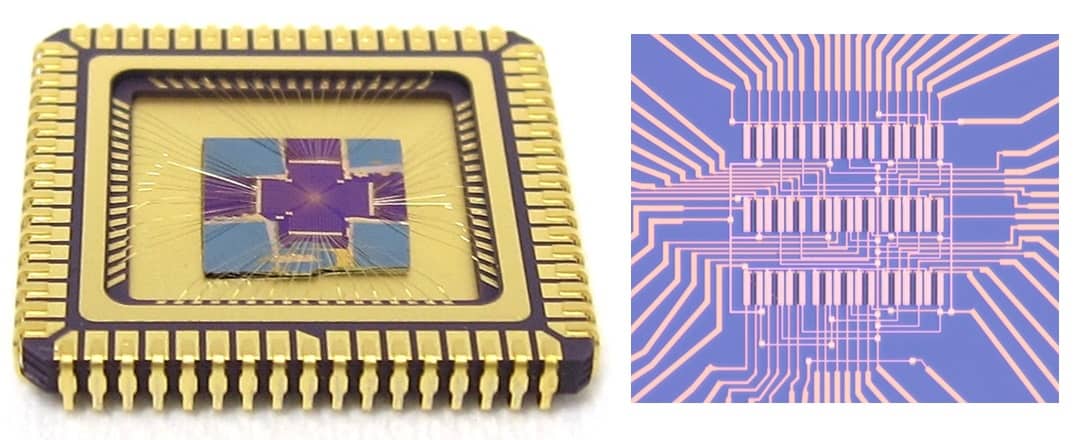
Researchers in Austria have designed a network of image sensors in which images are encoded as bright pixels with varying optical intensities. They have demonstrated that by tuning the sensitivity of the sensors, in terms of pixel brightness, their new device is capable of self-computation and therefore bypasses the need to relay the signals to higher-level processing units (Nature 10.1038/s41586-020-2038-x).

Design and working principle

Inspired by the natural interconnected architecture of the brain, Lukas Mennel and colleagues from Thomas Mueller’s group at the Institute of Photonics, Vienna University of Technology,  implemented an artificial neural network (ANN) in their image sensor to overcome the high-latency computing issue. They put together rows and columns of photodiodes – tiny, light-sensitive semiconductors, each having a few layers of tungsten diselenide – sequentially on a chip to create a photosensor network.

Lukas Mennel and Thomas Mueller

Neurons, the interconnected elements of the brain, are connected to each other by synapses, with the strength of the synaptic connections playing a critical role in neuronal information processing. Aware of this concept, Mueller’s research group designed the network such that each semiconductor’s response to light can be strengthened or weakened by applying an external voltage. A change in the voltage thus results in a change in the connection (synaptic) strength. This tuning capability then set the stage for the researchers to take advantage of machine learning algorithms such as ANNs.

Combining sensors and machine learning

The researchers implemented two types of ANNs: a classifier and an autoencoder. A classifier learns to classify images into different categories after a series of training processes (supervised learning), while an autoencoder recognizes a characteristic component or structure of an image from input data, without extra information (unsupervised learning).

In their design, the responsivities of the photodiodes under optical illumination were set by gate voltages, which themselves were results of either supervised or unsupervised learning processes. Changes in the optical intensity affect the output of the 3×3 array of pixels, enabling the device to self-sense and self-compute in nanoseconds.

“We have presented an ANN vision sensor for ultrafast recognition and encoding of optical images. The device concept is easily scalable and provides various training possibilities for ultrafast machine vision applications,” the authors conclude.  This is indeed a promising technology, however, there is more to be done for it to be used in practical applications. For instance, imaging under dim light would be difficult. Redesigning the device to improve its semiconductors’ light absorption could increase the range of light intensities that it can detect.

Copyright © 2026 by IOP Publishing Ltd and individual contributors