A call for unity within particle physics

Every five years or so, members of the European Strategy Group (ESG) for particle physics face a monumental task: recommending medium- and long-term plans for the community’s future. In January this group – which comprises scientific delegates appointed by each CERN member state; directors and representatives from major European laboratories and organizations; and a few non-European invitees – met for the final time in Bad Honnef, Germany. We now await their recommendation, which is due in May* when the CERN council announces the laboratory’s future direction. (*See editor’s note below.)

I sincerely hope the announcement will fill the particle-physics community with renewed motivation and engagement. However, particle physicists, accelerator physicists and engineers must reckon with the fact that many of us have dedicated years of our lives to a single project. For some, it has been decades. As a result, we have become so strongly sorted by project allegiance that we resemble opposing sides of a political debate. And the reality is that, come May, some of us could learn that our project is being mothballed.

In the wake of the ESG’s recommendation, we will need to ask ourselves, “Where to from here?” The world only needs so many high-energy colliders. Once the eventual decision is made (even if it’s not immediately conclusive), and as effort is redirected from one project to another, we will need to learn how to work and live well together as a single, unified community.

Building on consensus

For some time, consensus has been brewing that the next high-energy machine should be a positron–electron (e+/e) or muon collider of sufficient energy to spawn copious Higgs bosons. This so-called “Higgs factory” would enable a detailed investigation of the once-elusive Higgs boson, and would add shading and nuance to our understanding of the Standard Model of particle physics, while not precluding the construction of a proton–proton collider at some later date. Yet the question remains: which collider should CERN pursue?

At this point, readers may well be asking where my own biases lie. The answer is that I have worked on both major CERN-based post-Large Hadron Collider projects – the Compact Linear Collider (CLIC) and the e+/e Future Circular Collider (FCC-ee) – and I see merits in each. In any discussion of this tumultuous subject, this is something that bears repeating: there are merits in both projects. Beyond Europe, Japan’s proposed International Linear Collider (ILC) and plans for a Chinese Electron Positron Collider (CEPC) must also be taken into consideration as we plan our next moves within a global context. The same goes for the recently funded electron–ion collider in Brookhaven, US, and the renewed interest in muon colliders.

The competition between CEPC and FCC-ee has spurred rapid advances in both designs. Similarly, the non-guaranteed future of all four major projects (CLIC, FCC, ILC and CEPC) has demanded rigour from the physicists working on them. Rivalry and disagreements have strengthened each proposal, lending support to the notion that ideas subjected to criticism evolve and grow stronger than ideas left unchallenged. The result is four strong proposals. If ambition were the selection criterion, all four would be overqualified.

Respectful academic disagreements of this type have advanced our field. Embedded in this respect is an acknowledgement that our favoured project might not go ahead. Disappointment for some is inevitable, and many in the community are bracing for it as we try to envision a path forward. For so many of us, what we do for work forms a strong pillar of our identity. We’re dedicated to our research because we love it. But because we love it, and because it forms part of who we are, the ESG’s recommendation could be shattering.

The particle accelerator community is known for its adaptability, problem solving and perseverance. Our next challenge will be to find the capacity and skill, as well as the generosity and courtesy, to hold colleagues from other projects in the same regard as we hold favourite colleagues from our own projects. We can be disappointed, and we can express disappointment, but only in a tone that assures respect.

It is also important to recognize the wider impact of our curiosity-driven search for the next collider. Regardless of the outcome from Bad Honnef, advances and innovations from the various projects have already made their mark on the accelerator community. As a large, low-emittance electron storage ring, FCC-ee has rekindled ties between the collider and light-source communities. Decades of work on CLIC have produced X-band technology that is now being used in medical accelerators. The CLIC accelerating structures have also been repurposed as an XFEL driver known as CompactLight. Meanwhile, the high-field magnets of an FCC hadron-colliding variant (FCC-hh), if demonstrated, would have a profound impact on MRI machines. A wise strategy would be to seek to capitalize still more on these pioneering developments, independent of the project from which they arose, and independent of the ESG’s decision.

Common goals

Once the decision is made (which may take a while, especially if the ESG’s recommendation is not conclusive), there will be an opportunity to welcome talented people from unsuccessful projects into the endorsed one. As we near the date of the report’s release, proponents from each side must find a way to live and work well together. After all, we share common goals: to advance human knowledge, to be inspired by the physics of nature, and to continue the scientific and technological advances in our fields.

  • Editor’s note: This article was written before the COVID-19 pandemic forced a shutdown at CERN and the cancellation of scientific events worldwide. The special session of CERN Council for approval of the strategy, originally scheduled for 25 May 2020, has now been postponed. 
How to transform bosons into fermions

Physicists in the US have shown that normally gregarious bosons can behave like solitary fermions and occupy distinct quantum states when cooled down to very low temperatures and manipulated with laser beams. Expanding on earlier work, they found that this process of “fermionization” can encompass the particles’ velocities as well as their spatial properties. This transformation, they say could prove handy in the development of quantum technologies.

Bosons are atoms or other particles with an integer amount of spin. Many such particles can occupy a single quantum state, a property that leads to the phenomenon of Bose-Einstein condensation. Discovered experimentally in 1995, this unusual state of matter is made when a gas of atoms is cooled down to just a fraction of a degree above absolute zero and results in all atoms occupying the same quantum ground state.

In stark contrast, fermions have half-integer spin and obey the Pauli exclusion principle. This means that no two fermions can occupy the same quantum state at one time. This property of fermions is what guides the behaviour of atomic electrons, giving us the periodic table of the elements, molecules and solid matter. However, by tuning the interaction between fermions they can be made to pair up and behave like bosons – which is the case with Cooper pairs of electrons forming a condensate that gives rise to the phenomenon of superconductivity.

Spatially fermionic

In the latest work, David Weiss, Marcos Rigol and colleagues at Pennsylvania State University have instead shown how bosons can be made to act like fermions. They do so by cooling a gas of bosonic atoms to very low temperatures and using laser beams to confine the atoms within an array of 1D potential wells. Strong interaction among the bosons then forces the particles to distance themselves from one another along the 1D axes. Although each atomic wave function is spread out in space, the large amount of energy needed to overlap those wave functions means that two particles do not occupy the same region of space. In other words, they behave – spatially at least – like fermions.

This fermionization was first demonstrated in 2004, both by Weiss and colleagues at Penn State and (in a slightly different form) by an independent team at the Max Planck Institute for Quantum Optics in Garching, Germany. As with its latest research, Weiss’s group used a gas containing around 100,000 atoms of rubidium-87 that was cooled down to just a few millionths of a Kelvin. But in that earlier work, the researchers maintained the gas in an equilibrium state. This meant that even though the atoms acted like fermions in terms of their spatial positioning they nevertheless had a velocity distribution that was typical of bosons.

In 2005, Rigol (then a PhD student at the University of Stuttgart) worked out that the ultracold bosons should behave differently when in a dynamic state. He predicted that the strongly interacting particles should form what is known as a Fermi sea when allowed to fly apart. Rather than having a very limited spread of velocities (akin to bosons), the particles should each have a different velocity (akin to fermions).

Flying apart

This is what the group has now found. By shutting off the lasers that keep the bosons confined to 1D, allowing them to fly apart, the researchers found that the initially sharp peak in the particles’ velocity distribution gradually smoothed out into a rounded distribution. They also found that by suddenly changing the depth of the axial trap, the particles’ velocity distribution oscillates between its bosonic and fermionic forms – again, as predicted by theory.

According to Weiss, this observation of “dynamical fermionization” in a 1D gas should help to shed light on non-equilibrium quantum systems more broadly. These could include fast processes in solids or in molecules in solutions. “We hope to identify universal principles in dynamical quantum systems,” he says.

Weiss adds that this understanding could also have technological benefits. As he points out, quantum computers are generally kept out of equilibrium in order to evolve the system’s wave function in such a way as to obtain a solution to a problem. And in practice, he adds, quantum simulators are fundamentally not that different. “They often aspire to observe equilibrium physics, but it is not always clear that the changes required to set them up do not take them out of equilibrium,” he says.

The research is described in Science.

Physics in the pandemic: ‘It was like waiting for a tsunami that is sure to strike’

I am a physics teacher at King Edward’s School in Birmingham, UK, and it’s now a couple of weeks since all schools in the country were closed – except to the small number of pupils whose parents or carers work in key sectors, such as health or social care.

I have to confess that all my boys (King Edward’s is single-sex) were excited at the prospect of no school, possibly because they are in the lowest-risk group when it comes to COVID-19. Some of us initially did think that the government should have acted earlier in the wake of growing problems. But we certainly don’t expect to be back after the Easter holidays, prompting a couple of the more thoughtful members of my sixth-form tutor group to buy me bottles of wine as a parting gift.

There was a buzz about the place, with the school feeling like it was on a war footing.

In the final week before the shut-down, we actually had even fewer staff absences than usual, with just a handful of staff sensibly self-isolating. In fact, there was a buzz about the place, with the school feeling like it was on a war footing.

Pupils at King Edward’s School don’t do A-levels, like most 18-year-olds in the rest of the country. Instead, they take the International Baccalaureate (IB) and my fellow teachers and I would normally submit coursework scores to the IB after our students go on study leave in preparation for their exams. But because the school was due to shut on 20 March, the deadline was brought forward.

The IB algorithm then selected its samples of what it wants to moderate, which sent teachers scurrying away to quiet corners to annotate the coursework with more detail to justify the marks awarded. Squeezed between lessons we attended INSET (in-service training) sessions so that we can now teach online during the shutdown, with teachers sharing ideas before they went their separate ways.

Teachers scurried away to quiet corners to annotate the coursework with more detail to justify the marks awarded.

During quieter moments in those last days at school, colleagues shared their anxiety about what was to come. It was like waiting for a tsunami that is sure to strike but we don’t really know how big the wave will be and how much damage it will wreak.

Quite naturally, there was also some anxiety about being in such close proximity with other people, mainly students, who might be asymptomatic super-spreaders. Media reports suggest that people in the lowest age groups are as good as immune to the virus, which is perhaps why amongst our boys, the novelty of using hand sanitisers wore off within a day and they were fairly blasé about social distancing.

That final week at King Edward’s also brought home to me just why the school is so successful. While it has more than its fair share of bright students and lots of talented teachers, it’s more than just a school. It is a community, almost an extended family.

In the face of COVID-19, the life of a teacher has become pretty surreal. Though it has made teaching and learning more difficult, I think we are happy that schools are shut for all except the children of key workers – if only so that it reduces the risk to our families and slows the spread of the virus more generally.

As we said our goodbyes on that final day, I knew I was not alone in hoping that we will all be returning to our classrooms just as soon this nightmare is over.

The clever device that can let you see in 3D beyond the diffraction limit

What do you do if you want to look inside a biological cell, hoping to see objects that are well beyond the diffraction limit of a microscope – roughly 200nm? One solution is to use the Nobel-prize-winning technique of “super-resolved fluorescence microscopy”, which involves tagging samples with fluorescent markers.

In its basic form, however, super-resolution microscopy only produces 2D images, meaning it does not produce any “depth” information in 3D. That’s where Double Helix Optics, a small firm in Boulder, Colorado, comes in.

As I found out on a recent visit, this start-up company has developed a small optical device, called a SPINDLE, that can be bolted on to a standard wide-field optical microscope, allowing you to use “out-of-focus” light to generate 3D images at super resolution.

In this short video, Ronald Zimmerman – Double Helix’s director of sales and product management – introduces the basic principles of the device and outlines possible applications, including studying the motion of individual viruses. The video was filmed just before the great global coronavirus lock-down, which makes that particular application potentially more valuable and useful than ever.

Find out more about SPINDLE on the Double Helix Optics website.

New map pinpoints US power lines susceptible to space weather super-storms

A new geoelectrical hazard map covering two-thirds of the United States has been released by the US Geological Survey (USGS). The map shows the voltages liable to be induced on the US power grid in the event of a once-in-a-century magnetic super-storm and it could help power companies better protect their infrastructure and reduce the risk of future blackouts.

Geomagnetic storms are rare disturbances of the Earth’s magnetic environment that begin with large ejections of charged particles from the Sun that boost the intensity of the solar wind. When these particles reach Earth, they interacts with the magnetosphere and ionosphere to create a magnetic storm. If the original coronal mass ejection is large enough, the result is a magnetic super-storm.

These storms generate electric fields in the Earth’s crust and mantle — which have the potential to disrupt electric power grids and even cause large-scale outages. In the March of 1989, for example, a storm caused a 9 h blackout in Quebec, Canada. Larger events — like the storms that struck in May 1921 and “Carrington storm” of 1859 — caused stunning aurora and widespread disruption to telegraph networks, even setting some telegraph stations on fire.

Huge economic cost

According to the US National Academy of Sciences, were a super-storm of similar intensity to the Carrington event to strike the US today, it would cause widespread blackouts, significant infrastructure damage and cost the US economy some $2 trillion.

In their study, Jeffrey Love and colleagues at the USGS analysed magnetic measurements – both long-term monitoring of geomagnetic disturbances by ground-based observatories during 1985-2015 and magnetotelluric surveys of the local electrical conductivity of the Earth.

They combined these with the most recent public maps of America’s high-voltage transmission lines. The geographical limits of the study were constrained by the fact that, to date, only the upper two thirds of the US mainland has been magnetically surveyed.

Four regions at high risk

The team identified four areas of the US that would be particular vulnerable in the event of a geomagnetic super-storm: the East Coast; the Denver metropolitan area; the Pacific Northwest; and the Upper Midwest. In some areas, transmission line voltages could approach 1000 V in the event of a super-storm, they found.

“It is noteworthy that high hazards are seen in the northern Midwest and in the eastern part of the United States – near major metropolitan centres,” Love told Physics World. These areas of increased hazard are the result of three factors, he explained – “the level of magnetic storm activity, the electrical conductivity structure of the solid Earth, and the topology of the power grid”.

The research demonstrates the importance of underlying geological structures on the intensity of storm-induced voltages in given areas. In areas of more electrically resistive rock, it is difficult for currents to flow through the ground in response to a storm-induced geoelectric field. Instead, huge and destructive currents are driven along power lines – a scenario that played out in Quebec.

Long lines are more susceptible

In addition, the team note that regions full of long transmission lines – such as might connect geographically sparse centres of population — might be particularly susceptible to geomagnetically-induced current. “Long transmission lines tend to experience greater storm-time voltage because voltage is the integration of an electric field across a length — in this case the length of the transmission line,” Love explained. “Whether or not this voltage, however, translates to a problem for the power grid depends on the parameters of the grid: line resistance and interconnectivity.”

“The new voltage map is a critical step forward in our ability to assess the nation’s risk to geoelectrical hazards,” said USGS director Jim Reilly. “This information will allow utility companies to evaluate the vulnerability of their power-grid systems to magnetic storms and take important steps to improve grid resilience.”

“One of the main challenges for risk analysts when it comes to space weather hazards has been the lack of data available to help establish worst-case scenario,” commented Edward Oughton, a data scientist from the University of Oxford’s Environmental Change Institute. “This uncertainty holds back effective decision making, and leads to a non-optimal allocation of limited resources.”

With their initial study complete, the researchers are now awaiting the completion of the magnetotelluric surveying of the outstanding, southwestern, part of the contiguous United States – a project for which funding has recently been legislated. When this has been completed, Love said, the team will combining these measurements with observatory data to complete the mapping project.

The research is described in the journal Space Weather.

How does respiratory motion impact pencil-beam scanning proton therapy?

Measurement set-up

Intensity-modulated proton therapy (IMPT) delivered via proton pencil-beam scanning (PBS) is one of the most precise methods available to target tumours with high radiation doses while minimizing the impact to surrounding healthy tissue. However, the interplay effect, caused by interaction of respiratory-related tumour motion and the motion of the proton beam, can negatively affect radiation dose distribution.

Much research has been published about the interplay effect. A measurement-based study of symmetric and asymmetric breathing patterns from the University of Cincinnati College of Medicine has now reconfirmed that standard fractionation can be used to treat moving targets with symmetric motion amplitude less than 5 mm, and that using a higher fractionation regimen will help minimize interplay effect-caused degradation of target dose. But the study also found that this is not the case for small tumour targets affected by large motion and irregular breathing patterns  (J. Appl. Clin. Med. Phys. 10.1002/acm2.12846).

By measuring beam delivery of up to 15 treatment fractions, with different symmetric and asymmetric breathing patterns, the researchers determined that irregular motion causes systematic errors that cannot be recovered by increasing fractionation. For patients with irregular breathing, patient-specific motion management is needed to ensure effective dose delivery to the target tumour and to reduce toxicities to surrounding healthy tissue.

Principal investigator Eunsin Lee and colleagues quantified the dosimetric influence of the interplay effect for different target sizes, motion amplitudes and pencil-beam spot sizes. They did not use any simulation models or treatment delivery logfiles, but rather delivered an actual fractional dose of 200 cGy multiple times for a specific number of fractions.

Eunsin Lee

“In PBS proton therapy, each layer is delivered in a series of discrete pencil beam spots. The scanning magnets are used to reconfigure the system to deliver dose in the subsequent position,” explains Lee. “This is not an instantaneous process. In the presence of tumour motion due to respiration, the spot can be delivered in an incorrect position. This makes scanning proton beams inherently sensitive to motion, because in addition to the motion of the tumour, the beam itself is also moving during the delivery.”

“The effect is random, so if a desired dose is delivered in a small fractional dose in multiple days, the interplay effects can be mitigated,” he adds. “We wanted to quantify how differently fractionation mitigates the interplay effect by utilizing a conformity index and a homogeneity index and as a function of fractionations.”

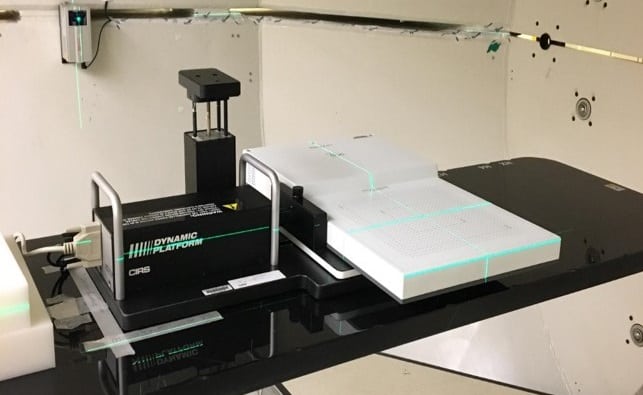
The team generated treatment plans to mimic 3- and 10-cm diameter spherical targets, at 1 and 5 cm depths in a solid water phantom. All target volumes were covered by 95% isodose line. They simulated respiratory motion ranges of ±0.5, ±1.0 and ± 2.0 cm, using sine and cosine4 waves to represent sinusoidal symmetric and realistic asymmetric breathing patterns, respectively.

The researchers delivered a dose of 200 cGy per fraction in 1, 5, 10 and 15 fractions. For the small 3 cm target, they used an energy spectrum of eight layers with 119 spots at the shallow depth, and nine layers with 296 spots at the deeper depth. For the larger 10 cm targets, they used 22 layers with 1488 spots at 1 cm and 23 layers with 4615 spots at 5 cm.

They then evaluated the dose conformity and uniformity of each measurement dataset at the centre plane of each moving target. They determined that breathing patterns had a larger impact on dose distribution conformity, but less impact on homogeneity. Dose homogeneity was impacted to a greater extent by intrinsic beam spot characteristics.

Based on their actual measurements, the researchers reconfirmed findings of prior studies that the interplay effect decreased as the numbers of fractions delivered increased. However, increasing fractionation did not improve dose conformity or homogeneity in cases of relatively large motion, such as deep breathing by a patient when a small tumour was being targeted.

“Our study was limited to investigating PBS interplay effect with a simple geometric shape of a moving target in a homogeneous water phantom and evaluating the motion-affected dose in 2D plane measurements,” says Lee. “We recognize that the interplay effect on PBS delivery with irregular target geometry, under realistic patient-specific breathing motion and with the high heterogeneity of a real patient body may be much more complicated to quantify.”

Next, the team plans to investigate interplay effects on several real patient cases using anthropomorphic phantom studies such as breast, lung and liver that require motion management techniques such as respiratory gating and breath hold.

Backpack computers for small animals, decade of LHC physics in numbers, post-manuscript-submission press conference

Looking out of my window at the garden during this lockdown, I am a bit envious of the birds that are free to come and go as they please. But what if I wanted to know what the fat wood-pigeon gets up to when it is not feasting on my newly seeded lawn.

Simon Ripperger and colleagues at the Ohio State University have created a tiny wireless backpack computer  that can be used to track animals in the wild (see figure). The device was created to study the social habits of the vampire bat, but I’m guessing that it would also work on a pigeon.

Has it really been 10 years since the Large Hadron Collider (LHC) at CERN started taking data? To celebrate a decade of achievement, Sarah Charley has charted progress at CERN in numbers.

Did you know that since 2010, exactly 2947 summer students have worked at CERN? They probably played a role in drinking the 10 million cups of coffee served at CERN restaurants in the past decade and hopefully had a hand in producing 2725 scientific papers.

Collisions at the LHC produced about eight million Higgs particles, at least according to the Standard Model, and physicists had to sift through 278 petabytes of data to find a few Higgs to study.

Another figure that Charley came up with is the total mass of all the protons that have whizzed around the LHC since 2010. Any guesses?

You can find the answer in “10 years of LHC physics, in numbers”, which appears in Symmetry.

A few weeks ago, I shared a video by the Irish medical researcher Ciaran Fairman that imagined a post-game analysis of a talk at a scientific conference. Now, Fairman is back in the above video with a similar take on the submission of a scientific paper for peer review. I like his comments on a certain referee, “you’re going to have to reference their work, there’s really no point in arguing with them”.

Online Demo: 10 years of PeakForce Tapping – Imaging in Liquid

View on demand

In this online demonstration you can learn about the theoretical and practical PeakForce technology for imaging in liquid. This webinar will introduce PeakForce Tapping technology with Scan Asyst mode for liquid measurement. A short introduction will describe the PeakForce principle and what probes can be used. Live measurement samples will be studied and relevant parameters will be explained.

Who should attend:
– Everyone who has interest in AFM
– PeakForce Tapping users who want to extend their knowledge

Presenters:


Dr Samuel Lesko
Senior Application Development Manager


Dr Udo Volz
Application Scientist

Quantum computing meets particle physics for LHC data analysis

An international collaboration is exploring how quantum computing could be used to analyse the vast amount of data produced by experiments on the Large Hadron Collider (LHC) at CERN. The researchers have shown that a “quantum support vector machine” can help physicists make sense out of the huge amounts of information generated at CERN.

Experiments on the LHC can produce a staggering one petabyte per second of data from about one billion particle collisions per second. Many of these data must be discarded because the experiments are only able to focus on a subset of collision events. Nevertheless, CERN’s data analysis now relies on close to one million CPU cores working in 170 computer centres around the globe.

The LHC is currently undergoing an upgrade that will boost the collision rate. The computing power necessary to process and analyse the additional data is expected to increase by a factor of 50–100 by 2027. While improvements in current technologies will address a small part of this gap, researchers at CERN will have to find new and smarter ways to address the computing challenge – which is where quantum computing comes in.

Quantum collaboration

In 2001, the lab set up a public–private partnership called CERN openlab to accelerate the development of new computing technologies needed by CERN’s research community. One of the several leading technology companies involved in this collaboration is IBM, which is also a major player in the field of quantum computing research and development.

Quantum computers could, in principle, solve certain problems in much shorter times than conventional computers. While significant technological challenges must be overcome to create practical quantum computers, IBM and a handful of other companies have built commercial quantum computers that can already do calculations.

Federico Carminati, a computer physicist at CERN and CERN openlab’s chief innovation officer, explains the lab’s interest in a quantum solution: “We are looking into quantum computing, as it might provide a possible solution to our computing power problem.” He told Physics World that CERN openlab is not looking to try to implement a powerful quantum computer tomorrow, but rather to play “the medium–long game” to see what is possible. “We can try to simulate nuclear physics, the scattering of the nuclei, maybe even simulate quarks and the fundamental interactions,” he explains.

CERN openlab and IBM started working together on quantum computing in 2018. Now, physicists at the University of Wisconsin led by Sau Lan Wu, CERN, IBM Research in Zurich and Fermilab near Chicago, are looking at how quantum machine learning could be used to identify Higgs boson events in LHC collision data.

Promising results

Using IBM’s quantum computer and quantum computer simulators, the team set out to apply the quantum support vector machine method to this task. This is a quantum version of a supervised machine learning system that is used to classify data.

“We analysed simulated data of Higgs experiments with the aim of identifying the most suited quantum machine learning algorithm for the selection of events of interest, which can be further analysed using conventional, classical, algorithms,” explains Panagiotis Barkoutsos of IBM Research.

The preliminary results of the experiment were very promising. Five quantum bits (qubits) on an IBM quantum computer and quantum simulators were applied to the data. “With our quantum support vector machine, we analysed a small training sample with more than 40 features and five training variables. The results come very close to – and sometimes even better than – the ones obtained using the best known equivalent classical classifiers and were obtained efficiently and in short time,” says Barkoutsos.

Seeking out new physics

Discovering the Higgs boson in the LHC data is often compared to “finding a needle in a haystack”, given its very weak signal. Indeed, most of the vast amount of computing time used by LHC physicists so far went to the Higgs boson analysis.

An important goal of the LHC is to test the Standard Model of particle physics to the breaking point in a search for new physics – and quantum computing could play an important role. “This is exactly something we are aiming for, the very fine analysis of complex data that would produce anomalies, helping us to improve the Standard Model or to go beyond it,” concludes Carminati.

The team has not yet published its results, but a manuscript is being finalized. Work is also underway using a greater number of qubits, more training variables and larger sample sizes.

Chemical characterization of heterogenous polymeric materials on the nanoscale using photothermal AFM-IR

View on demand

View this webinar to learn how Photothermal AFM-IR can provide new insights into your polymer research. This webinar will cover numerous applications in the field of polymer characterization both in academia and industry. In order to illustrate the broad applicability, we will discuss selected examples in detail, ranging from phase separation in polymer blends/block copolymers, reverse engineering in multilayer films, fibres and thin-film characterization. Photothermal AFM-IR can provide nanoscale chemical information with highly resolved IR spectra, that directly correlate to FT-IR transmission spectroscopy.

Presenters:


Dr Miriam Unger
NanoIR Application Scientist


Dr Hartmut Stadler
Application Scientis

Copyright © 2026 by IOP Publishing Ltd and individual contributors